58
0
5 4.132
-5
Time, sec
Mode 1
0 5 10 15
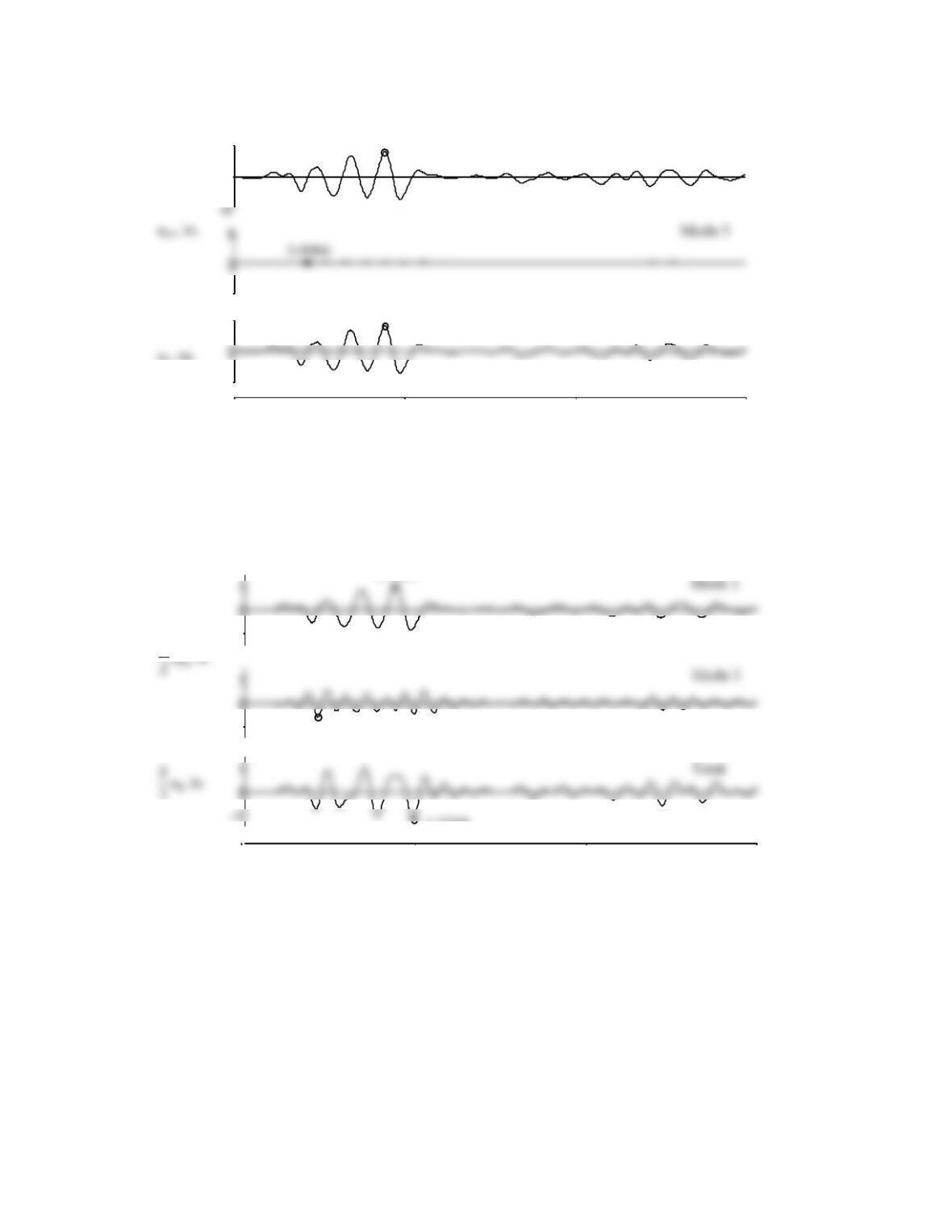
Fig. P13.26c
-5
5 4.182 Total
-1
-1
0.6027
0 5 10 15
1.2219
Time, sec
Fig. P13.26d
bun
Figure P13.26c
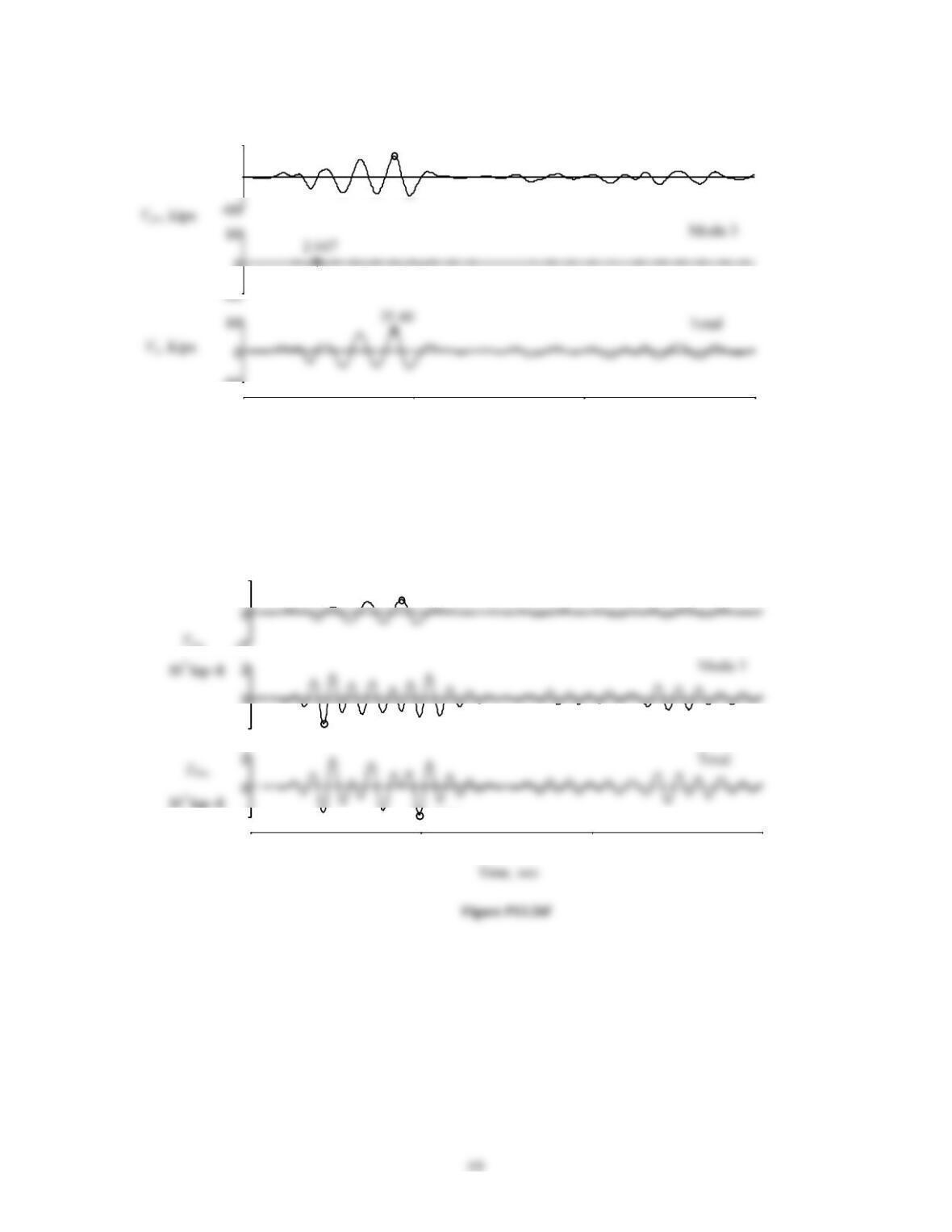
Figure P13.26d
0
50 34.21
0
Mode 1
0 5 10 15
-50
Time, sec
Fig. P13.26e
-2
2 822.2
-2
1671
Mode 1
0 5 10 15
-2
1899
Figure P13.26e
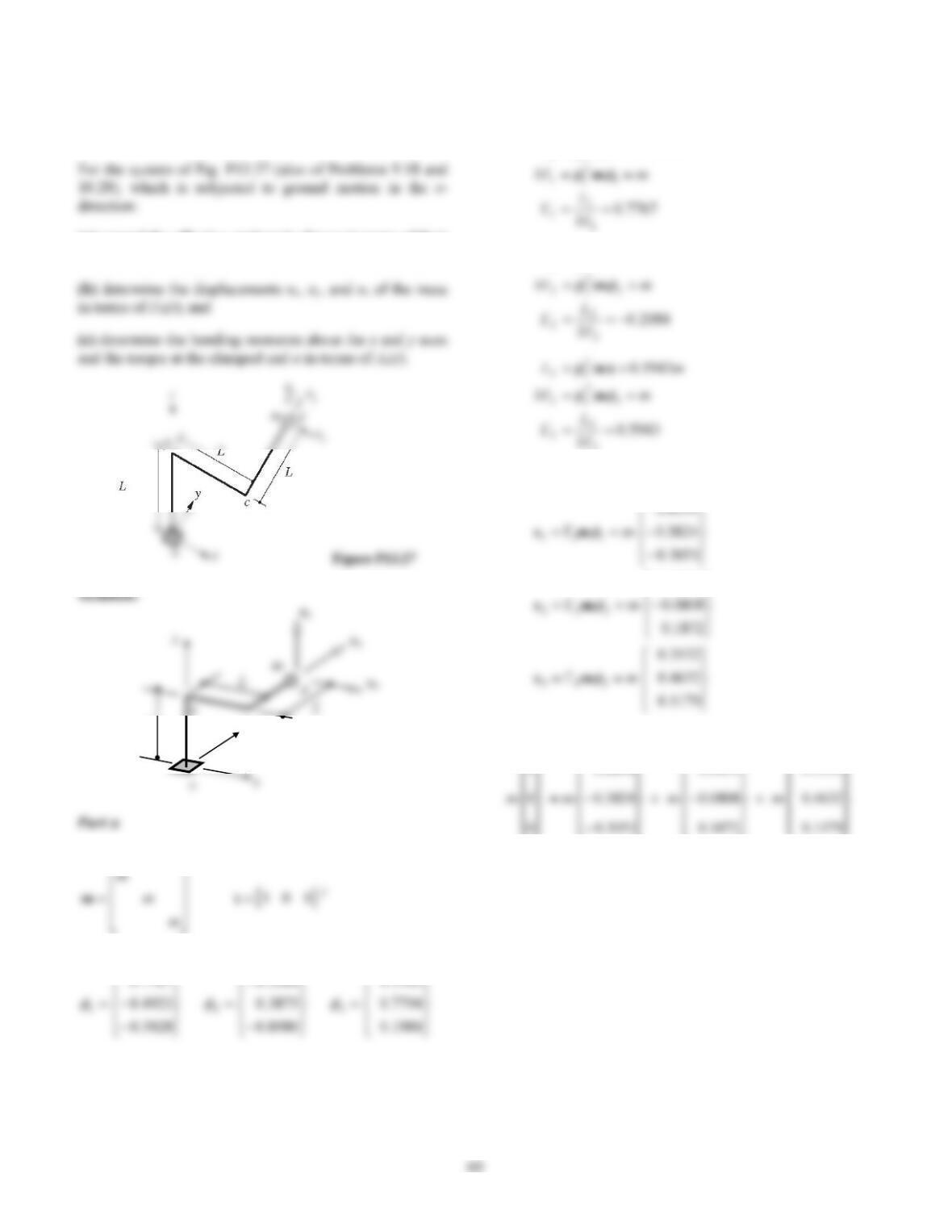
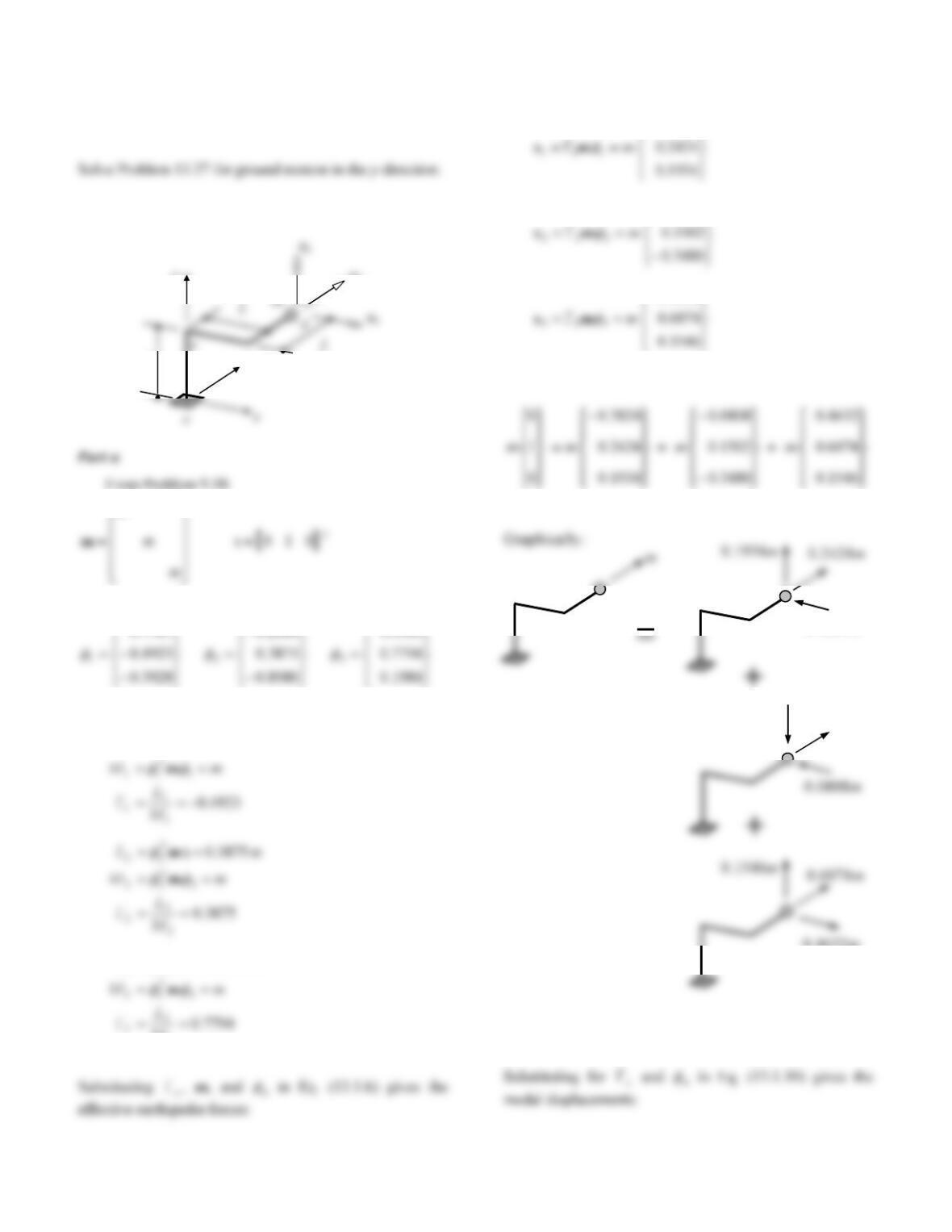
Problem 13.27
(a) expand the effective earthquake forces in terms of their
modal components and show this expansion graphically;
L
z
x
From Problem 9.18:
From Problem 10.28:
Substituting m,
, and
n in Eq. (13.1.5) gives:
7767.0
11
mL
T
m
2084.0
22
mL
T
m
3
Substituting n
, m, and
n in Eq. (13.1.6) gives the
effective earthquake forces:
0434.0
Thus, Eq. (13.1.4) specializes to:
L
y
c
61
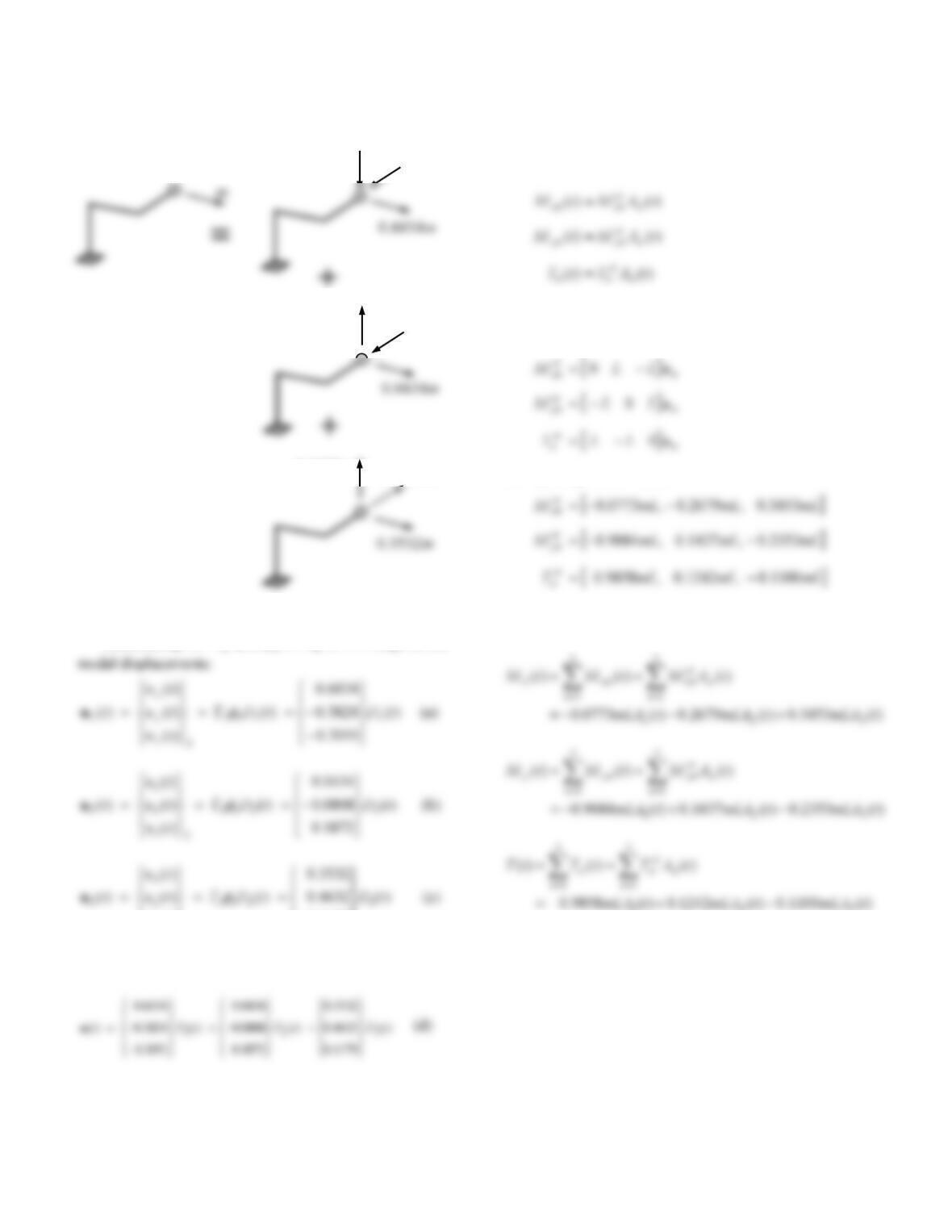
Graphically:
Part b
Substituting for n
and
1179.0
)(
3
tu
z
Combining modal responses in Eqs. (a), (b), and (c) gives
the total displacement response:
Part c
From Eq. (13.1.13), the earthquake-induced bend-ing
moments and torques at the base due to the nth mode are:
where st
yn
st
xn MM ,, and st
n
T are expressed in terms of n
s
as the scalar products:
and n
s are given in Part a:
Combining these modal contributions for each response
gives the total response in terms of )(tAn:
321
0.3051m 0.3824m
0.1872m 0.0808m
0.1179m 0.4632m
62
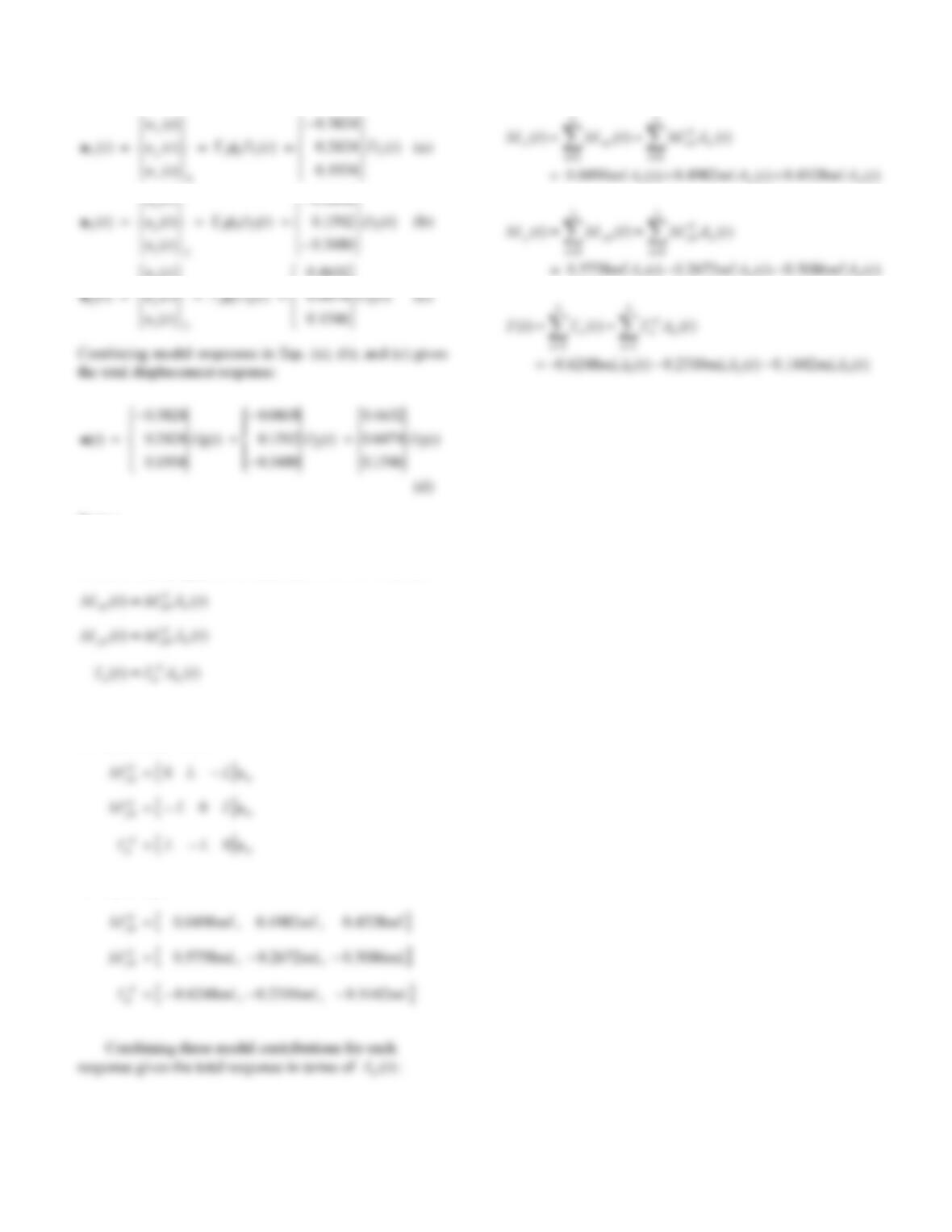
Problem 13.28
Solution:
L
x
From Problem 9.18:
m
From Problem 10.28:
Substituting m, , and
n in Eq. (13.1.5) gives:
4923.0
11
mL
T
m
7794.0
3
33
M
mL
T
m
3824.0
0808.0
4632.0
Thus, Eq. (13.1.4) specializes to:
Part b
0.3824m
0.3480m0.1502m
0.4632m
z
L
y
c
uy
63
4632.0
)(
tu
x
Part c
From Eq. (13.1.13), the earthquake-induced bending
moments and torques at the base due to the nth mode are:
where st
yn
st
xn MM ,, and st
n
T are expressed in terms of n
s
as the scalar products:
and n
s are given in Part a:
321
64
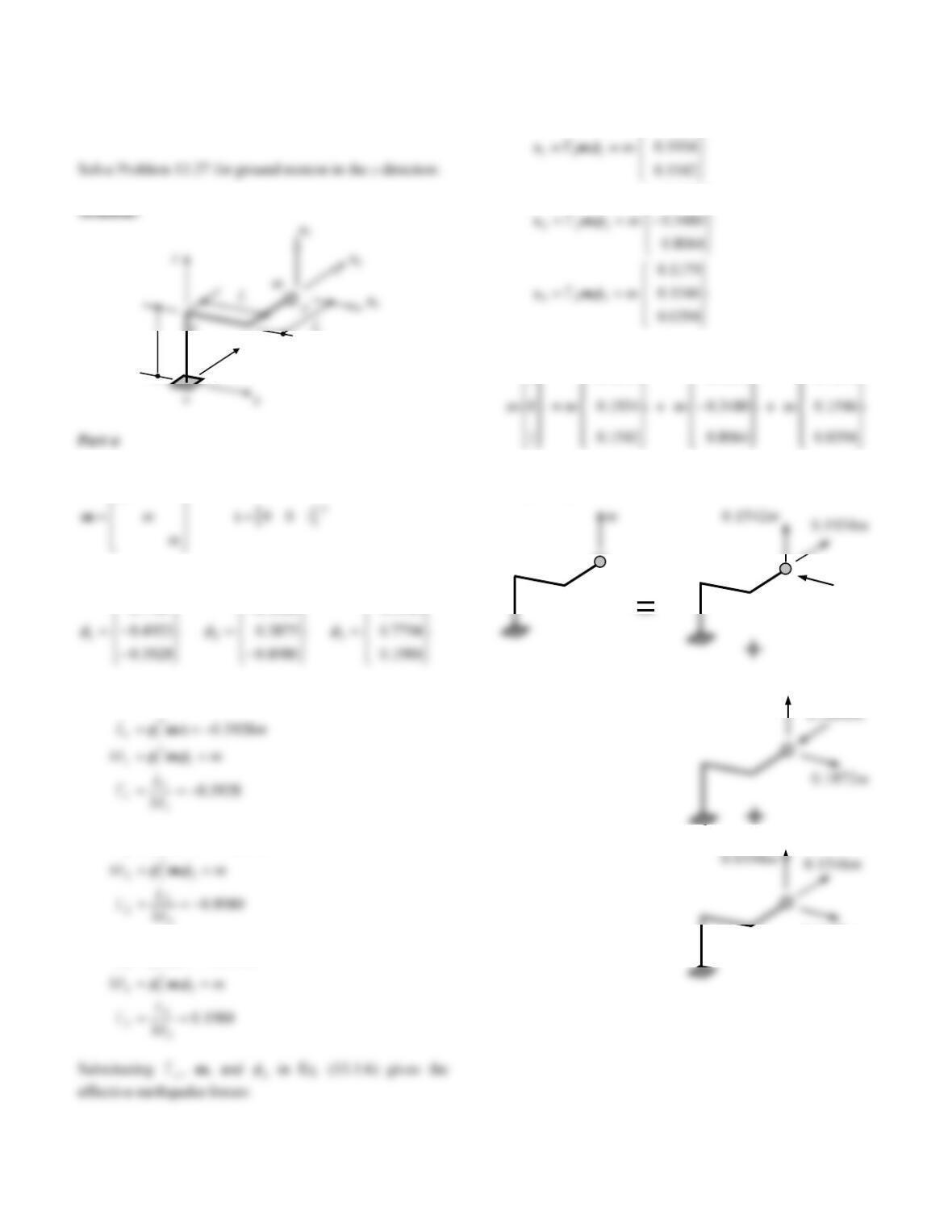
Problem 13.29
z
x
From Problem 9.18:
m
From Problem 10.28:
5943.0
2084.0
7767.0
Substituting m, , and
n in Eq. (13.1.5) gives:
8980.0
2
22
mL
T
m
1984.0
33
mL
T
m
3051.0
1872.0
Thus, Eq. (13.1.4) specializes to:
1179.0
1872.0
3051.0
0
Graphically:
0.3051m
0.8064m0.3480m
0.1179m
L
L
y
c
b
65
Part b
)(
1542.0
1934.0
)(
)(
)(
)( 1111
1tDtD
tu
tu
t
z
y
x
u (a)
)(
3480.0
)(
)(
)( 2222
2tDtD
tu
t
y
x
u (b)
)(
1546.0
)(
)(
)( 3333
3tDtD
tu
t
y
u (c)
Part c
From Eq. (13.1.13), the earthquake-induced bend-ing
moments and torques at the base due to the nth mode are:
)()(
tAMtM
n
st
xnxn
mLmLmLM
st
xn
1153.0,1544.1,0391.0
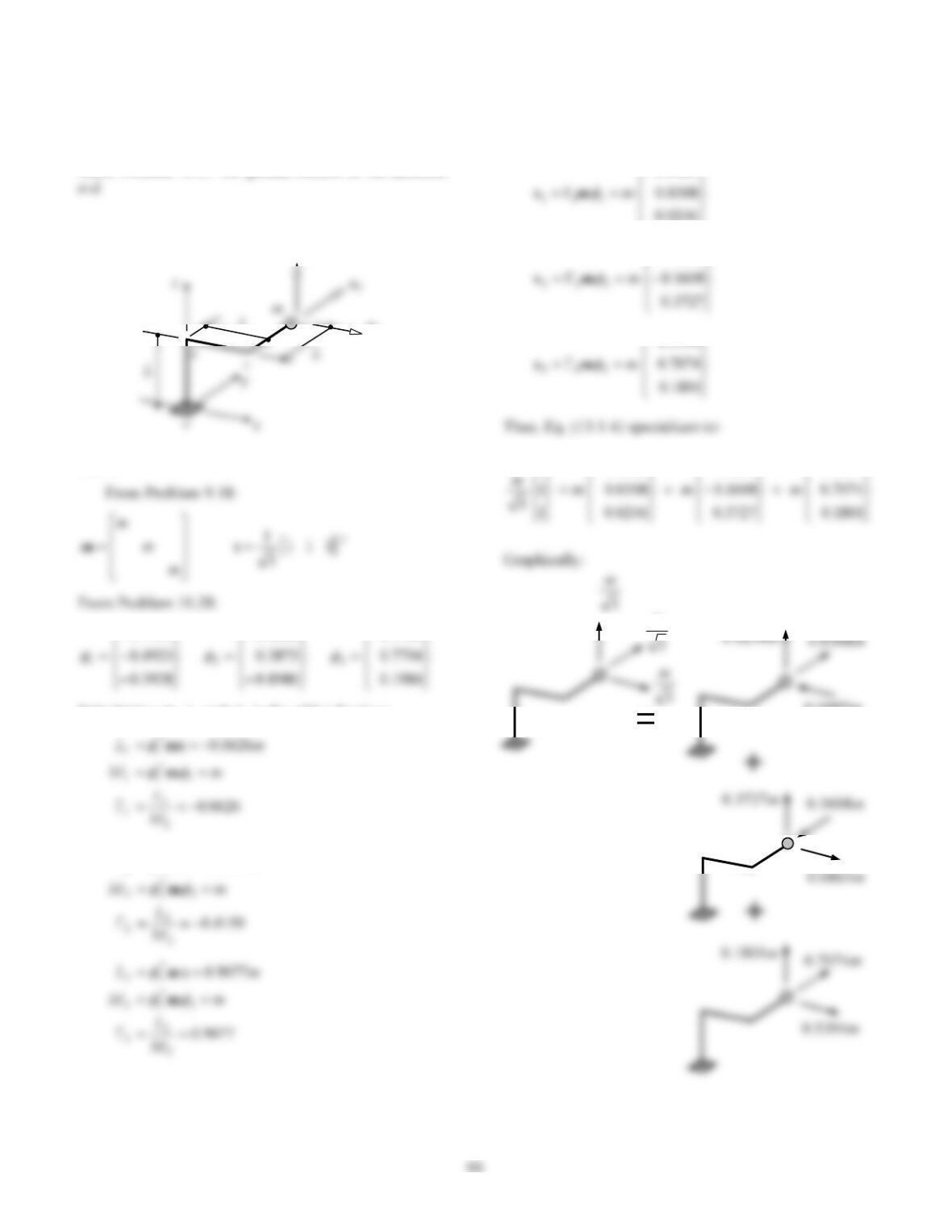
Combining these modal contributions for each response
gives the total response in terms of )(tAn:
321
321
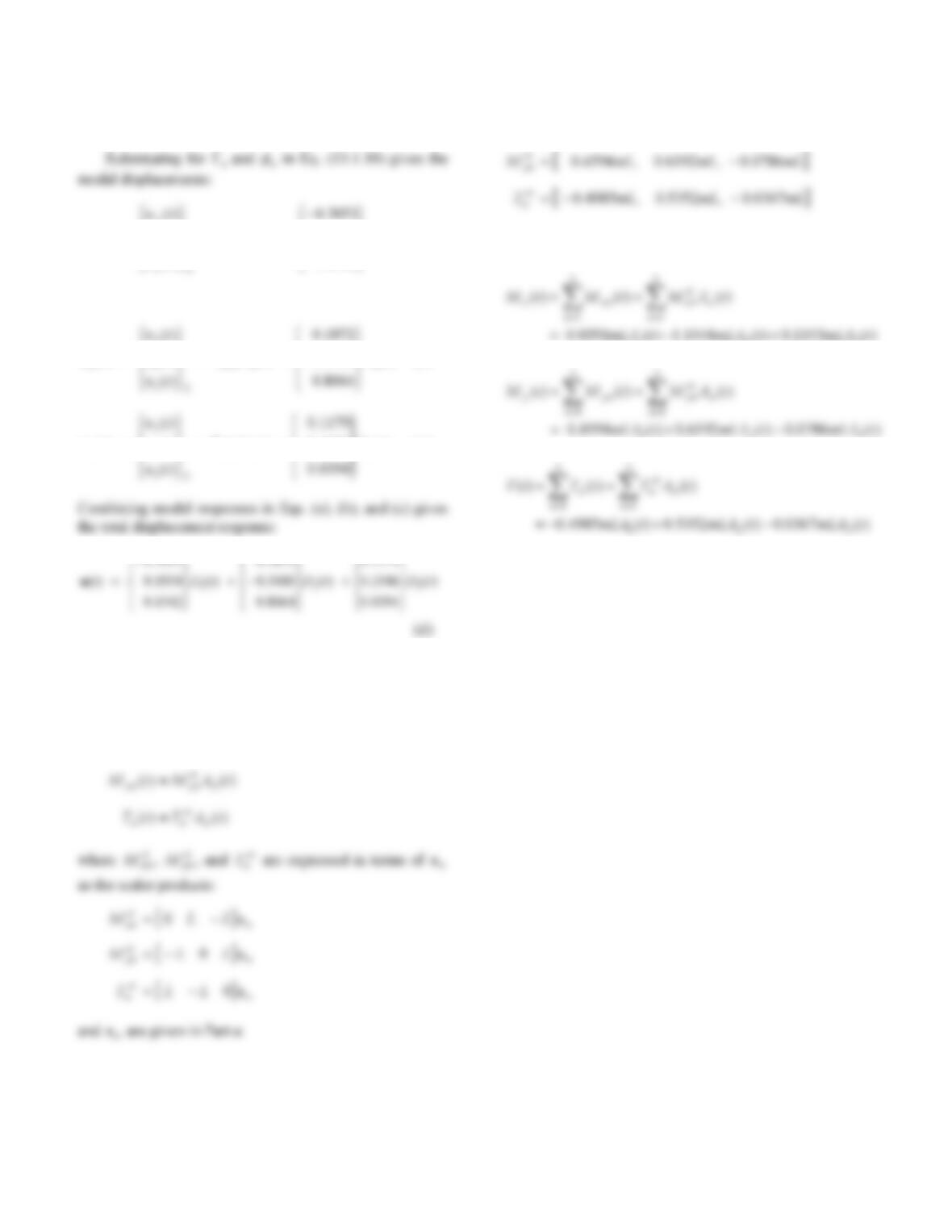
Problem 13.30
Solve Problem 13.27 for ground motion in the direction
Solution:
Part a
5943.0
2084.0
7767.0
Substituting m, , and
n in Eq. (13.1.5) gives:
4150.0
22
mL
T
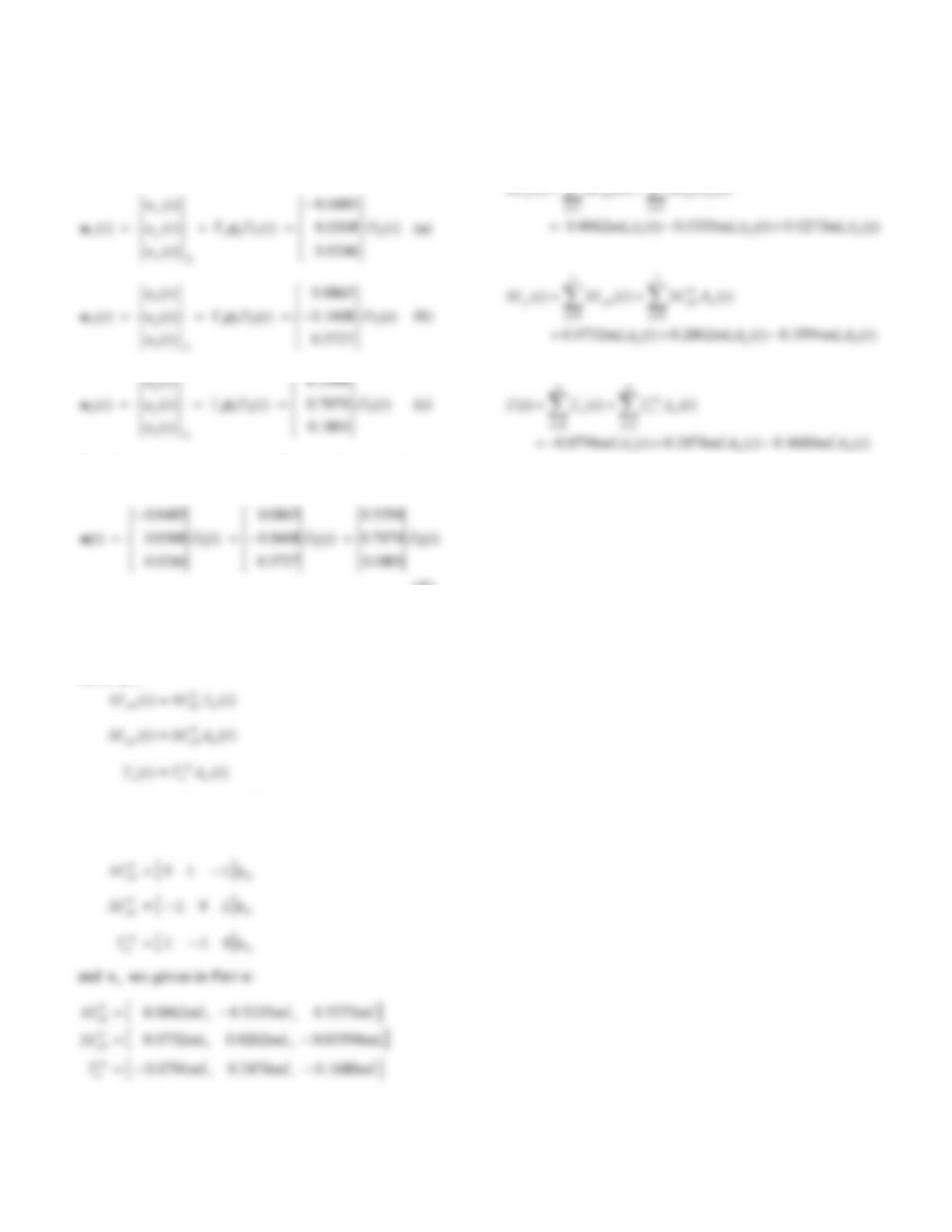
m
Substituting
n, m, and
n in Eq. (13.1.6) gives the
effective earthquake forces:
0246.0
0485.0
0865.0
5394.0
0865.0
0485.0
1
0.0485m
m
L
d
uz
ux
67
Part b
Substituting for n and
n in Eq. (13.1.10) gives the
modal displacements:
Combining modal responses in Eqs. (a), (b), and (c) gives
the total displacement response:
(d)
Part c
From Eq. (13.1.13), the earthquake-induced bend-
ing moments and torques at the base due to the nth
mode are:
where st
yn
st
xn MM , , and st
n
T are expressed in terms of
n
s as the scalar products:
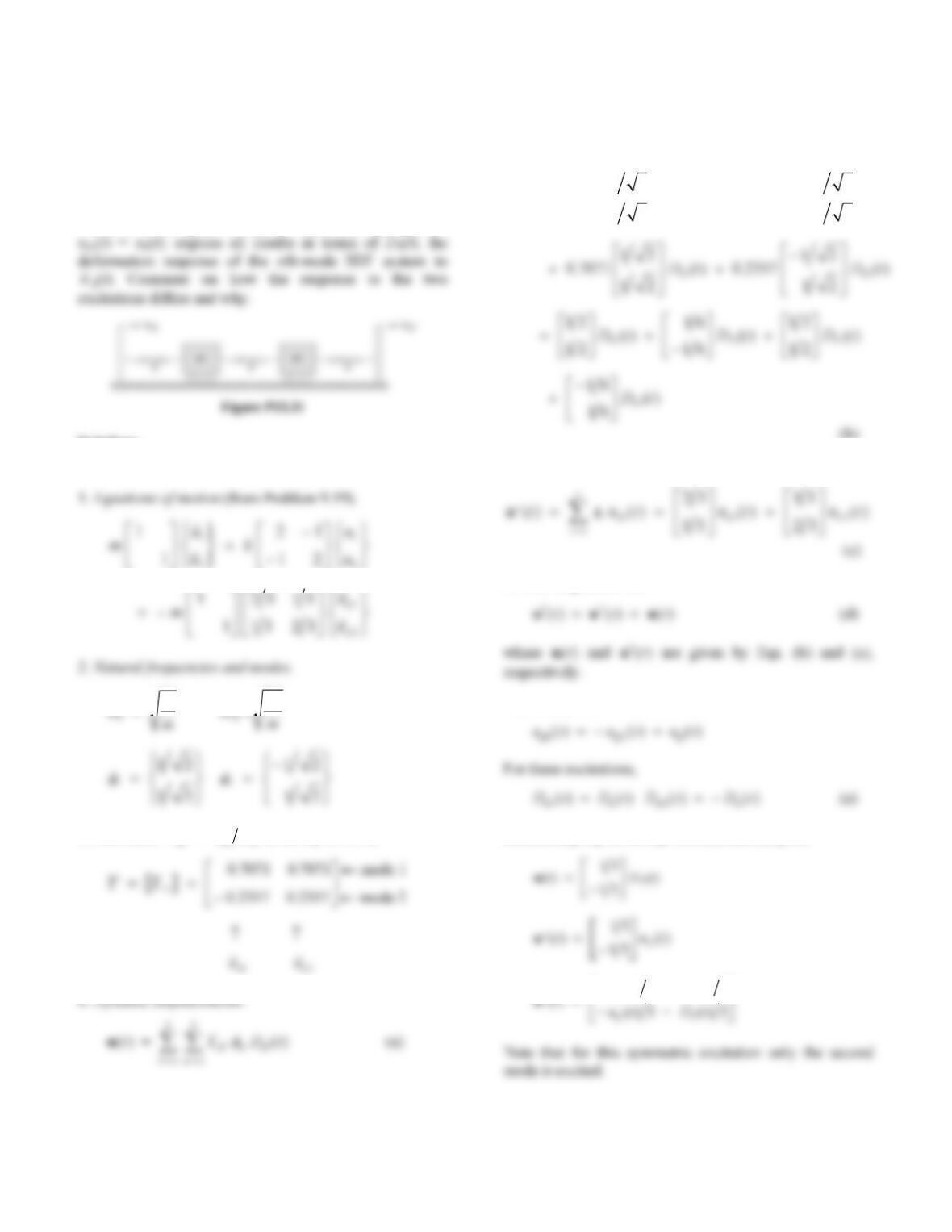
Combining these modal contributions for each response
gives the total response in terms of )(tAn:
3
3
st
68
Problem 13.31
The system of Fig. P13.31 (and of Problem 9.19) is sub-
jected to support motions ug1(t) and ug2(t). Determine the
motion of the two masses as a function of time for two
excitations: (a) ug1(t) = −ug2(t) = ug(t), and (b) ug2(t) =
Solution:
t
k3
3. Determine nl nl n
L
M
from Eq. (13.5.3).
Substituting for
nl and
n gives
11 21
12 12
() 0.7071 () ( 0.2357) ()
12 12
tDt Dt
u
(b)
5. Quasi-static displacements.
6. Total displacements.
7. Excitation a.
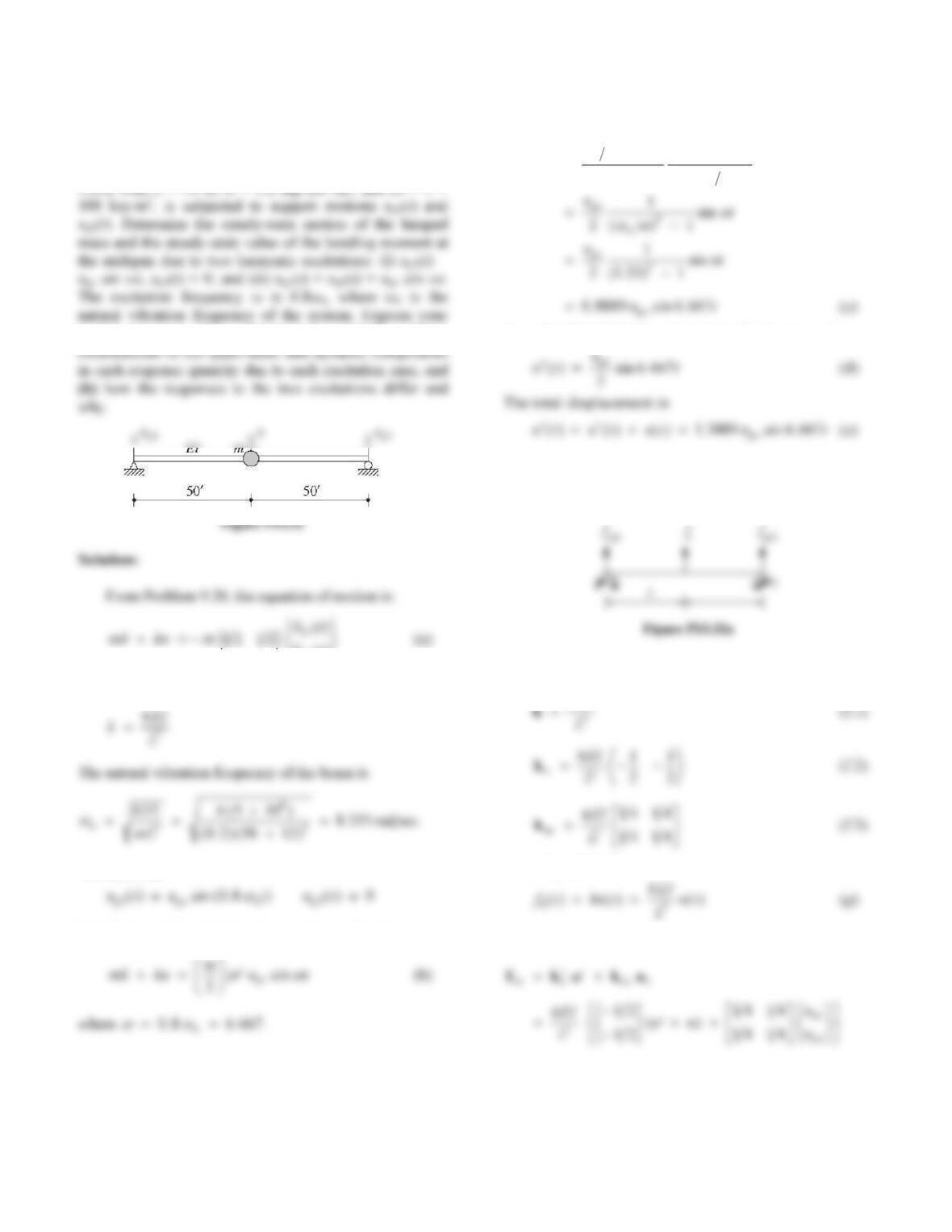
Substituting Eq. (e) in Eqs. (b), (c), and (d) gives
2
() 3 () 3
g
t
ut Dt
69
8. Excitation b.
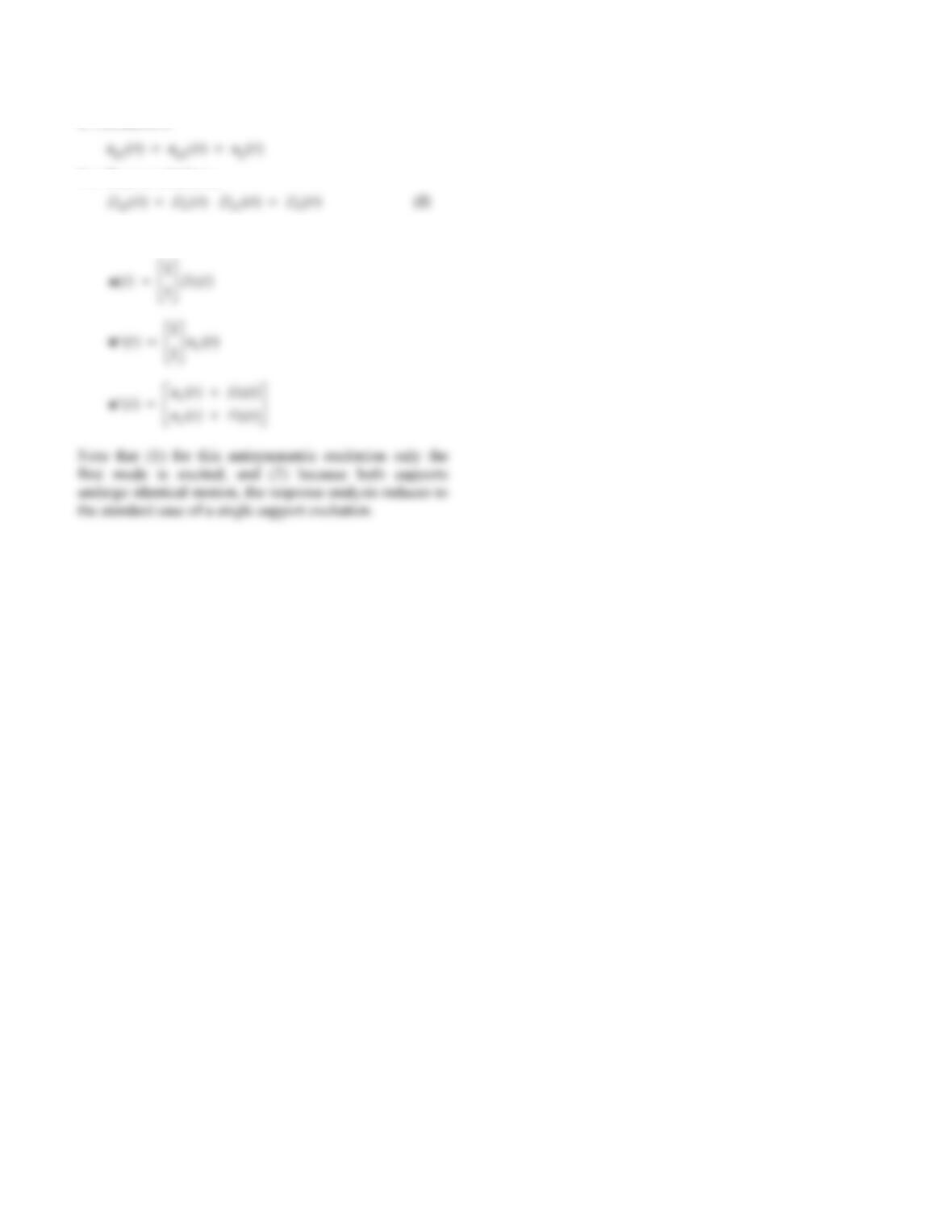
For these excitations,
Substituting Eq. (f) in Eqs. (b), (c), and (d) gives
70
Problem 13.32
The undamped system of Fig. P13.32 (and of Problem
results in terms of ugo. Comment on (a) the relative
2
g
(a)
where
Excitation (i)
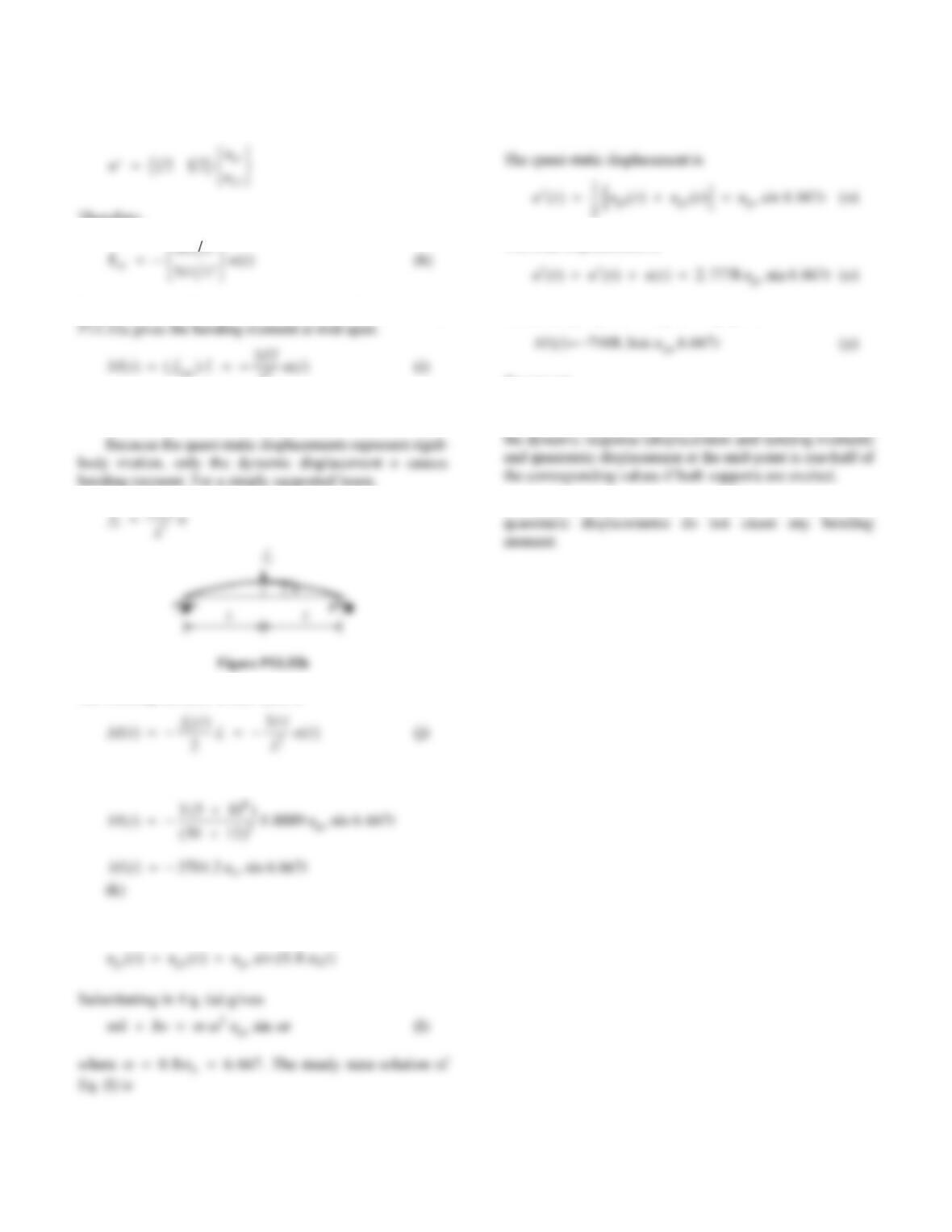
Substituting in Eq. (a) gives the equations of motion:
The steady state solution of Eq. (b) is
ut mu
kt
go
n
() ()
()
sin
21
1
2
2
From Problem 9.20, the quasistatic displacement is
To compute the bending moment we determine the
equivalent static forces
f
s
,
f
sg1, and
f
sg2.
From Problem 9.20,
E
I
From Eq. (13.5.9),
From Eq. (13.5.12),
71
where
Therefore,
3
Static analysis of the beam due to the forces in Fig.
I
Lut
Alternative derivation
I
The bending moment at mid-span is
I
Substituting Eq. (c) in Eq. (i) or (j) gives
M
Excitation (ii)
u
t
u
t
go
( ) . sin .
1 7778 6 667 (m)
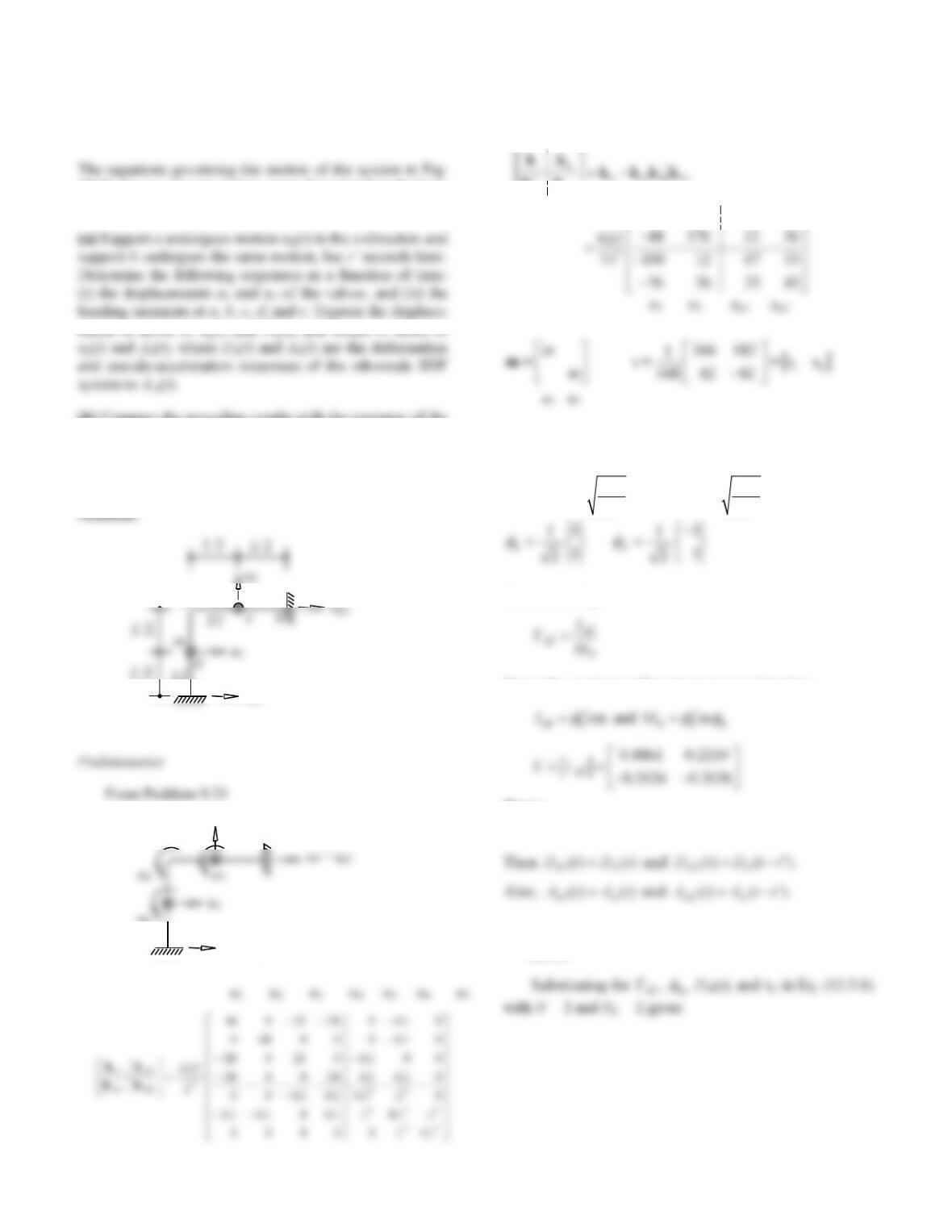
The total displacement is
Substituting Eq. (m) in Eq. (i) or (j) gives
Comments
(1) If the beam is subjected to motion at only one support,
(2) Because the structure is statically determinate, the
72
Problem 13.33
P9.21 due to support motions were formulated in Problem
9.21.
(b) Compare the preceding results with the response of the
system if both supports undergo identical motion ug(t).
Comment on how the responses in the two cases differ and
why.
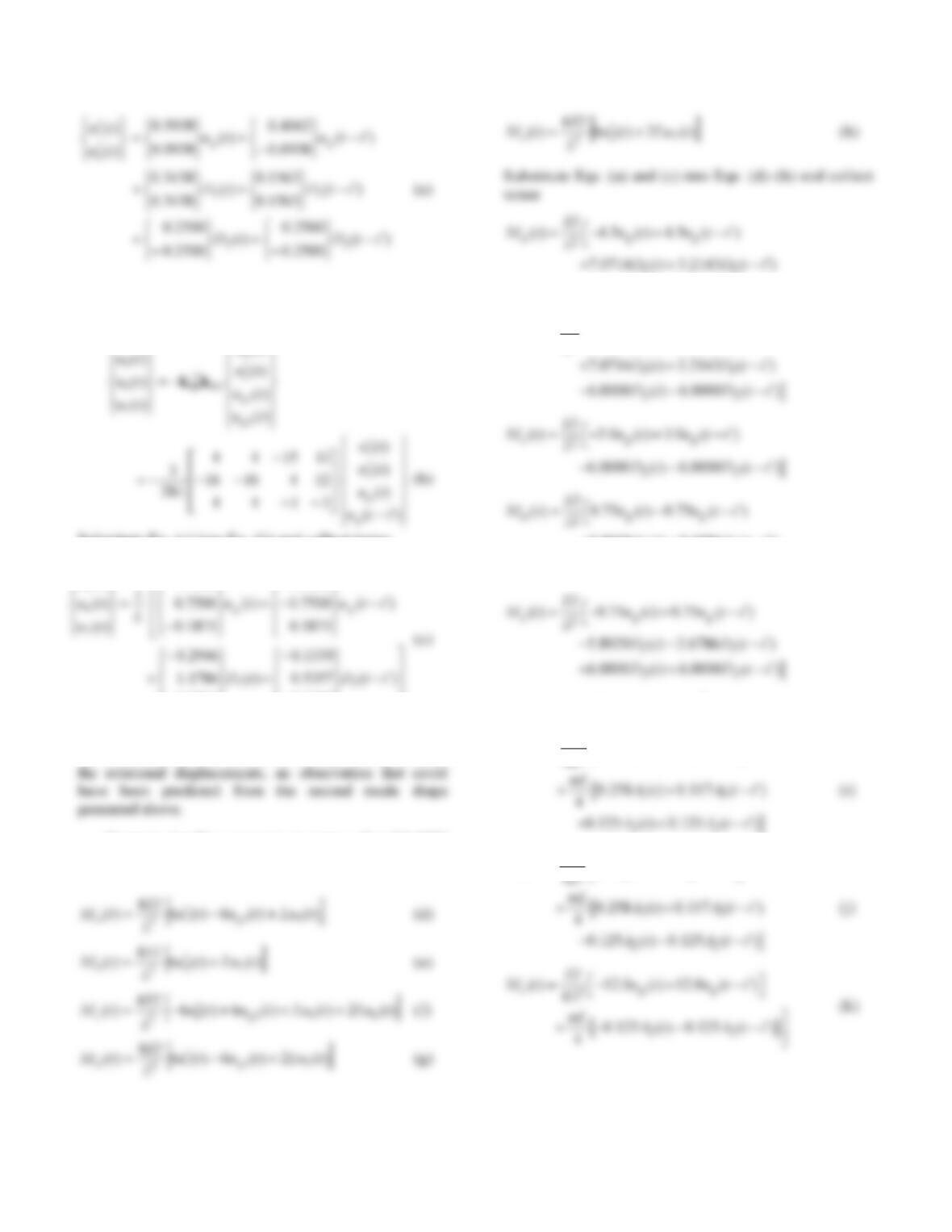
Condense out the rotational DOF 567
[, , ]
T
uuu
Solve φmφk 2
for natural frequencies and modes:
12
33
10.4745 13.8564
EI EI
mL mL
Determine nl
:
for mode n and ground motion at support l, where
Part a
Given )()(
1tutu gg and )()(
2ttutu gg
.
1. Determine the total displacements, u1 and u2 of the
valves.
ug1
a
EI
m
u5
u2
u3 = ug1
176 48 100 76
ggg
kk
73
2. Determine the bending moments at a, b, c, d, and e.
Recover the rotational DOF T
uuu ],,[ 765
)(
tu
t
Substitute Eq. (a) into Eq. (b) and collect terms
1339.0
2946.0
3125.1
3125.1
)(
5
tu
Note that there is no contribution from the second mode to
Compute bending moments in terms of nodal DOF
and support displacements
11
22
6.0000 ( ) 6.0000 ( )
Dt Dtt
2
() 1.5 () 1.5 ( )
bgg
EI
Mt ut utt
L
11
22
5.8929 ( ) 2.6786 ( )
6.0000 ( ) 6.0000 ( )
Dt Dt t
Dt Dtt
Substituting 2
/)()( nnn tAtD
:
2
() 18 () 18 ( )
4
agg
EI
Mt ut utt
L
2
() 6.0 () 6.0 ( )
bgg
EI
Mt ut utt
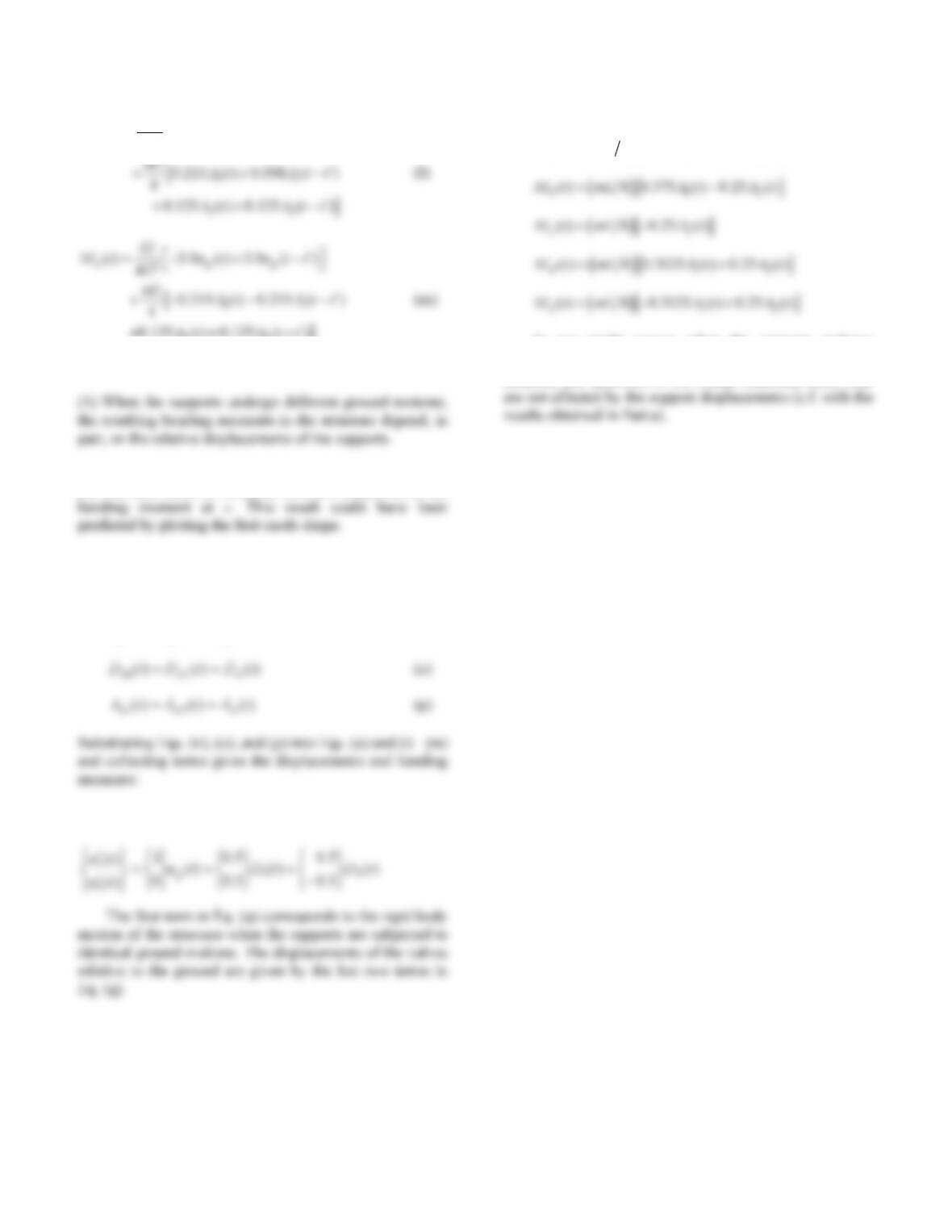
74
2
() 3.0 () 3.0 ( )
4
dgg
EI
Mt ut utt
L
22
0.125 ( ) 0.125 ( )
At At t
Notes:
(2) The first mode of vibration does not contribute to the
Part b
For identical support motions,
)()()( 21 tututu ggg (n)
1. Total displacements, u1 and u2 of the valves.
2. Bending moments at a, b, c, d, and e.
12
() 4 0.375 () 0.25 ()
a
M
tmL At At
As we might expect, when the supports undergo
identical motions, the resulting bending moments in the
structure are functions of the modal responses only; they
M
M
M
M