1
CHAPTER 12
Problem 12.1
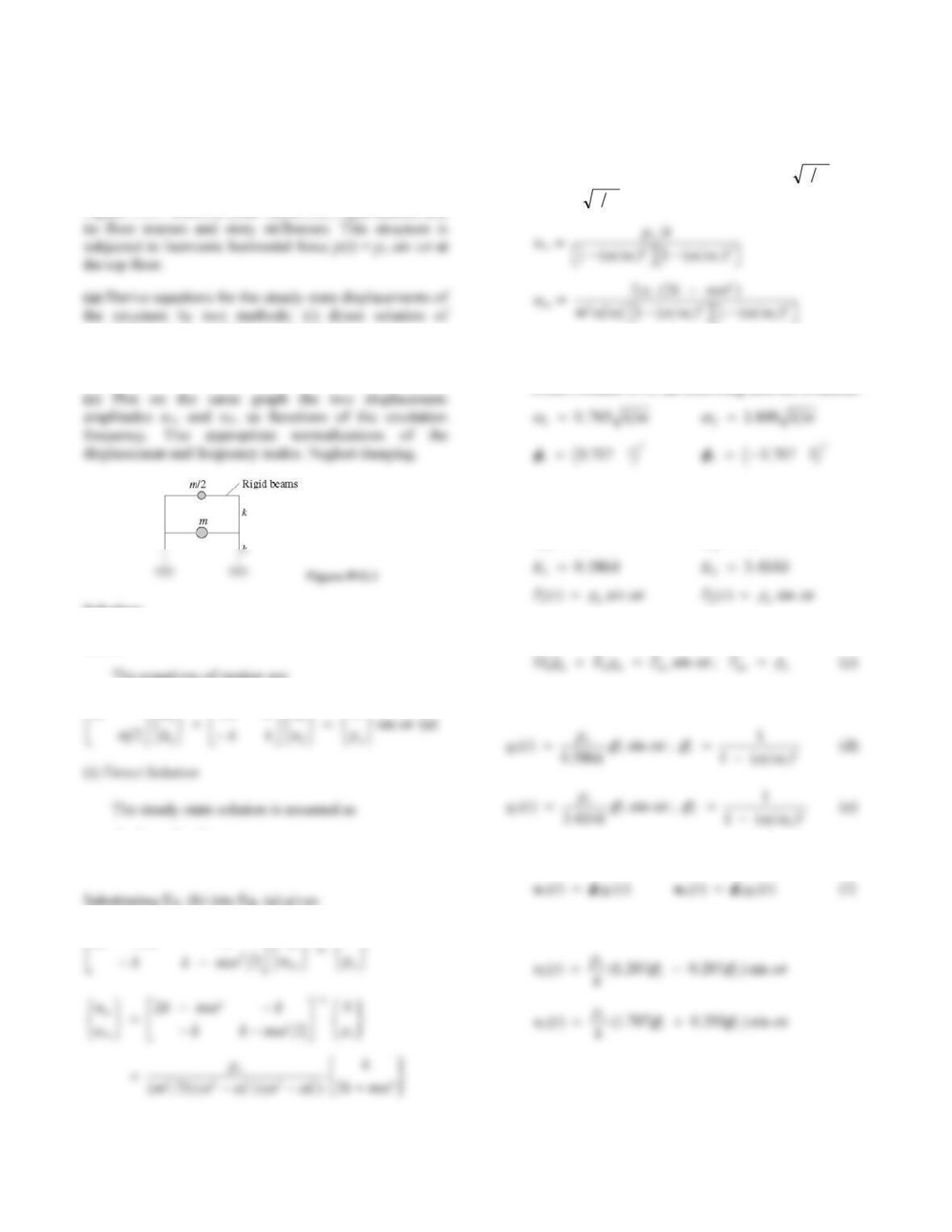
Figure P12.1 shows a shear frame (i.e., rigid beams) and
coupled equations; and (ii) modal analysis.
(b) Show that both methods give equivalent results.
K
k
K
k
P
t
t
P
t
t
Solution:
Part a
The equations of motion are
m
u
kk
u
20
L
L
u
u
u
ut
o
o
1
2
1
2
R
S
TU
V
WR
S
TU
V
Wsin
(b)
2
0
2
1
km k
u
o
L
where, from Problem 10.6,
10 765.km and
21 848.km, or
(ii) Modal Analysis
From Problem 10.6, the following data are available:
From Eqs. (12.3.4) and (10.4.7),
M
n,
K
n, and
P
t
n() are
obtained:
M
m
1
M
m
2
1. Set up modal equations.
M
K
P
t
P
2. Solve modal equations.
3. Determine modal responses.
4. Combine modal responses.
2
Part b
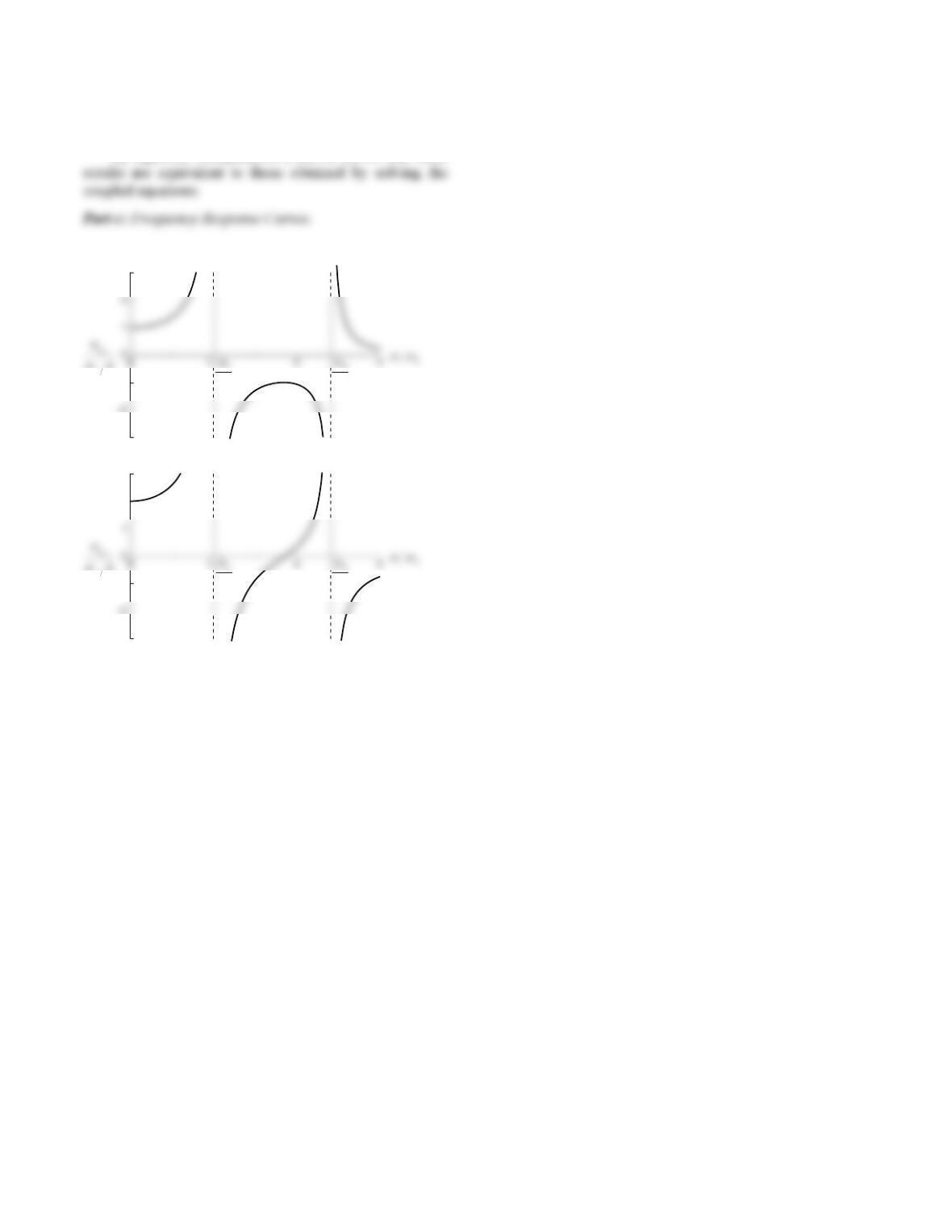
By algebraic manipulation it can be shown that these
-3
-1
3
-3
-1
2
3
pk
o
pk
o
2
1
1
1
1
1
Problem 12.2
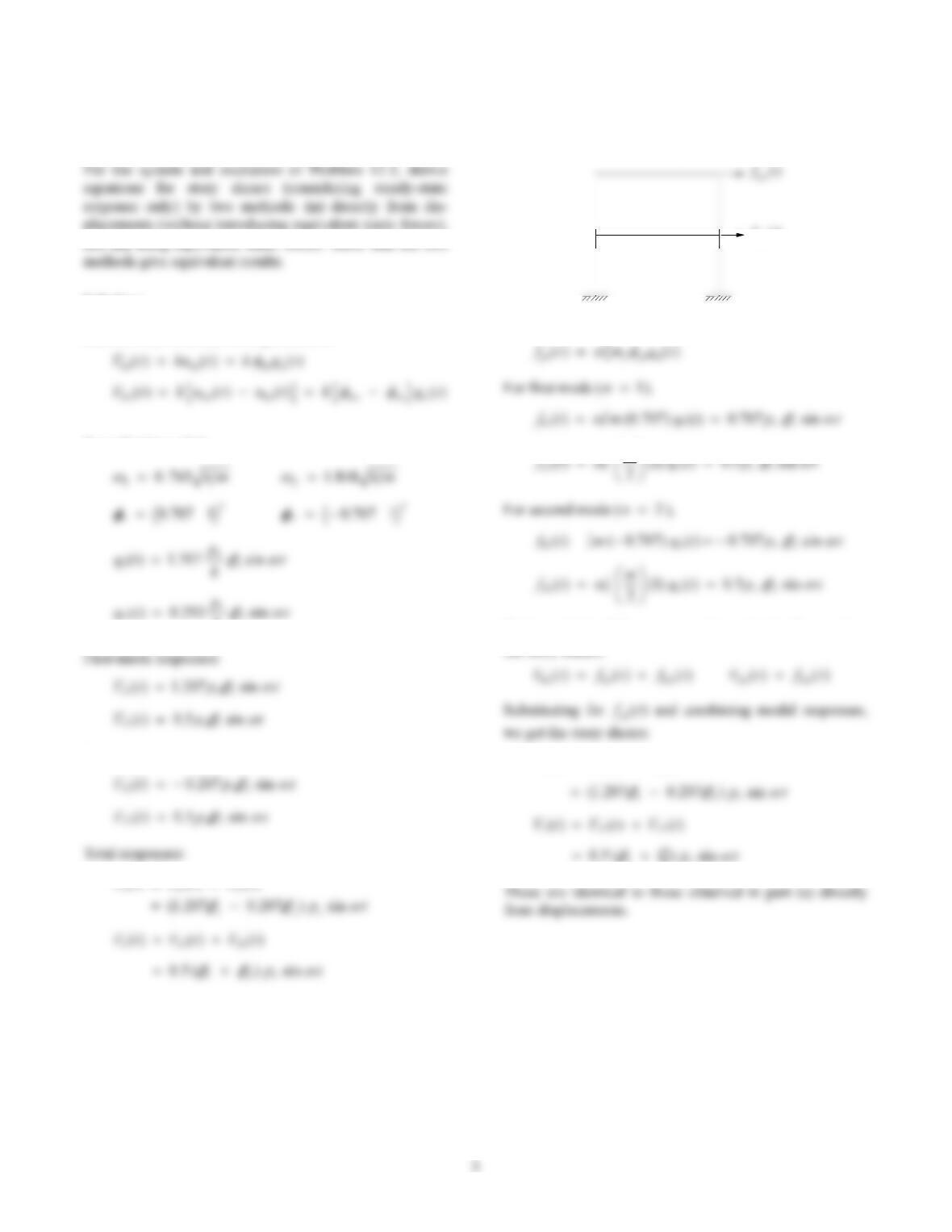
and (b) using equivalent static forces. Show that the two
Solution:
Part a: Story shears from displacements.
From Problem 12.1,
k
Second-mode responses:
() () ()
Vt V t V t
Part b: Story shears from equivalent static forces.
f (t)
1n
The equivalent static forces are
2
m
Static analysis of the structure shown in the figure gives
the story shears:
11112
() () ()
Vt V t V t
12
o
4
Problem 12.3
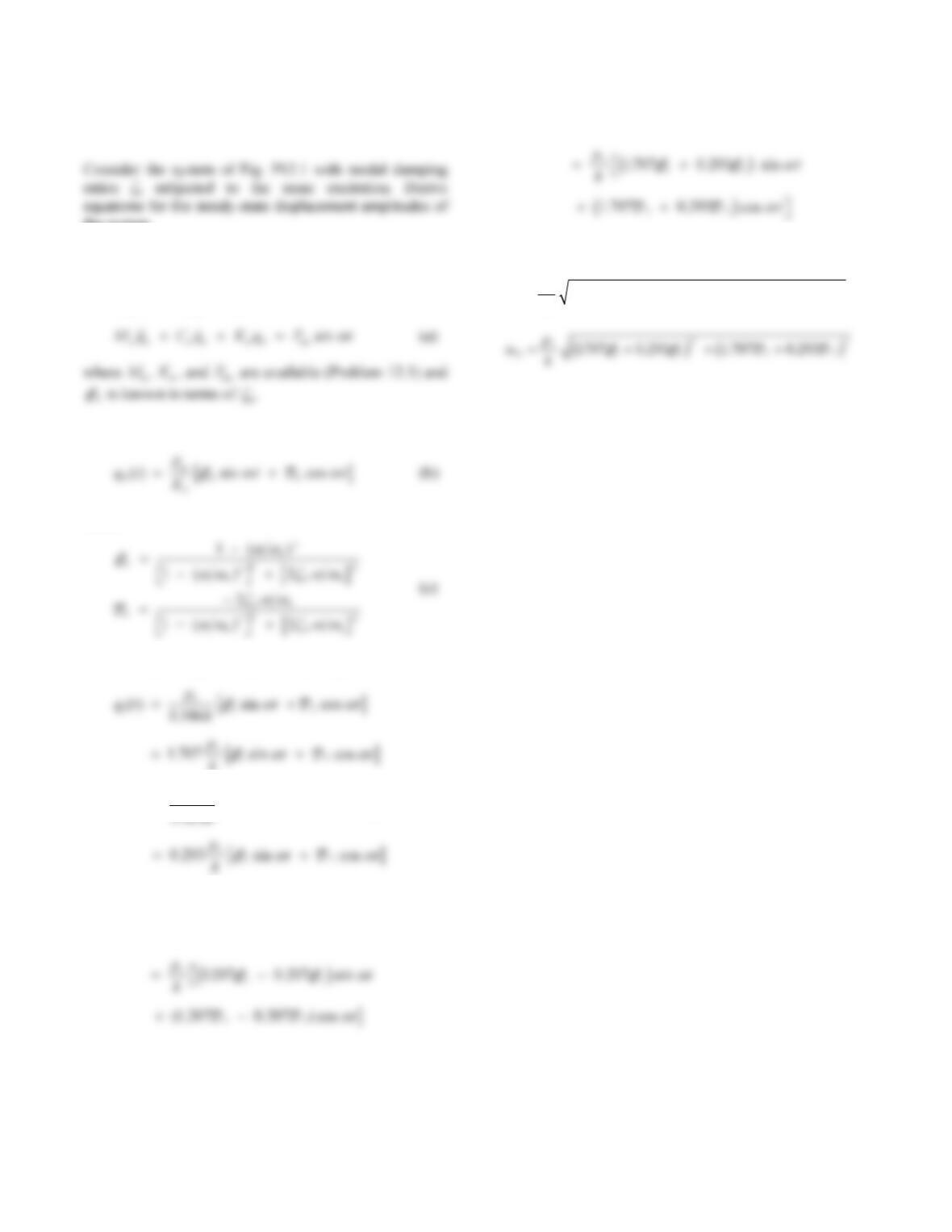
the system.
Solution:
1. Set up modal equations.
2. Solve modal equations.
where
Substituting for
P
no and
K
n into Eq. (b) gives
k
222
() sin cos
o
p
qt t t
CD
3. Combine modal responses.
1111122
() () ()
ut qt qt
2211222
() () ()
ut qt qt
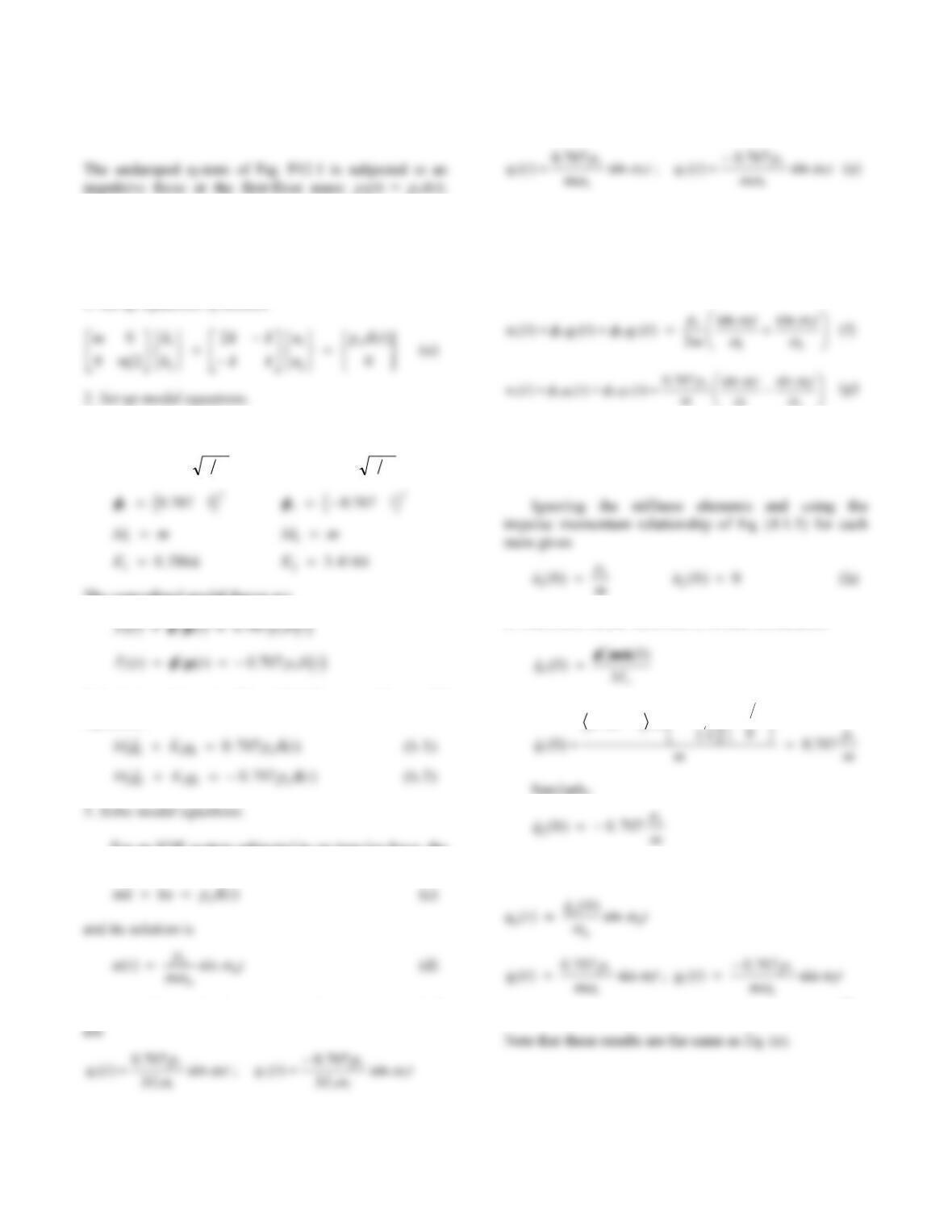
4. Determine displacement amplitudes.
22
11212
1207 0.207 1.207 0.207
o
o
p
uk
CC D D.
5
Problem 12.4
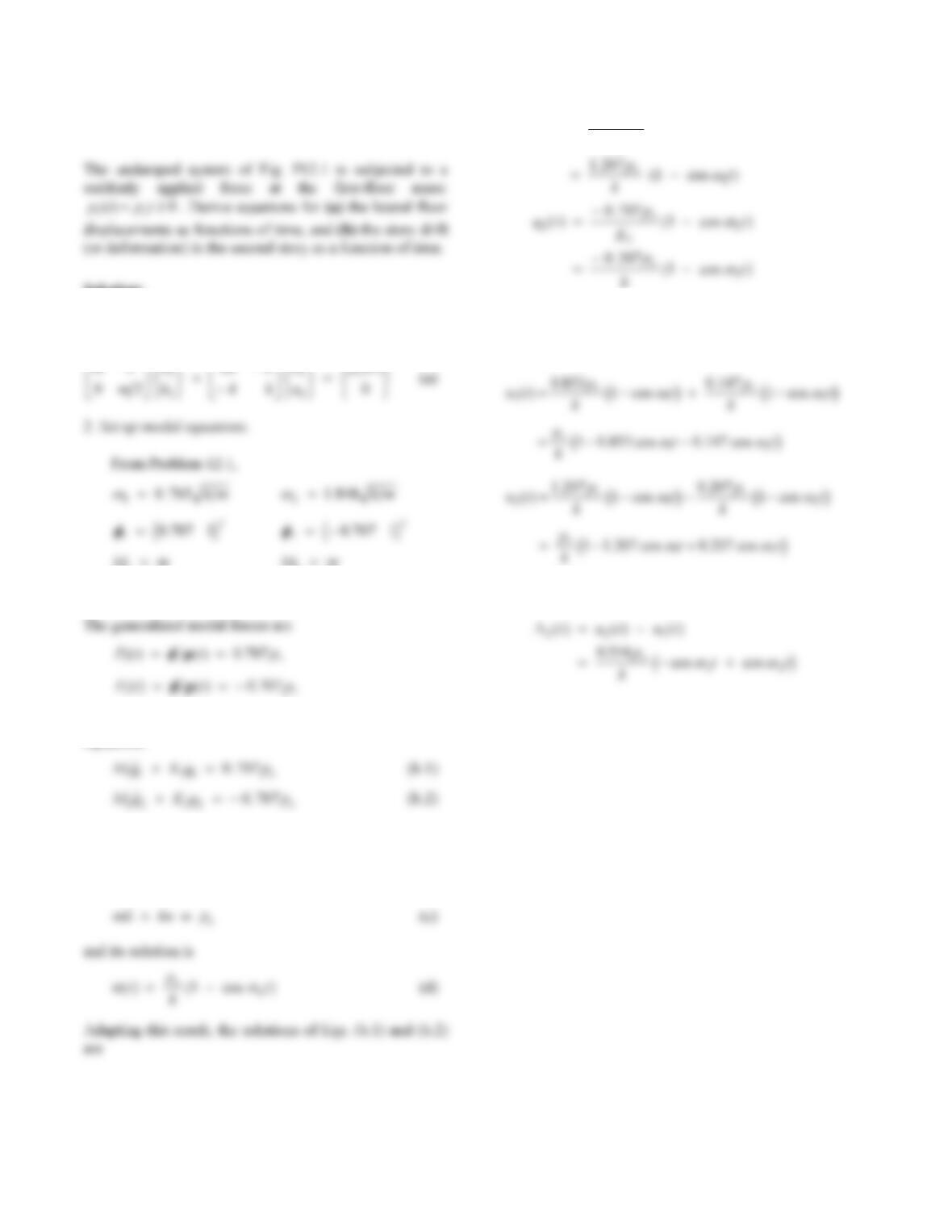
Derive equations for the lateral floor displacements as
functions of time.
Solution:
1. Set up equations of motion.
From Problem 12.1,
10 765.km
21 848.km
The generalized modal forces are
To
Substituting these in Eq. (12.3.3) gives the modal
equations:
For an SDF system subjected to an impulse force, the
governing equation is
Adapting this result, the solutions of Eqs. (b.1) and (b.2)
Substituting for
M
n gives
4. Combine modal responses.
u() ()tqt
nn
n
1
2
12
Alternative method
1. Determine initial velocities.
2. Determine initial velocities in modal coordinates.
1
0.707 1 12 0
o
pm
mp
3. Determine free vibration response.
(i)
6
Problem 12.5
Solution:
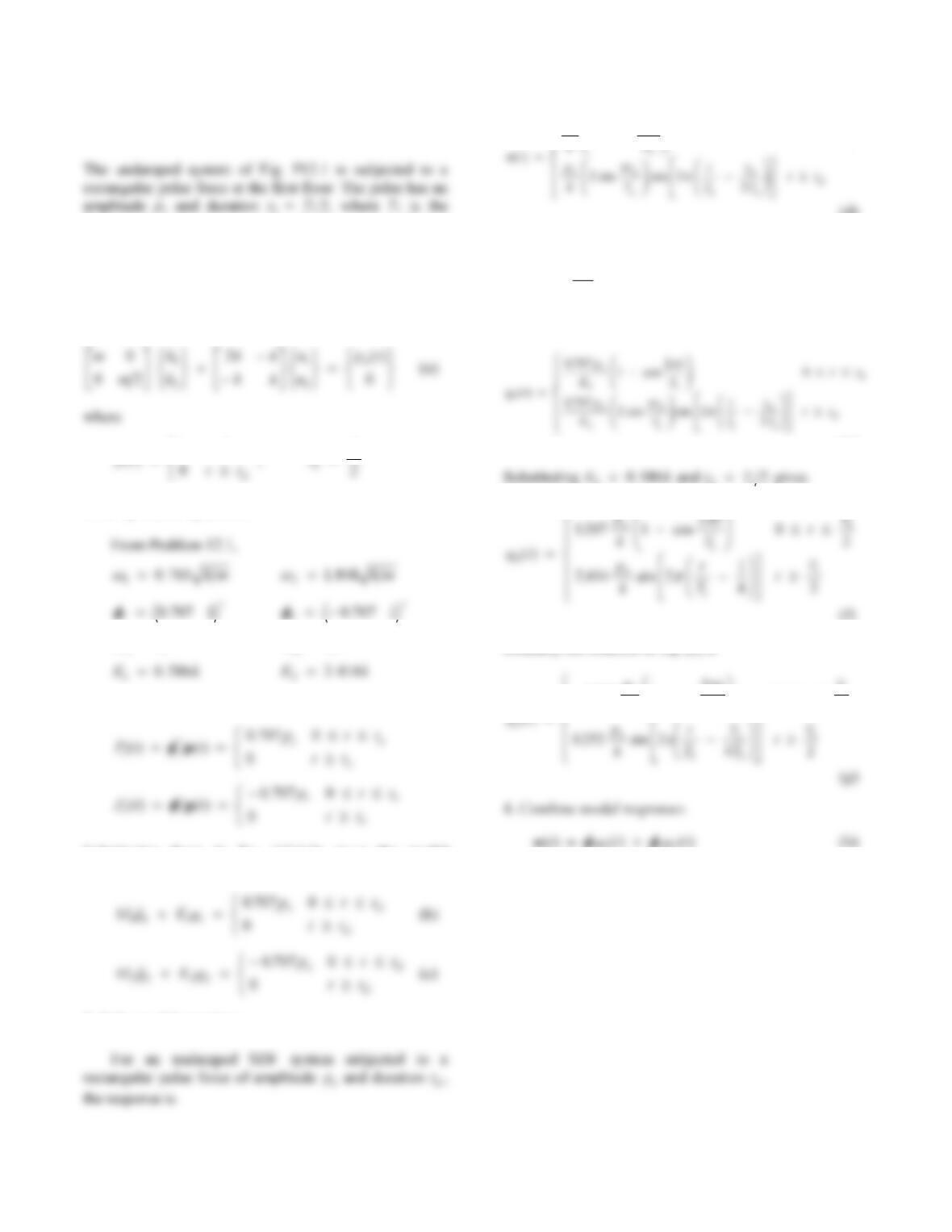
1. Set up equations of motion.
m
u
kk
u
pt
0
2
() (a)
M
m
1
M
m
2
K
k
10 586.
K
k
23 414.
Substituting these in Eq. (12.3.3) gives the modal
equations:
M
K
M
K
3. Solve modal equations.
For an SDF system subjected to a suddenly applied
force, the governing equation is
qt p
Kt
o
1
1
1
0 707 1
() .( cos )
4. Combine modal responses.
11 2 2
() () ()tqt qt
u
5. Determine second-story drift.
7
Problem 12.6
fundamental vibration period of the system. Derive
equations for the floor displacements as functions of time.
Solution:
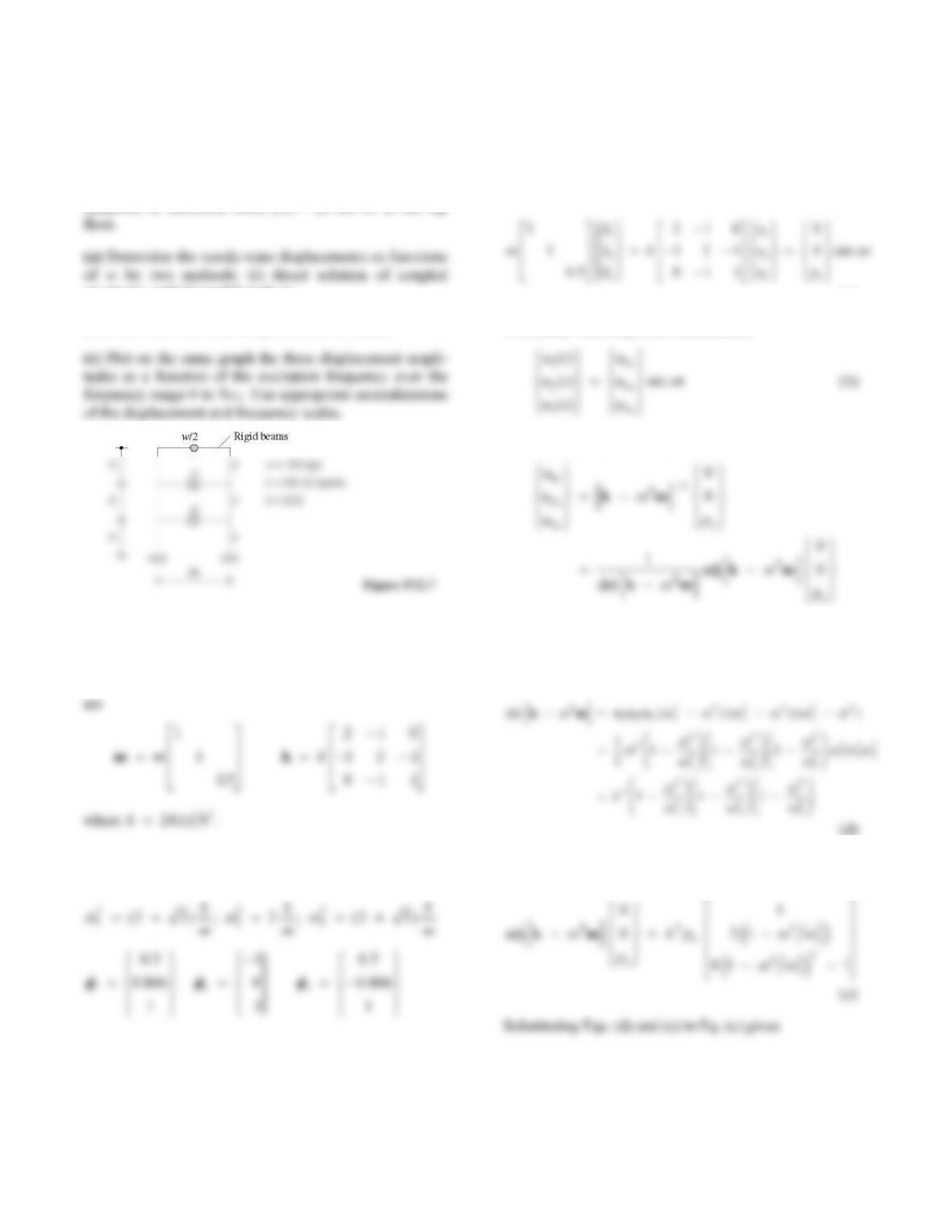
1. Set up equations of motion.
pt pt t
K
k
t
T
od
()
R
T
2. Set up modal equations.
M
m
1
M
m
2
K
k
K
k
The generalized modal forces are
Substituting these in Eq. (12.3.3) gives the modal
equations:
3. Solve modal equations.
p
t
o
d
cos
F
GI
J
R
|
120
(d)
where
Tn
n
2
Adapting this result, the solution of Eq. (b) is
(e)
10 586
d12 gives
Similarly the solution of Eq. (c) is
p
k
t
TtT
o
2
1
0207 1 202
.cos
F
H
G
I
K
J
R
|
|
11 2 2
8
Problem 12.7
Figure P12.7 shows a shear frame (i.e., rigid beams) and
its floor weights and story stiffnesses. This structure is
subjected to harmonic force p(t) = po sin ωt at the top
equations; and (ii) modal analysis.
(b) Show that both methods give the same results.
Solution:
Part a
From Problem 9.8, the mass and stiffness matrices
From Problem 10.11, the natural frequencies
n and
modes n
are given by
(i) Direct Solution
The equations of motion are
(a)
The steady-state response is assumed as
Substituting Eq. (b) in Eq. (a) gives
(c)
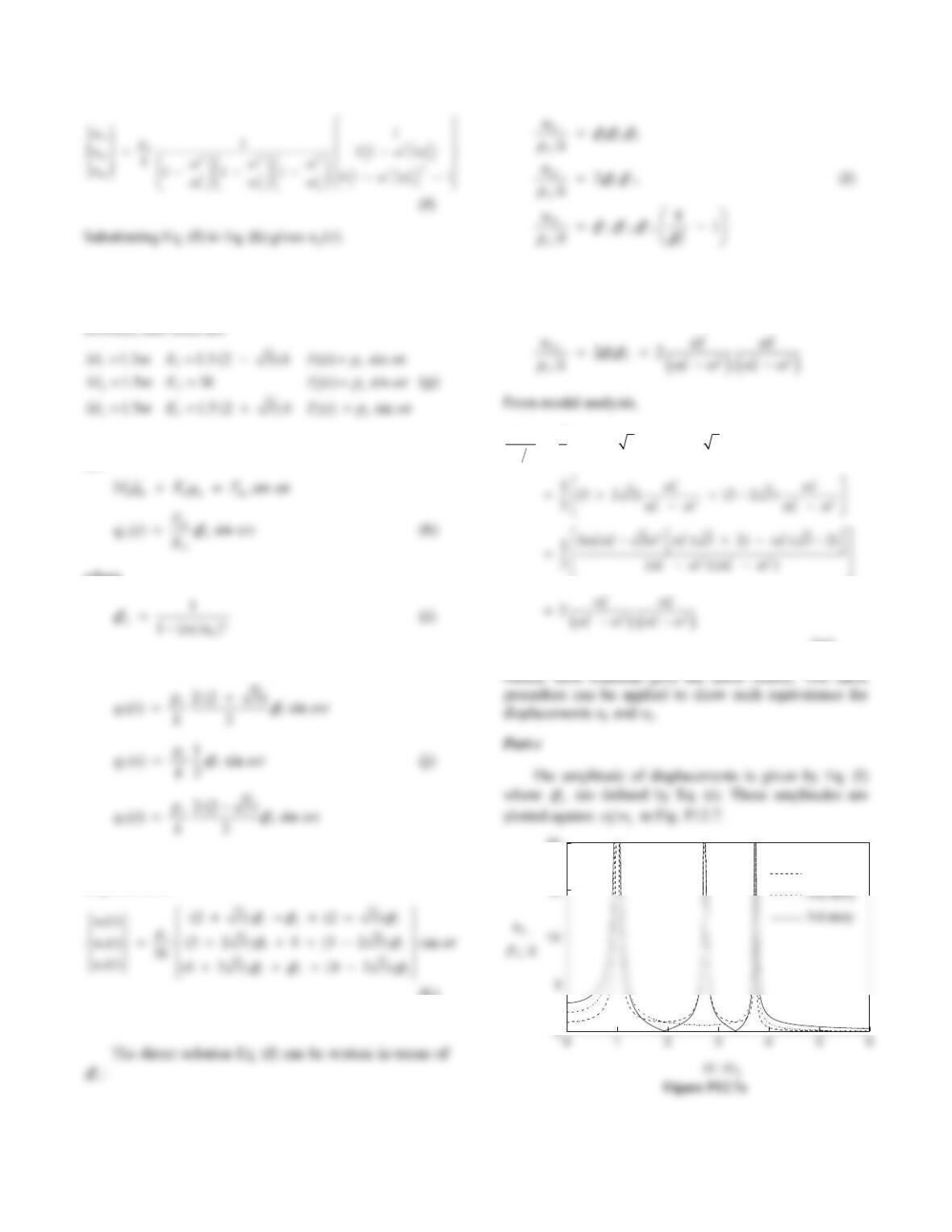
The determinant can be expressed in terms of the natural
frequencies:
Similarly,
9
(ii) Modal Analysis
Using Eq. (12.3.4), the generalized modal mass,
The modal equations and their steady-state solution
are
where
Substituting Eq. (i) in Eq. (h) gives
Substituting Eq. (j) and n
in Eq. (12.3.2) gives the floor
displacements:
(k)
Part b
This result is equivalent to Eq. (k) from modal analysis.
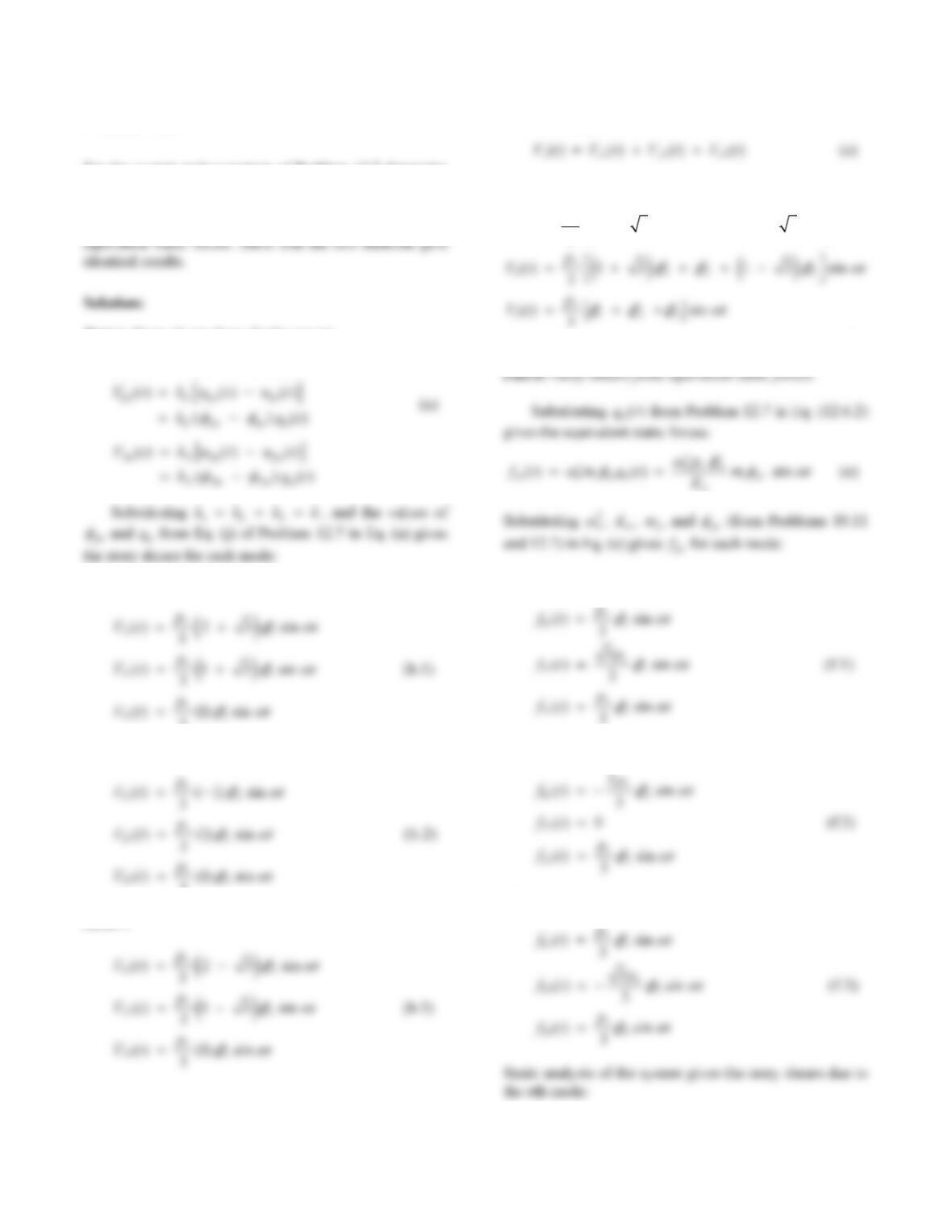
This equivalence can be proven for u2, for example, as
follows: The direct solution gives
2
13
1(3 2 3 + (3 2 3)
3
o
o
u
pk
)CC
(m)
15
20
1st story
10
Problem 12.8
For the system and excitation of Problem 12.7 determine
the story shears (considering steady-state response only)
by two methods: (a) directly from displacements (without
introducing equivalent static forces), and (b) using
Part a: Story shears from displacements.
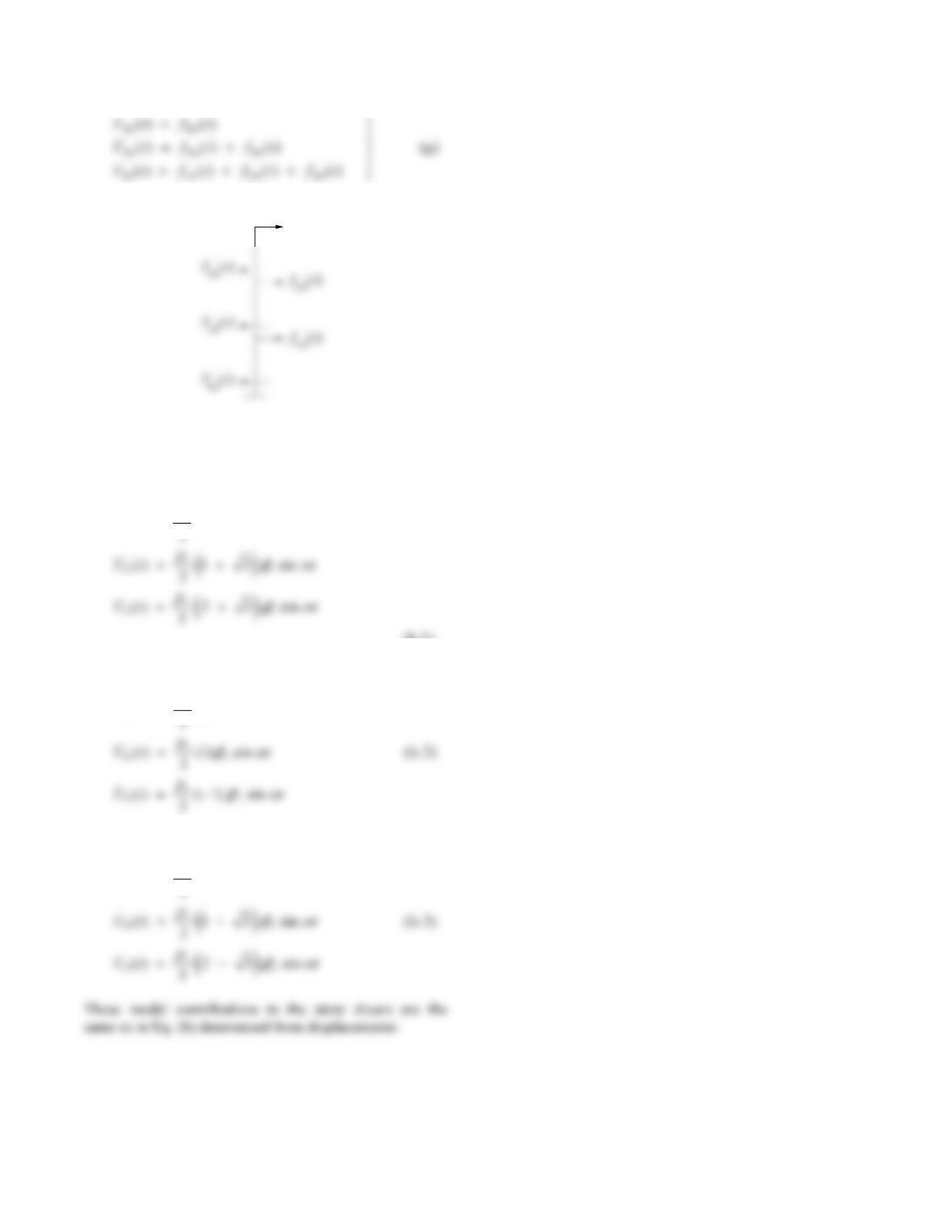
V
t
k
u
t
k
q
t
nn nn11111
() () ()
k
k
k
k
Mode 1
3
Mode 2
3
Mode 3
The total story shears are
Substituting Eqs. (b) in Eq. (c) gives
1123
() 2 3 2 3 sin
3
o
p
Vt t
CC C
(d)
Mode 1
Mode 2
Mode 3
11
f (t)
3n
Substituting Eq. (f) in Eq. (g) gives Vt
jn ( ) for each mode:
Mode 1
31 1
() (1) sin
o
p
Vt t
C
(h.1)
Mode 2
32 2
() (1) sin
o
p
Vt t
C
Mode 3
33 3
() (1) sin
o
p
Vt t
C
12
Problem 12.9
respect to the vertical axis of rotation. Determine the
steady-state amplitudes of displacement and acceleration
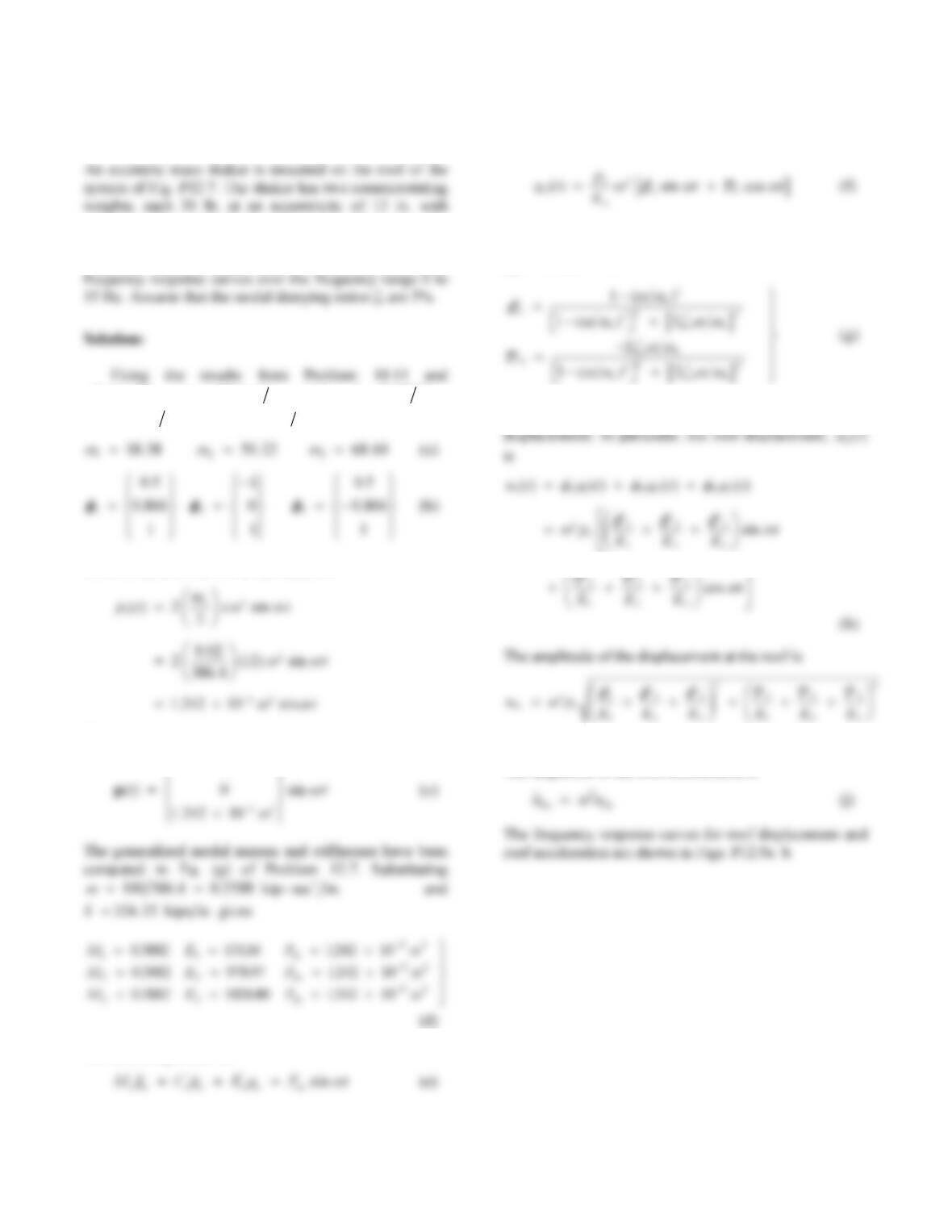
at the roof as a function of excitation frequency. Plot the
substituting 100 kips gm and 3
24kEIh
326.32 kips in. gives
n in rads sec and n
:
t
The excitation force due to the shaker is
Thus
k
0
The modal equations are
For
n
005. and the values of
n,
jn ,
K
n,
M
n, and
P
no defined in Eqs. (a), (b), and (d), the solution is
where
po
1 242 10 3
.
Substituting q
t
n() and n
in Eq. (12.5.2) gives the lateral
(i)
The amplitude of the roof acceleration is
13
0.3
0 5 10 15
0
0.01
0.02
0.04
u o 3 ,
in.
Exciting frequency, Hz
14
Problem 12.10
impulsive force at the second-floor mass: p2(t) = poδ(t),
where po = 20 kips. Derive equations for the lateral floor
displacements as functions of time.
326 32..kips in gives
n in rads sec and n
:
(a)
The generalized modal masses and stiffnesses have been
computed in Eq. (g) of Problem 12.7. Substituting
The generalized modal forces due to the impulsive force
at the second floor are
The modal equations and their solutions are
P
P
M
qt t
11
2 427
() . sin
U
Substituting n
and q
t
n() in Eq. (12.5.2) gives the lateral
displacements:
15
Problem 12.11
Solution:
123
11 1
0.3882 0.3882 0.3882
MMM
(a)
200
The modal equations and their solutions are
M
K
P
Substituting
P
no ,
M
n, and
n in Eq. (d) gives
Substituting n
and q
t
n() in Eq. (12.5.2) gives the lateral
displacements:
or,
ut
06129
0 3812
()
.
.
R
U
R
U
R
U
Part b
The second-story drift is
3
Problem 12.12
The undamped system of Fig. P12.7 is subjected to a
rectangular pulse force at the third floor. The pulse has an
Solution:
From Problem 12.10,
118 38.
250 22.
368 60.
T
T
T
1
1
1
M
M
M
K
K
K
(a)
t
t
t
t
the accompanying figure:
p, kips
1d
The generalized modal forces are
The modal equations are
The solution of Eq. (c) is
(d)
Substituting
P
no ,
K
n, and
T
n in Eq. (d) gives
qt t
T
T
1
1
3
15249 1 2
() . cos
F
H
GI
K
J
H
K
U
|
|
W
|
qt t
T
1
1
30498 2 0250
() . sin .
F
H
GI
K
J
U
|
|
The story displacements are
where n
are known and q
t
n() is given by Eq. (e) if
d and by Eq. (f) if
d
17
Figure P12.13 shows a structural steel beam with E =
30,000 ksi, I = 100 in4, L = 150 in., and mL = 0.864 kip–
system to an impulsive force p1(t) = poδ(t) at the left mass,
where po = 10 kips and δ(t) is the Dirac delta function.
M
K
P
t
Solution:
EI mL/3 mL/3
1. Determine stiffness and mass matrices.
2. Determine natural frequencies and modes.
From Problem 10.2,
1
1
For the given data,
n in rads sec are
where
M
M
12
0 576 0 576
..
4. Solve modal equations.
5. Combine modal responses.
ut
1
1
()
R
R
18
-3
-3
3
-3
-3
3
-3
-3
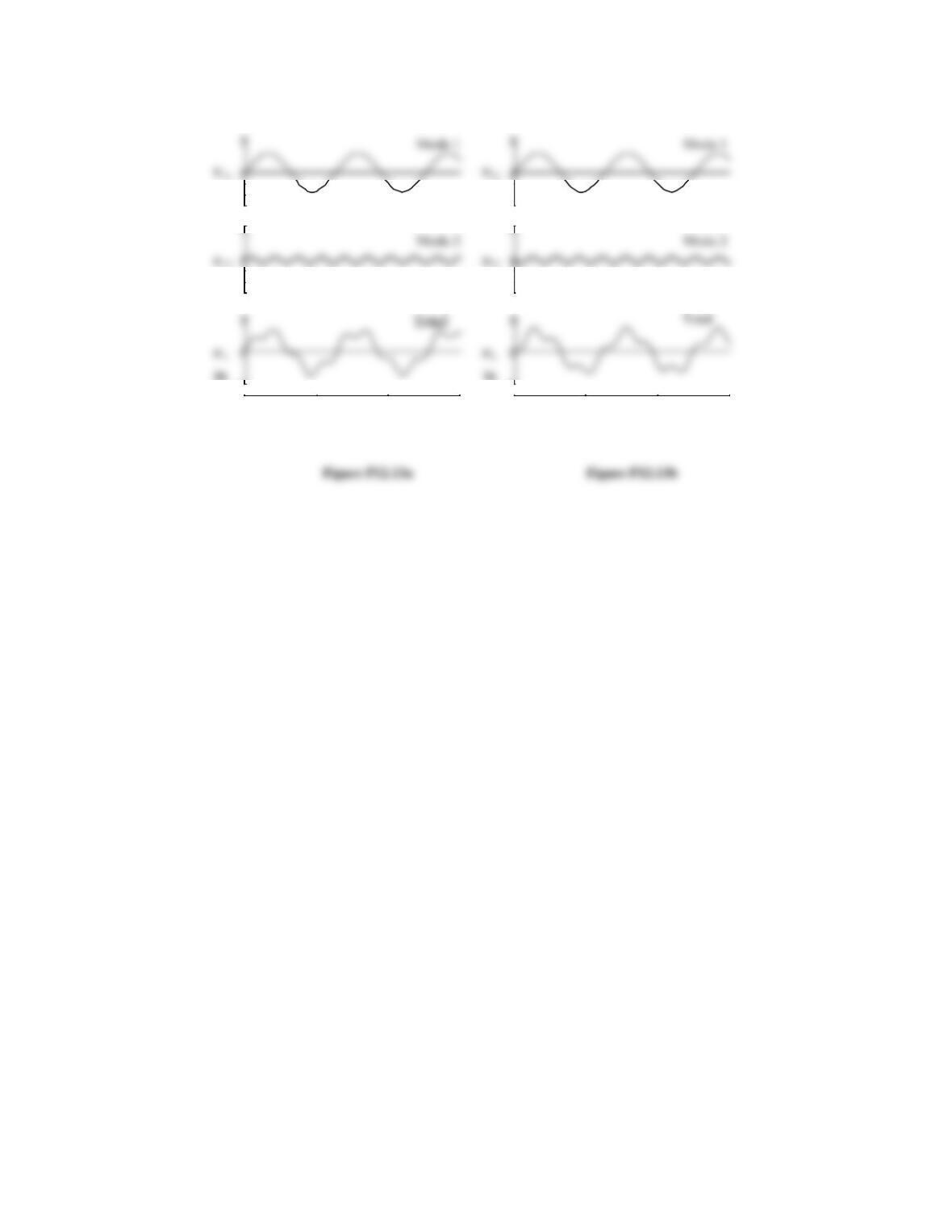
Time, sec Time, sec
0 0.5 1 1.5 0 0.5 1 1.5
19
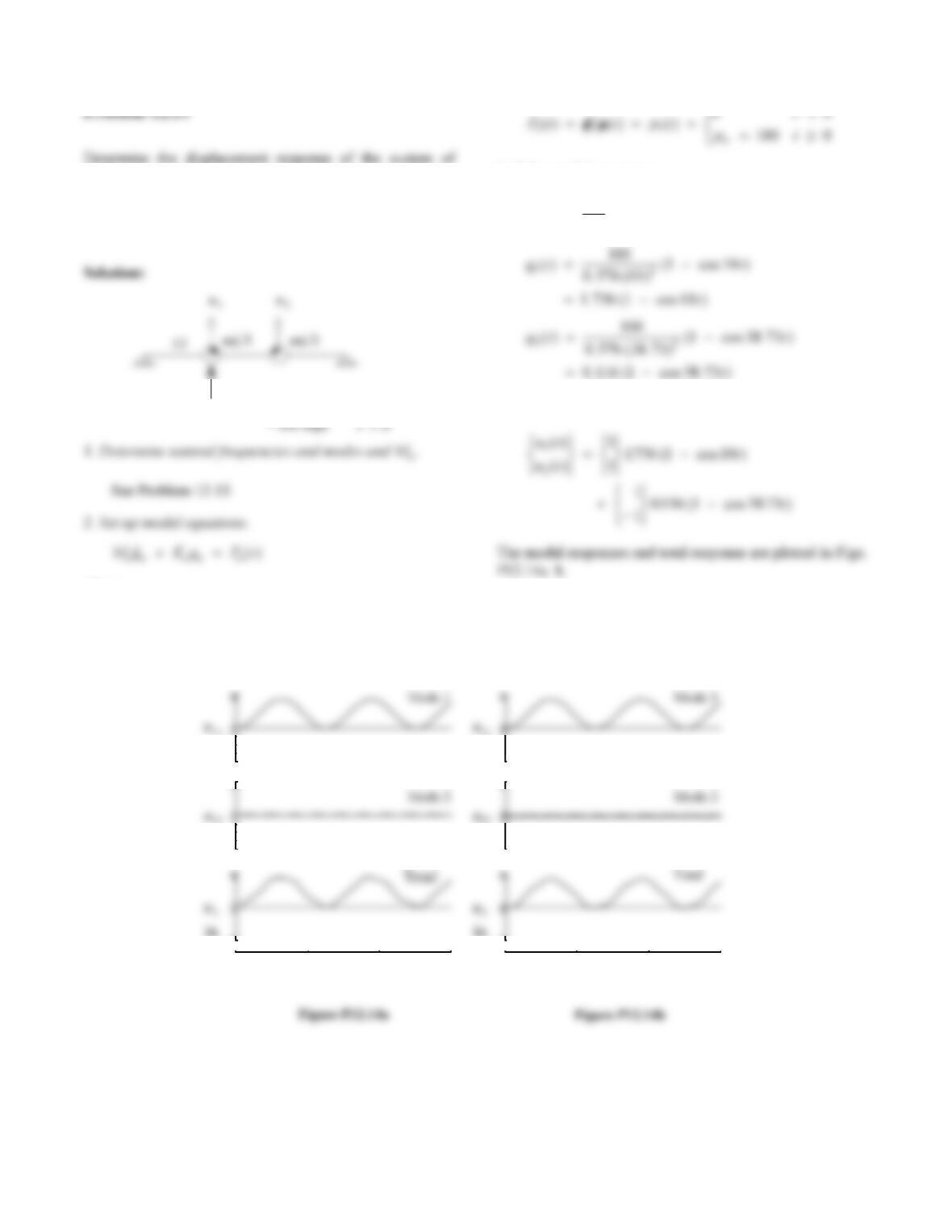
Problem 12.13 to a suddenly applied force of 100 kips
applied at the left mass. Plot as functions of time the
displacements uj due to each vibration mode separately and
combined.
p ( t )
1
0
t 0
{
where
3. Solve modal equations.
qt p
Kt
n
o
n
n
( ) ( cos )
11
4. Combine modal responses.
-4
-4
4
-4
-4
4
-4
-4
Time, sec Time, sec
0 0.5 1 1.5 0 0.5 1 1.5