1
CHAPTER 14
modal damping ratios for the two-story shear frame of
Figure P9.5 with damping. The Rayleigh damping matrix
provides a damping ratio of 5% in both modes. Use the
Solution:
The mass and stiffness matrices of the system are:
n
damping procedure (Section 11.4.1).
The eigenvalue problem to be solved is defined by Eq.
(A14.2.8) with the matrices a and b, defined in Eq.
(A14.2.5).
00 0
m
000
m
From these eigenvalues, n
and n
can be determined
from Eq. (14.5.6):
From these eigenvalues, the damped frequencies are
determined from their definition in Eq. (14.5.4):
Solution of the eigenvalue problem provides also the
eigenvectors:
classically damped system, and identical to the natural
modes of the associated undamped system determined by
solving Problem 10.6.
To verify that the eigenvectors n
are orthogonal, we
0
21
TT
k
(14.6.1) and (14.6.2).
2
Problem 14.2
Determine the natural frequencies, natural modes, and
modal damping ratios for the two-story frame of Figure
P9.5, with a damper only in the first story with damping
coefficient c1 = 0.4 km , where k = 24EI/h3 is the story
stiffness; express frequencies in terms of m and k. Show
that the natural modes satisfy the orthogonality properties.
Solution:
The mass, stiffness and damping matrices of the
2
1
2
00.4 0
000
mkm
m
amc
The eigenvalue problem can be solved numerically
i
k7641.01014.0, 1
1
m
k
8346.1
22
1316.0
Re
1
1
1
0537.0
Re
2
2
2
From these eigenvalues, the damped frequencies are
determined from their definition in Eq. (14.5.4):
eigenvectors:
Note that the eigenvectors are complex valued, as expected
for a nonclassically-damped system.
ik
TT 1049.00282.0
21
k
Substituting individual terms in the left side of Eqs.
(14.6.1) and (14.6.2)
3
Problem 14.3
Determine the free vibration response of the two-story
shear frame of Problem 14.1, a classically damped system,
due to initial displacements of Figure P10.8a. Use the
theory for nonclassically damped systems developed in
Section 14.7, to solve the problem. Verify that the results
match the solution of Problem 10.9 by classical modal
analysis.
Solution:
The initial displacement and velocity vectors are:
Substituting them in Eq. (14.7.4) together with m, c,
n
, and n
determined in Problem 14.1 gives:
Using n
B and n
determined in solving Problem 14.1,
n
and n
are determined from Eq. (14.7.2) as follows:
Substituting n
and n
into Eq. (14.7.6) gives the
free-vibration response:
This result agrees with the solution of Problem 10.9.
4
Problem 14.4
Determine the free vibration response of the two-story
shear frame of Problem 14.2 due to initial displacements of
Fig. P10.8a.
Solution:
The initial displacement and velocity vectors are:
Substituting them in Eq. (14.7.4) together with m, c,
n
, and n
determined in Problem 14.2 gives:
Using n
B and n
determined in solving Problem 14.2,
n
and n
are determined from Eq. (14.7.2) as follows:
Substituting n
and n
into Eq. (14.7.6) gives the
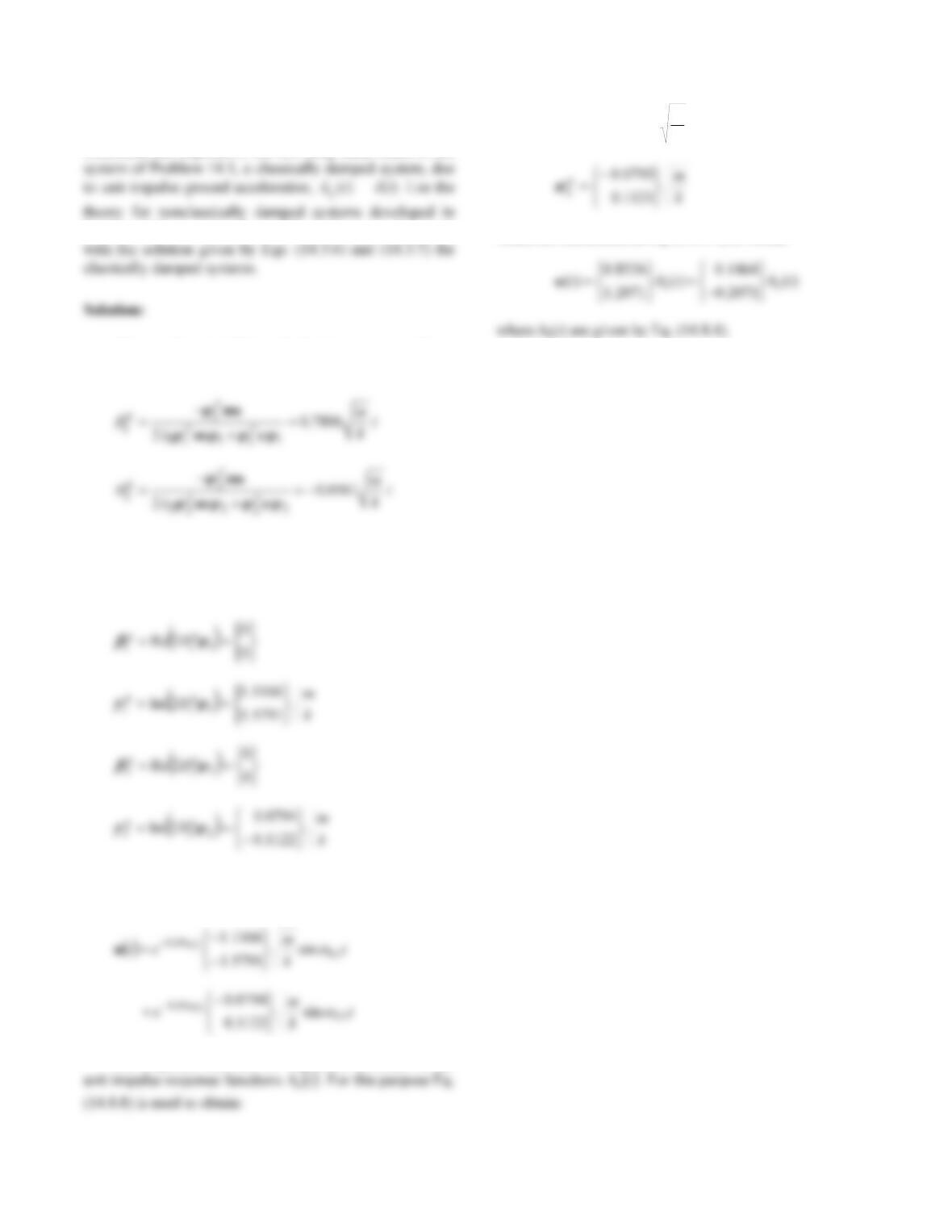
free-vibration response:
5
Problem 14.5
Determine the response of the two-story shear frame of the
Section 14.8, to solve the problem. Compare the result
g
n
B are determined by substituting m, c, and n
from Problem 14.1 in Eq. (14.8.1)
Using the g
n
B and n
from the solution to Problem
14.1, g
n
and g
n
are determined from Eq. (14.8.2) as
follows:
Substituting the g
n
and g
n
into Eq. (14.8.3) gives
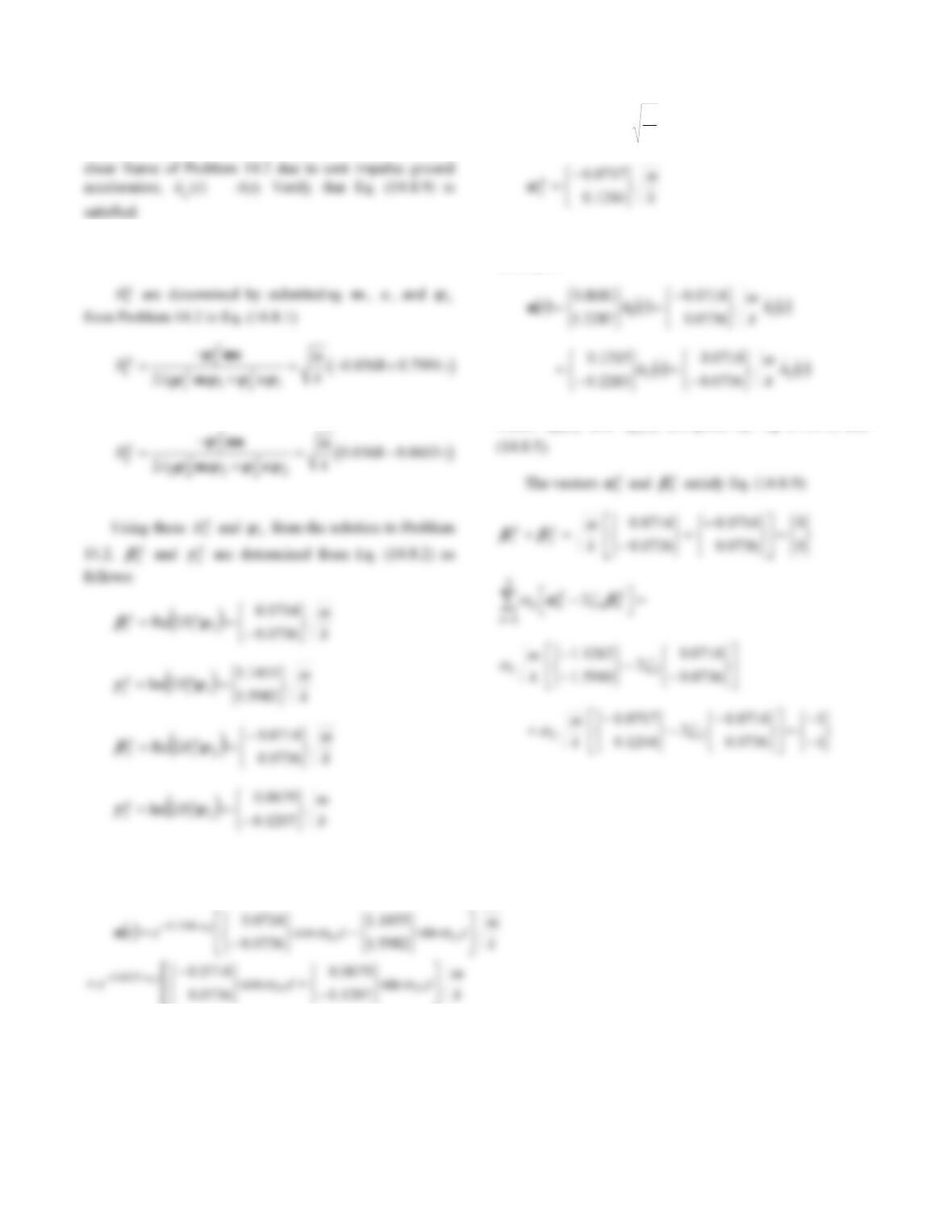
the desired response:
The response can also be expressed in terms of the
k
m
g
5772.1
1152.1
1
which are substituted in Eq. (14.8.7), to obtain
6
Problem 14.6
Determine the free vibration response of the two-story
Solution:
Substituting the g
n
and g
n
into Eq. (14.8.3) gives
the desired response:
The response can also be addressed in terms of the
unit impulse response functions
thn. For this purpose Eq.
(14.8.8) is used to obtain:
k
m
g
5940.1
1262.1
1
which are substituted together with g
n
in Eq. (14.8.7),
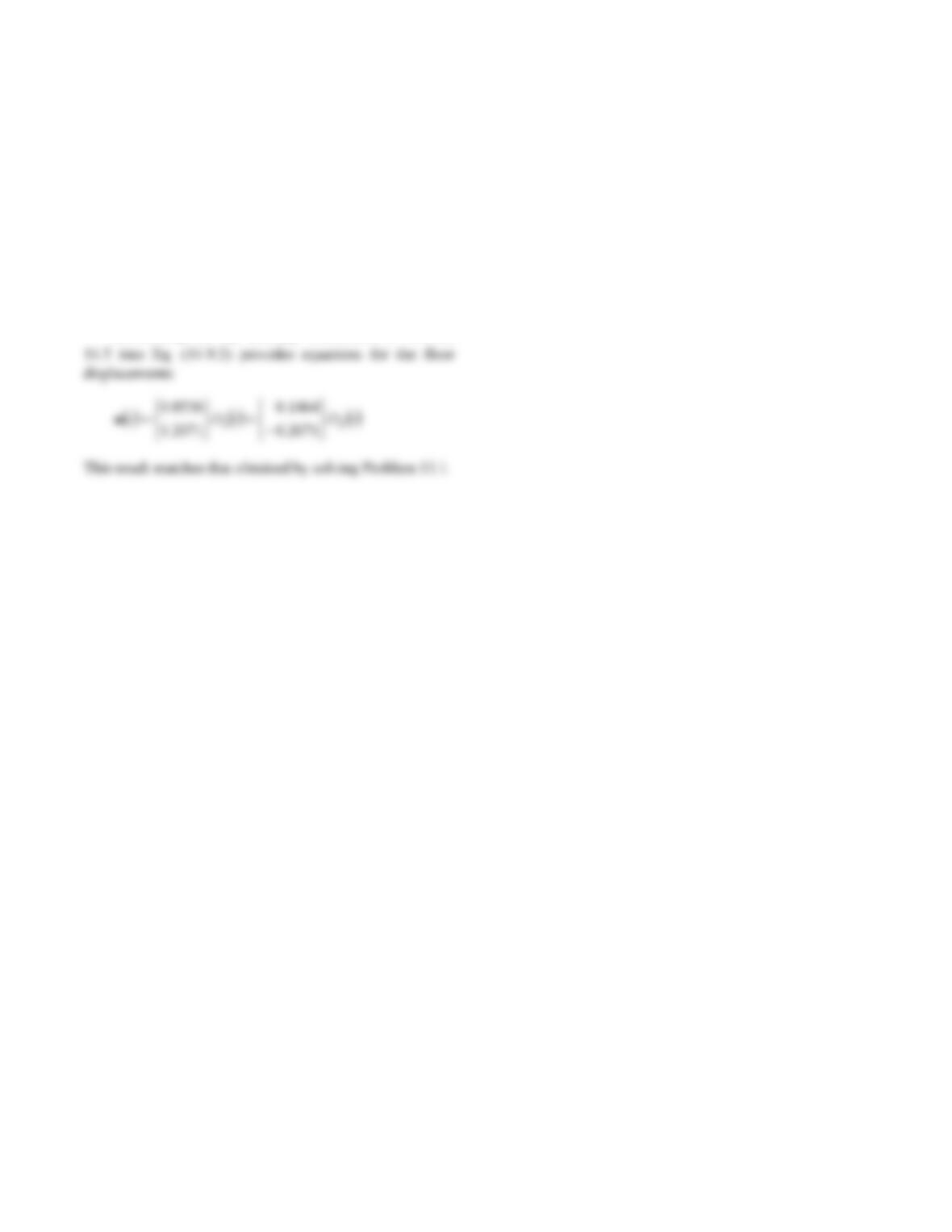
leading to:
where
ht
and
ht
are given by Eq. (14.8.4) and
7
Problem 14.7
For the two-story shear frame of Problem 14.1, a
classically damped system, excited by horizontal ground
motion ()
g
ut
, determine the floor displacement response
in terms of Dn(t). Use the theory for nonclassically damped
systems developed in Section 14.9 to solve the problem.
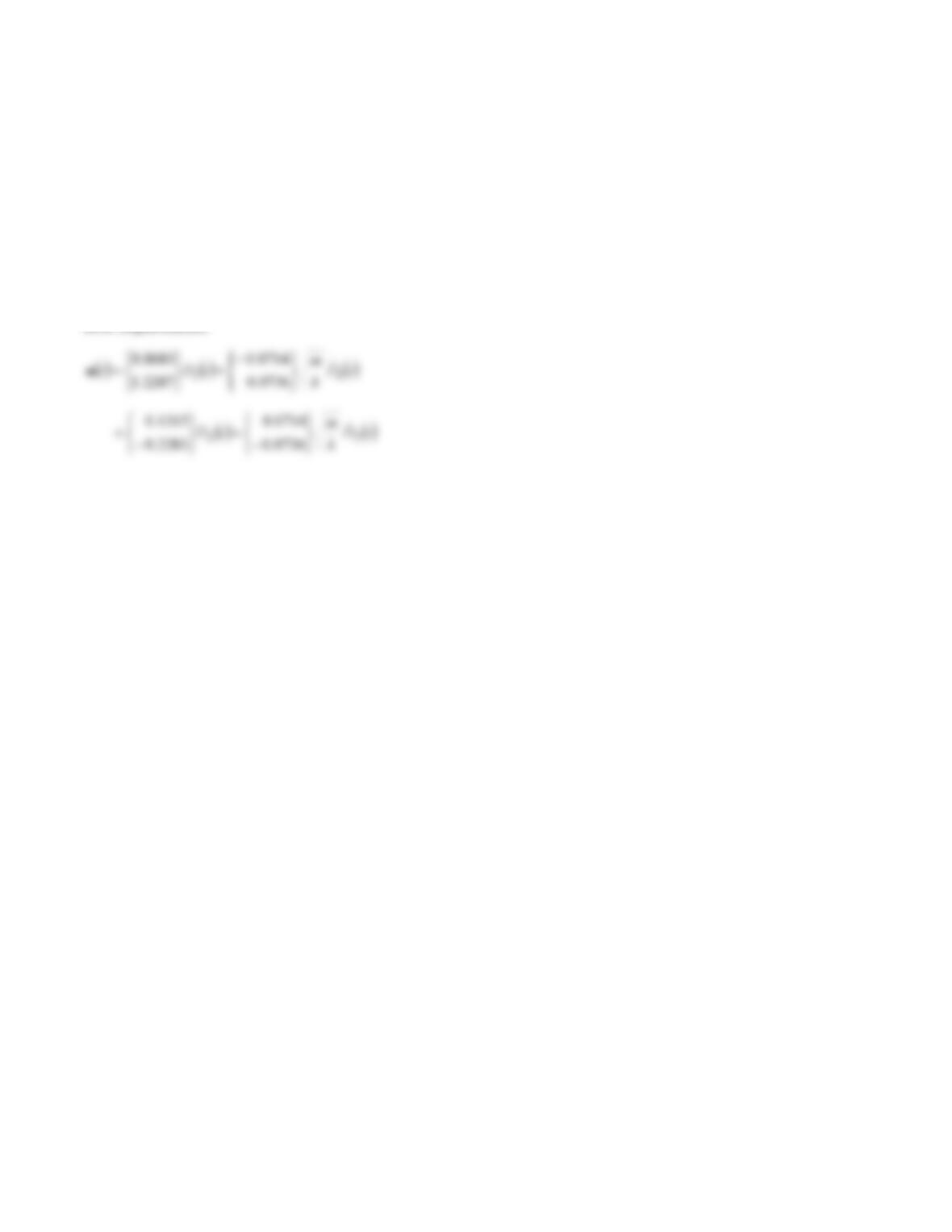
Compare the result with that determined in Problem 13.1.
Solution:
Substituting the g
n
and g
n
determined in Problem
8
Problem 14.8
For the two-story shear frame of Problem 14.2 excited by
horizontal ground motion ()
g
ut
, determine the floor
displacement response in terms of Dn(t) and ()
n
Dt
.
Solution:
Substituting the g
n
and g
n
determined in solving
Problem 14.6 into Eq. (14.9.2) provides equations for the
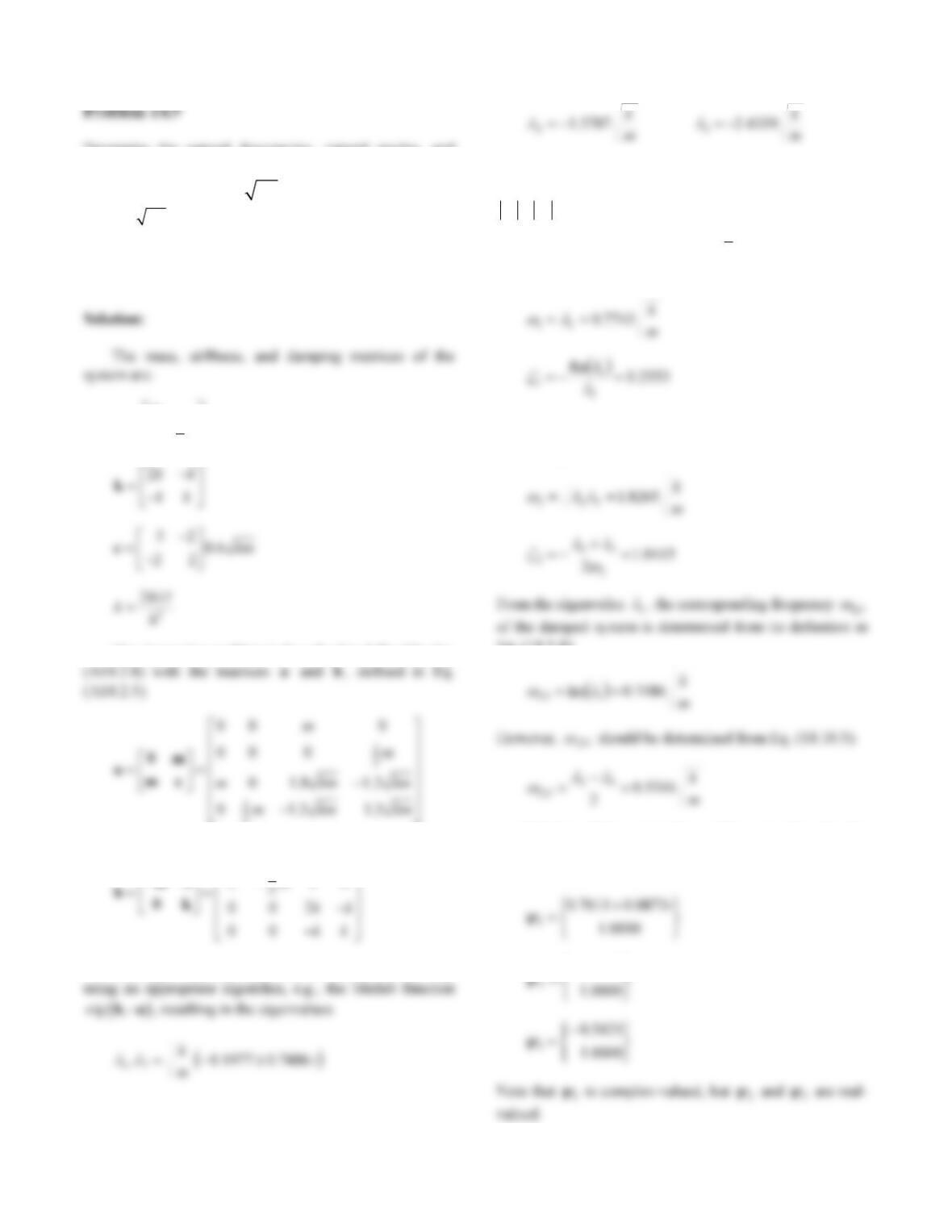
floor displacements:
9
Determine the natural frequencies, natural modes, and
modal damping ratios for the two-story frame of Fig. P9.5,
with dampers 10.6ckm in the first story and
c2 = 1.2 km in the second story, where k = 24EI/h3 is the
story stiffness; express frequencies in terms of m and k.
Show that the natural modes satisfy the orthogonality
properties.
m
m
2
1
m
The eigenvalue problem to be solved is defined by Eq.
1
000
000
m
m
m0
The eigenvalue problem can be solved numerically
Note that two of the eigenvalues of the system are complex
conjugates, whereas two are real and negative valued, with
23
.
From the eigenvalues 1
and 1
, 1
and 1
can be
determined from Eq. (14.5.6):
Substituting eigenvales 2
and 3
in Eqs. (14.10.3) and
(14.10.4) gives
Eq. (14.5.4):
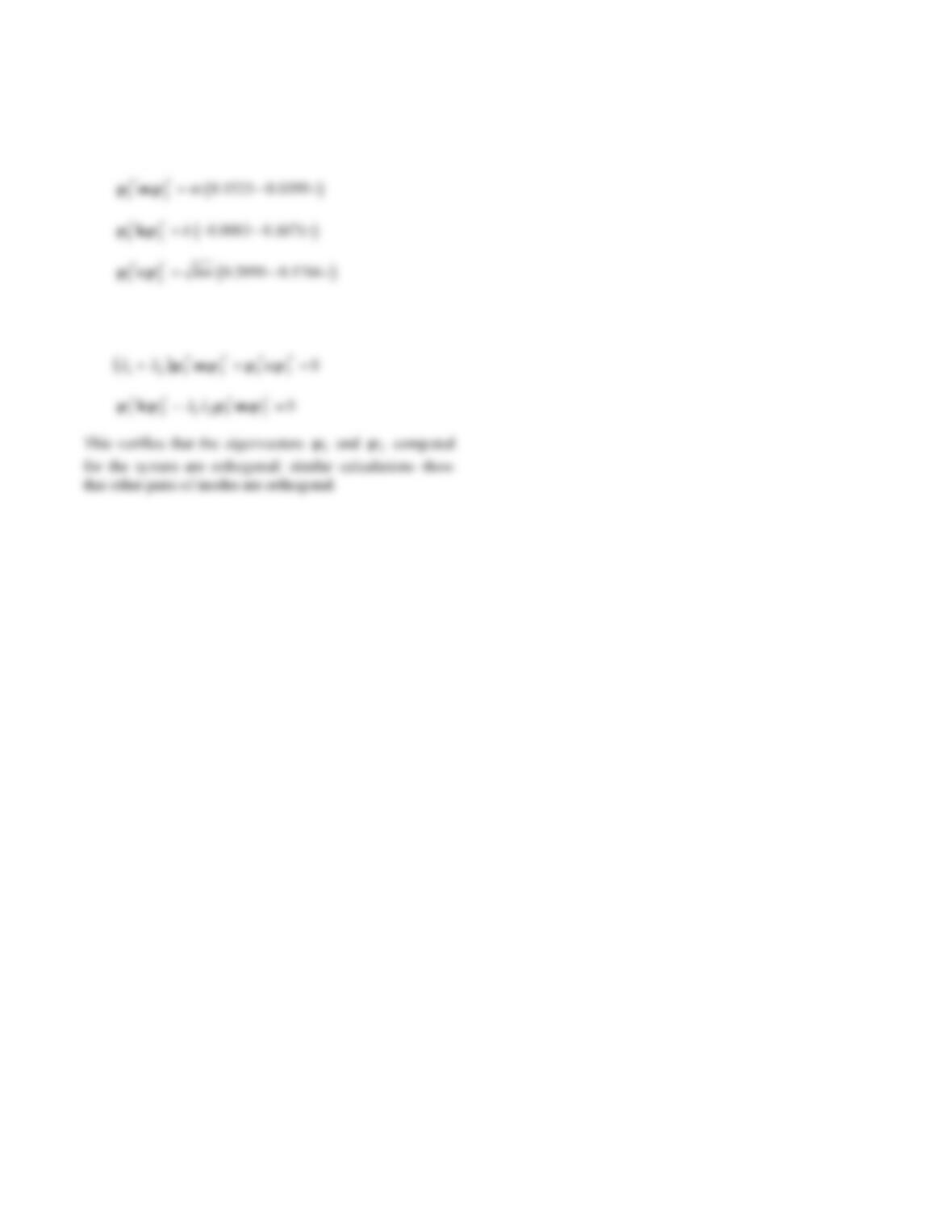
Solution of the eigenvalue problem provides also the
14
eigenvectors, but only the third and fourth
components [see Eq. (A14.2.7)] are shown below:
4568.0
10
To verify that the eigenvectors 1
and 2
are
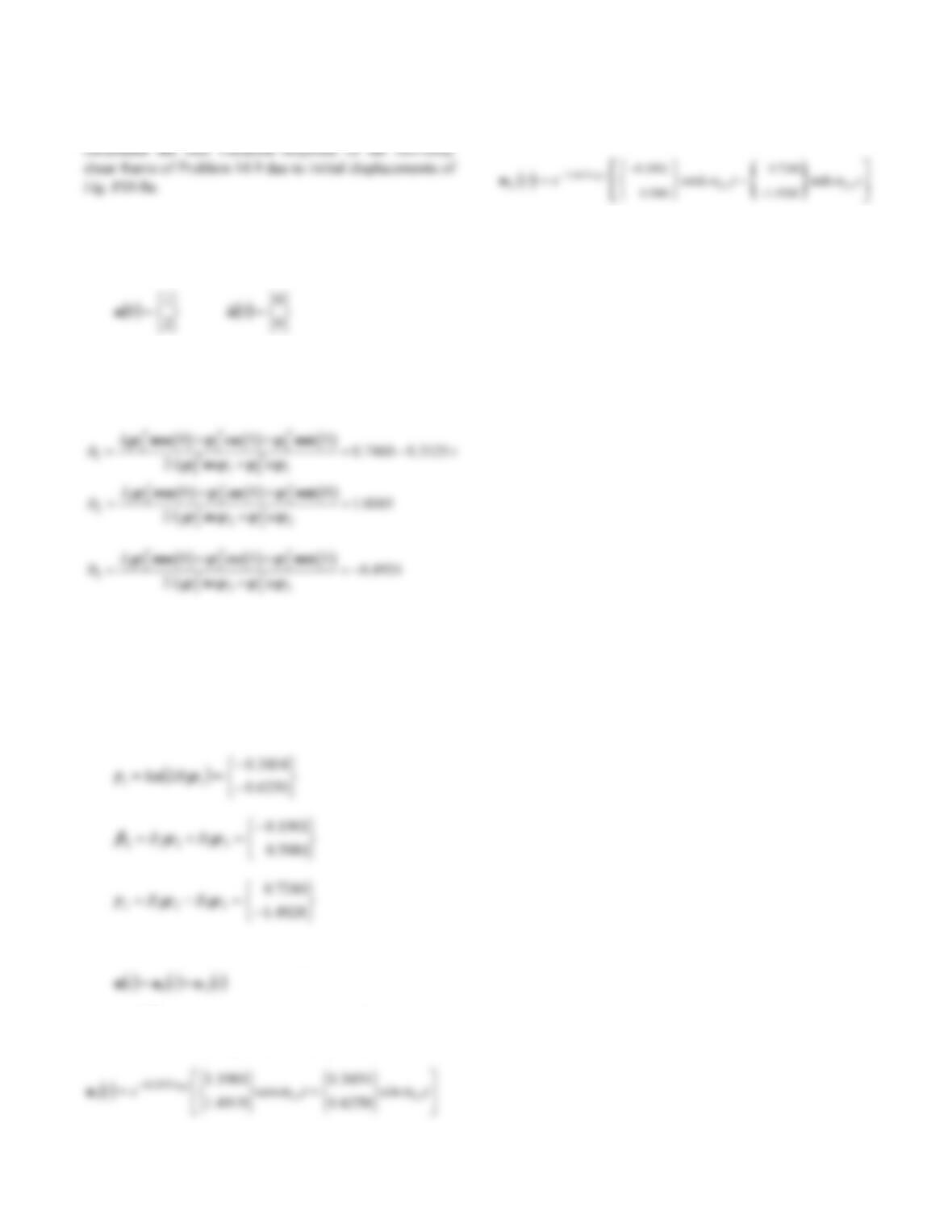
orthogonal, we compute the individual terms in the left
side of Eqs. (14.6.1) and (14.6.2).
Substituting these individual terms in the left side of Eqs.
(14.6.1) and (14.6.2)
11
Problem 14.10
Solution:
The initial displacement and velocity vectors are:
Substituting them in Eq. (14.7.4) together with m, c,
n
, and n
determined in the solution to Problem 14.9
gives:
Using n
B and n
from Problem 14.1, 1
and 1
are
determined from Eq. (14.7.5) and 2
and 2
from Eqs.
(14.10.8) and (14.10.9) as follows
4919.1
1901.1
2Re 111
B
The free-vibration response is given by
where
t
1
u is determined by substituting 1
and 1
into
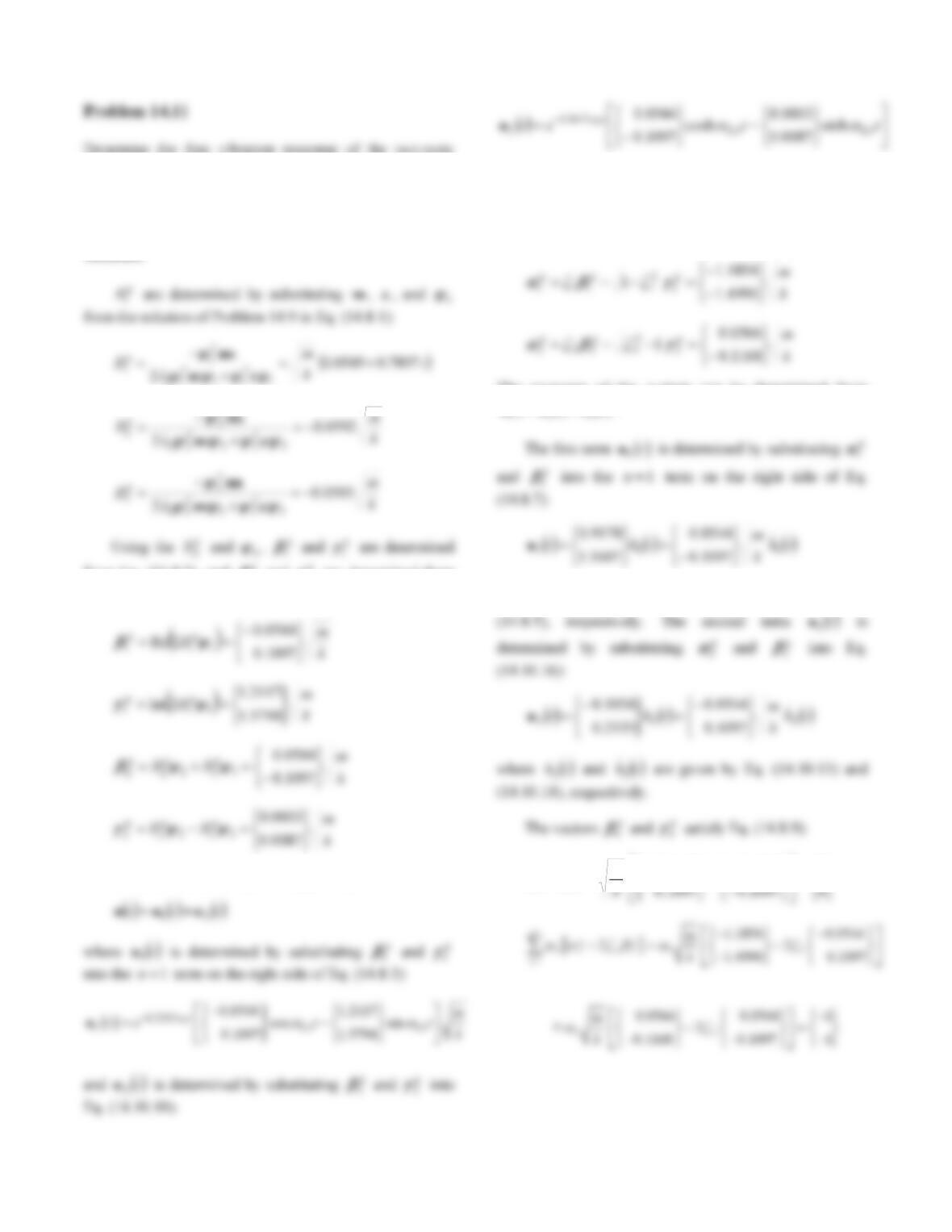
the 1n term on the right side of Eq. (14.7.6):
and
t
2
u is determined by substituting 2
and 2
into
Eq. (14.10.7):
12
Determine the free vibration response of the two-story
shear frame of Problem 14.9 due to unit impulse ground
acceleration, ()
g
ut
= δ(t). Verify that Eq. (14.8.9) is
satisfied.
Solution:
T
from Eq. (14.8.2), and g
2
and g
2
are determined from
Eqs. (14.10.11) and (14.10.12) as follows:
The free-vibration response is given by
The response can also be expressed in terms of the unit
impulse response functions
thn. For this purpose Eqs.
(14.8.8) and (14.10.17) give
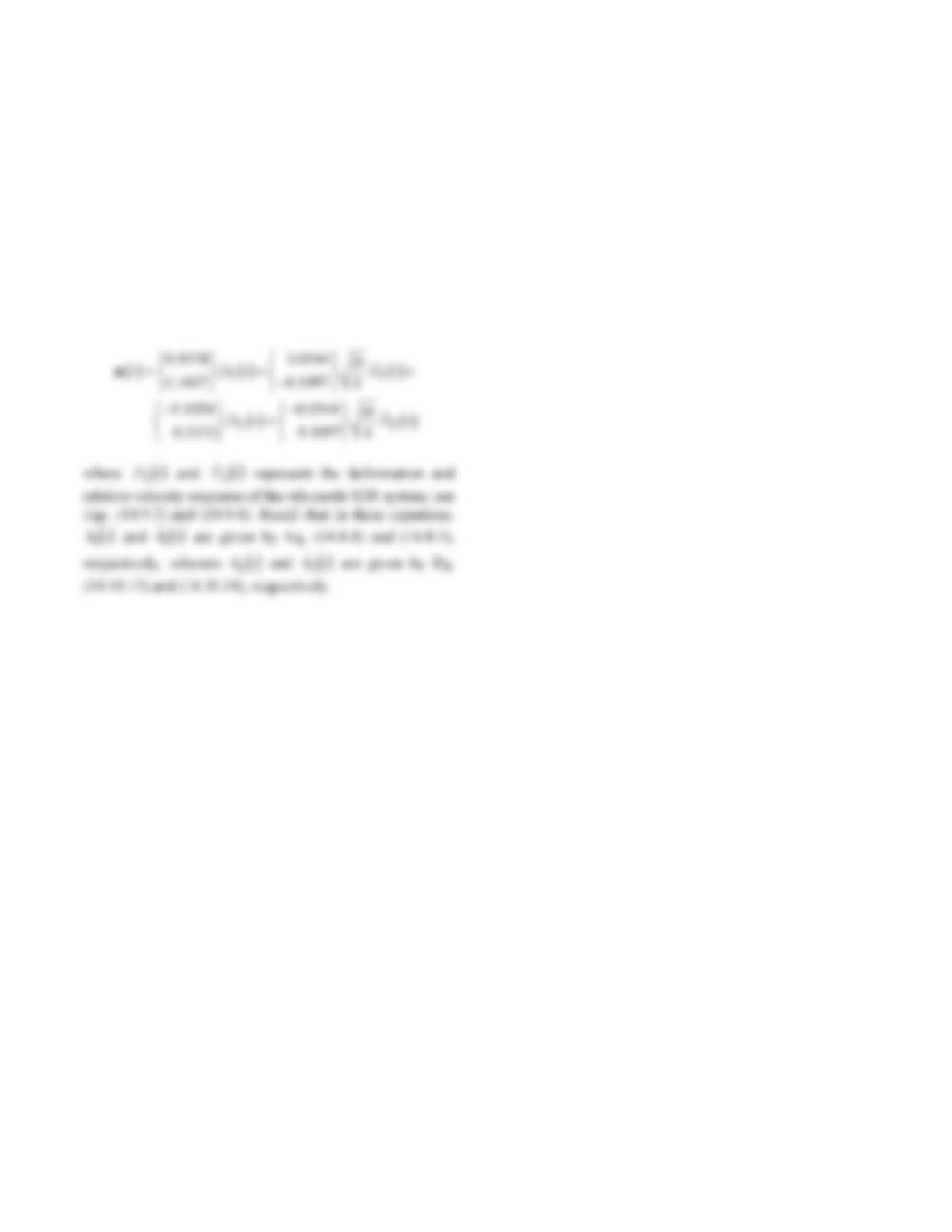
The response of the system can be determined from
ttt 21 uuu
.
where
th
1 and
th
1
are given by Eqs. (14.8.4) and
0
0
0544.0
0544.0
21 k
m
gg
13
Problem 14.12
For the two-story shear frame of Problem 14.9 excited by
horizontal ground motion ()
g
ut
, determine the floor dis-
placement response in terms of Dn(t) and ()
n
Dt
.
Solution:
Substituting the g
n
and g
n
determined in the
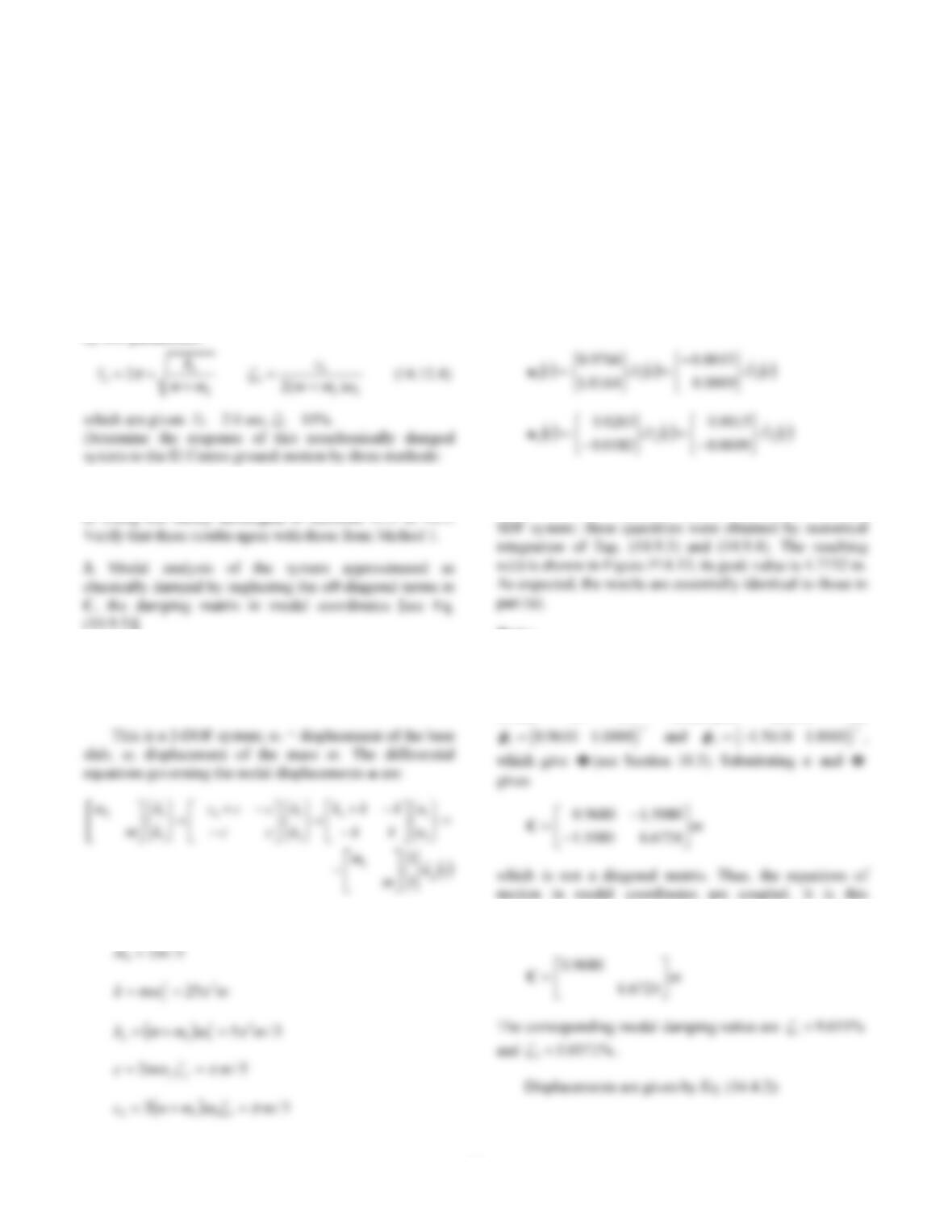
solution of Problem 14.11 into Eq. (14.9.2) provides
equations for the floor displacements:
14
Problem 14.13
Consider a one-story building with mass m, lateral stiffness
k, and damping coefficient c (Fig. 21.2.1a). On a fixed
base, this SDF system has the natural frequency ωf , natural
period Tf = 0.4 sec, and damping ratio ζf = 2%; the
subscript f is chosen instead of n to emphasize that these
are properties of the structure on a fixed base. As shown in
Fig. 21.2.1b. this one-story building is mounted on a base
slab of mass mb = 2m/3, which in turn is supported on a
base isolation system with lateral stiffness kb and linear
viscous damping cb. The isolation system is characterized
by two parameters:
1. Solving the coupled equations of motion.
Solution:
Part a
where:
Solving these coupled differential equations
numerically by the Runge–Kutta method, using the Matlab
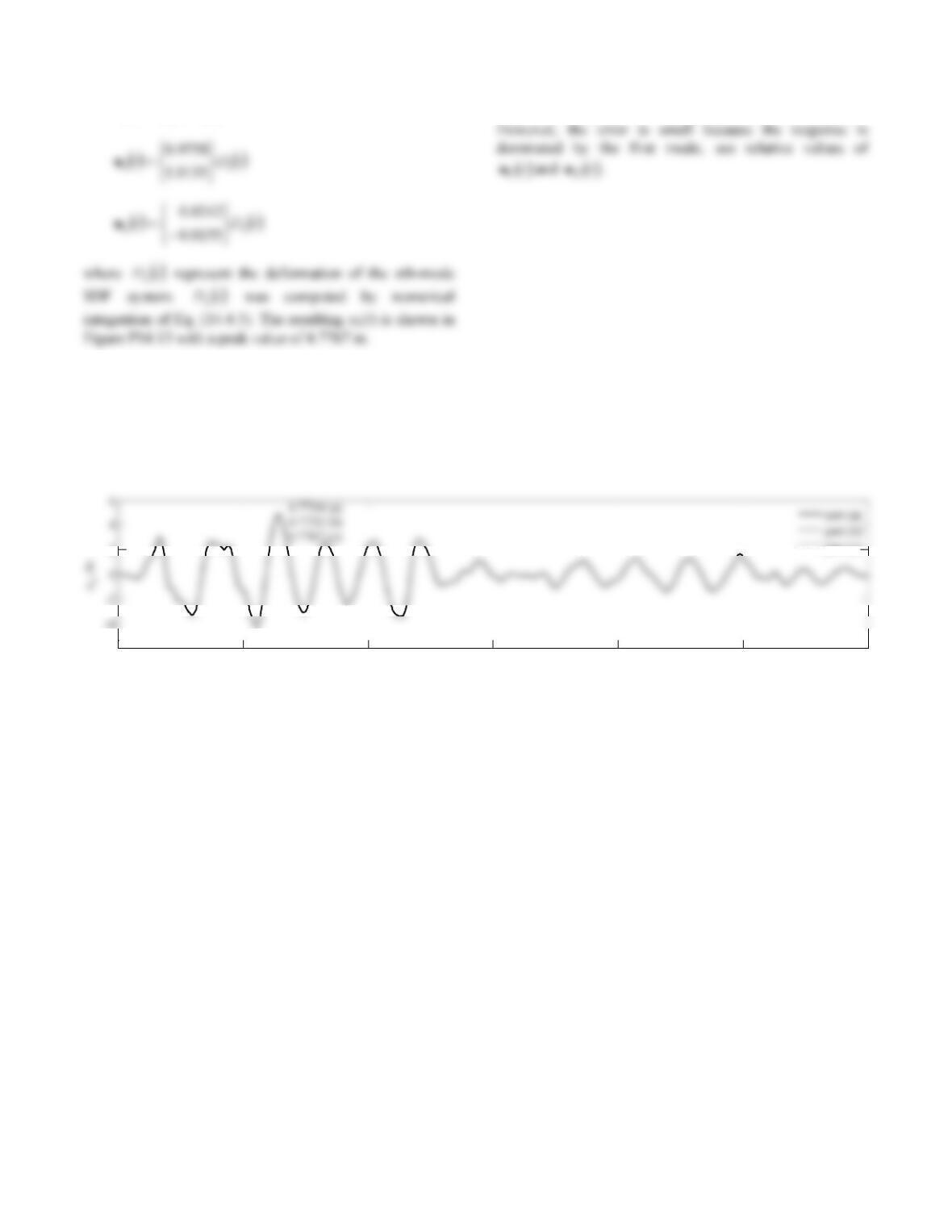
function ode45, gives u1(t) shown in Figure P14.13. The
peak value of the deformation in the isolation system
(displacement of the base slab) = 4.7714 in.
Part b
Modal analysis of the nonclassically damped system
following Examples 14.13 and 14.14, gives the dis-
placement response:
ttt 21 uuu
where
tDn and
tDn
represent the deformation and
relative velocity response, respectively, of the nth-mode
Part c
The damping matrix in modal coordinates is given by
Eq. (10.9.5): T
CΦcΦ, where the natural vibration
modes of the undamped system are
coupling we are neglecting in classical modal analysis to
obtain the diagonal C matrix.
15
ttt 21 uuu
For this example, the off-diagonal terms of C is not
small (compared to diagonal terms) and one would expect
that neglecting it would produce significant error.
0 5 10 15 20 25 30
-6
2
time, sec
part (c)
Figure P14.13