1
CHAPTER 18
Problem 18.1
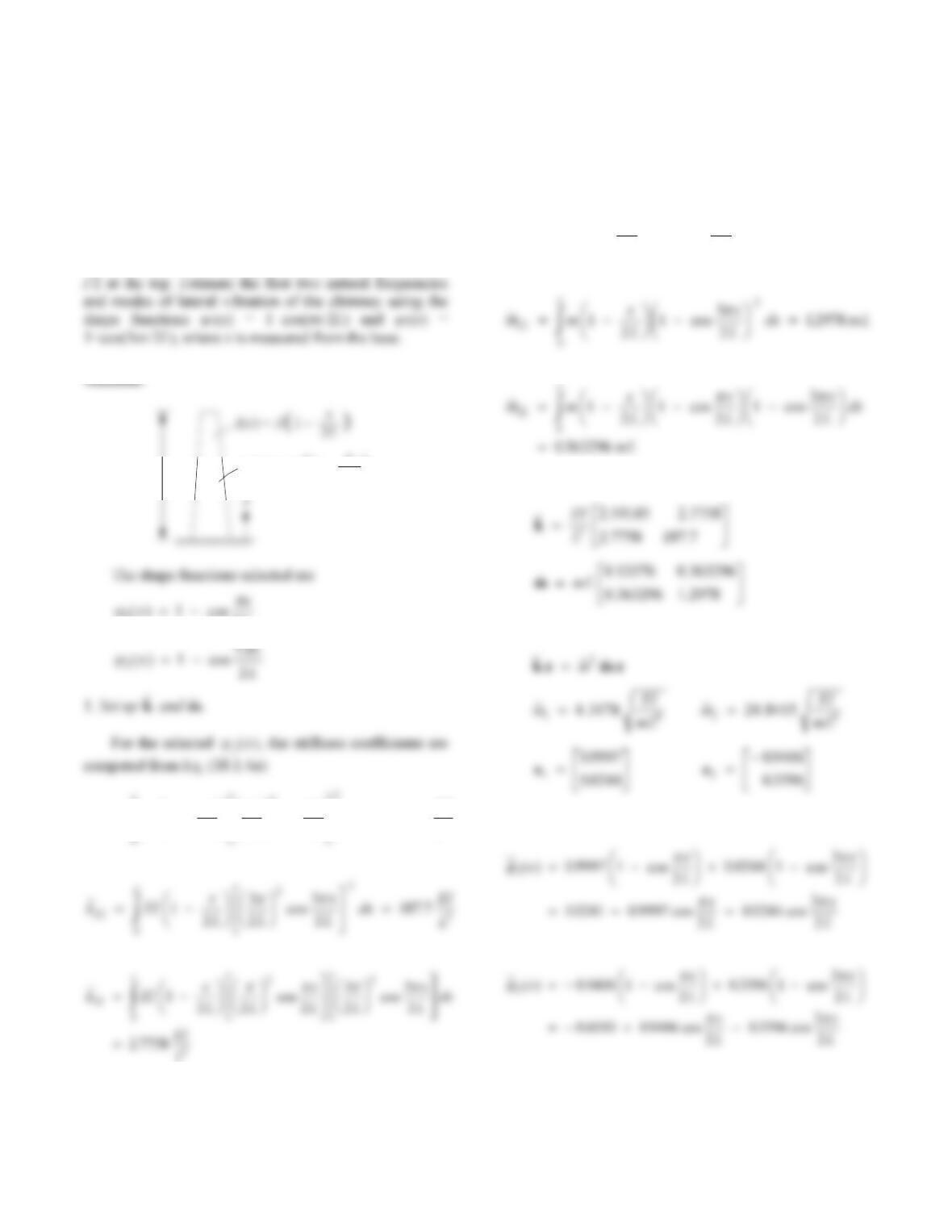
A chimney of height L has been idealized as a cantilever
beam with mass per unit length varying linearly from m at
the base to m/2 at the top, and with second moment of
cross-sectional area varying linearly from I at the base to
L
m(x) = m 1 – x
2L
( )
112
L
~cos .kEIx
LL
x
Ldx EI
L
L
11
22
3
122 2 2 59145
F
H
GI
K
JF
H
GI
K
J
L
N
M
M
O
Q
P
P
z
Similarly the mass coefficients are determined from Eq.
(18.1.4b):
~cos .mm x
L
x
Ldx mL
L
11
0
2
1212013376
F
H
G
I
K
J
F
H
G
I
K
J
z
Thus
2. Solve eigenvalue problem.
3. Determine natural modes from Eq. (18.1.8).
2
Problem 18.2
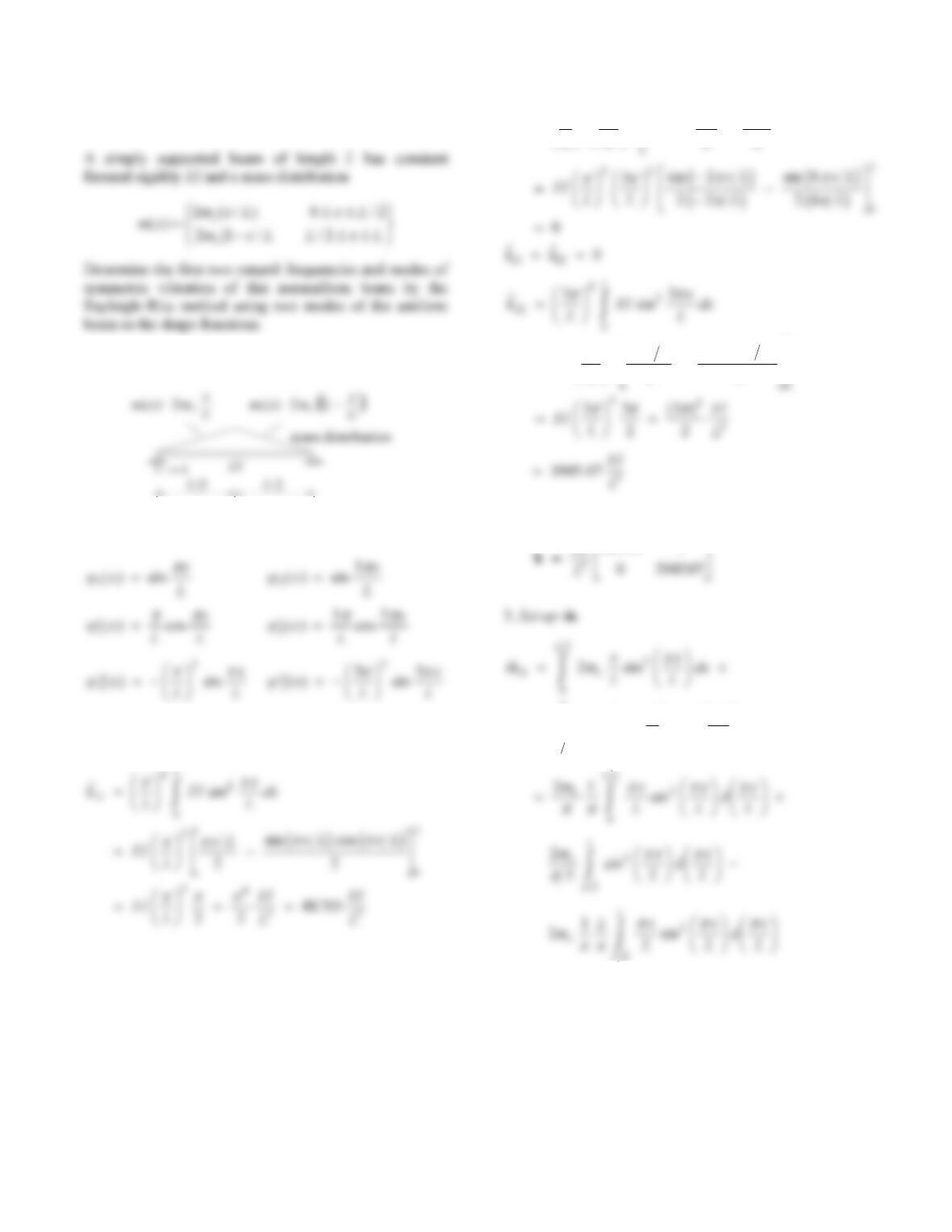
Solution:
1. Select shape functions.
2. Set up
k
.
~sin sin
kLL EI x
L
x
Ldx
L
12
22
33
F
H
G
I
K
J
F
H
G
I
K
J
z
sin
EI L
xL xL
L
3
33
2
6
4
F
H
GI
K
J
L
M
MO
P
P
bg
Thus
48 705 0
L
sin
mx
L
x
Ldx
o
L
L
2
2
21
F
H
GI
K
JF
H
GI
K
J
z
3
L
N
M
M
2
4
2
4
2
2
2
mL xL xL xL
o
L
()()sin( )
L
F
F
F
M
P
L
MO
P
22
4
1
8
1
8
2
24
2
2
mL mL
oo
()
~sin sin
L
mm
x
L
x
L
x
Ldx
o
L
12
2
23
F
H
GI
K
J
F
H
GI
K
J
z
22
22
4
24
22
m
L
xL
Ldx xL
Ldx
o
L
L
L
L
R
S
|
T
|
U
V
|
W
|
zz
sin ( )
()
sin ( )
()
2
33
333
2
2
mLx
L
x
Ldx
L
o
L
L
sin
F
H
GI
K
J
F
H
GI
K
J
z
4
L
N
M
MO
Q
P
P
2
3
32
4
1
8
1
8
2
2
mL
o
()
()
Thus
4. Solve reduced eigenvalue problem.
kz mz
2
5. Determine natural vibration modes from Eq. (18.1.8).
5
Problem 18.3
the consistent-mass matrix, and (b) the lumped-mass
matrix. Compare these results with the exact solutions
Figure P18.3
125
346
The 6 6 stiffness and mass matrices with reference
14
9 9086.EI
mL
24
43 818.EI
mL
0.2196 0 0.0386 0
3. Solution using lumped mass matrix.
05
.
Eliminate the three rotational DOFs by static
condensation to obtain
10 2196 0 6588 0 0 6588
LL L.. .
6
Problem 18.4
assemblage of two finite elements (Fig. P18.4), using
(a) the consistent-mass matrix, and (b) the lumped-mass
1. Stiffness and mass matrices.
1
The 6 6 stiffness and mass matrices are given in
Example 18.2. Impose boundary conditions uu
12
2. Solve eigenvalue problem.
()km
20
3. Solution using lumped mass matrix.
Eliminate the DOF 2 by static condensation to obtain
Natural mode after calculating rotations using static
condensation equations:
4. Compare with exact frequencies.
The finite element method using consistent mass provides
an excellent result for the fundamental frequency, but the
7
Problem 18.5
elements (Fig. P18.5), using (a) the consistent-mass
matrix, and (b) the lumped-mass matrix. Compare these
results with the exact solutions obtained by solving
Solution:
1. Stiffness and mass matrices.
Figure P18.5a
The 6 6 stiffness and mass matrices are given in
022
22
LL
N
M
Q
PL
2. Solve eigenvalue problem.
2
()0
km
3. Solution using lumped mass matrix.
L
O
05
.
Eliminate the two rotational DOFs by static
condensation to obtain
Natural frequency:
Natural mode after calculating rotation using static
condensation equations:
4. Compare with exact frequencies.
For a beam clamped at one end and simply supported
The finite element method using consistent mass provides
an excellent result for the fundamental frequency, but the
8
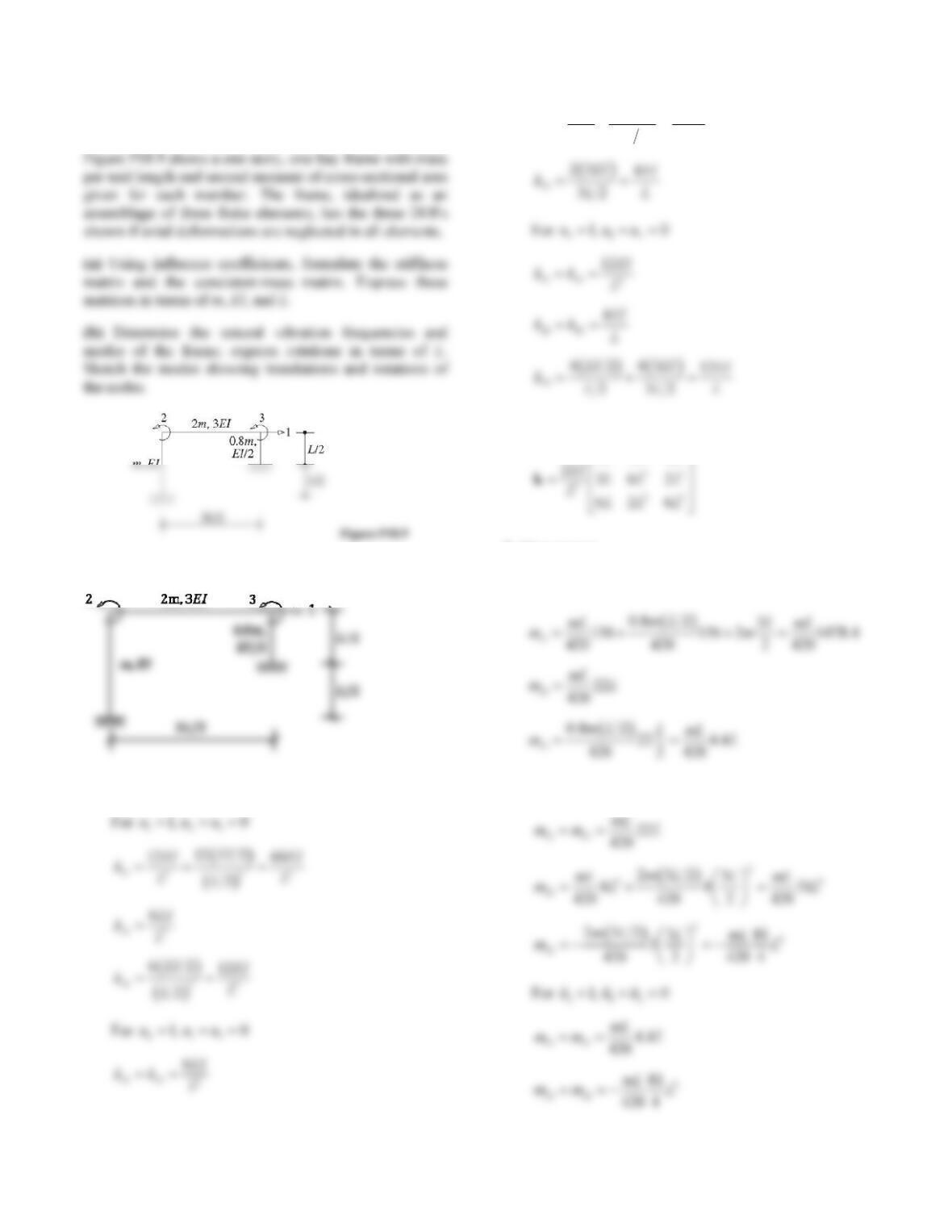
Problem 18.6
Sketch the modes showing translations and rotations of
the nodes.
Solution:
1. Stiffness matrix.
4EI +2h
4E(
I
/2)
h
4EI +2h
4E(
I
/2)
2h
2E(I/2)
N
Q
2. Mass matrix.
4mh /420 +
3
3
4mh /420 +
3
Thus
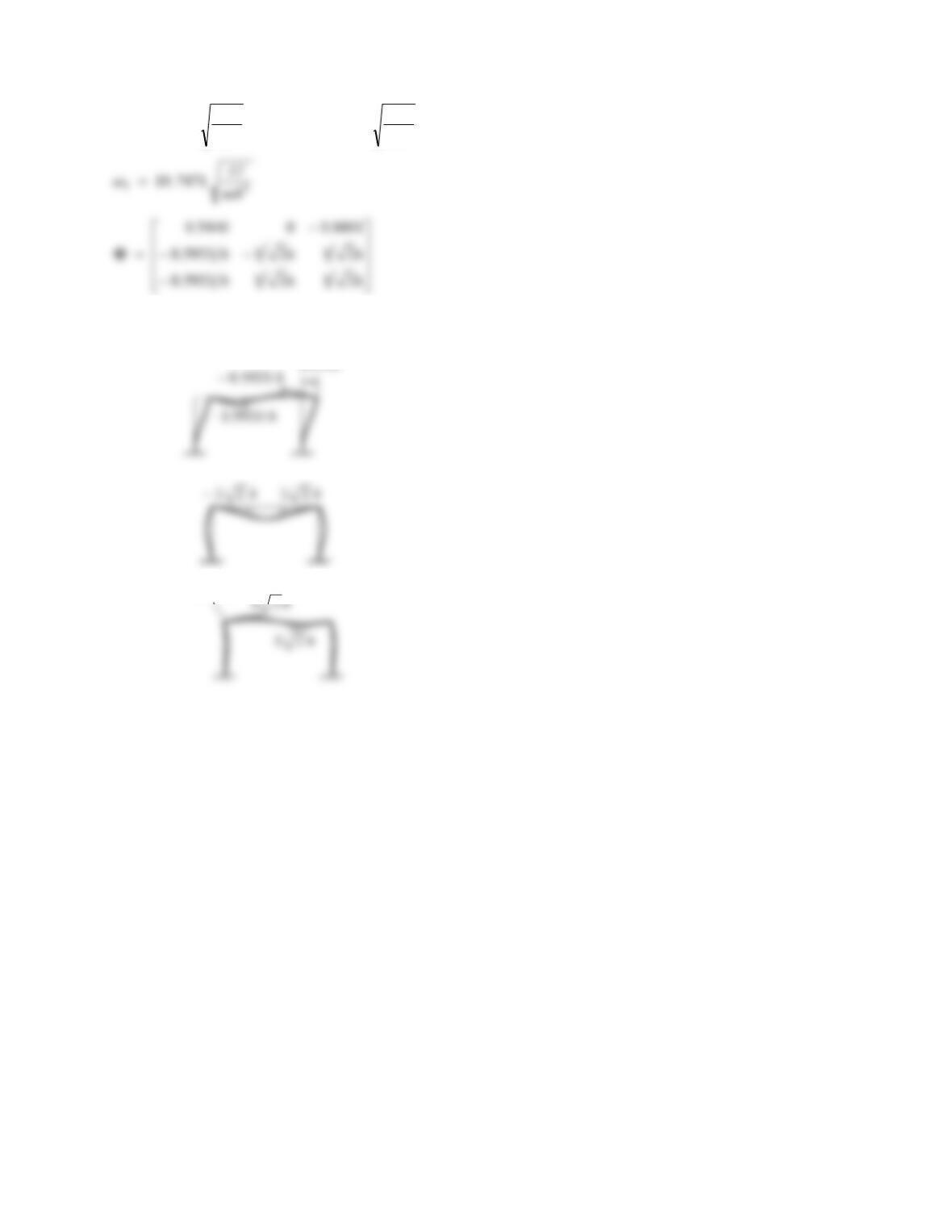
9
14
1 5354.EI
mh
24
4 0365.EI
mh
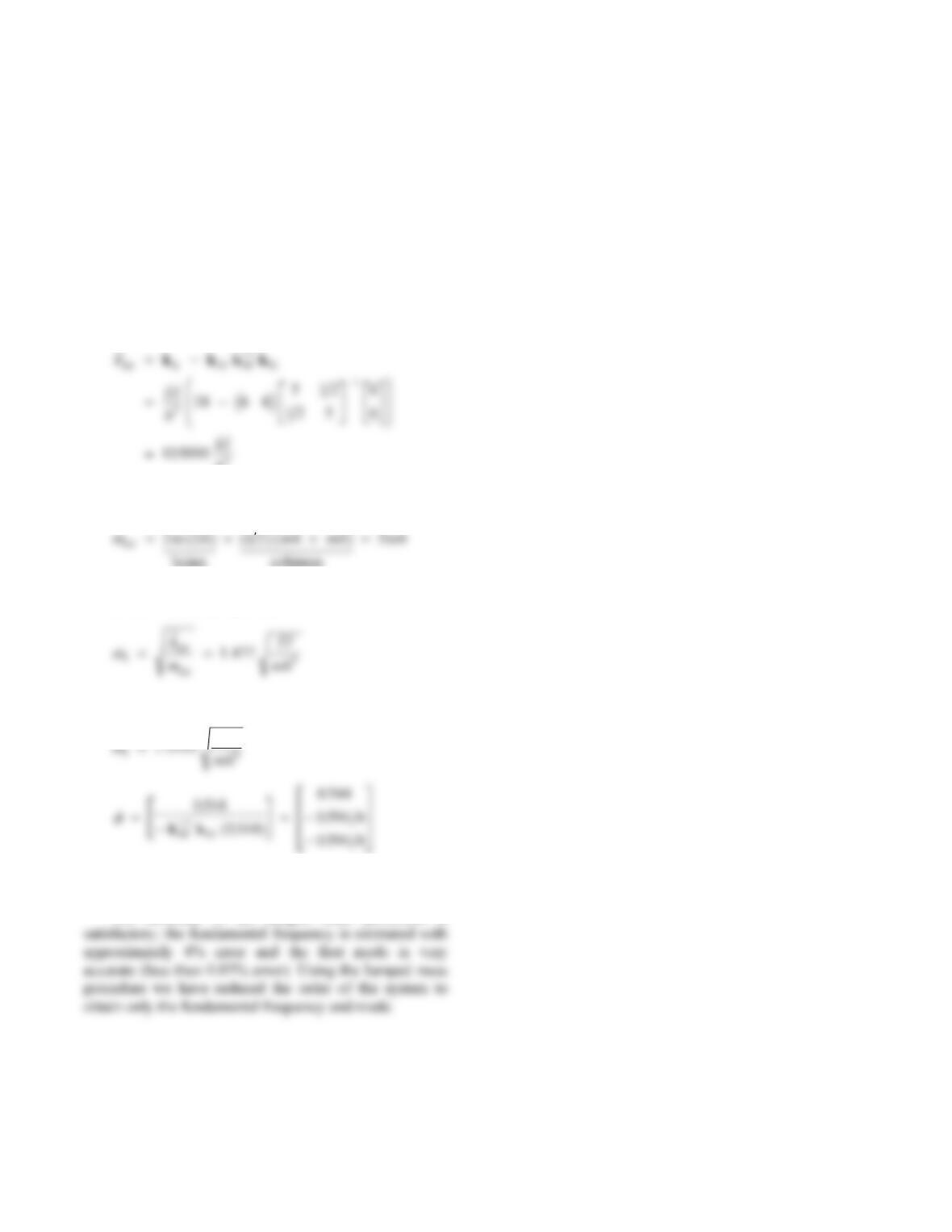
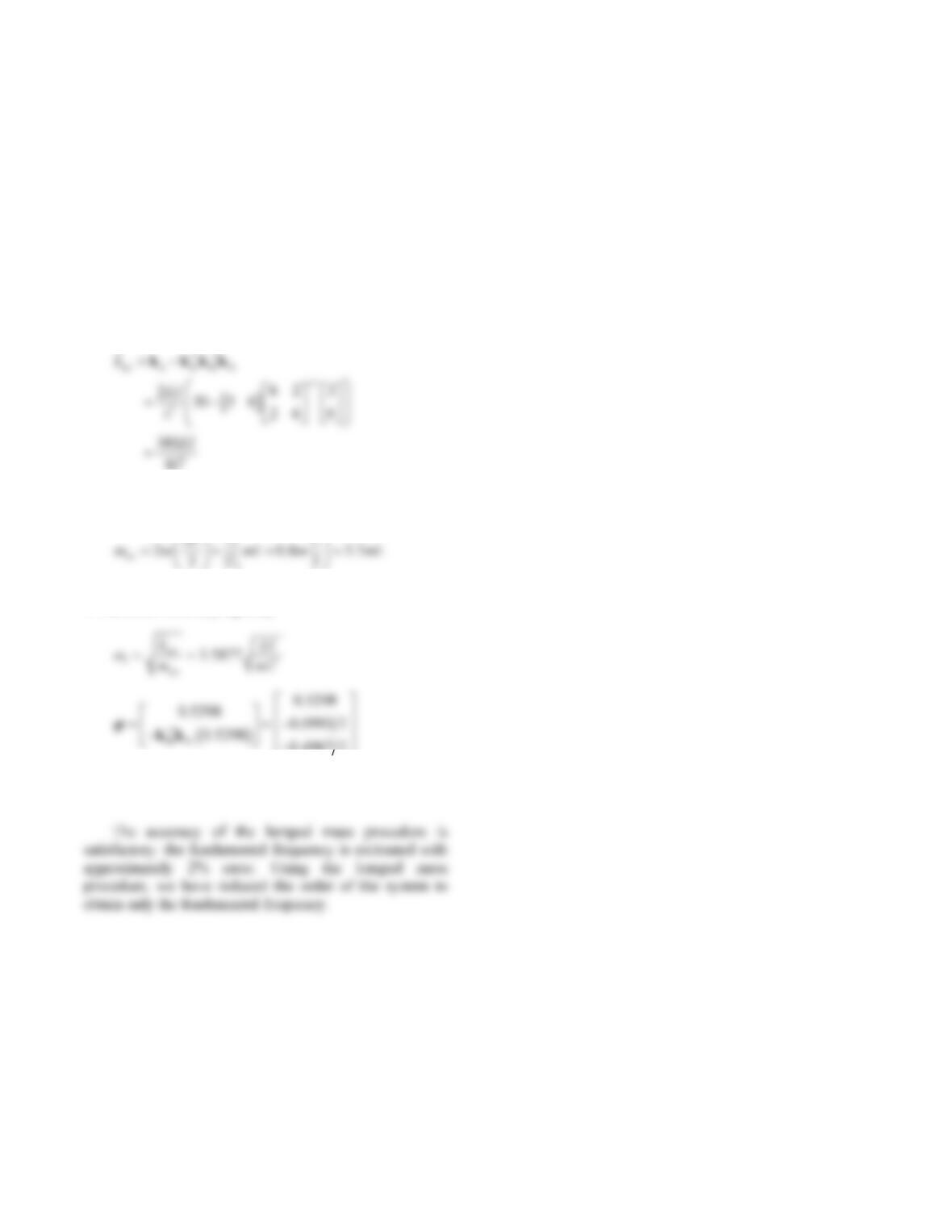
4. Plot modes.
0.5440
–
0.001 1/ 2 h
10
Problem 18.7
Repeat Problem 18.6 using the lumped-mass approxi-
mation. Comment on the effects of mass lumping on the
vibration properties.
Solution:
1. Determine lateral stiffness.
Statically condense joint rotations in the stiffness
matrix of Problem 18.6:
h
2. Calculate lumped mass.
3. Calculate natural frequency.
The exact value is
4. Comment on accuracy.
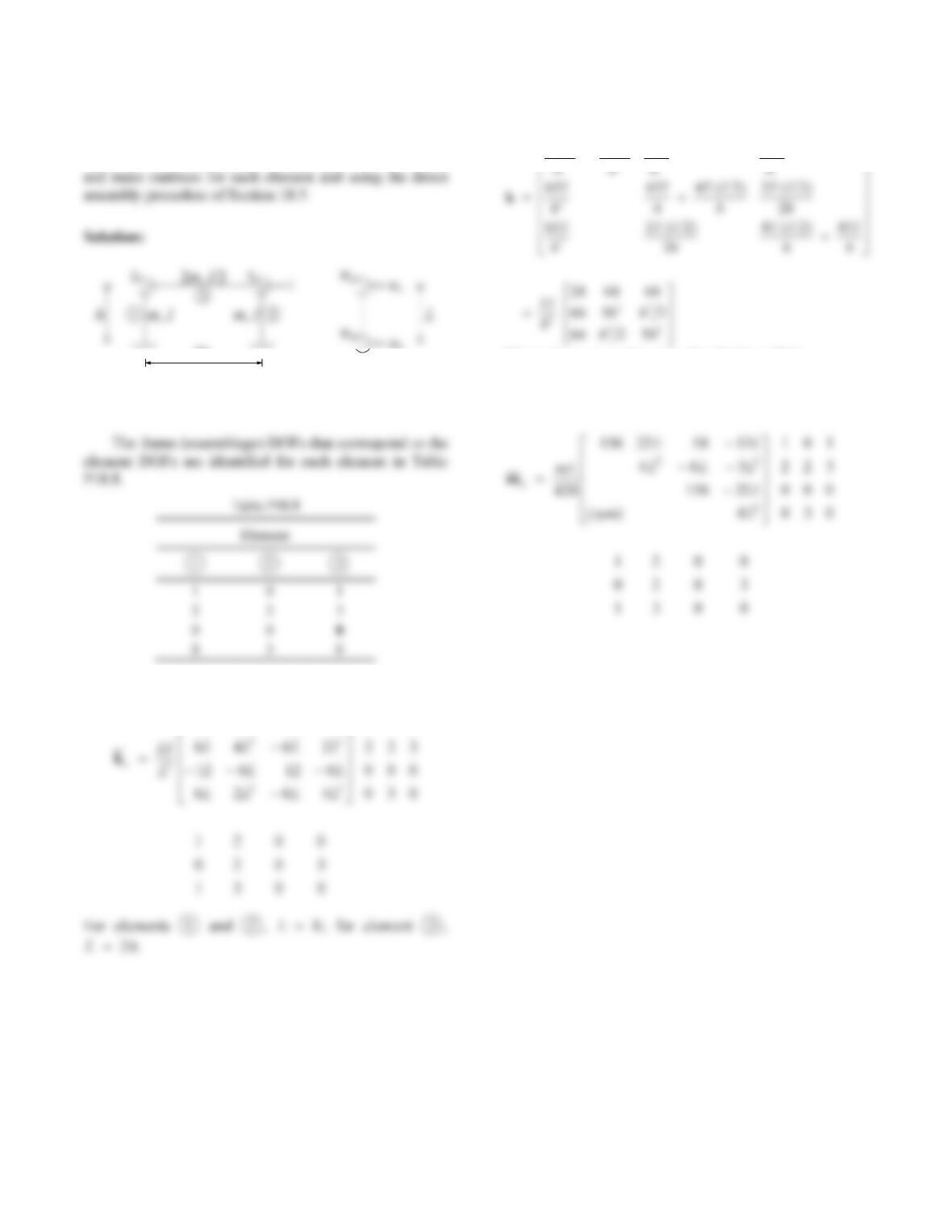
The accuracy of the lumped mass procedure is
11
Problem 18.8
Repeat part (a) of Problem 18.6 starting with the stiffness
2h
3
1. Identify DOFs.
2. Element stiffness matrix.
12 6 12 6 1 0 1
LL
3. Assemble element stiffness matrices.
332 2
12 12 6 6
EI EI EI EI
This is the same as determined in Problem 18.6.
4. Element mass matrix.
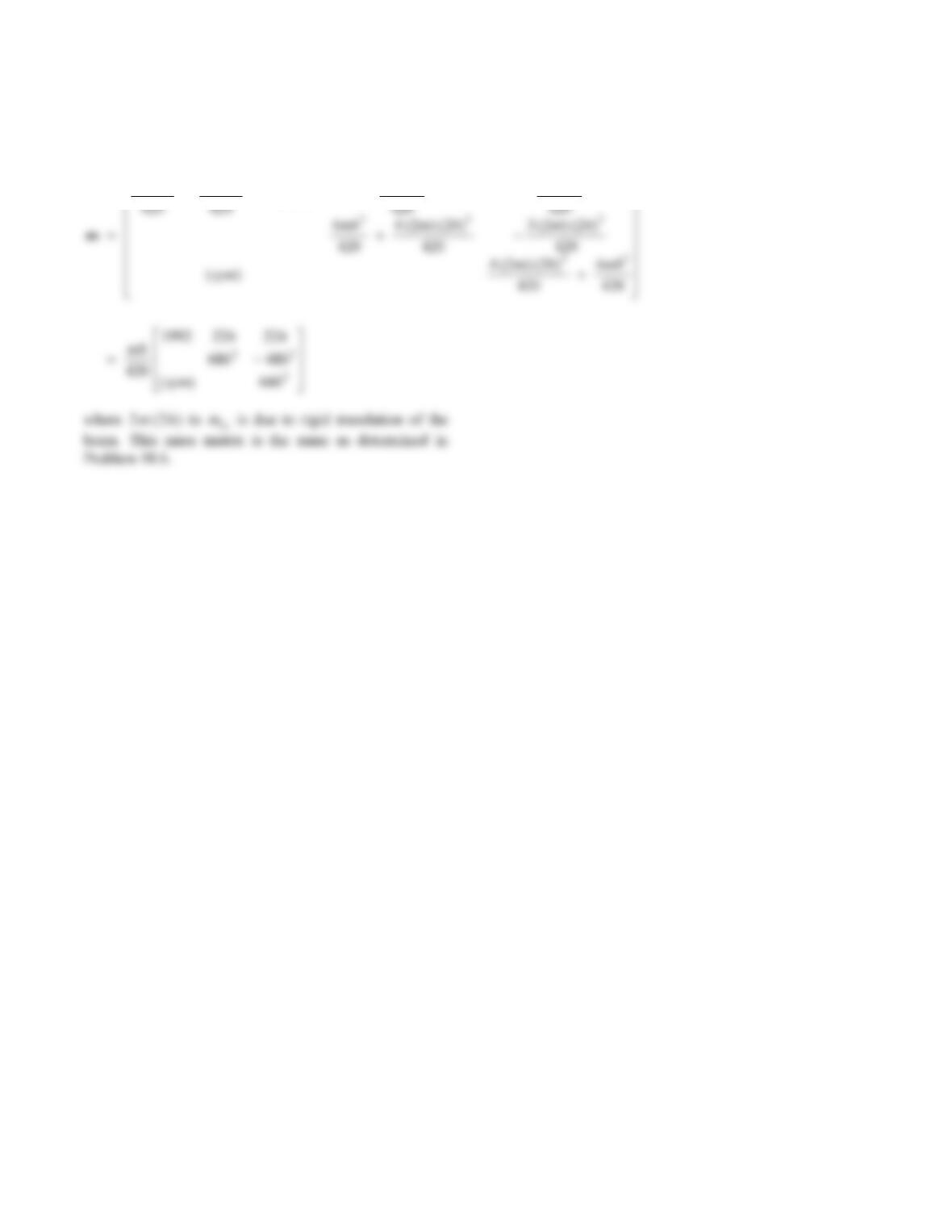
12
5. Assemble element mass matrices.
L
M
O
P
156
156
22
22
mh mh mh mh mh
()
13
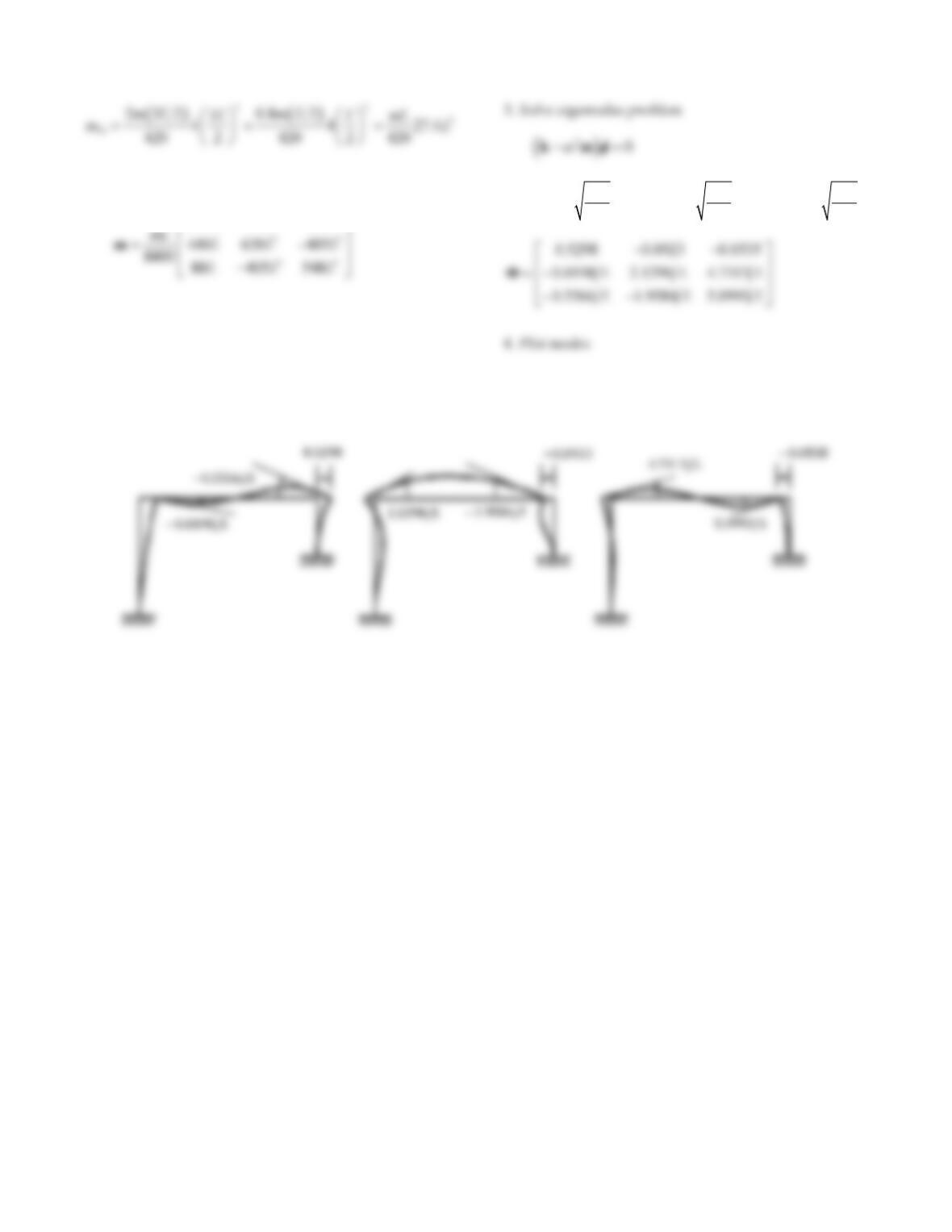
Problem 18.9
Solution:
1. Stiffness matrix.
22
43
412
32
EI
EI EI
kLL L
Thus,
30 3 6
LL
2. Mass matrix.
For 123
1, 0uuu
For 213
1, 0uuu
14
Thus,
29568 440 88
LL
123
44 4
3.6674 8.3397 27.6452
EI EI EI
mL mL mL
15
Problem 18.10
Repeat Problem 18.9 using the lumped-mass approxi-
mation. Comment on the effects of mass lumping on the
vibration properties.
Solution:
1. Determine lateral stiffness.
Statically condense joint rotations in the stiffness
matrix of Problem 18.9:
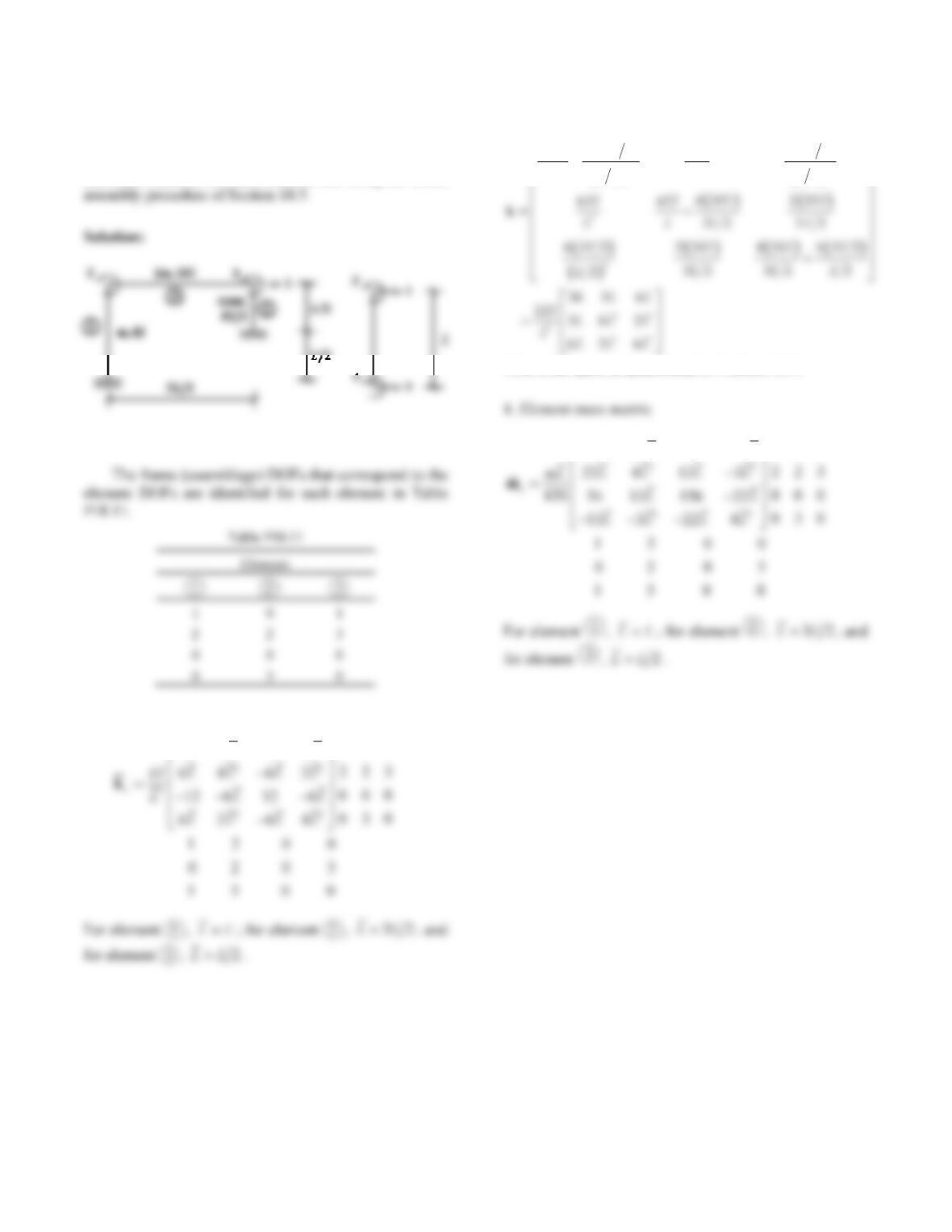
2. Calculate lumped mass.
3. Calculate natural frequency.
L
4. Comment on accuracy.
16
Problem 18.11
Repeat part (a) of Problem 18.9 starting with the stiffness
and mass matrices for each element and using the direct
1. Identify DOFs.
2. Element stiffness matrix.
101
12 6 12 6
LL
3. Assemble element stiffness matrices.
33 2 2
12 2 6 2
12 6
22
EI EI
EI EI
LL
LL
This is the same as determined in Problem 18.9.
101
156 22 54 13
LL
17
Problem 18.12
Determine the consistent geometric stiffness matrix for
the frame in Fig. P18.12 subjected to the gravity load PGr
element method. How would it change if linear
interpolation functions were used?
Figure P18.12
22
34 3 223
LL LL
N
For element (1), ,2
gr
LLN P ; for element (2),
2. Assemble element geometric stiffness matrices.
3. Element geometric stiffness matrix using linear
interpolation functions.
10 10101
10 1 0000
Ge
L
k
For element (1), ,2
gr
LLN P ; for element (2),
4. Assemble element geometric stiffness matrices using
2000
L