21
Problem 4.14
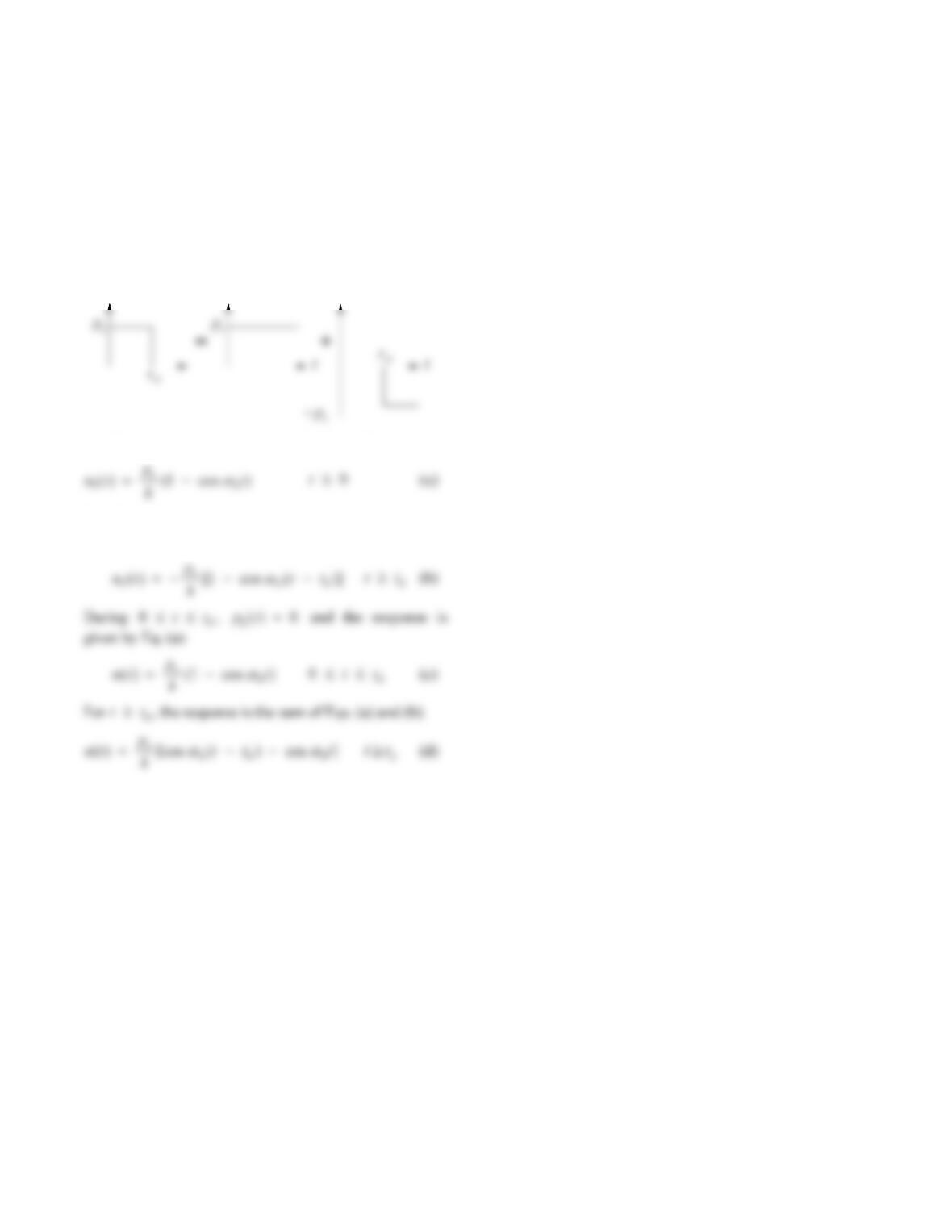
Determine the response of an undamped system to a
rectangular pulse force of amplitude po and duration td by
considering the pulse as the superposition of two step
excitations (Fig. 4.6.2).
Solution:
p
t( )
t( )
p
1t( )
p
2
The response to p
t
1() is given by Eq. (4.7.2):
t
To obtain the response to p
t
2(), this equation can be
modified as follows: replace po by po and t by
t
t
d
:
t
t
t
t
t
t
t
t
t
22
Problem 4.15
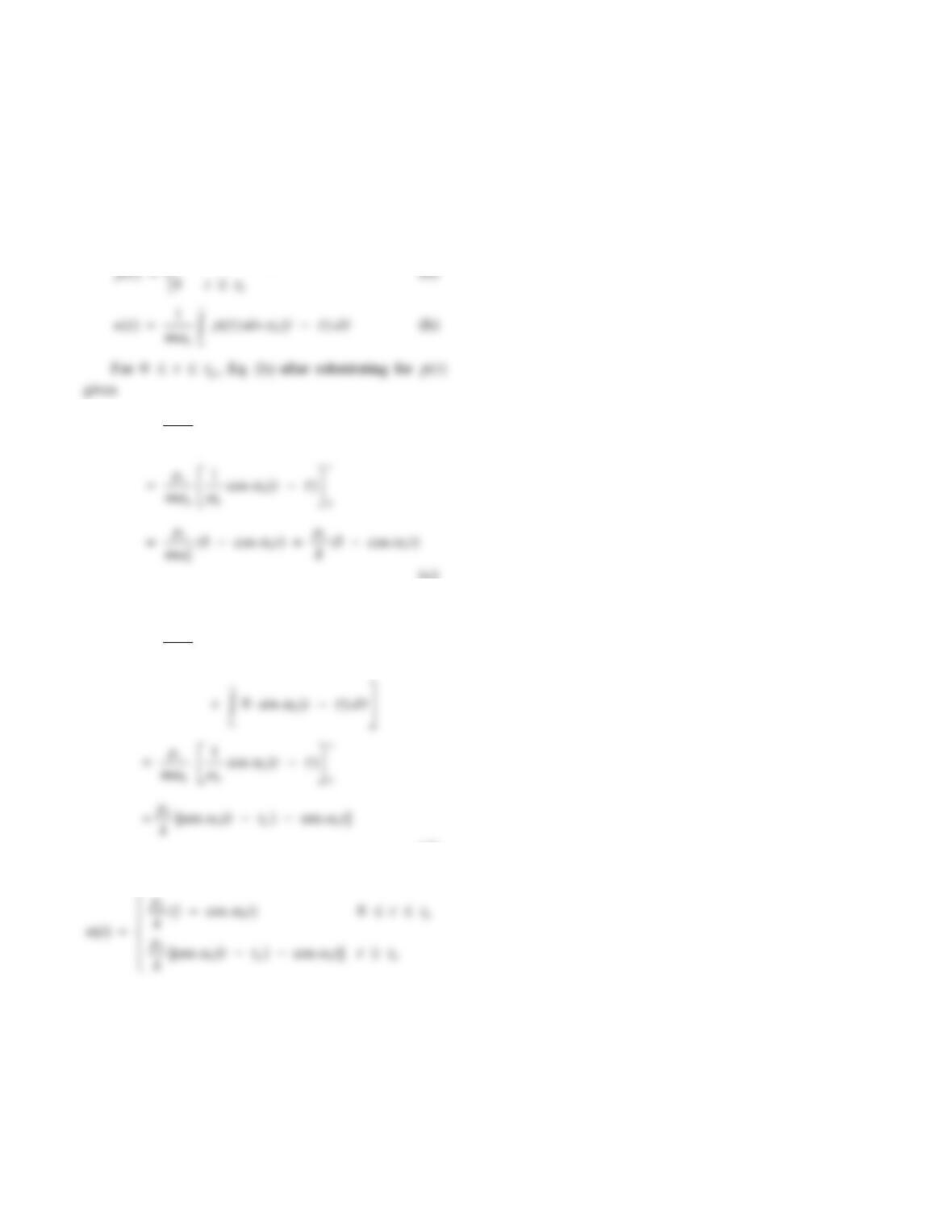
Using Duhamel’s integral, determine the response of an
undamped system to a rectangular pulse force of
amplitude po and duration td.
Solution:
0
od
p
tt
0
1
() sin ( )
t
on
n
ut p t d
m
(c)
For
t
t
d
, Eq. (b) after substituting for p
t
() gives
0
1
() sin ( )
d
t
on
n
ut p t d
m
(d)
The complete response is:
t
t
t
23
Problem 4.16
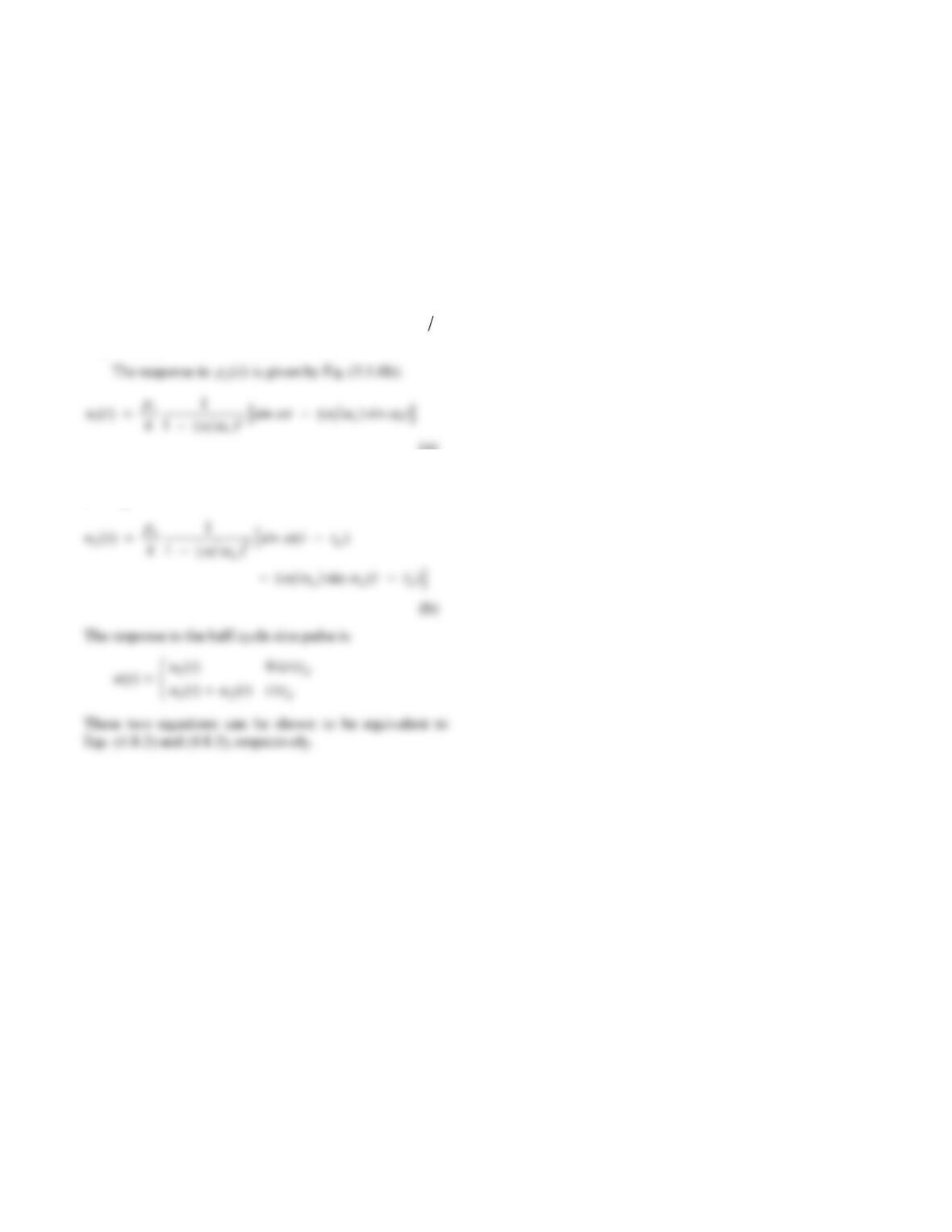
Determine the response of an undamped system to a half-
cycle sine pulse force of amplitude po and duration td by
considering the pulse as the superposition of two
sinusoidal excitations (Fig. 4.6.2); td /Tn ≠ 1/2.
Solution:
The half-cycle sine pulse p
t
() is the sum of two
sinusoidal excitations: 1() sin
o
p
tp t
starting at
t
0
and 2() sin
o
p
tp t
starting at
t
t
d
, where
t
t
dd
(Fig. 4.6.2b).
(a)
To obtain the response to p
t
2(), in Eq. (a) replace t by
tt
d
t
24
Problem 4.17
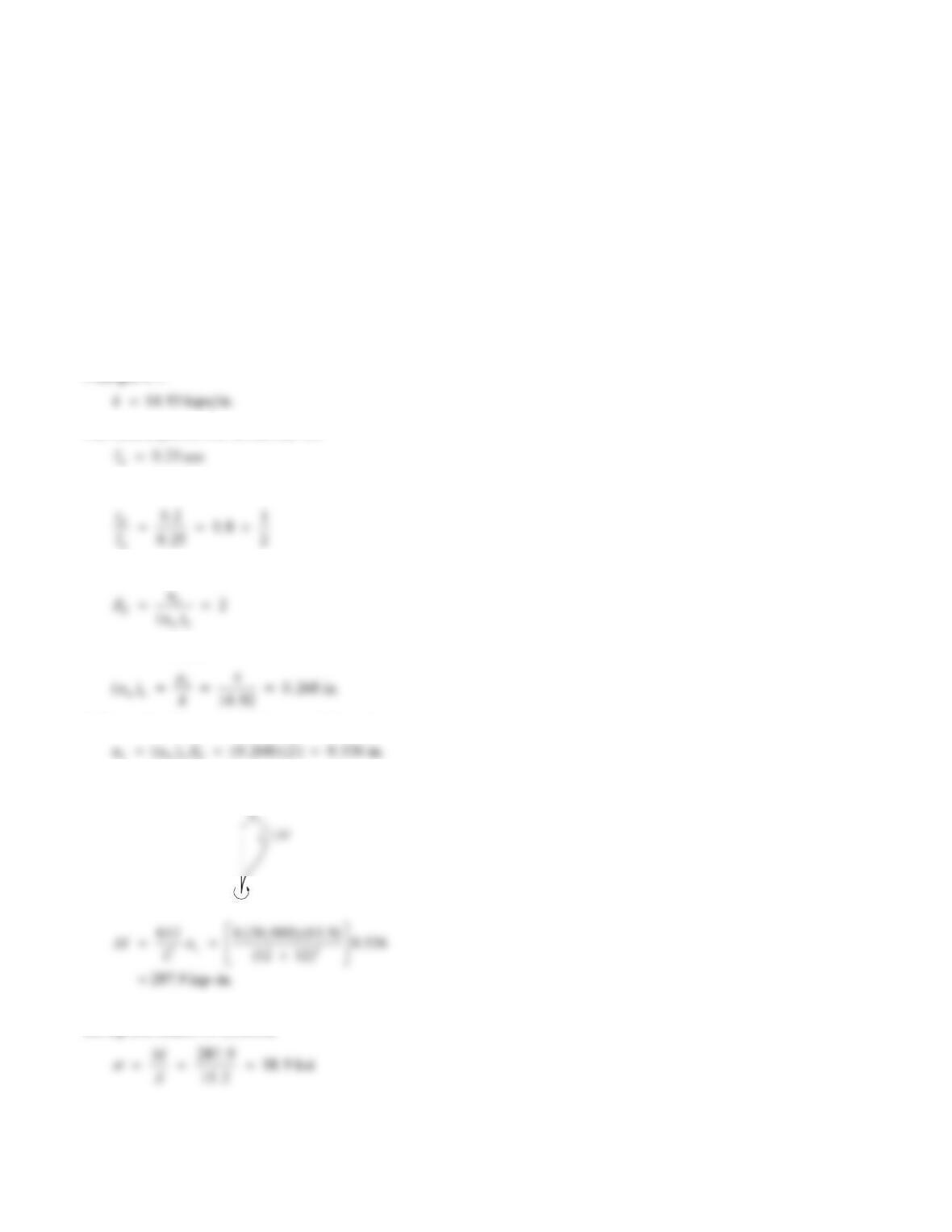
The one-story building of Example 4.1 is modified so that
the columns are clamped at the base instead of hinged.
For the same excitation determine the maximum
displacement at the top of the frame and maximum
bending stress in the columns. Comment on the effect of
base fixity.
Solution:
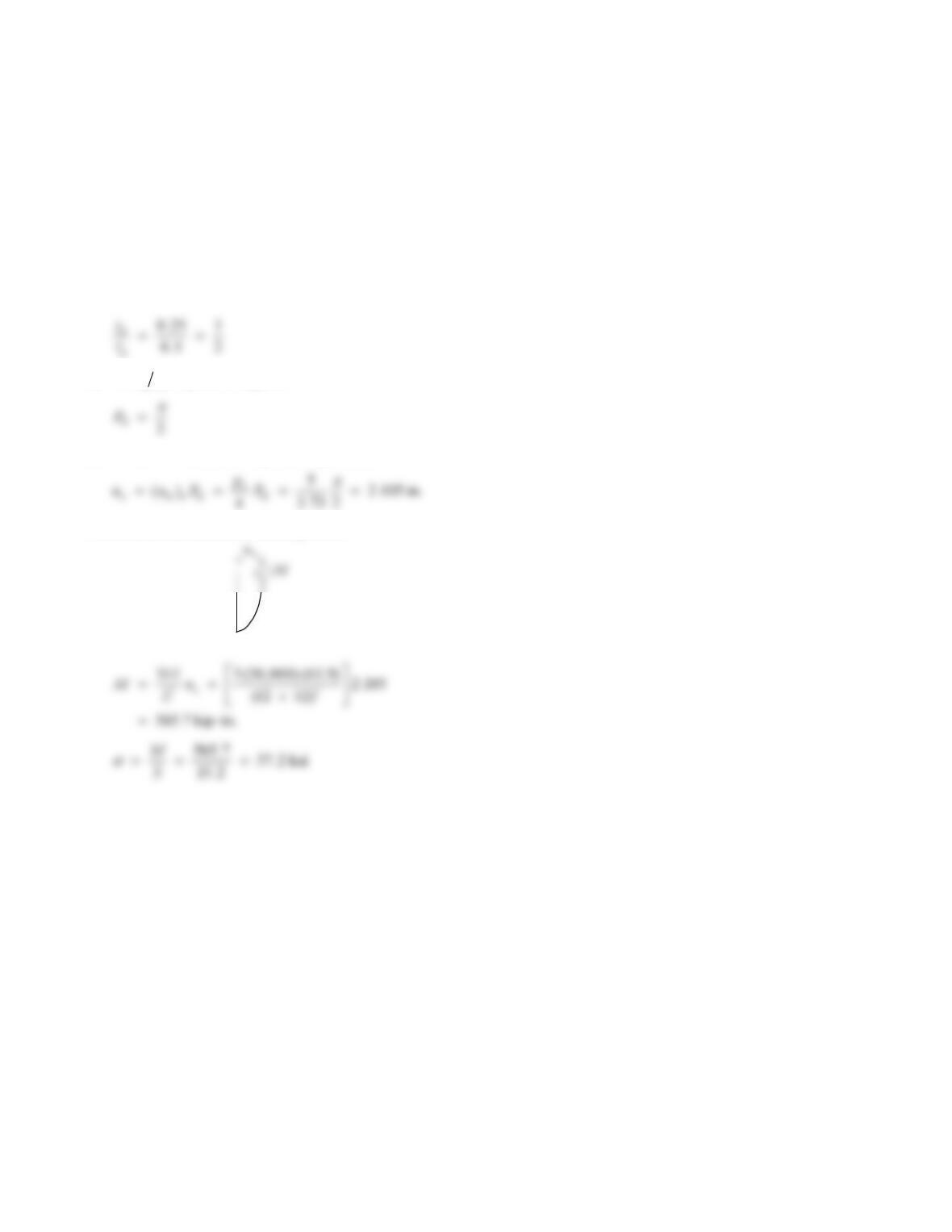
1. Determine the natural vibration period.
With the base of the columns clamped, the lateral
stiffness will be four times of the value computed in
Example 4.1:
The natural period will be halved, i.e.,
2. Determine Rd.
Equation (4.7.12) gives
3. Determine ()ust o .
4. Determine the maximum dynamic deformation.
o
5. Determine the maximum bending stress.
M
The bending stress is largest at the outside of the flange at
the top and bottom of columns:
6. Effect of base fixity.
For this excitation, the deformation as well as
bending stress is reduced by clamping the columns at
their base.
25
Problem 4.18
Determine the maximum response of the frame of
Example 4.1 to a half-cycle sine pulse force of amplitude
po = 5 kips and duration td = 0.25 sec. The response
quantities of interest are: displacement at the top of the
frame and maximum bending stress in columns.
Solution:
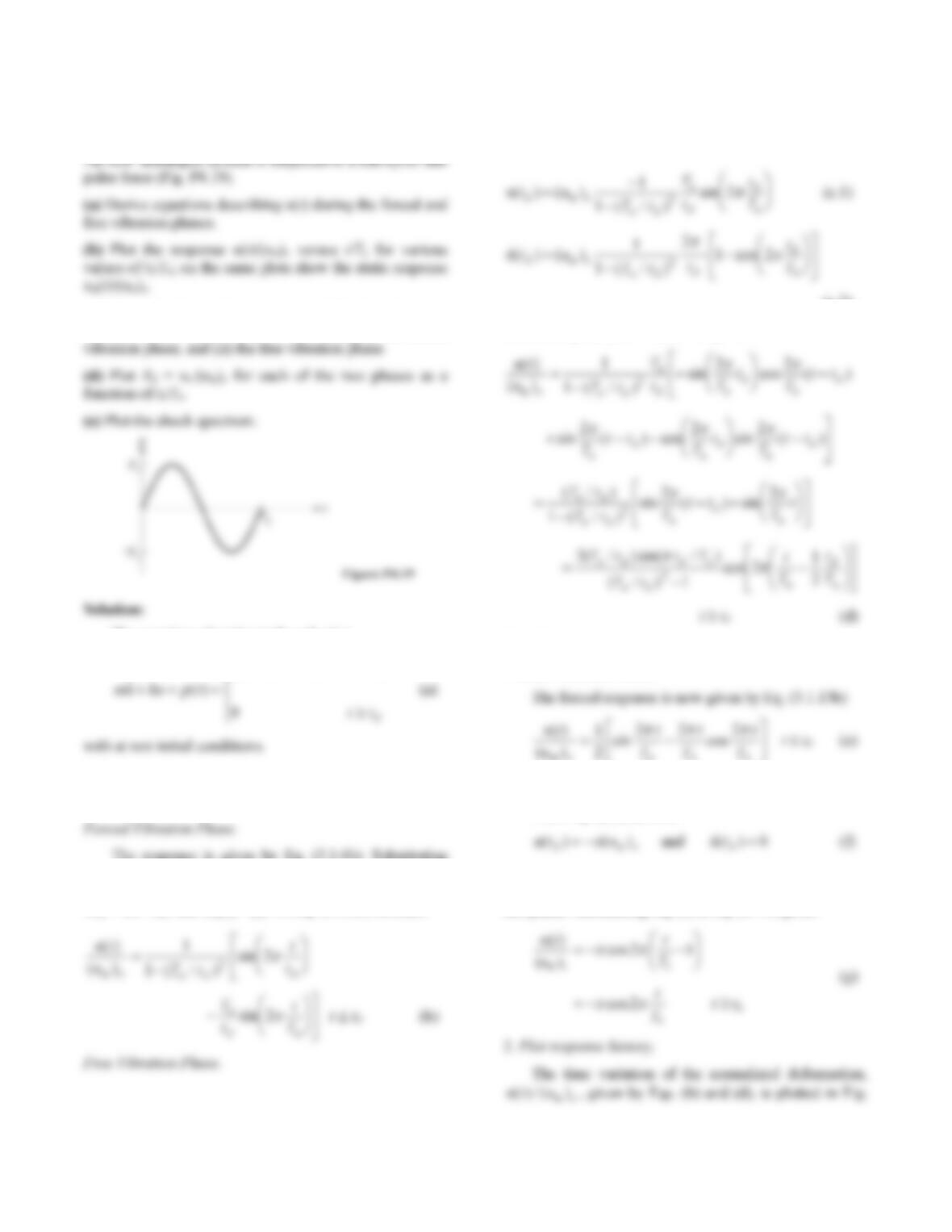
1. Determine Rd.
For this
t
t
dn, Eq. (4.8.12) gives
2. Determine the maximum dynamic deformation.
3. Determine the maximum bending stress.
M
26
Problem 4.19
(c) Determine the peak response uo, defined as the max-
imum of the absolute value of u(t), during (i) the forced
The equation of motion to be solved is
ptttt
odd
sin( / )
2
1. Determine response u(t).
Case 1: td / Tn 1
The response is given by Eq. (3.1.6b). Substituting
2/td,
T2/ , and () /upk
, Eq. (3.1.6b) becomes
The motion is described by Eq. (4.7.3) with ut
d
()
and ()ut
d, determined from Eq. (b):
(c.2)
Substituting Eq. (c) in Eq. (4.7.3) gives
Case 2: td /Tn = 1
Forced Vibration Phase.
st
Free Vibration Phase.
From Eq. (e) determine
The second equation implies that the displacement in the
forced vibration phase reaches its maximum at the end of
this phase. Substituting Eq. (f) in Eq. (4.7.3) gives
27
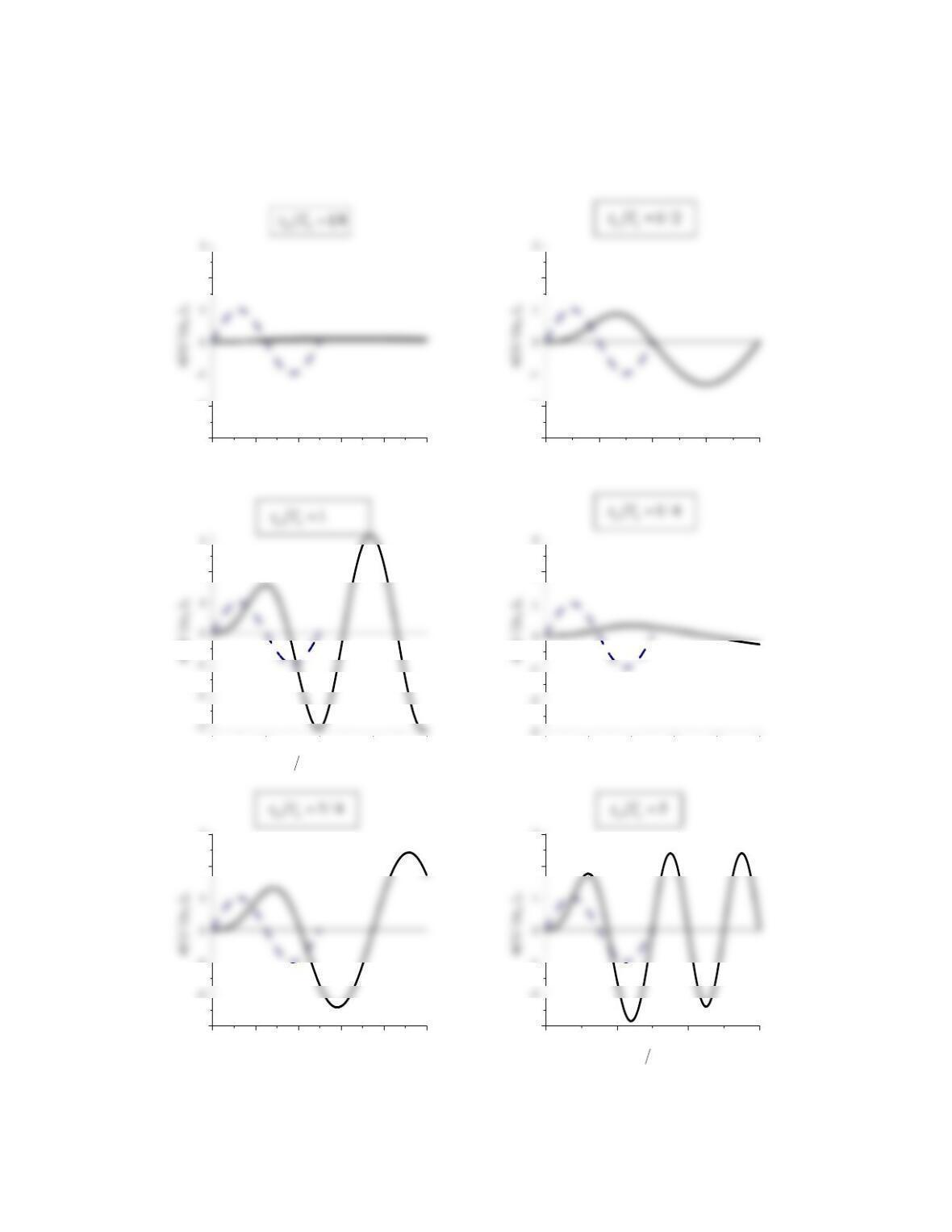
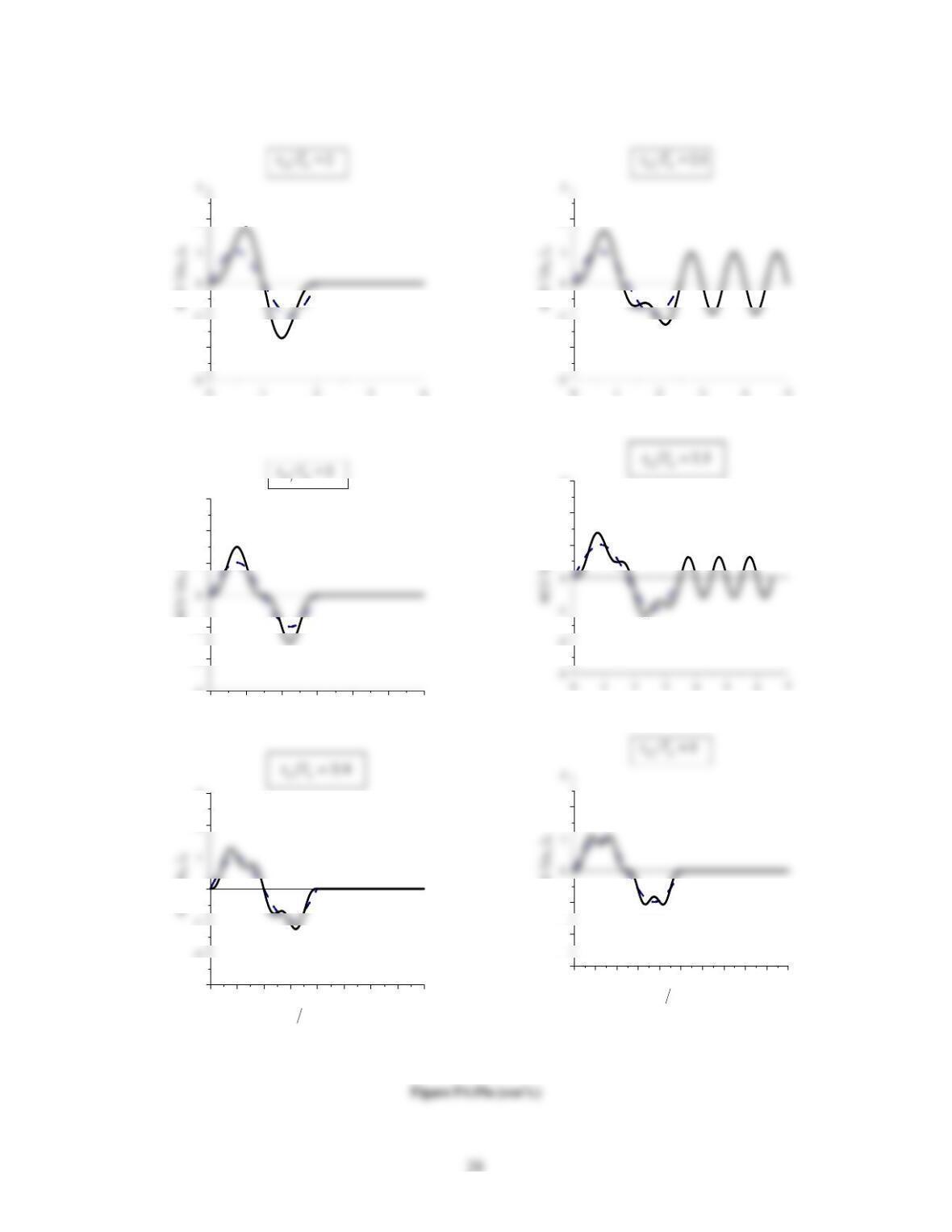
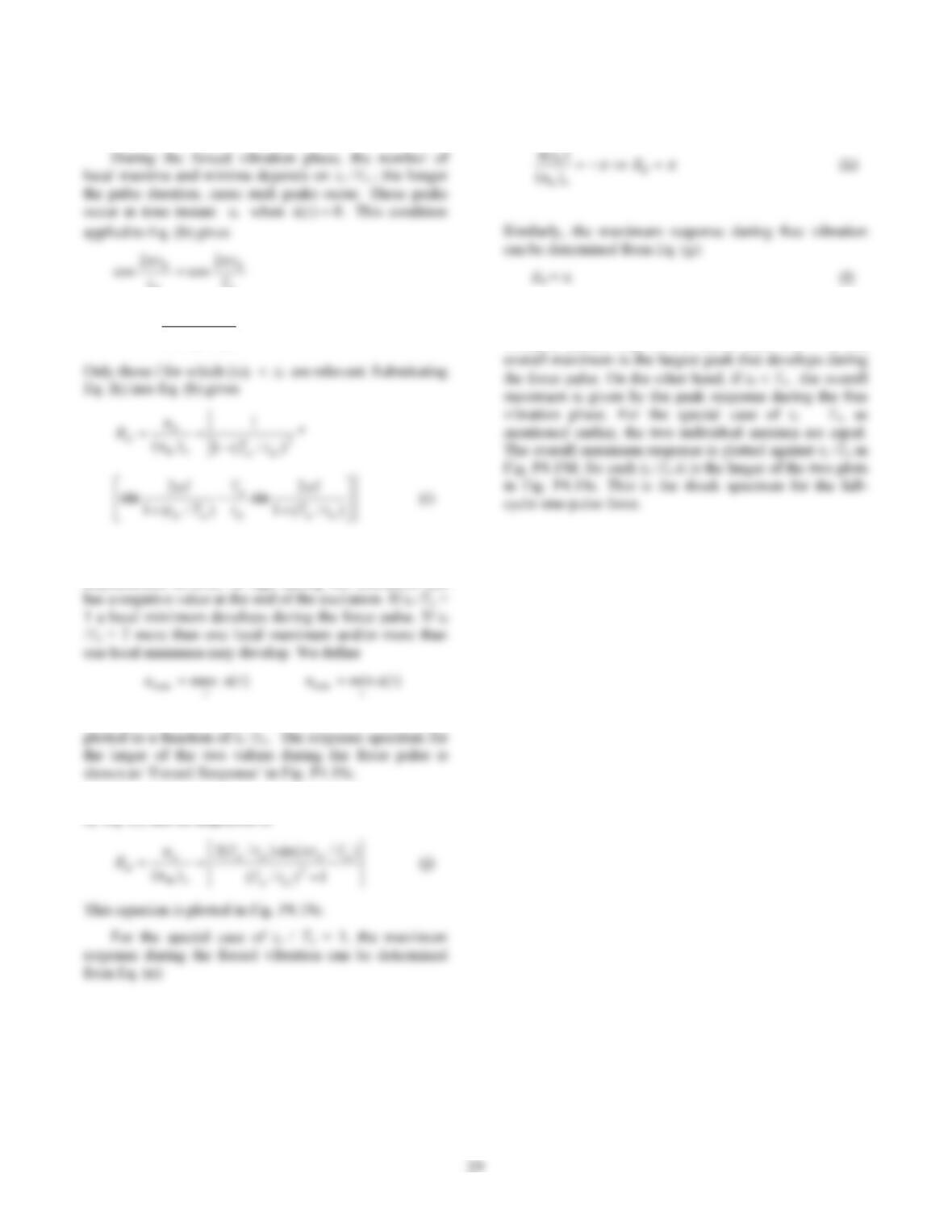
P4.19a for several values of td /Tn . For the special case
of td /Tn = 1, Eqs. (e) and (g) describe the response of the
system and these are also plotted in Fig. P4.19a. The
static solution is included in these figures.
0 0.05 0.1 0.15 0.2 0.25
-3
-2
2
0 0.25 0.5 0.75 1
-3
-2
2
00.511.52
2
3
()/()
tT
n
00.10.20.30.40.5
2
()/()
0 0.3 0.6 0.9 1.2 1.5
-3
-1
2
3
0123
-3
-1
2
3
tTn
Figure P4.19a
-2
2
()/()
0123456
-3
-2
-1
1
2
3
utu
dn
012345678
-3
0
2
3
()/()
tTn
-2
2
()/()
1
2
3
sto
012345678910
-3
-2
-1
2
utu
()/()
tTn
3. Determine maximum response.
nd T
t
() (/)
tl
tT
t
l
dn
d01
l = 1, 2, 3…. (h)
At least one local maximum occurs during the force
pulse, irrespective of the td /Tn value. If td T
n > 1/2 the
displacement reverses in sign during the excitation and
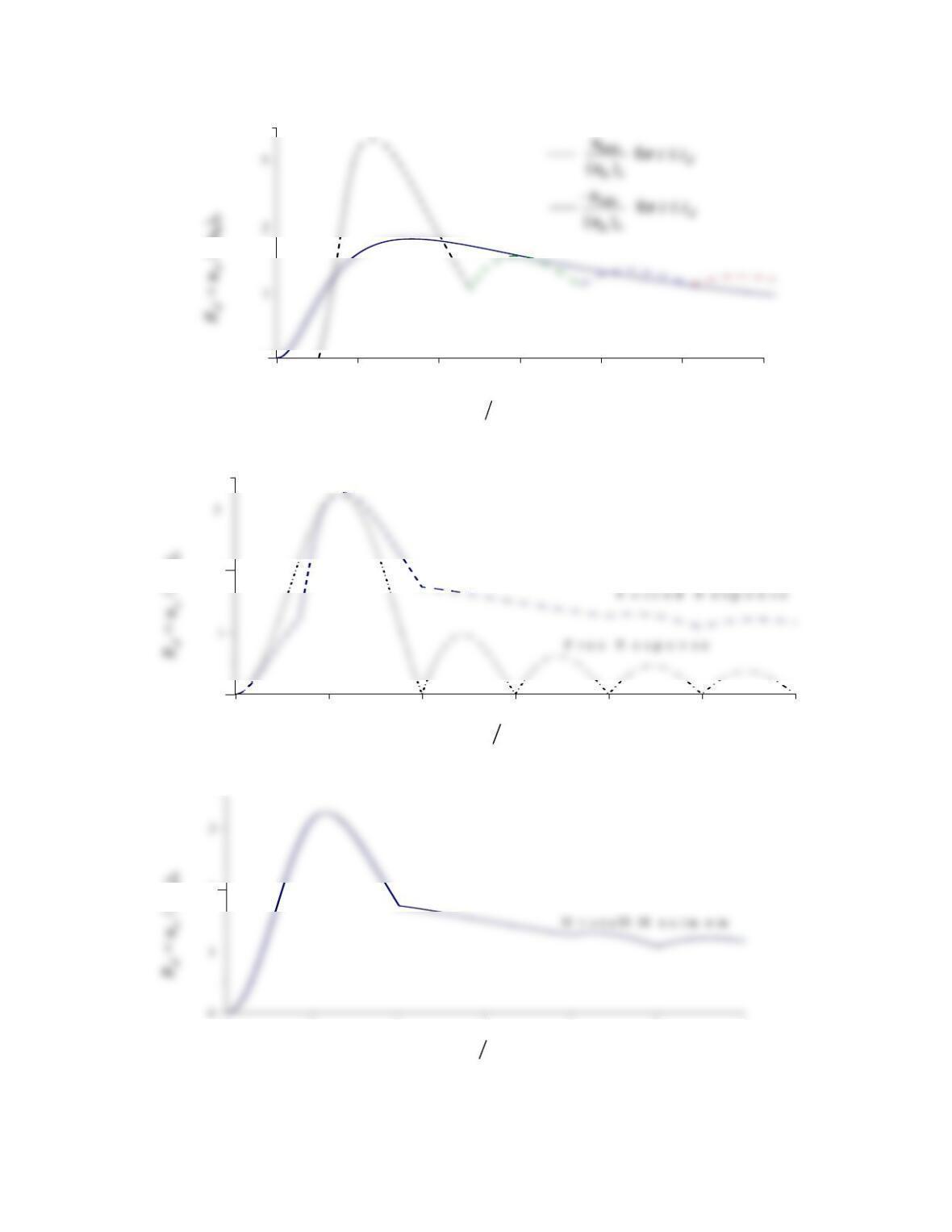
Figure P4.19b shows umax/(ust)o and umin/(ust)o
During the free vibration phase, the response is given
by Eq. (d) and its amplitude is
()ut t T
n
00 and
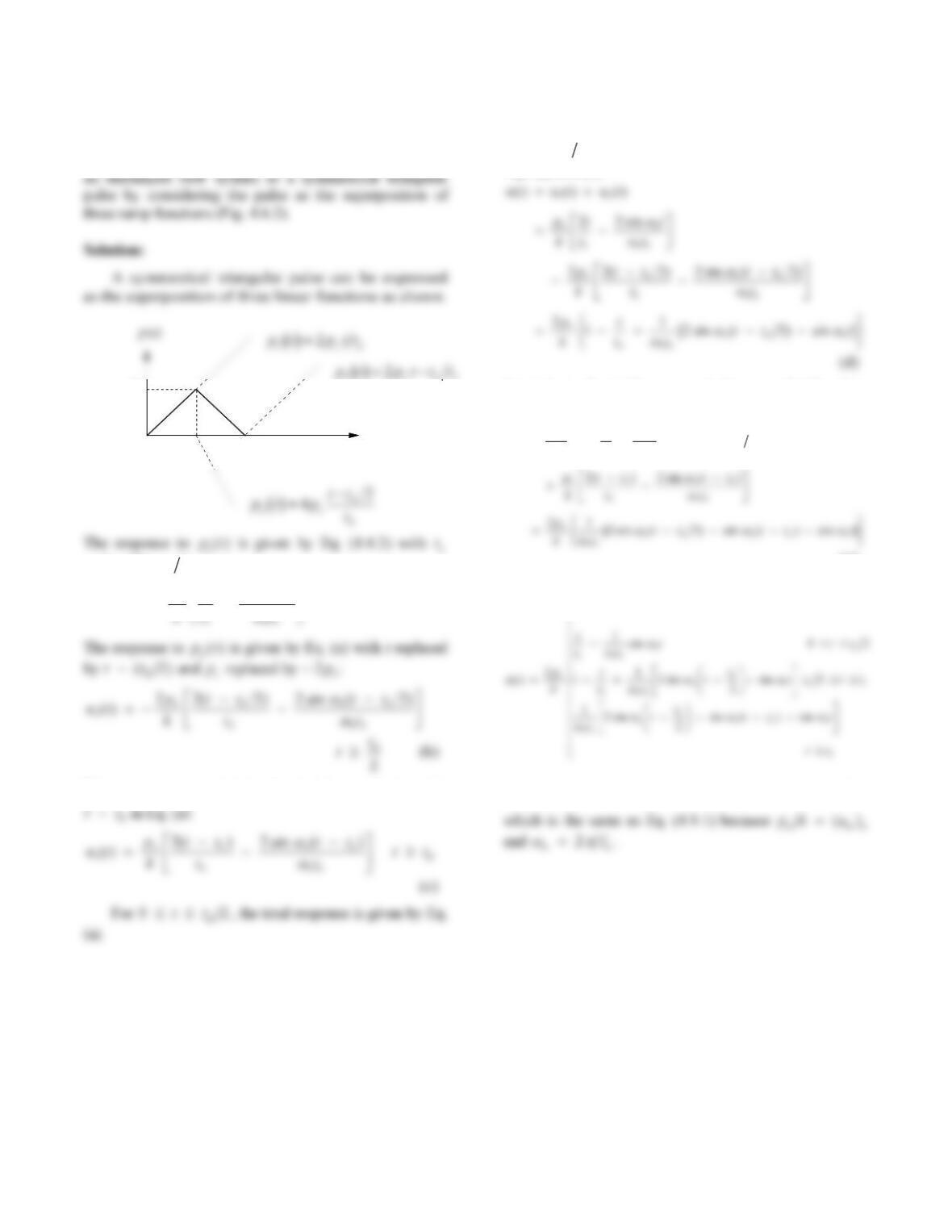
The overall maximum response is the larger of the
two maxima determined separately for the forced and free
vibration phases. Fig. P4.19c shows that if td Tn, the
30
tT
dn
0
0123456
0123456
tT
dn
0
2
st
0123456
tT
dn
2
st
Figure 4.19b
Figure 4.19c
Figure 4.19d
31
Problem 4.20
Derive equations (4.9.1) for the displacement response of
t
t
td
t
p
o
td
replaced by
t
d2:
1
22sin
() on
t
t
t
p
tt
ut kt t
t
0 (a)
The response to p
t
3() is obtained by replacing t by
t
t
p
t
t
t
t
k
T
For
t
t
t
dd
2
, the total response is the sum of
Eqs. (a) and (b):
For
t
t
d
, the total response is the sum of either Eqs.
(a), (b), and (c) or Eqs. (c) and (d):
21
( ) 1 2 sin ( 2) sin
o
nd n
dnd
pt
ut t t t
ktt
(e)
The total response can be summarized as
(f)
32odd
An undamped system is subjected to the triangular pulse
in Fig. P4.21.
(a) Show that the displacement response is
12
n
T
tt
Rd during (i) the forced vibration phase, and (ii) the free
vibration phase.
(c) Plot Rd for the two phases against td /Tn . Also plot the
mu ku ptt t t
tt
d
S
T
|bg
0 (a)
1. Forced vibration phase.
t
t
Rewritting in terms of
t
d/
T
n gives
t
n
From Eq. (b), u(
t
d) and ()ut
d are determined:
ut u t
t
do
nd
nd
() sin
F
H
G
I
K
J
st
bg
1
d
Rewriting in terms of nd Tt gives
3. Response plots.
The normalized deformation ut u o
() st
bg
given by
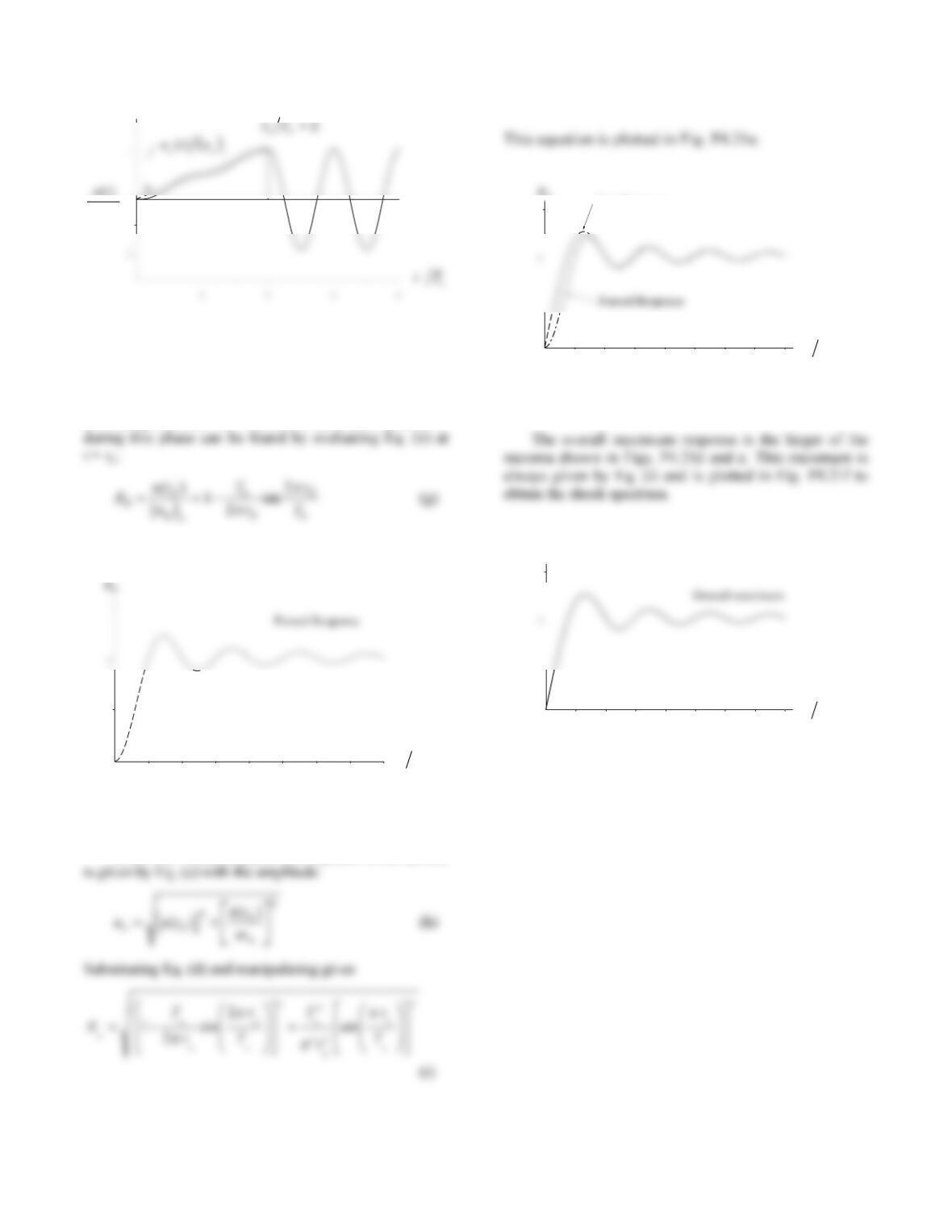
Figure P4.21b
0
1
ut
(
)
ut
33
Figure P4.21c
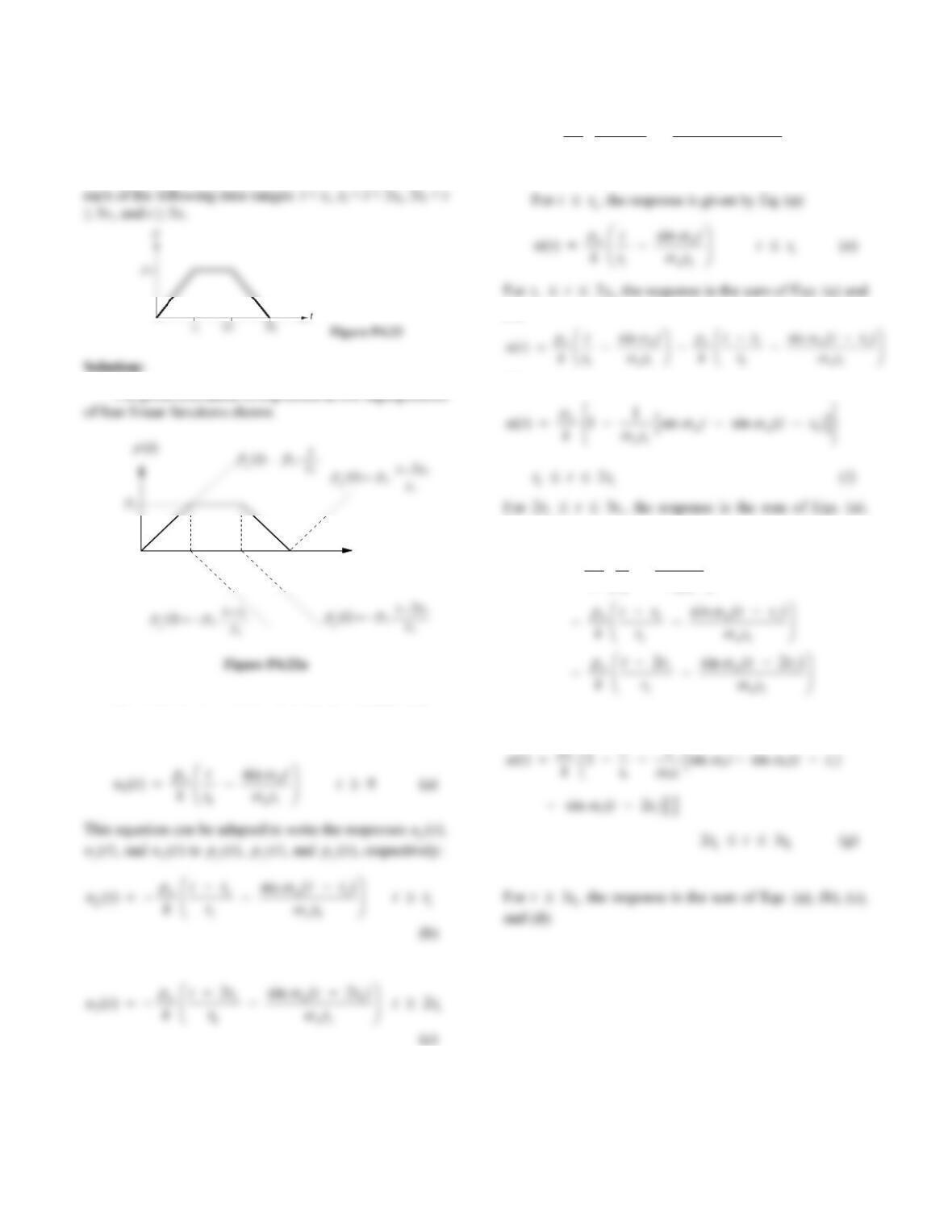
4. Response spectrum.
During the forced vibration phase u is a non-
decreasing function of t. Thus, the maximum value of u
This equation is plotted in Fig. P4.21d.
Figure P4.21d
In the free vibration phase the response of the system
Figure P4.2e
Figure P4.21f
0
ut
u
st o
(
)
()
1 2 3 4
tT
n
d
1 2 3 4
R
d
Free Response
0
tT
n
d
1 2 3 4
Rd
tT
n
d
34
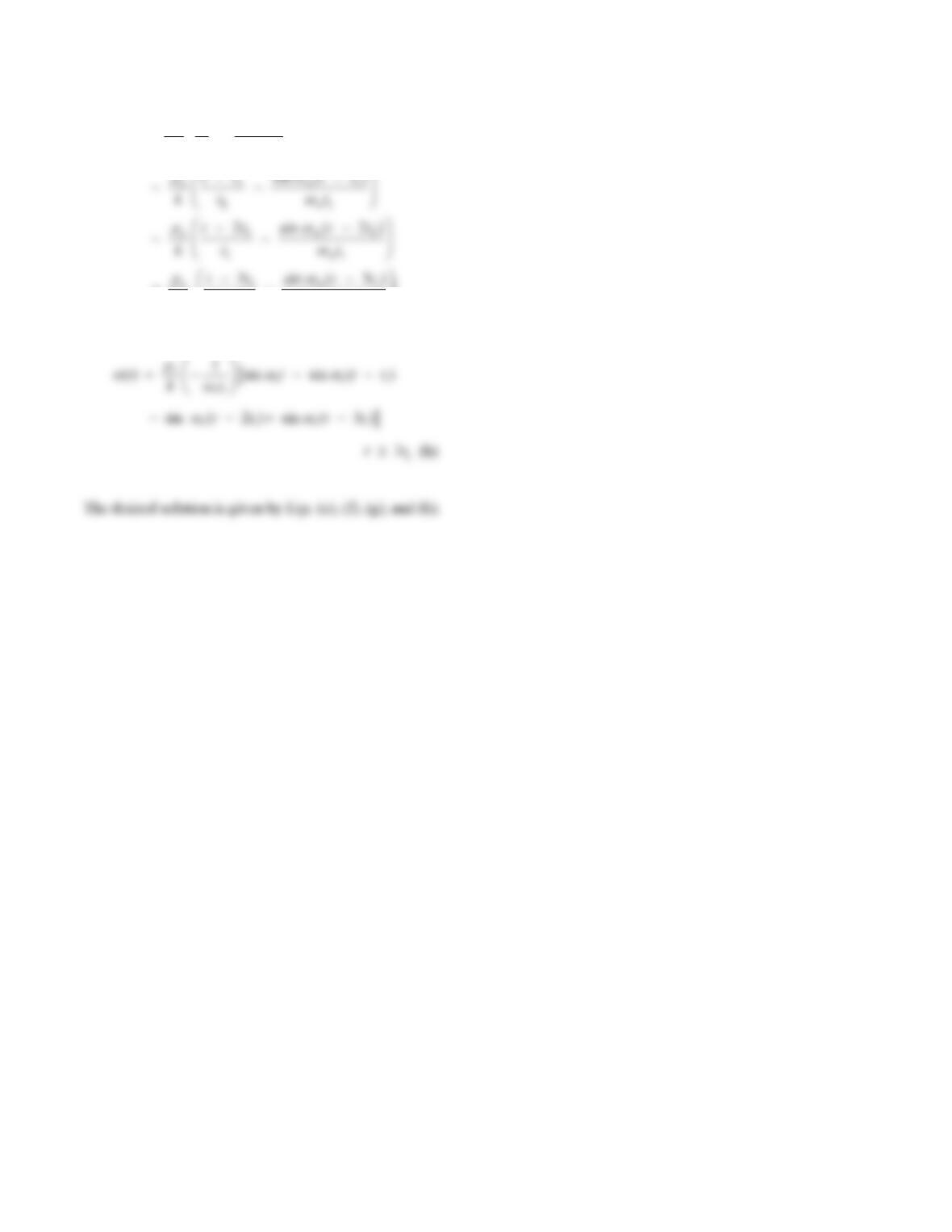
Problem 4.22
Derive equations for the deformation u(t) of an undamped
SDF system due to the force p(t) shown in Fig. P4.22a for
t
t
t
t
t
t
3t1
t
The response to p
t
1() is given by Eq. (4.2.2) with
t
r
replaced by
t
1:
F
I
t
t
t
t
t
t
t
F
I
t
t
F
I
t
t
ut p
k
tt
t
tt
t
on
n
4
1
1
1
1
33
() sin ( )
F
H
G
I
K
J
t
t
31
(d)
11
(b):
or
11
(b), and (c):
ut p
k
t
t
t
t
on
() sin
F
H
GI
K
J
or
t
t
F
I
t
t
t
t
t
35
ut p
k
t
t
t
t
k
t
t
on
n
on
n
() sin
F
H
GI
K
J
H
GI
K
J
11
1
1
or
36
Problem 4.23
An SDF system is subjected to the force shown in Fig.
P4.22a. Determine the maximum response during free
vibration of the system and the time instant the first peak
occurs.
Solution:
The response for
t
t
31 is given by Eq. (h) of
Problem 4.22. After some trigonometric and algebraic
manipulation this can be rewritten as
(a)
The response attains a maximum when
The first peak occurs at
t
t
o
given by
T
The maximum response is obtained by evaluating Eq. (a)
at
t
37
Problem 4.24
many values of td /Tn to determine the complete shock
spectrum. Obviously, this is time consuming but
Solution:
If
t
T
dn
, the maximum deformation can be
estimated by assuming that the force of Fig. P4.22a is a
pure impulse. Its magnitude is
k
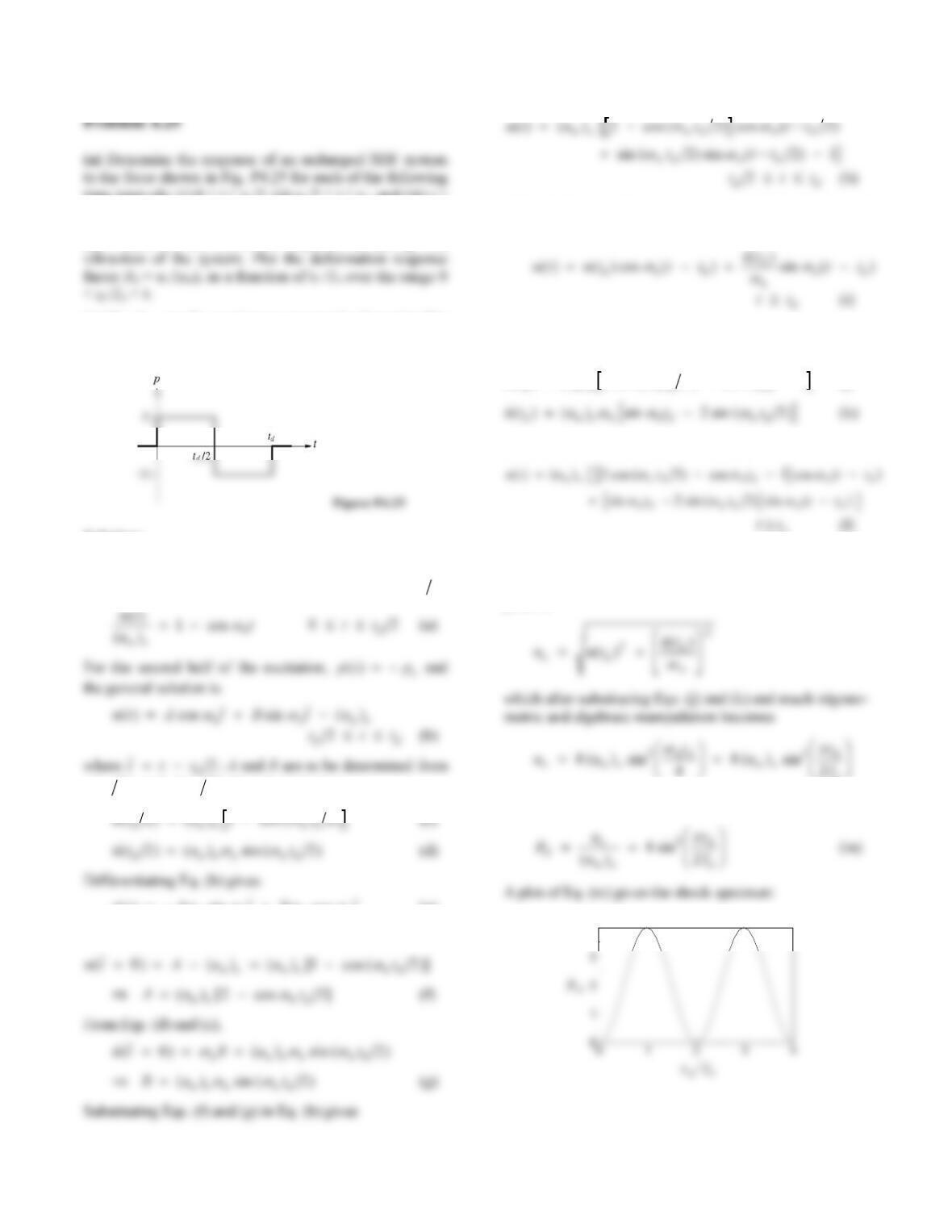
A plot of Eq. (c) gives the shock spectrum:
0 0.2 0.4 0.6 0.8 1
0
tdTn
t
T
The exact value of the maximum response is given by Eq.
(c) of Problem 4.23:
Therefore,
38
time intervals: (i) 0 ≤ t ≤ td /2; (ii) td /2 ≤ t ≤ td ; and (iii) t ≥
td. Assume that u(0) = ݑሶ (0) = 0.
(b) Determine the maximum response uo during free
t
t
(c) If td /Tn , can the maximum response be determined by
treating the applied force as a pure impulse?
State reasons for your answers.
t
t
Solution:
(a) During the first half of the excitation, p
t
po
()
and
the response is given by Eq. (4.3.2) where ()up
k
s
to o
:
t
t
t
st
t
t
t
u
t
d
()2 and ()u
t
d2. Equation (a) gives
t
t
s
( ) sin cosut A t B t
nn n n
(e)
From Eqs. (b) and (c),
st
st
A
t
s
st
s
After the force ends at
t
d, the system vibrates freely and
the response is
This free vibration is initiated by u
t
d
() and ()u
t
d
determined from Eq. (h):
ut u t t
( ) ( ) cos ( ) cos22 1
(j)
Substituting Eqs. (j) and (k) in Eq. (i) gives
d
Equations (a), (h), and (l) give the desired results.
(b) The maximum displacement during the free vibration
phase is
n
H
K
The corresponding deformation response factor is
4
t
t
t

39
(c) If the excitation is considered as a pure impulse, its
40
Problem 4.26
(weight = 100.03 kips) was determined in Example 4.2.
(a) If the tank is empty (weight = 20.03 kips), calculate
the maximum base shear and bending moment at the base
of the tower supporting the tank.
(b) By comparing these results with those for the full tank
(Example 4.2), comment on the effect of mass on the
response to impulsive forces. Explain the reason.
Solution:
(a) From Example 2.7, weight kips03.20w(empty
T
t
T
Because
t
T
dn025., the force may be treated as a pure
The equivalent static force is
The resulting shear and bending moment diagrams for the
tower are as shown:
80 ‘
Shear Moment
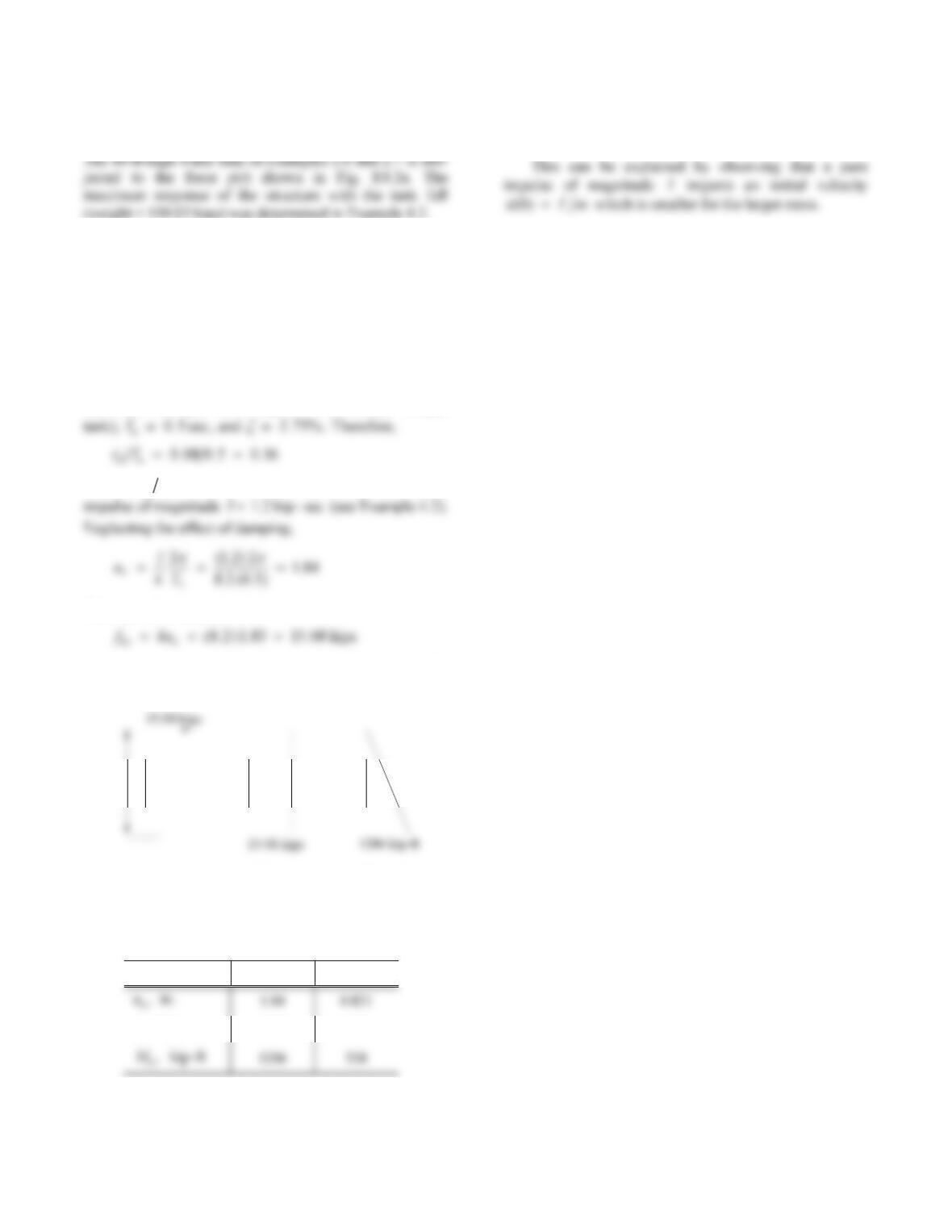
(b) The maximum responses of the tank for empty and
full conditions are summarized next:
Empty Full
kip ,
b
V 15.08 6.73
Increasing the mass has the effect of reducing the
dynamic response.