92
Problem 13.38
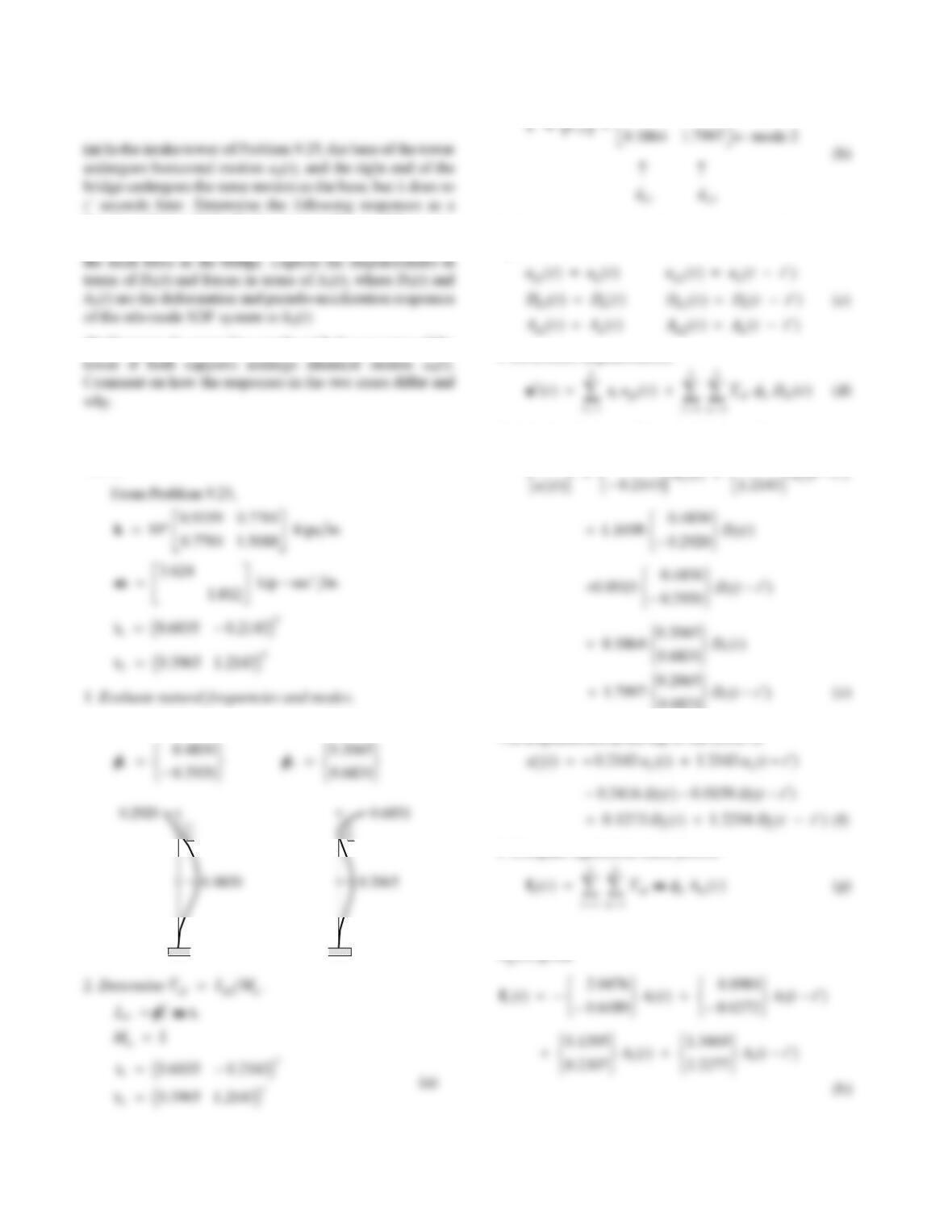
function of time: (i) the displacement at the top of the tower,
(ii) the shear and bending moment at the tower base, and (iii)
(b) Compare the preceding results with the response of the
Solution:
Part a
136.02
298.04
1.1698 0.0515 mode 1
3. Determine response of the nth-mode SDF system to
()ut
gl .
4. Determine displacements.
Substituting Eqs. (a), (b), and (c) in Eq. (d) gives
1
0.6035 0.3965
() () ( )
t
ut ut ut t
0.6831 Dt t
(e)
The displacement at the top of the tower is
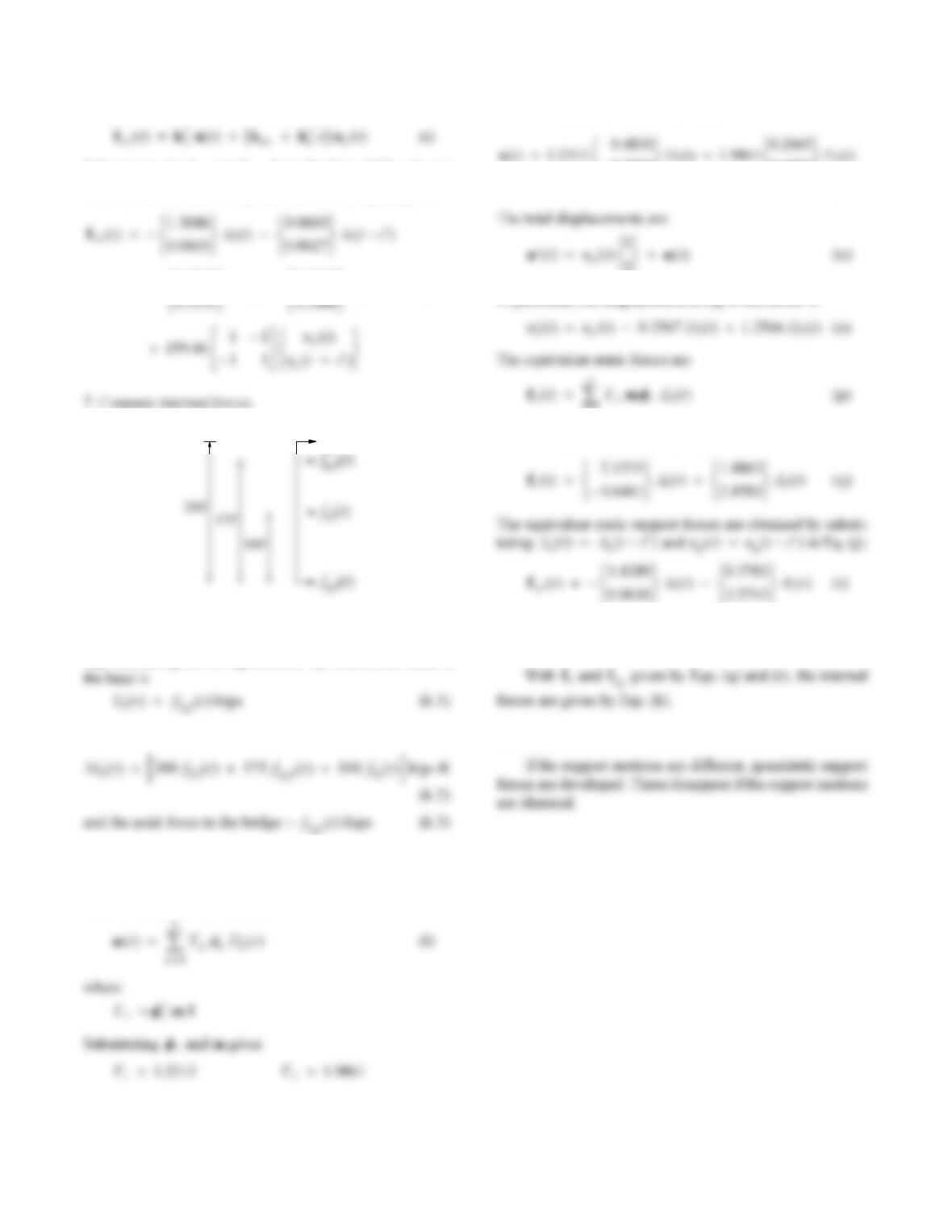
5. Compute equivalent static forces.
Substituting for m and n
, Eq. (b) for n
l
, and Eq. (c) for
A
t
gives
93
6. Compute equivalent static support forces.
Substituting for
k
g
and
k
gg from Problem 9.25 and u()
t
from the second half of Eq. (d), and from Eq. (a) gives
22
0.0348 0.3355
() ( )
A
tAtt
(j)
Observe that at each time instant, the equivalent static
forces shown in the accompanying figure and defined by
Eqs. (h) and (j) are in equilibrium. By statics, the shear at
The moment at the base is
Part b
If both supports undergo identical motion ut
g()
, the
relative motion of the structure is
Substituting n
and
n in Eq. (l) gives
12
0.2920 0.6831
(m)
1
In particular, the displacement at top of the tower is
1
n
Substituting for
n, m, and n
gives
These support forces could also be obtained by static
analysis of the structure subjected to fSt()
.
Comments.
f (t)
s2
94
Problem 13.39
Figure P13.4 shows a two–story frame (the same as that in
Problems 9.6 and 10.10) with m = 100 kips/g, I = 727 in4 for
beams and columns, and E = 29,000 ksi. Determine the
response of this frame to ground motion characterized by the
Solution:
Initial calculations.
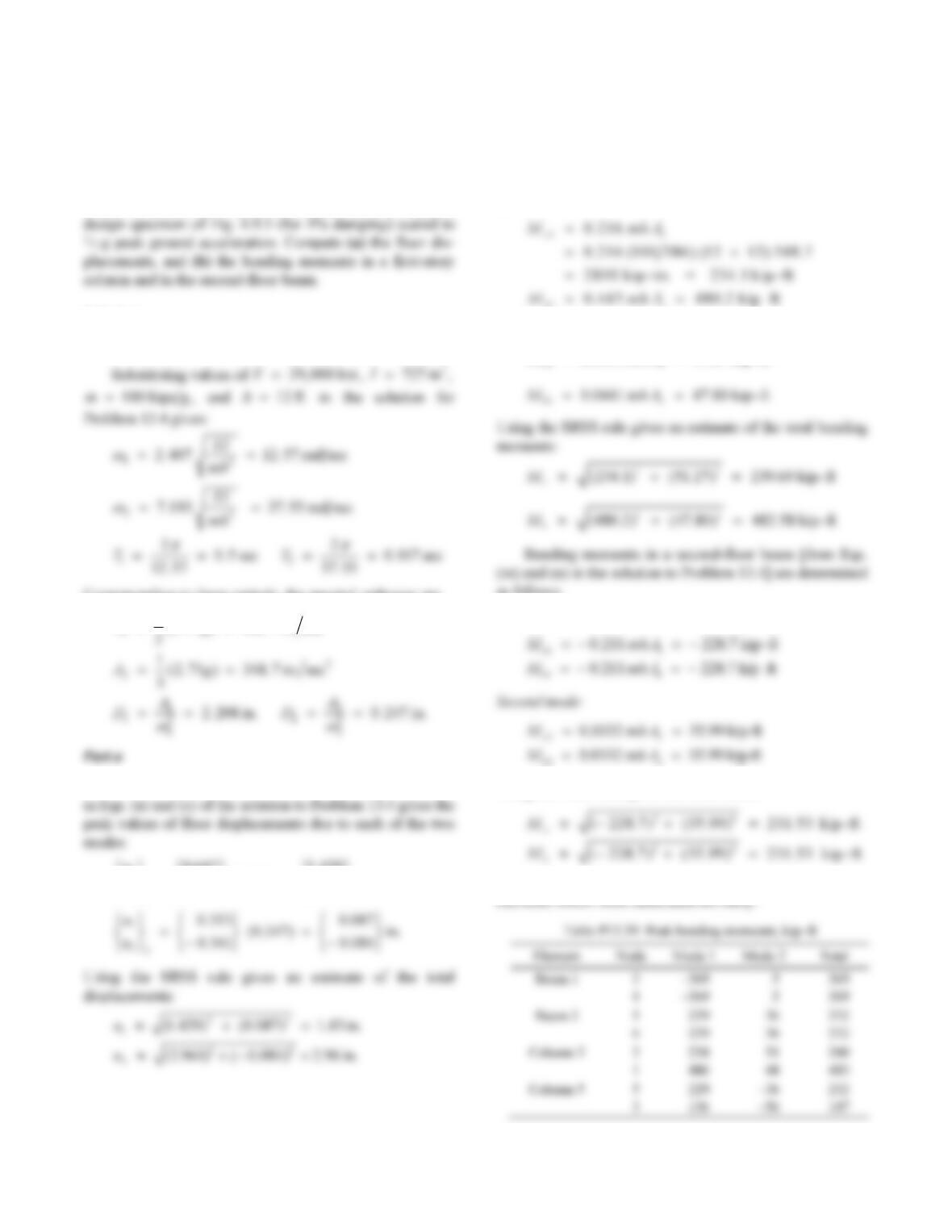
Corresponding to these periods, the spectral ordinates are
A
2
1
Substituting the above
D
1 and
D
2 for
D
t
1()
and
D
t
2()
1
21
0.647 1.429
(2.208) in.
1.341 2.961
u
u
Part b
Bending moments in a first-story column [from Eqs. (k)
and (l) in the solution to Problem 13.4] are determined as
follows.
First mode:
11
b
Second mode:
0.0473 51.27 kip–ft
MmhA
as follows.
First mode:
Using the SRSS rule gives the total values:
Table P13.39 summarizes the bending moments in all

95
5
6
2
96
Problem 13.40
The two-story shear frame of Fig. P13.1 (also of Problems
9.5 and 10.6) has the following properties: h = 12 ft, m = 100
motion is to be estimated by response spectrum analysis
(RSA) and compared with the results of Problem 13.2 from
are doing so to avoid errors inherent in reading Dn and An
from the response spectrum. However, in the standard
application of RSA, Dn(t) or An(t) would not be available and
(c) Combine the peak modal responses using an appropriate
Solution:
Initial calculations.
Part a: Spectral ordinates.
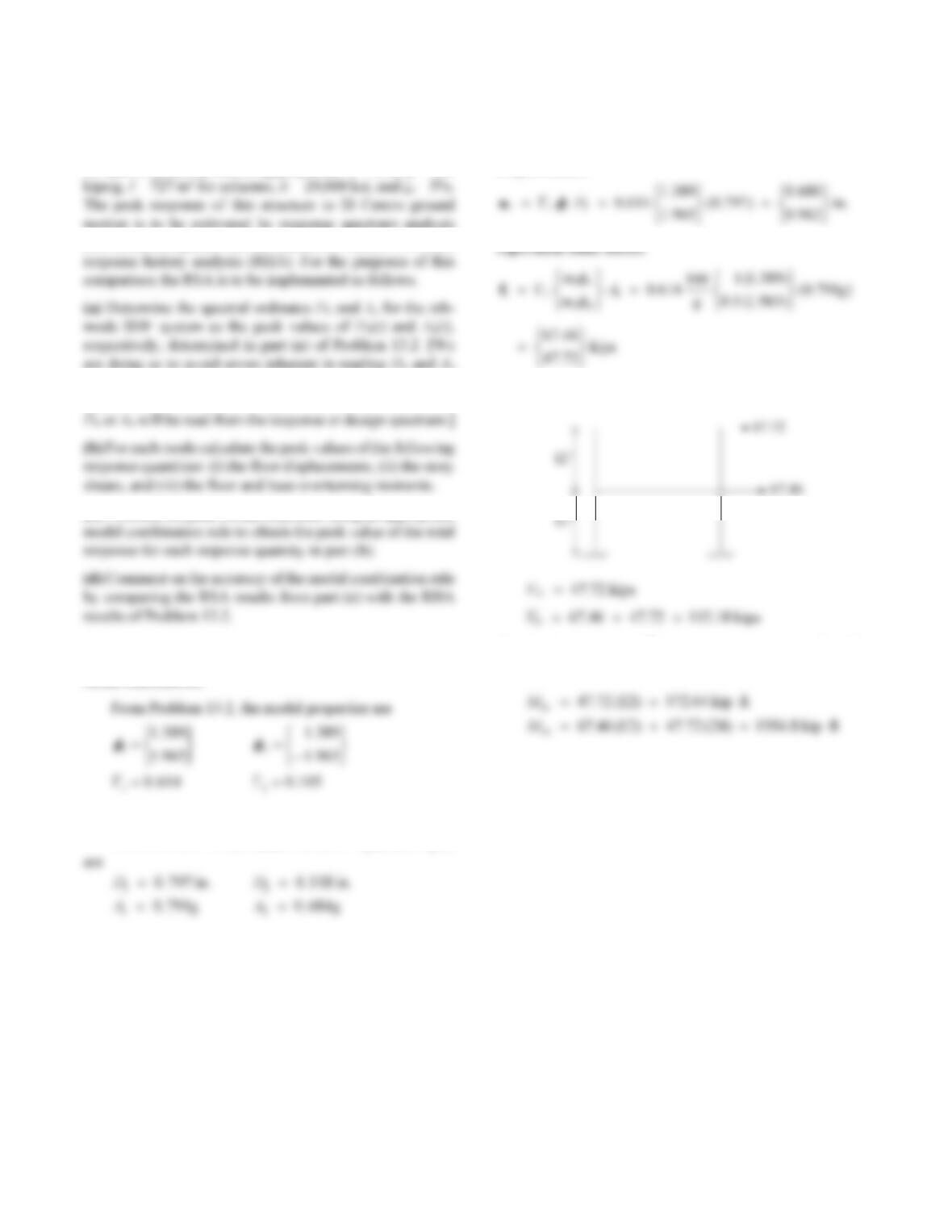
From Problem 13.2, the peak values of
D
t
n()
and
A
t
n()
D
D
A
A
Part b
1. Peak responses due to mode 1.
Displacements:
Story shears:
Overturning moments: These moments are denoted by
M
1
at the first floor level and
M
b at the base.
97
2. Peak responses due to mode 2.
Story shears:
Overturning moments:
Part c
The peak modal responses are combined by the SRSS
rule:
The resulting RSA estimate and the RHA results (from
Problem 13.2) are presented in Table P13.40.
Table P13.40
Response RSA RHA Error, %
u1, in. 0.680 0.679 0.15
Part d: Comments.
98
Problem 13.41
Figure P13.11 shows three-story frames (the same as those
in Problem 9.9 and 10.19) with m = 100 kips/g, I = 1400 in4,
E = 29,000 ksi, and h = 12 ft. Determine the response of this
frame to ground motion characterized by the design
spectrum of Fig. 6.9.5 (for 5% damping) scaled to 1/3 g peak
ground acceleration. Compute (a) the floor displacements,
and (b) the bending moments in a first-story column and in
the second-floor beam.
m100 kips g , and h12 f
t
in the solution for
Problem 13.11 gives:
110 57.
234 56.
359 42.
T
T
T
, the spectral ordinates are
D
1313.in.
D
20 292.in.
D
30 088.in.
Substituting numerical values for n and
n from
Problem 13.11 and
D
n values above in Eq. (13.8.1a) gives
the peak displacements due to each of the three modes:
1 0.148
222
Observe that the first mode contributes essentially the entire
floor displacements.
Part b: Element forces.
To compute the element forces use the results from
Problem 13.11 and replace
A
t
n()
by the spectral values .
n
A
The bending moments in a first-story column due to the
first mode are
11
0.7526 0.7526 (100 g) (12) 0.903g
815.52 kip–ft
a
MmhA
These bending moments due to the second mode are
22
0.08381 0.08381 (100 g) (12) 0.903g
a
MmhA
Due to the third mode the bending moments are
Combining modal responses by the SRSS rule gives
222
(815.52) + (90.82) + (19.56)
M
11
586.66 kip–ft
ab
MM
Problem 13.42
Figure P13.12 shows three-story frames (the same as those
in Problems 9.10 and 10.20) with m = 100 kips/g, I = 1400
in4, E = 29,000 ksi, and h = 12 ft. Determine the response of
spectrum of Fig. 6.9.5 (for 5% damping) scaled to 1/3 g peak
ground acceleration. Compute (a) the floor displacements,
and (b) the bending moments in a first-story column and in
the second-floor beam.
Solution:
Part a: Floor displacements.
Combining modal displacements by the SRSS rule gives
Observe that the first mode contributes essentially the entire
floor displacements.
Part b: Element forces.
To compute the element forces use the results from
The bending moments in a first-story column due to the
first mode are
0.697 0.697(100 / g)(12)0.828g
0.151 0.151(100 / )(12)0.828g
MmhA
MmhA g
Due to the third mode the bending moments are
Combining modal responses by the SRSS rule gives
22 2
(692.5) (110.5) (25.55) 701.8 kip–ft
a
M
100
Problem 13.43
Figure P13.13 show three-story frames (the same as those in
Problems 9.11 and 10.21) with m = 100 kips/g, I = 1400 in4,
E = 29,000 ksi, and h = 12 ft. Determine the response of this
and (b) the bending moments in a first-story column and in
the second-floor beam.
Solution:
13.12 gives
9.31 rad / sec 25.25 rad / sec 47.16 rad / sec
123
3.959 in. 0.547 in. 0.157 in.
DDD
Problem 13.13 and n
D values above in Eq. (13.8.1a) gives
15.672
0.536 0.163
10.
019
Observe that the first mode contributes essentially the entire
floor displacements.
Part b: Element forces.
To compute the element forces use the results from
The bending moments in a first-story column due to the
first mode are
11
0.7124 0.7124(100 / g)(12)0.889g
a
MmhA
The bending moments due to the second mode are
Due to the third mode the bending moments are
Combining modal responses by the SRSS rule gives
The bending moments in the second-story beam due to each
of the three modes are computed similarly to obtain
Combining modal displacements by the SRSS rule gives
101
Problem 13.44
Figure P13.14 show three-story frames (the same as those in
Problems 9.12 and 10.22) with m = 100 kips/g, I = 1400 in4,
E = 29,000 ksi, and h = 12ˊ. Determine the response of this
frame to ground motion characterized by the design
spectrum of Fig. 6.9.5 (for 5% damping) scaled to 1/3 g peak
ground acceleration. Compute (a) the floor displacements,
and (b) the bending moments in a first-story column and in
the second-floor beam.
Solution:
13.12 gives
12 3
7.558 22.320 45.740
01/3 g()
g
u
, the spectral ordinates are
4.877 in. 0.700 in. 0.167 in.
DD D
Substituting numerical values for n
and n
from
Problem 13.14 and n
D values above in Eq. (13.8.1a) gives
1 7.058
3.220 0.067
Combining modal displacements by the SRSS rule gives
Observe that the first mode contributes essentially the entire
floor displacements.
Part b: Element forces.
To compute the element forces use the results from
Problem 13.14 and replace )(tAn by the spectral values
n
A.
The bending moments in a first-story column due to the
first mode are
11
0.844 0.844(100 / g)(12)0.722g
a
MmhA
Bending moments due to the second mode are
22
0.132 0.132(100 / g)(12)0.903g
a
MmhA
Bending moments due to the third mode are
Combining modal responses by the SRSS rule gives
The bending moments in the second-story beam due to
each of the three modes are computed similarly to obtain
Combining modal displacements by the SRSS rule gives
102
Problem 13.45
The three-story shear frame of Fig. P13.5 (also of Problems
9.7 and 10.11) have the following properties: h = 12 ft,
m = 100 kips/g, I = 1400 in4, E = 29,000 ksi, and ζn = 5%.
The peak response of this structure to El Centro ground
motion is to be estimated by response spectrum analysis
(RSA) and compared with the results of Problem 13.7 from
(b) For each mode calculate the peak values of the following
response quantities: (i) the floor displacements, (ii) the story
shears, and (iii) the floor and base overturning moments.
Solution:
05
R
U
.
1
R
U
05
R
U
.
Part a: Spectral ordinates.
A
A
A
Part b: Peak modal responses.
Substituting numerical values for n,
n, and
D
n in Eq.
(13.8.1a) gives the peak displacements due to each of the
three modes:
05
0551
R
U
R
U
.
.
Substituting
n, mj, n
, and
A
n in Eq. (13.8.2) gives
the equivalent static forces due to each of the three modes:
271
R
U
R
U
(.)
.
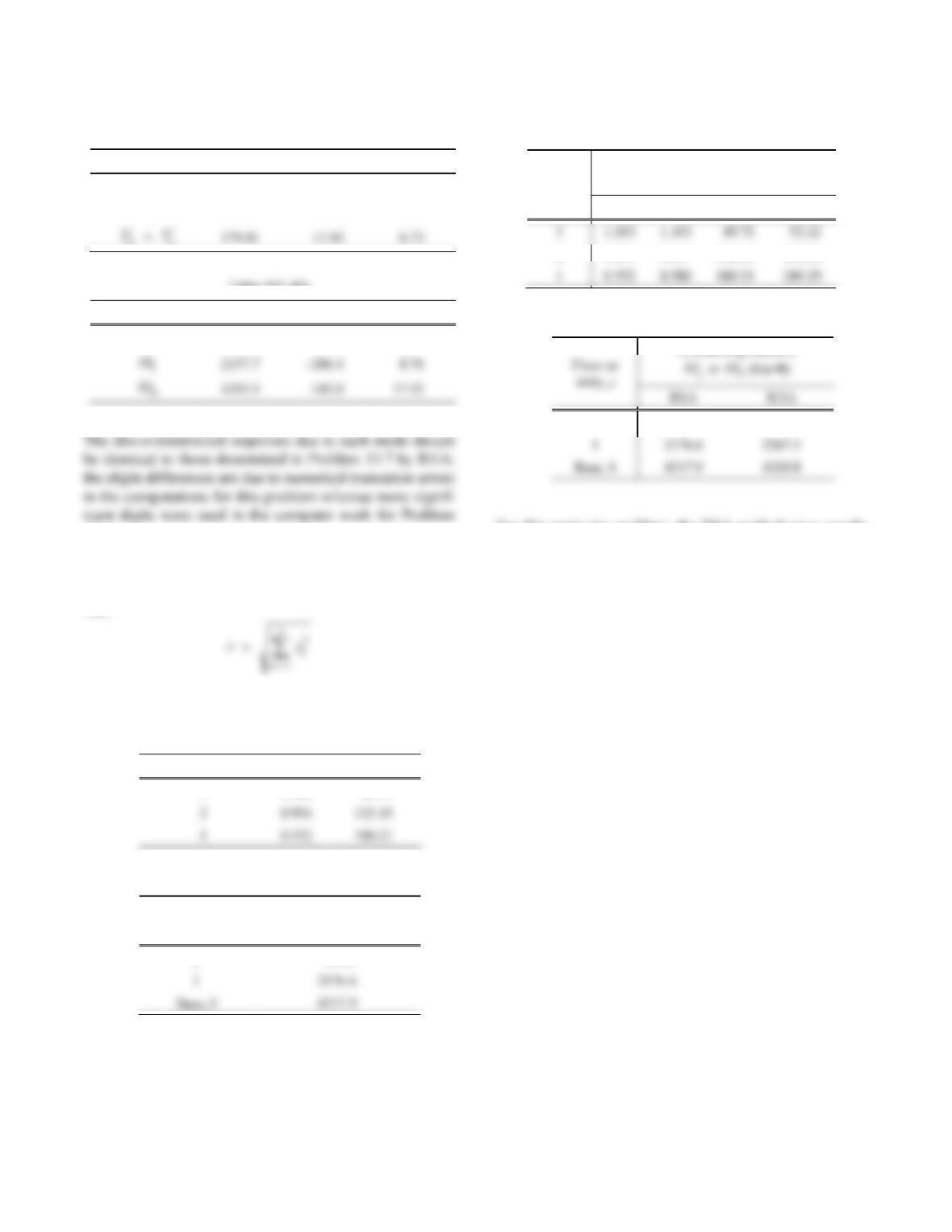
These forces are shown in the following figure.
12 ‘
Static analysis of the structure subjected to forces fn
103
Table P13.45a
Story shear Mode 1 Mode 2 Mode 3
V
3 48.18 –11.92 2.71
V
2 131.63 –11.92 –1.98
Table P13.45b
Floor moments Mode 1 Mode 2 Mode 3
M
2 578.2 –143.0 32.52
M
13.7.
Part c
The peak modal responses are combined by the SRSS
rule:
For each response quantity
r
n available in Part b are
substituted to obtain the total response (Tables P13.45c–d).
Table P13.45c
Floor or story, j uj, in.
V
j, kips
3 1.103 49.71
Table P13.45d
Floor or story, j
Overturning moment,
M
j
or
M
b (kip–ft)
2 596.5
Part d: Comments.
Comparison of the RSA results in Tables P13.23c–d
with RHA results from Problem 13.9 is summarized in
Tables P13.45e–f.
Table P13.45e
Floor or
story, j
uj
(in.)
Shear Vj
(kips)
RSA RHA RSA RHA
2 0.954 0.957 132.15 138.08
Table P13.45f
Overturning moment
2 596.5 626.6
For this particular problem, the RSA method gives results
that are very close to the RHA results, in part, because most
of the response is due to one mode, the first mode.
V
V
104
Problem 13.46
The three-story shear frame of Fig. P13.6 (also of Problems
9.8 and 10.12) have the following properties: h = 12 ft,
respectively, determined in part (a) of Problem 13.8. [We
are doing so to avoid errors inherent in reading Dn and An
from the response spectrum. However, in the standard
application of RSA, Dn(t) or An(t) would not be available,
and Dn or An will be read from the response or design
results of Problems 13.7–13.8.
Solution:
Initial calculations.
123
1.403 0.5 0.0972
Part a: Spectral ordinates.
n() are
12 3
123
1.086 in. 0.272 in. 0.109 in.
0.741g 0.887g 0.756g
DD D
AA A
523.1
045.1
478.0
)086.1(
1
686.0
314.0
403.1
1
u in.
Substituting n
, mj, n
, and An in Eq. (13.8.2) gives the
equivalent static forces due to each of the three modes:
1(0.314) 32.63
These forces are shown in the following figure.
51.99
22.17
3.67
m/2
f3
f1f
2
12′
Static analysis of the structure subjected to forces n
f
gives the responses due to each mode. These computations
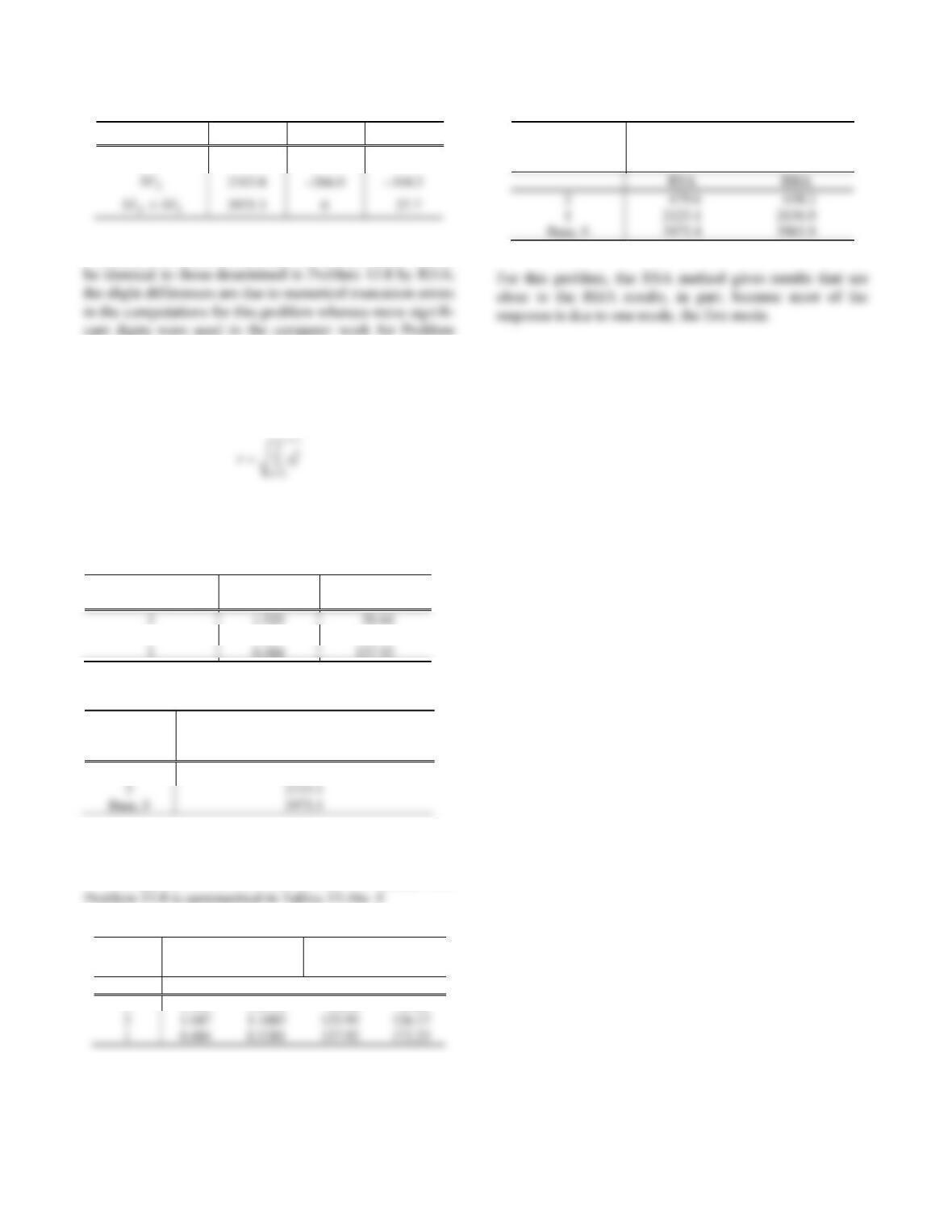
Table 13.46a
Story shear Mode 1 Mode 2 Mode 3
105
Table 13.46b
Floor moments Mode 1 Mode 2 Mode 3
3
M 623.8 –266.0 44.1
The above-determined responses due to each mode should
13.8.
Part c
The peak modal reponses are combined by the SRSS
rule:
For each response quantity rn available in Part b are substi-
tuted to obtain the total response (Tables 13.46c–d)
Table 13.46c
Floor or story, j uj, in. Vj, kips
2 1.047 123.95
Table 13.46d
Floor j
Overturning moment,
Mj or Mb (kip–ft)
3 679.6
Part d: Comments.
Comparison of the RSA results with RHA results from
Table 13.46e
Floor or
story, j uj (in.) Shear Vj (kips)
RSA RHA RSA RHA
3 1.529 1.4332 56.64 54.85
Table 13.46f
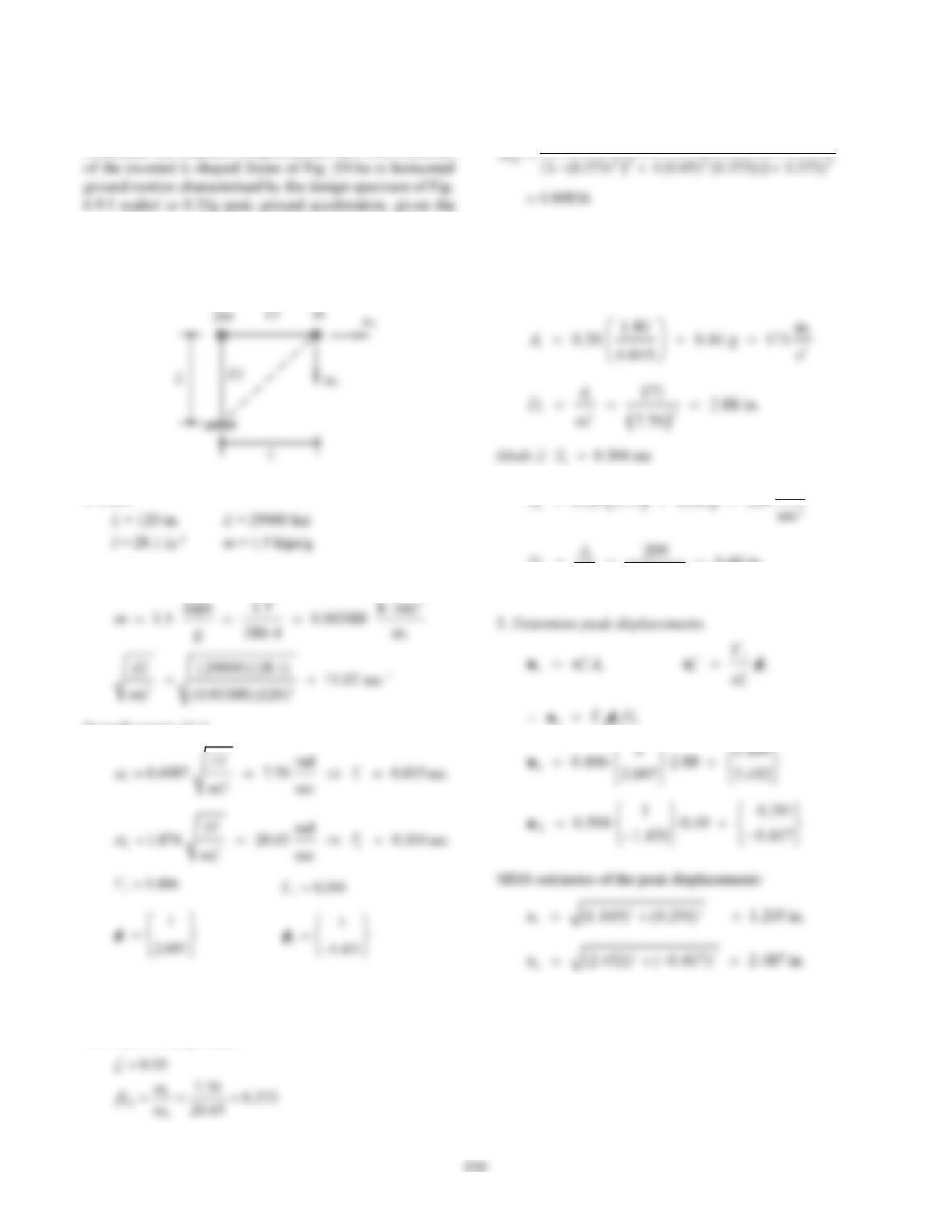
Floor or story, j
Overturning moment,
Mj or Mb (kip–ft)
Problem 13.47
Determine the response (displacements and base moment)
L = 10 ft, m = 1.5 kips/g, E = 29,000 ksi, and I = 28.1 in4;
the given value of I is for a 6-in. standard steel pipe.
Solution:
1. Data.
2. Natural frequencies and modes.
From Example 13.1:
3. Determine correlation coefficient.
Use both the SRSS and CQC modal combination rules.
For CQC, we require
12:
From Eq. (13.7.10):
)373.0()373.01()05.0(8
5.12
4. Determine spectral ordinates.
From Fig. 6.9.5:
Mode 1: 10.815 secT
22
2
2
in.
20.65
D
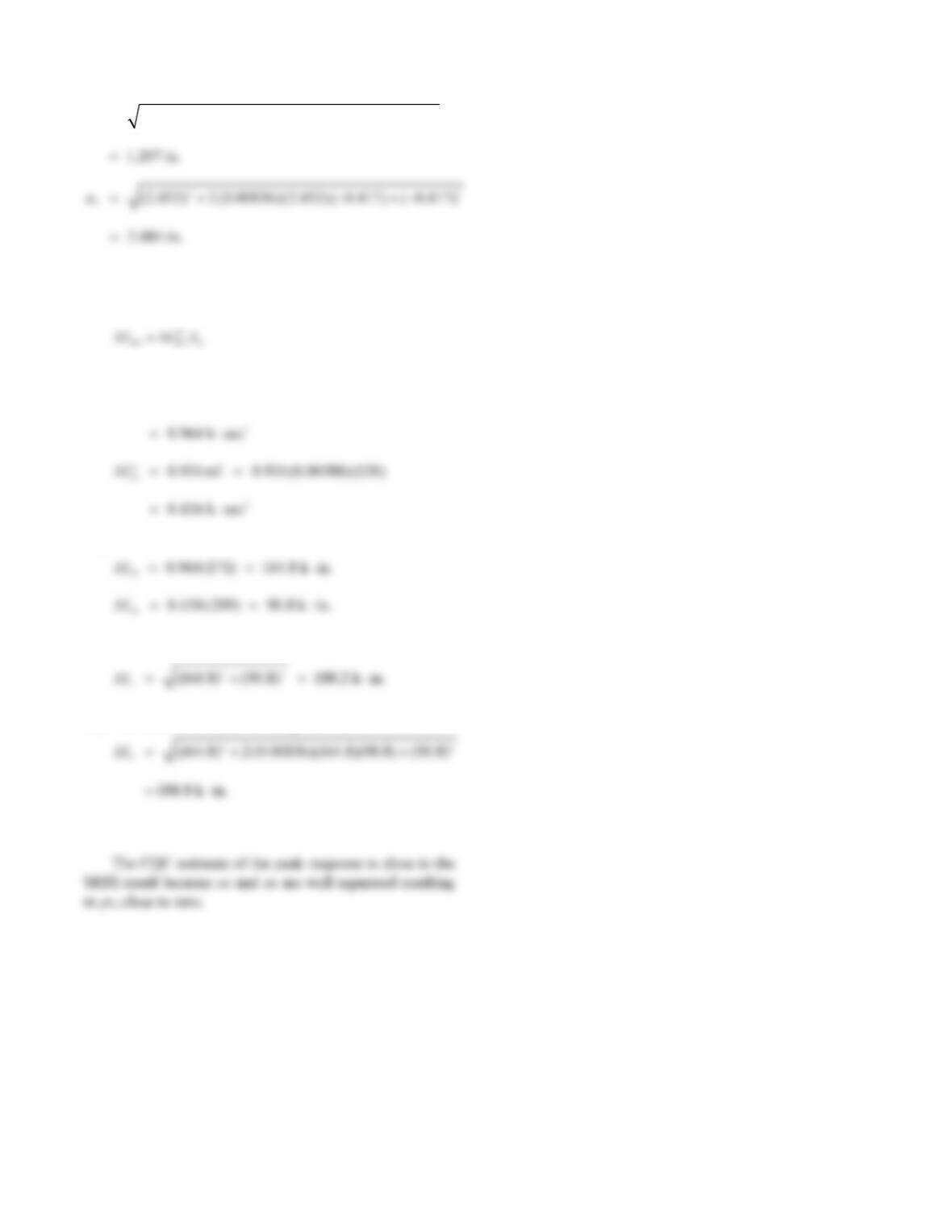
CQC estimates of the peak displacements:
107
22
1
(1.169) 2 (0.00836) (1.169) (0.291) (0.291)
u
6. Determine peak bending moments.
Peak modal responses:
From Figure E13.1:
1
2.069 2.069 (0.00388) (120)
st
b
MmL
Hence,
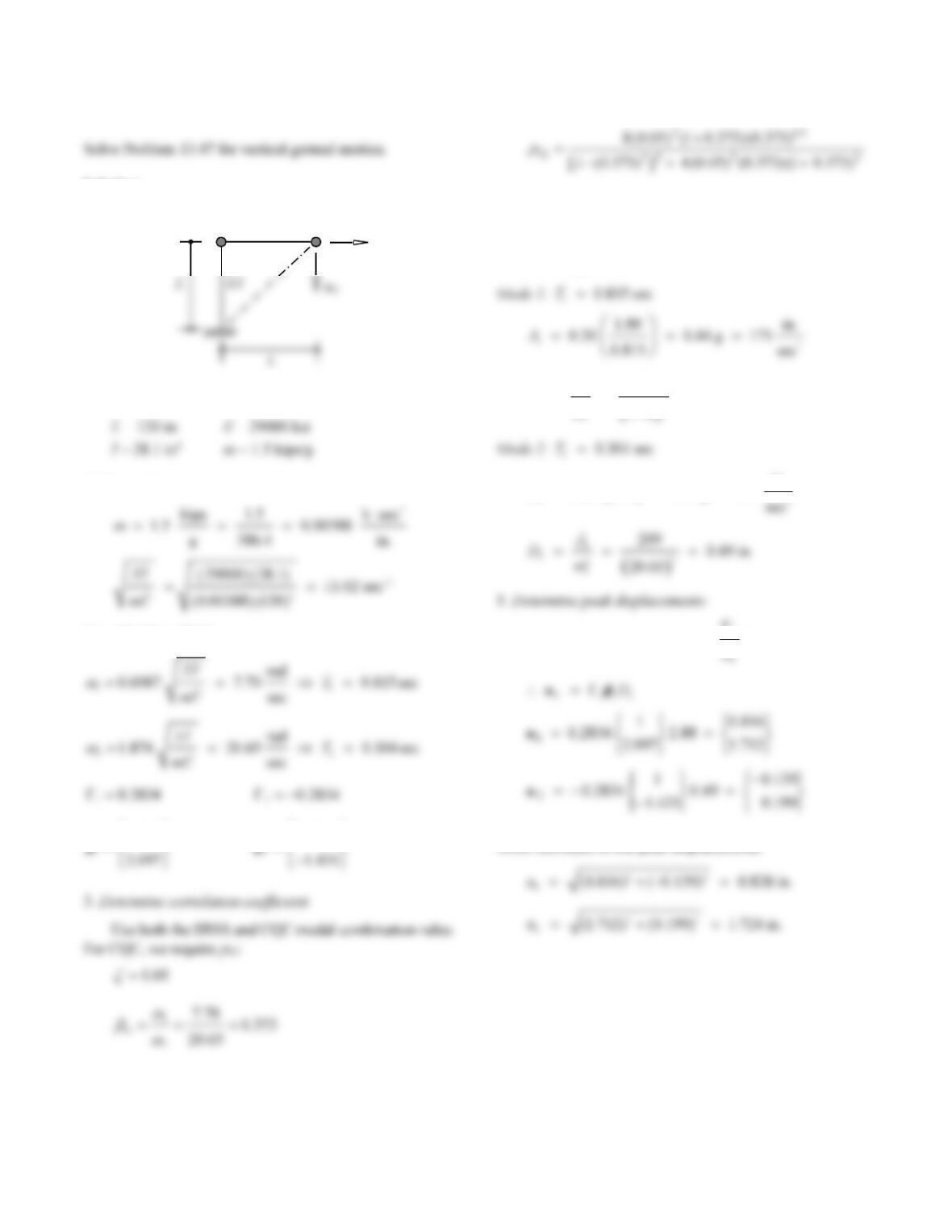
SRSS estimate of the peak bending moment:
CQC estimate of the peak bending moment:
7. Comments.
108
Problem 13.48
Solution:
1. Data.
2. Natural frequencies and modes.
From Problem 13.15:
1
1
From Eq. (13.7.10):
00836.0
4. Determine spectral ordinates.
From Fig. 6.9.5:
1
12
2
171 2.88 in.
7.70
A
D
22
in.
0.20 2.71 0.54 g 209
A
2
un
st st
nnn n n
A
uu
SRSS estimates of the peak displacements:
2m m
EI
u1