1
CHAPTER 2
Problem 2.1
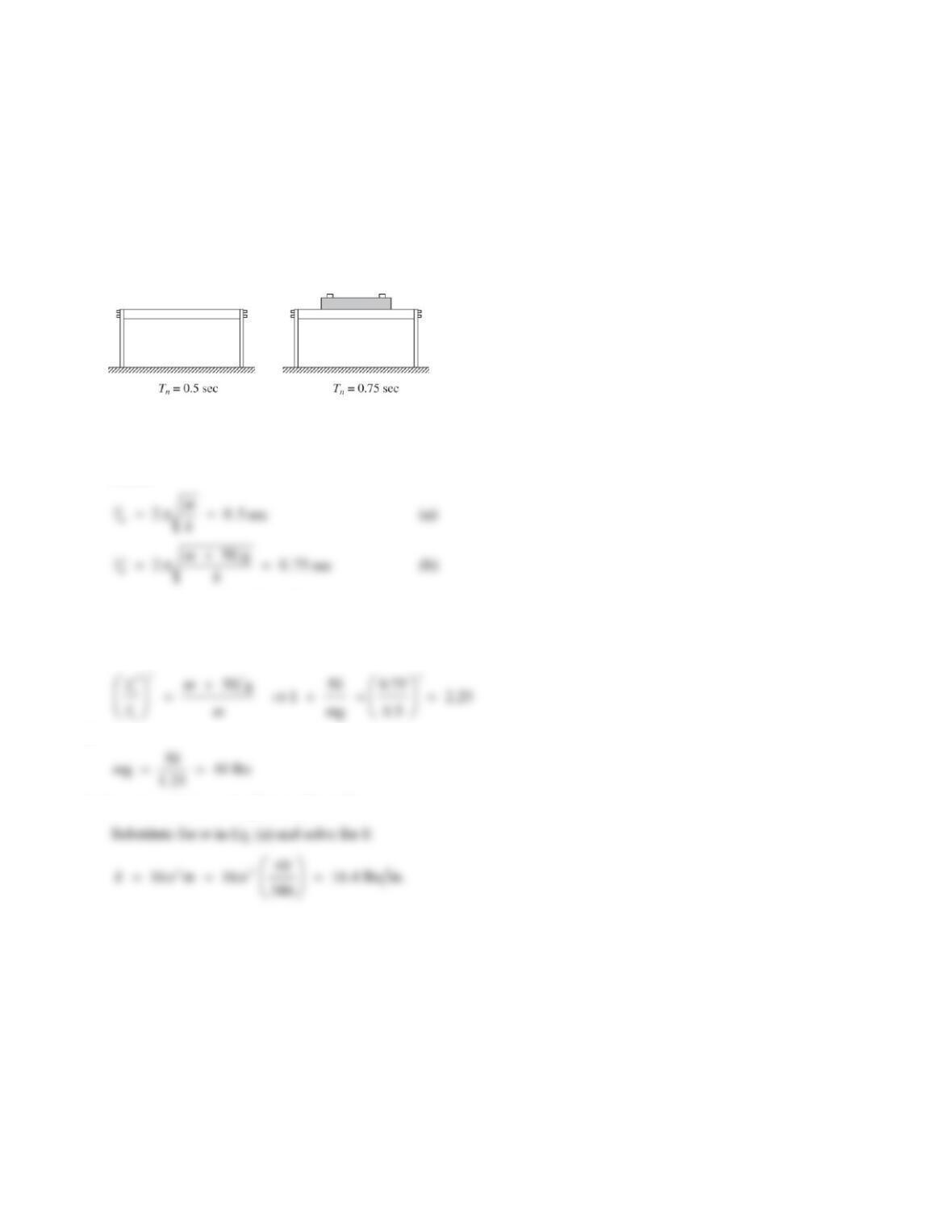
A heavy table is supported by flat steel legs (Fig. P2.1). Its
natural period in lateral vibration is 0.5 sec. When a 50-lb
plate is clamped to its surface, the natural period in lateral
vibration is lengthened to 0.75 sec. What are the weight
and the lateral stiffness of the table?
Figure P2.1
Solution:
Given:
1. Determine the weight of the table.
Taking the ratio of Eq. (b) to Eq. (a) and squaring the
result gives
or
2. Determine the lateral stiffness of the table.
2
Problem 2.2
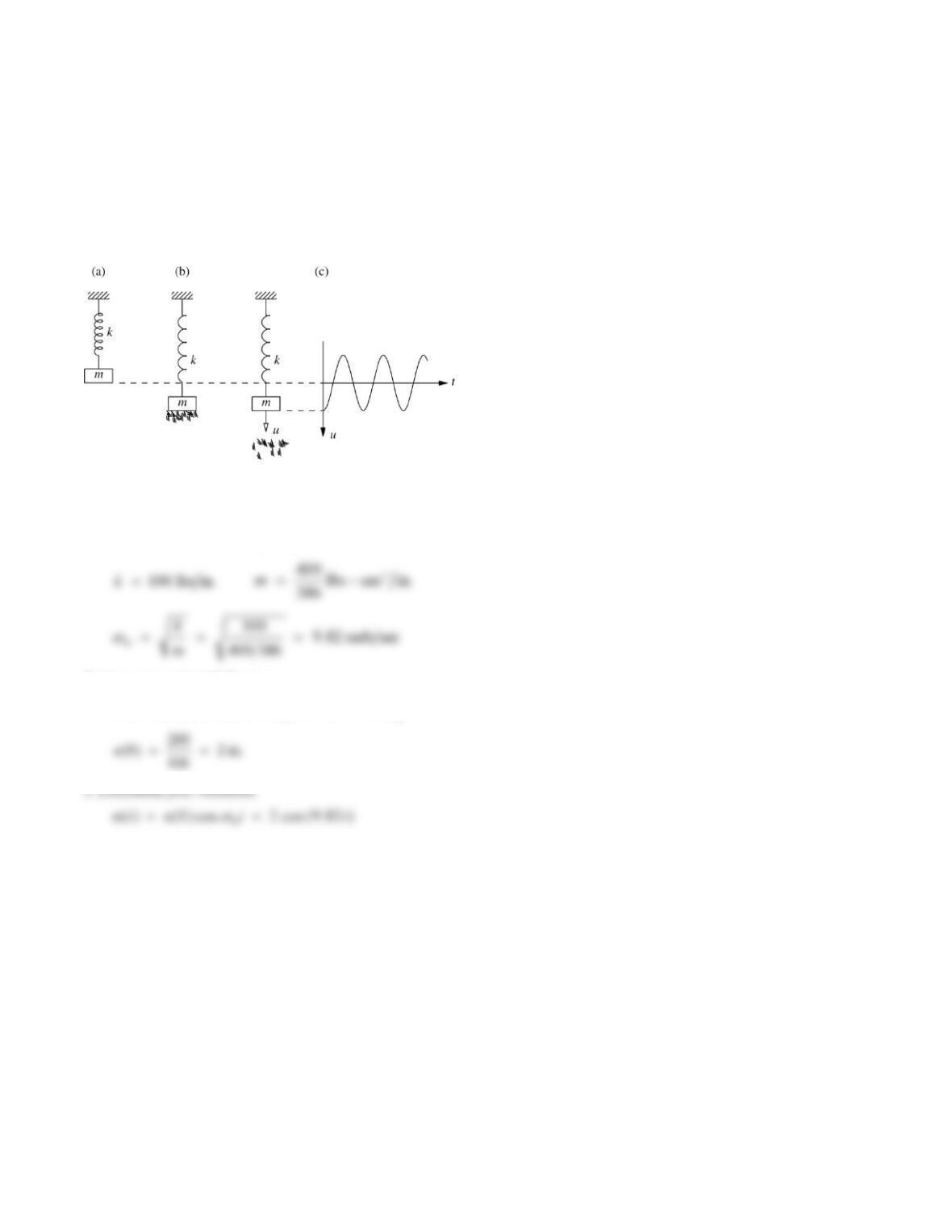
An electromagnet weighing 400 lb and suspended by a
spring having a stiffness of 100 lb/in. (Fig. P2.2a) lifts
200 lb of iron scrap (Fig. P2.2b). Determine the equation
describing the motion when the electric current is turned
off and the scrap is dropped (Fig. P2.2c).
Figure P2.2
Solution:
1. Determine the natural frequency.
2. Determine initial deflection.
Static deflection due to weight of the iron scrap
3
Problem 2.3
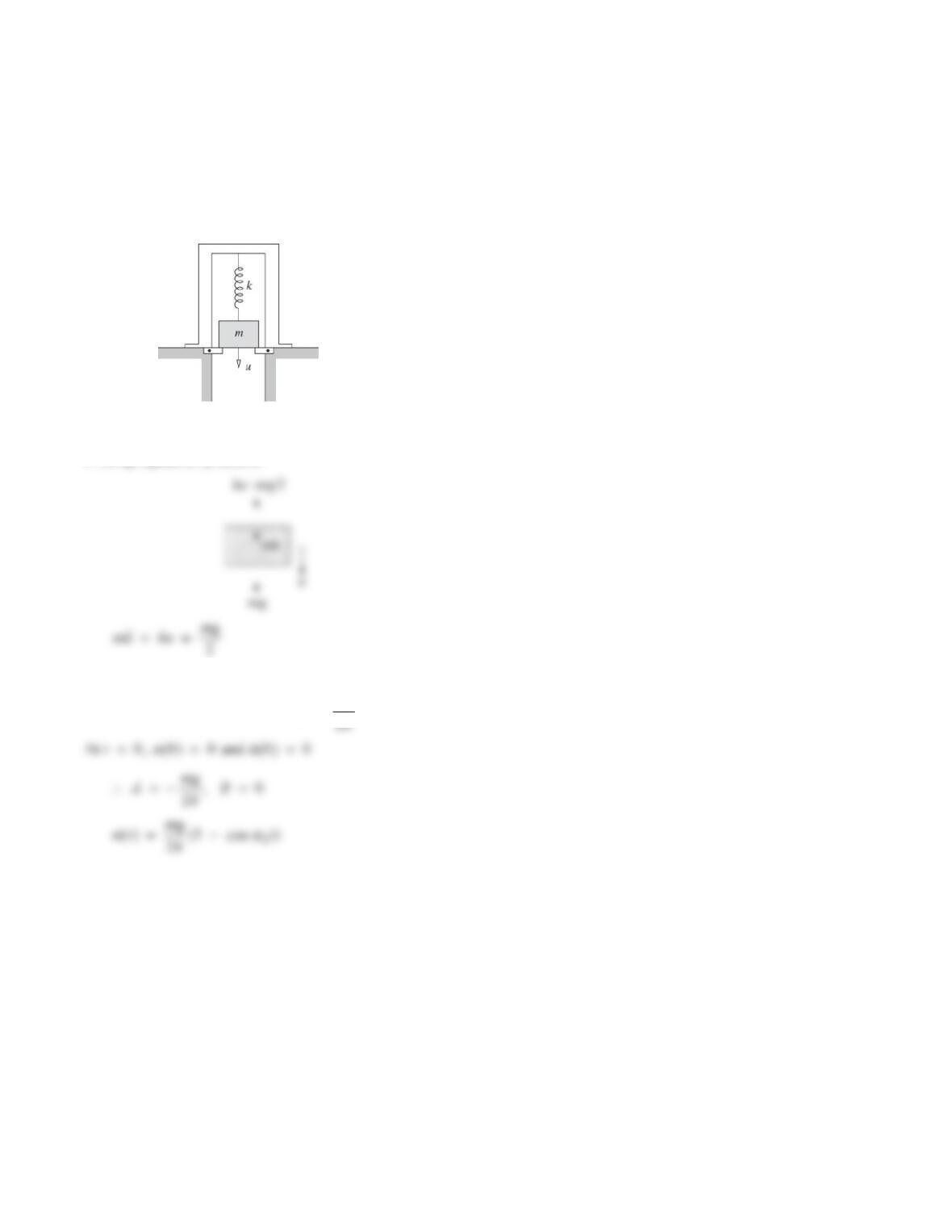
A mass m is at rest, partially supported by a spring and
partially by stops (Fig. P2.3). In the position shown, the
spring force is mg/2. At time t = 0 the stops are rotated,
suddenly releasing the mass. Determine the motion of the
mass.
Figure P2.3
Solution:
1. Set up equation of motion.
2. Solve equation of motion.
ut A t B t m
nn
( ) cos sin
g
4
Problem 2.4
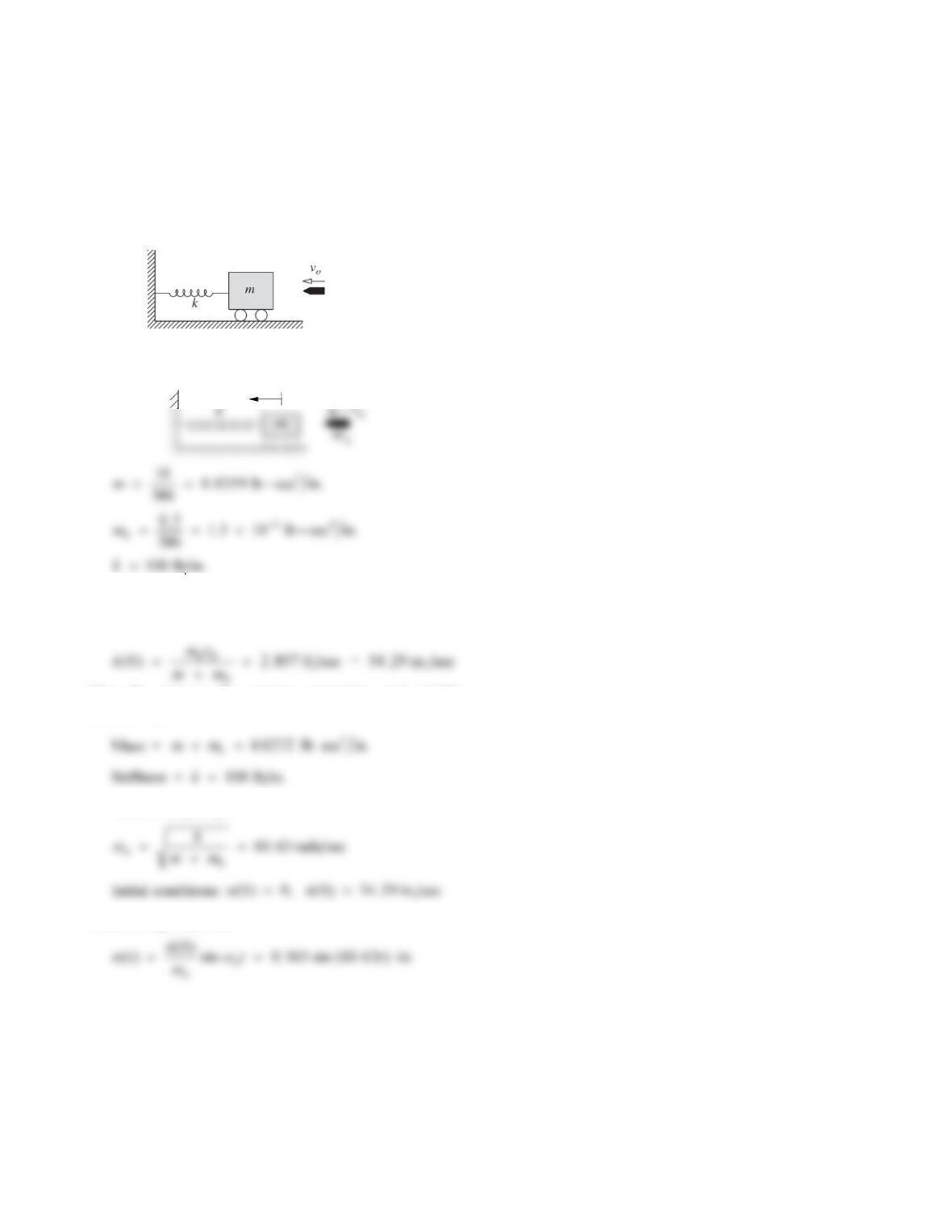
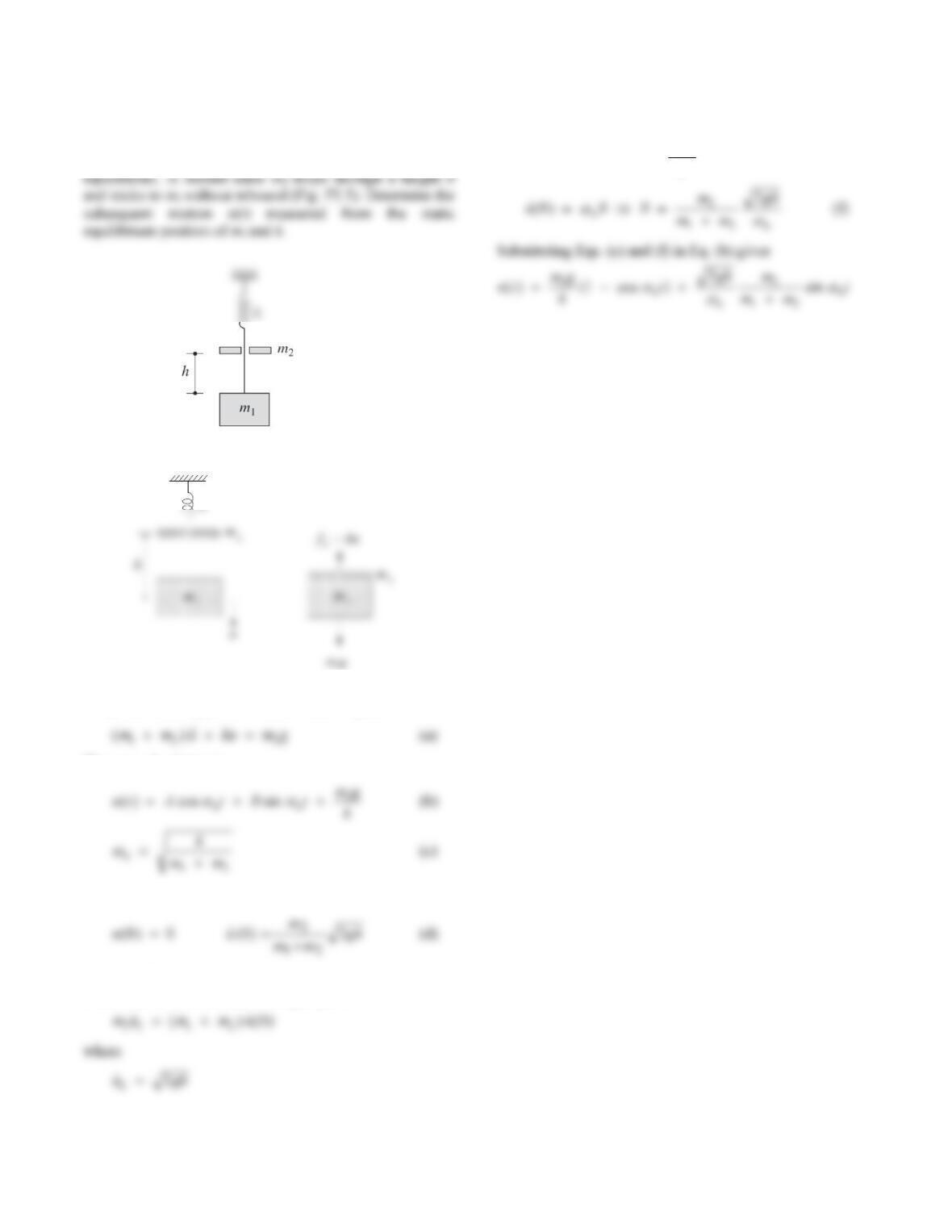
The weight of the wooden block shown in Fig. P2.4 is 10
lb and the spring stiffness is 100 lb/in. A bullet weighing
0.5 lb is fired at a speed of 60 ft/sec into the block and
becomes embedded in the block. Determine the resulting
motion u(t) of the block.
Figure P2.4
Solution:
u
Conservation of momentum implies
mv m m u
00 0 0()
()
After the impact the system properties and initial
conditions are
Natural frequency:
The resulting motion is
5
Problem 2.5
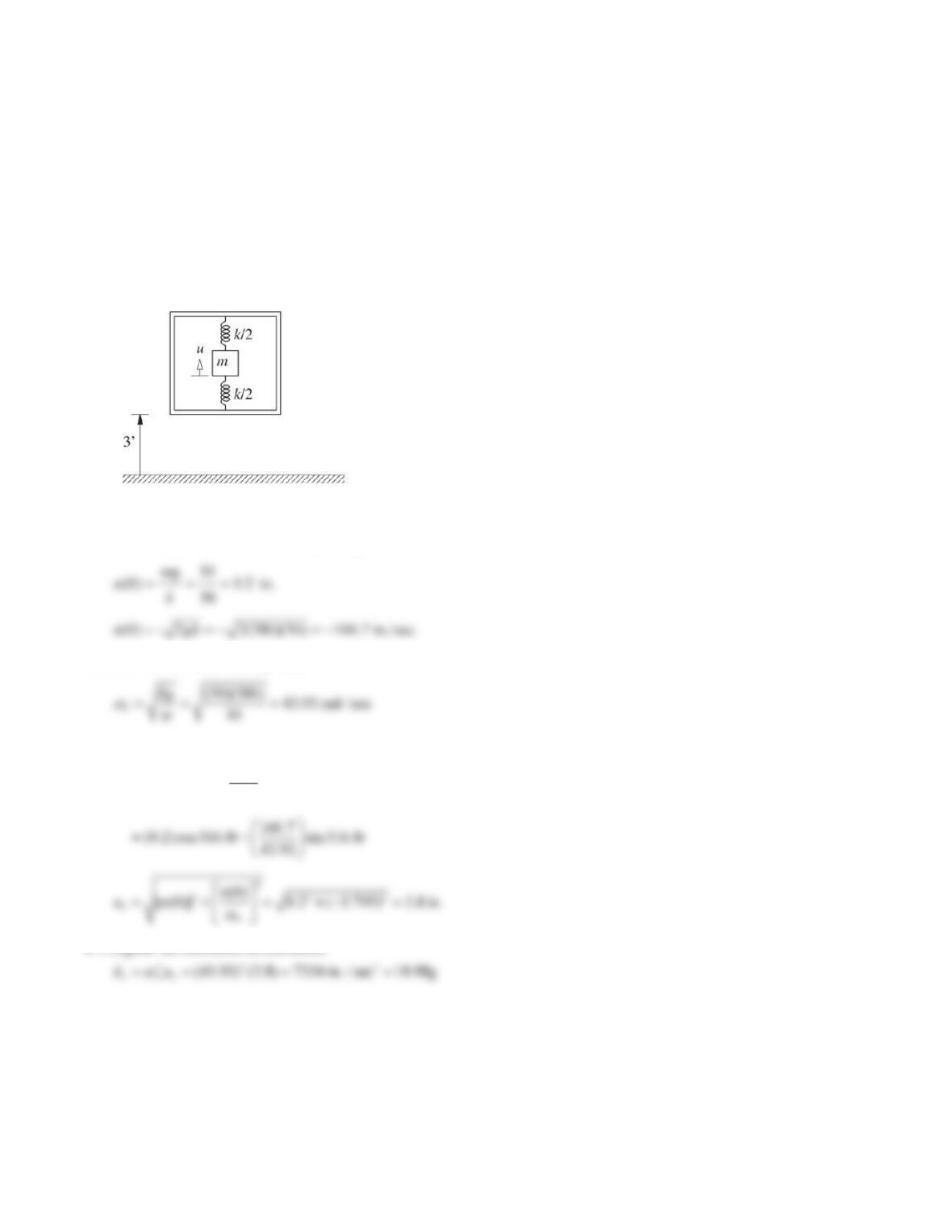
A mass m1 hangs from a spring k and is in static
Figure P2.5
Solution:
With u measured from the static equilibrium position
of m1 and k, the equation of motion after impact is
The general solution is
The initial conditions are
The initial velocity in Eq. (d) was determined by
conservation of momentum during impact:
Impose initial conditions to determine A and B:
uA
m
k
()00 2
g (e)
6
Problem 2.6
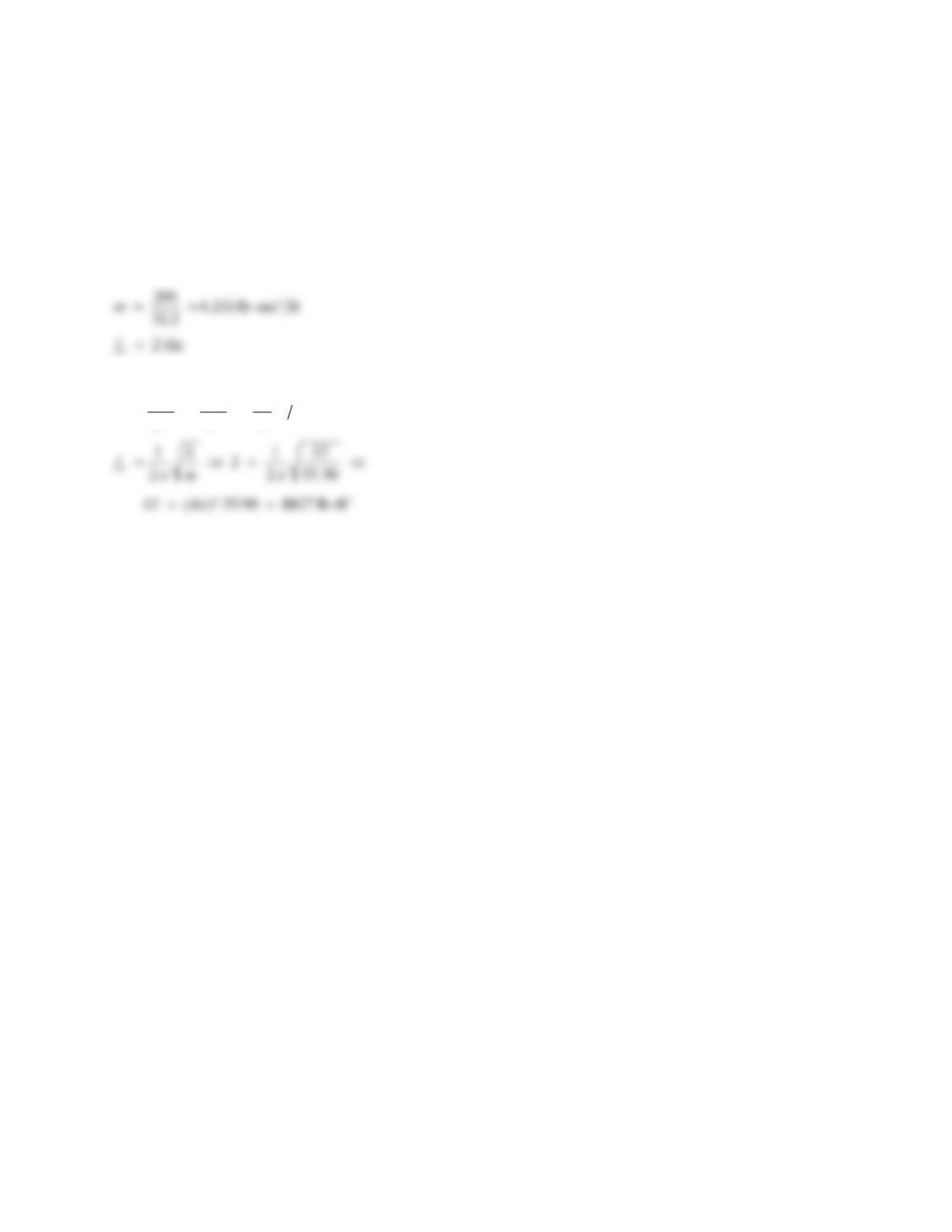
The packaging for an instrument can be modeled as shown
in Fig. P2.6, in which the instrument of mass m is
restrained by springs of total stiffness k inside a container;
m = 10 lb/g and k = 50 lb/in. The container is accidentally
dropped from a height of 3 ft above the ground. Assuming
that it does not bounce on contact, determine the maximum
deformation of the packaging within the box and the
maximum acceleration of the instrument.
Figure P2.6
Solution:
1. Determine deformation and velocity at impact.
2. Determine the natural frequency.
3. Compute the maximum deformation.
(0)
(0)cos sin
on n
n
u
uu t t
7
Problem 2.7
Consider a diver weighing 200 lb at the end of a diving
board that cantilevers out 3 ft. The diver oscillates at a
frequency of 2 Hz. What is the flexural rigidity EI of the
diving board?
Solution:
Given:
Determine EI:
kEI
L
EI EI
33
39
33 lb ft
8
initial displacement u(0) and initial velocity ݑሶ (0) is
t
n
n
etuuutu
–
})]0()0([)0({)(
Solution:
Equation of motion:
Dividing Eq. (a) through by m gives
Equation (b) thus reads
Assume a solution of the form ut e
st
() . Substituting
this solution into Eq. (c) yields
Because est is never zero, the quantity within parentheses
must be zero:
The general solution has the following form:
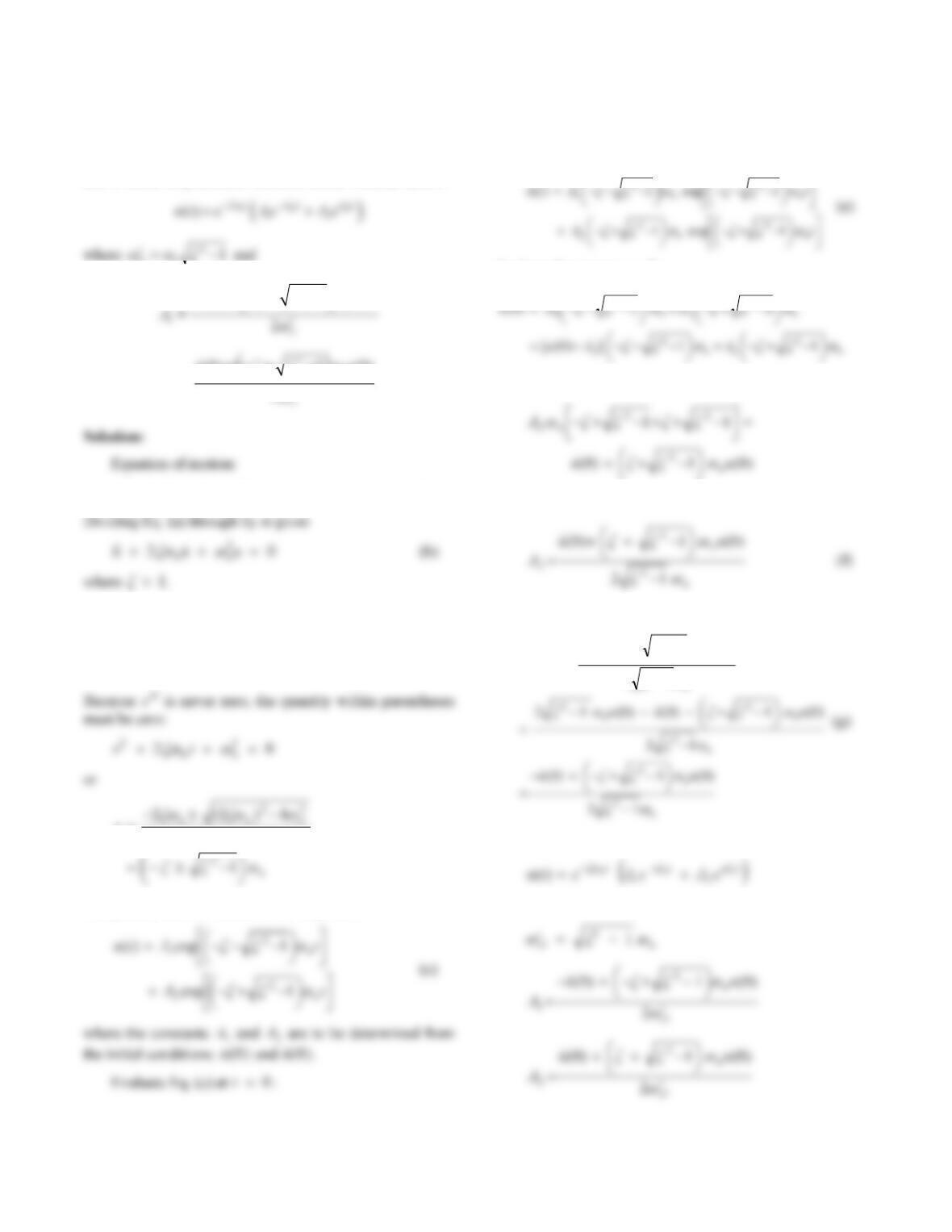
where the constants
A
1 and
A
2 are to be determined from
the initial conditions: u()0 and ()u0.
Evaluate Eq. (d) at t0:
9
Problem 2.9
Show that the motion of an overcritically damped system
due to initial displacement u(0) and initial velocity ݑሶ (0) is
Dn
2
(0) 1 (0)
n
uu
2
(0) 1 (0)
2
n
uu
A
mu cu ku
0 (a)
Assume a solution of the form ut e
st
() .
Substituting this solution into Eq. (b) yields
0)2( 22 st
nn ess
s
2
The general solution has the following form:
)0()0( 2121 uAAAAu
(d)
Differentiating Eq. (c) with respect to t gives
Evaluate Eq. (e) at t
0:
2
2
or
or
Substituting Eq. (f) in Eq. (d) gives
n
n
uu
uA
12
)0(1)0(
)0(
2
2
1
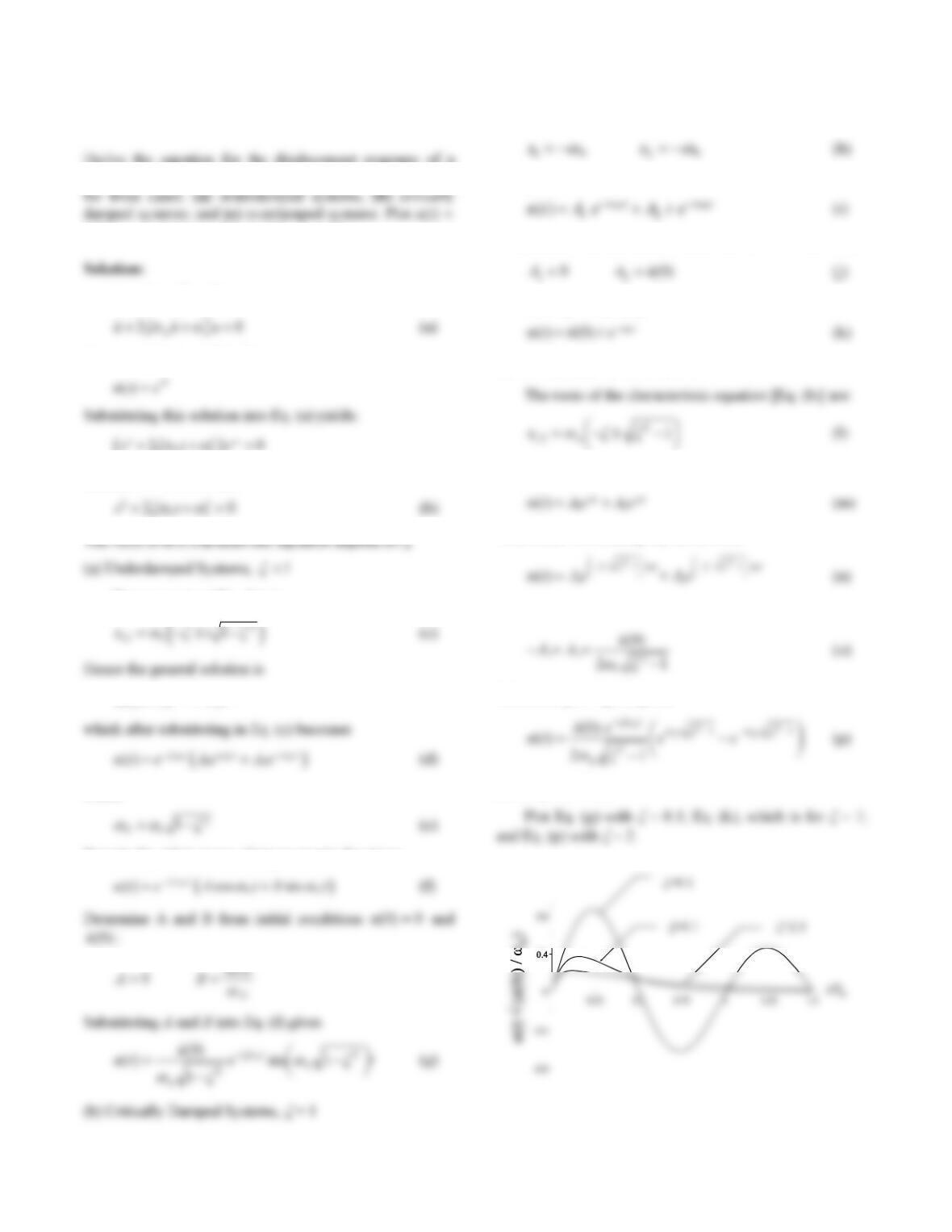
The solution, Eq. (c), now reads:
where
10
Problem 2.10
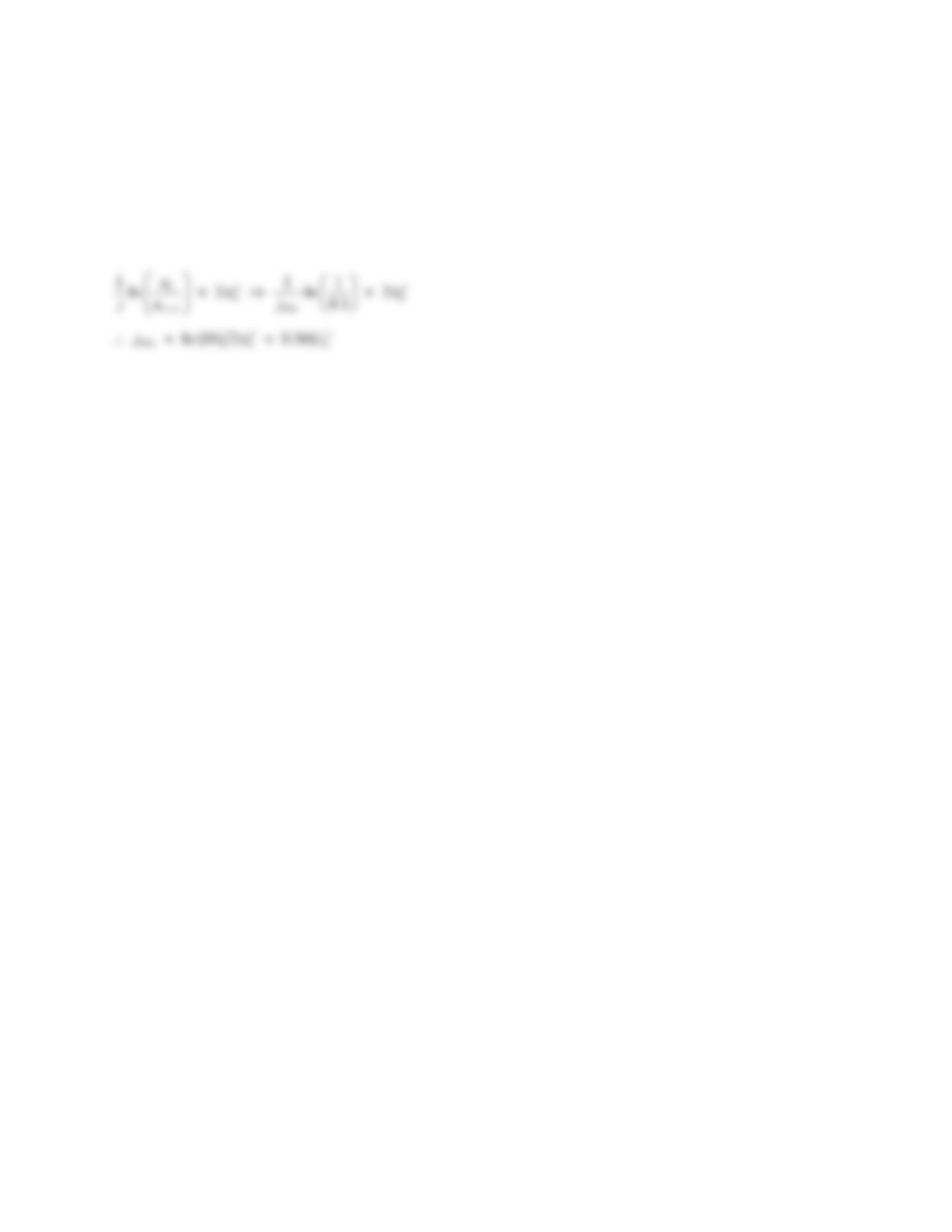
Derive the equation for the displacement response of a
viscously damped SDF system due to initial velocity ݑሶ (0)
ݑሶ (0)/ωn against t/Tn for ζ = 0.1, 1, and 2.
Equation of motion:
Assume a solution of the form
nn
Because e
s
t is never zero
The two roots of Eq. (b) are
12
()
s
tst
ut Ae Ae
where
Rewrite Eq. (d) in terms of trigonometric functions:
The roots of the characteristic equation [Eq. (b)] are:
The general solution is
Determined from the initial conditions u(0)
0 and ()u0:
Substituting in Eq. (i) gives
(c) Overdamped Systems, 1
The general solution is:
which after substituting Eq. (l) becomes
Determined from the initial conditions u()00
and ()u0:
Substituting in Eq. (n) gives
(d) Response Plots
11
Problem 2.11
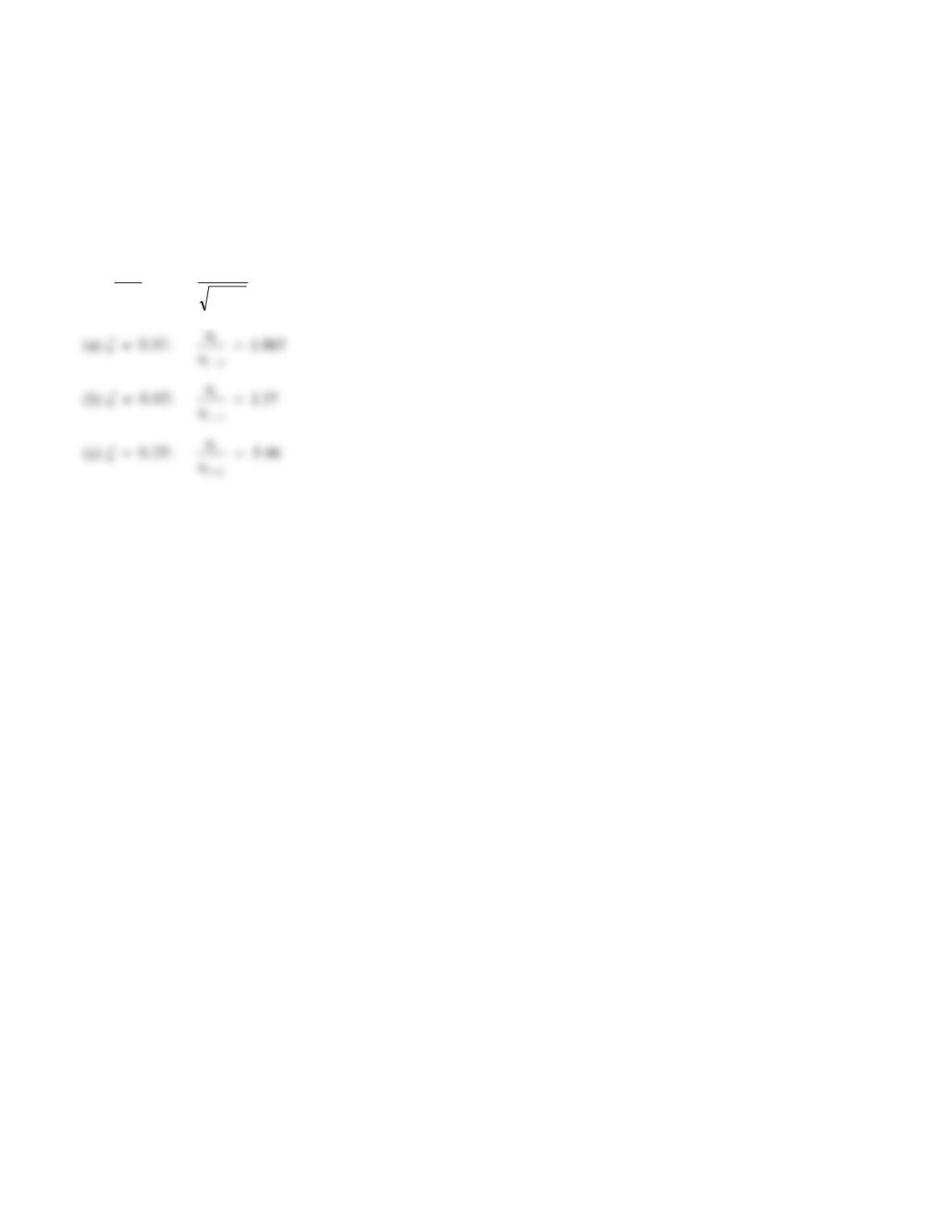
For a system with damping ratio ζ, determine the number
of free vibration cycles required to reduce the displacement
amplitude to 10% of the initial amplitude; the initial
velocity is zero.
Solution:
12
Problem 2.12
What is the ratio of successive amplitudes of vibration if
the viscous damping ratio is known to be (a) ζ = 0.01,
(b) ζ = 0.05, or (c) ζ = 0.25?
Solution:
2
11
2
exp
i
i
u
u
13
Problem 2.13
The supporting system of the tank of Example 2.6 is
enlarged with the objective of increasing its seismic
reistance. The lateral stiffness of the modified system is
double that of the original system. If the damping
coefficient is unaffected (this may not be a realistic
assumption), for the modified tank determine (a) the
natural period of vibration Tn, and (b) the damping ratio ζ.
Solution:
Given:
k = 2 (8.2) = 16.4 kips/in.
14
Problem 2.14
The vertical suspension system of an automobile is ideal-
ized as a viscously damped SDF system. Under the 3000-lb
weight of the car the suspension system deflects 2 in. The
suspension is designed to be critically damped.
(a) Calculate the damping and stiffness coefficients of the
suspension.
(b) With four 160-lb passengers in the car, what is the
effective damping ratio?
(c) Calculate the natural frequency of damped vibration for
case (b).
Solution:
(a) The stiffness coefficient is
The damping coefficient is
2
cr
cc km
(b) With passengers, the weight is w = 3640 lb. The damp-
ing ratio is
(c) The natural vibration frequency for case (b) is
2
1
Dn
15
Problem 2.15
The stiffness and damping properties of a mass–spring–
damper system are to be determined by a free vibration
test; the mass is given as m = 0.1 lb-sec2/in. In this test the
mass is displaced 1 in. by a hydraulic jack and then
suddenly released. At the end of 20 complete cycles, the
time is 3 sec and the amplitude is 0.2 in. Determine the
stiffness and damping coefficients.
Solution:
1. Determine
and
n.
Therefore the assumption of small damping implicit in the
above equation is valid.
2. Determine stiffness coefficient.
3. Determine damping coefficient.
16
Problem 2.16
A machine weighing 250 lb is mounted on a supporting
system consisting of four springs and four dampers. The
vertical deflection of the supporting system under the
weight of the machine is measured as 0.8 in. The dampers
are designed to reduce the amplitude of vertical vibration
to one-eighth of the initial amplitude after two complete
cycles of free vibration. Find the following properties of
the system: (a) undamped natural frequency, (b) damping
ratio, and (c) damped natural frequency. Comment on the
effect of damping on the natural frequency.
Solution:
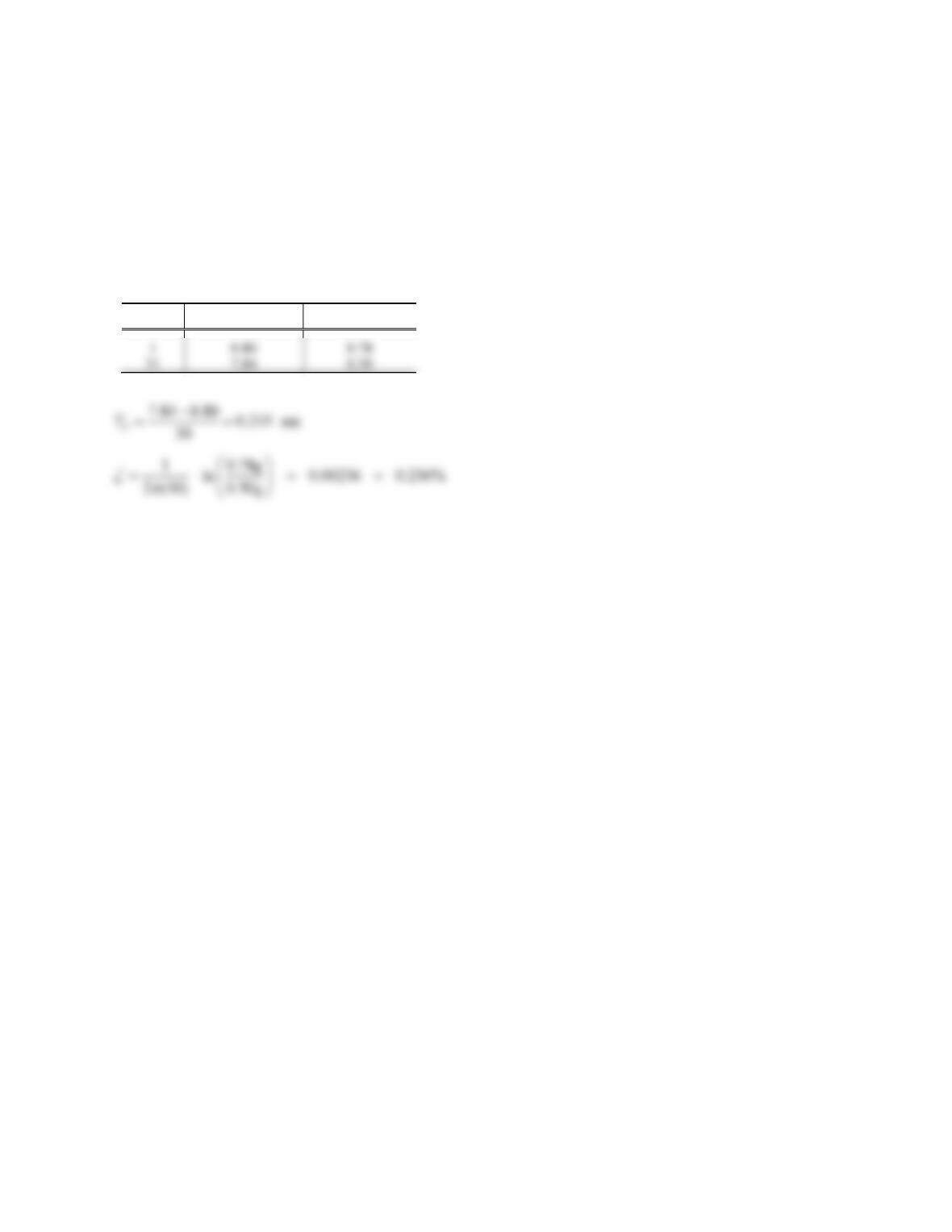
(a) in.lbs 5.312
8.0
250
k
(b) Assuming small damping,
This value of
may be too large for small damping
assumption; therefore we use the exact equation:
or,
17
Problem 2.17
Determine the natural vibration period and damping ratio
of the aluminum frame model (Fig. 1.1.4a) from the
acceleration record of its free vibration shown in Fig.
1.1.4b.
Solution:
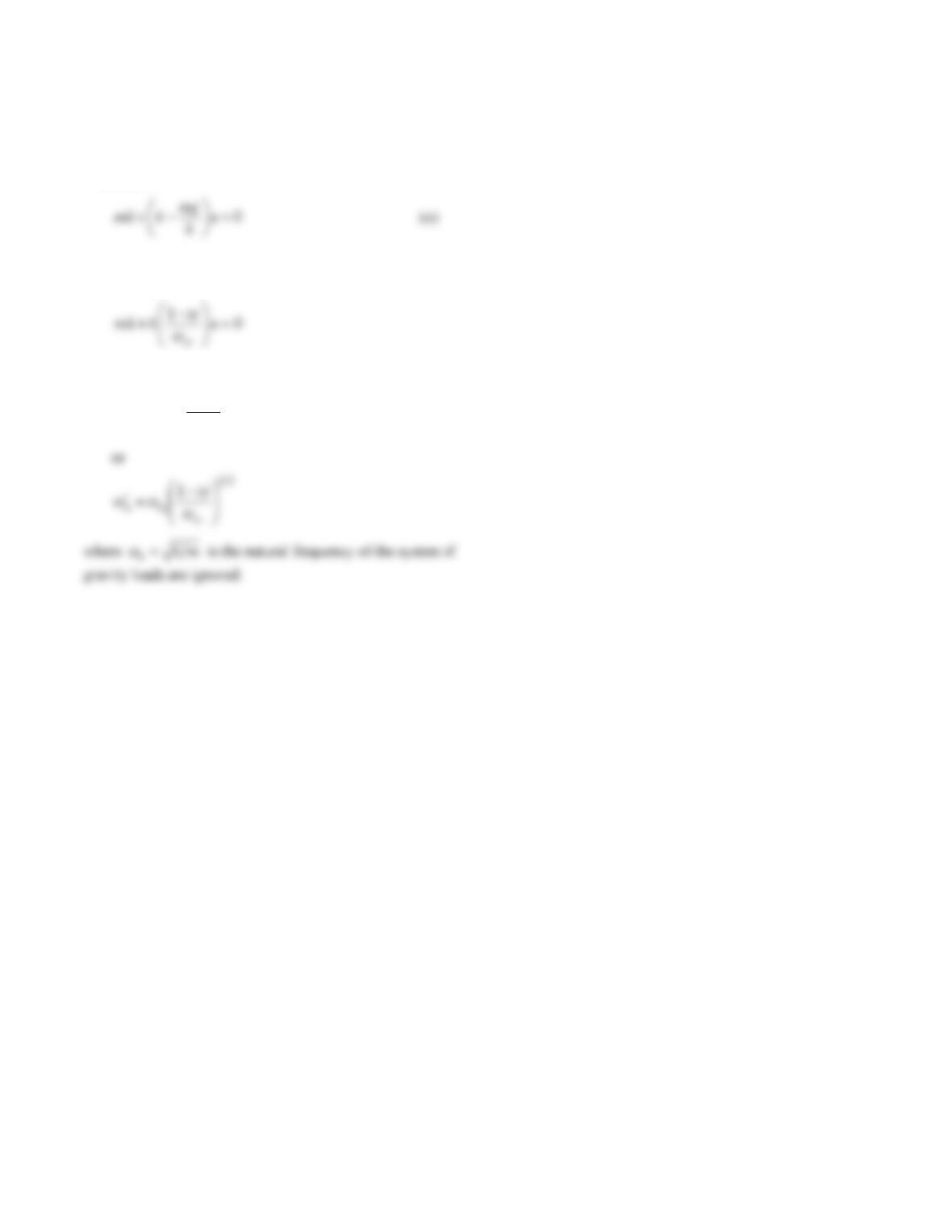
Reading values directly from Fig. 1.1.4b:
Peak Time, ti(sec) Peak,
ui(g)
18
Problem 2.18
The equation of motion for the system of E1.6a is
available:
Recalling that the buckling weight,
cr
wkh
, Eq. (a)
can be rewritten as
The natural frequency n
of this system is given by
21
n
cr
w
km
w
19
Problem 2.19
An impulsive force applied to the roof slab of the building
of Example 2.8 gives it an initial velocity of 20 in./sec to
the right. How far to the right will the slab move? What is
the maximum displacement of the slab on its return swing
to the left?
Solution:
For motion of the building from left to right, the
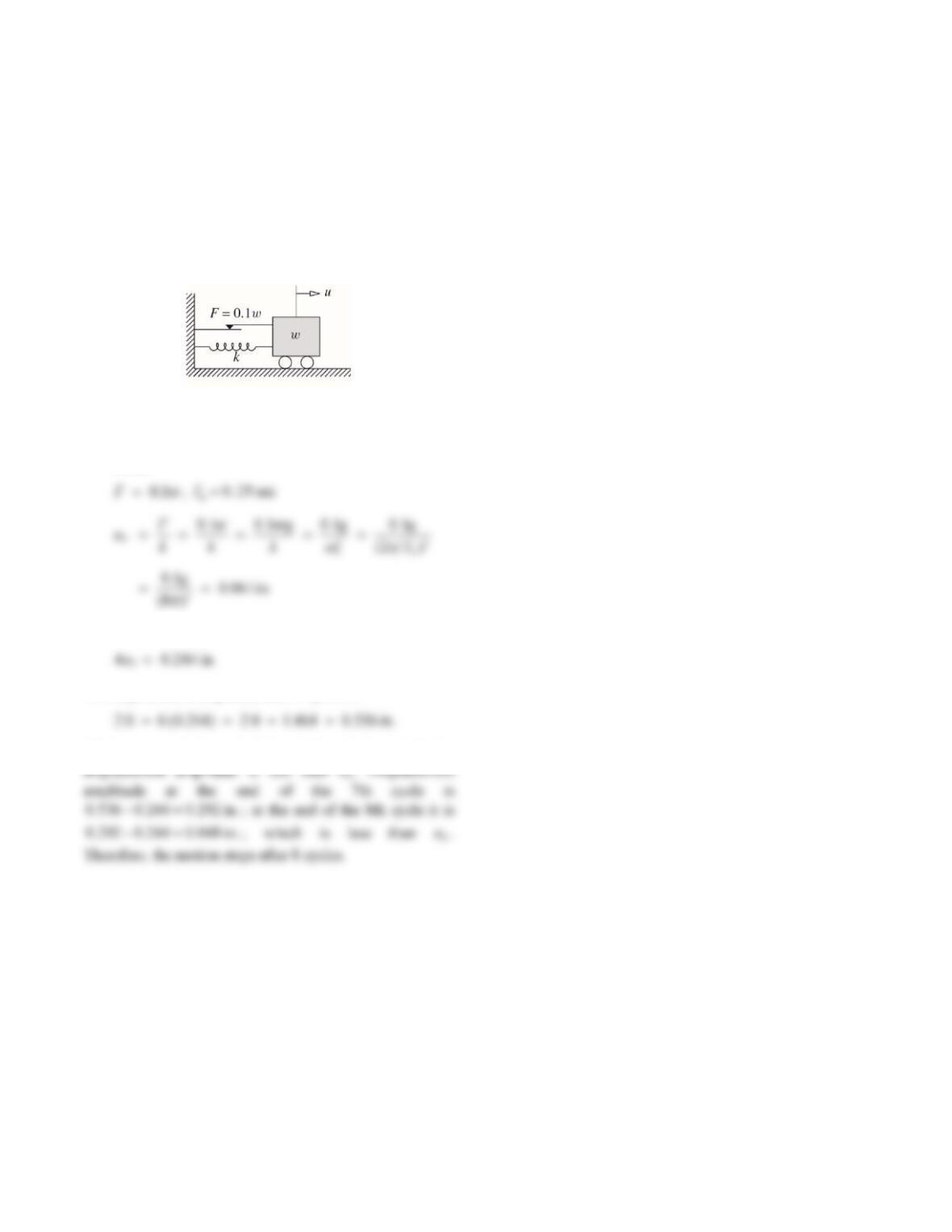
governing equation is
With initial velocity of ()u0 and initial displacement
u()00, the solution of Eq. (b) is
F
At the extreme right, ()ut 0; hence from Eq. (d)
Substituting
n4, u
F
015.in.
, and ()u0
20 in. sec in Eq. (e) gives
Substituting Eq. (f) in Eq. (c) gives the displacement to the
right:
After half a cycle of motion the amplitude decreases by
F
20
Problem 2.20
An SDF system consisting of a weight, spring, and friction
device is shown in Fig. P2.20. This device slips at a force
equal to 10% of the weight, and the natural vibration
period of the system is 0.25 sec. If this system is given an
initial displacement of 2 in. and released, what will be the
displacement amplitude after six cycles? In how many
cycles will the system come to rest?
Figure P2.20
Solution:
Given:
The reduction in displacement amplitude per cycle is
The displacement amplitude after 6 cycles is
Motion stops at the end of the half cycle for which the