1
CHAPTER 8
Repeat parts (a), (b), and (c) of Example 8.1 with one
change: Use the horizontal displacement at C as the gener-
alized coordinate. Show that the natural frequency, damp-
Solution:
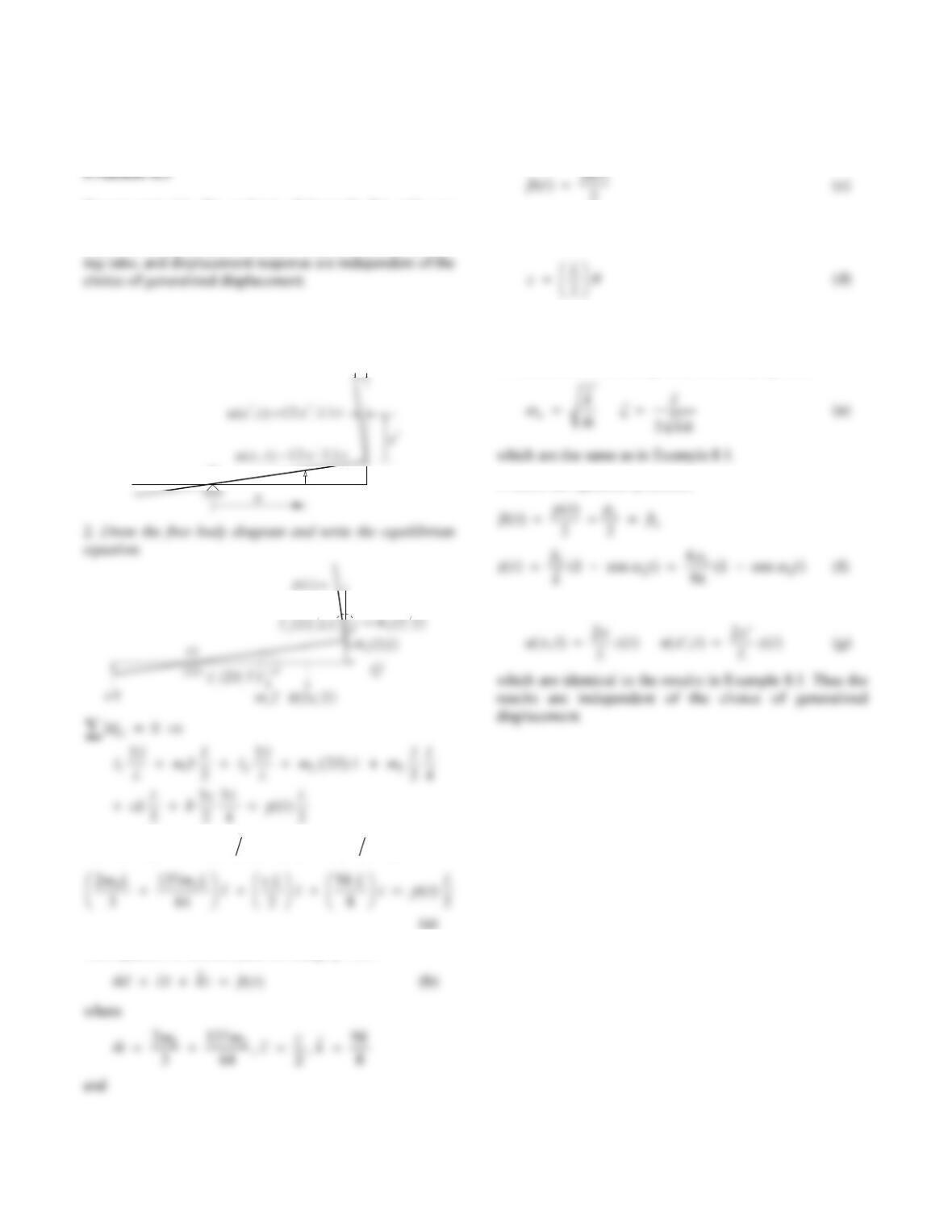
1. Determine the shape function.
O
z
Substituting ImL
11
212 and ImL
22
2128 gives
The equation of motion (after dividing by L) is
The relation between z and the rotation
about fulcrum O
is
Substituting Eq. (d) into Eq. (a) leads to the same equation
of motion as in Example 8.1.
3. Determine natural frequency and damping ratio.
4. Solve the equation of motion.
5. Determine displacements.
2
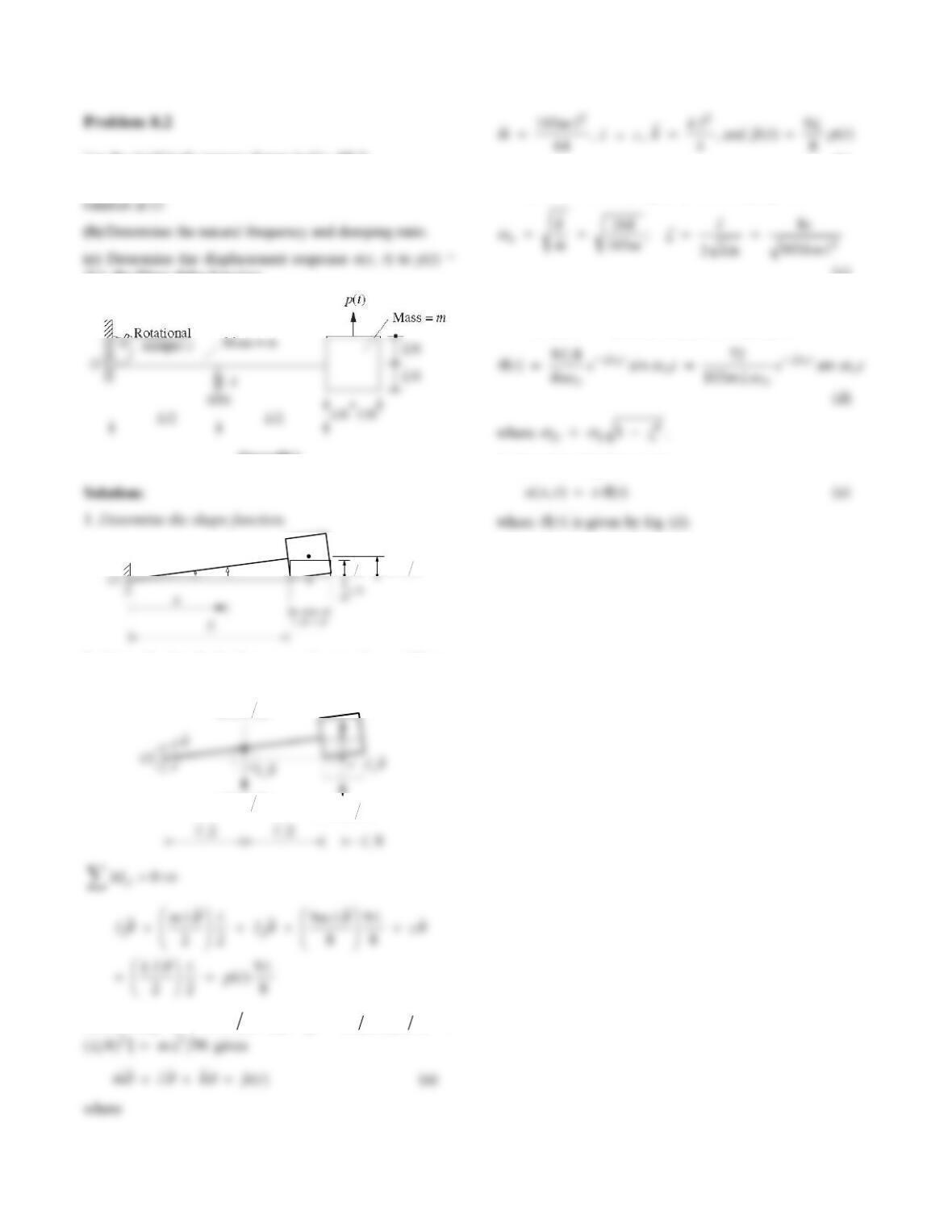
For the rigid-body system shown in Fig. P8.2:
(a) Formulate the equation of motion governing the
δ(t), the Dirac delta function.
Figure P8.2
uxtx(,)
L8
L8
9
2. Draw the free body diagram and write the equilibrium
equation.
pt
()
k2
()
L
m2
()
L
9
m8
()
L
Substituting ImL
1
212 and Im L
2
2
12 4()[()
(b)
3. Determine natural frequency and damping ratio.
(c)
4. Solve the equation of motion.
For pt t() ()
, the solution of Eq. (a) is
5. Determine displacements.
3
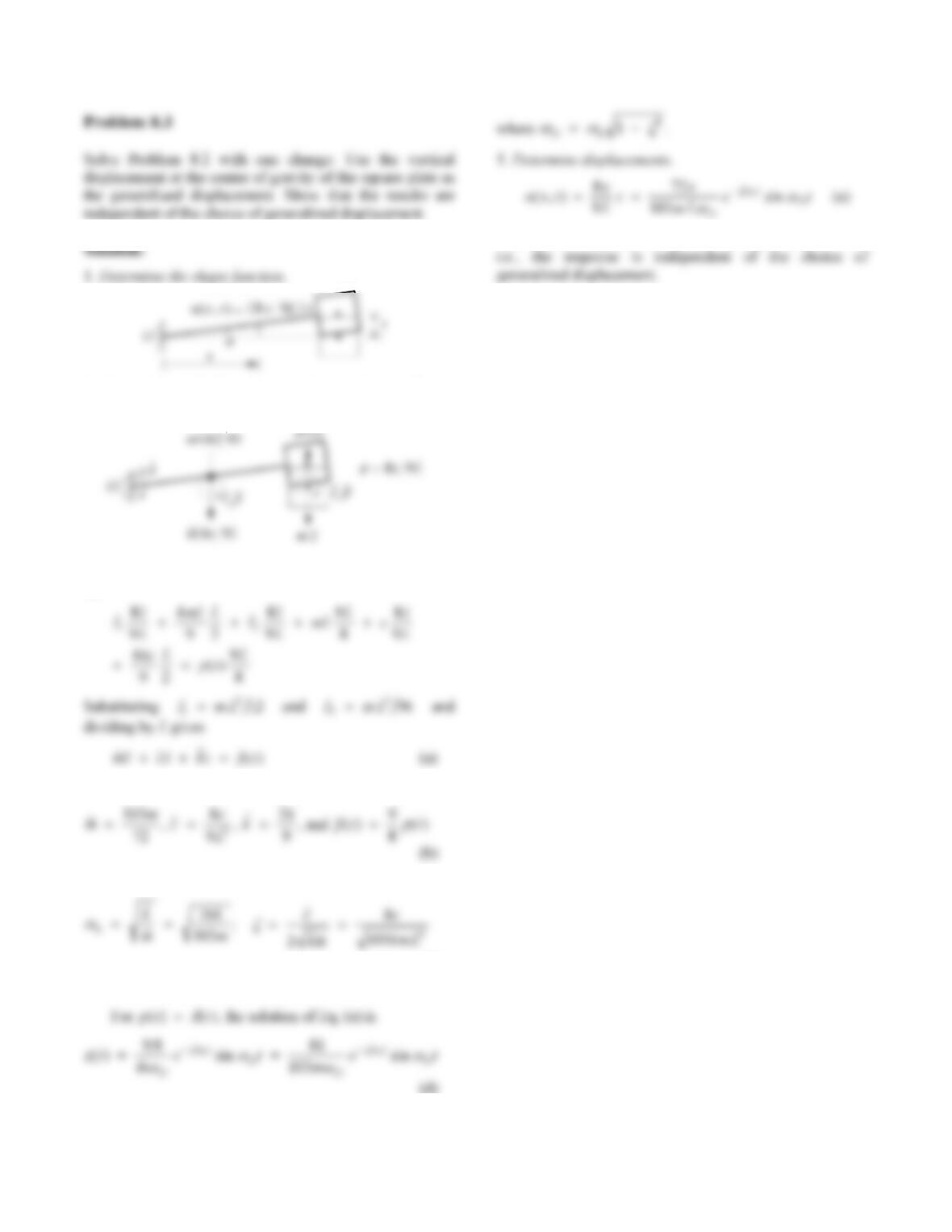
2. Draw the free body diagram and write the equilibrium
equation.
MO
0
where
3. Determine natural frequency and damping ratio.
(c)
4. Solve the equation of motion.
This result is identical to Eqs. (d) and (e) in Problem 8.2,
4
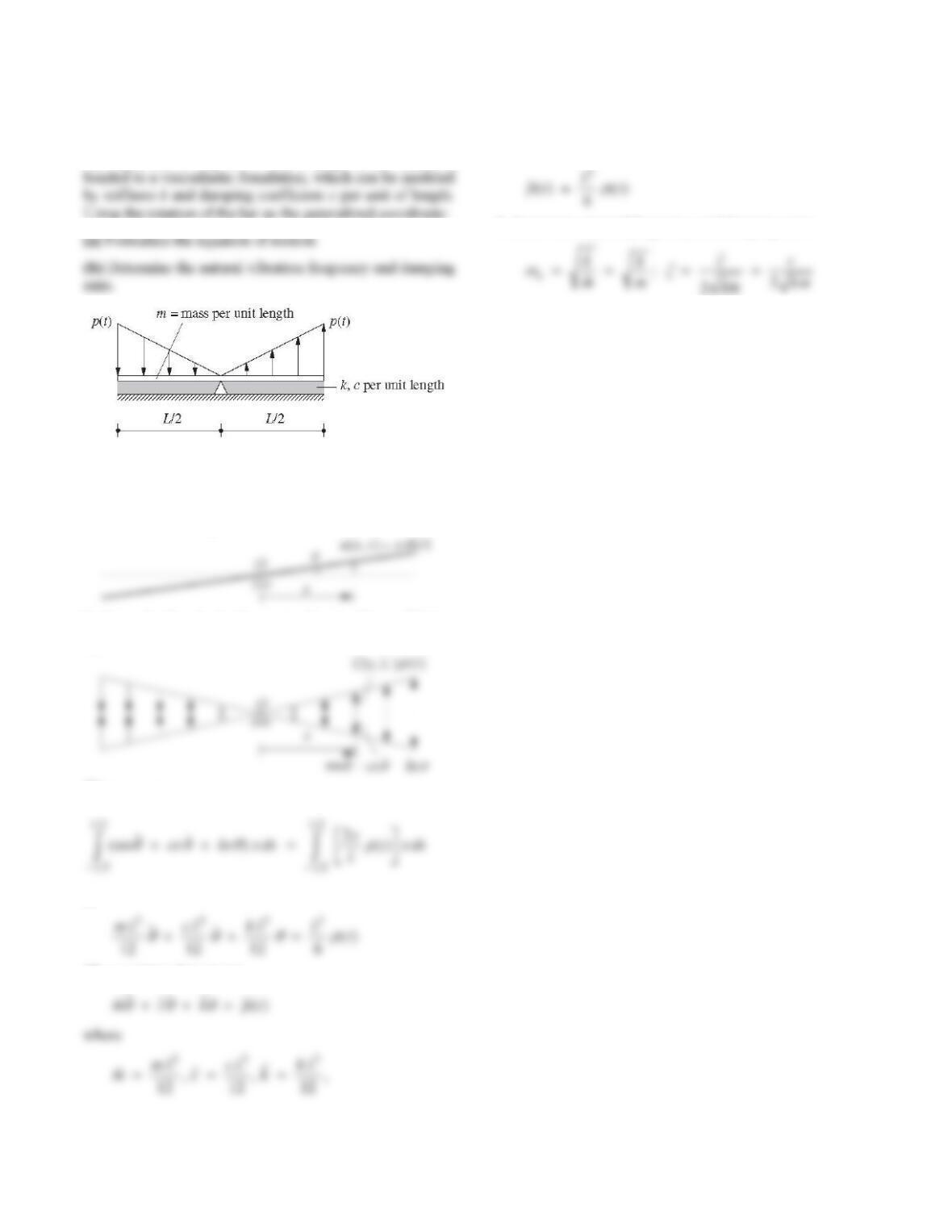
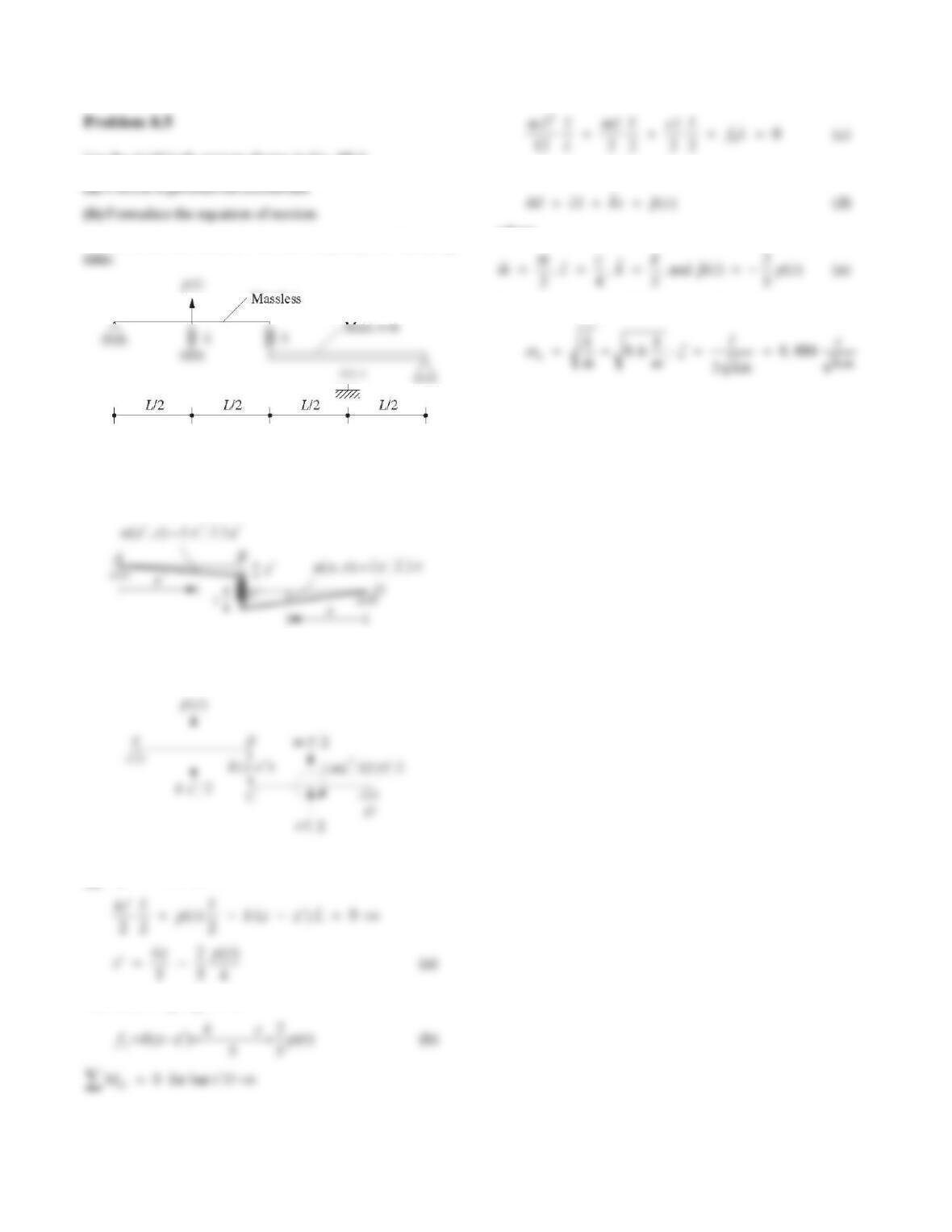
Problem 8.4
The rigid bar in Fig. P8.4 with a hinge at the center is
Figure P8.4
Solution:
1. Determine the shape function.
2. Draw the free body diagram and write the equilibrium
equation.
MO
0
or
The equation of motion is
and
3. Determine natural frequency and damping ratio.
5
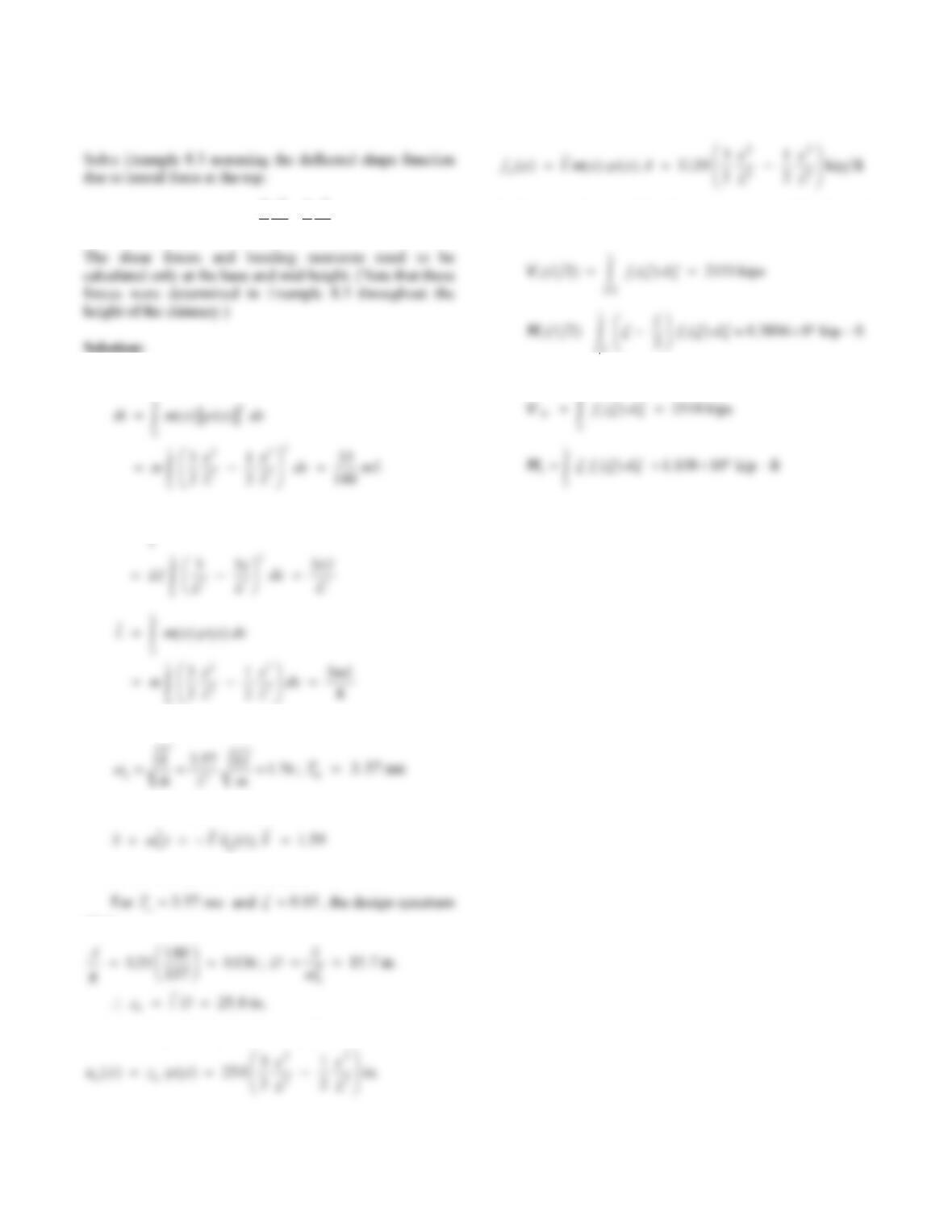
For the rigid-body system shown in Fig. P8.5:
(c) Determine the natural vibration frequency and damping
Figure P8.5
Solution:
1. Determine the shape function.
2. Draw the free body diagram and write the equilibrium
equation.
MA
0 for bar AB
The force in spring BC is
Substituting Eq. (b) in Eq. (c) gives
where
3. Determine natural frequency and damping ratio.
6
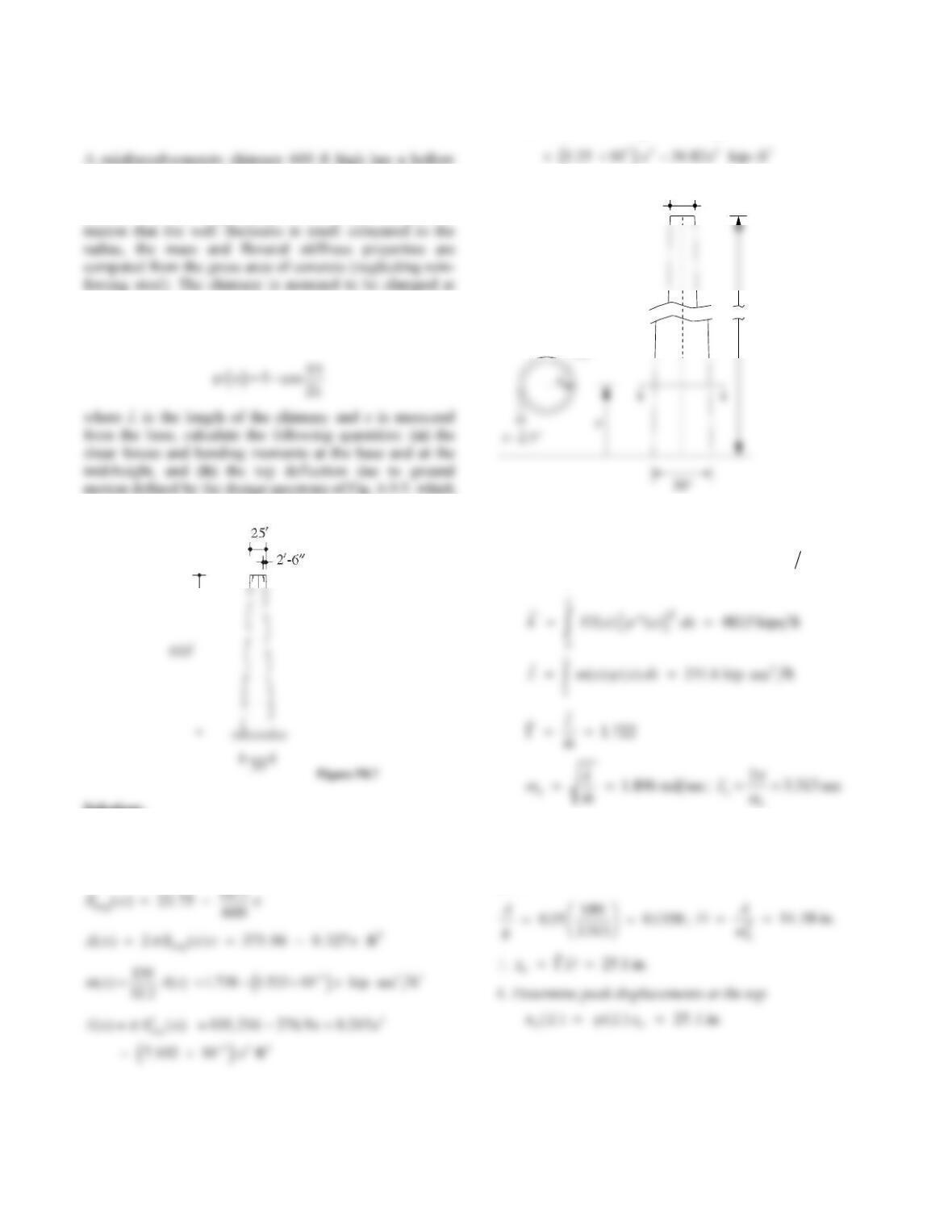
Problem 8.6
23
23
31
22
x
x
xLL
1. Determine the generalized properties.
2
() ()
L
kEIxxdx
2. Determine the natural period.
3. Formulate the equation of motion.
4. Determine the peak value of zt()
.
gives
A
5. Determine peak displacements of the tower.
6. Determine equivalent static forces.
7. Compute shear and bending moment at mid-height and
at the base.
L
7
Problem 8.7
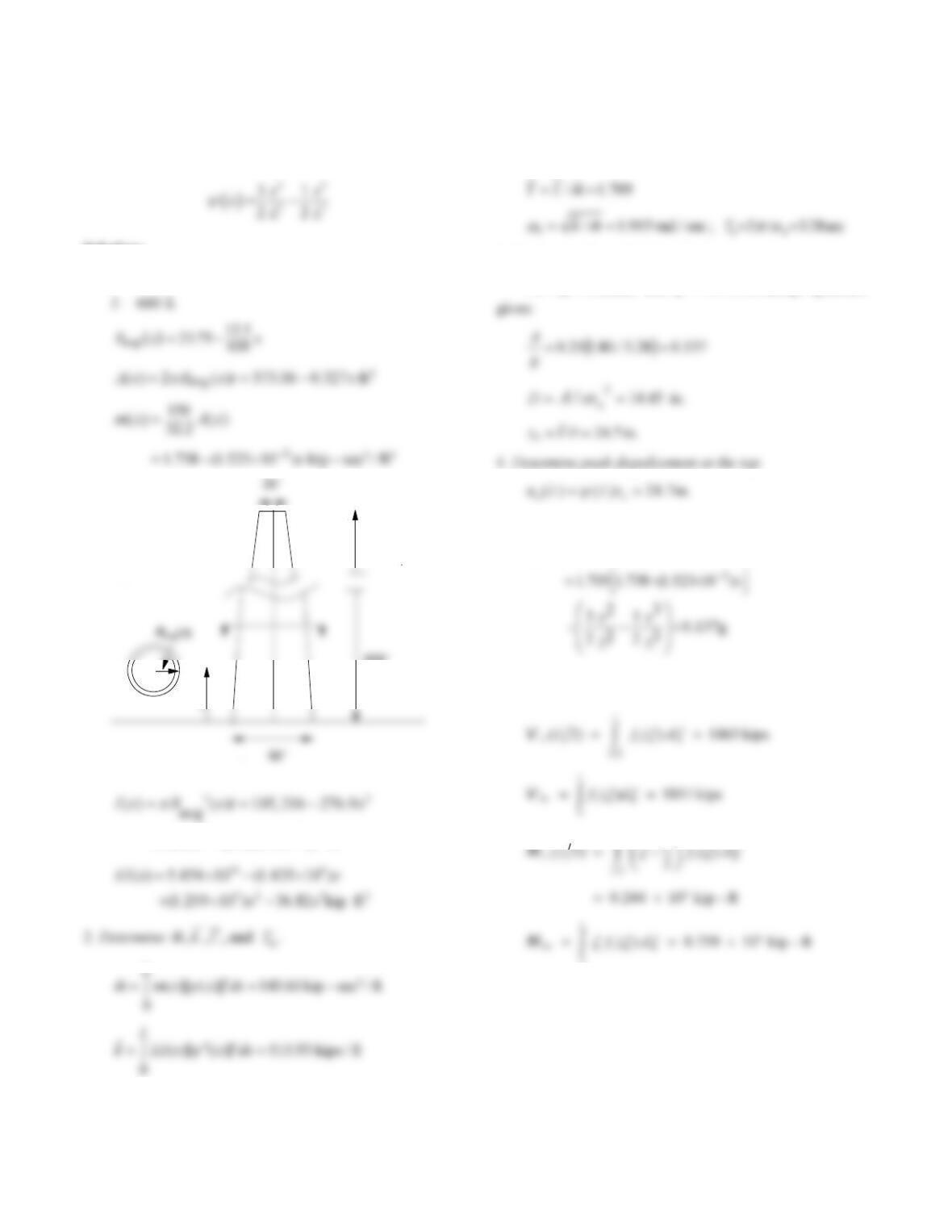
A reinforced–concrete chimney 600 ft high has a hollow
circular cross section with outside diameter 50 ft at the
base and 25 ft at the top; the wall thickness is 2 ft 6 in.,
uniform over the height (Fig. P8.7). Using the approxi-
the base, and its damping ratio is estimated to be 5%. The
unit weight of concrete is 150 lb/ft3, and its elastic modulus
Ec = 3600 ksi. Assuming that the shape function is
is scaled to a peak acceleration of 0.25g.
Solution:
1. Determine properties of the chimney.
L
600 f
t
I
L
L
z
10 8
( ) 5.454 10 1.435 10
EI x x
600‘
25‘
R (x)
avg
2. Determine
m,
k
,
and
T
n.
22
0
() () 134.5kip–sec ft
L
mmxxdx
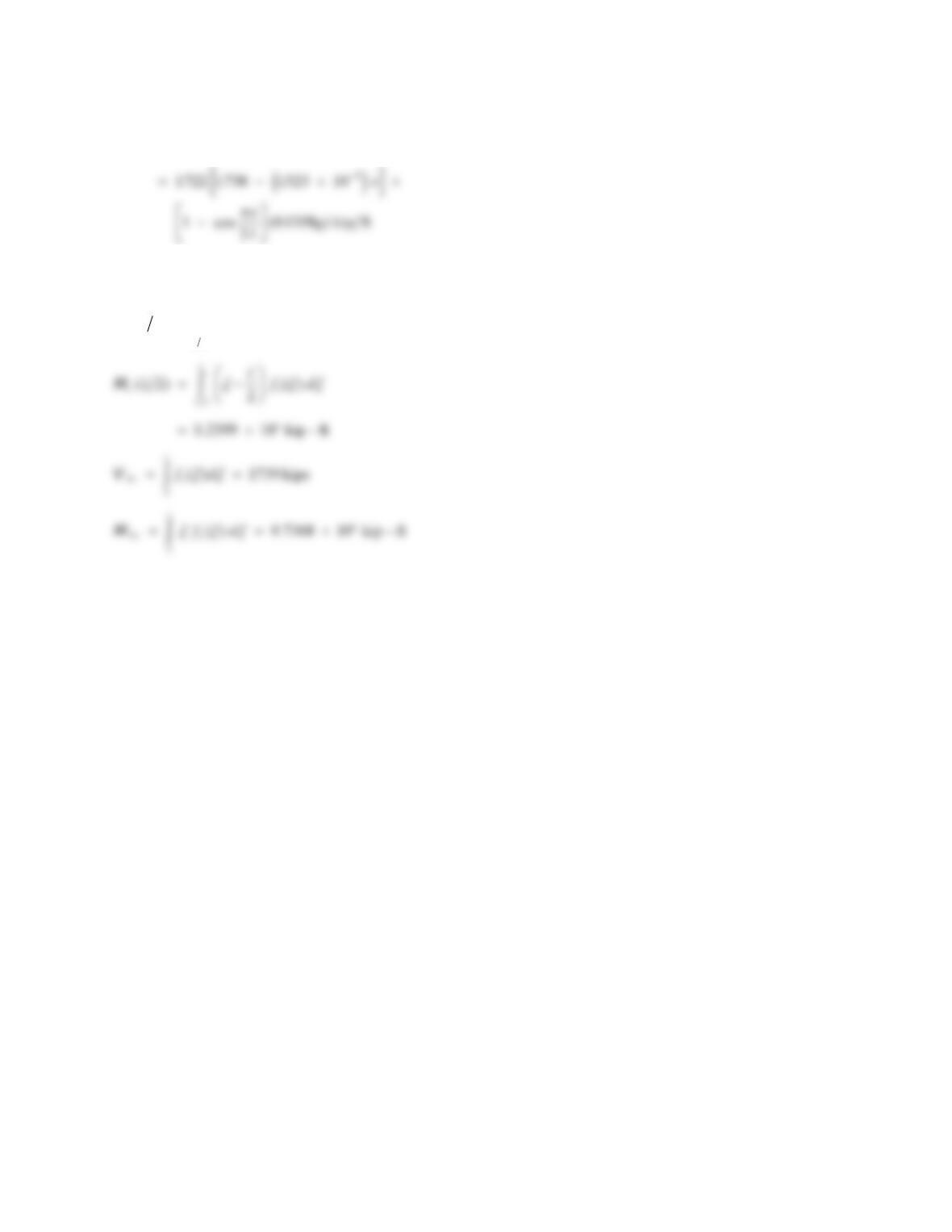
3. Determine the peak value of zt()
.
For 3.313 sec
n
T
and 0.05
, the design spectrum
gives
8
5. Determine equivalent static forces.
fx mx xA
o() ~() ()
6. Determine shear and bending moment at mid-height and
at the base.
2
( 2) ( ) 1426 kips
L
oo
L
Lfd
V
9
Problem 8.8
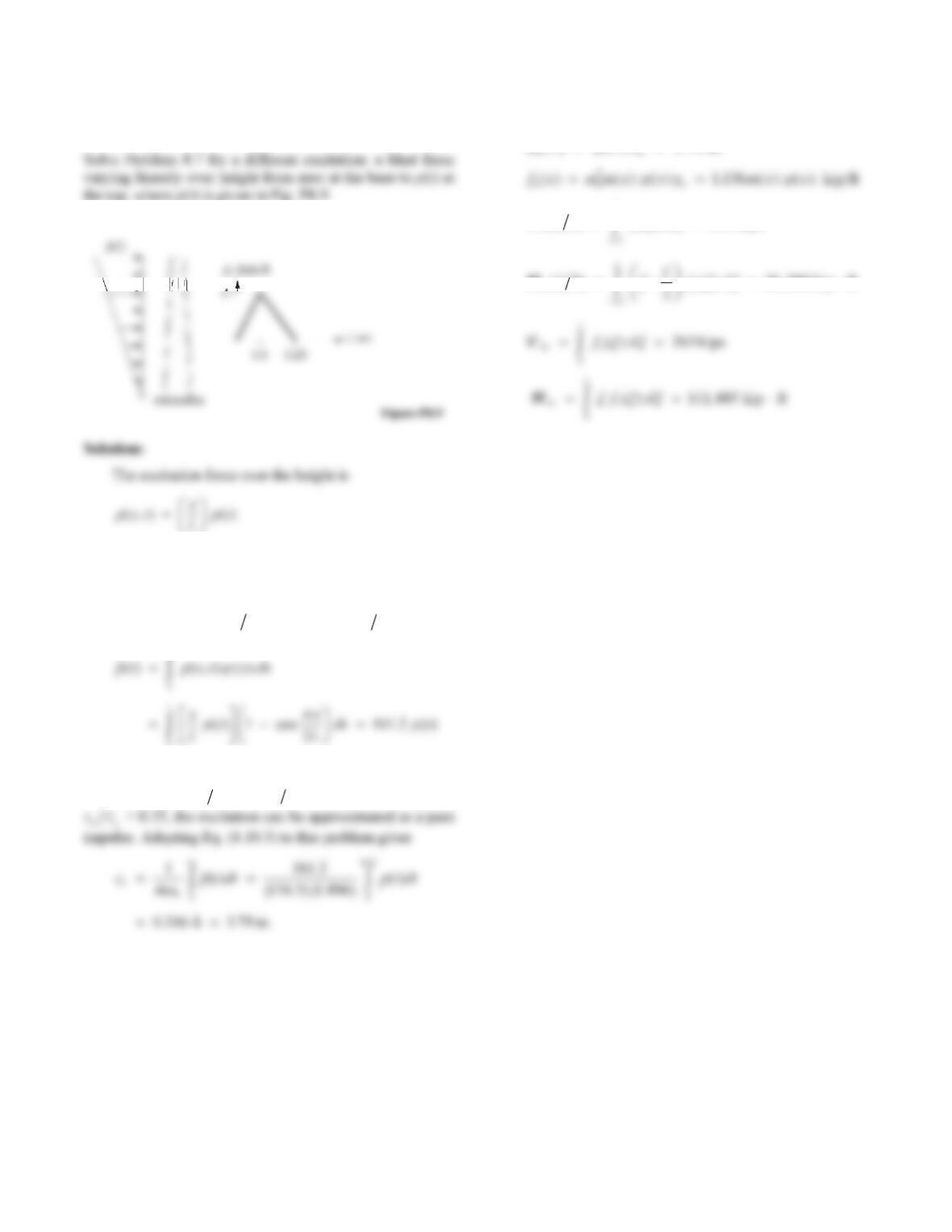
Solve Problem 8.7 asssuming that the shape function is
Solution:
1. Determine properties of the chimney.
4253
0.243 (7.102 10 ) ft
xx
2
( ) ( ) 240.27 kip – sec / ft
0
L
Lmxxdx
3. Determine the peak value of z(t).
For 3.28sec
n
T
and 0.05
, the design spectrum
5. Determine equivalent static forces.
() () ()
o
fx mx xA
6. Determine shear and bending moment at mid-height and
at base.
L
L
0
x
600‘
10
Problem 8.9
1. Formulate equation of motion.
()mz k z p t
2
134.5 kip-sec ftm
; 483.5 kips ftk
L
2. Solve the equation of motion.
Note that
t
T
dn
0 25 3 313 0 075.. .
. Because
t
T
3. Determine peak responses.
u
L
L
z
() () .
379in.
( 2) ( ) 216 kips
L
oo
Lfd
V
(2) () 36,290kip–ft
oo
Lfd
M
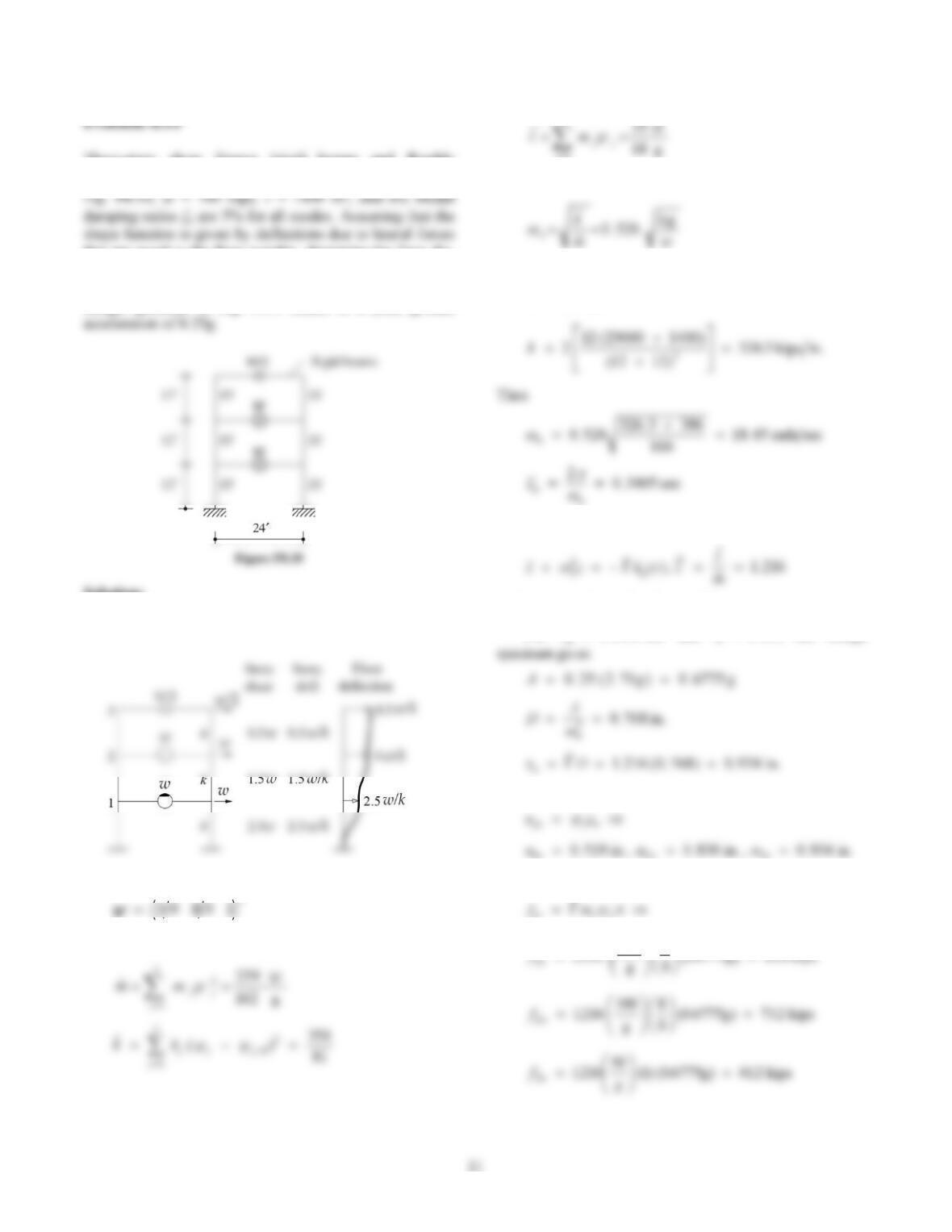
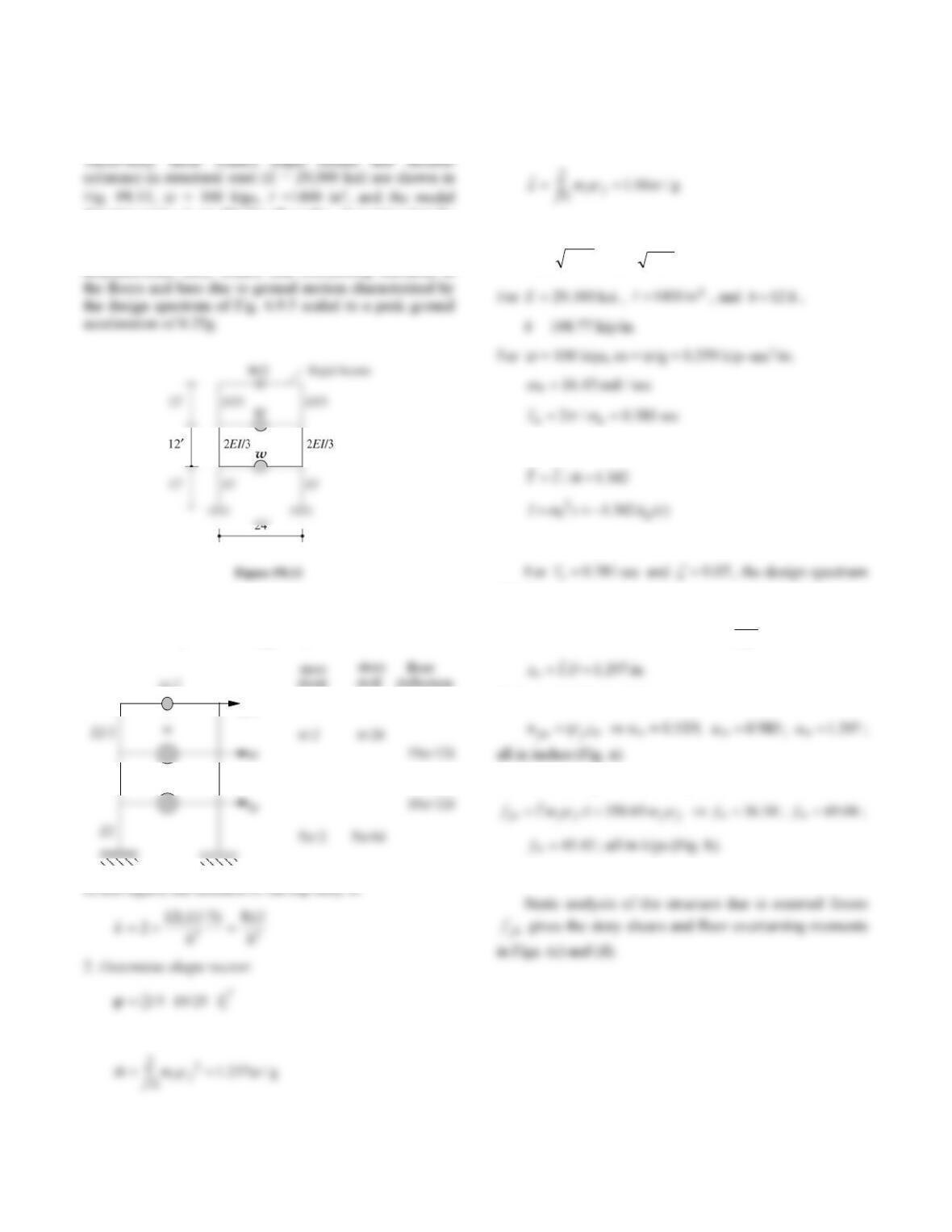
Three-story shear frames (rigid beams and flexible
columns) in structural steel (E = 29,000 ksi) are shown in
that are equal to the floor weights, determine the floor dis–
placements, story shears, and overturning moments at the
floors and base due to ground motion characterized by the
design spectrum of Fig. 6.9.5 scaled to a peak ground
Solution:
1. Determine the shape function.
z
Shape vector:
2. Determine generalized properties.
1
j
3. Determine the natural period.
where
kips100
w
4. Determine the equation of motion.
5. Determine the peak value of zt()
.
For
T
0 3405. sec and
005., the design
6. Determine floor displacements.
7. Determine equivalent static forces.
F
I
F
I
F
I
F
I
F
I
12
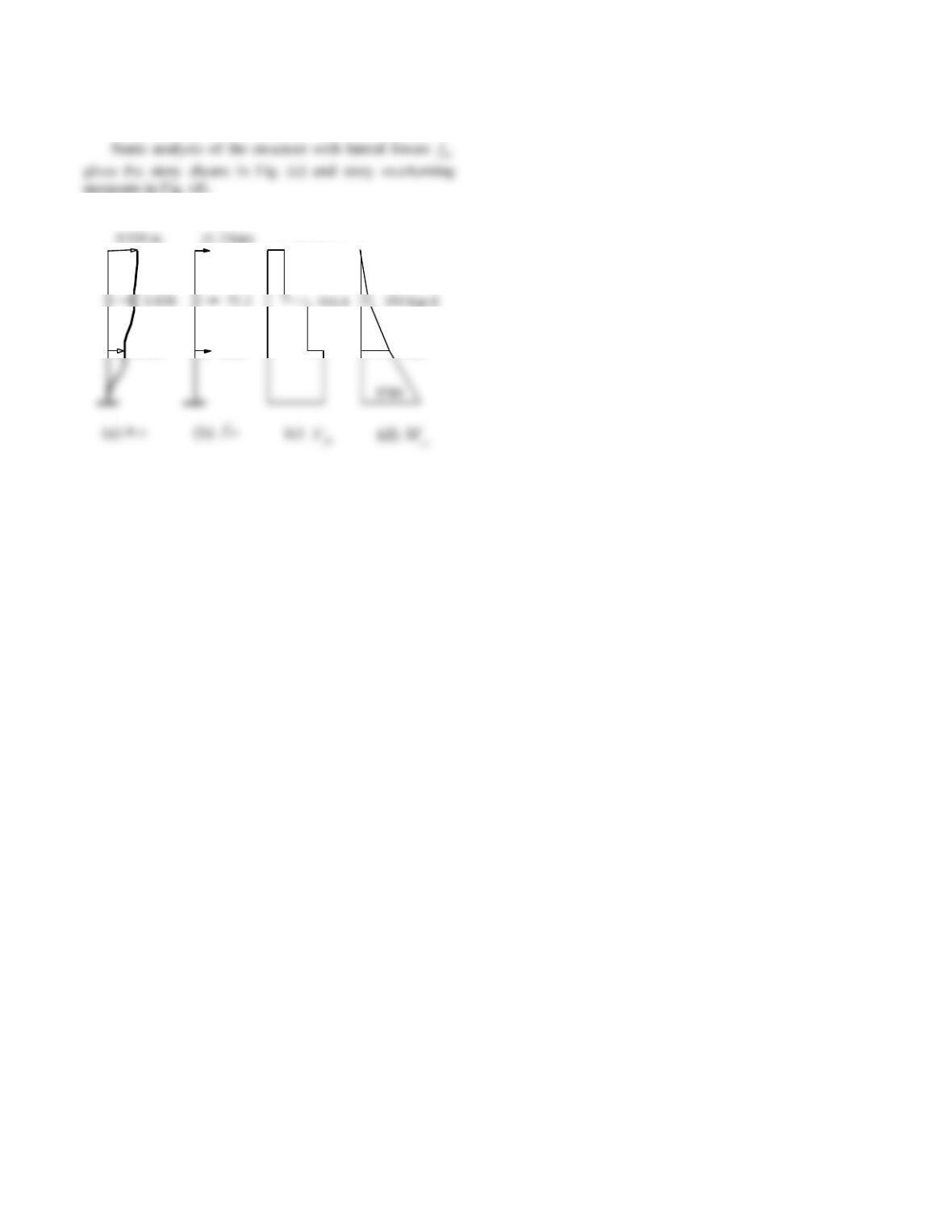
8. Determine story shears and overturning moments.
0.519
45. 8
41. 2 kips
160.2
1867
13
Problem 8.11
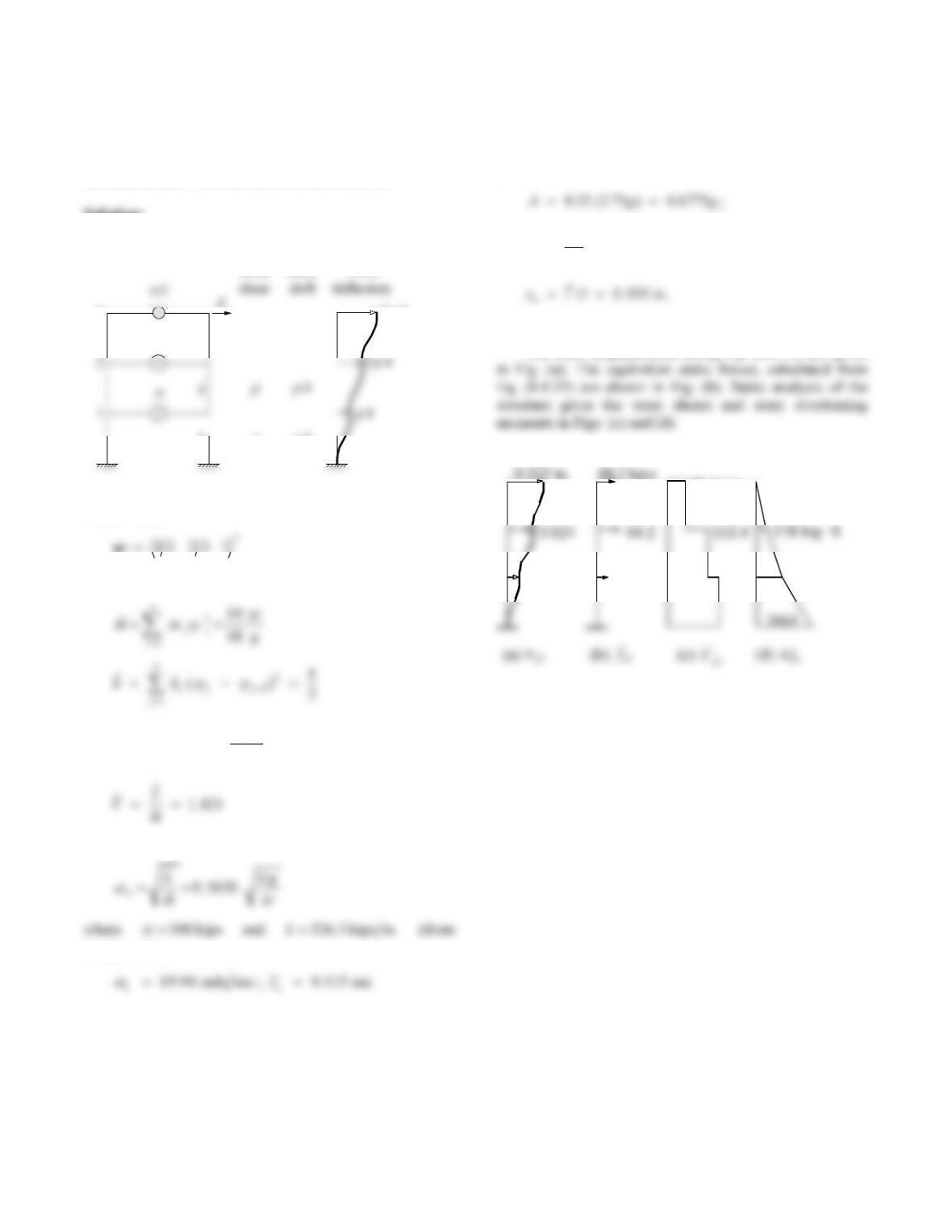
damping ratios ζn are 5% for all modes. Assuming that the
shape function is given by deflections due to lateral forces
that are equal to the floor weights, determine the floor
displacements, story shears, and overturning moments at
Solution:
1. Determine deflections to applied forces.
3. Determine generalized properties.
~().kk k
j
jjj
1
3
1
20797
4. Determine the natural period.
nkm km
~
/~./0 803
5. Determine the equation of motion.
6. Determine the peak value of z(t).
gives:
/ 2.71 0.25 0.677Ag
; 20.966 in.
n
A
D
7. Determine floor displacements.
k
k
E
8. Determine equivalent static forces.
k
k
9. Determine story forces.
shear
3w/2
drif
t
3w/4
k
deflectio
n
25w/12
k
w/2
w/2
w
2EI/3

14
s
0.52
0.99
15
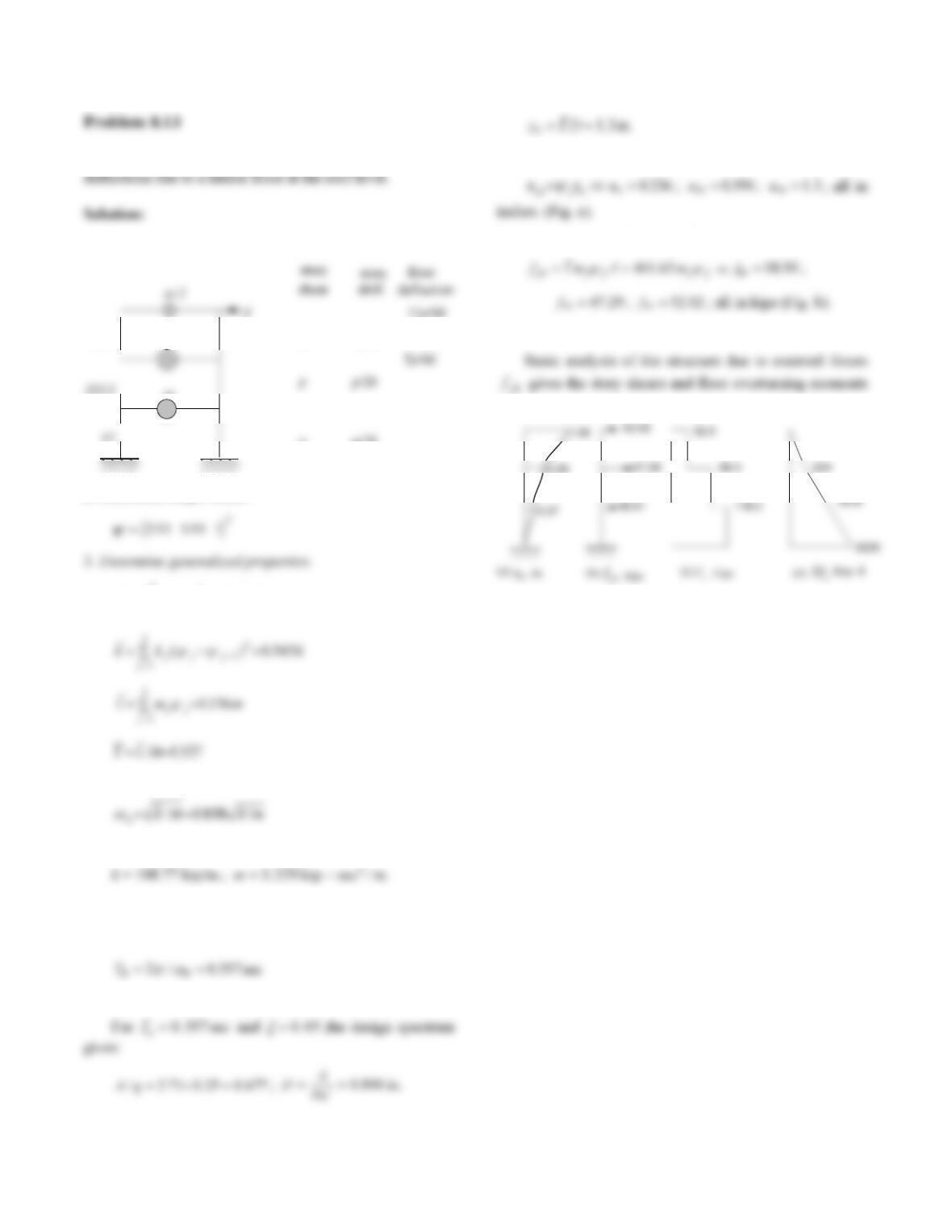
Problem 8.12
Solve Problem 8.10 using the shape function given by
deflections due to a lateral force at the roof level.
Solution:
1. Determine the shape function.
Shape vector:
2. Determine generalized properties.
g2
3
~3
1
w
j
jj
mL
3. Determine the natural period.
Problem 8.9).
4. Determine the peak value of zt()
.
For 0.315 sec
n
T
and 0.05
, the design spectrum
gives
20.6577 in.
n
A
D
5. Determine peak responses.
The floor displacements using Eq. (8.4.14) are given
0.312
32.1
48.2 kips
144.5
1927
3
k
k
Story
Story
p/k
p/k
Floor
3p/k
p
p
w
w
16
Solve Problem 8.11 using the shape function given by
1. Determine deflections due to applied forces.
2. Determine shape vector:
M
g/739.0
~3
1
2w
jjj
mm
4. Determine the natural period.
From Problem 8.11:
Substituting in above equation:
n17 58.rad/sec
5. Determine the peak value of z(t).
6. Determine the peak responses.
7. Determine equivalent static forces.
p
8. Determine story forces.
p
p
in Figs. (c) and (d).
p
p
p
/k
11p/6k
2p/6k
w
w
E
I/3
2EI/3