17
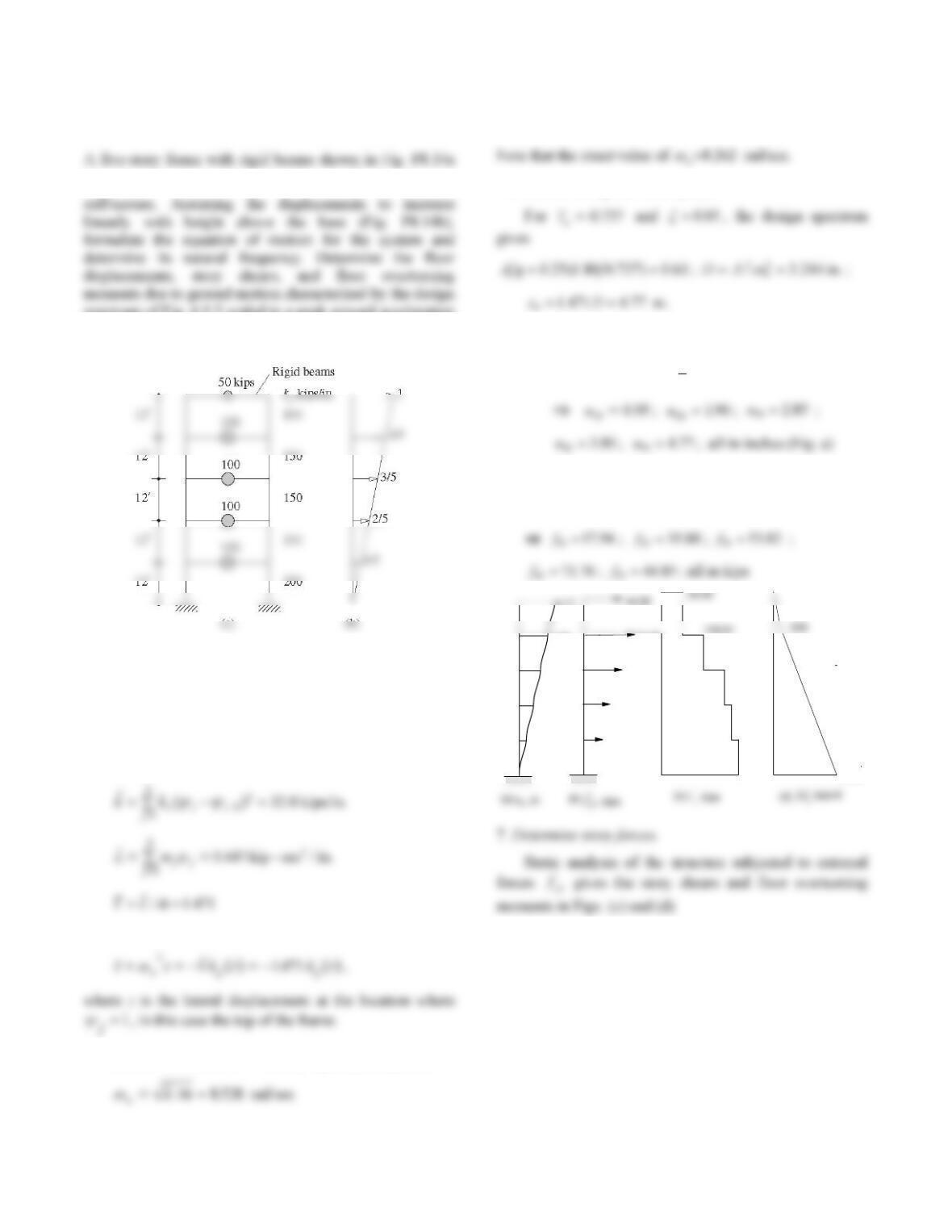
Problem 8.14
is subjected to ground acceleration
g
ut
; kj are story
spectrum of Fig. 6.9.5 scaled to a peak ground acceleration
of 0.25g.
Figure P8.14
Solution:
1. Determine generalized properties.
522
1
0.44 kip sec in./
jj
j
mm
2. Formulate the equation of motion.
3. Determine the natural vibration frequency and period.
Tnn
2 0 737
/.
sec
4. Determine the peak value of z(t).
5. Determine the peak values uj0 of floor displacements.
uz
jo j o
5
j
j
6. Determine equivalent static forces (Fig. b).
0346.6
jj jj
j
fmA m
kips
35.88
17.94
53.82
71.76
206.31
224.25
9149
6458
3982
1937
170.43
4.77
3.80
2.85
1.90
0.95
18
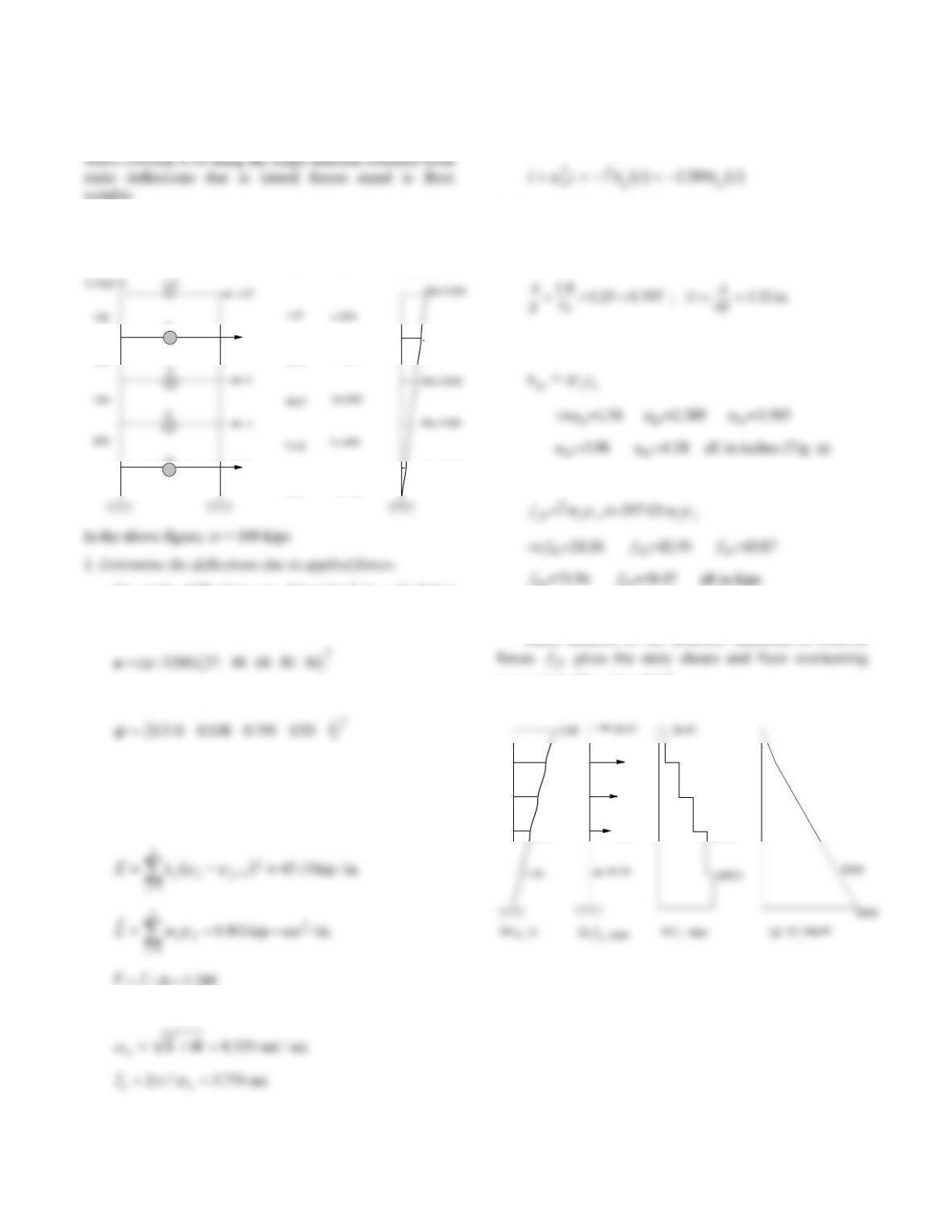
Problem 8.15
Solution:
The static deflections are determined by calculating
the story shears and the resulting story drifts,and adding
these drifts from the bottom to the top to obtain
2. Determine the shape vector.
3. Determine generalized properties.
5
22
1
0.622 kip sec / in.
jj
j
mm
/ 1.289Lm
4. Determine the natural vibration period.
5. Formulate the equation of motion.
6. Determine the peak value of z(t).
For 0.754sec
n
T and 0.05
, the design spectrum
gives:
7. Determine the peak values uj0 of floor displacements.
8. Determine the equivalent static forces (Fig. b).
9. Determine story forces.
Static analysis of the structure subjected to external
moments in Figs. (c) and (d).
110.0
170.9
213.8
461.6
1782
3833
71.56
60.87
42.94
3.98
3.39
2.39
w
w
w
w
Story
3w/2
9w/2
Story
w/100
9w/400
drift
shea
r
Floor
deflection
27w/1200
80w/1200
150
200
19
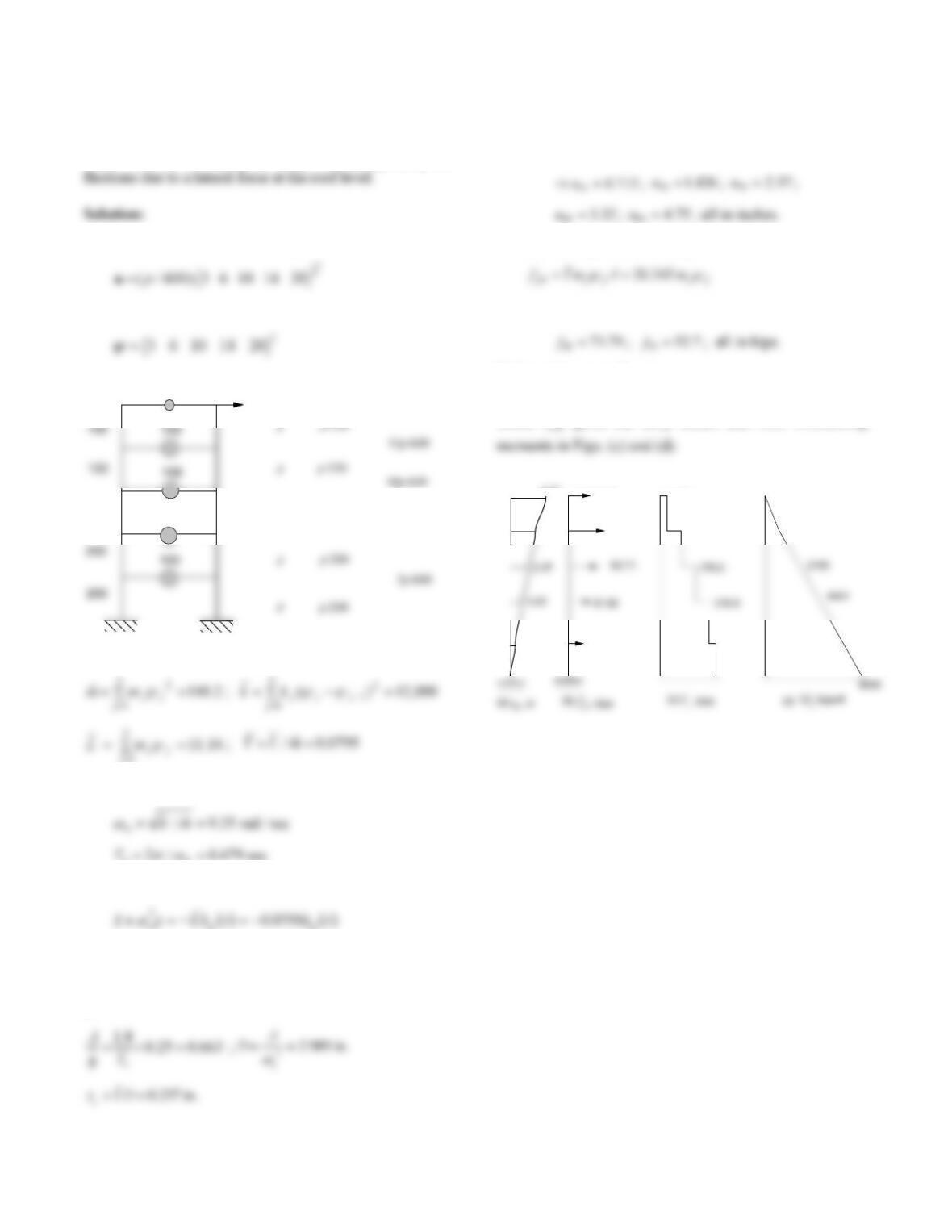
Problem 8.16
Solve Problem 8.14 using the shape function given by de-
1. Determine deflections due to applied force.
2. Determine the shape vector.
3. Determine generalized properties.
4. Determine the natural vibration period.
nn
5. Formulate the equation of motion.
6. Determine the peak value of z(t).
For 0.679sec
n
Tand 0.05
, the design spectrum
gives:
7. Determine peak responses.
j
ojo
uz
8. Determine equivalent static forces.
f10 15 81.; 20 31.62f; 30 52.71f
9. Determine story forces.
Static analysis of the structure subjected to external
forces fj0 gives the story shears and floor overturning
p
p
p/
p/
52.70
73.79
p
p
p/
p/
15.81
52.7
126.5
226.6
632
0.71
3.32
4.75
6831
p
story
shear
p
story
drift
p/
150
floor
displacement
20p/600
6p/600
k
j
kips/in.
100
150
50 kips
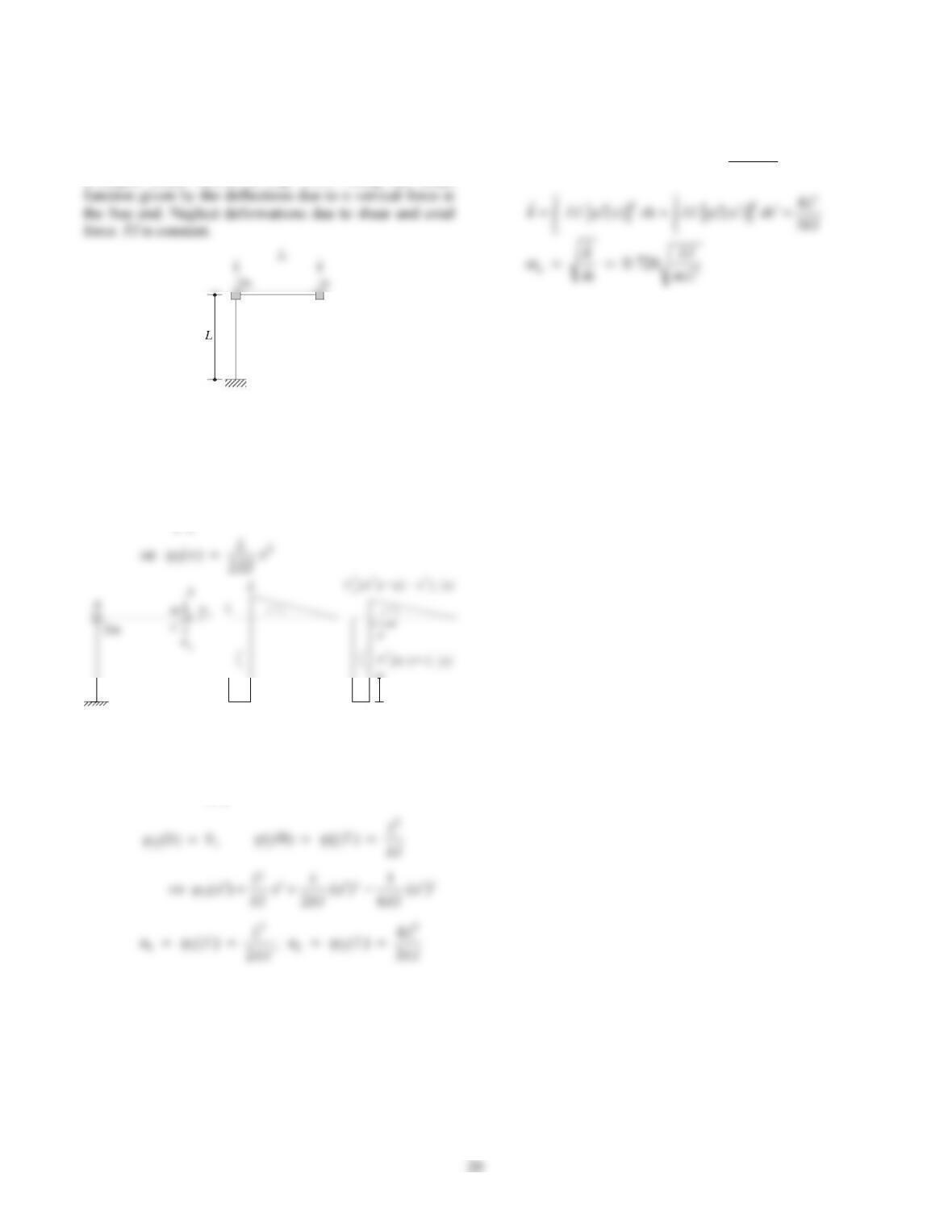
Problem 8.17
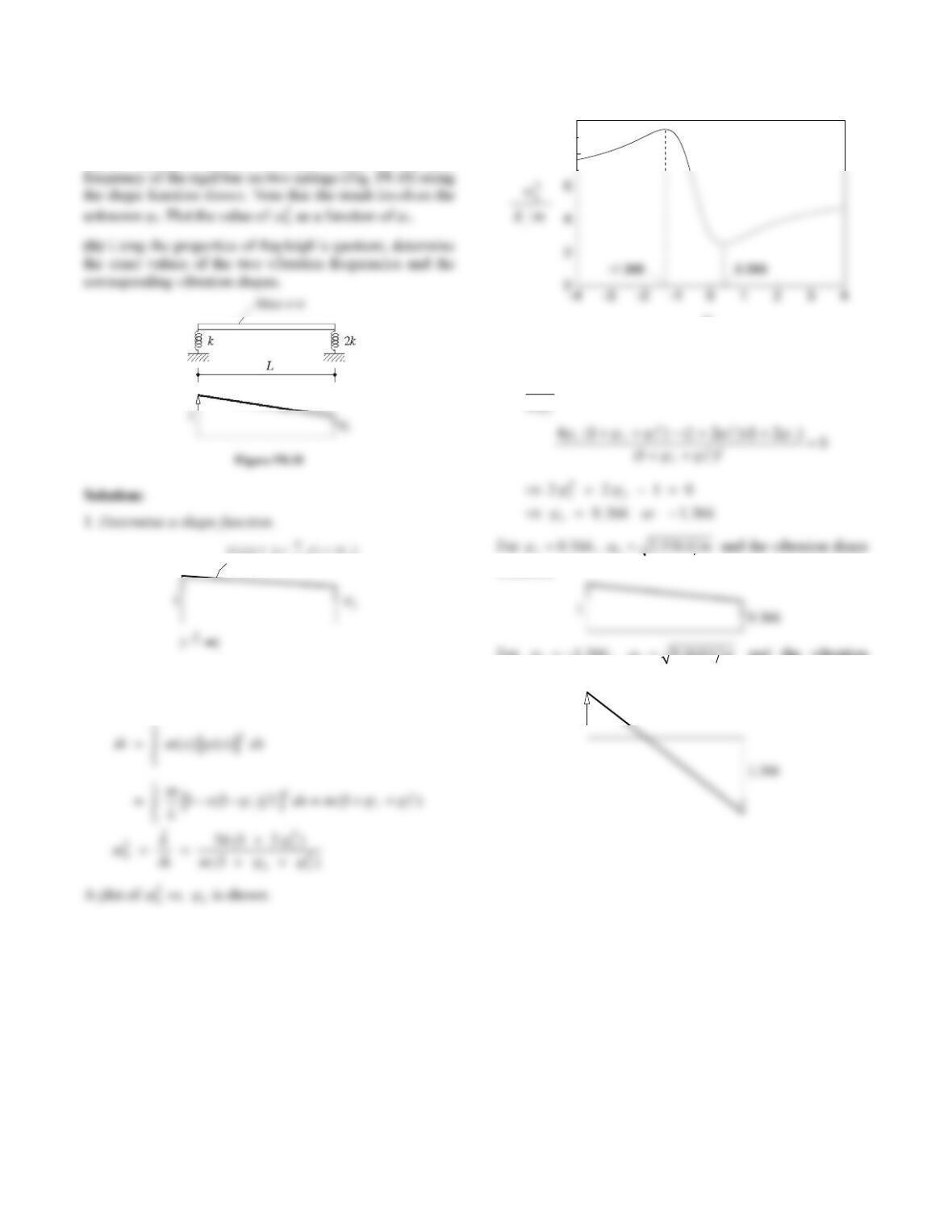
Determine the natural vibration frequency of the inverted
L-shaped frame shown in Fig. P8.17 using the shape
L
Figure P8.17
Solution:
1. Determine the shape function.
11
() ()
xx
x
dd
;
11
000() ()
A
x
Moment diagram Curvature
22
00
() ()
xx
x
dd
;
2. Determine the natural frequency.
()mmmumu mL
E
I
291
36
1
2
2
26
22
21
Problem 8.18
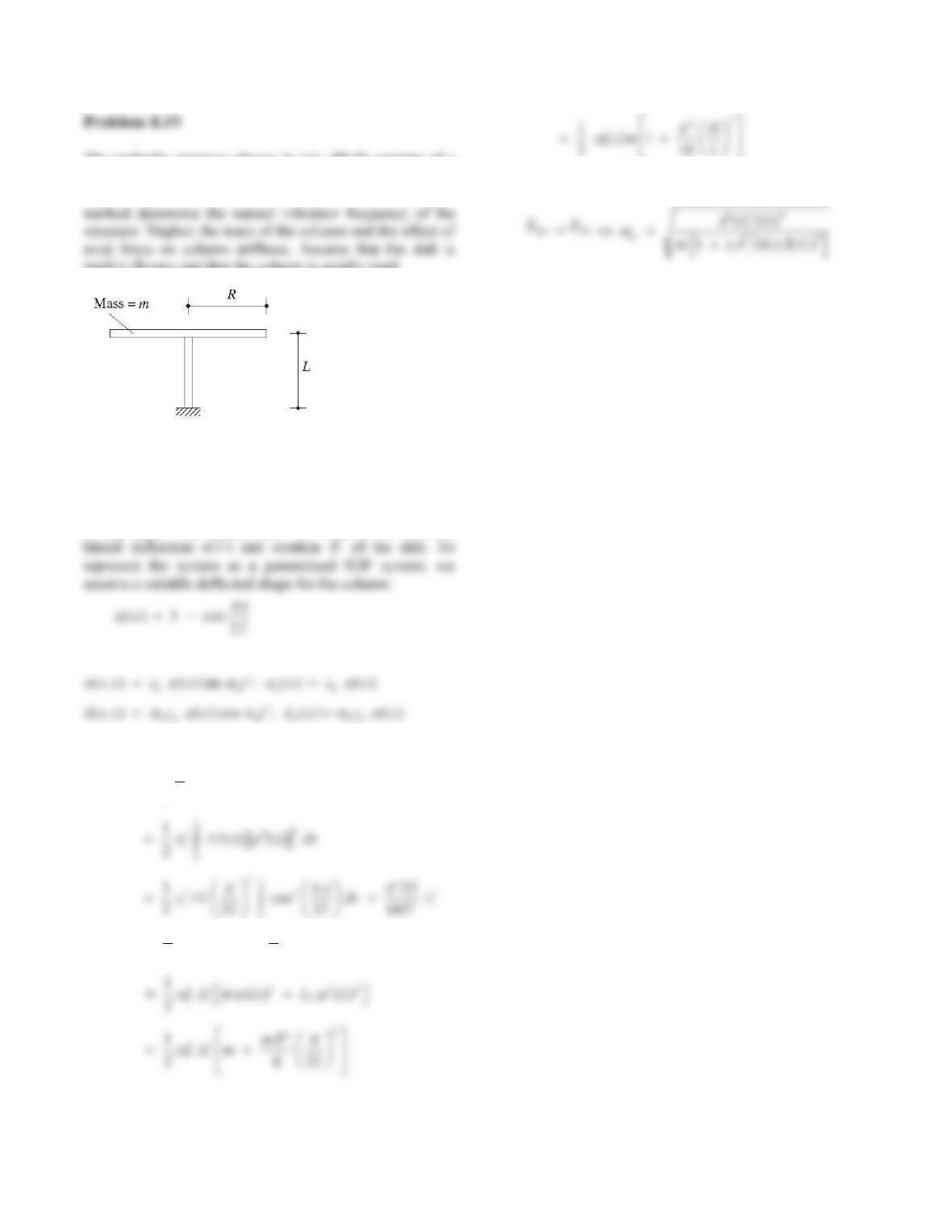
(a) By Rayleigh’s method determine the natural vibration
r
()
L
()
x11
2. Determine natural frequency.
() ( )kk k k
r
r
12 12
22 2
8
10
r
3. Find stationary values of
n
2.
d
d
n
2
0
r
nkm
is shown:
For 1.366
r
, 9.464
nkm
and the vibration
shape is shown:
1
22
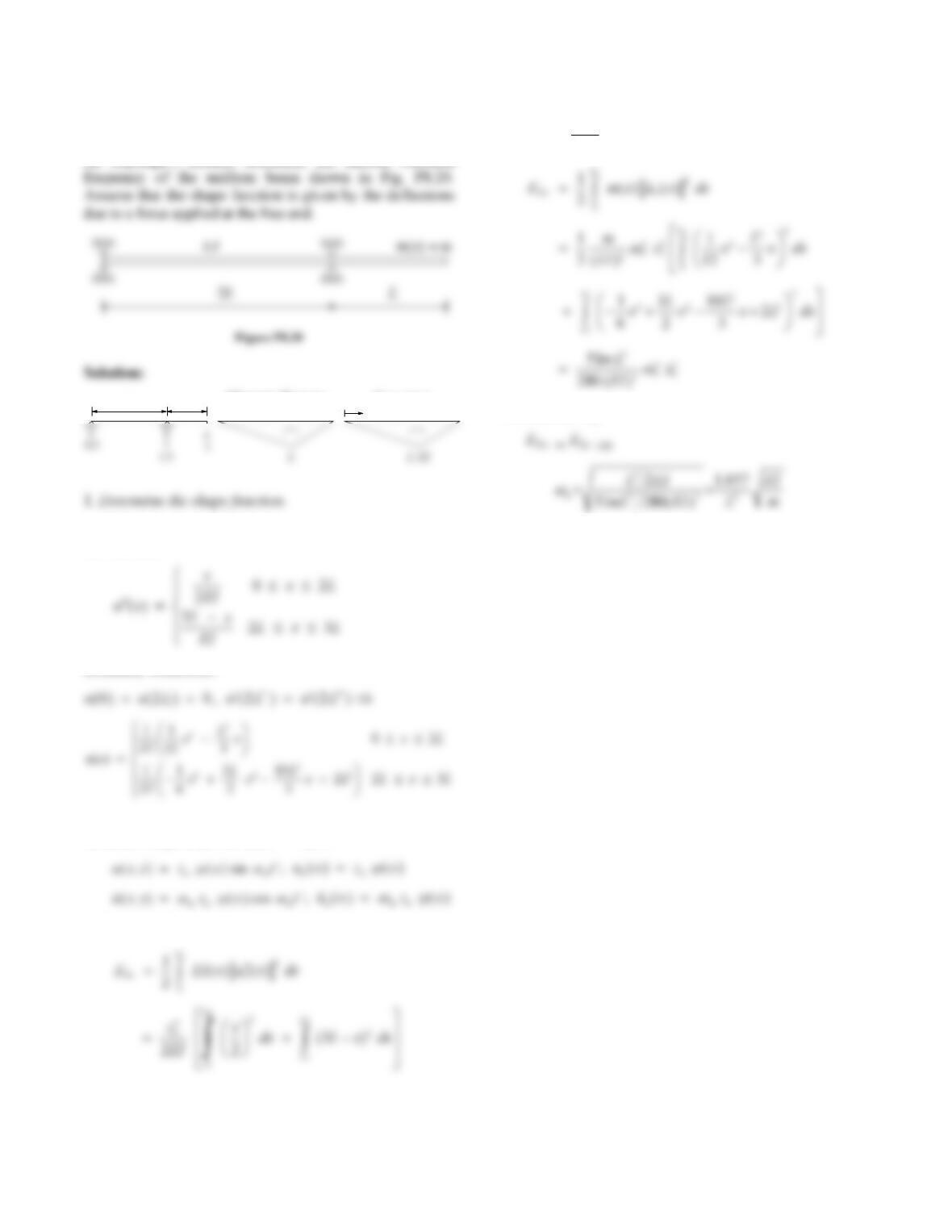
The umbrella structure shown in Fig. P8.19 consists of a
uniform column of flexural rigidity EI supporting a
uniform slab of radius R and mass m. By Rayleigh’s
K
rigid in flexure and that the column is axially rigid.
Figure P8.19
Solution:
1. Determine the shape function.
Assume that the slab is rigid in flexure and column is
axially rigid. The system has two degrees of freedom:
Then
2. Determine ESo and E
K
o.
2
0
1() ()
2
L
So o
EEIxuxdx
22
11
() ()
22
Ko o O o
EmuL IuL
3. Determine
n.
23
Problem 8.20
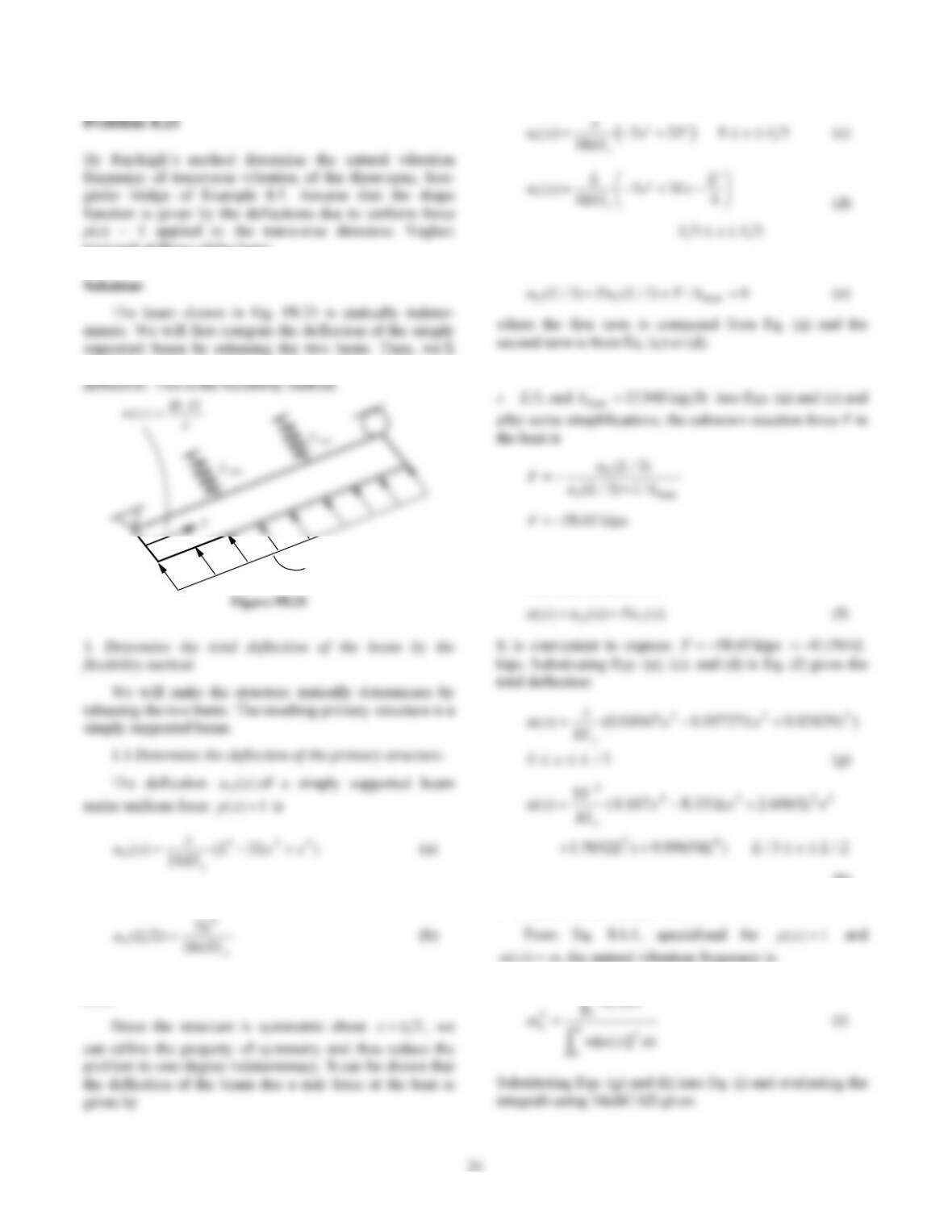
By Rayleigh’s method determine the natural vibration
2L
K
L
Moment diagram Curvature
x
Calculate the deflection due to a unit force applied at
the free end:
Boundary conditions:
Assumed shape function
() ()
x
u
x
.
x
z
x
2. Determine ESo and E
K
o.
L
E
I
zo
3
2
2
3. Determine
n.
torsional stiffness of the bents.
solve the unknown reactions in the two bents and the total
and the deflection at the mid-span is
1.2 Determine the unknown reaction force F at the
bent.
Thus, at 3/Lx
the compatibility condition states
Substituting L = 375 ft, E = 3,000 ksi, Iy = 65,550 ft4,
1.3 Determine the total deflection.
The total deflection is
(h)
2. Compute natural frequency.
L
dxxu
)(
1)( x
p

25
26
Problem 8.22
Repeat Problem 8.21 using a simpler approach in which
the deflections are assumed to be u(x) = uo sin(πx/L), where
uo is the mid-span deflection due to uniform force p(x) = 1
applied in the transverse direction.
Solution:
1. Determine the mid-span deflection o
u of the beam due
to 1)( xp .
2. Compute natural frequency.
The deflection is given by
with o
u given by Eq. (a). From Eq. 8.6.1, specialized for
1)( xp and mxm )( , the natural vibration frequency is:
Substituting Eq. (b) into Eq. (c) with 18.45 gm and
evaluating the integrals gives
27
Problem 8.23
Repeat Problem 8.21 using a simpler approach in which
the deflections are assumed to be u(x) = uo ψ(x), where uo is
the mid-span deflection due to uniform force p(x) = 1
applied in the transverse direction and
34
16
() 2
5
xx x
xLL L
Note that ψ(x) is the deflected shape of a simply supported
beam without bents subjected to transverse force p(x) = 1.
Solution:
1. Determine the mid-span deflection o
uof the beam due to
1)( xp .
2. Determine the deflection u(x).
The deflection is given by
where )(x
will be taken as the deflected shape of a
simply supported beam without bents. Dividing Eq. (a) of
Problem 8.21 by Eq. (b), also of Problem 8.21, gives
Substituting )(x
in Eq. (a) gives
3. Compute natural frequency.
614.20
00295.0
252.1
n
rad/sec
n
n
T
20.305 sec
28
Problem 8.24
stiffness of the bents.
Solution:
Including the torsional stiffness of the bents adds
1. Determine the total deflection of the beam by the
flexibility method.
deflection )(
1xu of the beam due to unit lateral force at the
bend (first released structure) were given by Eqs. (a), (c),
3/0
6
)(
2Lx
EI
Lx
xu
y
(a)
The compatibility conditions at the location of the bents
(3/Lx ) state
Substituting L = 375 ft, E = 3000 ksi, Iy = 65,550 ft4,
and x = L/3 into Eqs (a) and (c) of Problem 8.21 and Eqs.
(a) and (b) above, we have
7
212 10759.2)3/(
Lu ft
Thus, solving Eqs. (c) and (d) simultaneously gives
56.58
1
F kips
where )(
0xu is defined by Eq. (a) of Problem 8.21; )(
1xu
2. Compute natural frequency.
From Eq. 8.6.1, specialized for 1)(
xp and
Substituting Eq. (e) into Eq. (f) and evaluating the integrals
using MathCAD gives
n
29
Problem 8.25
length and flexural rigidity EI. An infinitely long,
uniformly distributed force po per foot length (that
represents a very long train) travels across the bridge at a
uniform velocity v (Fig. P8.25). Determine an equation for
the deflection at mid-span as a function of time. Neglect
Solution:
1. Determine the generalized mass, generalized stiffness,
and natural frequency.
The front of the load ),( txp traveling with a velocity
0
0
d
o
tt
vtx
p
From Eq. (8.3.26) the generalized force is
L
dxxtxptp
)(),()(
~
This generalized force is plotted next:
3. Solve the equation of motion.
The particular solution to Eq. (f) can be obtained by
superposing the steady-state responses to the constant and
2
sin
~
2mL
dx
L
x
mm
L
Infinitely long train
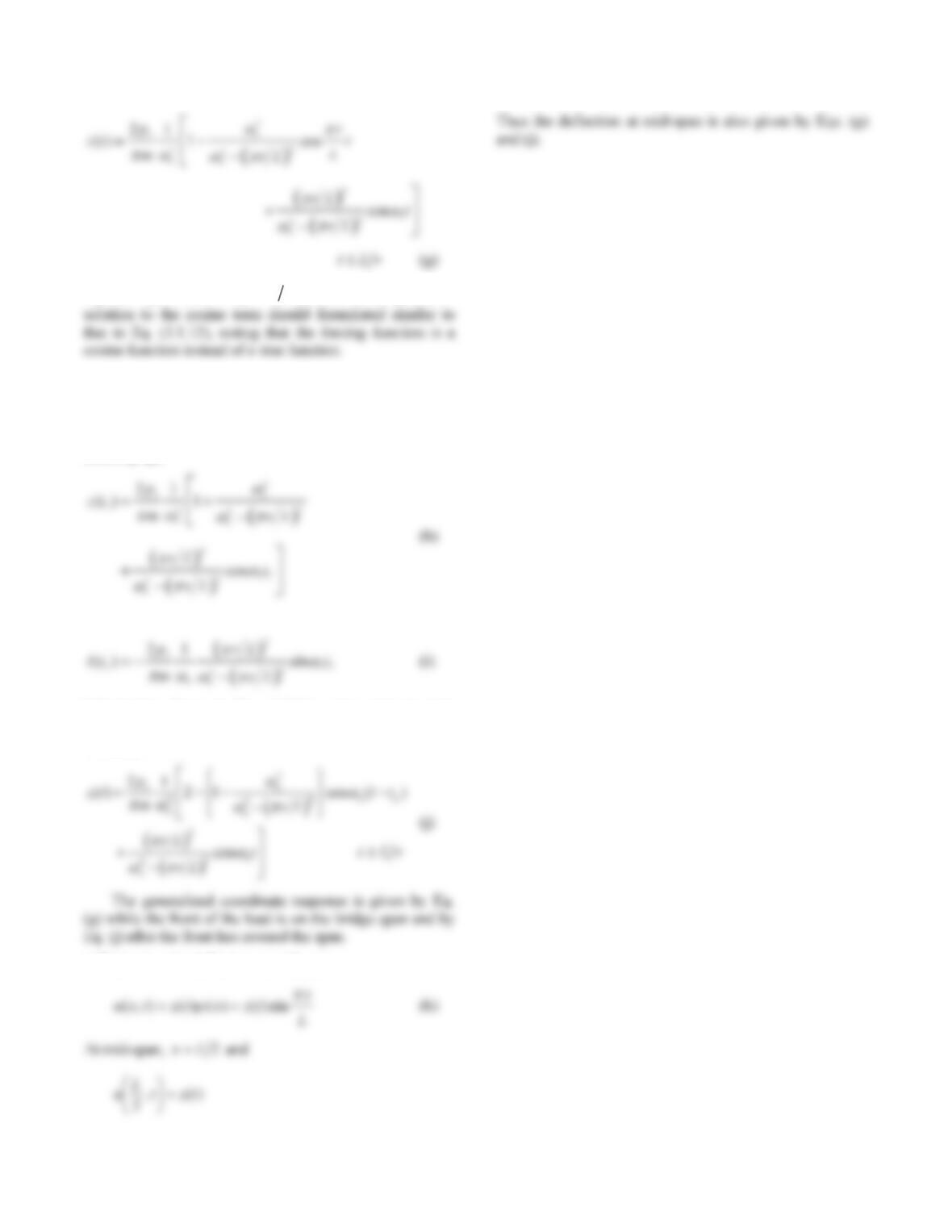
30
Equation (g) is valid if Lv
n
; otherwise the particular
Response for d
tt .
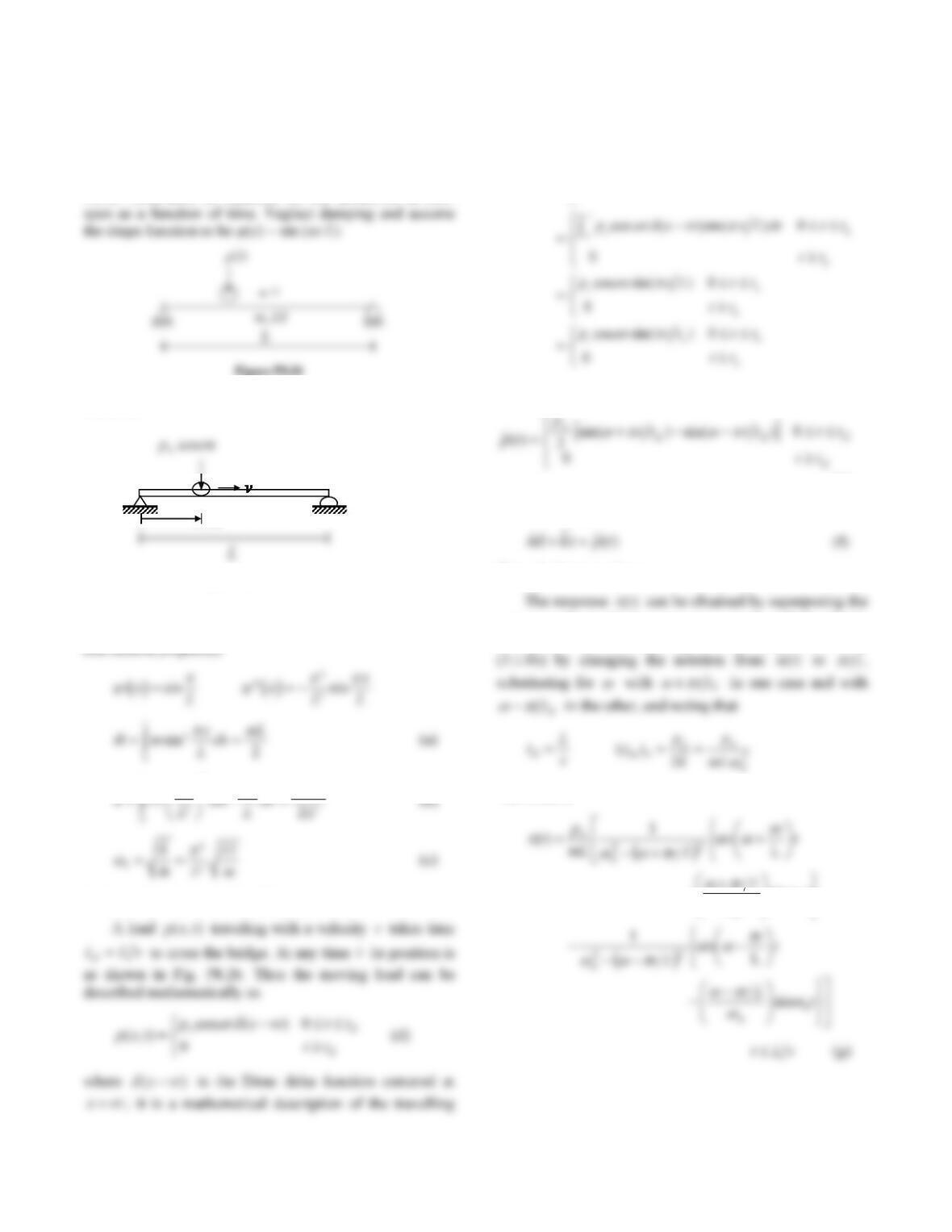
The motion is described by Eq. (4.5.3) with zinstead
of u, d
t instead of r
t, and )( d
tz and )( d
tz
determined
from Eq. (g):
Substituting these in Eq. (4.5.3), using trigonometric
identities, and manipulating the mathematical quantities,
we obtain
4. Determine the deflection at mid-span.
31
Problem 8.26
A pulsating force p(t) = po cos ωt travels across the bridge
of Fig. P8.25 at a uniform velocity of v, as shown in Fig.
P8.26. Determine an equation for the deflection at mid-
Solution:
1. Determine the generalized mass, generalized stiffness,
2
24
2
L
x
EI
(b)
2. Determine the generalized force.
concentrated load. From Eq. (8.3.26) the generalized force
is
() ( , ) ( )
L
pt pxt x dx
This can be rewritten as
(e)
3. Solve the equation of motion.
Forced vibration phase.
responses due to the two sine terms in the right-hand side
of Eq. (e). The individual responses are adapted from Eq.
The result is
t
Lv
n
n
sin
m, E
I
Figure P8.26a
vt
32
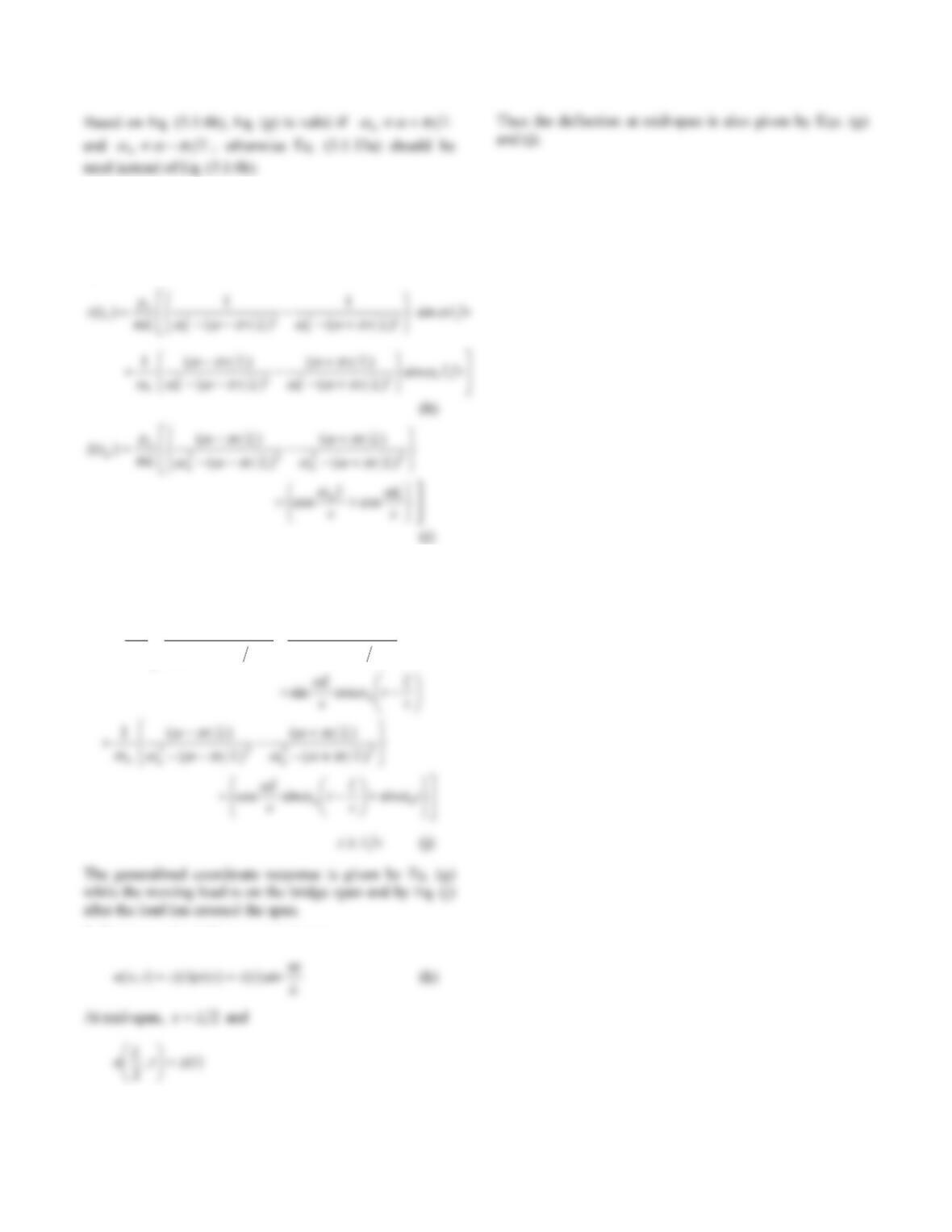
Free vibration phase.
The motion is described by Eq. (4.7.3) with )(tz
instead of )(tu , and )( d
tz and )( d
tz
determined from Eq.
(g):
Substituting these in Eq. (4.7.3), using trigonometric
identities, and manipulating the mathematical quantities,
we obtain
LvLv
mL
p
tz
nn
o
)(
1
)(
1
)(
2222
4. Determine the deflection at mid-span.