1
CHAPTER 13
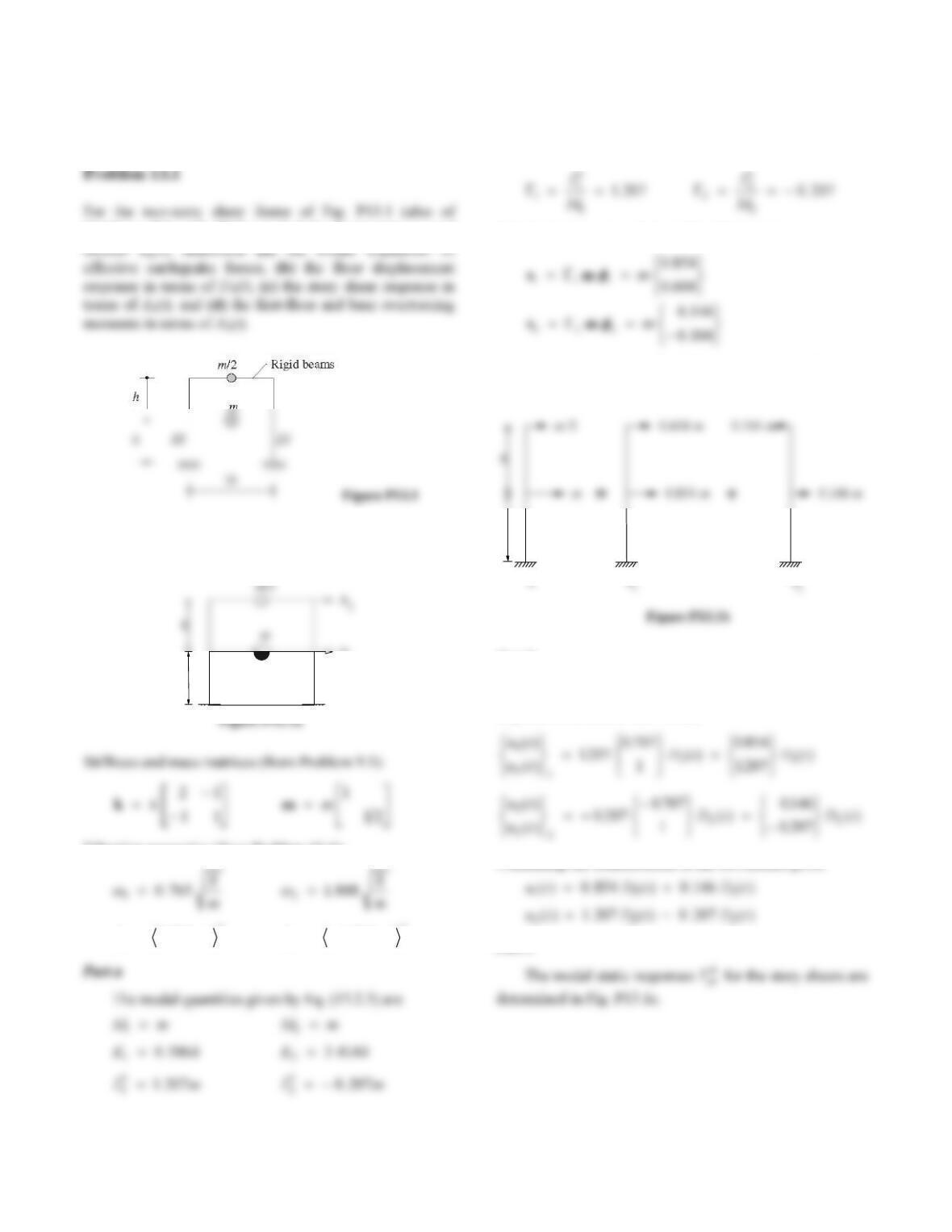
Problems 9.5 and 10.6) excited by horizontal ground
Solution:
u
1
h
Vibration properties (from Problem 10.6):
10.707 1 T
20.707 1 T
Substituting
n, m, and n
in Eq. (13.2.4) gives
The modal expansion of effective earthquake forces is
shown in Fig. P13.1b.
s
s
s
h
Part b
Substituting
n and jn
in Eq. (13.2.5) gives floor
displacements due to each mode:
Combining the contributions of the two modes gives
Part c
2
First mode
Second mode
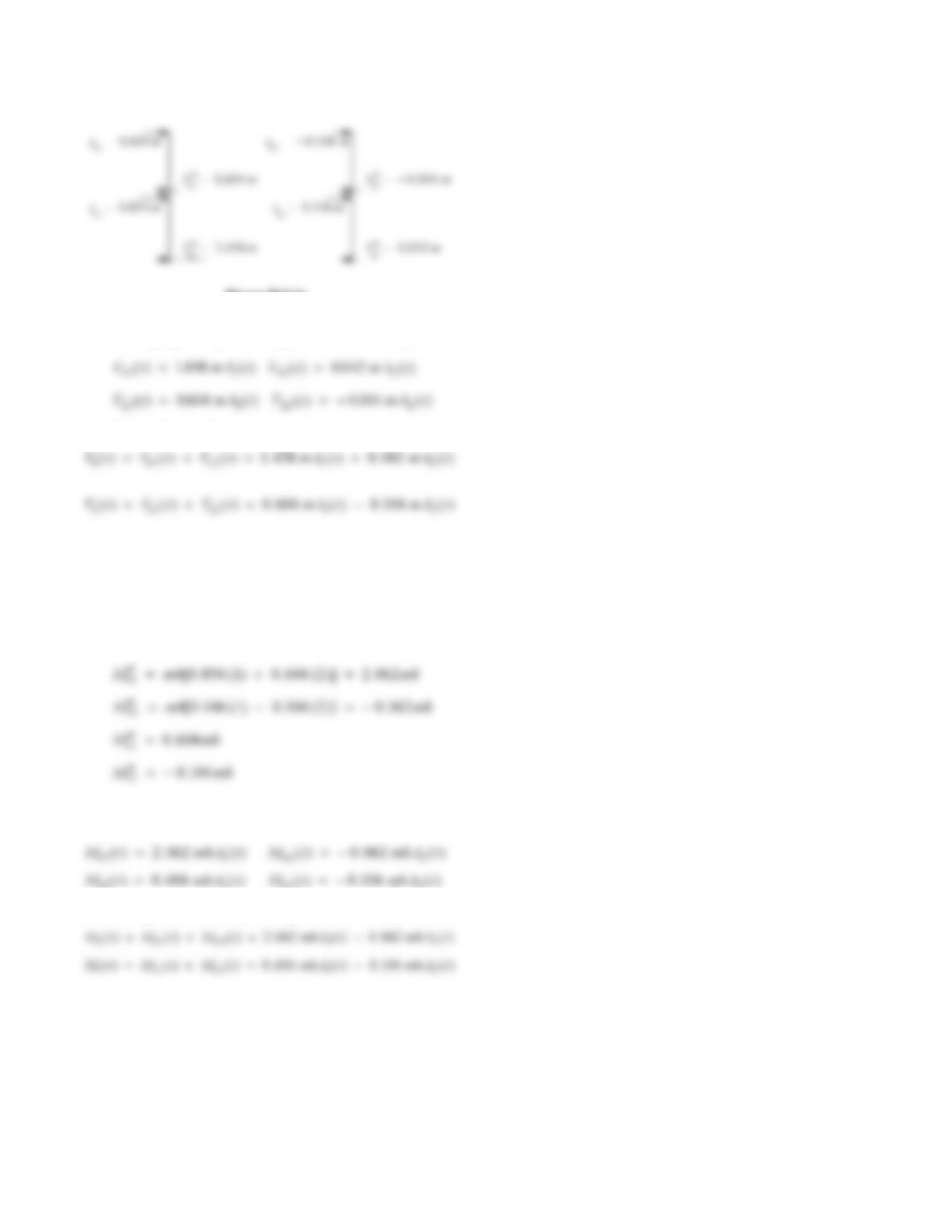
Fig. P13.1c
Substituting Vjn
st in Eq. (13.2.8) gives the modal responses:
Combining the modal responses gives the total responses:
A
A
A
A
Part d
Static analysis of the structure for external floor forces
sn gives the modal static responses Mbn
st and Mn1
st for
M
b
and
M
1, the overturning moments at the base and the first
floor, respectively:
Substituting Mbn
st and Mn1
st in Eq. (13.2.8) gives the modal
responses:
M
t
A
t
M
t
A
t
M
t
A
t
M
t
A
t
11 1
12 2
Combining the modal responses gives the total response:
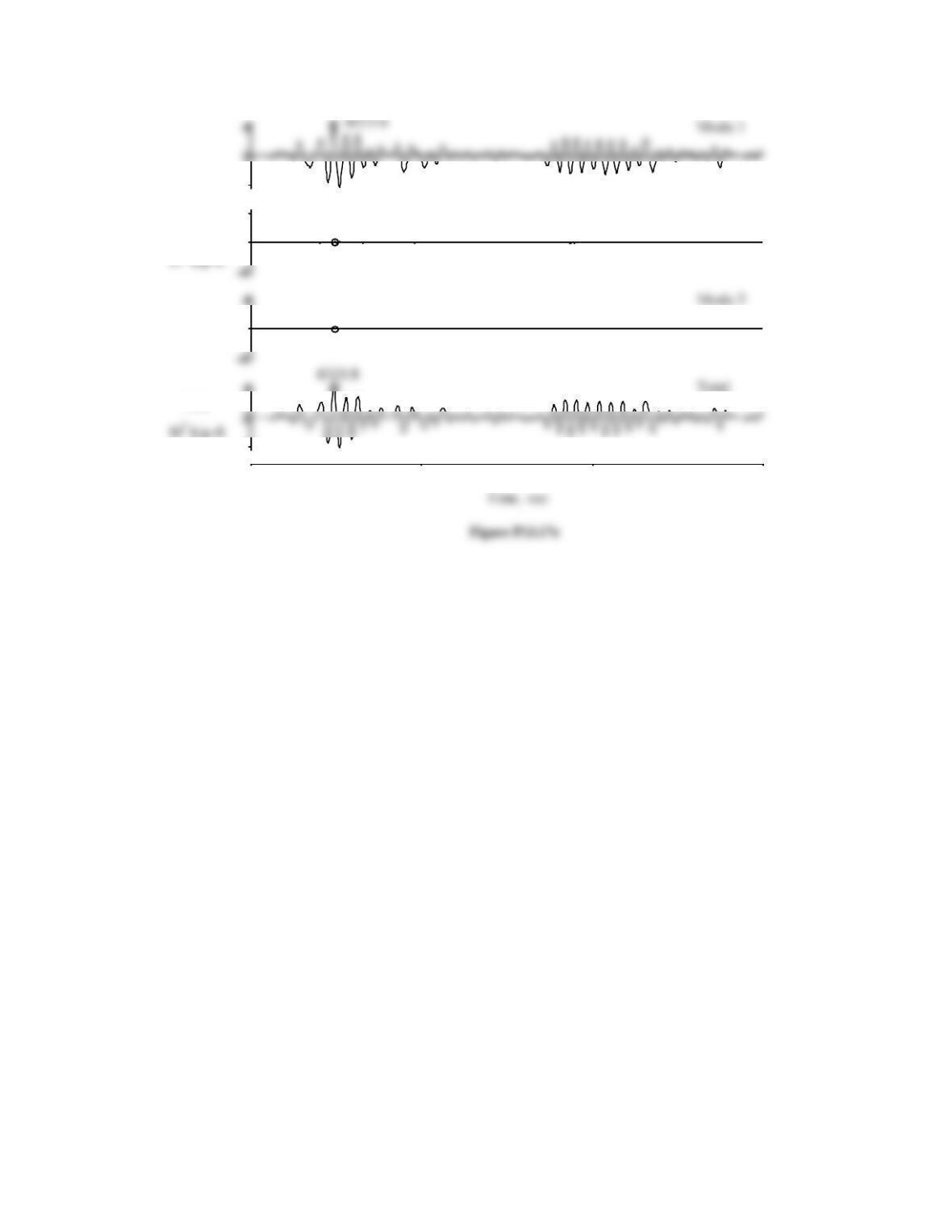
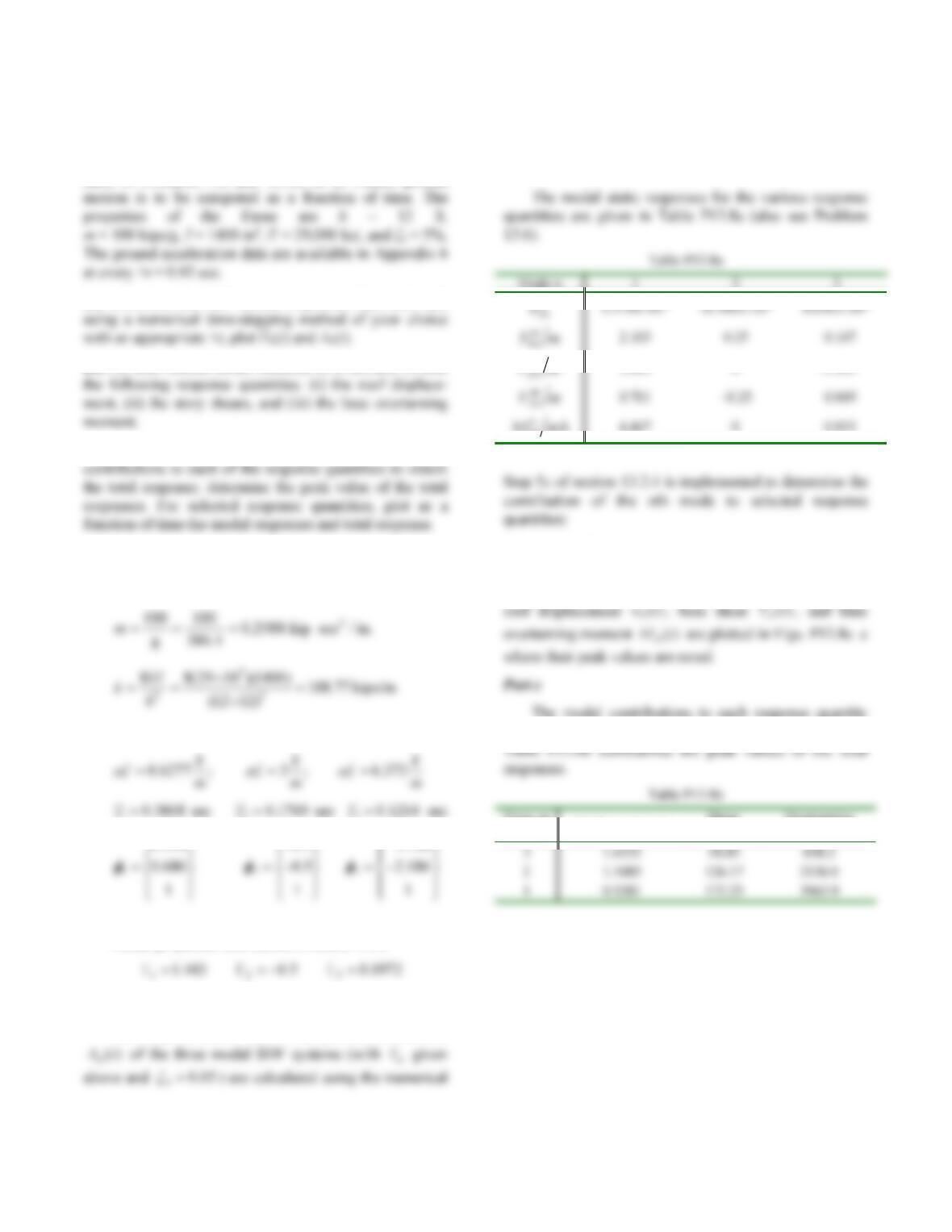
Figure P13.1c
3
Problem 13.2
The response of the two–story shear frame of Fig. P13.1
(also of Problems 9.5 and 10.6) to El Centro ground
motion is to be computed as a function of time. The
acceleration data are available in Appendix 6 at every
∆t = 0.02 sec.
(a) Determine the SDF system responses Dn(t) and An(t)
using a numerical time-stepping method of your choice
A
each floor, (ii) the story shears, and (iii) the floor and base
overturning moments.
(c) At each instant of time, combine the modal contribu-
tions to each of the response quantities to obtain the total
response; determine the peak value of the total responses.
For selected response quantities plot as a function of time
the modal responses and total response.
Vibration properties (from Problem 10.6):
T
10 321. sec T20 133. sec
M
Modal properties:
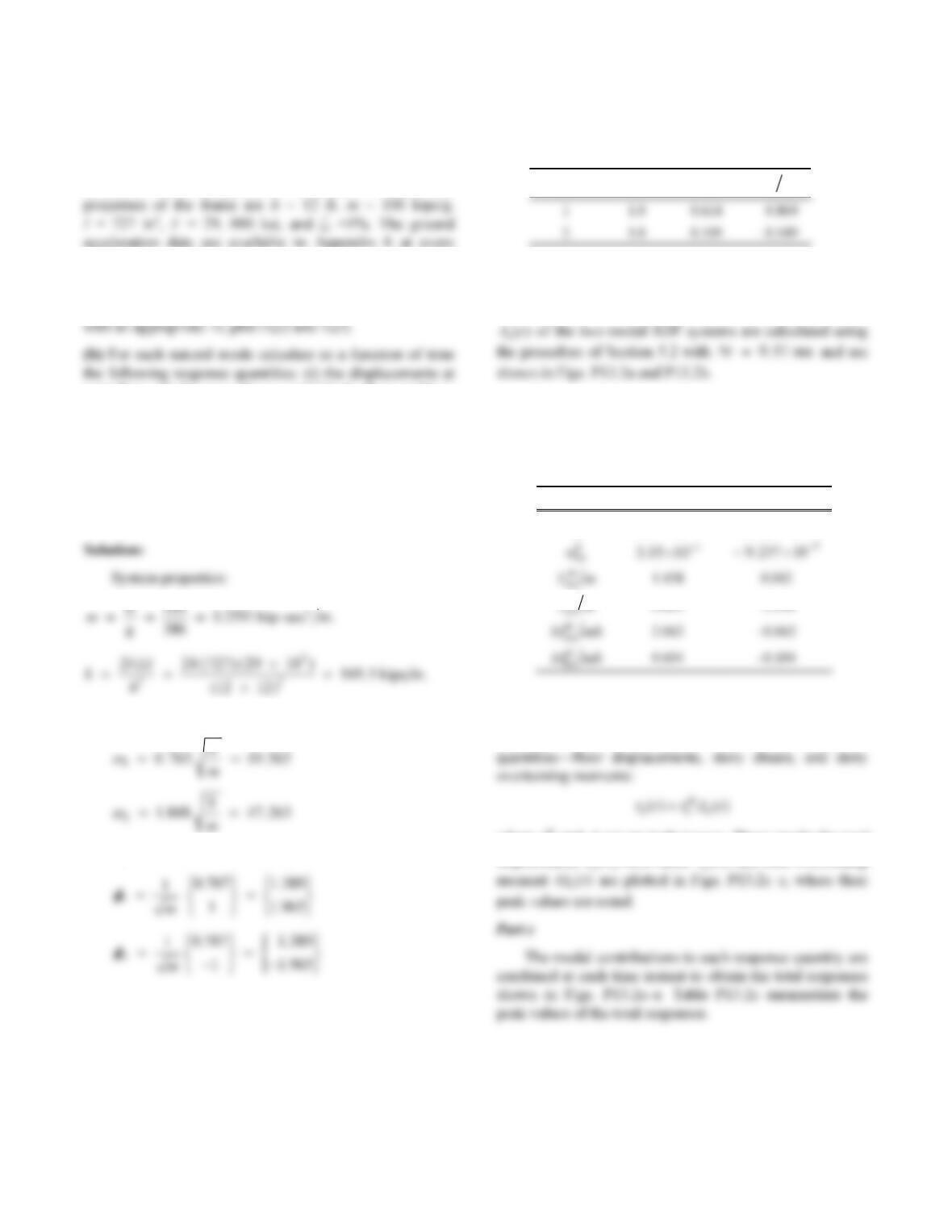
Table P13.2a
Mode
M
n Ln
h Lh
n
Part a
The displacements D
t
n()
and pseudo-accelerations
Part b
The modal static responses for the various response
quantities are given in Table P13.2b.
Table P13.2b
Mode n 1 2
un1
st 3
2.23 10
6 529 10 5
.
st 0.604 –0.104
Step 5c of Section 13.2.4 is implemented to determine
the contribution of the nth mode to selected response
where r
n
st and
A
t
n()
are both known. These results for roof
displacement u
t
, base shear
V
t
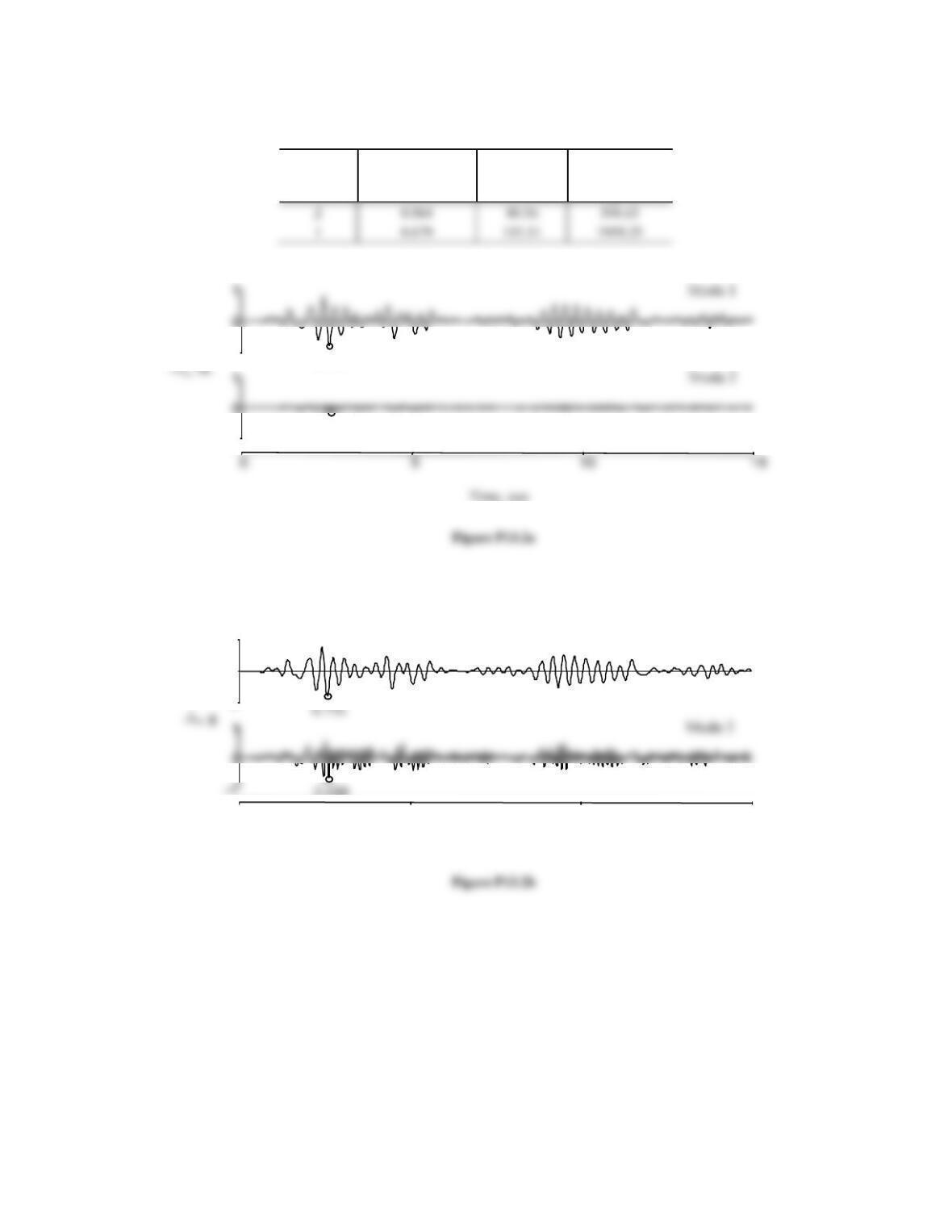
, and base overturning
4
Table P13.2c
Floor or
Story Displacement, in. Shear, kips
Overturning
moment,
kip–ft
0.797
0.118
-1
-1
-1
0
1
0.684
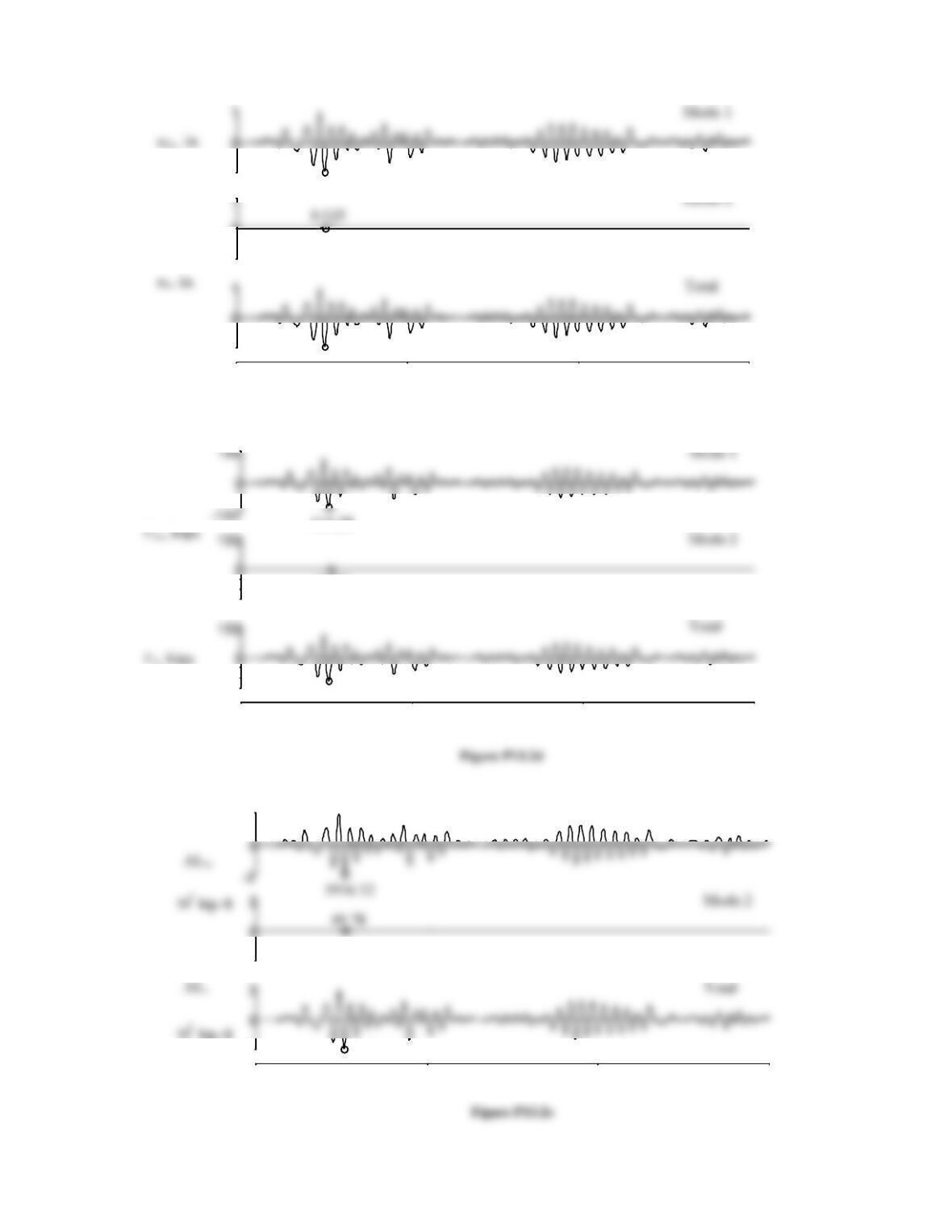
0 5 10 15
Mode 1
Time, sec
5
-1
-1
0
-1
0.964
Time, sec
0 5 10 15
Fig. P13.2c
-150
115.28
2.933
-150
115.11
0 5 10 15
Time, sec
2
-2
-2
1959. 25
0 5 10 15
Mode 1
Time, sec
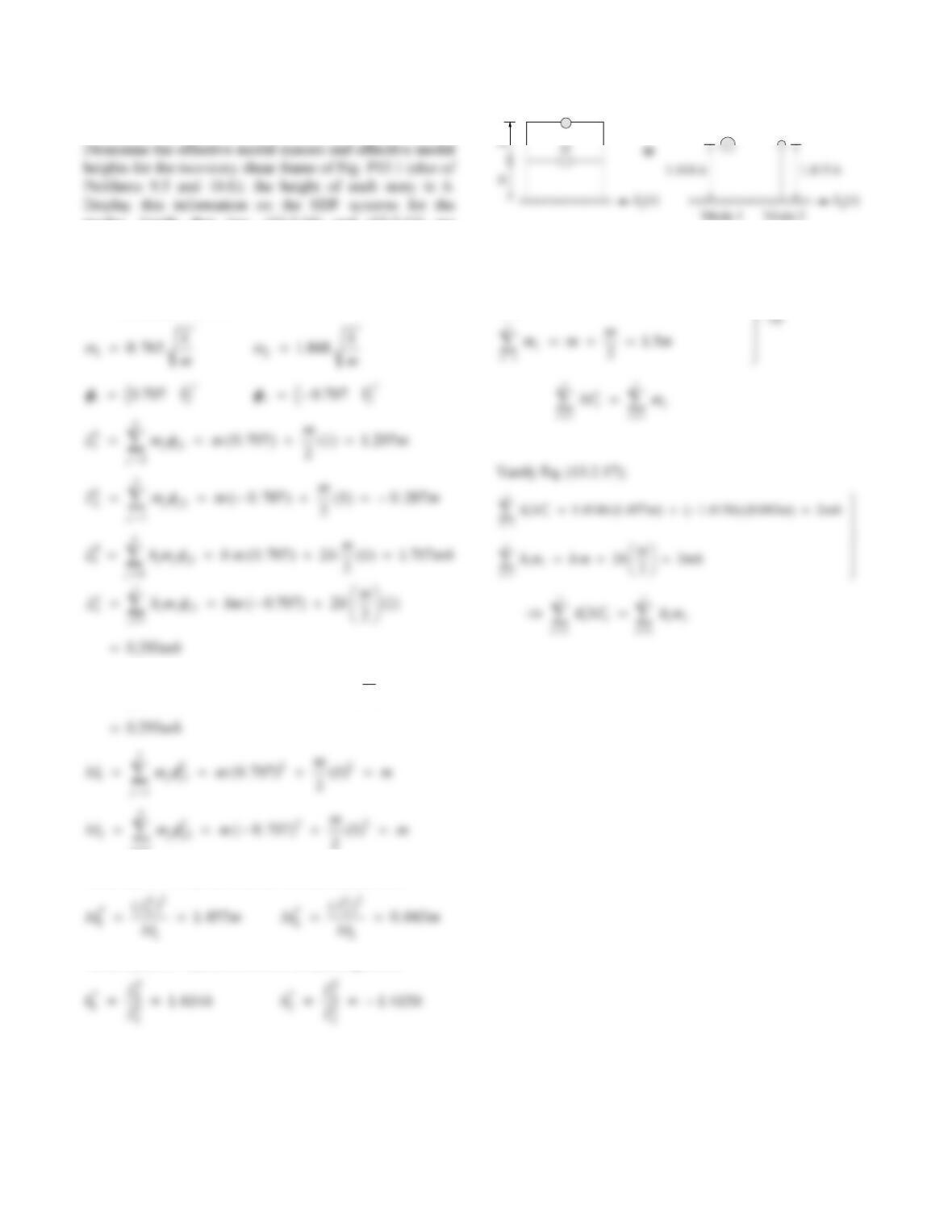
Figure P13.2c
6
Problem 13.3
modes. Verify that Eqs. (13.2.14) and (13.2.17) are
satisfied.
Solution:
From Problem 13.2:
2
2
2
1
(0.707) 2 (1)
2
jjj
j
m
Lhmhm h
j
1
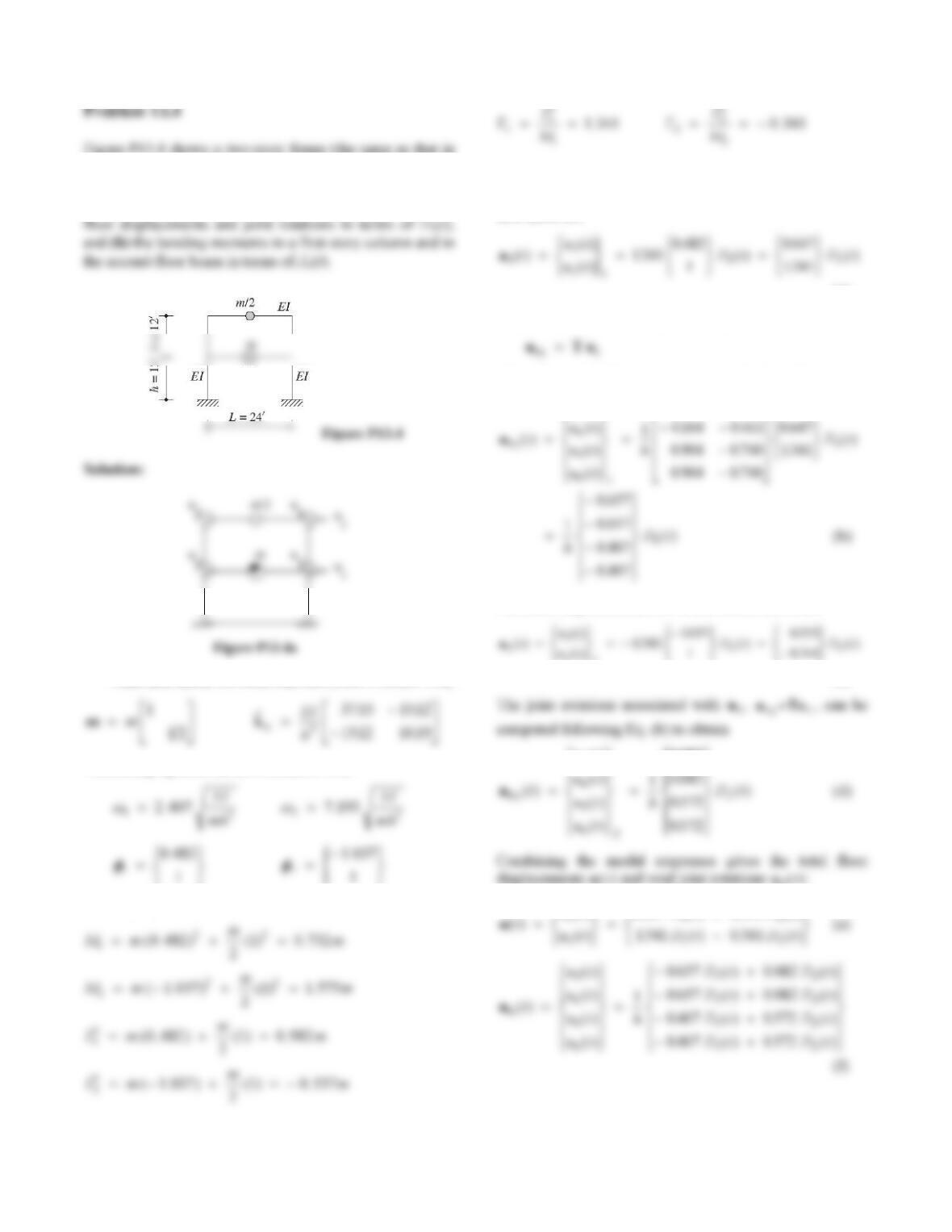
From Eq. (13.2.9a), the effective modal masses are
From Eq. (13.2.9a), the effective modal heights are
m/2
1.457 m0.043 m
Mode 1 Mode 2
Verify Eq. (13.2.14):
2
*
1
1.457 0.043 1.5
n
n
Mmmm
7
Figure P13.4 shows a two–story frame (the same as that in
Problems 9.6 and 10.10) with flexural rigidity EI for beams
and columns. Determine the dynamic response of this
structure to horizontal ground motion ݑሷ g(t). Express (a) the
Mass and lateral stiffness matrices (from Problem 9.6):
Vibration properties (from Problem 10.10):
Modal properties:
Part a
From Eq. (13.2.5), the floor displacements due to the
first mode are
(a)
The joint rotations associated with u1 are
where T is available in the solution to Problem 10.10:
3
0164 0 411
()
..
ut
R
U
L
O
The floor displacements due to the second mode are
22
TU
W
TU
W
TU
W
(c)
3
0082
()
.
ut
R
U
R
U
.().()
Dt Dt
R
0647 0353
Part b
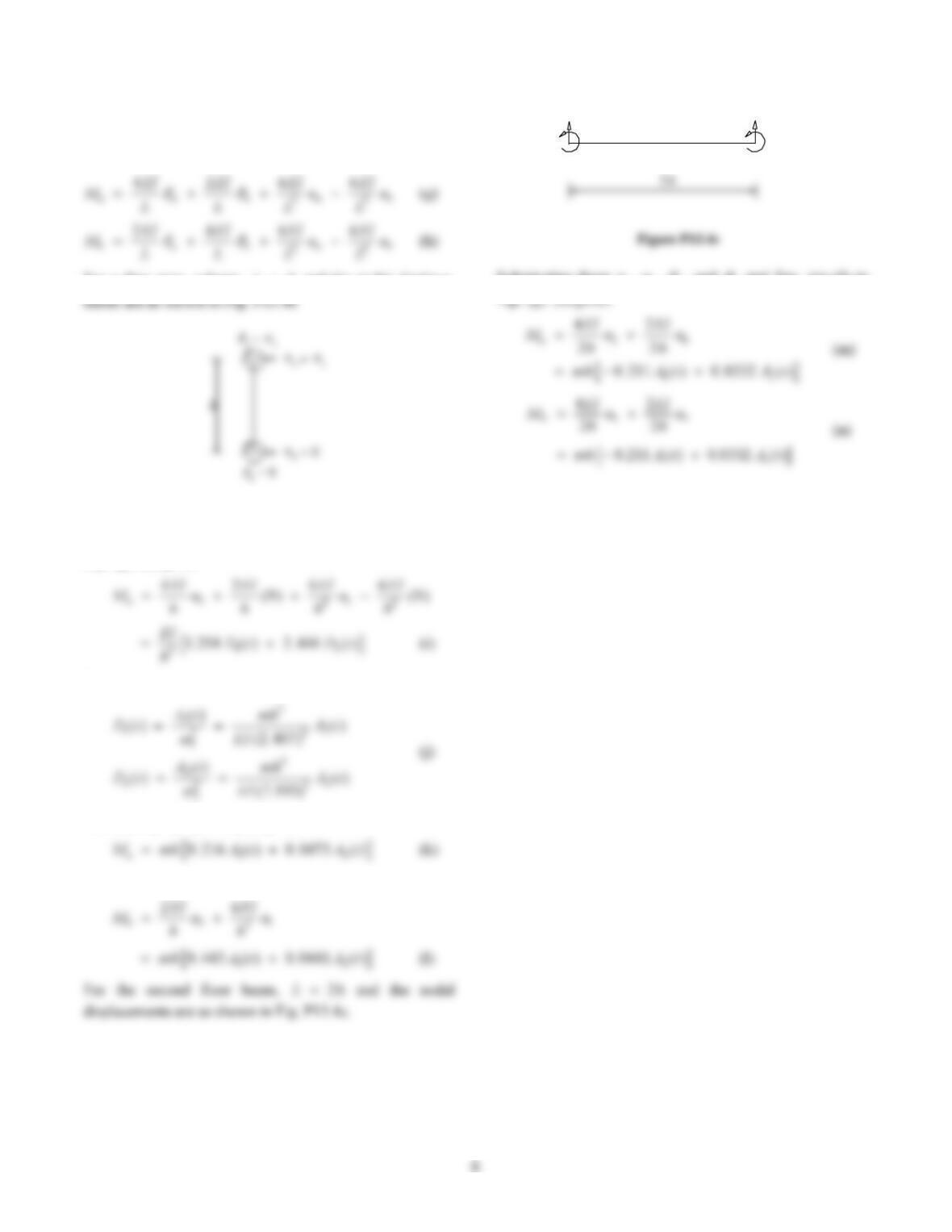
The bending moments at the ends of a flexural element
are related to the nodal displacements by
For a first story column, Lh and the nodal displace-
Substituting these ua, ub,
a, and
b and Eqs. (e)–(f) in
Eqs. (g)–(h) gives:
Relate D
t
n()
to
A
t
n()
:
Substituting Eq. (j) in Eq. (i) gives
Similarly,
a b
b
u = 0
a
5
u
= b
6
u
=
a
u = 0
Substituting these ua, ub,
a, and
b and Eqs. (e)–(f) in
Fi
g
ure P13.4b
Problem 13.5
effective earthquake forces, (b) the floor displacement
response in terms of Dn(t), (c) the story shear response in
terms of An(t), and (d) the base overturning moment in
m
u1
1
12
m
m
12 1
011
k
k
Vibration properties (from Problem 10.11):
123
0.5 1 0.5
0.866 0 0.866
The first-mode properties are computed from Eq. (13.2.3):
3
3
22 22
11
(0.5) (0.866) (1) 1.5
jj
m
M
mm m m
Similar calculations for the second and third modes give:
20.5
h
Lm
30.134
h
Lm
Part a
Substituting
n, m, and n
in Eq. (13.2.4) gives
1 0.5 0.6220
1 1 0.3333
The modal expansion of m1 is shown next:
Part b
Substituting for
n and n
gives
1
( ) 1 0.3333
ut
10
1
( ) 0.5 0.0447
ut
Combining the modal responses gives the floor
displacements:
Part c
Static analysis of the frame for external floor forces sn
gives V
st , i = 1, 2, 3:
The total story shears are
Substituting values of Vjn
st gives
Vt m At A t A t
1123
2 3213 0 1667 0 0121() . () . () . ()
Part d
Static analysis of the frame for external floor forces sn
gives Mbn
st :
Mmh
b10 6220 1 1 0773 2 0 6220 3
st
.().().()
The base overturning moment response is
Substituting values of Mbn
st gives
11
motion ݑሷ g(t), determine (a) the modal expansion of
effective earthquake forces, (b) the floor displacement
response in terms of Dn(t), (c) the story shear response in
Solution:
Mass and stiffness matrices (from Problem 9.8)
where kEIh83
/ and h = story height
The first mode properties are computed from Eq. (13.2.3):
Mm
11069
.
Similar calculations for the second and third modes give:
22
2
05
L
M.
Part a
Substituting n
, m, and n
in Eq. (13.2.4) gives
0.5 0.701
The modal expansion of m1 is shown next:
12 ft
EI
12
Part b
44.0
)(
1
tu
25.0
)(
2
1
tu
)(
212.0
31.0
)(
)(
1
tD
tu
tu
ut Dt Dt Dt
2123
0 962 0 25 0 212() . () . () . ()
Part c
Part d
sn gives Mbn
st :
The base overturning moment response is:
Substituting values of Mbn
st gives
Static analysis of the frame for external floor forces sn
gives Mn1
st :
The first floor overturning moment response is
Substituting values of Mn1
st gives
s3
m1 s1s2
13
The second floor overturning moment rseponse is
Substituting values of Mn
st
2 gives
14
Problem 13.7
The response of the three-story shear frames of Fig. P13.5
(also of Problems 9.7 and 10.11) to El Centro ground
motion is to be computed as a function
of time. The properties of the frame are h = 12 ft,
m = 100 kips/g, I = 1400 in4, E = 29,000 ksi, and ζn = 5%.
(a) Determine the SDF system responses Dn(t) and An(t)
displacement, (ii) the story shears, and (iii) the base
overturning moment.
(c) At each instant of time combine the modal
contributions to each of the response quantities to obtain
2
100 100 0.2588 kip– sec in.
g 386.4
m
Vibration properties (from Problem 10.11):
123
0.3418 sec 0.1251 sec 0.0716 secTTT
Modal properties (from Problem 13.5):
Part a
The displacements Dt
n()
and pseudo-acceleration
Part b
The modal static responses for the various response
quantities are given in Table P13.7a (also see Problem
13.5).
Table P13.7a
Mode n 1 2 3
Vm
bn
st 2.3213 0.1667 0.0121
Step 5c of Section 13.2.4 is implemented to determine the
contribution of the nth mode to selected response
quantities:
Part c
responses.
3 1.103 52.22 626.6
-1
-1
0.1096
-1
0.0498
-1
0.7153
-1
0.6065
0 5 10 15
15
-1
0.0365
-1
0.0044
0 5 10 15
-200
-200
11.92
-200
189.29
0 5 10 15
-200
Time, sec
16
-4
0
4
143.1
-4
4 4320. 8
3
Mode 2
0 5 10 15
0
17.5
M
b
,
M
bn
,
17
Problem 13.8
The response of the three-story shear frames of Fig. P13.6
(also of Problems 9.8 and 10.12) to El Centro ground
(a) Determine the SDF system responses Dn(t) and An(t)
(b) For each natural mode, calculate as a function of time
(c) At each instant of time combine the modal
Solution:
System properties:
Vibration properties (from Problem 10.12):
123
0.314 0.5 3.186
Modal properties from (from Problem 13.6):
Part a
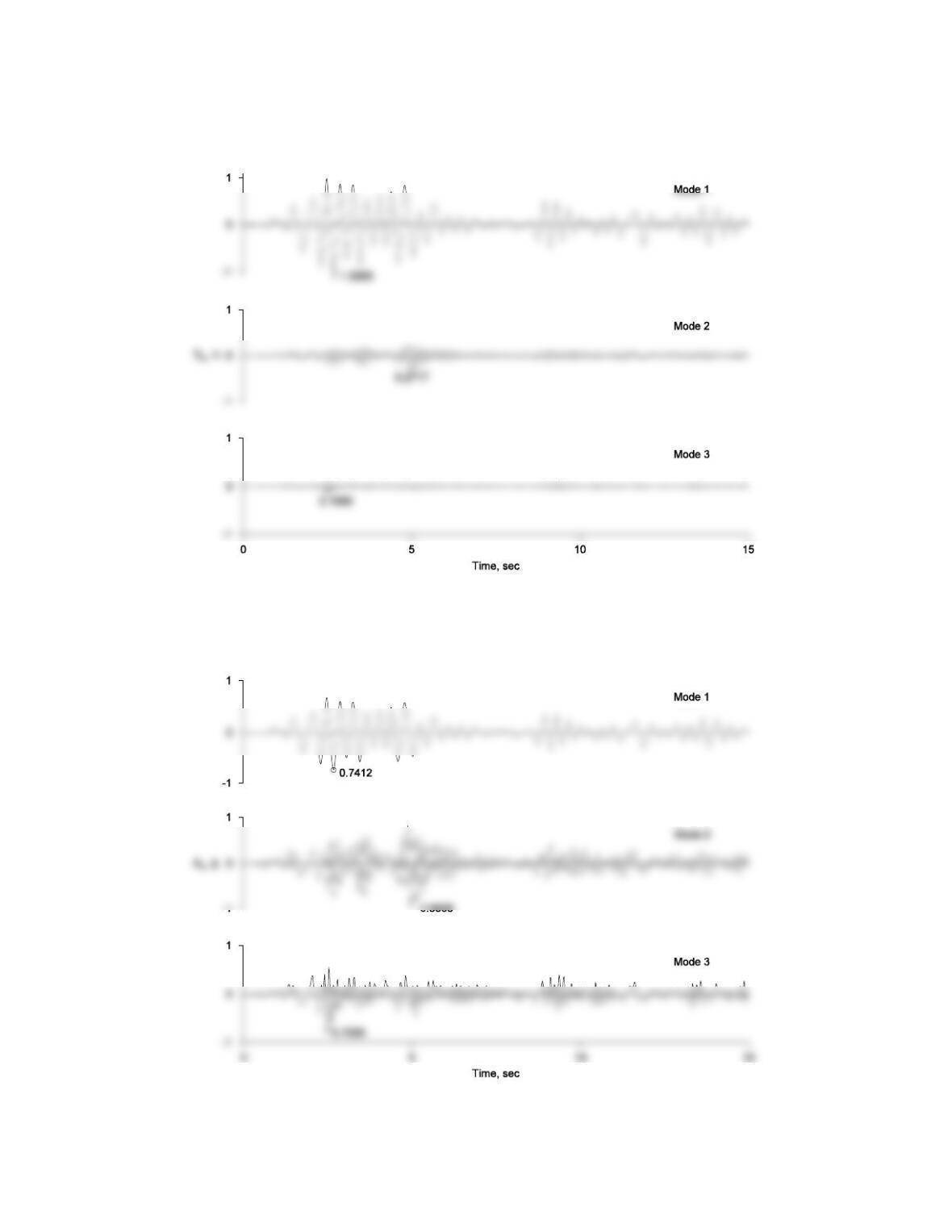
The displacements )(tDn and pseudo-acceleration
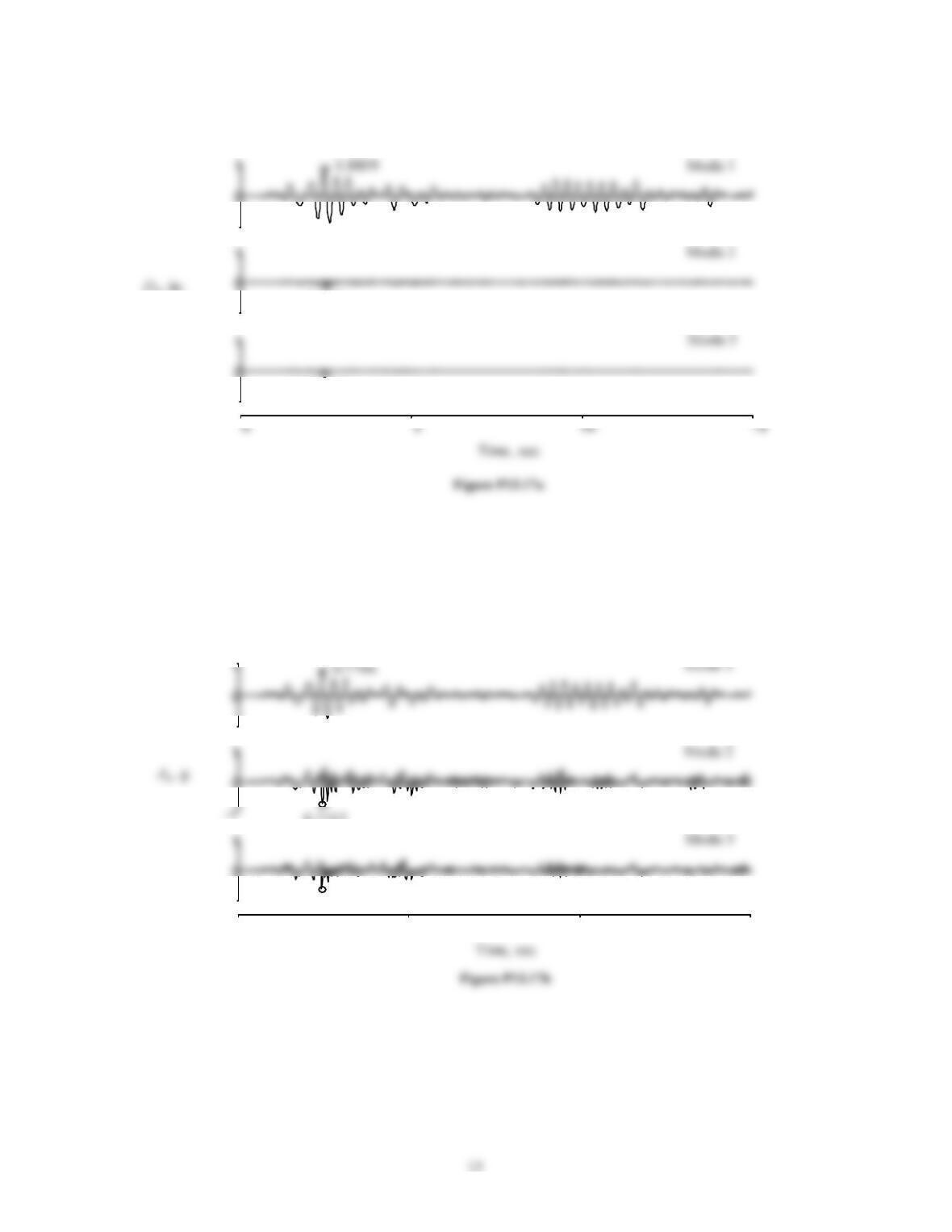
procedure of Section 5.2 with sec 02.0t. The results
are shown in Figs. P13.8a–b.
Part b
Mode n 1 2 3
st
st
hmMbn
)()( st tArtr nnn
where st
n
r and )(tAn are both known. These results for
The modal contributions to each response quantity
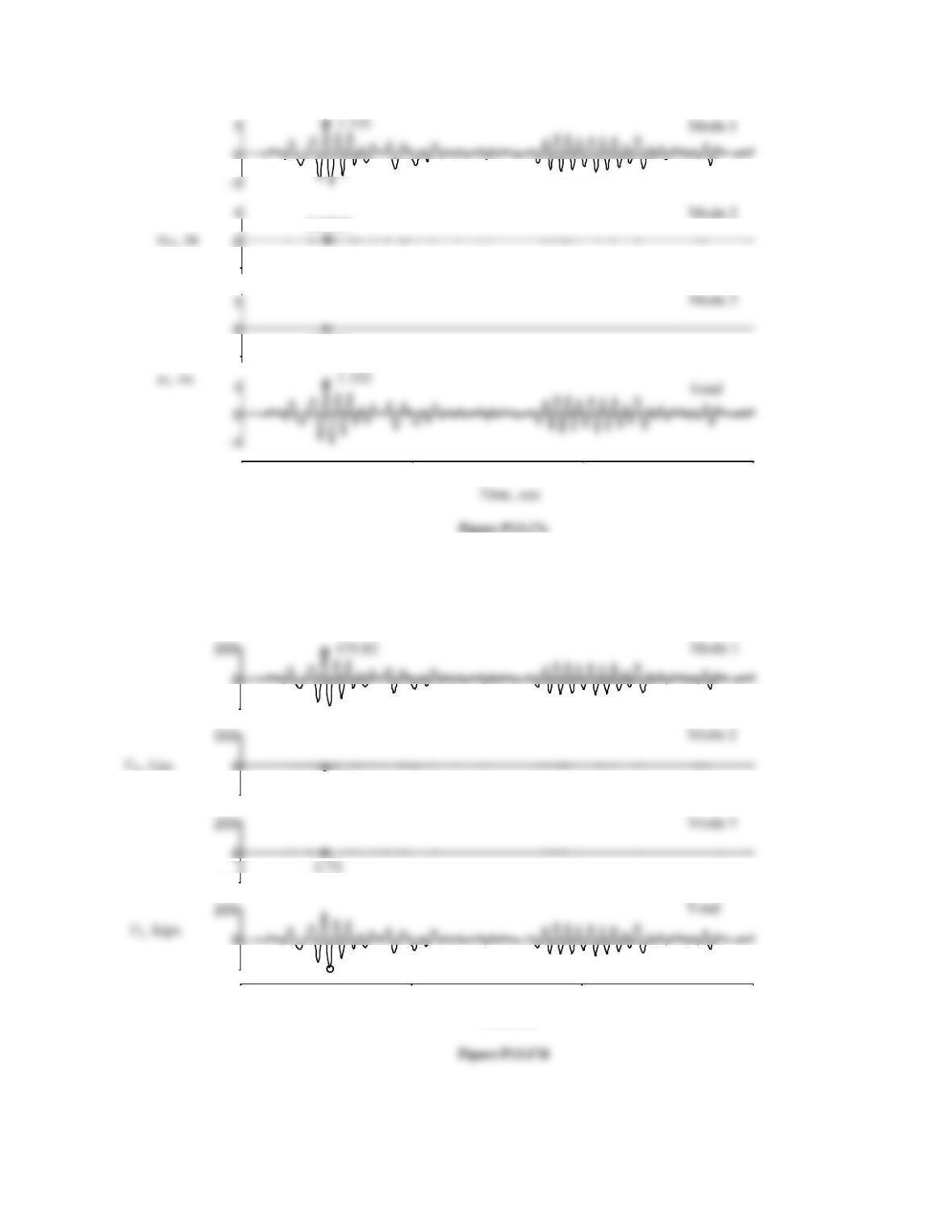
are combined at each time instant to obtain Figs. 13.8c–e.
Floor or
Story Displacement, in. Shear
kips.
Overturning
moment, kip–ft.
18
Fig. P13.8a
Figure P13.8a
Figure P13.8b
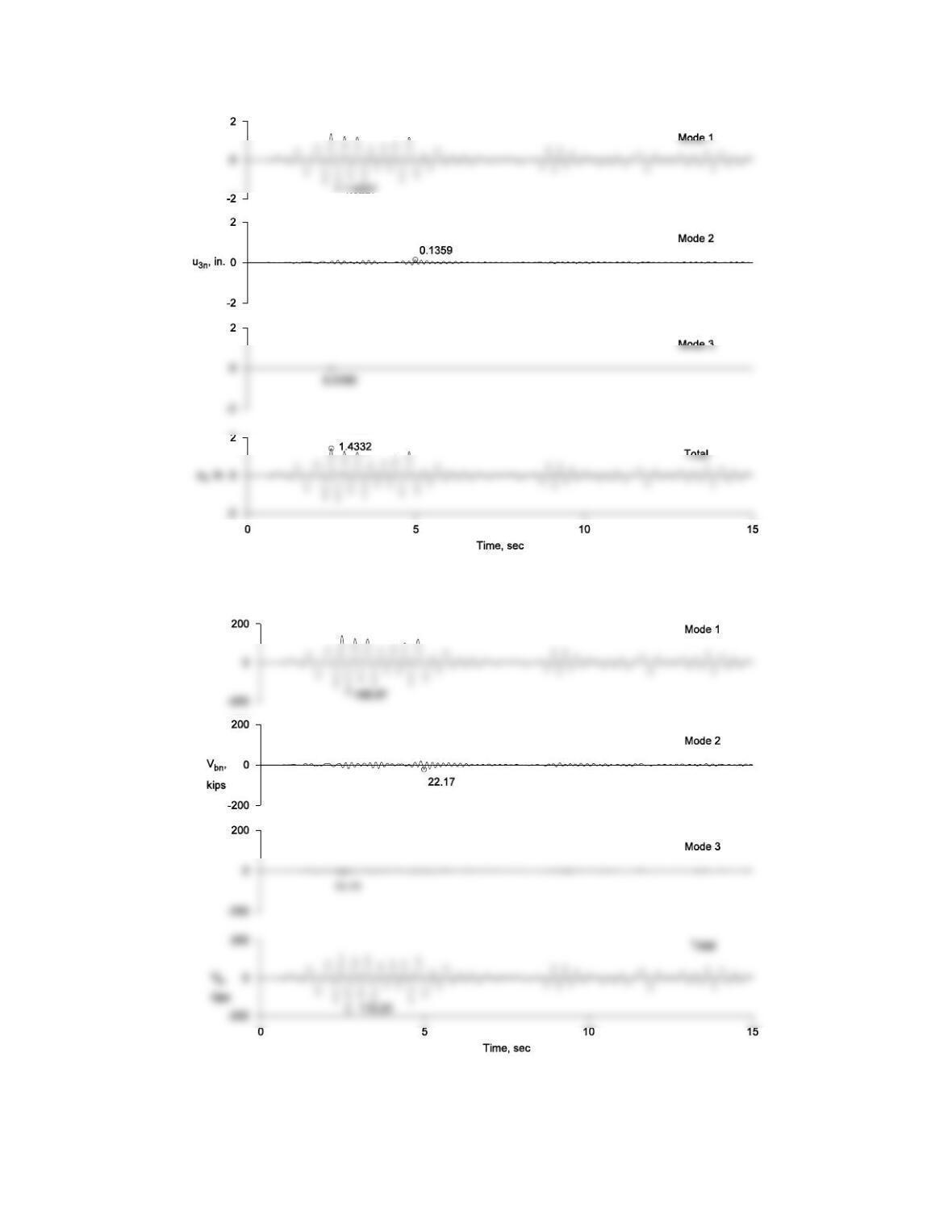
19
Figure P13.8c
Figure P13.8d