1
CHAPTER 10
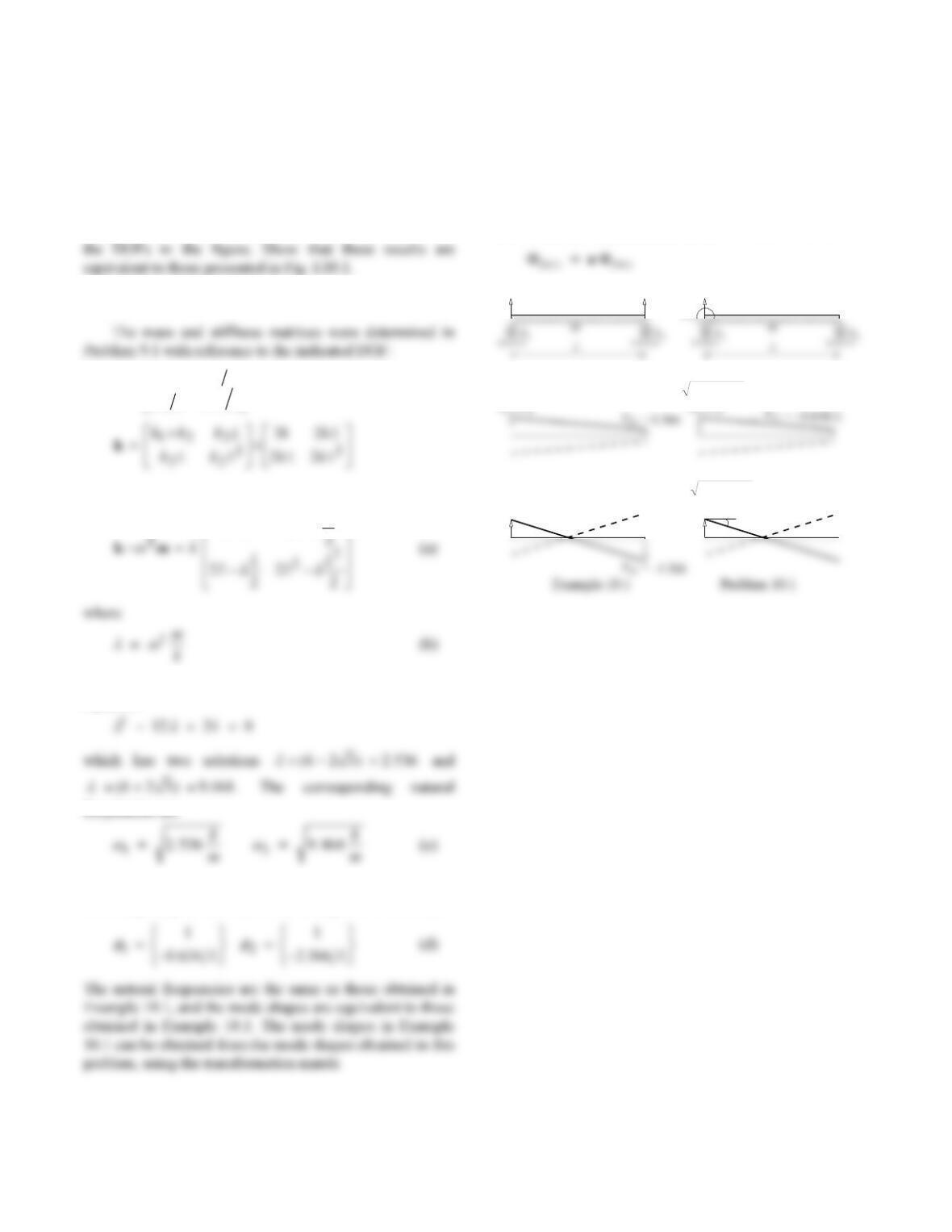
Problem 10.1
Determine the natural vibration frequencies and modes of
the system of Fig. P9.1 with k1 = k and k2 = 2k in terms of
Solution:
32
2
2
mLmL
mLm
m
Then
23
L
L
Substituting Eq. (a) in Eq. (10.2.6) gives the frequency
equation:
frequencies are
The natural modes are determined from Eq. (10.2.5)
following the procedure shown in Example 10.1 to obtain
L1
01
a
that relates the displacements in the two sets of DOFs:
u1
u2
u2
u1
First mode,
1= 2.536 k/m
Second mode,
2= 9.464 k/m
12 = 1
12 = 1
22 = –2.366/ L
2
Problem 10.2
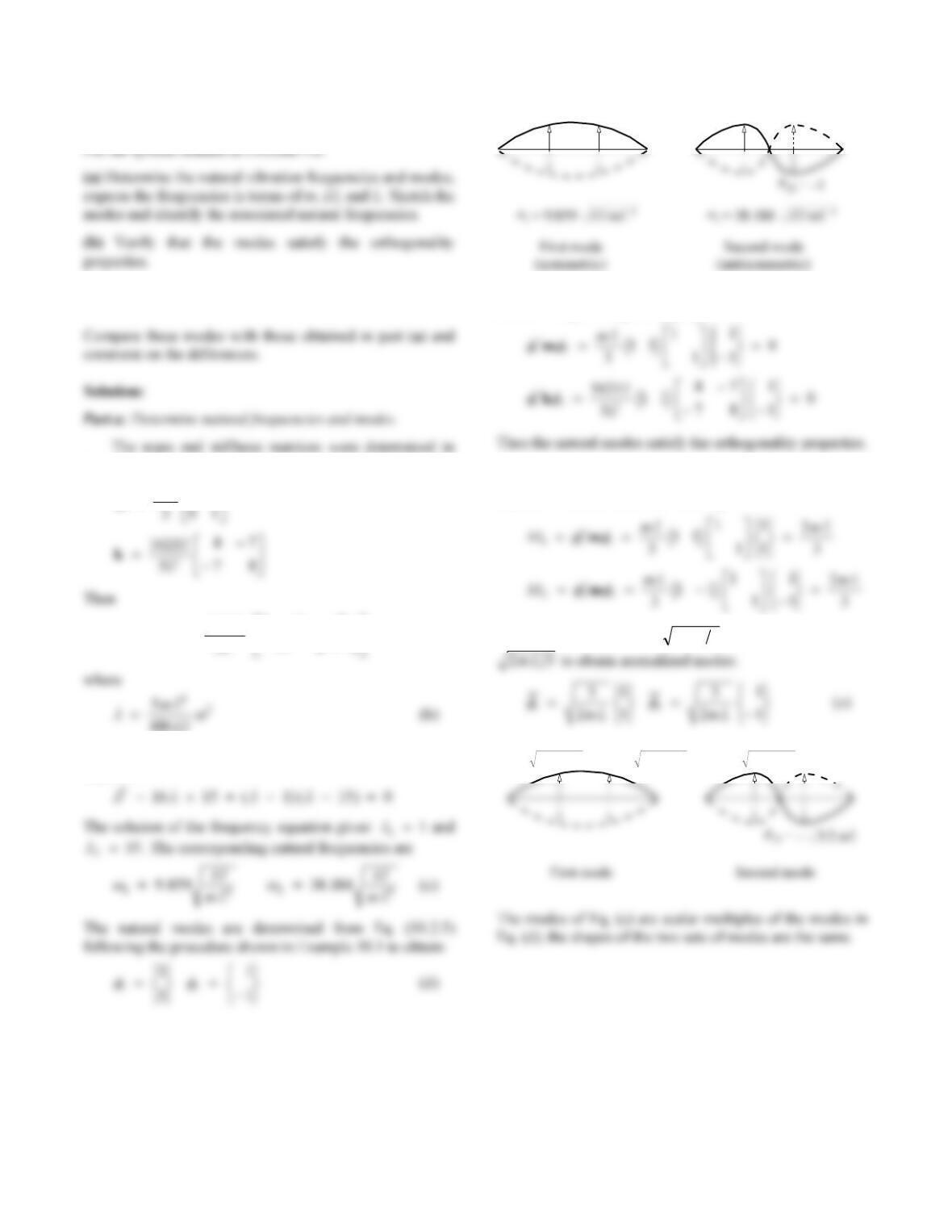
(c) Normalize each mode so that the modal mass Mn has
unit value. Sketch these normalized modes.
Problem 9.2:
10
mL
m
3
87
162
78
5
EI
L
2
km (a)
486
E
I
Substituting Eq. (a) in Eq. (10.2.6) gives the frequency
equation:
11 = 1
21 = 1
12 = 1
Part b: Verify orthogonality properties.
Part c: Normalize modes so that
M
n1.
Divide
1 of Eq. (d) by 23mL and
2 of Eq. (d) by
11 = 3/2 mL
21 = 3/2 mL
12 = 3/2 mL
3
Problem 10.3
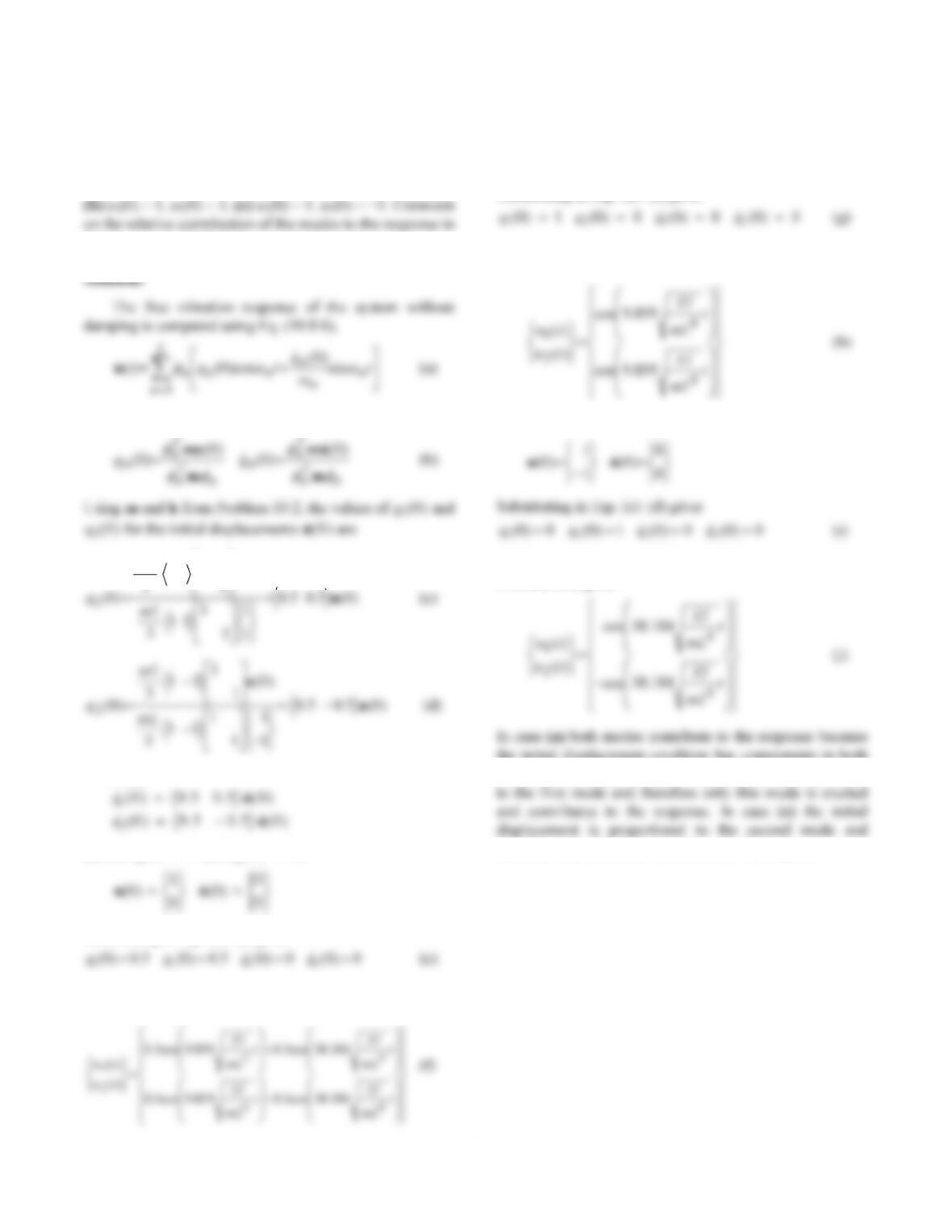
Determine the free vibration response of the system of
Problem 9.2 (and Problem 10.2) due to each of the three
sets of initial displacements: (a) u1(0) = 1, u2(0) = 0;
the three cases. Neglect damping in the system.
where according to Eq. (10.8.5)
)0(
1
11
u
Lm
Similarly,
(a) For u101() and u200(),
Substituting in Eqs. (c)–(d) gives
Substituting Eq. (e) in Eq. (a) and using the modes from
Problem 10.2 gives
(b) For u101()
and u201(),
0
0
)0(
1
1
)0( uu
Substituting in Eqs. (c)–(d) gives
Substituting Eq. (g) in Eq. (a) and using the modes from
Problem 10.2 gives
(c) For u101()
and u201(),
Substituting Eq. (i) in Eq. (a) and using the modes from
Problem 10.2 gives
the initial displacement condition has components in both
modes. In case (b) the initial displacement is proportional
therefore only this mode contributes to the response.
4
Problem 10.4
Repeat Problem 10.3(a) considering damping in the
system. For each mode the damping ratio is ζn = 5%.
Solution:
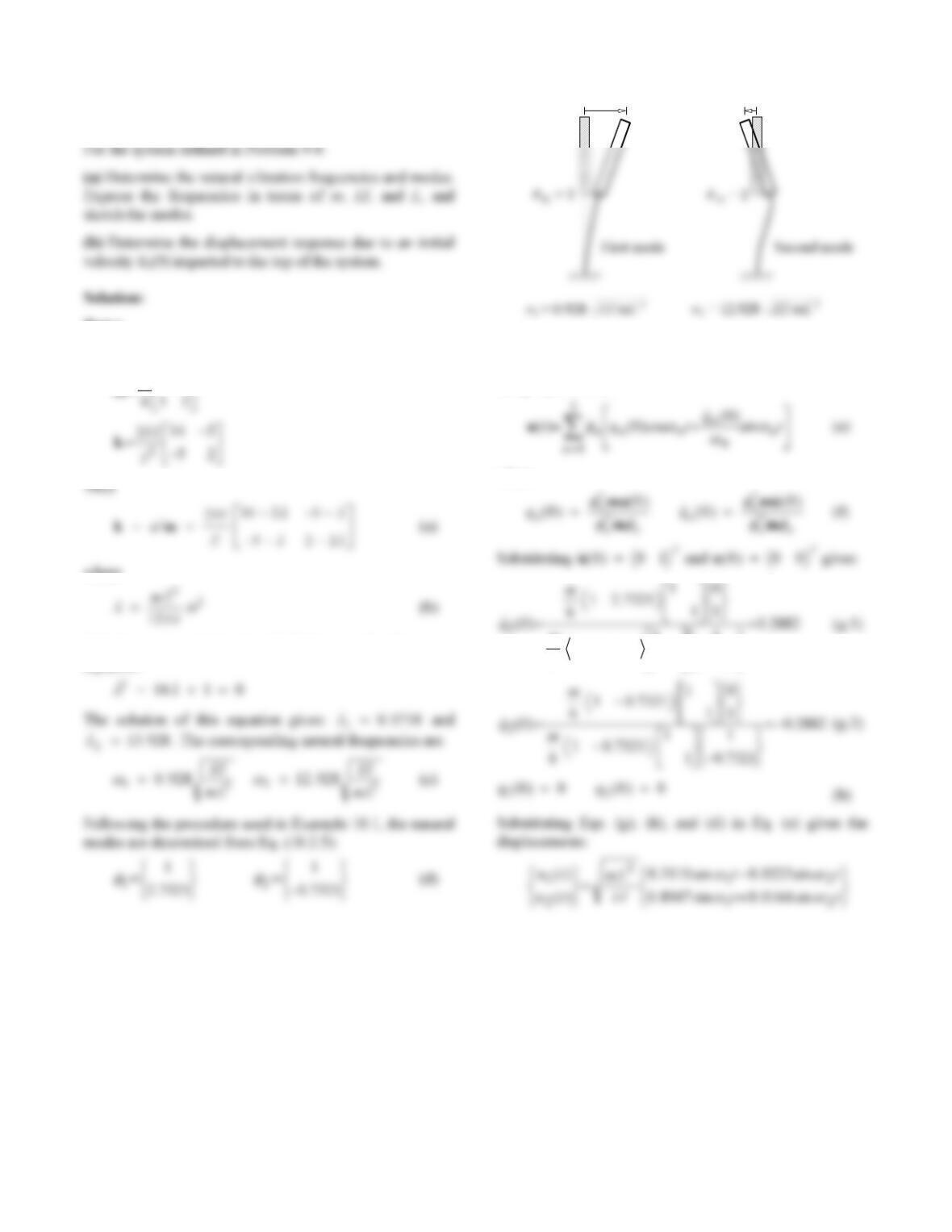
The free vibration response of the system of Problem
9.2 including damping is computed using Eq. (10.10.4):
For the given initial conditions u101() and u200()
,
Eq. (e) of Problem 10.3 gives
(f)
5
Problem 10.5
Part a
From Problem 9.4, the mass and stiffness matrices are.
21
12
m
m
where
Substituting Eq. (a) in Eq. (10.2.6) gives the frequency
equation:
21 = 2.7321
22 = – 0.7321
Part b
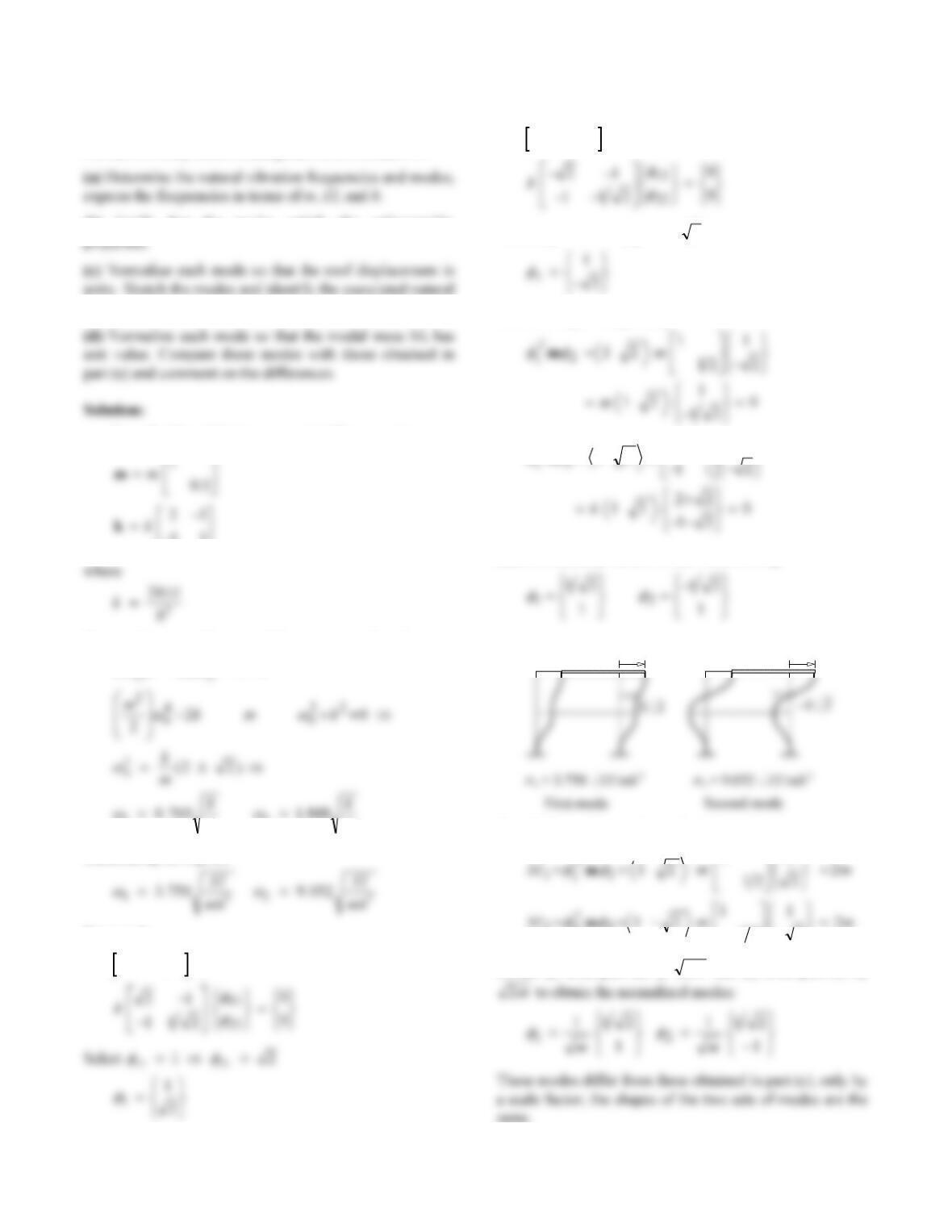
The free vibration response of the system is computed
using Eq. (10.8.6):
where
7321.2
1
1
1
7321.21
6
6
Problem 10.6
For the two-story shear building shown in Problem 9.5:
(b) Verify that the modes satisfy the orthogonality
frequencies.
From Problem 9.5, the mass and stiffness matrices are
Part a: Determine the natural frequencies and modes.
2
det 0
n
km
10 765.k
m
21 848.k
m
Substituting for k gives
First mode:
km 0
1
2
1
Second mode:
km 0
2
2
2
Select
12 22
12
Part b: Verify orthogonality.
1
12
21
k
T
k
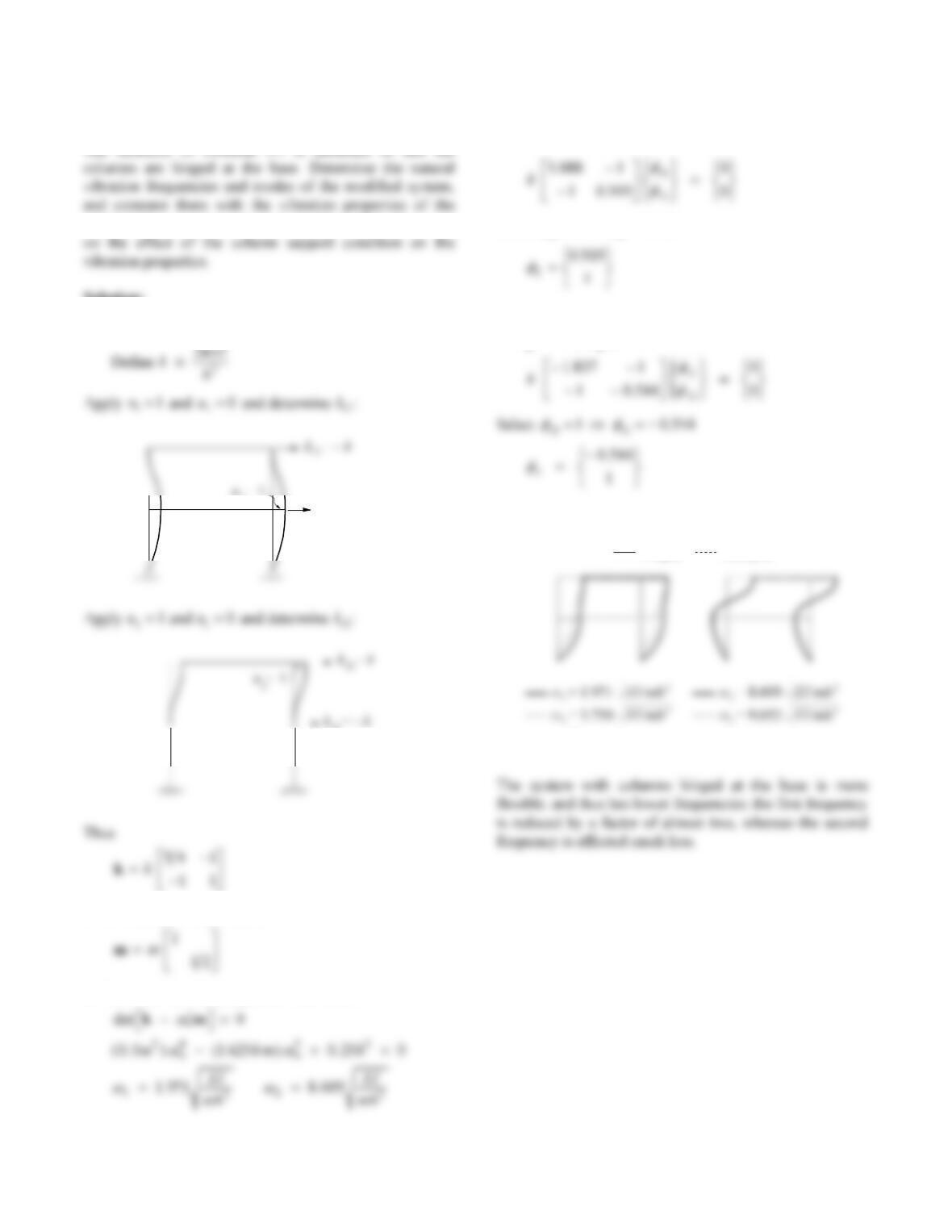
Part c: Normalize modes to unit value at roof.
11
Part d: Normalize modes so that
M
n1.
1
1
2
21
2
2
2
Divide
same.
7
Problem 10.7
The structure of Problem 9.5 is modified so that the
original structure determined in Problem 10.6. Comment
Solution:
1. Determine the stiffness matrix.
u = 1
1k = k + k /4
= 5 k/4
11
12
2. Determine the mass matrix.
3. Determine natural frequencies and modes.
Determine first mode:
2
11
km 0
Select 21 11
1 0.919
Determine second mode:
2
22
km 0
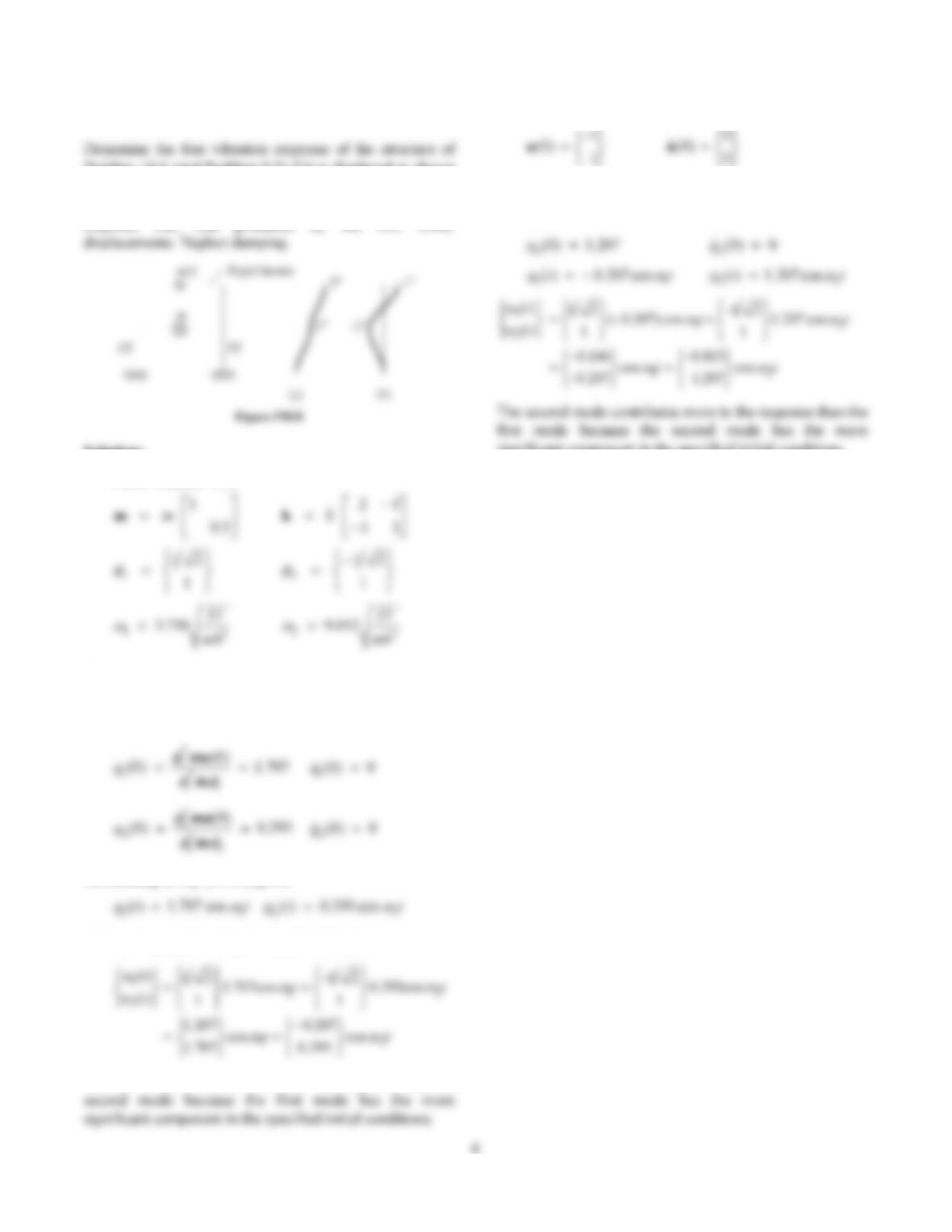
4. Compare vibration properties for hinged and clamped
cases.
First mode Second mode
hinged clamped
Problem 10.8
Problem 10.6 (and Problem 9.5) if it is displaced as shown
in Figs. P10.8a and b and released. Comment on the
relative contributions of the two vibration modes to the
response that was produced by the two initial
Solution:
From Problem 10.6,
Part a
1
(0) 2
u 0
(0) 0
u
Substituting in Eq. (10.8.8) gives
Substituting qt
n()
and
n in Eq. (10.8.7) gives
The first mode contributes more to the response than the
Part b
Following the procedure of part (a) we obtain
1(0) 0.207q
1(0) 0q
significant component in the specified initial conditions.
9
Problem 10.9
Repeat Problem 10.8 for the initial displacement of Fig.
P10.8a, assuming that the damping ratio for each mode is
5%.
Solution:
From Problem 10.8
Substituting qn()0 and ()qn0 in Eq. (10.10.2) gives
qt e t t
t
DD
11
1
1
21
11
1707 1707
1
() . cos .sin
F
H
G
G
I
K
J
J
(b)
Substituting Eqs. (a) and (b) in Eq. (10.8.7) gives
10
Problem 10.10
Determine the natural vibration frequencies and modes of
the system defined in Problem 9.6. Express the frequencies
in terms of m, EI, and h and the joint rotations in terms of
u2
u3
u5
u4
u6
u1
With reference to the lateral floor displacements u1
and u2, the mass matrix and the condensed stiffness matrix
(from Problem 9.6) are
1. Determine natural frequencies.
2. Determine first mode.
2
11
ˆtt tt
km 0
3. Determine second mode.
4. Determine joint rotations.
where
Tkk
1
00 0
t
(b)
Substituting
k
00 and
k
0
t
from Problem 9.6 in Eq. (b) gives
L
O
0164 0 411
..
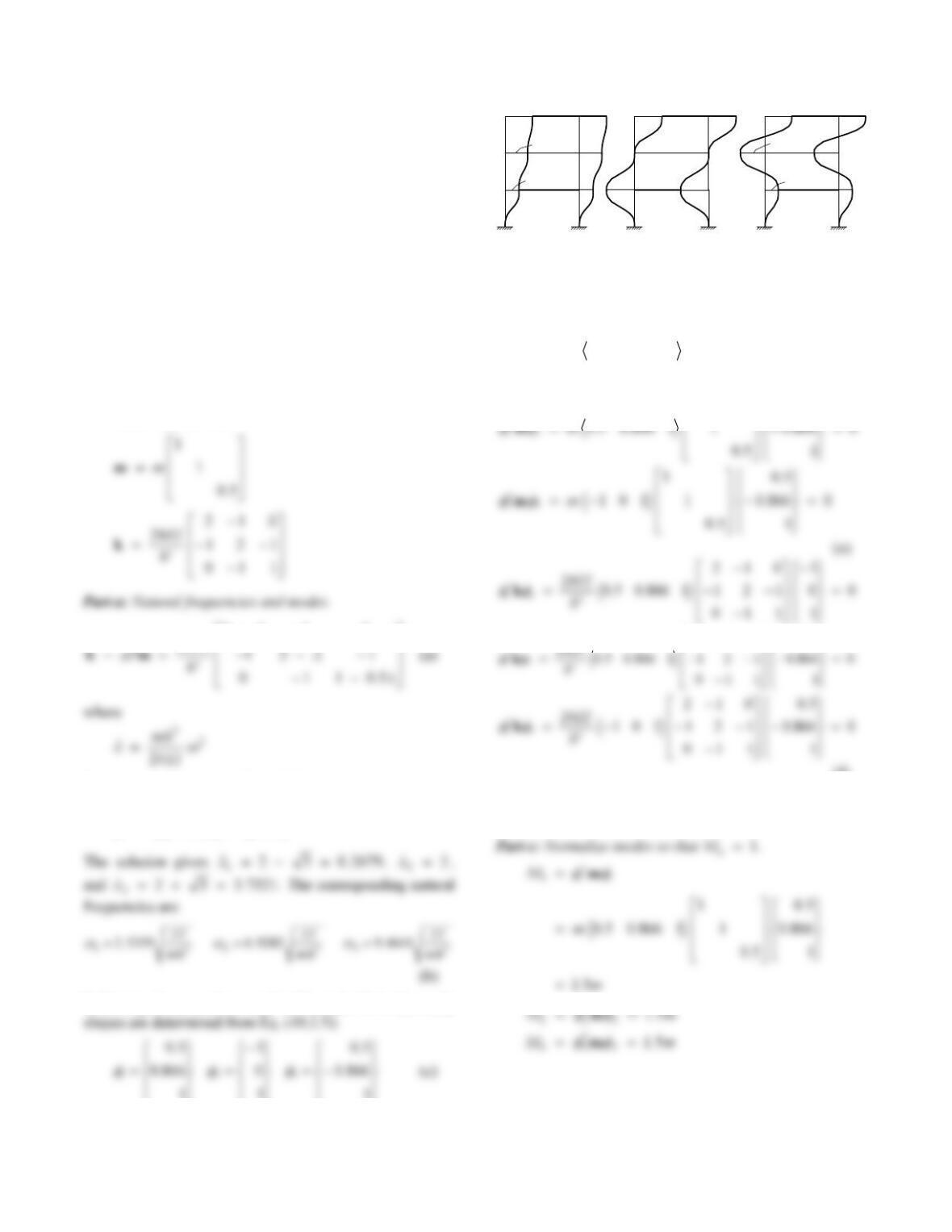
The joint rotations associated with the first mode are
obtained by substituting 1t
u in Eq. (a):
u
3
6
0164 0 411
0490
R
T
U
W
L
N
O
Q
R
T
U
W
..
.
Similarly, 2t
u in Eq. (a) gives the joint rotations
associated with the second mode:
u
u
hh
5
0904 0740
0904 0740
1
1677
1677
|
|
|
|
M
P
TU
W
|
|
|
|
..
..
.
.
0.482
0.490/ h
1
Second mode
N
11
Problem 10.11
For the three-story shear building shown in Fig. P9.7:
(a) Determine the natural vibration frequencies and modes;
express the frequencies in terms of m, EI, and h. Sketch the
modes and identify the associated natural frequencies.
(b) Verify that the modes satisfy the orthogonality
properties.
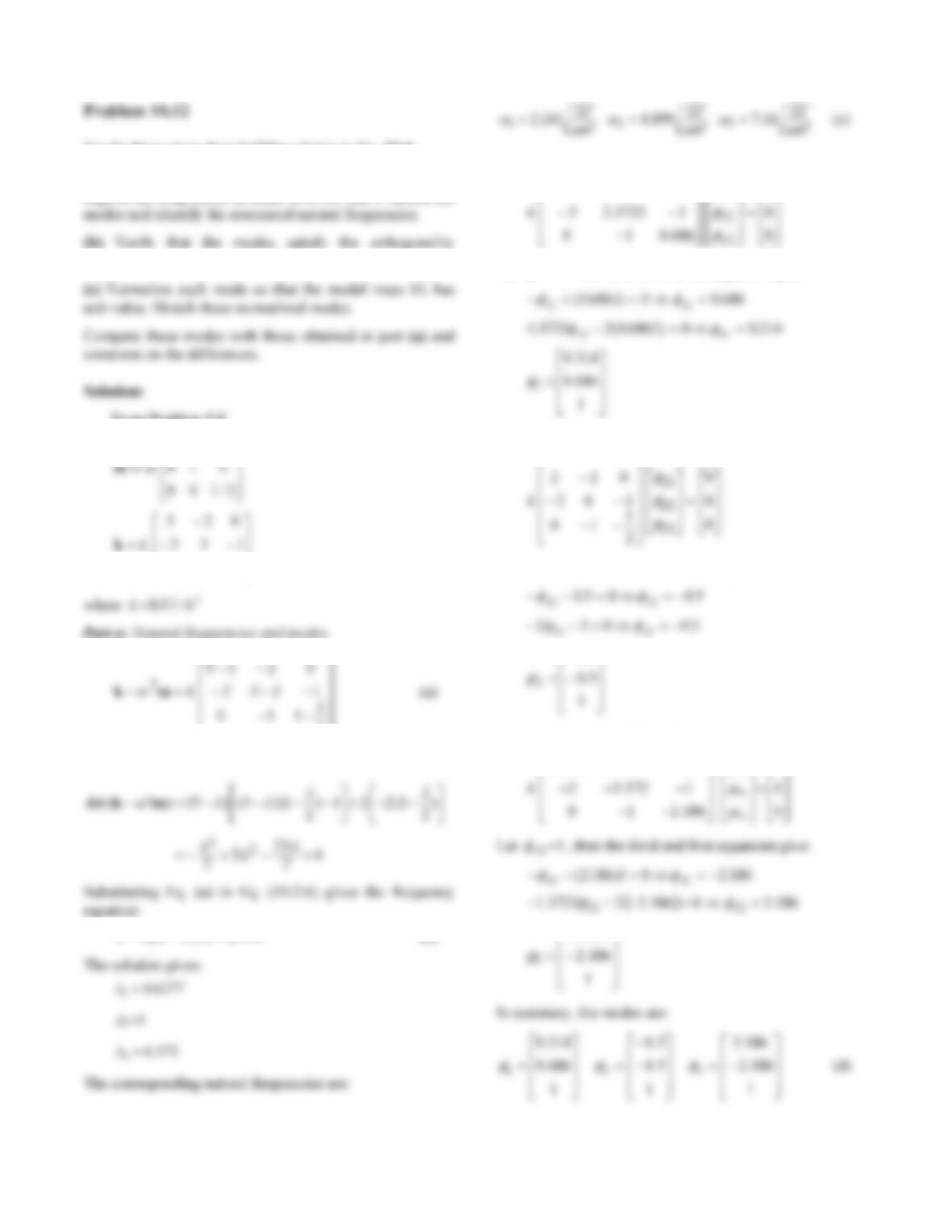
(c) Normalize each mode so that the modal mass Mn has
unit value. Sketch these normalized modes.
Compare these modes with those obtained in part (a) and
comment on the differences.
Solution:
From Problem 9.7,
210
24 12 1
EI
Substituting Eq. (a) in Eq. (10.2.6) gives the frequency
equation:
32
6920
Following the procedure used in Example 10.1, the mode
Part b: Verify modal orthogonality.
12
11
0.5 0.866 1 1 0 0
0.5 1
Tm
m
10.5
Tm
210 0.5
(f)
Thus the computed modes satisfy the orthogonality
properties.
T
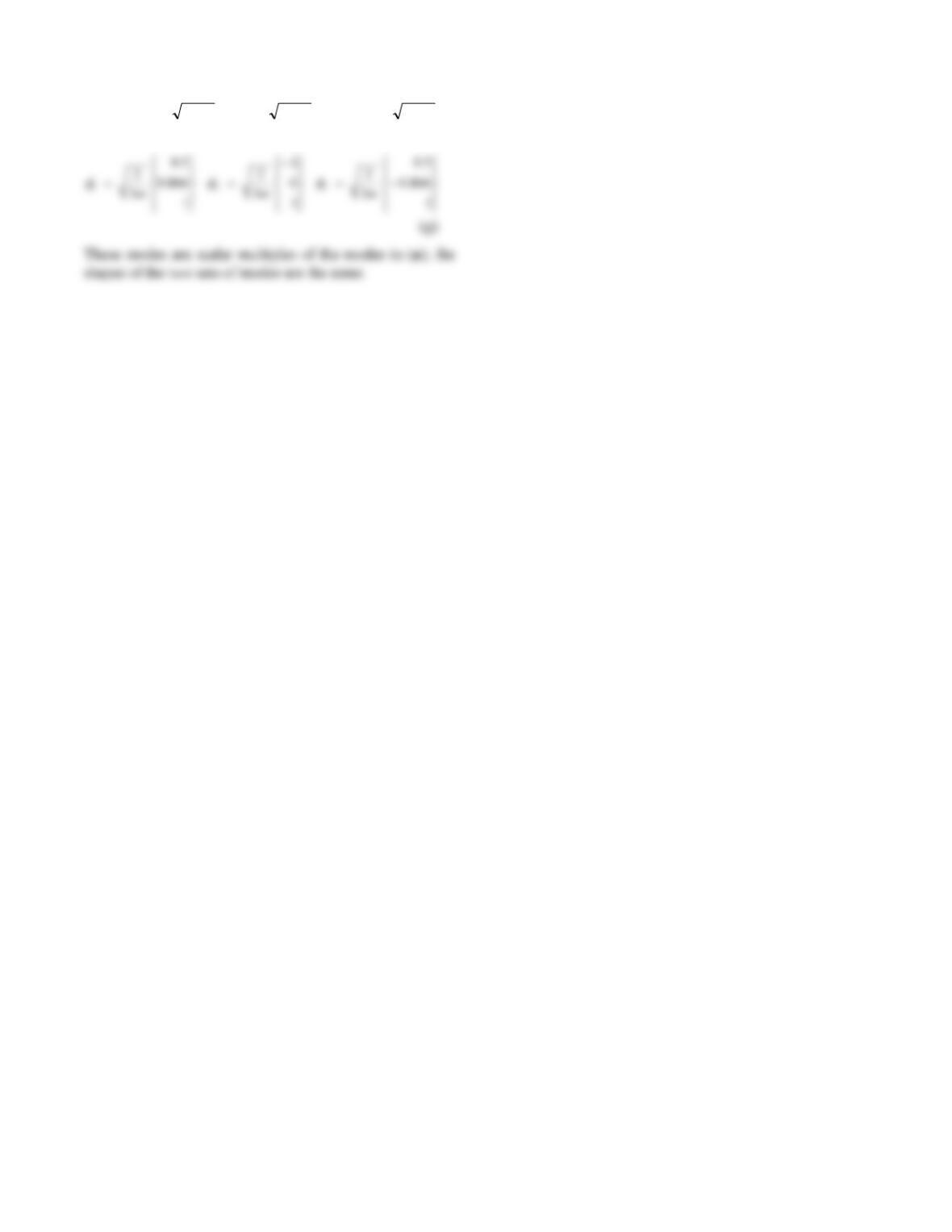
First mode Second mode Third mode
111
0.866 – 0.866
0.5 – 1 0.5
12
Divide
1 by 15.m,
2 by 15.m, and
3 by 15.m to
obtain the normalized modes:
13
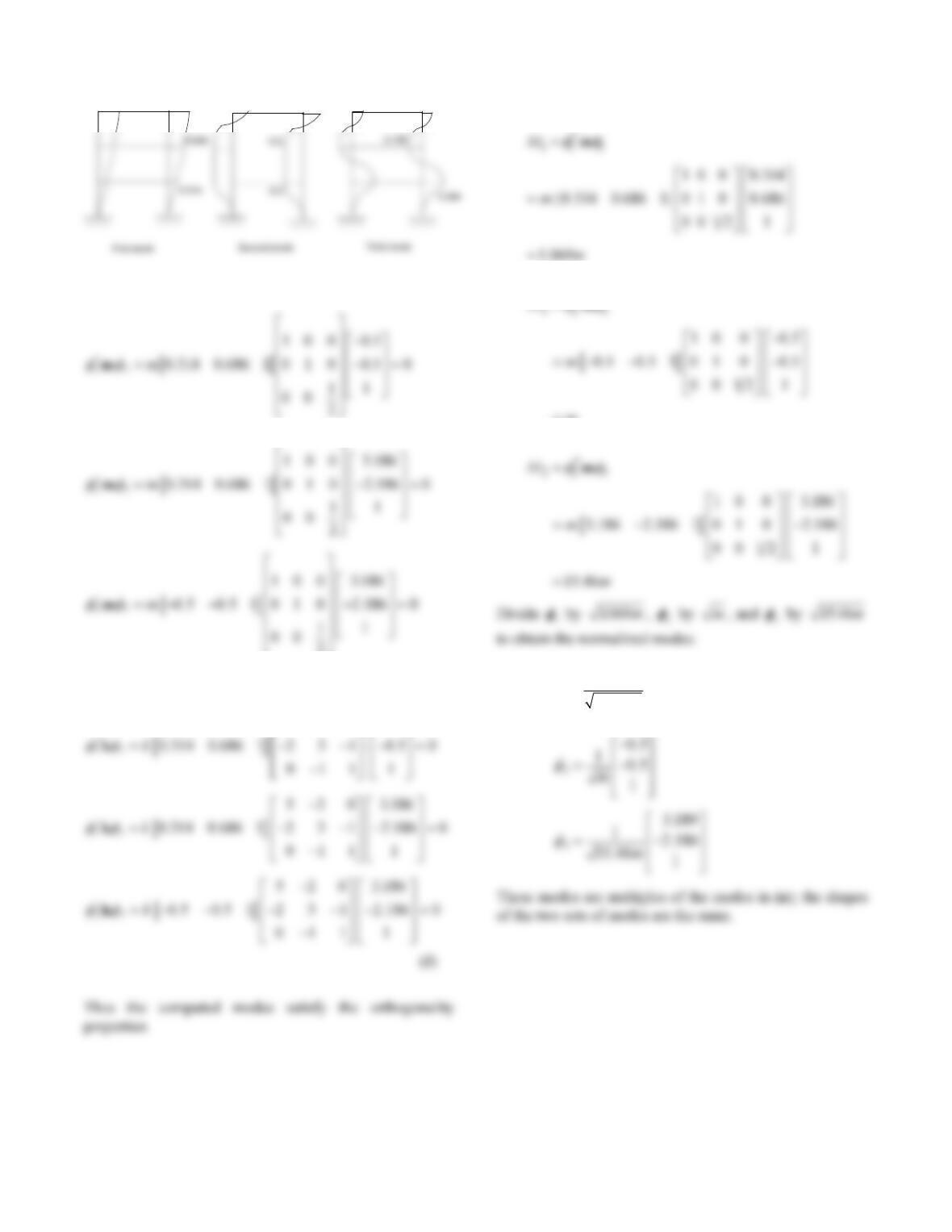
For the three-story shear building shown in Fig. P9.8:
(a) Determine the natural vibration frequencies and modes;
express the frequencies in terms of m, EI, and h. Sketch the
properties.
From Problem 9.8,
001
110
2
where
mk
2/
32
Substituting
10 6277
. in Eq. (a) gives
0
023723.4
11
Let 13 1
, then the third and first equations give:
Substituting
23 in Eq. (a) gives
Let 23 1
, then the third and first equations give:
5.0
Substituting
3
6372
.
in Eq. (a) gives
31
1.372 2 0 0
186.3
14
Part b: Verify modal orthogonality.
(e)
5 2 0 0.5
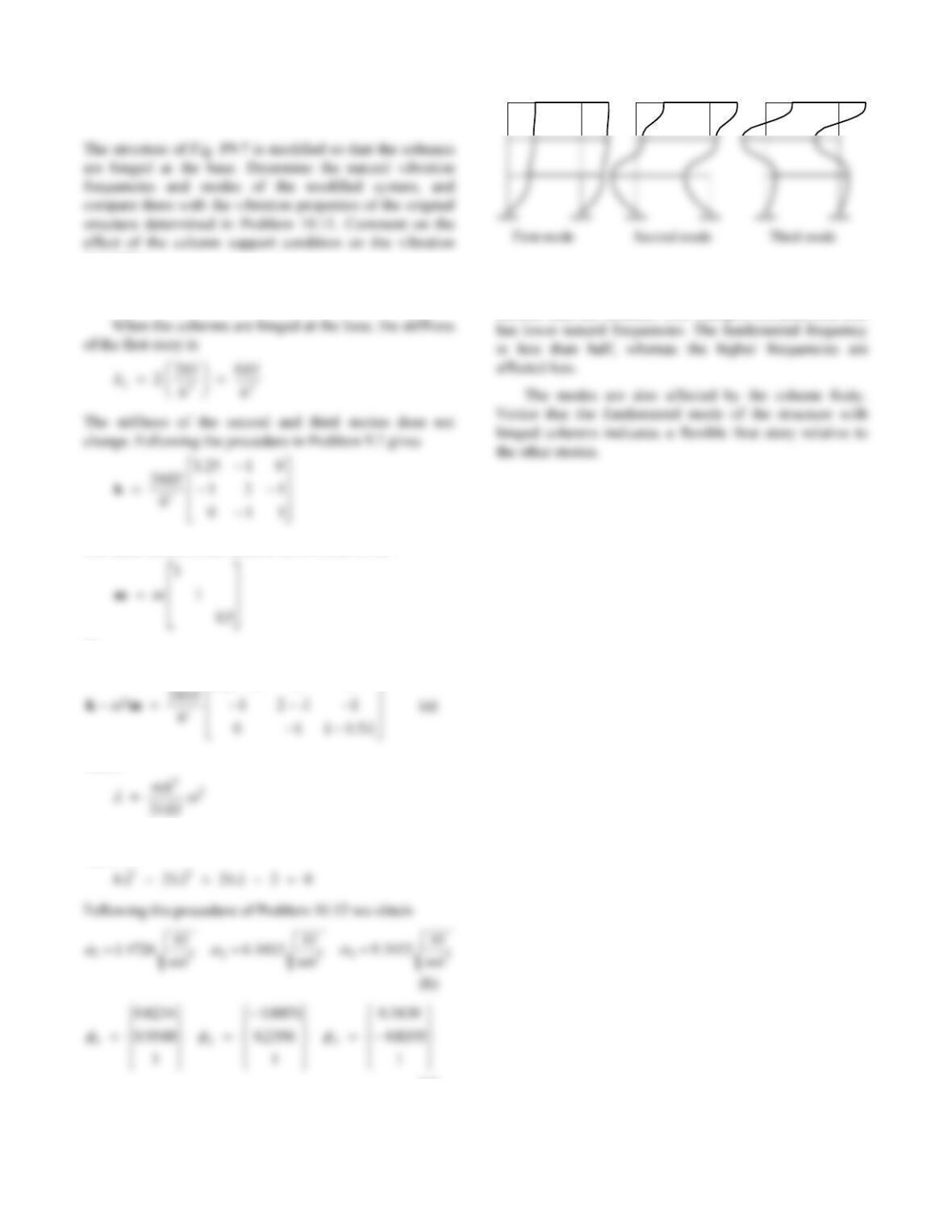
Part c: Normalize modes so that Mn1.
T
m
1
0.314
10.686
1.069 1
m
1
1
1
15
Problem 10.13
properties.
Solution:
The mass matrix is the same as in Problem 10.12:
Then
1.25 1 0
where
Substituting Eq. (a) in Eq. (10.2.6) gives the frequency
equation:
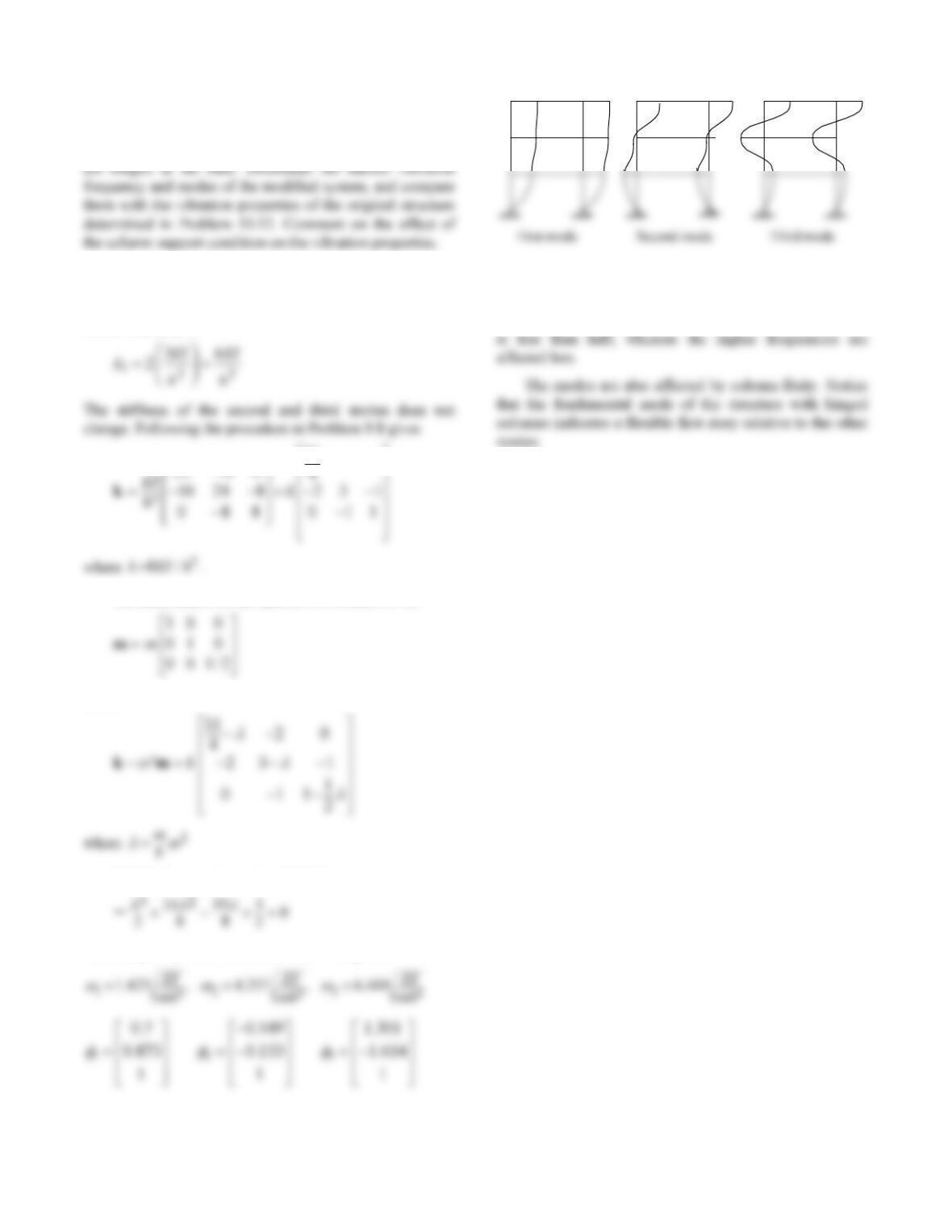
(c)
The structure with columns hinged at the base is more
flexible than the structure with clamped columns, and thus
16
Problem 10.14
The structure of Fig. P9.7 is modified so that the columns
Solution:
When the columns are hinged at the base, the stiffness
of the first story is
11 20
The mass matrix is the same as in Problem 10.12:
Then
Substituting Eq. (a) in Eq. (10.2.6) gives:
Following the procedure of Problem 10.12 gives:
The structure with columns hinged at the base is more
flexible than the structure with clamped columns, and thus
has lower natural frequencies. The fundamental frequency
17
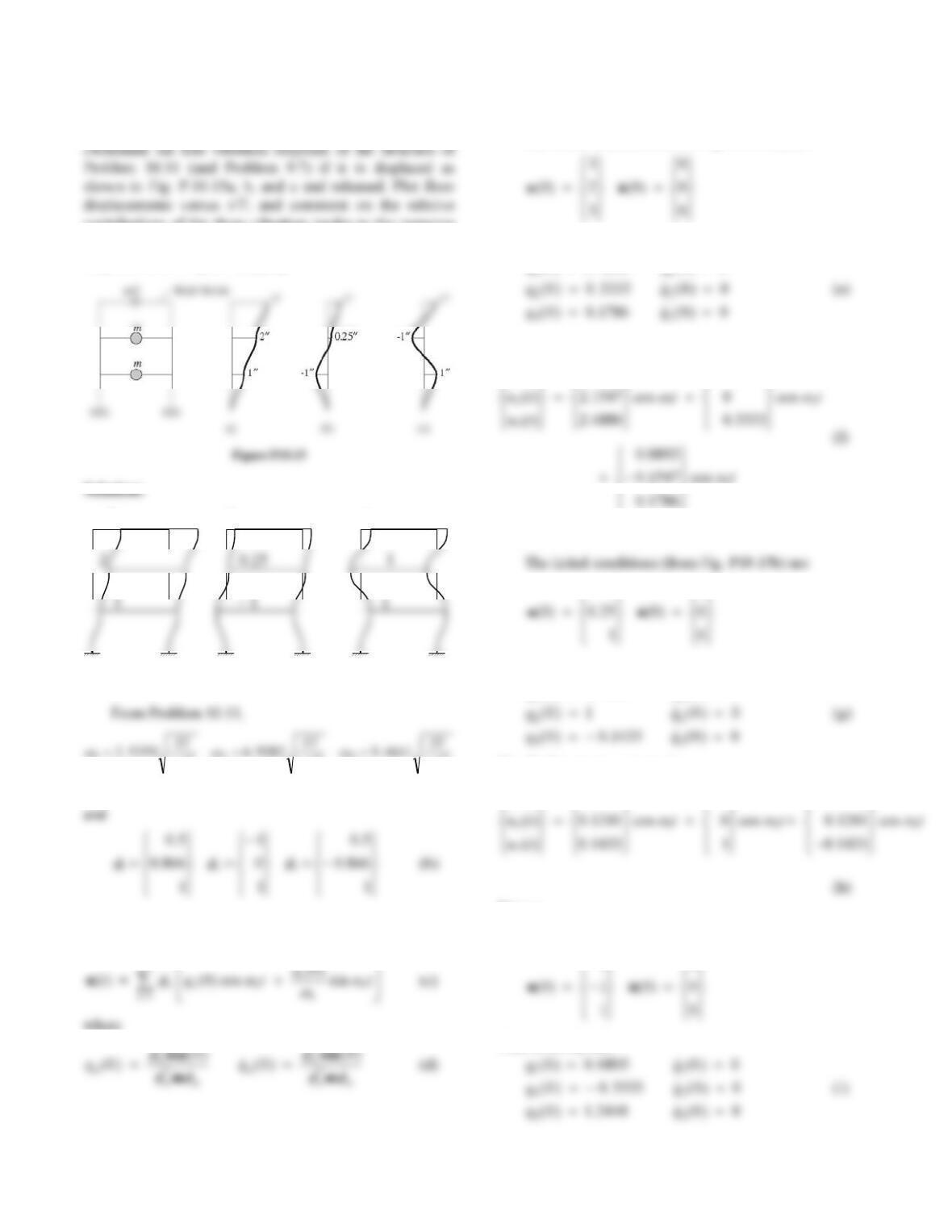
Problem 10.15
contributions of the three vibration modes to the response
that was produced by each of the three initial
displacements. Neglect damping.
Figure 10.15a Figure 10.15b Figure 10.15c
132333
2 5359 6 9282 9 4641…
mh
mh
mh
(a)
The response of the system to initial displacements is
obtained from Eqs. (10.8.6) and (10.8.5):
3
Case a
The initial conditions (from Fig. P10.15a) are
Then from Eq. (d):
qq
0 2 4800 0 0
() . ()
Substituting Eqs. (b) and (e) in Eq. (c) gives u()t in inches:
1
3
( ) 1.2440 0.3333
ut
Case b
10
Then from Eq. (d),
qq
11
0 0 1433 0 0
() . ()
The displacement response is
1
( ) 0.0717 1 0.0717
ut
Case c
The initial conditions (from Fig. P10.15c) are
10
Then from Eq. (d),
311
18
The displacement response is
1
( ) 0.0447 0.3333
ut
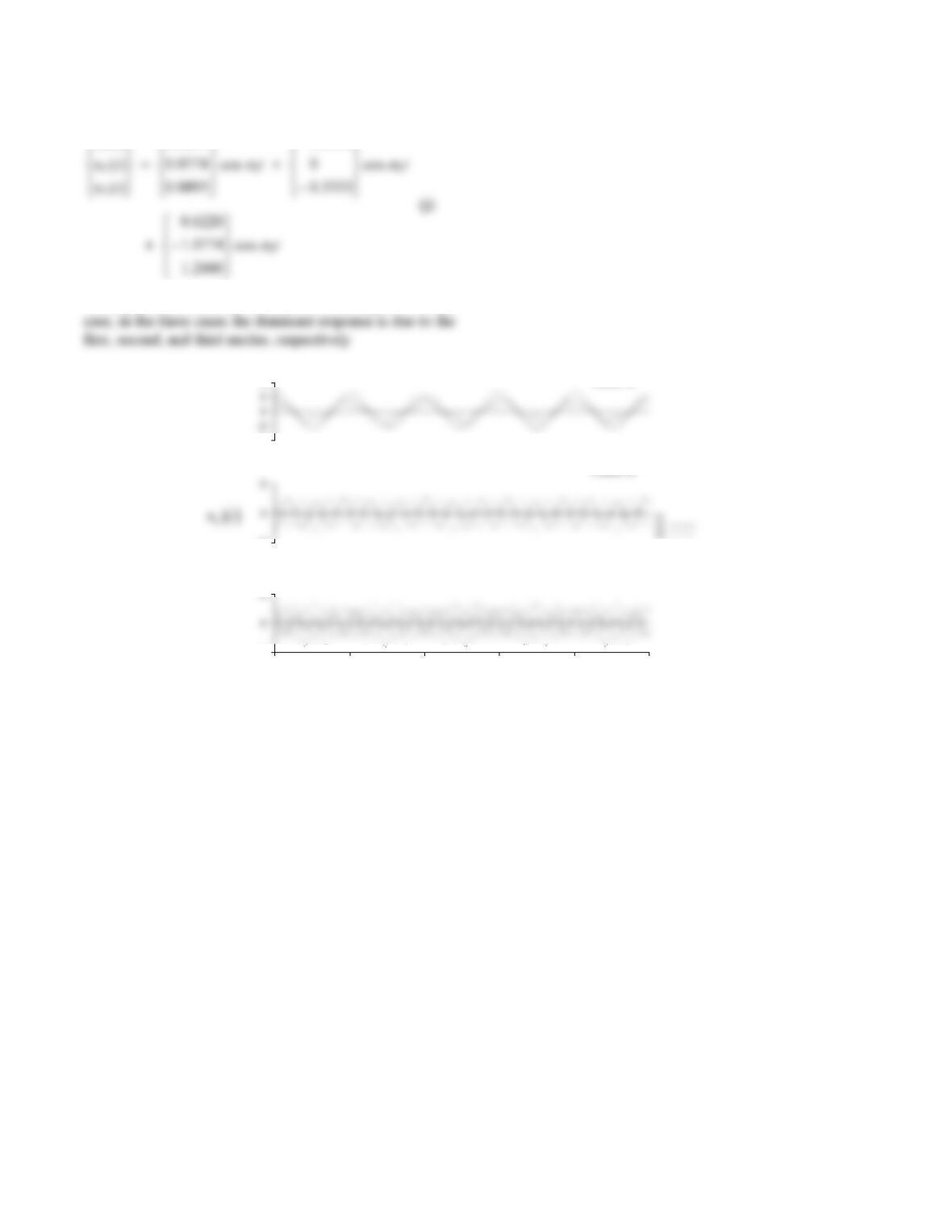
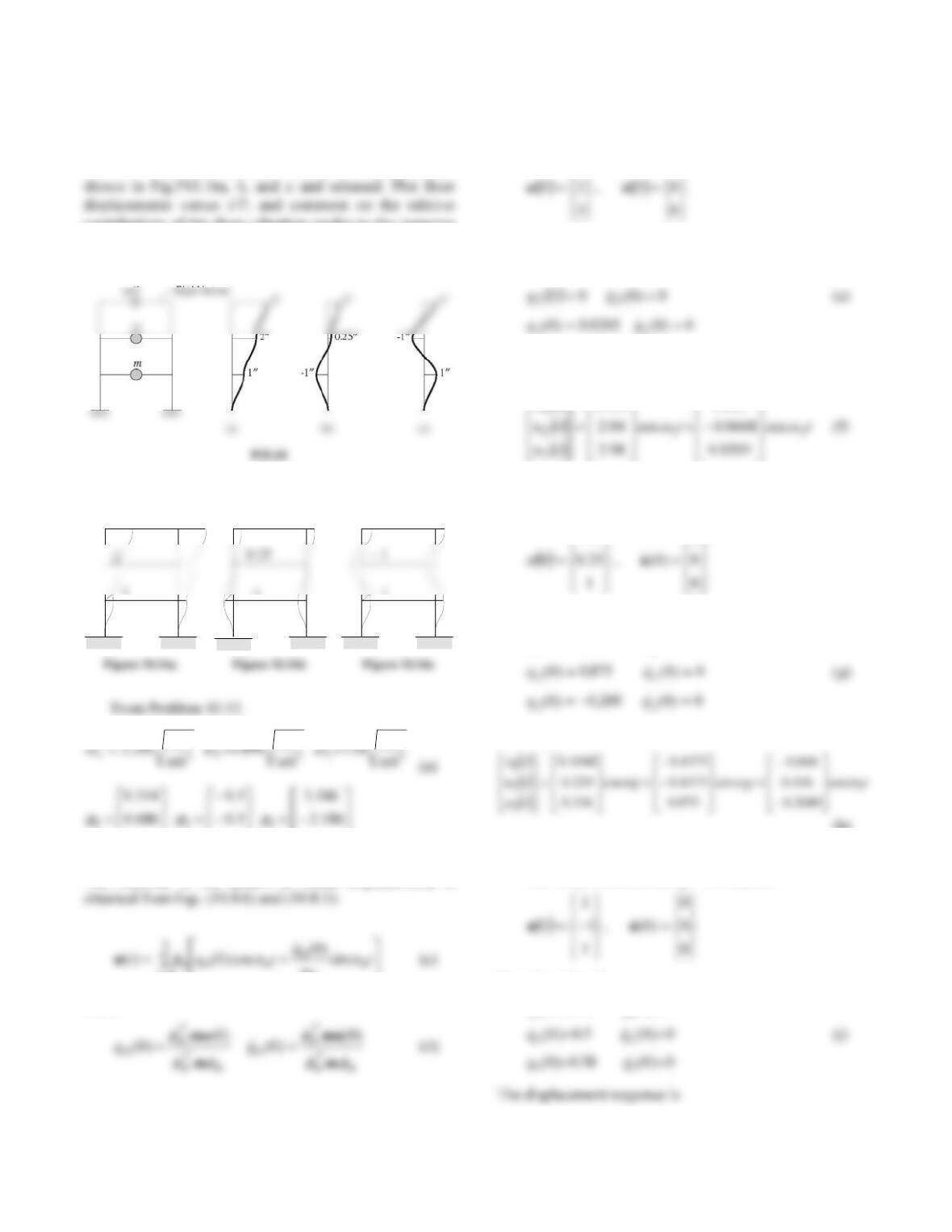
Although all three modes contribute to the response in each
.
Figure P10.15d
-4
4
Case a
-2
Case b
-2
0 1 2 3 4 5
t/T
1
Case c
Case a
Case b
Case c
19
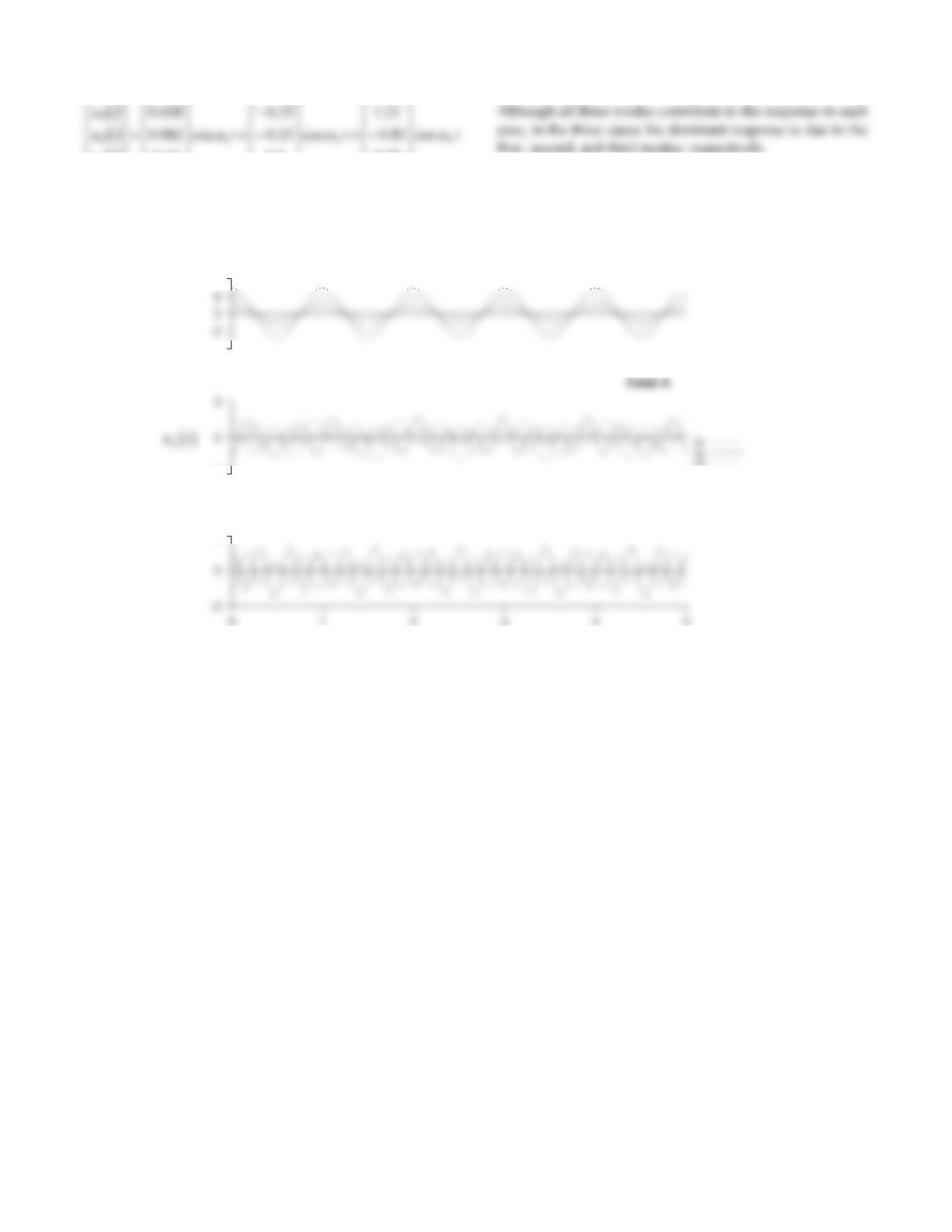
Problem 10.16
Determine the free vibration response of the structure of
Problem 10.12 (and Problem 9.8) if it is displaced as
contributions of the three vibration modes to the response
that was produced by each of the three initial
displacements. Neglect damping.
Solution:
1
1
1
2
1
3
(b)
The response of the system to initial displacements is
n
nn
1
where
Case a
The initial conditions from (Fig. P10.16a) are
1
0
Then from Eq. (d):
0)0(98.20
11
qq
33
Substituting Eqs. (b) and (e) in Eq. (c) gives u()t in
inches:
tu
065.0
935.0
Case b
The initial conditions (from Fig. P10.16b) are
1
0
Then from Eq. (d):
qq
11
00334 00() . ()
The displacement response is
(h)
Case c
The initial conditions (Fig. P10.16c) are:
Then from Eq. (d):
qq
11
0012 00() . ()
3 11
1– 1 1
20
tu
3
38.0
5.0
12.0
(j)
-4
4
Case a
-2
2
0 1 2 3 4 5
t/T1
Case c
Figure P10.16d
Case a
Case c