1
CHAPTER 3
Problem 3.1
The mass m, stiffness k, and natural frequency ωn of an
undamped SDF system are unknown. These properties are
to be determined by harmonic excitation tests. At an exci-
tation frequency of 4 Hz, the response tends to increase
without bound (i.e., a resonant condition). Next, a weight,
∆ω = 5 lb, is attached to the mass m and the resonance test
is repeated. This time resonance occurs at f = 3 Hz.
Determine the mass and the stiffness of the system.
Solution:
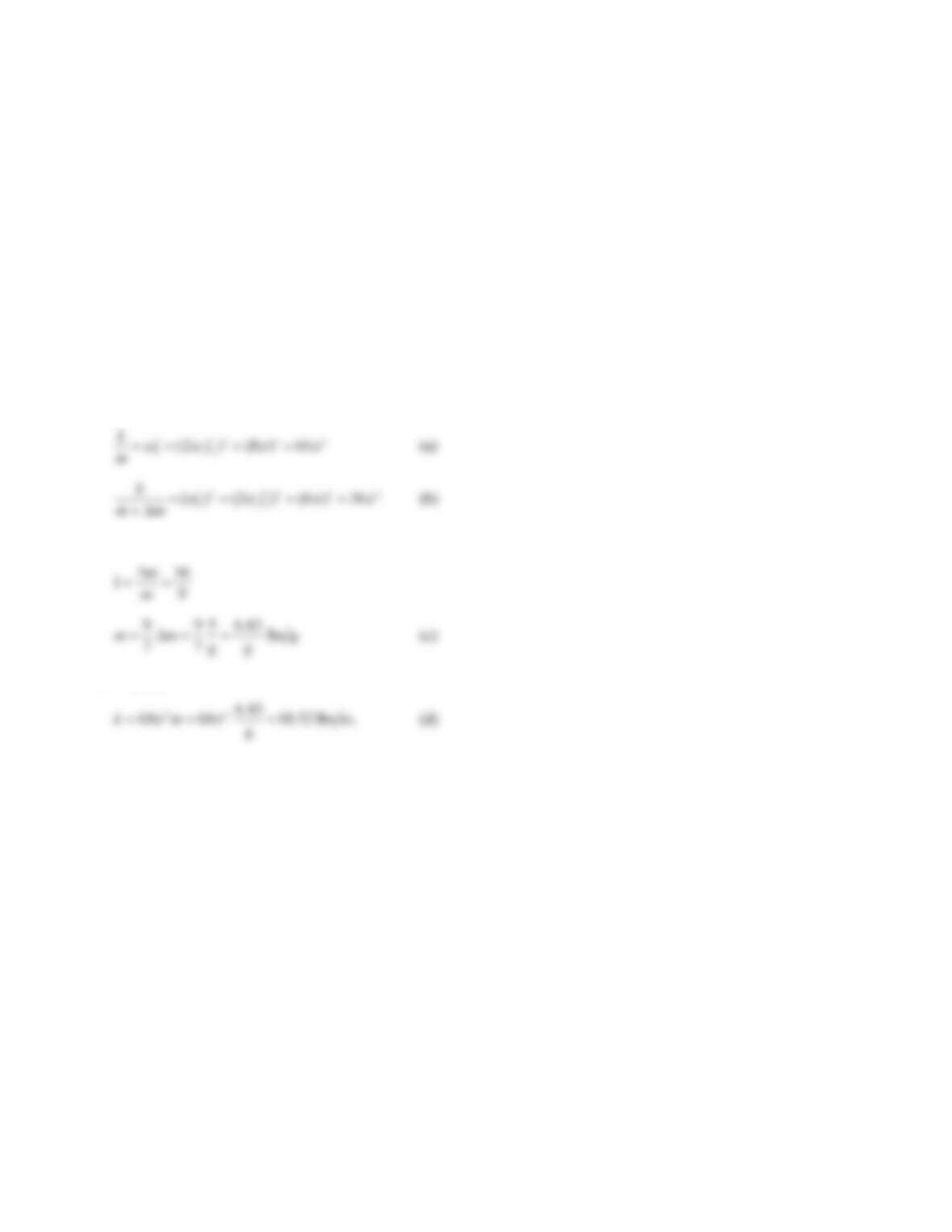
From the given data,
Dividing Eq. (a) by Eq. (b) gives
From Eq. (a),
2
Problem 3.2
An SDF system is excited by a sinusoidal force. At
resonance the amplitude of displacement was measured to
be 2 in. At an exciting frequency of one-tenth the natural
frequency of the system, the displacement amplitude was
measured to be 0.2 in. Estimate the damping ratio of the
system.
Solution:
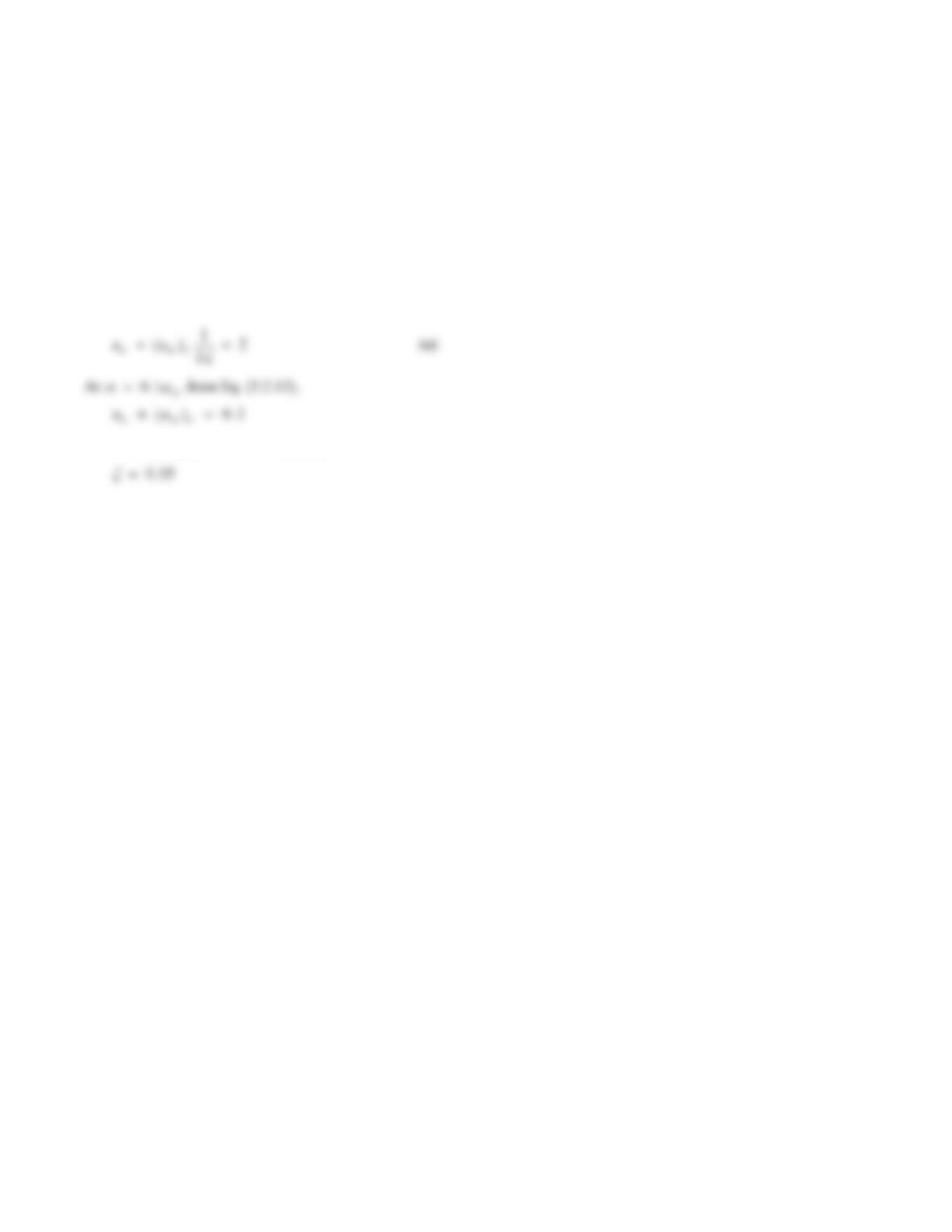
At
n, from Eq. (3.2.15),
Substituting () .u
s
to 02
in Eq. (a) gives
3
Problem 3.3
In a forced vibration test under harmonic excitation it was
noted that the amplitude of motion at resonance was
exactly four times the amplitude at an excitation frequency
20% higher than the resonant frequency. Determine the
damping ratio of the system.
Solution:
Assuming that damping is small enough to justify the
approximation that the resonant frequency is
n and the
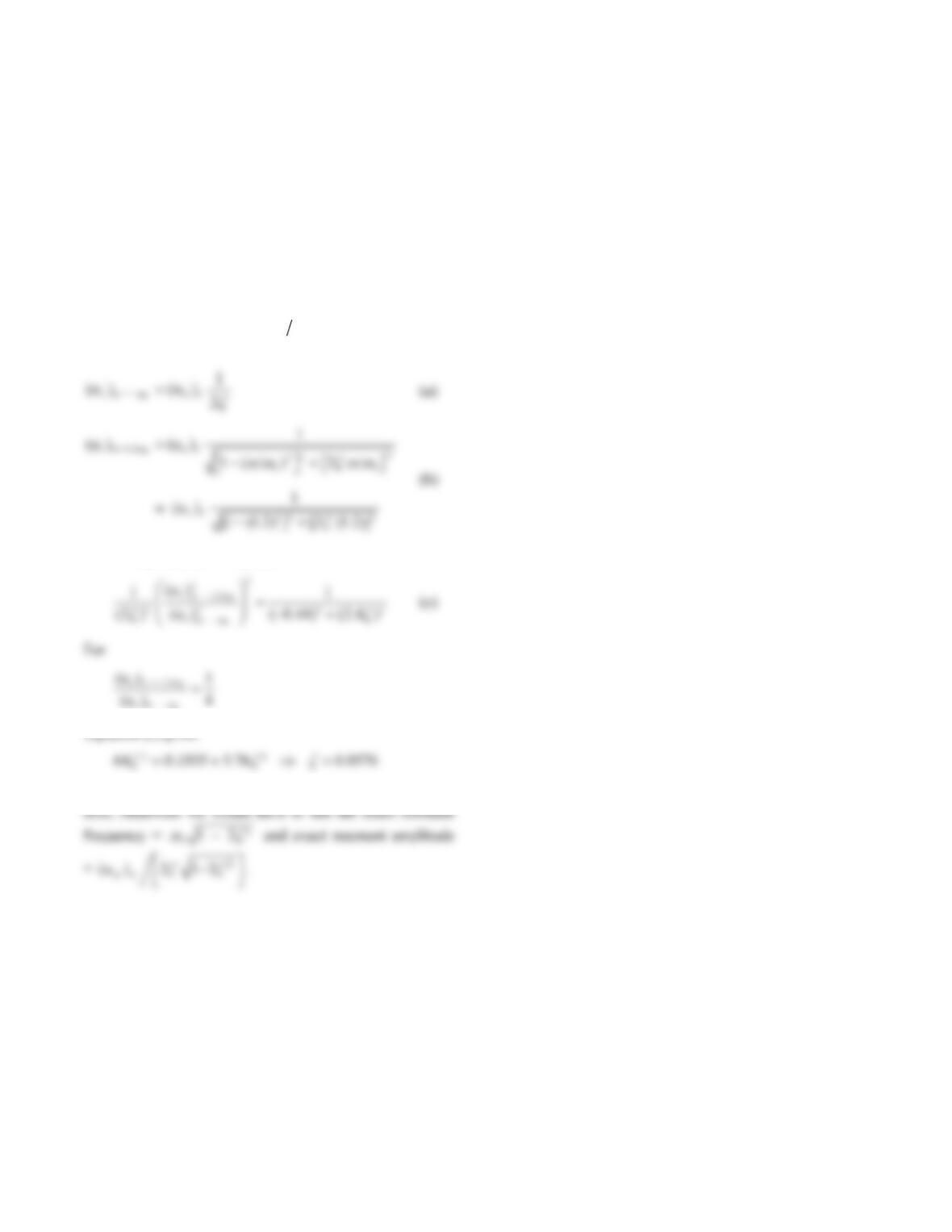
resonant amplitude of Rd is 12
, then the given data
implies:
Combining Eq. (a) and Eq. (b):
n
Equation (c) gives
Assumption of small damping implied in Eq. (a) is reason-
4
vertical vibration of the machine–spring system is 200
cycles per minute. The machine generates a vertical force
1.042 in. at 180 rpm, and 0.0248 in. at 600 rpm. Calculate
the amplitude of vertical motion of the machine if the steel
springs are replaced by four rubber isolators that provide
the same stiffness but introduce damping equivalent to ζ =
200
n
2
()
1
st o
o
n
u
u
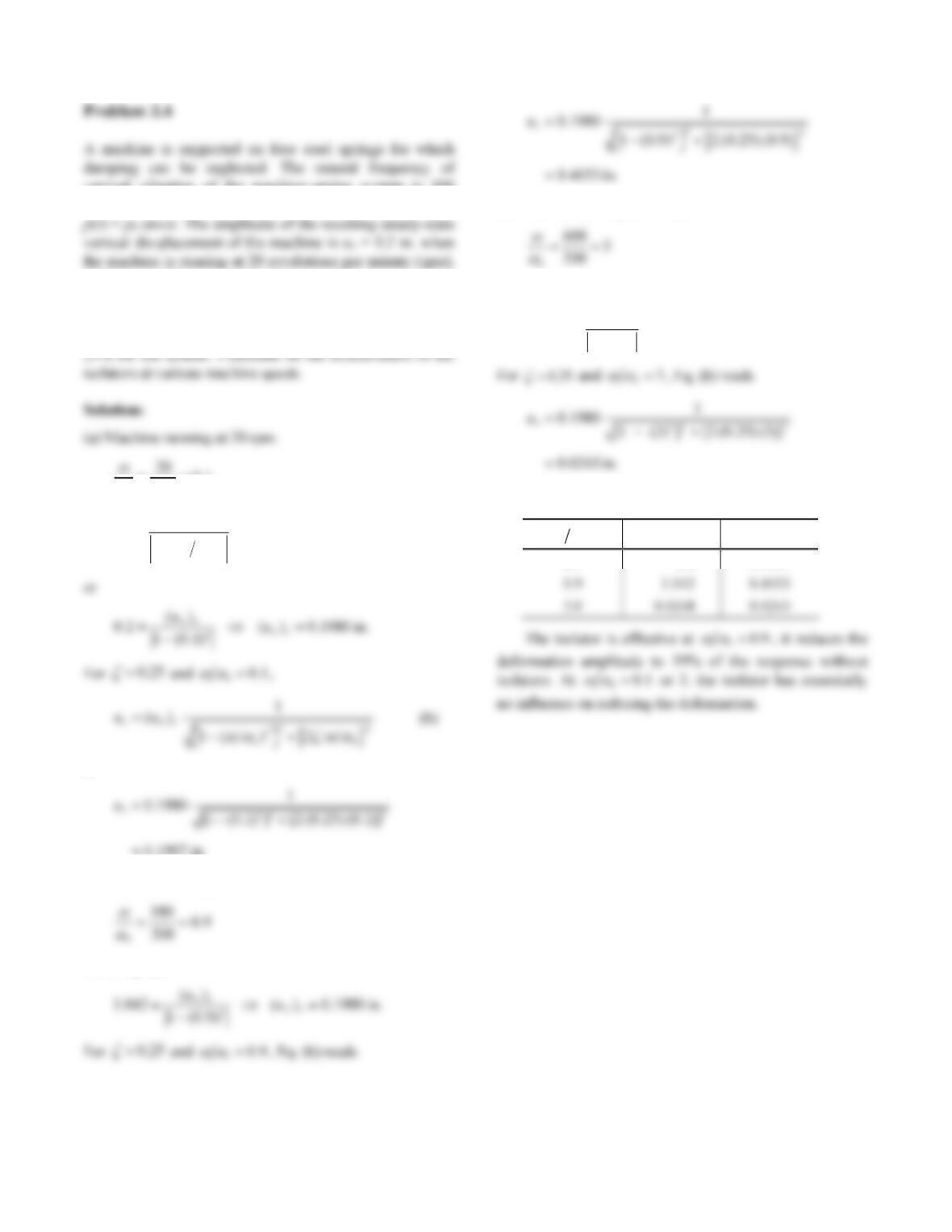
(a)
or
0.1997 in.
(b) Machine running at 180 rpm.
From Eq. (a),
(c) Machine running at 600 rpm.
From Eq. (a),
2
()
0.0248 ( ) 0.1980 in.
1(3)
st o
st o
uu
(d) Summarizing these results together with given data:
n ()uo
0 () .
uo
025
0.1 0.2 0.1997
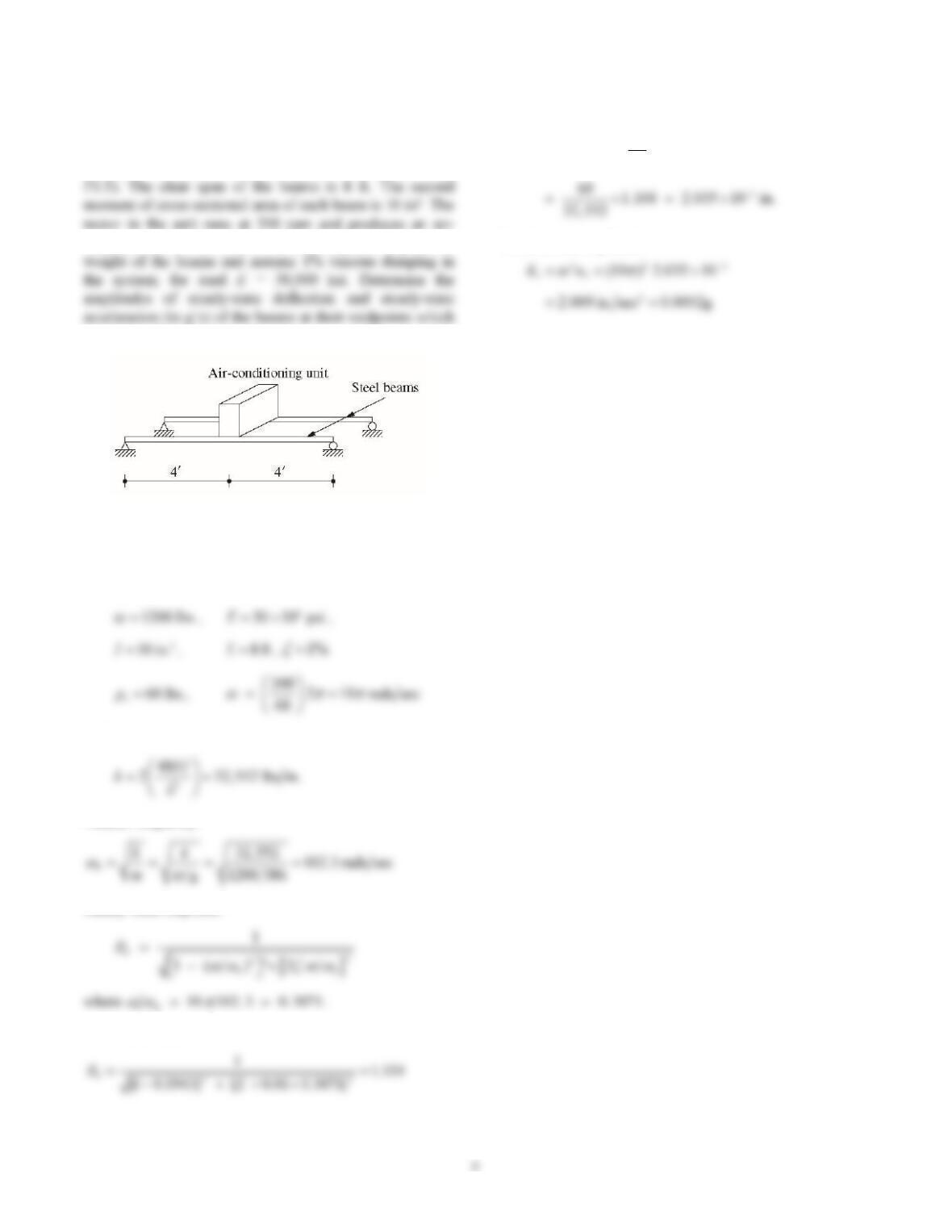
Problem 3.5
An air-conditioning unit weighing 1200 lb is bolted at the
middle of two parallel simply supported steel beams (Fig.
balanced vertical force of 60 lb at this speed. Neglect the
result from the unbalanced force.
Figure P3.5
Solution:
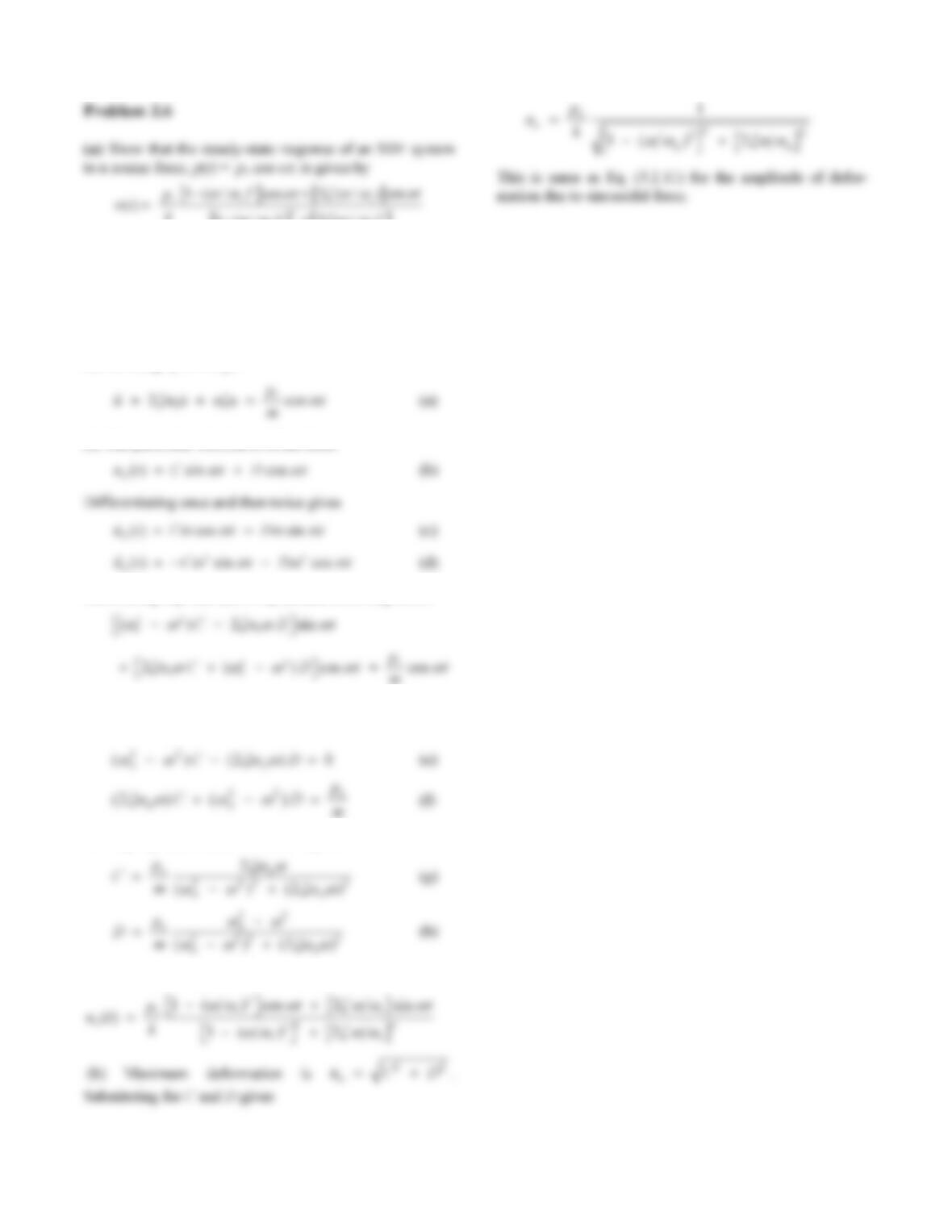
Given:
Stiffness of two beams:
Natural frequency:
Steady-state response:
Therefore,
Displacement:
()
o
ostod d
p
uuR R
k
Acceleration amplitude:
6
1(/) 2(/)
nn
(b) Show that the maximum deformation due to cosine
force is the same as that due to sinusoidal force.
Solution:
In Eq. (3.2.1) replacing the applied force by pt
ocos
and dividing by m we get
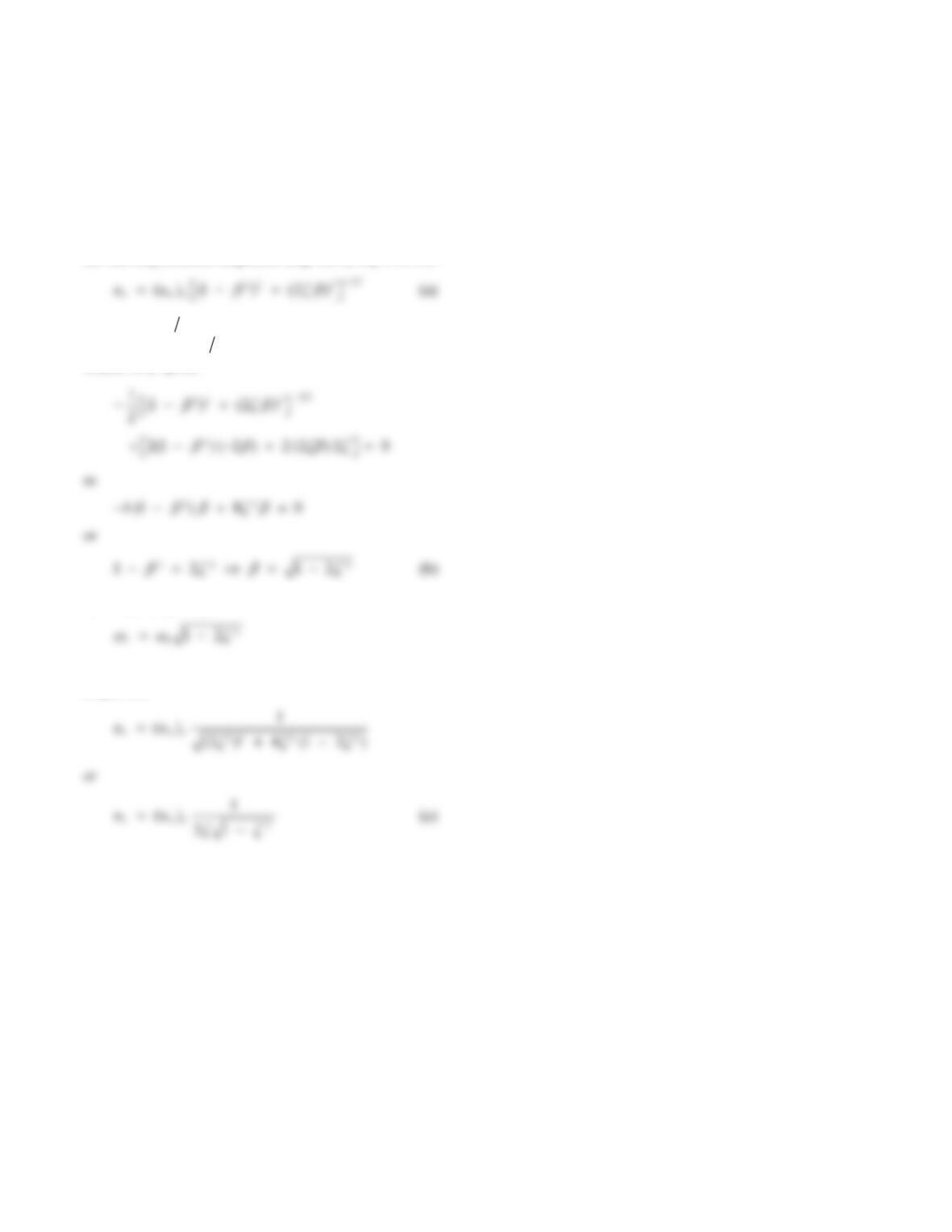
(a) The particular solution is of the form:
Substituting Eqs. (b)–(d) in Eq. (a) and collecting terms:
Equating coefficients of sin t
and of cos t
on the two
sides of the equation:
Solving Eqs. (e) and (f) for C and D gives
Substituting Eqs. (g) and (h) in Eq. (b) gives
7
Problem 3.7
(a) Show that ωr = ωn (1 −2ζ 2)1/2 is the resonant
frequency for displacement amplitude of an SDF system.
(b) Determine the displacement amplitude at resonance.
Solution:
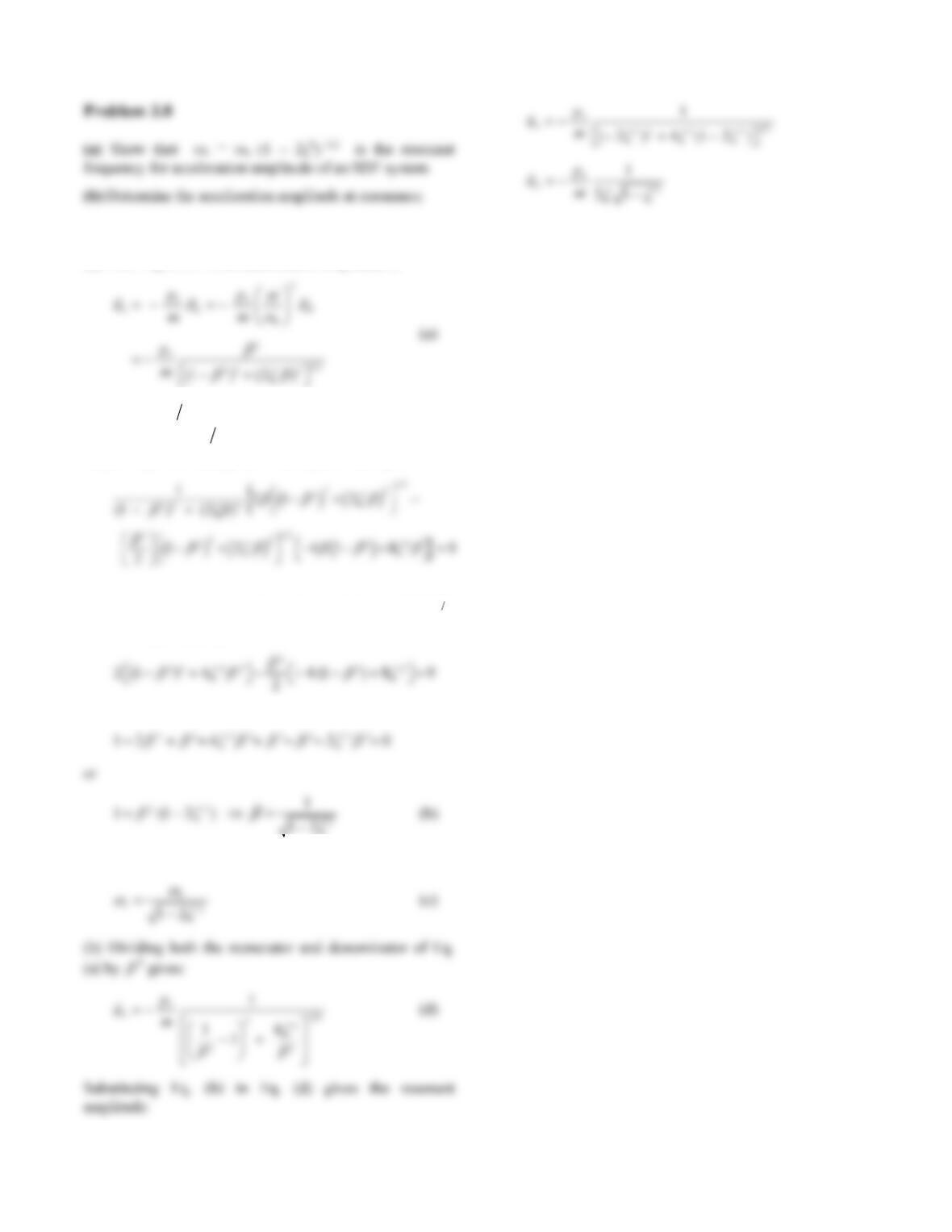
(a) The displacement amplitude in given by Eq. (3.2.11):
where
n. Resonance occurs at
when uo is
maximum, i.e., du d
o
0. Differentiating Eq. (a) with
respect to
gives
Resonant frequency:
(b) Substituting Eq. (b) in Eq. (a) gives the resonant
amplitude:
8
Solution:
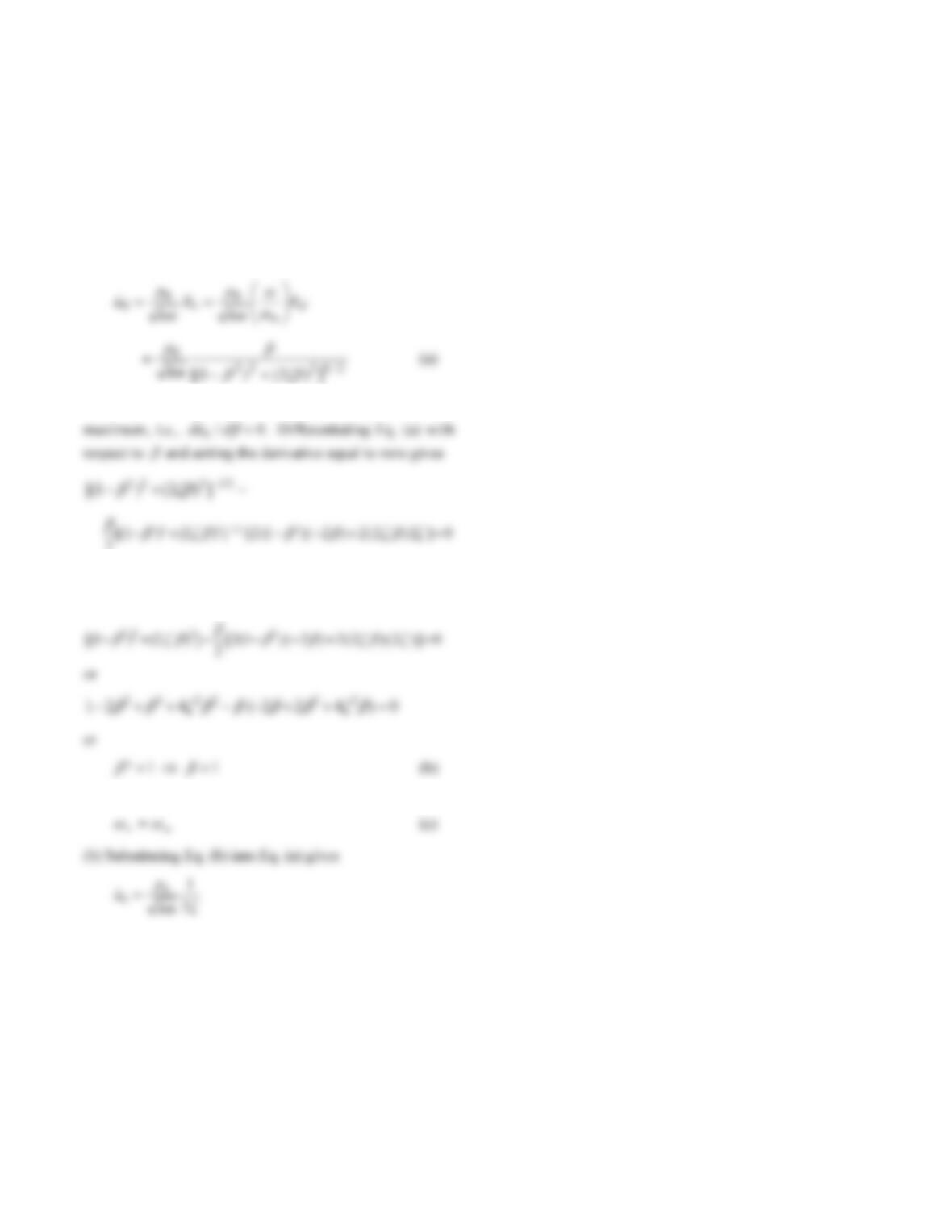
(a) From Eq. (3.2.19) the acceleration amplitude is
where n
. Resonance occurs at
where o
u
is
maximum, i.e., 0
o
du d
. Differentiating Eq. (a) with
respect to
and setting the result equal to zero gives
Multiplying the numerator by 22 2 12
[(1 ) (2 ) ]
and dividing it by
gives
or
Resonant frequency:
9
Problem 3.9
(a) Show that ωr = ωn is the resonant frequency for
velocity amplitude of an SDF system.
(b) Determine the velocity amplitude at resonance.
Solution:
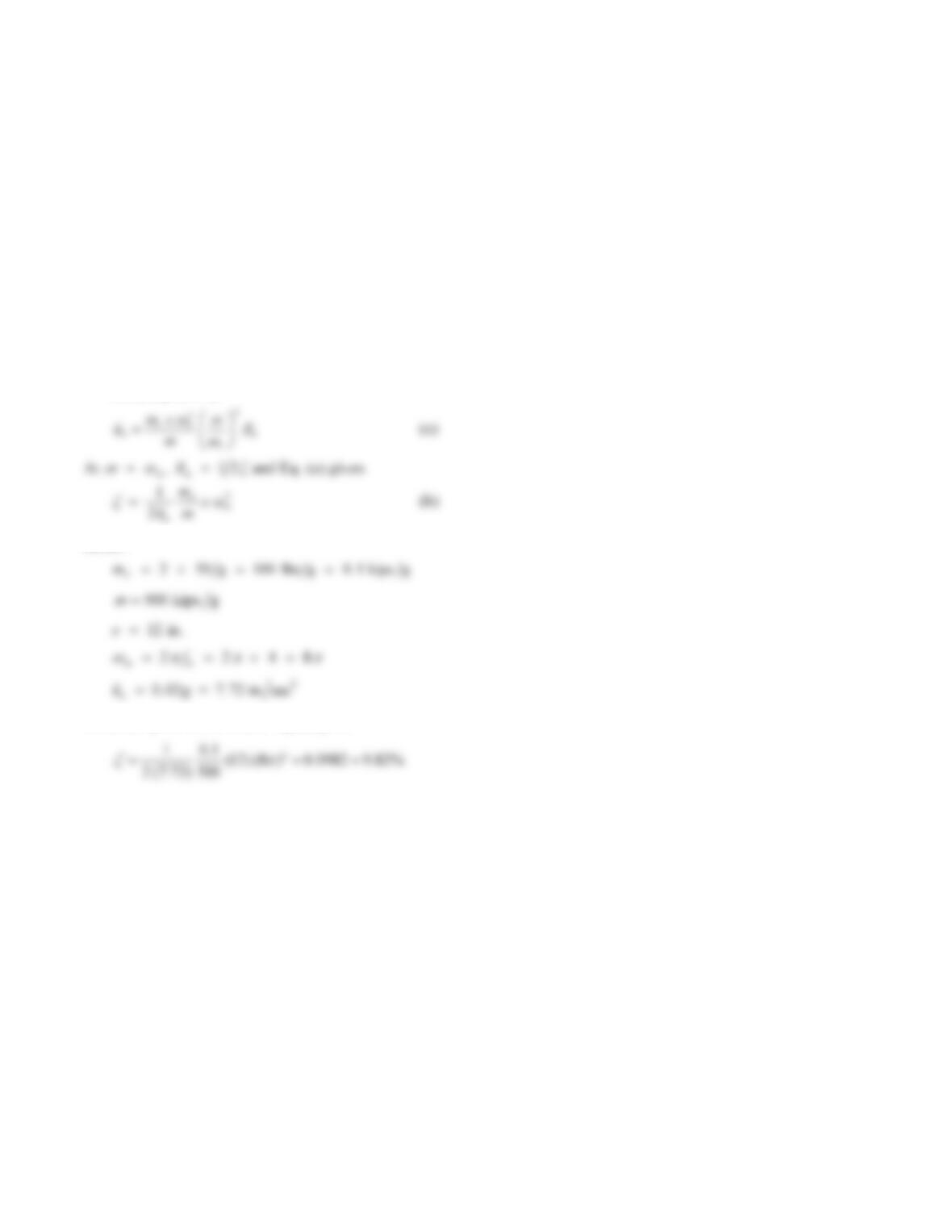
(a) From Eq. (3.2.17), the velocity amplitude is
where
/n. Resonance occurs at
where u
is
2
Multiplying the numerator by [( ) ( ) ] /
12
22 232
gives
Resonant frequency:
10
Problem 3.10
A one-story reinforced concrete building has a roof mass
of 500 kips/g, and its natural frequency is 4 Hz. This
building is excited by a vibration generator with two
weights, each 50 lb, rotating about a vertical axis at an
eccentricity of 12 in. When the vibration generator runs at
the natural frequency of the building, the amplitude of roof
acceleration is measured to be 0.02g. Determine the
damping of the structure.
Solution:
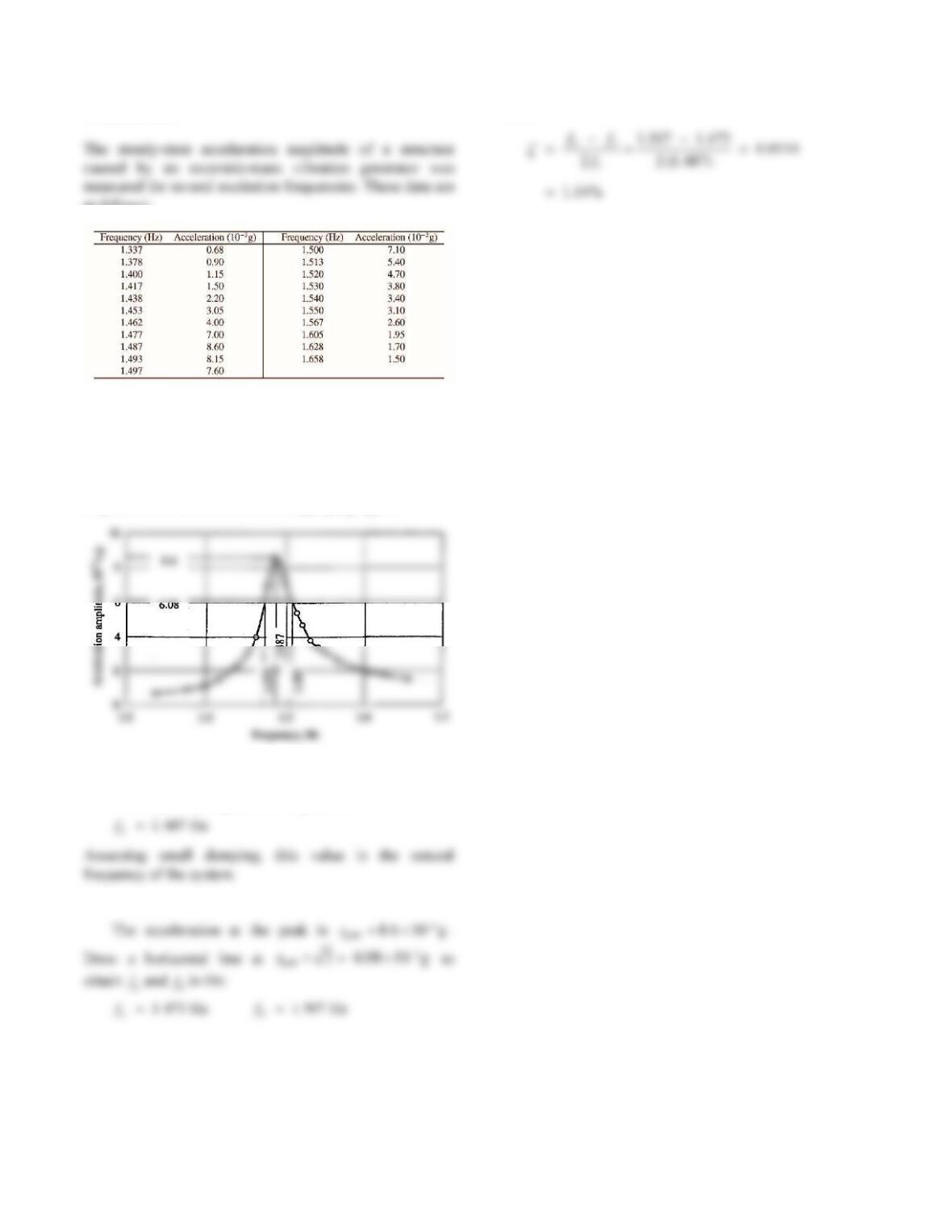
We assume that the structure has no mass other than
the roof mass.
From Eq. (3.3.4),
Given:
Substituting the above data in Eq. (b) gives
11
Problem 3.11
as follows:
Determine the natural frequency and damping ratio of the
structure.
Solution:
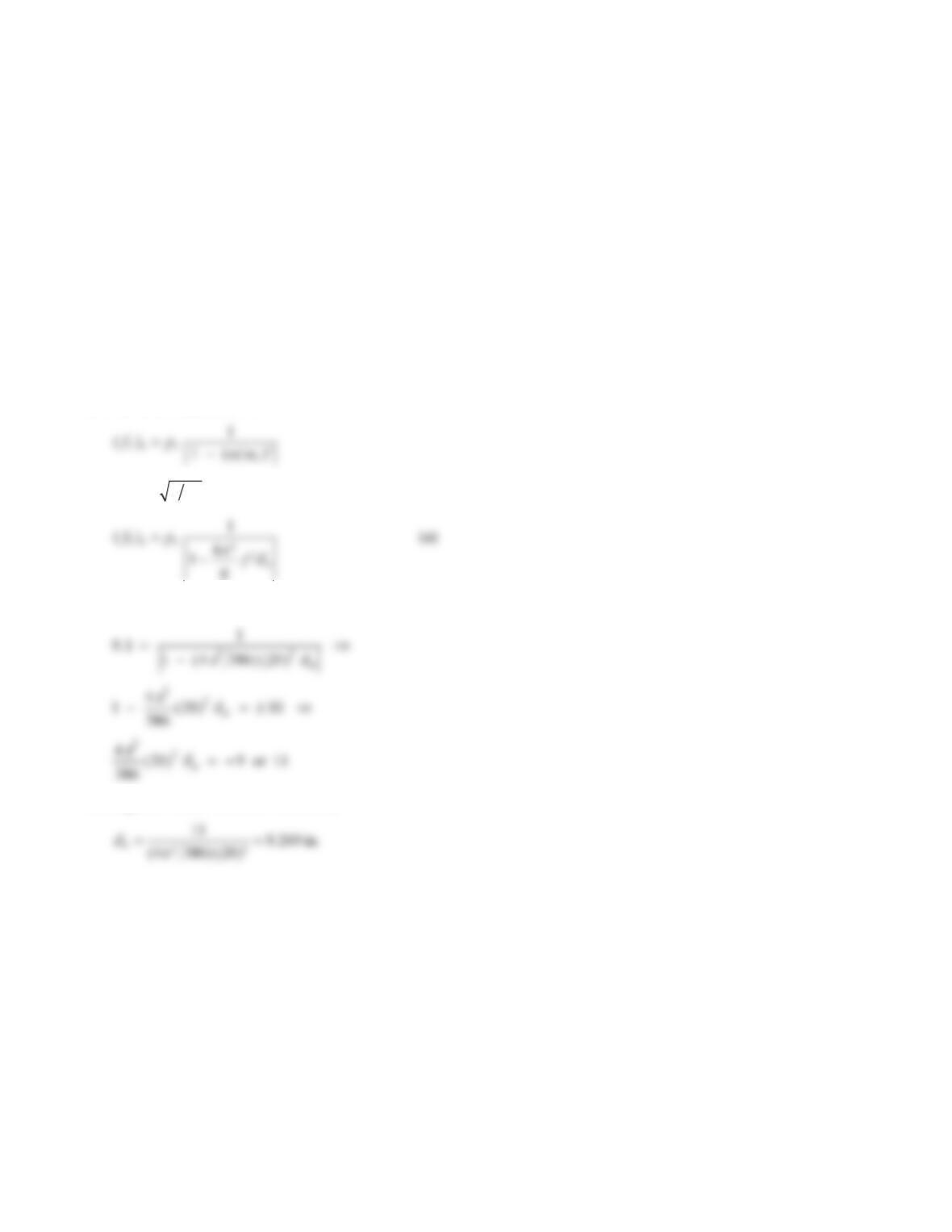
The given data is plotted in the form of the frequency
response curve shown in the accompanying figure:
(a) Natural frequency:
The frequency response curve peaks at
(b) Damping ratio:
Then,
12
Problem 3.12
Consider an industrial machine of mass m supported on
spring-type isolators of total stiffness k. The machine
operates at a frequency of f Hz with a force unbalance po.
(a) Determine an expression giving the fraction of force
transmitted to the foundation as a function of the forcing
frequency f and the static deflection δst = mg/k. Consider
only the steady-state response.
(b) Determine the static deflection δst for the force trans–
mitted to be 10% of po if f = 20 Hz.
Solution:
(a) Transmissibility is given by Eq. (3.5.3) with
0.
Thus the force transmitted is
where g
nst
and 2
f
. Therefore
(b) For T
() 0.1
oo
f
p and 20f, Eq. (a) gives
The negative value is invalid. Therefore,
13
Problem 3.13
For the automobile in Example 3.4, determine the
amplitude of the force developed in the spring of the
suspension system when the automobile is traveling at 40
mph.
Solution:
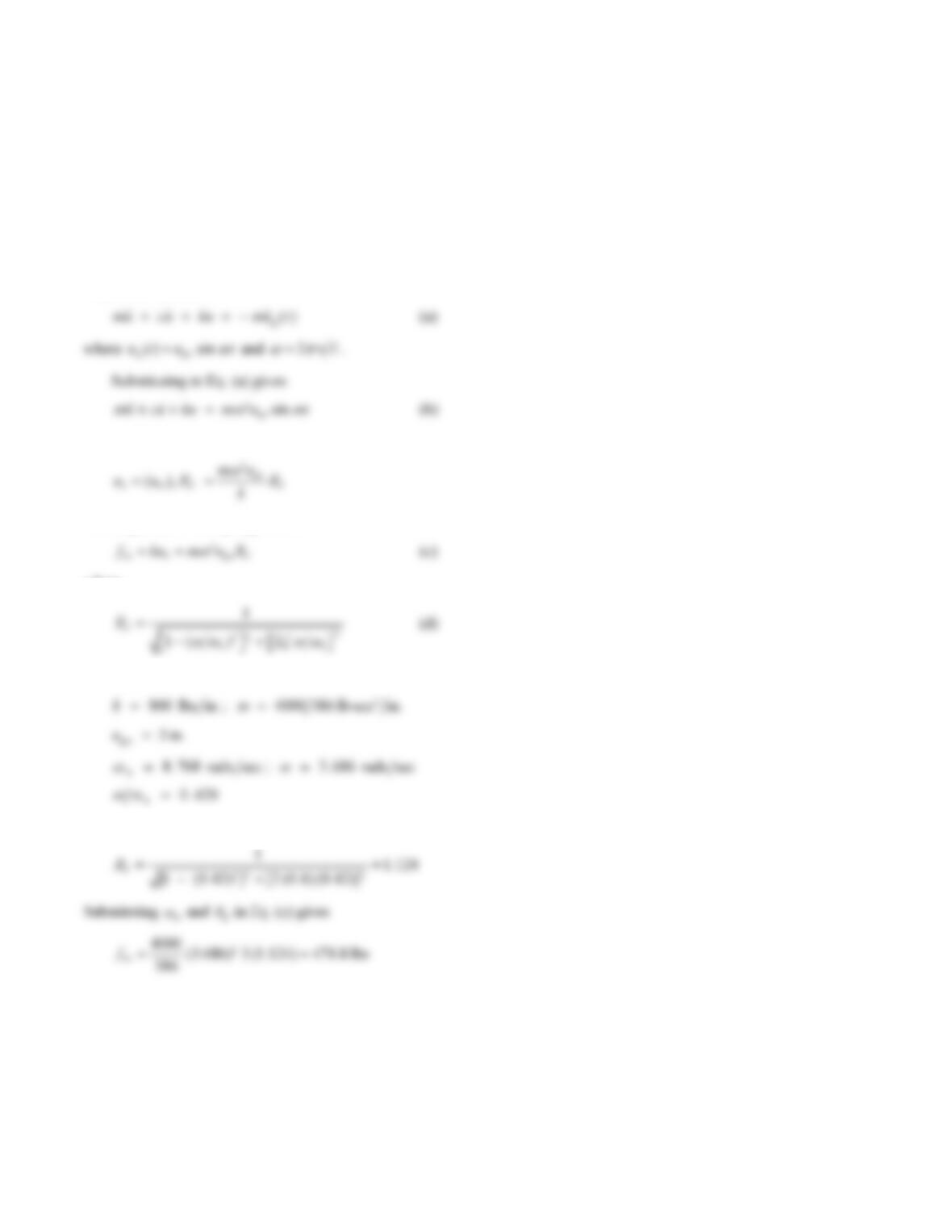
The equation governing the deformation ut()
in the
suspension system is
The amplitude of deformation is
The amplitude of the spring force is
where
Numerical calculations:
Thus Eq. (d) gives