21
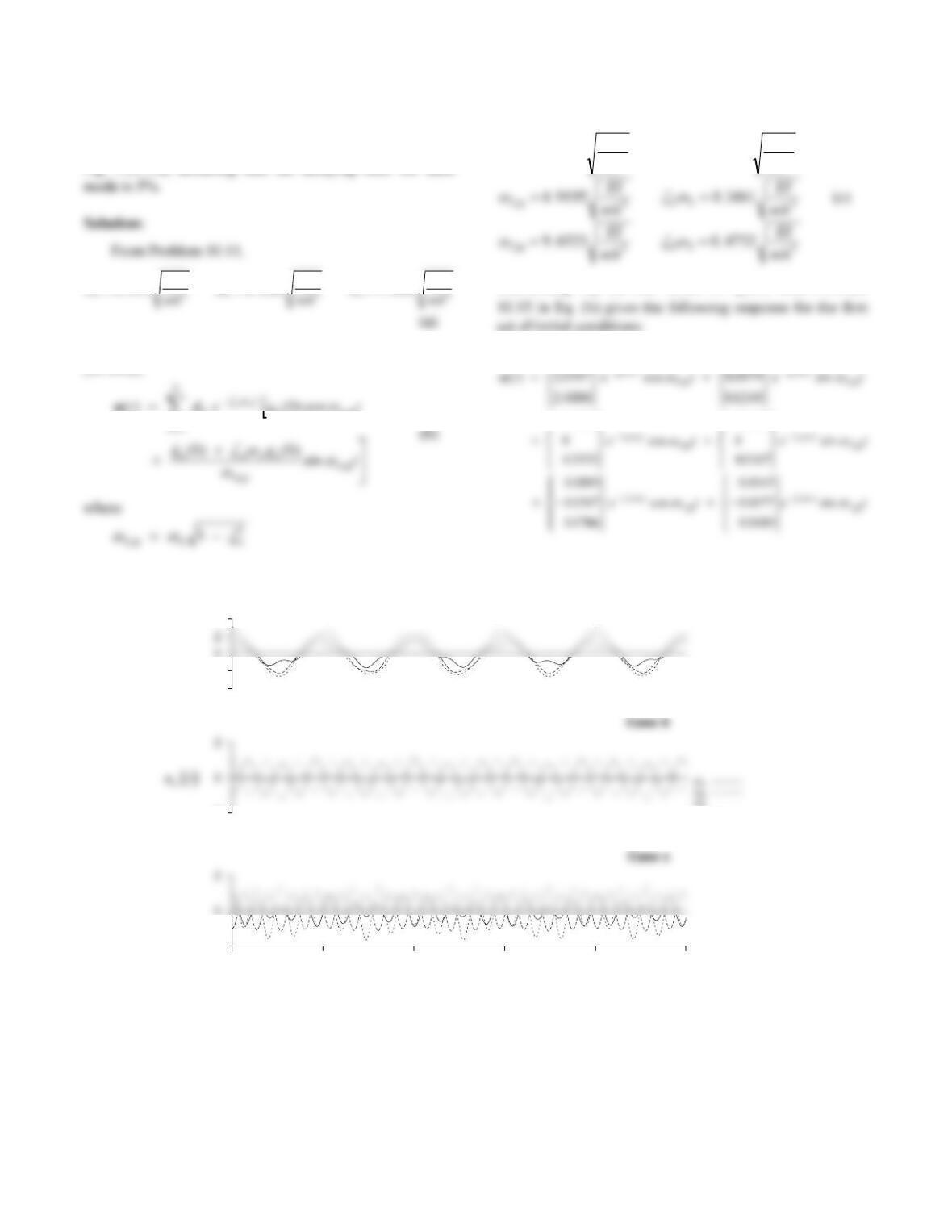
Problem 10.17
Repeat Problem 10.15 for the initial displacement of
Fig. P10.15a, assuming that the damping ratio for each
2 5359 6 9282 9 4641…
EI
EI
EI
The response of the system is given by Eqs. (10.8.7) and
(10.10.2):
u() ( )cos
teq t
n
nn
D
n
0
1
For
n
5% ,
1311 3
2 5327 0 1268
D
EI
mh
EI
mh
..
Substituting Eq. (c) and values of qn()0 from Problem
.
.
R
|
U
|
R
|
U
|
12440
0 0623
R
U
R
U
0 3333
0 0167
.
.
-4
-2
4
Case a
-2
-2
0 1 2 3 4 5
t/T1
Figure P10.17
Case a
Case a
22
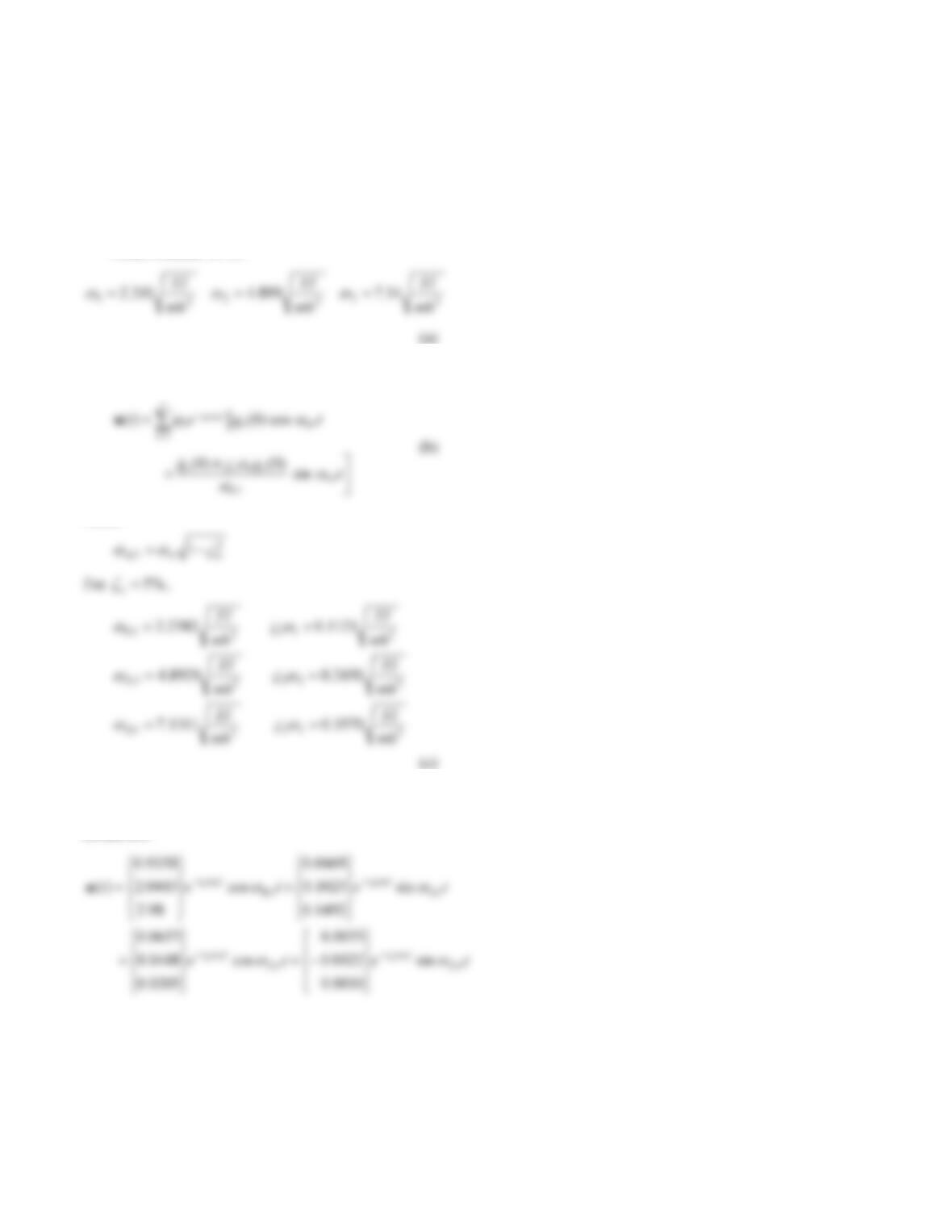
Problem 10.18
Repeat Problem 10.16 for the initial displacement of
Fig.10.16a, assuming that the damping ratio for each mode
is 5%.
Solution:
From Problem 10.12,
The response of the system is given by Eqs. (10.8.7) and
(10.10.2):
where
Substituting Eq. (c) and values of )0(
n
q from Problem
10.16 gives the following response for the first set of initial
conditions:
23
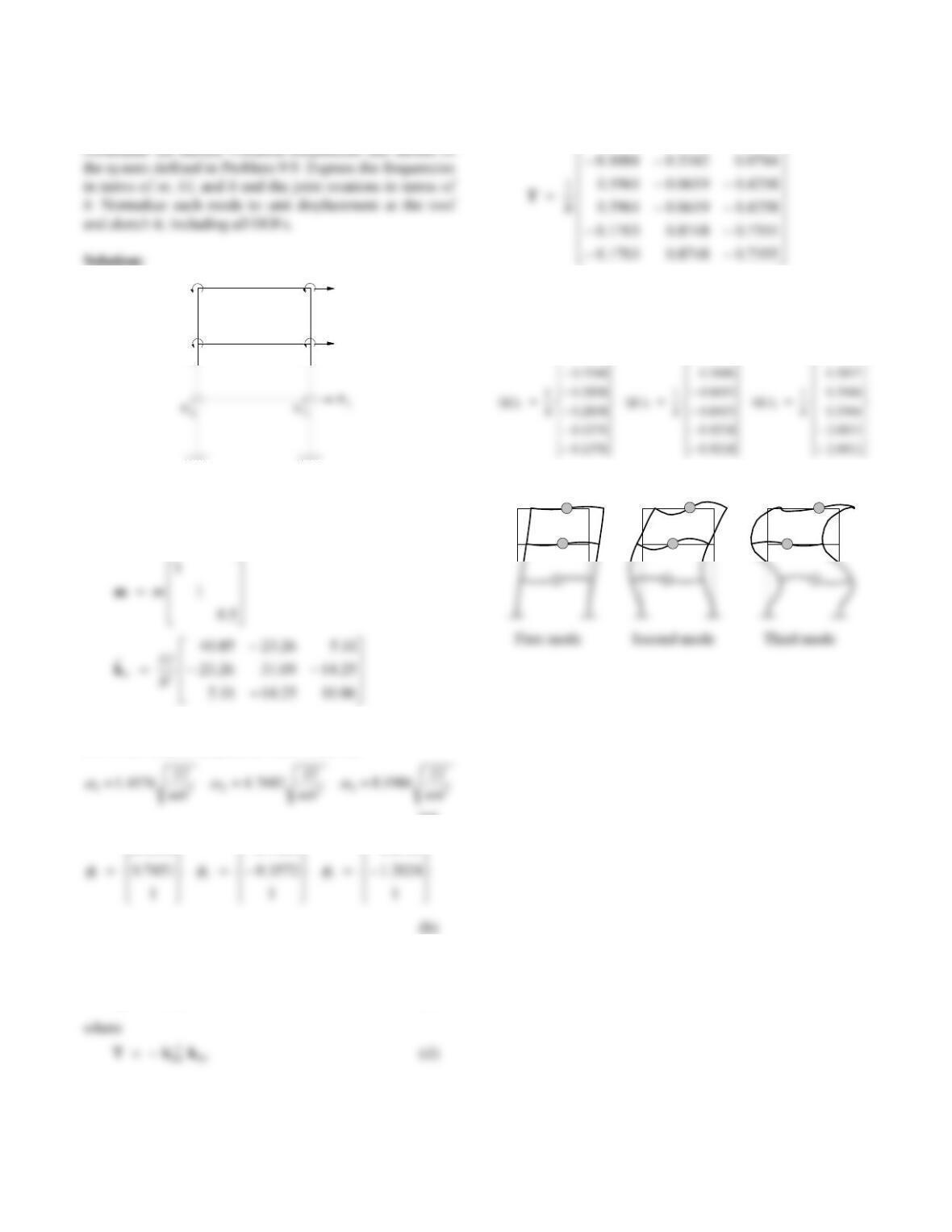
Problem 10.19
u2
u6
u7
u3
u8u9
With reference to the lateral floor displacements u1,
,
2
u and u3, the mass matrix and the condensed stiffness
matrix (from Problem 9.9) are
Obtained by using the same procedure as in Problem
10.11, the natural frequencies and modes are
(a)
0.3156 0.7409 1.2546
The joint rotations corresponding to the modes of Eq.
(b) are computed using Eq. (9.3.3):
uTu
0t (c)
Substituting k00 and k0t from Problem 9.9 in Eq. (d) gives
0.1084 0.5342 0.0744
The joint rotations associated with each mode are obtained
by substituting ut n
, n = 1, 2, and 3 in Eq. (c); the
results are
0.3548 0.3486 0.5837
24
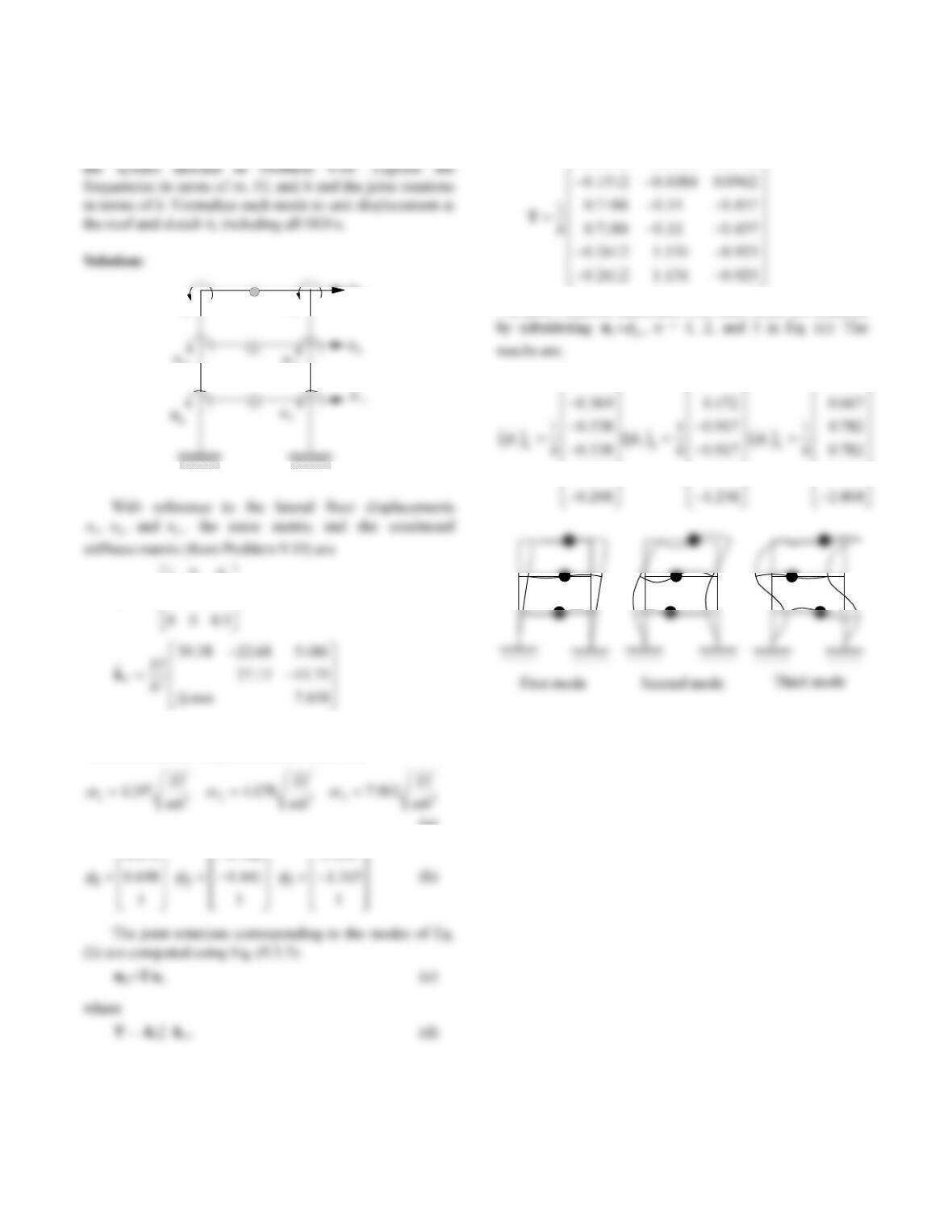
Problem 10.20
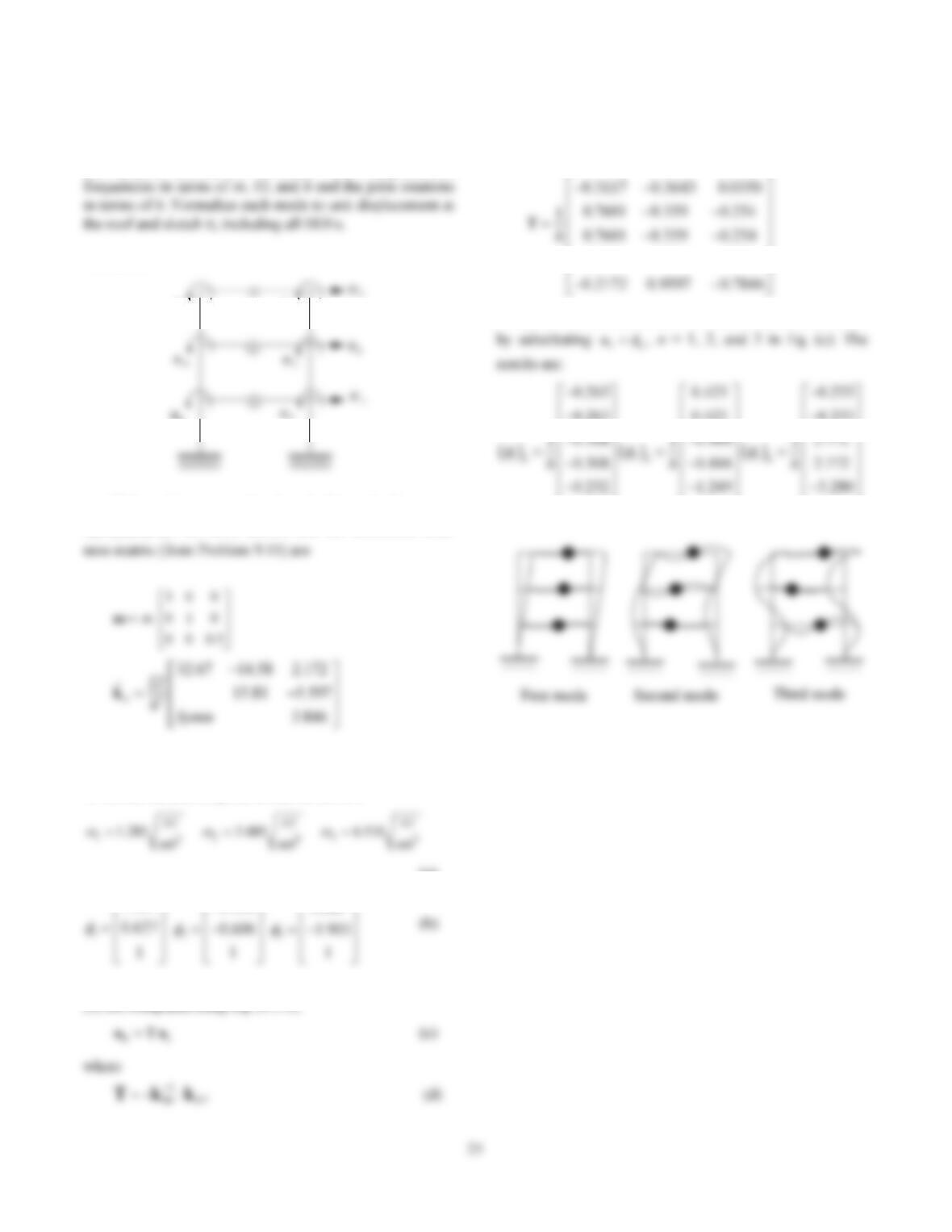
Determine the natural vibration frequencies and modes of
010
001
mm
Obtained by using the same procedure as in Problem
10.11, the natural frequencies and modes are:
(a)
Substituting k00 and k0t from Problem 9.10 in Eq.
(d) gives
0.1512 0.6084 0.0962
The joint rotations associated with each mode are obtained
0.369 0.472 0.667
0.208 1.238 2.808
u3
u7
u8u9
Problem 10.21
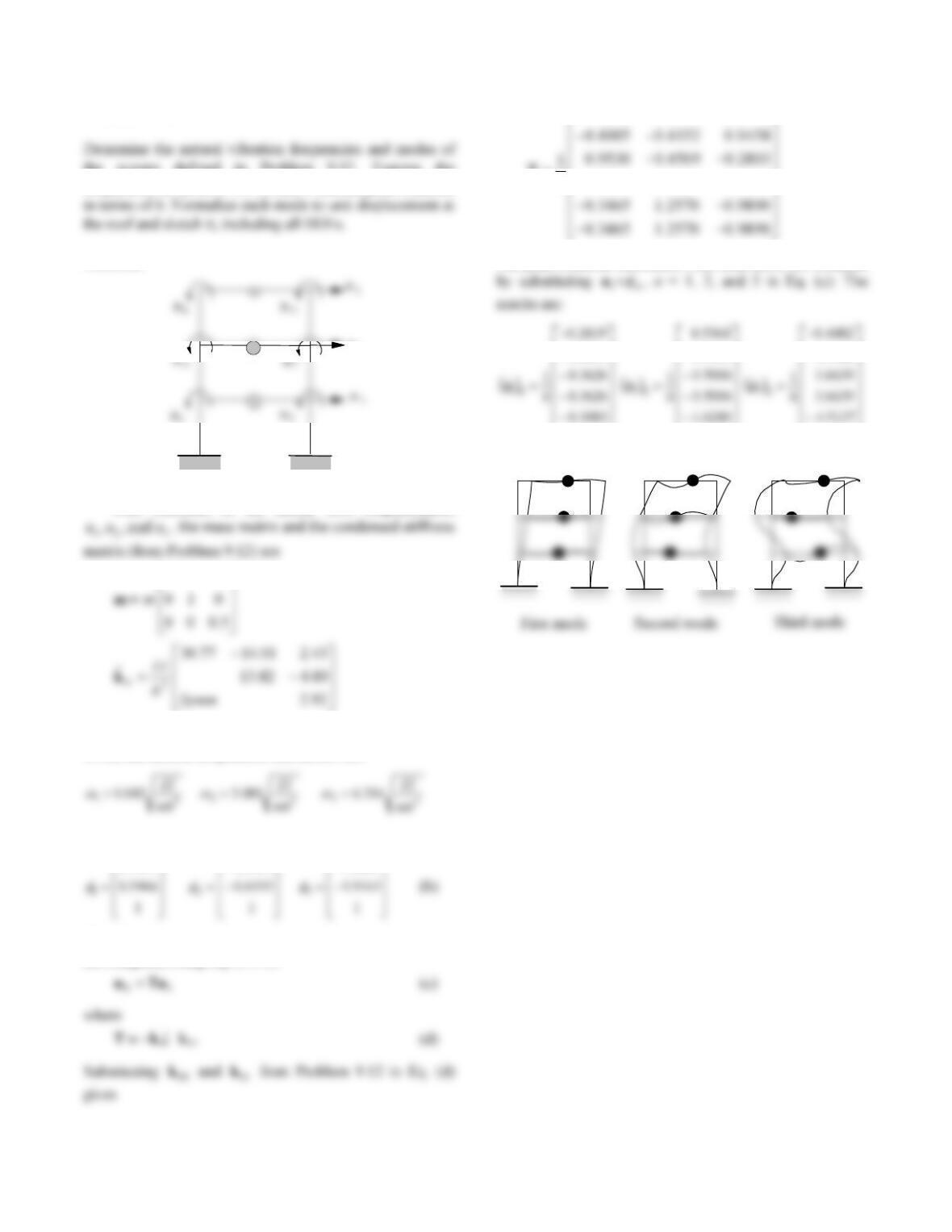
Determine the natural vibration frequencies and modes of
the system defined in Problem 9.11. Express the
Solution:
With reference to the lateral floor displacements
,,anduu u
, the mass matrix and the condensed stiff-
Obtained by using the same procedure as in Problem
10.12, the natural frequencies and modes are:
(a)
0.225
0.536
3.083
The joint rotations corresponding to the modes of Eq.
(b) are computed using Eq. (9.3.3):
Substituting 00
k and 0t
k from Problem 9.11 in Eq.
(d) gives
0.3117 0.3643 0.0350
0.2172 0.9597 0.7846
The joint rotations associated with each mode are obtained
0.263 0.423 0.233
0.232 1.249 3.280
u4u5
u8u9
26
Problem 10.22
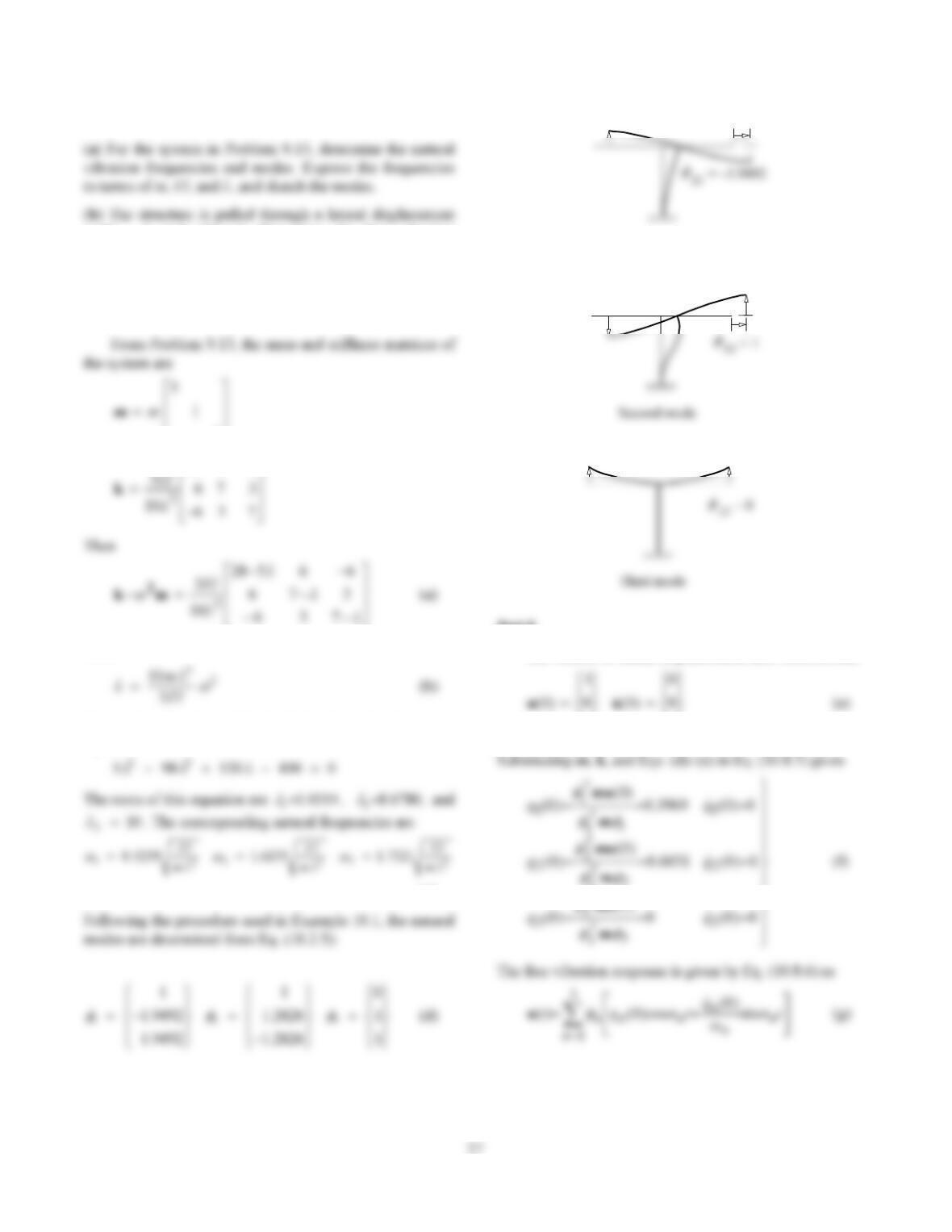
the system defined in Problem 9.12. Express the
frequencies in terms of m, EI, and h and the joint rotations
Solution:
u
2
4 u
With reference to the lateral floor displacements
001
Obtained by using the same procedure as in Problem
10.12, the natural frequencies and modes are:
(a)
1997.0
5454.0
2201.3
The joint rotations corresponding to the modes of Eq. (b)
are computed using Eq. (9.3.3):
0.4005 0.4152 0.0458
0.9530 0.4569 0.2803
h
T
The joint rotations associated with each mode are obtained
5137.4
4482.0
6240.1
5364.0
3083.0
2819.0
Problem 10.23
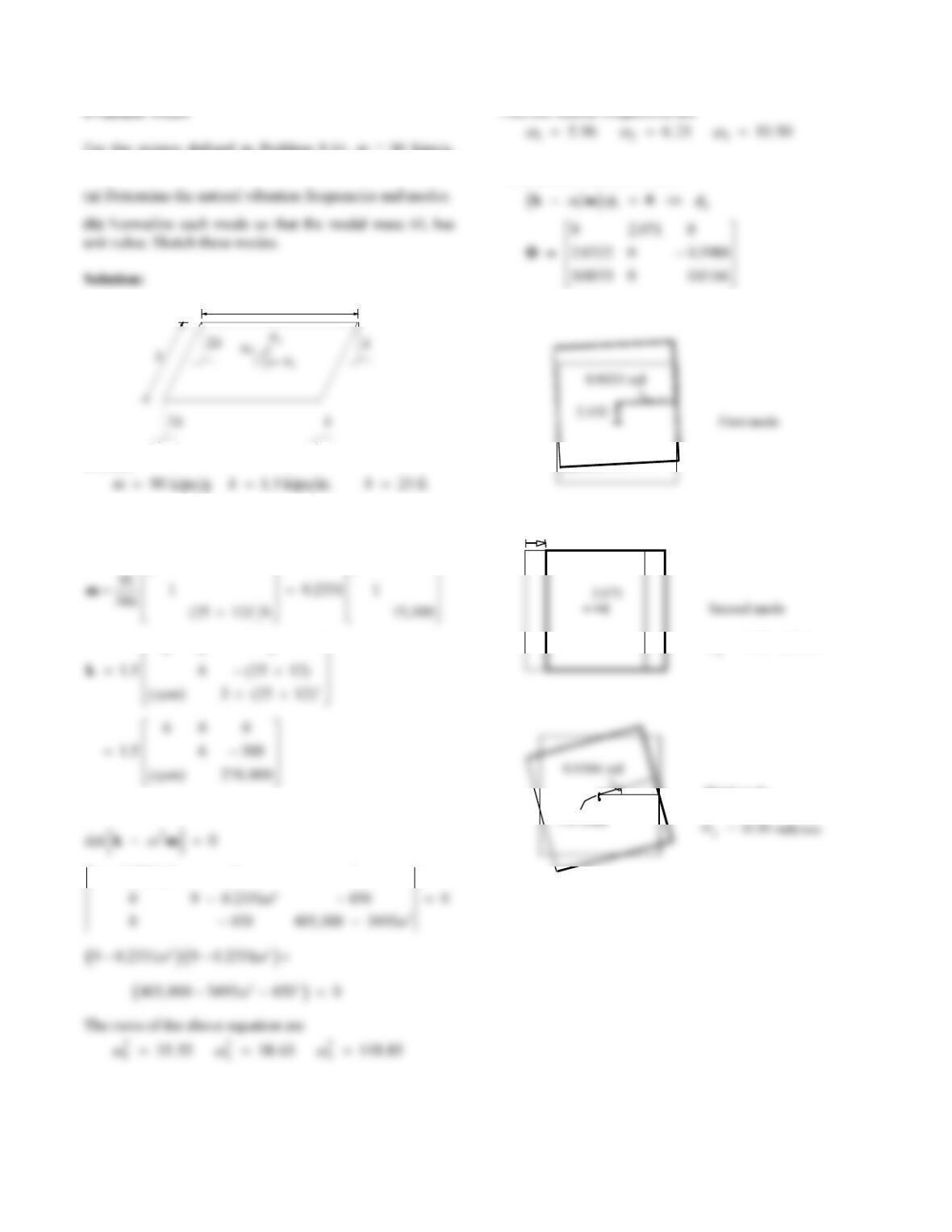
u1(0) = 1 and released. Determine the free vibration
response.
Solution:
Part a
1
6628
where
Substituting Eq. (a) in Eq. (10.2.6) gives the frequency
equation:
(c)
11 = 1
31 = 1.9492
First mode
32 = –1.2826
22 = 1.2826
23 = 1
33 = 1
Part b
The vectors of initial displacements and velocities are
0
0
)0(
2
2
T
mu

28
Substituting for
n, qn()0, and ()qn0 gives
29
For the system defined in Problem 9.14, m = 90 kips/g,
k = 1.5 kips/in., and b = 25 ft.
b
1. Data.
2. Determine the mass and stiffness matrices.
From Problem 9.14,
11
60 0
3. Determine natural frequencies.
2
9 0.2331 0 0
4. Determine natural modes.
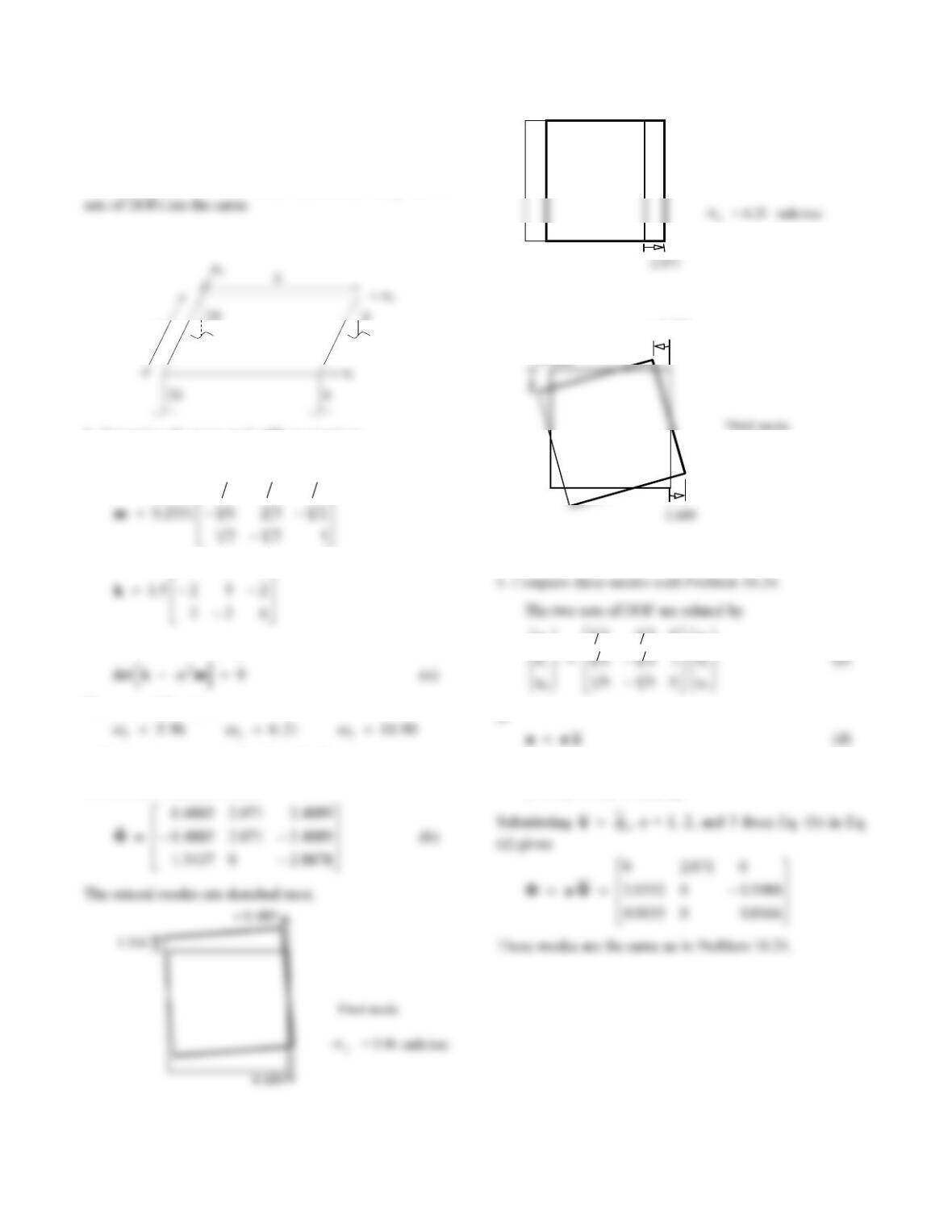
The natural modes are sketched next.
1 = 5.96 rads/sec
2.071
Third mode
30
Problem 10.25
Repeat Problem 10.24 using a different set of DOFs—
those defined in Problem 9.15. Show that the natural
vibration frequencies and modes determined using the two
Solution:
k
b
1. Determine the mass and stiffness matrices.
From Problem 9.15,
23 16 12
522
2. Determine natural frequencies.
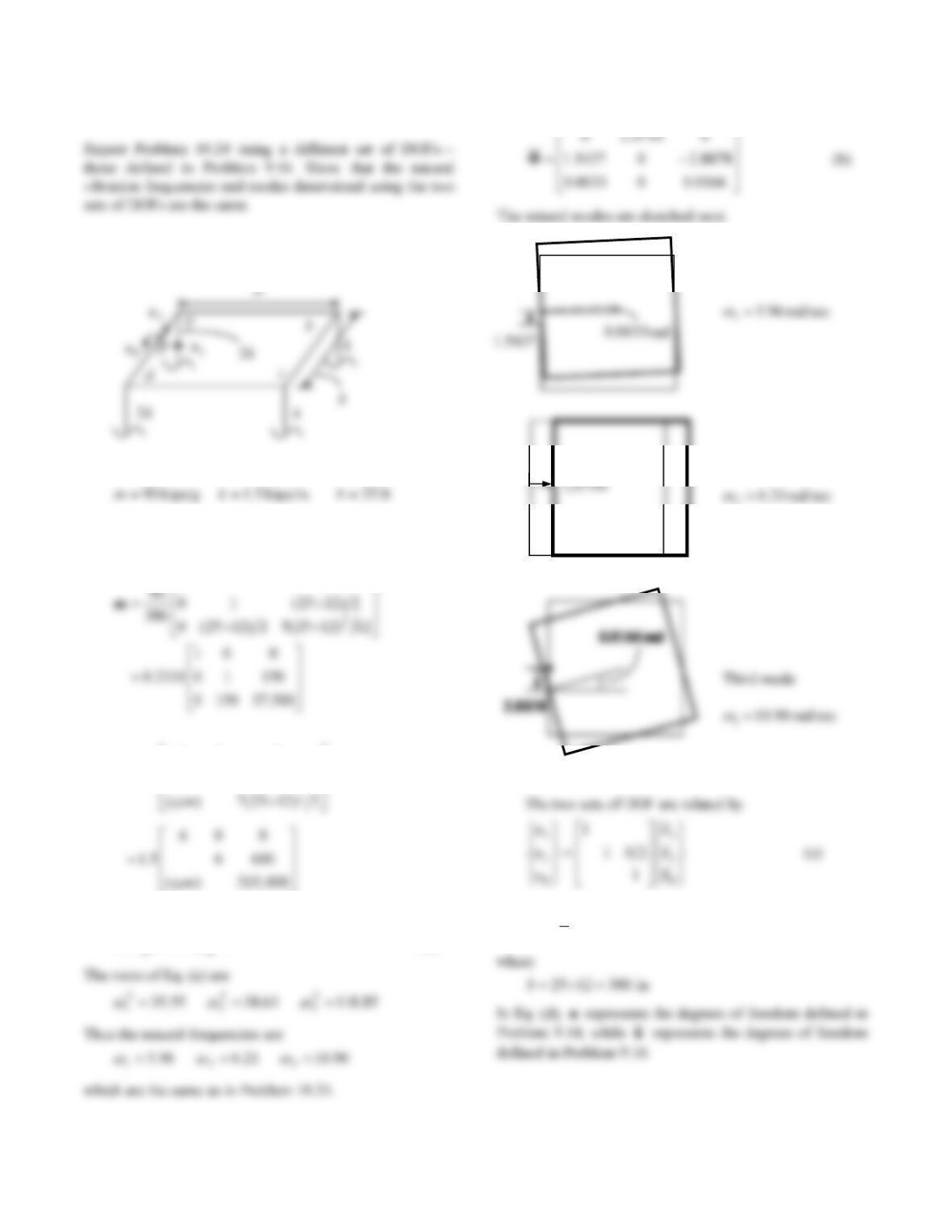
The roots of Eq. (a) are
which are the same as in Problem 10.24.
3. Determine natural modes.
Second mode
2 = 6.21 rads/sec
– 2.489
– 2.888
3 = 10.90 rads/sec
1
12 12 0
x
uu
where
b 25 12 300 in.
31
Problem 10.26
Solution:
1. Data.
2. Determine mass and stiffness matrices.
From Problem 9.16,
001
60 0
1.5 6 2(25 12)
k
3. Determine natural frequencies.
0det 2 mk
(a)
4. Determine natural modes.
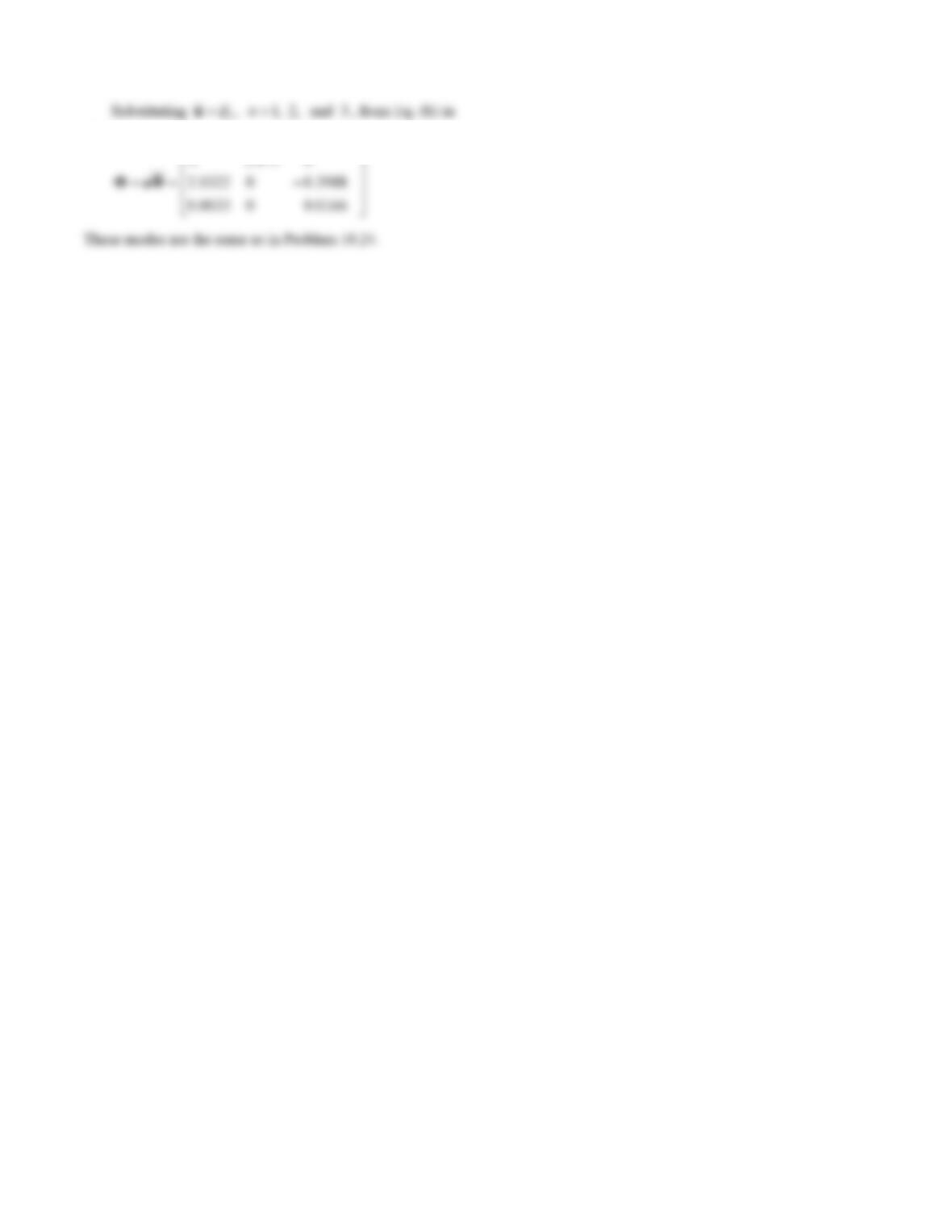
First mode
Second mode
5. Compare these modes with Problem 10.24.
or
uau (d)
32
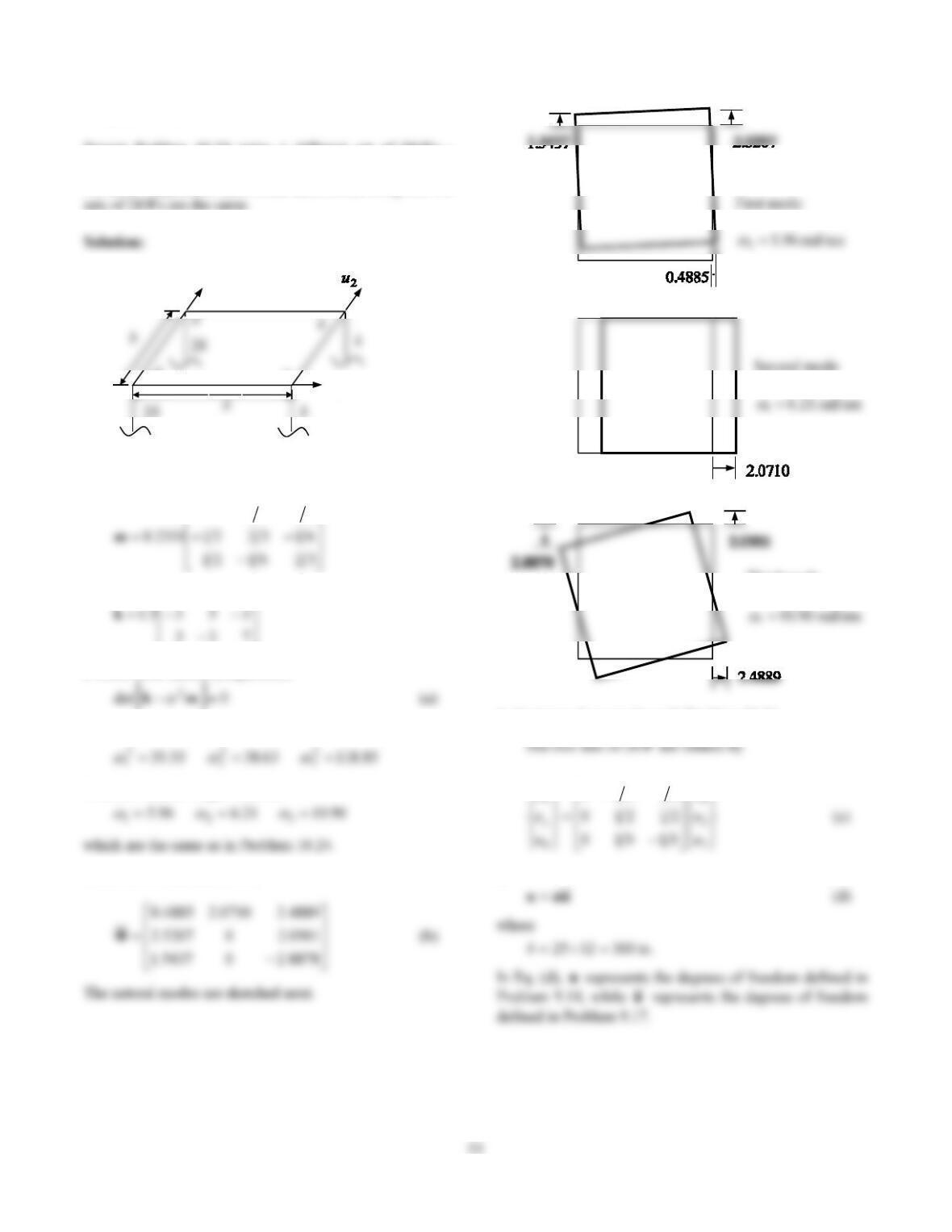
Eq. (d) gives
Problem 10.27
Repeat Problem 10.24 using a different set of DOFs—
those defined in Problem 9.17. Show that the natural
vibration frequencies and modes determined using the two
sets of DOFs are the same.
1. Determine mass and stiffness matrices.
From Problem 9.17,
21 211
3 36
2. Determine natural frequencies.
The roots of Eq. (a) are
Thus the natural frequencies are
3. Determine natural modes.
4. Compare these modes with Problem 10.24.
21 211
u
u
or
1
u
c
3
u
d
Second mode
Third mode
34
Problem 10.28
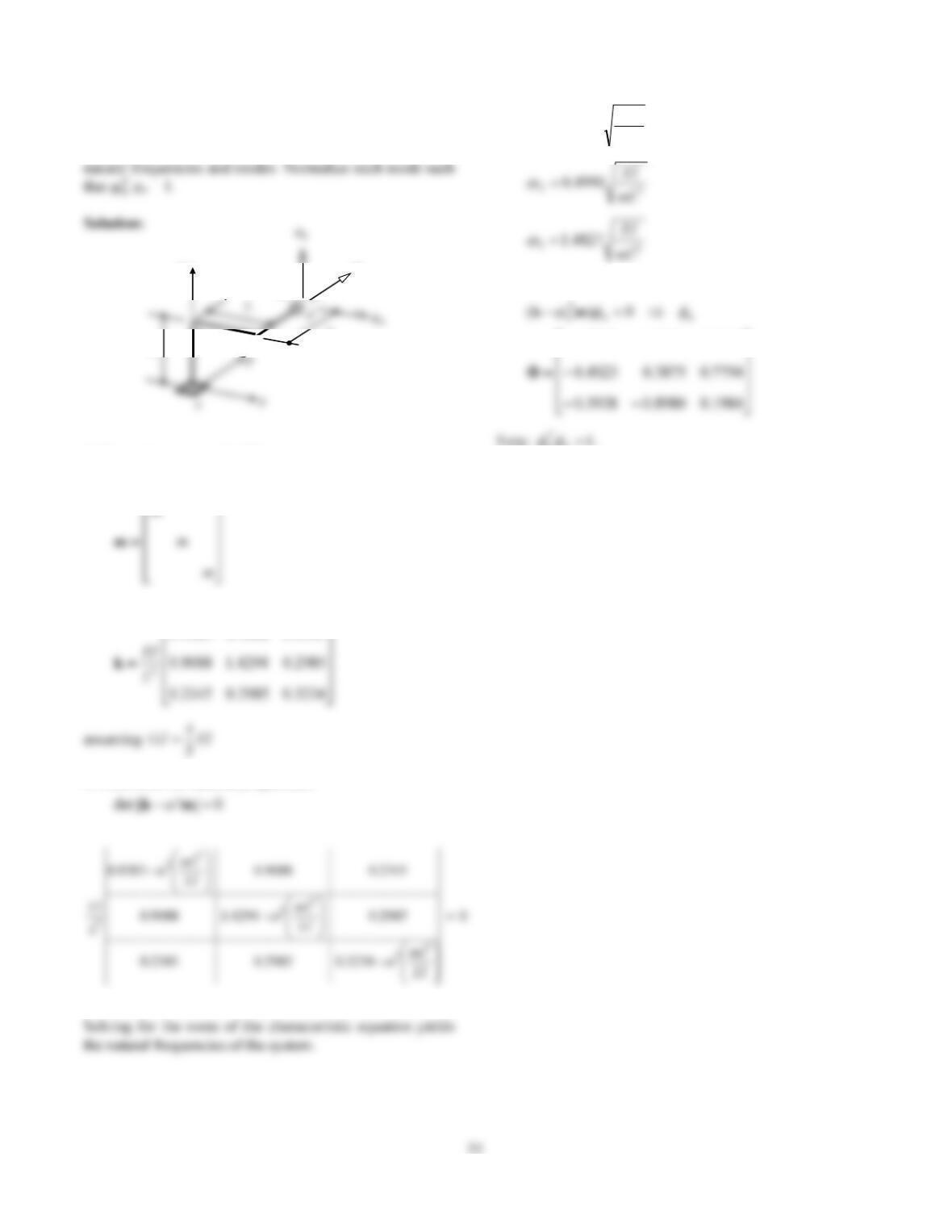
For the structure defined in Problem 9.18, determine the
1. Determine mass and stiffness matrices.
From solution to Problem 9.18:
and
2345.09088.09283.0
2. Determine the natural frequencies.
3
1
4834.0
mL
EI
3. Determine the natural modes.
5943.02084.07767.0
Note: 1
n
n
.
c
uy
L
m
z
L y
b
36
Problem 10.29
The floor weights and story stiffnesses of the three-story
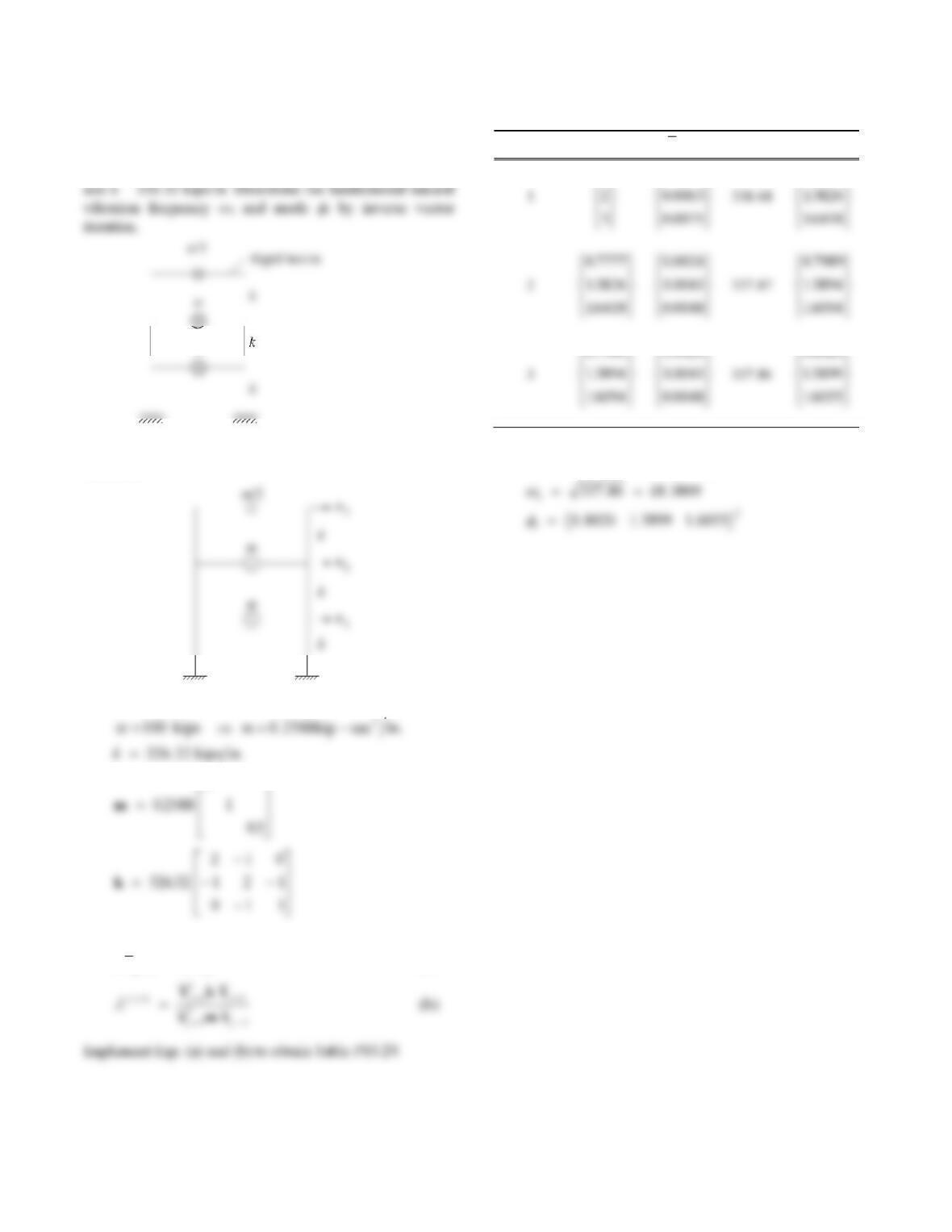
shear frame are shown in Fig. P10.29, where w =100 kips
Figure P10.29
Solution:
1. Data:
L
O
1
Inverse iteration equations:
kxmx
jj
1 (a)
Table P10.29
Iteration xj xj1
()j1 xj1
1
R
U
00036
.
R
U
07777
.
R
U
The fundamental natural frequency and mode are
w
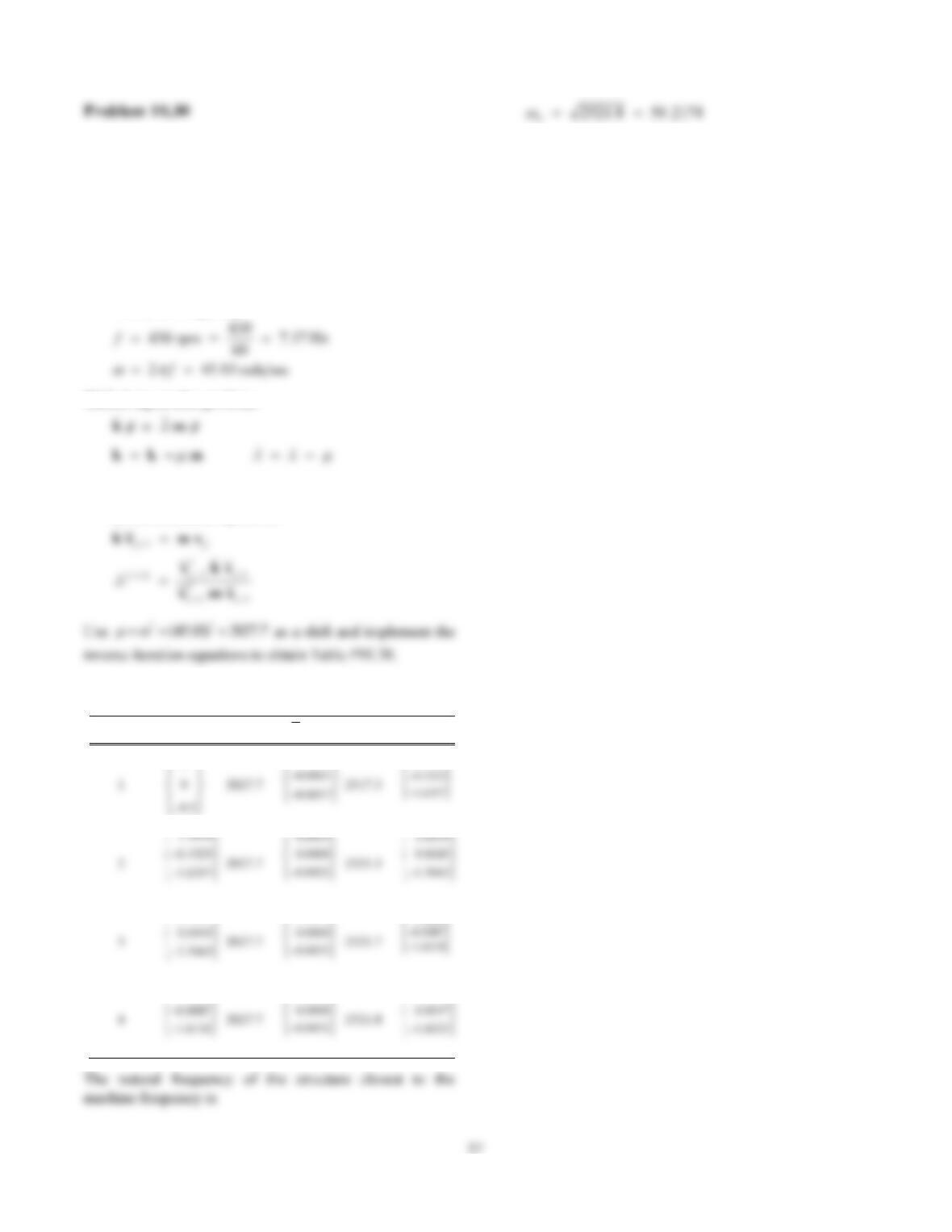
For the system defined in Problem 10.29, there is concern
for possible resonant vibrations due to rotating machinery
mounted at the second-floor level. The operating speed of
the motor is 430 rpm. Obtain the natural vibration
frequency of the structure that is closest to the machine
frequency.
Solution:
Excitation frequency:
Shifted eigenvalue problem:
and m and k are given in Problem 10.29.
Inverse iteration equations:
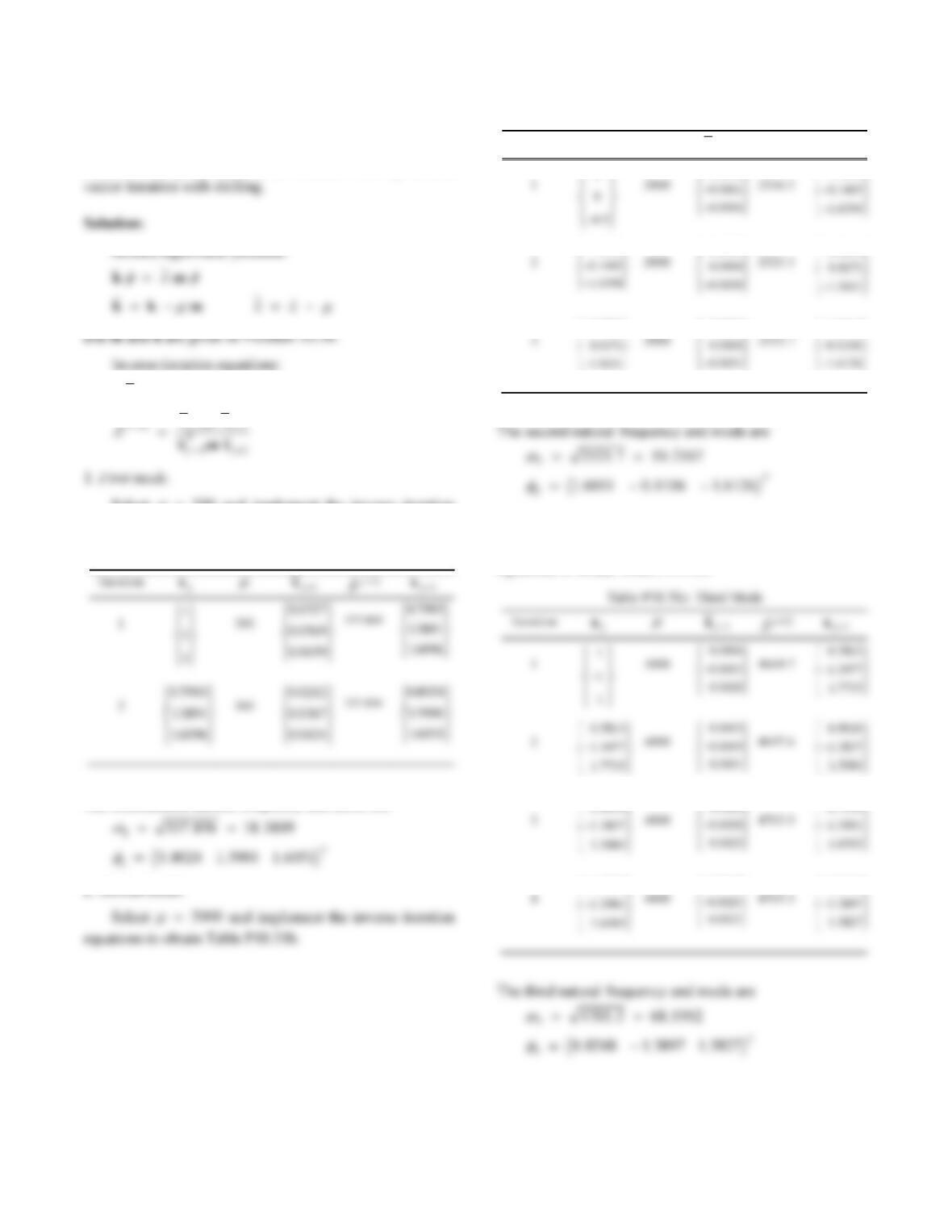
Table P10.30
Iteration xj
xj1
()j1 xj1
1
0.0017
1.5839
1.6239
0.0032
1.6020
1.6020
0.0033
1.6063
38
Problem 10.31
Determine the three natural vibration frequencies and
modes of the system defined in Problem 10.29 by inverse
kx mx
jj
1
T
xkx
Select
300 and implement the inverse iteration
equations to obtain Table P10.31a.
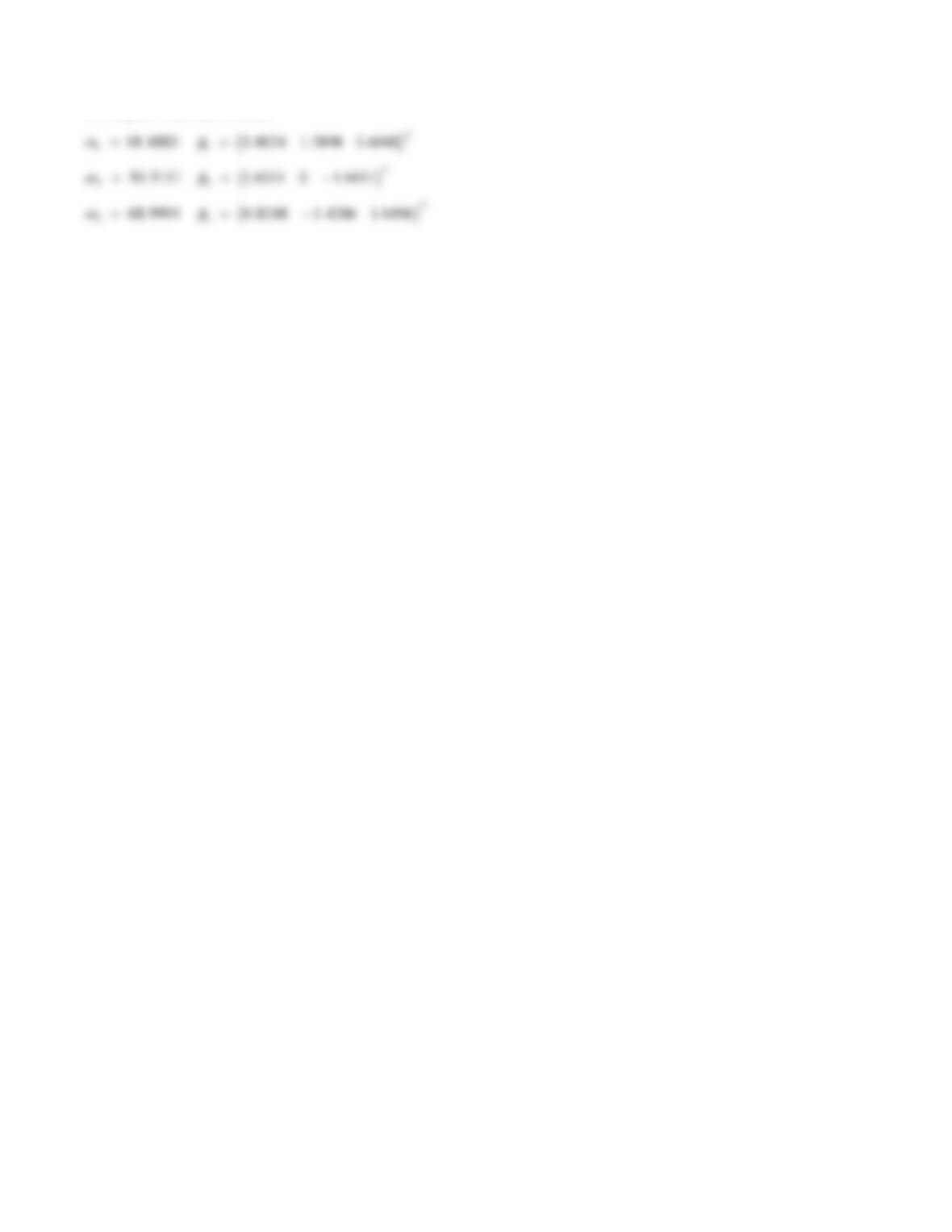
Table P10.31a: First Mode
The fundamental natural frequency and mode are
Table P10.31b: Second Mode
Iteration xj
xj1
()j1 xj1
1
0.0016
1.5813
1.5813
0.0031
1.6264
1.6264
0.0031
1.6011
3. Third mode.
Select
4000 and implement the inverse iteration
equations to obtain Table P10.31c.
0.7550
0.0012
0.8248
39
4. Compare with exact results.
40
Problem 10.32
Determine the three natural vibration frequencies and
modes of the system defined in Problem 10.29 by inverse
vector iteration with the shift in each iteration cycle equal
Solution:
Implement the iteration procedure of Eqs. (10.14.3) to
1. First mode.
Table P10.32a: First Mode
Iteration xj
xj1
()j1 xj1
0.8078
22 2645
.
R
U
08025
.
R
U
The fundamental natural frequency and mode are
2. Second mode.
Table P10.32b: Second Mode
Iteration xj
xj1
()j1 xj1
The second natural frequency and mode are
3. Third mode.
Table P10.32c: Third Mode
Iteration xj
xj1
()j
1 xj1
1
0.0036
0.7645
0.7645
0.7275
0.8025
The third natural frequency and mode are
34705 7 68 5981..