Archives: Quiz
ECON A 63008
Prohibiting price increases in situations of true scarcity could best be described as a. interfering with the “law” of supply and demand. b. thwarting the “law” of increasing returns to scale. c. violating the “law” of increasing cost. d. interfering […]
Economics 36506
If a currency increases in value as a result of government decree rather than market forces, the process is known as a. reflation. b. revaluation. c. appreciation. d. value-added. If marginal revenue and marginal cost are not equal, profit can […]
ECON E 35683
If workers expect inflation, and negotiate wage increases that exactly match price increases, the result is a a. horizontal aggregate supply curve at the level of potential GDP. b. vertical aggregate supply curve at the level of potential GDP. c. […]
BUS 47789
If savings exceeds investment at full employment, demand will fall short of total output. a. True b. False Figure 4-23 In Figure 4-23, which movement will be caused by changes in income? a. A to C b. C to A […]
Economics 60290
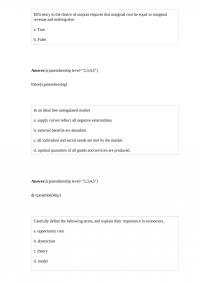
Efficiency in the choice of outputs requires that marginal cost be equal to marginal revenue and nothing else. a. True b. False In an ideal free unregulated market a. supply curves reflect all negative externalities. b. external benefits are abundant. […]
MicroEconomic 18046
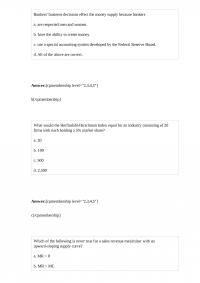
Bankers’ business decisions effect the money supply because bankers a. are respected men and women. b. have the ability to create money. c. use a special accounting system developed by the Federal Reserve Board. d. All of the above are […]
ECON E 23128
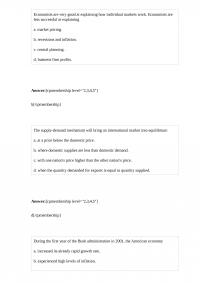
Economists are very good at explaining how individual markets work. Economists are less successful at explaining a. market pricing. b. recessions and inflation. c. central planning. d. business firm profits. The supply-demand mechanism will bring an international market into equilibrium […]
BUS 97698
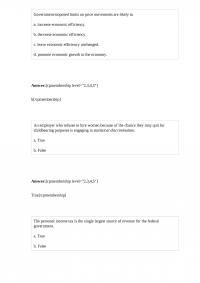
Government-imposed limits on price movements are likely to a. increase economic efficiency. b. decrease economic efficiency. c. leave economic efficiency unchanged. d. promote economic growth in the economy. An employer who refuses to hire women because of the chance they […]
ECB 32023
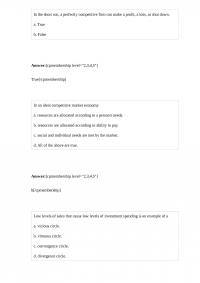
In the short run, a perfectly competitive firm can make a profit, a loss, or shut down. a. True b. False In an ideal competitive market economy a. resources are allocated according to a person’s needs. b. resources are allocated […]
ECON A 74939
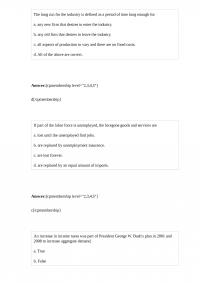
The long run for the industry is defined as a period of time long enough for a. any new firm that desires to enter the industry. b. any old firm that desires to leave the industry. c. all aspects of […]
BUS 36036
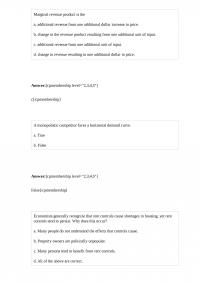
Marginal revenue product is the a. additional revenue from one additional dollar increase in price. b. change in the revenue product resulting from one additional unit of input. c. additional revenue from one additional unit of input. d. change in […]
ECON E 71233
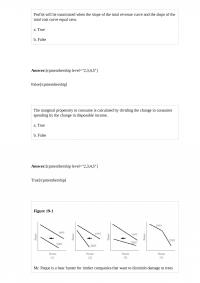
Profits will be maximized when the slope of the total revenue curve and the slope of the total cost curve equal zero. a. True b. False The marginal propensity to consume is calculated by dividing the change in consumer spending […]
ECON 40987
The central idea behind the Troubled Asset Relief Program was for the Treasury to sell mortgage-backed securities to interested investors, wait for prices to increase, and then buy these securities back for a profit. a. True b. False If the […]
MicroEconomic 73170
The price of a ride on the Washington, D.C. metro depends on the time of day you ride. This is an example of a. exploitation. b. inefficiency. c. political interference with a market. d. pricing to spread out demand. The […]
BUS 49382
In the 2007-2009 period, the expenditure level in the United States intersected the 45-degree line below potential GDP, causing a. hyperinflation. b. a growing trade deficit. c. a government budget surplus. d. unemployment. The United States has approximately a. 80,000 […]
ECON 55685
Whether prices or real GDP exhibit the greater response to increased aggregate demand depends on the degree of capacity utilization in the economy. a. True b. False One of the key factors in the economic success of South Korea was […]
BUS 74275
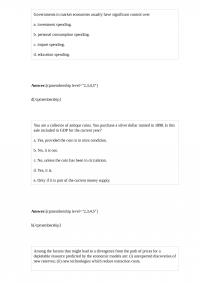
Governments in market economies usually have significant control over a. investment spending. b. personal consumption spending. c. import spending. d. education spending. You are a collector of antique coins. You purchase a silver dollar minted in 1898. Is this sale […]
BUS 74127
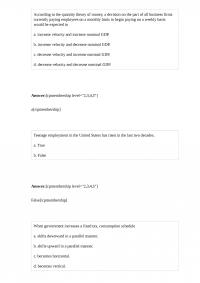
According to the quantity theory of money, a decision on the part of all business firms currently paying employees on a monthly basis to begin paying on a weekly basis would be expected to a. increase velocity and increase nominal […]
ECON E 79017
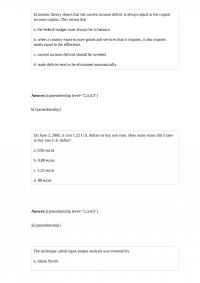
Economic theory shows that the current account deficit is always equal to the capital account surplus. This means that a. the federal budget must always be in balance. b. when a country exports more goods and services than it imports, […]
BUS 69244
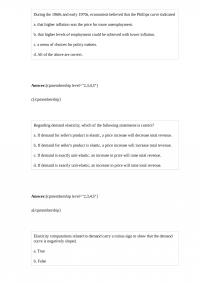
During the 1960s and early 1970s, economists believed that the Phillips curve indicated a. that higher inflation was the price for more unemployment. b. that higher levels of employment could be achieved with lower inflation. c. a menu of choices […]
ECON E 77824
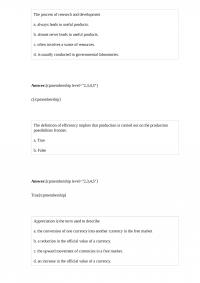
The process of research and development a. always leads to useful products. b. almost never leads to useful products. c. often involves a waste of resources. d. is usually conducted in governmental laboratories. The definition of efficiency implies that production […]
ECON 45462
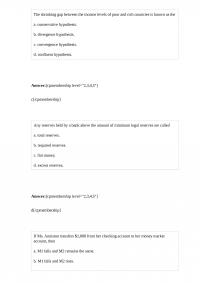
The shrinking gap between the income levels of poor and rich countries is known as the a. conservative hypothesis. b. divergence hypothesis. c. convergence hypothesis. d. confluent hypothesis. Any reserves held by a bank above the amount of minimum legal […]
Economics 13886
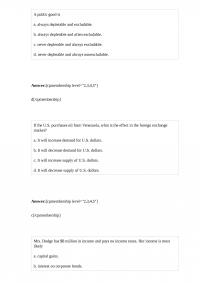
A public good is a. always depletable and excludable. b. always depletable and often excludable. c. never depletable and always excludable. d. never depletable and always nonexcludable. If the U.S. purchases oil from Venezuela, what is the effect in the […]
ECB 50812
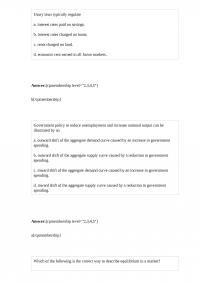
Usury laws typically regulate a. interest rates paid on savings. b. interest rates charged on loans. c. rents charged on land. d. economic rent earned in all factor markets. Government policy to reduce unemployment and increase national output can be […]
Economics 27165
Between 1981 and 1986, as the federal budget deficit increased, a. consumption spending fell. b. investment spending was crowded out. c. net exports increased. d. net exports were crowded out. As the rate of interest on borrowed funds increases, the […]
ECB 91732
Monetarists typically favor strong policy measures to fight recession. a. True b. False The payoff matrix is a fundamental tool of a. monopolistic competition. b. game theory. c. corporate finance theory. d. regulatory oversight. Answer: b The efficiency of the […]
ECON A 96394
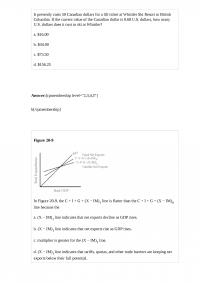
It presently costs 50 Canadian dollars for a lift ticket at Whistler Ski Resort in British Columbia. If the current value of the Canadian dollar is 0.68 U.S. dollars, how many U.S. dollars does it cost to ski at Whistler? […]
ECON E 96054
Among young Americans aged 19 to 25, _____% have no health insurance. a. 11% b. 17% c. 22% d. 26% A ceiling on interest rates is likely to lead to a. an increase in lending activity. b. more rapid capital […]
Economics 93183
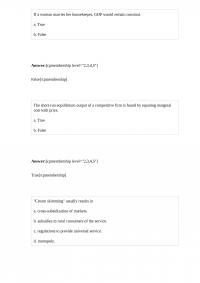
If a woman marries her housekeeper, GDP would remain constant. a. True b. False The short-run equilibrium output of a competitive firm is found by equating marginal cost with price. a. True b. False Answer: True “Cream skimming” usually results […]
ECON A 96561
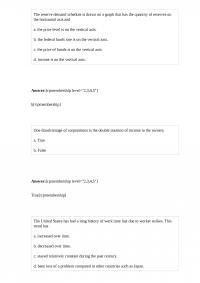
The reserve demand schedule is drawn on a graph that has the quantity of reserves on the horizontal axis and a. the price level is on the vertical axis. b. the federal funds rate is on the vertical axis. c. […]
Economics 31758
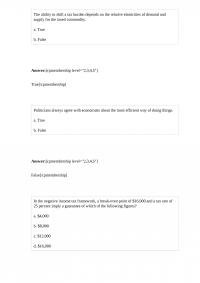
The ability to shift a tax burden depends on the relative elasticities of demand and supply for the taxed commodity. a. True b. False Politicians always agree with economists about the most efficient way of doing things. a. True b. […]
ECON A 96844
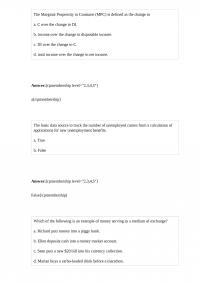
The Marginal Propensity to Consume (MPC) is defined as the change in a. C over the change in DI. b. income over the change in disposable income. c. DI over the change in C. d. total income over the change […]
MicroEconomic 91169
Which of the following usually leads to currency appreciation? a. galloping inflation b. relatively low interest rates c. declining real GDP d. fixed exchange rates The price of imported oil decreased in 2001. How did this affect the aggregate supply […]
Economics 45178
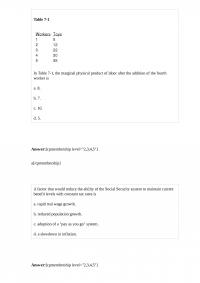
Table 7-1 In Table 7-1, the marginal physical product of labor after the addition of the fourth worker is a. 8. b. 7. c. 10. d. 5. A factor that would reduce the ability of the Social Security system to […]
MicroEconomic 23781
Serious environmental problems are a. unique to industrial economies. b. unique to Western economies. c. unique to civilized economies (i.e., those in which people live mainly in cities). d. None of the above is correct. Points along a budget line […]
Economics 32042
The net export component of aggregate demand is defined as U.S. a. imports minus U.S. exports. b. imports plus U.S. exports. c. exports minus U.S. imports. d. exports minus taxes and customs duties. At higher interest rates, banks will want […]
ECON 43560
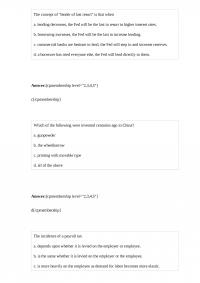
The concept of “lender of last resort” is that when a. lending decreases, the Fed will be the last to resort to higher interest rates. b. borrowing increases, the Fed will be the last to increase lending. c. commercial banks […]
BUS 15008
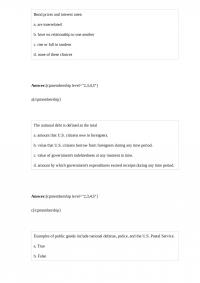
Bond prices and interest rates: a. are interrelated b. have no relationship to one another c. rise or fall in tandem d. none of these choices The national debt is defined as the total a. amount that U.S. citizens owe […]
ECON A 94431
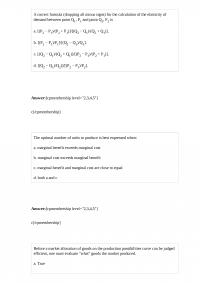
A correct formula (dropping all minus signs) for the calculation of the elasticity of demand between point Q1, P1 and point Q2, P2 is a. [(P2 − P1)/(P2 + P1)]/[(Q2 − Q1)/(Q2 + Q1)]. b. [(P2 − P1)/P1]/[(Q2 − Q1)/Q1]. […]
ECB 44119
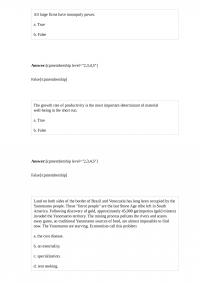
All large firms have monopoly power. a. True b. False The growth rate of productivity is the most important determinant of material well-being in the short run. a. True b. False Answer: False Land on both sides of the border […]
ECON A 84515
Japanese employers tend to hire employees right out of college and train them for a lifetime job with the company. Over time they found that women often, but not always, married after a few years and left the company so […]
BUS 42178
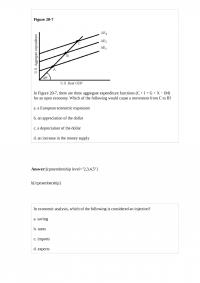
Figure 20-7 In Figure 20-7, there are three aggregate expenditure functions (C + I + G + X − IM) for an open economy. Which of the following would cause a movement from C to B? a. a European economic […]
Economics 81108
Economists define “efficiency” as the absence of waste. a. True b. False With regard to the characteristics of production indifference curves, which of the following statements is/are NOT true? a. Higher curves correspond to larger outputs. b. An indifference curve […]
Economics 49686
If workers and firms forecast inflation accurately, a. the aggregate supply curve will be vertical. b. the real wage will not decline as the price level rises. c. workers will not lose from inflation, and firms will not gain. d. […]
ECON E 23650
Appreciation of the Japanese Yen would lead to a. outward shift in the aggregate supply curve for Japan. b. upward shift in the aggregate demand curve for Japan. c. downward shift in the aggregate supply curve for Japan. d. downward […]
ECON E 34881
Reductions in the personal income tax, often advocated by supply-siders to increase labor supply and effort, can be expected to also a. decrease consumption spending. b. increase consumption spending. c. decrease investment spending. d. increase export sales. If the fluctuations […]
ECON A 73183
A shift in the demand curve occurs when a. suppliers place more goods on the market. b. the price of a good rises. c. consumers want to buy more or less than before at a given price. d. the price […]
Economics 12413
Economics can decide a. the appropriate trade-off between fairness and efficiency. b. which pricing arrangements are fair and which are unfair. c. whether a pricing decision will impose heavy inefficiency costs on society. d. All of the above are correct. […]
ECON 31086
The banking industry is heavily regulated because a. banking is a monopoly industry. b. most banks are owned by government agencies. c. bankers do what is best for their stockholders, not necessarily what is best for the economy. d. All […]
Economics 48382
At equilibrium, the market will clear, with no surpluses or shortages occurring. a. True b. False The supply curve of a depletable natural resource is usually a. downward sloping because the resource runs out over time. b. upward sloping because […]