
Prohibiting price increases in situations of true scarcity could best be described as
a. interfering with the “law” of supply and demand.
b. thwarting the “law” of increasing returns to scale.
c. violating the “law” of increasing cost.
d. interfering with the “law” of diminishing marginal utility.
Contractionary fiscal policy would be most effective in decreasing inflation when
a. the marginal propensity to consume low.
b. investment spending is insensitive to interest rates.
c. the economy has a high marginal tax rate.
d. investment spending is sensitive to interest rates.
When recessions occur, advocates of small government should recommend
a. reductions in the number of federal employees.
b. reductions in transfer payments.
c. reductions in taxes.

d. increases in transfer payments and government spending.
The demand for borrowed funds is
a. directly related to the interest rate.
b. inversely related to the growth in gross domestic product.
c. a derived demand.
d. leads to derived demand for capital goods.
Because monetary stimulus overwhelmed fiscal contraction in the United States during
the 1992- 2000 period,
a. real GDP grew.
b. real GDP decreased.
c. the rate of inflation increased.
d. the budget deficit increased.

A rational decision is one that
a. satisfies all desires.
b. avoids the intentional allocation of resources.
c. assigns available resources in the manner most preferred by decision makers.
d. assigns available resources to the uses with the lowest opportunity costs.
One explanation for the increase in the natural rate of unemployment in 2010 was a
mismatch between the skills of the American labor force and the skills that the modern
job market demanded.
a. True
b. False
Normally, to the extent that a governmental control mechanism succeeds in affecting
price, it can be expected to lead to a corresponding

a. reduction in the volume of sales only if the price is forced down.
b. reduction in the volume of sales if the price is forced down and an increase in the
volume of sales if the price is forced up.
c. decrease in the volume of sales whether the price is forced up or down.
d. increase in the volume of sales whether the price is forced up or down.
Marginal revenue equals the change in total revenue that is earned by selling one more
unit of output.
a. True
b. False
Aggregate supply tends to grow because
a. there are more workers in the economy every year.
b. there is more capital in the economy every year.
c. technology tends to improve every year.
d. All of the above are correct.

The prices that are in the public’s best interest will
a. always allow the regulated firm to break even.
b. always allow the regulated firm to make positive economic profits.
c. sometimes leave the regulated firm with economic losses.
d. leave the regulated firm with profits that are about 10 percent higher than those of
other firms.
If the elasticity of demand for cigarettes is 0.4, then an increase in the price of a pack of
cigarettes from $5.00 to $6.00 would reduce quantities demanded by about
a. 7 percent.
b. 40 percent.
c. 42 percent.
d. 220 percent.
Leverage is essential to a bank’s profitability but it also increases risk.
a. True
b. False
Define the following terms and explain their importance to the study of economics.
a. greenhouse gases
b. externality
c. emissions permits
d. known reserves
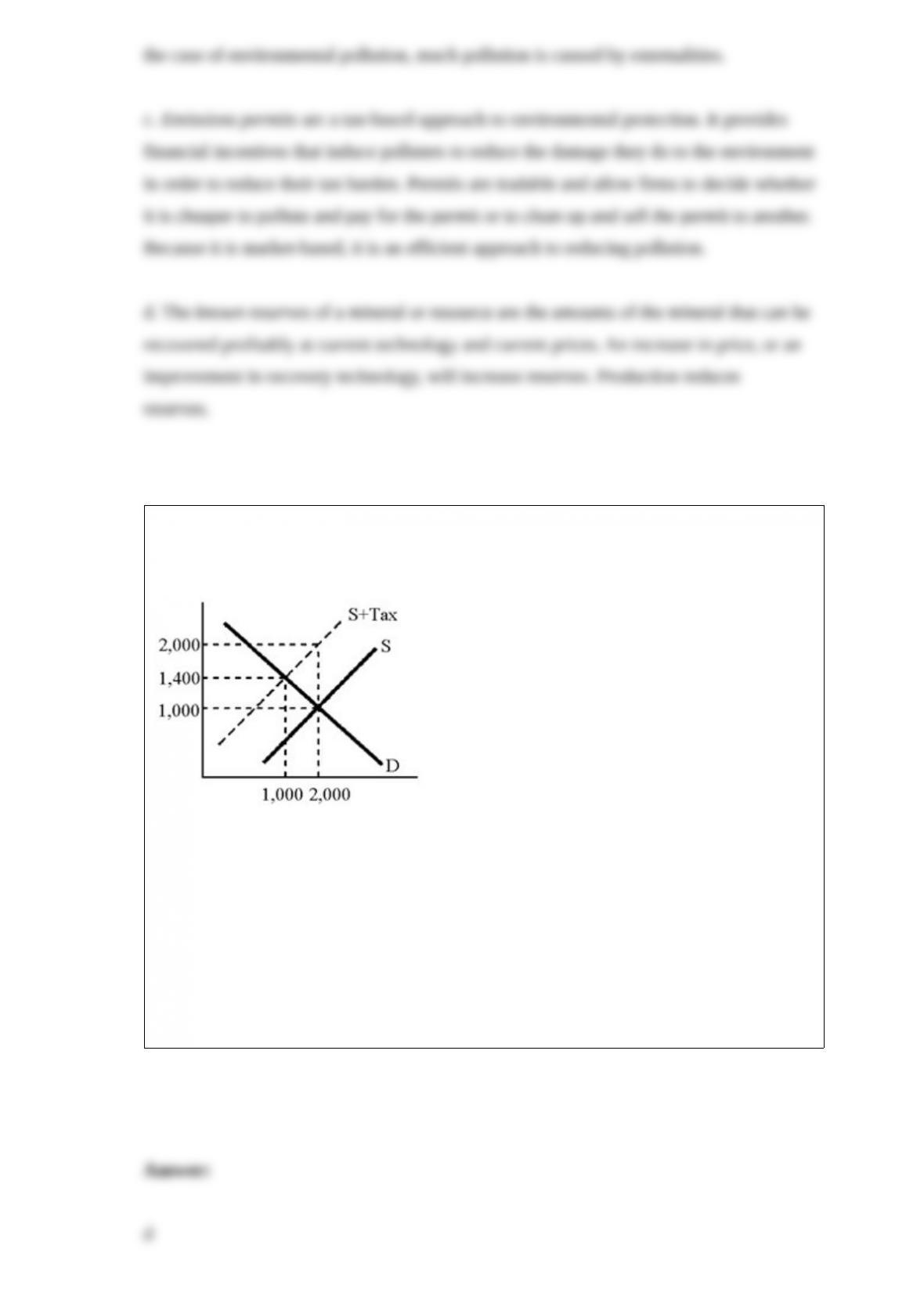
Figure 18-1
According to the graph in Figure 18-1, tax collections will be which of the following?
a. 14 million
b. 1.4 million
c. 12 million
d. 1 million

For both Keynesians and monetarists to predict accurately the effects of a change in the
money supply on the price level, they need to add ____ to their analysis.
a. aggregate demand
b. nominal GDP
c. real GDP
d. aggregate supply
e. government spending
Total utility decreases when diminishing marginal utility is present.
a. True
b. False
What will happen to the demand for reserves if real GDP increases?
a. It will shift outward.
b. It will shift inward.
c. It will remain unchanged.
d. It depends on what happens to interest rates.
In general, the quantity of savings supplied to be used for lending increases with the
rate of interest.
a. True
b. False
An oligopolist cares very much about what other firms in her industry are doing.
a. True
b. False

Corporations obtain funds when their previously issued stock is traded.
a. True
b. False
Which country most recently experienced hyperinflation?
a. Germany
b. Zimbabwe
c. Chile
d. all of the above
The rule of equating marginal benefit with marginal cost is proper for economics, but it
does not describe the way in which people make non-economic decisions.
a. True
b. False

The total amount of consumption of a society can be increased if
a. firms allow each worker to perform multiple tasks.
b. resources are allocated by a central planning group.
c. individuals engage in specialization and voluntary trade.
d. barter exchange is used in place of money.
Regulators often raise prices instead of lowering them. This is designed to
a. prevent the exit of competitors.
b. protect the consumer from cheap products.
c. ensure high-quality products.
d. ensure workers are adequately paid.
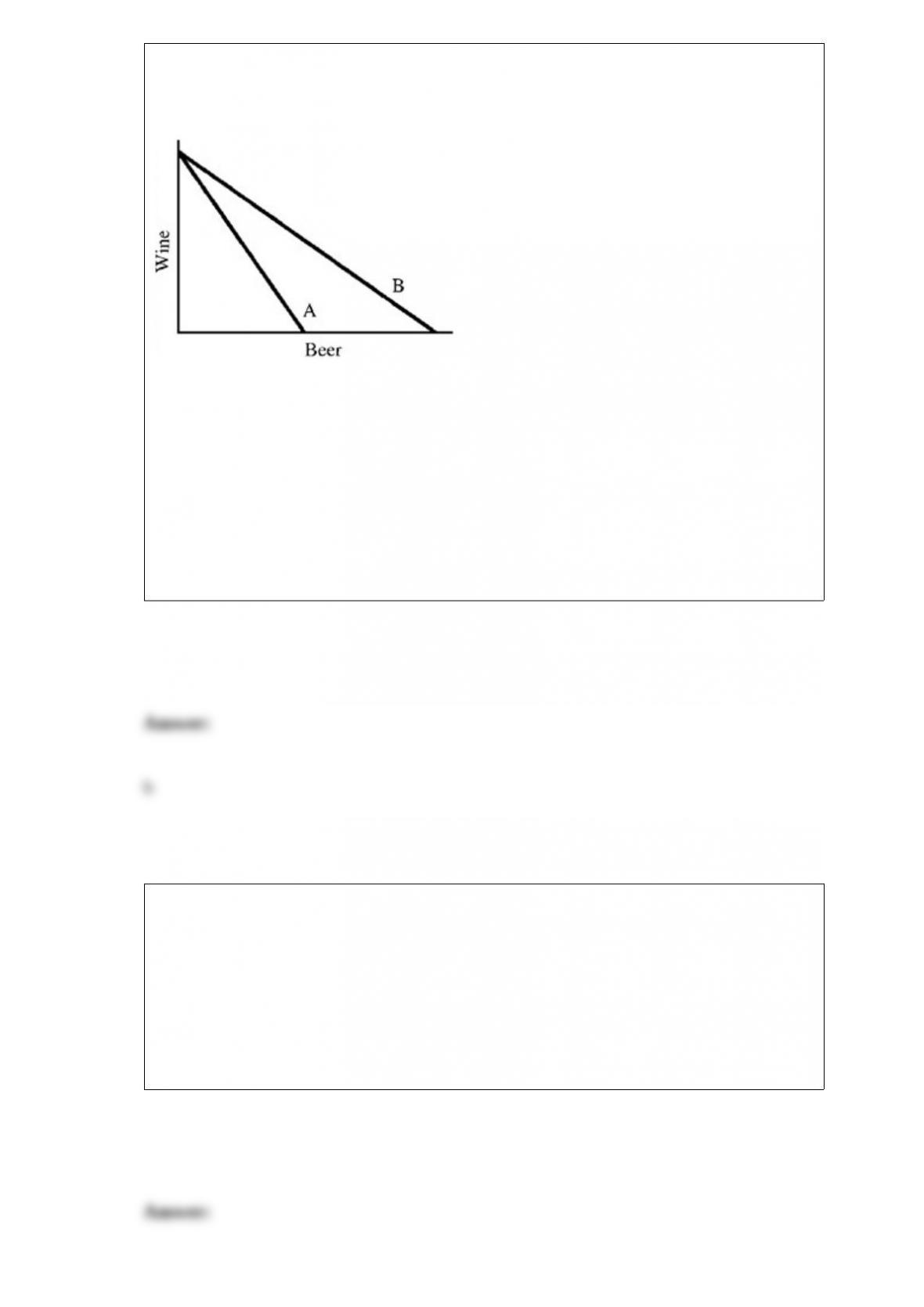
Figure 5-7
In Figure 5-7, budget line B compared to A clearly shows that the
a. price of wine increased.
b. price of beer decreased.
c. price of beer increased.
d. consumers’ money income increased.
Since 1970, the share of income going to the richest fifth of the population in the U.S.
has
a. diminished.
b. grown.
c. remained unchanged.

In the middle of a severe recession, Congress passes an increase in the level of
unemployment benefits. This would be considered by economists as a
a. positive tax.
b. negative tax.
c. form of government purchases.
d. variable tax.
In the national income accounts, new investment goods are considered
a. intermediate goods, and therefore, not counted.
b. final goods.
c. subtractions from final output.
d. depreciated goods
National income is the sum of

a. wages and profits.
b. wages, interest, profits, and rent.
c. interest and rent.
d. wages, transfer payments, and tax revenues.
When can a country gain a price advantage on imports by imposing a tariff?
a. when it is the largest country with absolute advantage in all goods
b. when it has a comparative advantage in the production of all goods
c. when it can do so without other countries retaliating with tariffs
d. when trade agreements prohibit quotas but permit tariffs
High levels of sales that spur high levels of investment spending is an example of a
a. vicious circle.
b. virtuous circle.
c. convergence circle.

d. divergence circle.
Small differences in economic growth rates translate into significant differences in
living standards.
a. True
b. False
If the Fed’s monetary policy causes a substantial increase in interest rates, what is the
most likely impact on velocity?
a. It will decrease.
b. It will increase.
c. It will remain constant.
d. Velocity is unrelated to interest rates.

Economists generally think that the ____ tax is among the best ways to raise revenue.
a. property
b. personal income
c. sales
d. value-added