If savings exceeds investment at full employment, demand will fall short of total output.
a. True
b. False
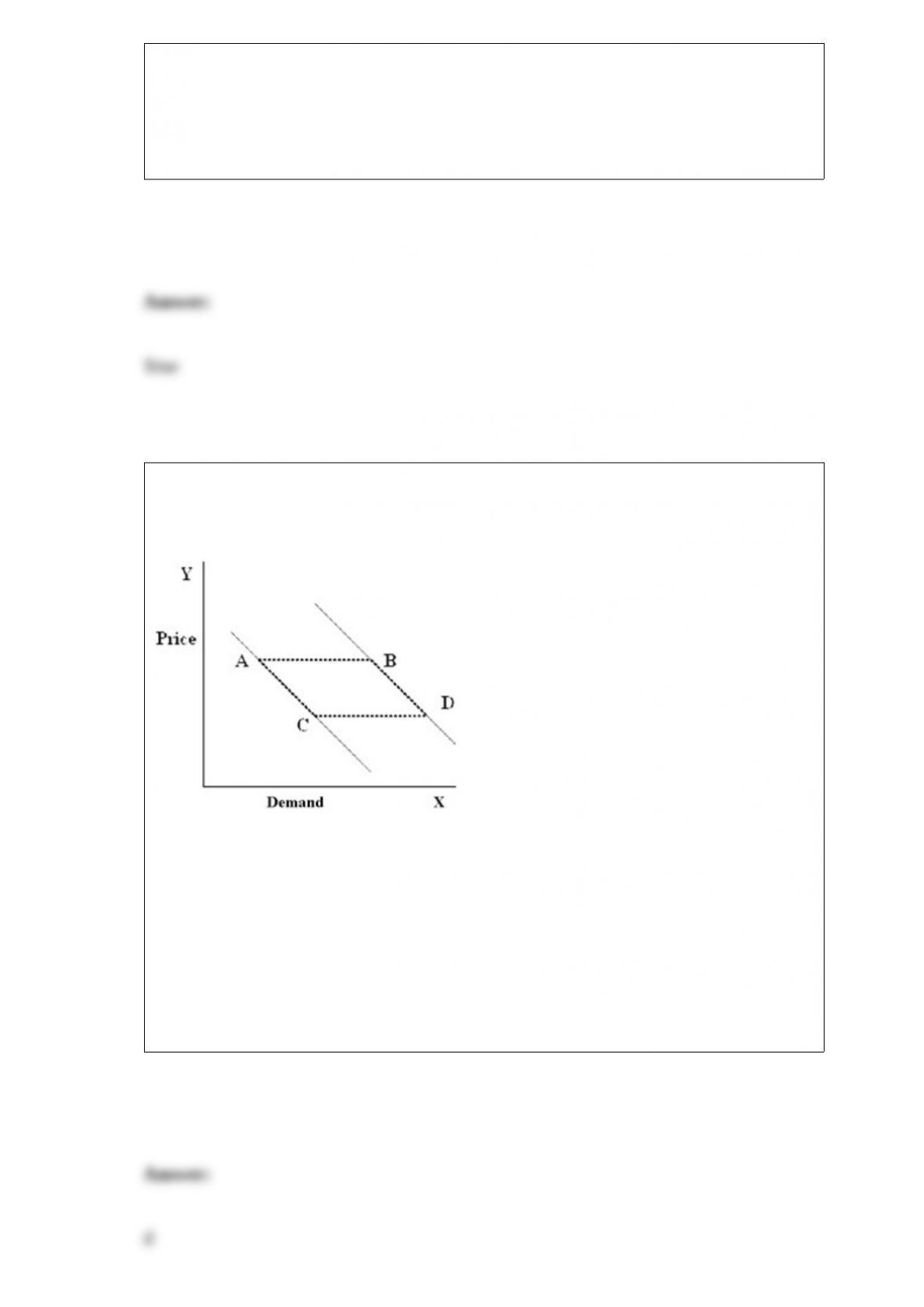
Figure 4-23
In Figure 4-23, which movement will be caused by changes in income?
a. A to C
b. C to A
c. B to D
d. B to A

The most likely group of the following that would be eligible for unemployment
insurance benefits is
a. new college graduates looking for their first job.
b. mothers returning to the labor force after caring for young children.
c. workers who quit their jobs.
d. experienced workers recently laid off.
The key characteristic of macroeconomics is the process of aggregation.
a. True
b. False
Figure 19-2
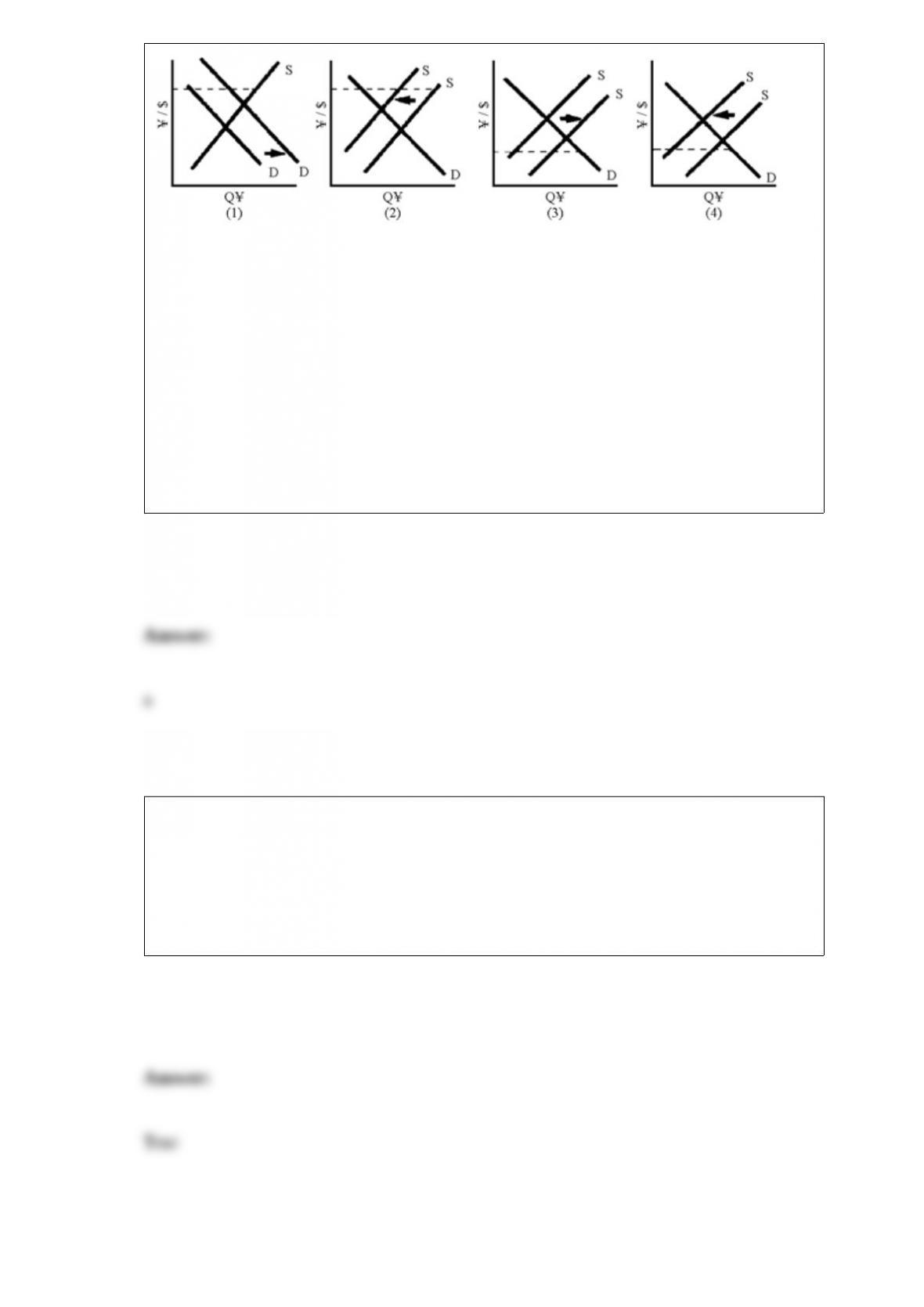
Of the graphs in Figure 19-2, where the broken line represents the fixed exchange rate,
which one shows a reduction in the price level in Japan that would reduce a balance of
payments deficit?
a. 1
b. 2
c. 3
d. 4
A change in the value of consumer’s stock market holdings will cause a shift in the
consumption function.
a. True
b. False

The majority of new jobs created in the service sector of the U.S. economy have been in
the information sector.
a. True
b. False
The environmental problems of China:
a. were caused by a lack of central planning in the economy.
b. were caused by the burning of low-quality, high-sulfur coal.
c. were caused by a lack of pollution controls.
d. All of the above are correct.
The Organization of Petroleum Exporting Countries (OPEC) is an example of
a. a price leadership system.
b. a generally unsuccessful cartel.
c. an organization devoted to tacit collusion.
d. a successful cartel.

In many high-tech industries in the economy, such as computers, medical equipment,
and automobiles
a. price competition is utilized by firms more than innovation to compete with rivals.
b. firms compete on the basis of innovation only; never engaging in price competition.
c. innovation is utilized by firms to compete with rivals more than price competition.
d. firms use price competition only; never engaging in innovation to compete with
rivals.
e. firms utilize innovation and price competition equally to compete with rivals.
Gross Domestic Product is an economic aggregate that represents the
a. potential output of a country.
b. total product of a nation’s economy.
c. total income earned from all sales.
d. total product that a country exports.

Economists use a resource’s price as an indicator of its relative scarcity.
a. True
b. False
As a competitive economy uses its stocks of a depletable resource,
a. the resource price will fall by ever greater amounts each year.
b. the resource price will rise by ever greater amounts each year.
c. the use of the resource will increase at an increasing rate.
d. resource use will drop to zero.
A firm will generally believe that if it increases its spending on R&D its competitors
will not follow, but if it decreases its spending they will follow.
a. True

b. False
A proportional tax is one in which the fraction of income paid in taxes rises as a
person’s income increases.
a. True
b. False
Usury laws interfere with the automatic workings of the market mechanism.
a. True
b. False
Under a regressive tax, the fraction of income paid in taxes
a. rises as income rises.
b. is unchanged as income changes.
c. falls as income rises.
d. is proportional to the change in income.
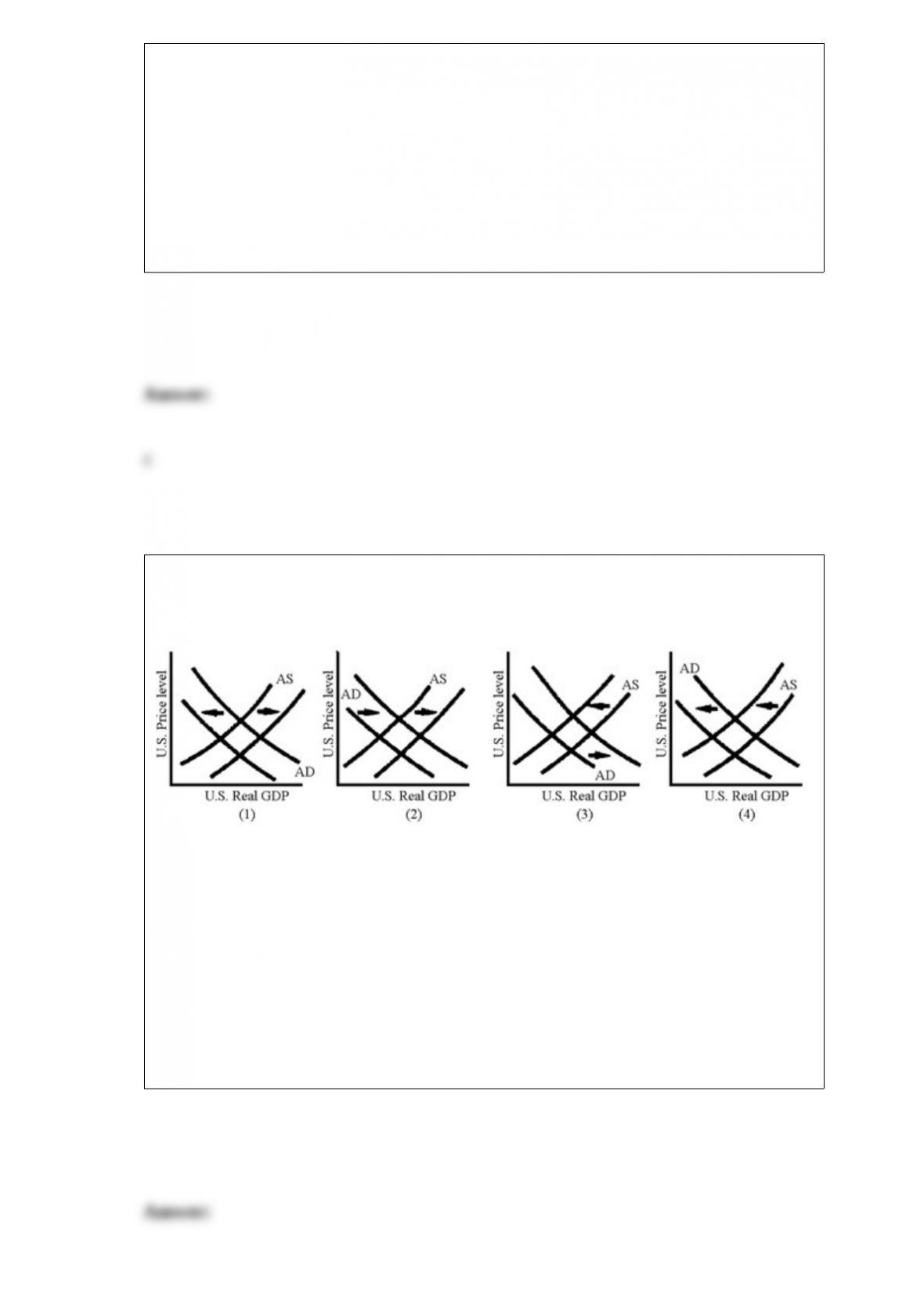
Figure 20-8
Which of the graphs in Figure 20-8 illustrates the AD-AS shifts associated with an
expansionary monetary policy?
a. 1
b. 2
c. 3
d. 4

Economists who believe that the economy has a strong self-correcting mechanism
argued that, after September 11, 2001, the economy needed
a. a quick and expansionary fiscal policy stimulus.
b. a quick and expansionary monetary stimulus.
c. only a short time to return to equilibrium full employment.
d. President Bush to propose a large budget stimulus package.
Assume that the MPC is .9 and investment falls by $30 billion. What is the change in
real GDP?
a. −$300 billion
b. −$270 billion
c. −$93 billion
d. −$39 billion
At the interest rate r, the price of a depletable natural resource three years from the
present (price in present = P) will be, everything else being equal, which of the
following?
a. 3P
b. P3
c. P(1 + r)3
d. 3P(1 + r)3
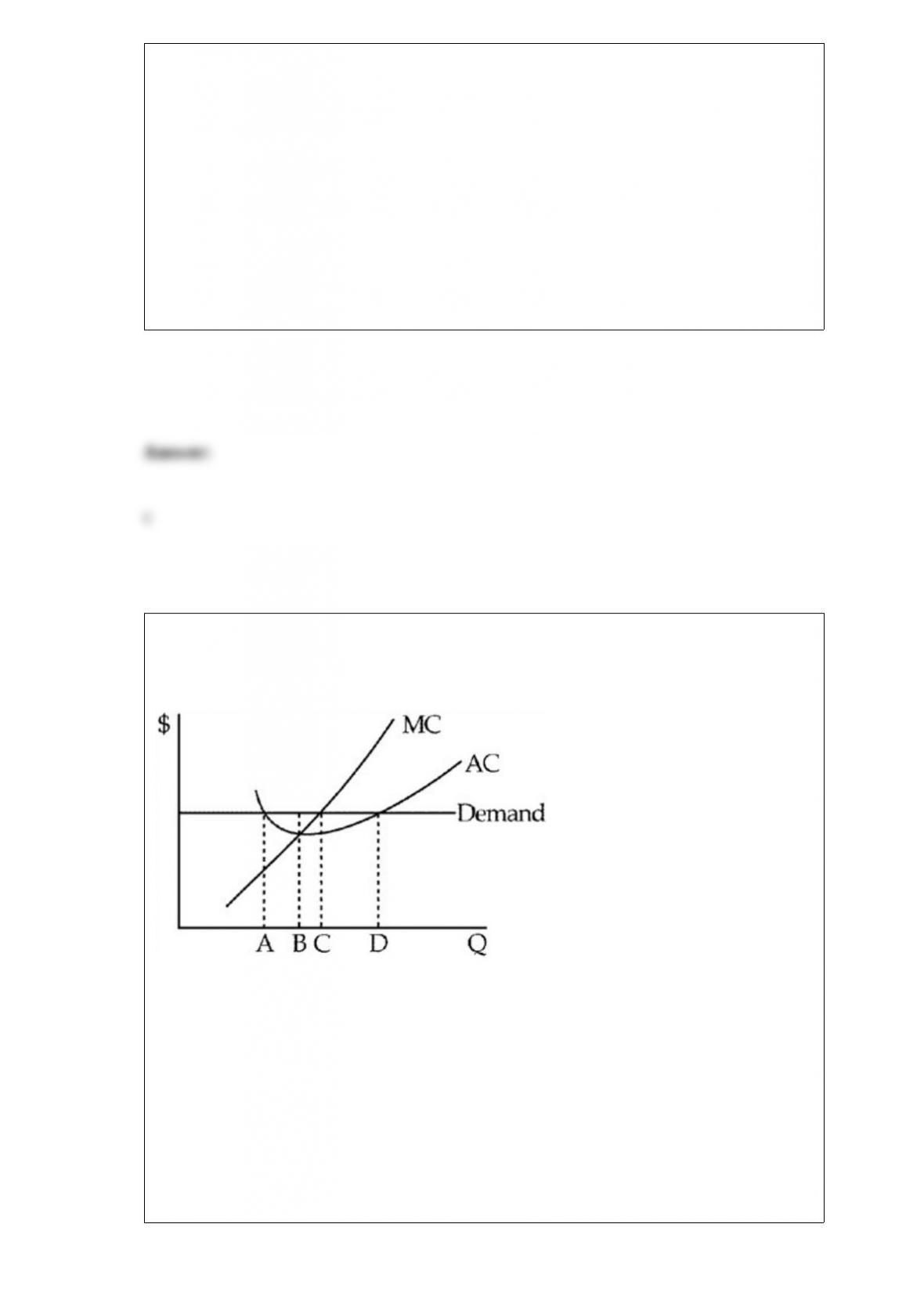
Figure 10-1
If the profit-maximizing firm depicted in Figure 10-1 is perfectly competitive, how
much output should it produce?
a. A
b. B
c. C
d. D

An increase in the interest rate is associated with an increase in bond prices.
a. True
b. False
A typical economy produces thousands of different goods. Is it accurate to say that
society faces a production possibilities frontier?
a. No, because two dimensions cannot capture the complexity of a full economy.
b. No, although a graph with several thousand dimensions would be appropriate.
c. Yes, although society does not face opportunity cost and the model does not apply.
d. Yes, because scarcity always imposes opportunity costs.
e. Uncertain-economic theory has no answer to this question.

Most economists agree that the focus of fiscal policy is to
a. plan the economy.
b. balance aggregate demand and aggregate supply.
c. balance the federal budget.
d. balance environmental needs and resources.
Maureen left her teaching job, which paid $30,000 per year, and invested $20,000 of
her retirement fund (which was earning 10 percent interest) in a new real estate
business. Her accountant predicted a $60,000 revenue the first year. Her husband, an
economist, forecast her profit to be
a. $10,000.
b. $28,000.
c. $32,000.
d. $60,000.
If a firm’s average cost is currently $100, and the marginal cost is $95, then the average
cost is currently falling.

a. True
b. False
Effective methods of dealing with externalities would include
a. taxing firms that generate beneficial externalities.
b. imposing fines equal to the difference between MSC and MPC on firms that generate
beneficial externalities.
c. giving a subsidy per unit equal to the difference between MSC and MPC to firms that
generate beneficial externalities.
d. restricting the output of firms that generate beneficial externalities.
The distribution of income in a market economy is determined by the minimum wage
laws.
a. True
b. False

The U.S. Constitution
a. prohibits tariffs on trade between Arkansas and New York but allows tariffs on trade
between Hawaii and Alaska.
b. prohibits tariffs on all trade.
c. allows tariffs on trade with other countries, but not on trade between the states.
d. allows tariffs only on goods purchased from the communist nations.
The government component (G) of total output includes goods and services purchased
by
a. the federal government plus transfer payments.
b. all government institutions plus transfer payments.
c. all government institutions.
d. all government institutions plus tax revenues.

Economists may disagree about how to solve an economic problem because they
a. use different models to analyze the problem and its solutions.
b. have different political and moral beliefs.
c. disagree about the facts of the situation.
d. All of the above are correct.
Scarcity limits the volume of goods that an economic system can produce, but does not
limit the production of services.
a. True
b. False
In an attempt to reduce poaching of elephant tusks for ivory, officials in Kenya burned
illegally gathered ivory. Economists tend to point out that
a. poaching can be reduced with price supports for ivory.
b. the supply of ivory has fallen, leading to an increase in price and reward for
poaching.
c. burning ivory decreases demand, leading to lower prices and reward for poaching.

d. the demand for ivory is higher, leading to an increase in price and reward for
poaching.
e. burning ivory raises demand, and controlled prices will lead to even greater
poaching.