
Between 1981 and 1986, as the federal budget deficit increased,
a. consumption spending fell.
b. investment spending was crowded out.
c. net exports increased.
d. net exports were crowded out.
As the rate of interest on borrowed funds increases, the quantity of investment funds
demanded diminishes.
a. True
b. False
In addition to fiscal policy, the other main tool used to affect aggregate demand is
a. trade policy.
b. industrial policy.
c. planning policy.
d. monetary policy.

If British government bonds pay a higher interest rate than U.S. government bonds, the
dollar should appreciate.
a. True
b. False
What do most economists think is the most accurate statement about velocity?
a. It is fairly constant in the short run, but varies considerably in the long run,
complicating predictions about nominal GDP.
b. M1 velocity is more stable in the short run than M2 velocity, and it has been a
superior tool in predicting changes in nominal GDP.
c. It is not constant in the short run, and predictions about nominal GDP have not fared
well.
d. M2 velocity has been less stable than M1 velocity, but both are reliable enough to
make accurate predictions about changes in nominal GDP.

Changes in the price level affect household wealth more than household income.
a. True
b. False
The reason for the multiplier effect is that
a. businesses make decisions about investment projects based on anticipated profits.
b. one person’s additional expenditure creates a new source of income for another
person, and this additional income leads to still more spending.
c. changes in government spending typically deepen recessions and exacerbate
inflationary conditions in the economy.
d. additional spending lowers the rate of interest and leads to further borrowing and
spending.
The expected effects of fiscal contraction are
a. higher real interest rates.

b. exchange rate depreciation.
c. increased trade deficit.
d. All of the above are correct.
If the MPC increases in value, what will happen to the slope of the consumption
function?
a. The slope will decrease and the consumption function will become flatter.
b. The slope will decrease and the consumption function will become steeper.
c. The slope will increase and the consumption function will become steeper.
d. The slope will increase and the consumption function will become flatter.
Investing in risky assets in the hope of earning profits is called speculation.
a. True
b. False

When you pay for some purchase with a check, cash must be transferred to another
account to pay for the check.
a. True
b. False
The velocity of circulation has remained constant over long periods of time.
a. True
b. False
Figure 6-6
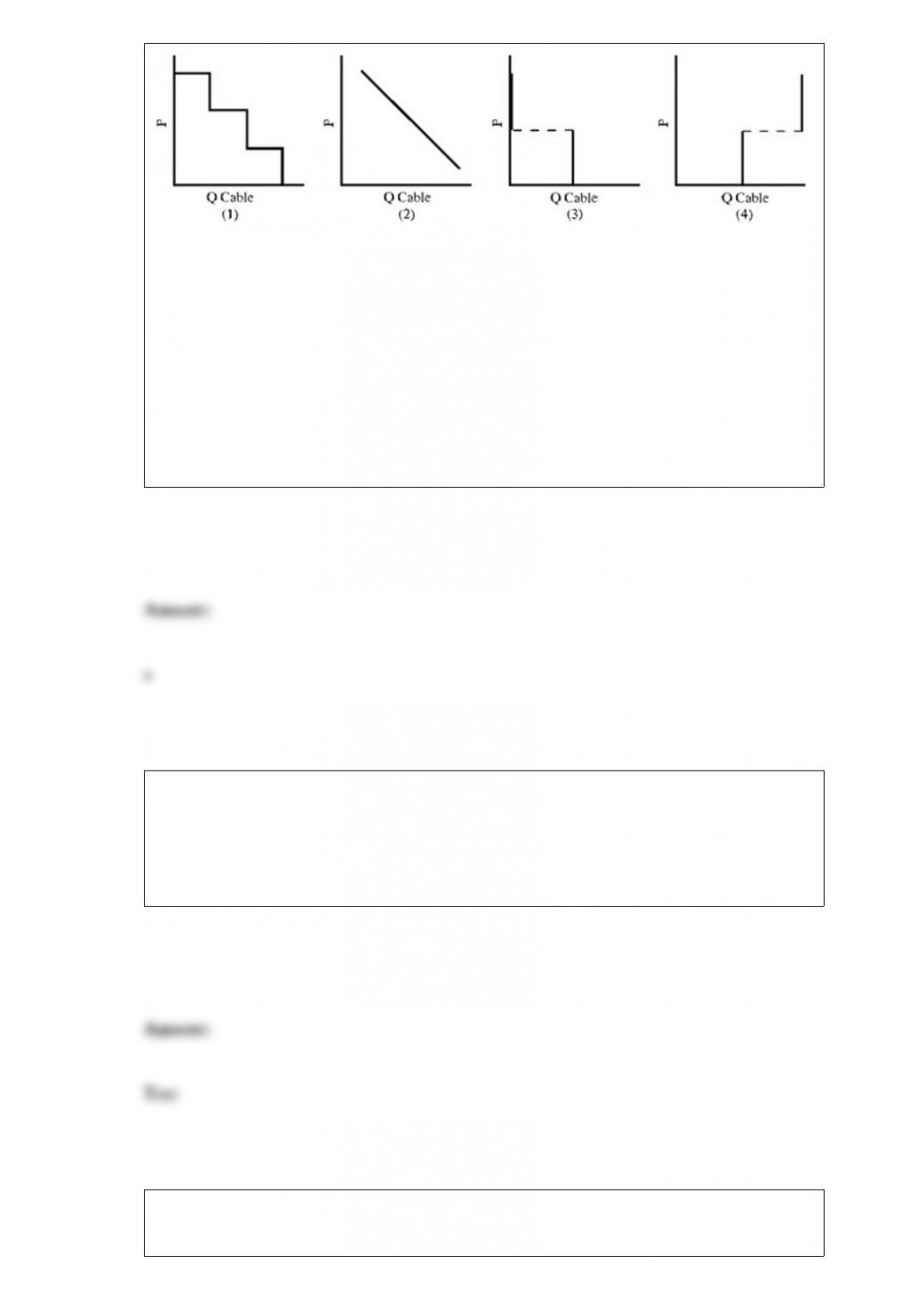
The purchase of premium cable channels is an “all or nothing” choice. Which graph in
Figure 6-6 best illustrates the cable market demand curve?
a. 1
b. 2
c. 3
d. 4
Stagflation is the simultaneous occurrence of inflation and high unemployment.
a. True
b. False
Individuals live and work in both individual and aggregate economic entities.

a. True
b. False
An increase in the interest rate causes the MRP of a resource to fall.
a. True
b. False
Firms need to know the shape of a demand curve to use marginal analysis.
a. True
b. False

Which requirement for perfect competition rules out trade associations or other
collusive arrangements in which firms work together to influence price?
a. Freedom of entry and exit.
b. Homogeneity of product.
c. Perfect information.
d. Numerous small firms and customers.
The worst and most difficult to extract resources are used first.
a. True
b. False
The expected effects of an increased budget deficit are
a. higher real interest rates.
b. exchange rate depreciation.
c. lower inflation.
d. All of the above are correct.

Most entrepreneurs are self-employed.
a. True
b. False
Interest rate increases lead to currency appreciation and increases in net exports.
a. True
b. False
The most efficient market structure in the long run is
a. perfect competition.

b. monopolistic competition.
c. oligopoly.
d. monopoly.
In 2010, the net national debt was about $9 trillion or approximately $29,000 per
person.
a. True
b. False
Briefly and concisely define the following terms:
a. fiscal federalism
b. horizontal equity
c. vertical equity
d. benefits principle of taxation

Comparing the United States to other economies, the United States is one of the ____
economy in the world.
a. most government-supervised
b. most privatized
c. most government-owned
d. least privatized
During the 2009-2010 debate on the stimulus package, democrats argued primarily for
increased government spending. What effect would this have on the value of the
multiplier?

a. It would decrease the value of the multiplier.
b. It would have no effect on the multiplier.
c. It would increase the value of the multiplier.
d. The effect is uncertain.
Resource prices are fixed for some period of time because
a. some workers enter into long-term contracts.
b. firms purchase raw materials on set-price contracts.
c. many workers get pay increases only once a year.
d. All of the above are correct.
What is true for monopoly that is not true for perfect competition?
a. The industry demand curve is downward sloping.
b. Profit is maximized where MR = MC.
c. The firm and the industry are exactly the same entity.

d. Positive economic profits may be earned in the short run.
Assume that the MPC is 0.80 and investment rises by $50 million. How much
additional saving will this generate in the second round of spending?
a. $10 million
b. $40 million
c. $50 million
d. $62.5 million
e. $250 million
Joe and Ed go to a diner that sells hamburgers for $5 and hot dogs for $3. They agree to
split the lunch bill evenly. Ed chooses a hot dog. The marginal cost to Joe then of
ordering a hamburger instead of a hot dog is
a. $1.
b. $2.
c. $2.50.
d. $3.

What determines the productivity growth rates of a country?
a. Amount of working capital currently available.
b. Rates of increase of capital, technology, and workforce quality
c. Current level of gross domestic product.
d. Current levels of human capital, physical capital, and technology.
In the long run, a profit-maximizing monopolist
a. earns zero economic profit.
b. produces the same amount as a perfectly competitive industry.
c. receives a higher price for his output than a perfectly competitive firm.
d. produces at the output level that minimizes his long-run average total cost.
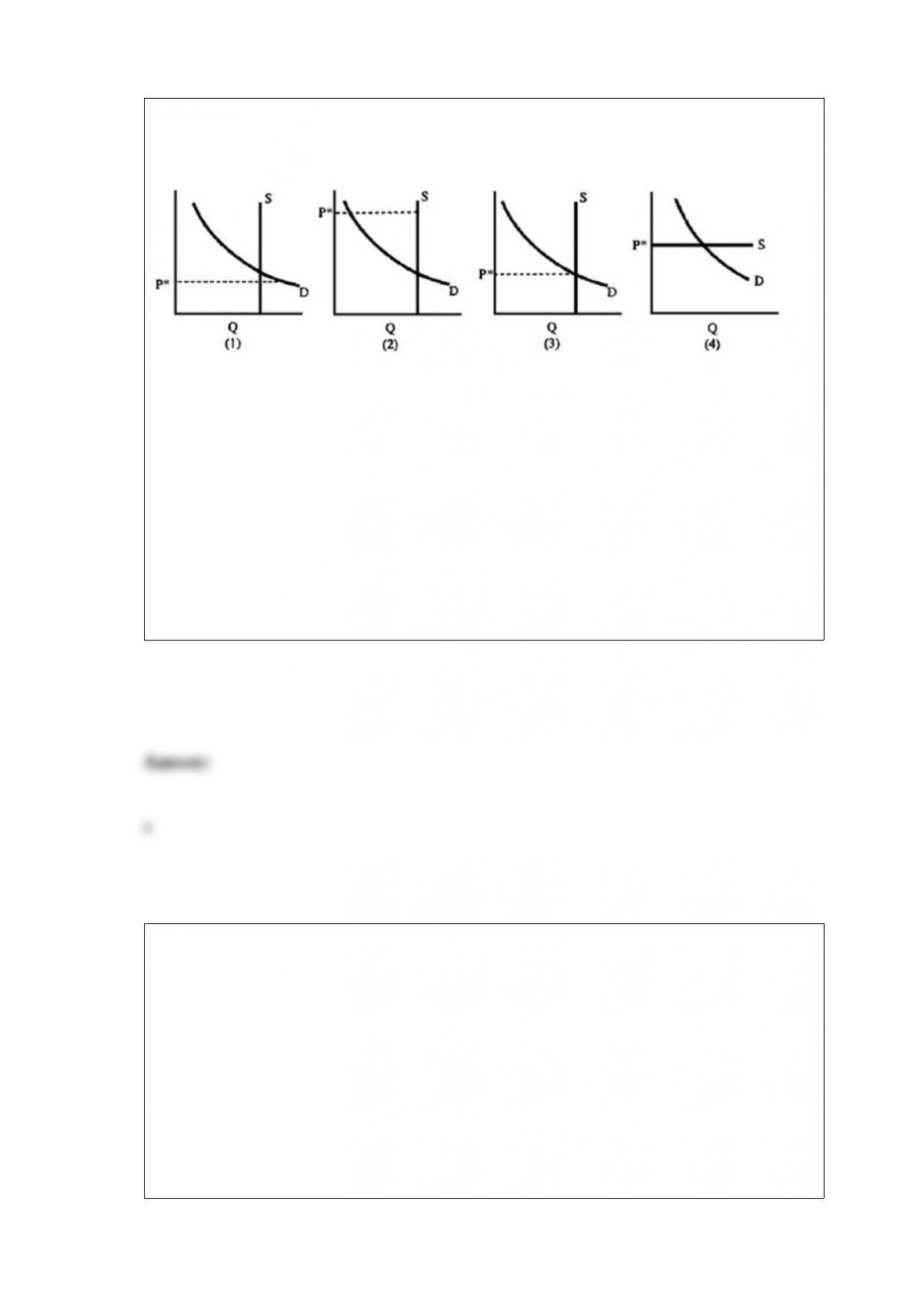
Figure 4-20
The presence of scalpers (people selling tickets at a price above the quoted price, P*) at
a recent Super Bowl game suggests that the market for stadium seats could be
represented by which graph in Figure 4-20?
a. 1
b. 2
c. 3
d. 4
Affirmative action programs,
a. according to critics, are clearly quota systems that lead to reverse discrimination.
b. according to supporters, make efforts to find qualified minorities and women and hire
them.
c. according to critics, clearly lead to the hiring of unqualified people and thus reduce
efficiency.
d. All of the above are true.