
Governments in market economies usually have significant control over
a. investment spending.
b. personal consumption spending.
c. import spending.
d. education spending.
You are a collector of antique coins. You purchase a silver dollar minted in 1898. Is this
sale included in GDP for the current year?
a. Yes, provided the coin is in mint condition.
b. No, it is not.
c. No, unless the coin has been in circulation.
d. Yes, it is.
e. Only if it is part of the current money supply.
Among the factors that might lead to a divergence from the path of prices for a
depletable resource predicted by the economic models are: (i) unexpected discoveries of
new reserves; (ii) new technologies which reduce extraction costs.

a. i and ii
b. i but not ii
c. ii but not i
d. neither i nor ii
If a decision maker uses marginal analysis, then the relevant costs are the
a. full costs of a particular activity or product.
b. fixed costs which do not vary with the extra activity or output.
c. profits obtained on the activity or product.
d. average costs for a particular activity or product.
e. additional costs of a particular activity or product.
Figure 10-5
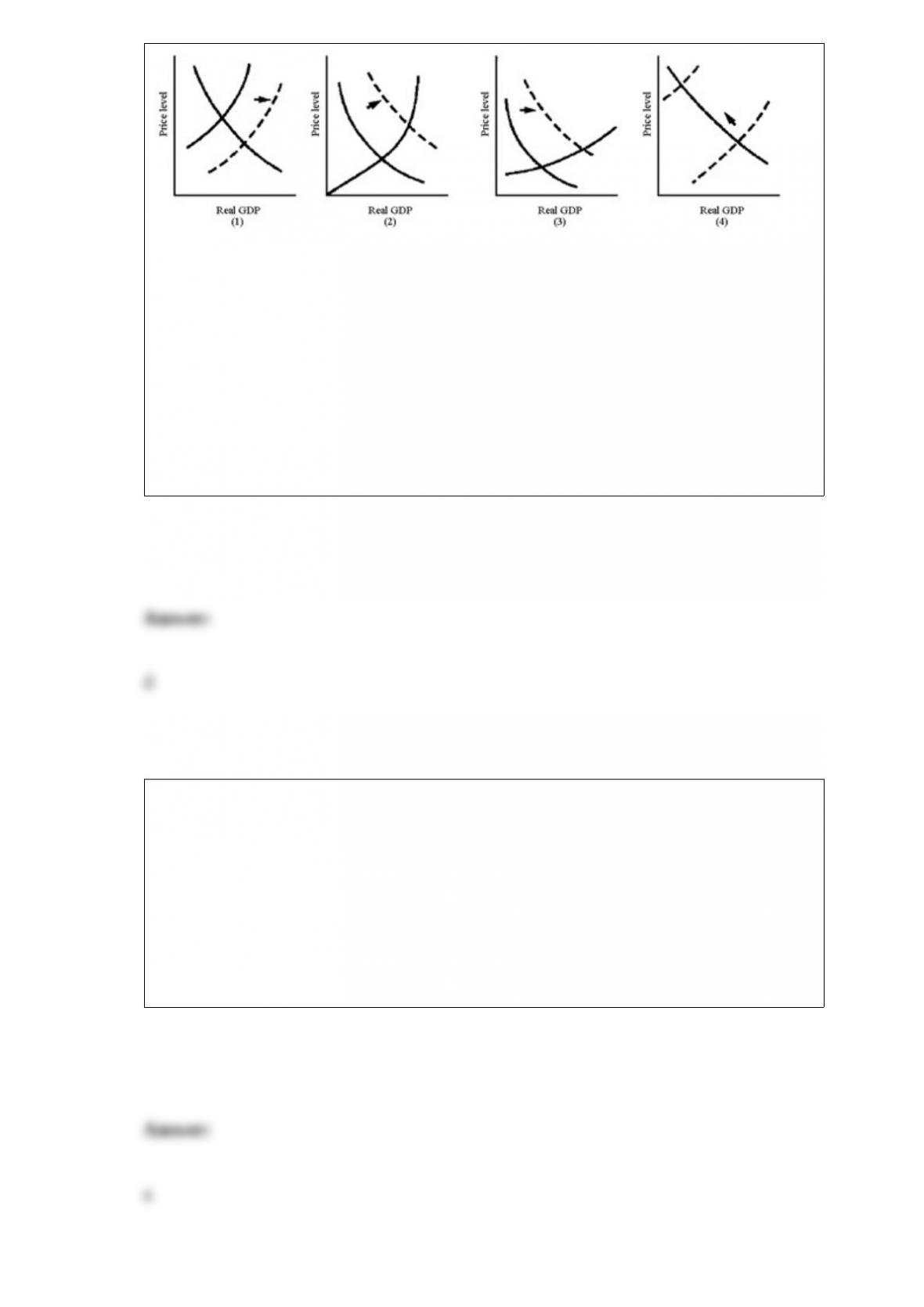
In Figure 10-5, which graph best illustrates the situation of an economy reacting to an
inflationary gap through an increase in wage levels?
a. (1)
b. (2)
c. (3)
d. (4)
The money multiplier yielded by the deposit creation formula assumes that
a. banks hold no excess reserves.
b. banks hold excess reserves.
c. recipients of loans take some of the proceeds in cash.
d. recipients of loans do not redeposit their funds in other banks.
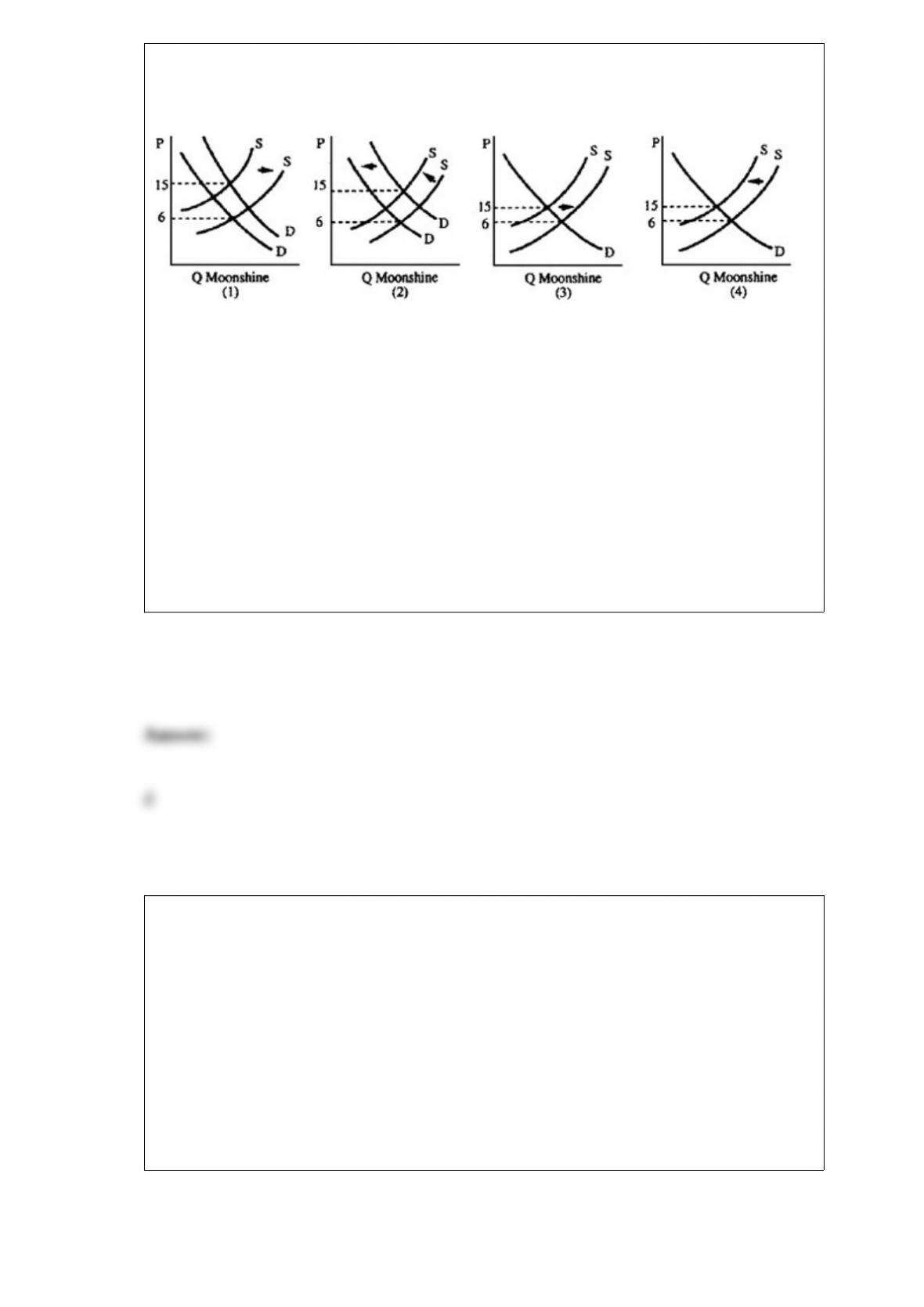
Figure 4-9
“Moonshine” is illegal home brew made by adding sugar to accelerate corn
fermentation. Ten pounds of sugar are necessary to make a gallon of moonshine. In the
mid-1970s, the price of sugar tripled and the price of moonshine skyrocketed from $6 to
$15 a gallon. Which graph in Figure 4-9 best illustrates this?
a. 1
b. 2
c. 3
d. 4
Economics is a social science rather than a “hard” science like physics because
a. economists abstract from reality when creating their theories.
b. economics is easier to study than physics.
c. economists must explain their theories to policy makers who lack formal
mathematical training.
d. economists study human behavior, which is affected by an unpredictable and vast
range of influences.

A Japanese recession will be counteracted by an appreciation of the Japanese yen.
a. True
b. False
Once the expenditure schedule has been adjusted for tax levels, the determination of
equilibrium GDP
a. is no longer possible.
b. becomes much more difficult.
c. proceeds exactly as before.
d. requires a higher multiplier value.
Variable costs increase when output rises.

a. True
b. False
In the long run,
a. all of the firm’s input quantities are variable.
b. the firm can vary the quantities of some but not all inputs.
c. managers become less efficient.
d. the total cost of producing any given level of output is greater than or equal to the
short-run total cost of producing that level of output.
One of the factors causing the shrinking gap between rich and poor countries is
a. learning by poor countries.
b. increasing resource discoveries.
c. increasing populations in poor countries.
d. transfers of income from rich countries.

Economists use the mechanism of supply and demand to study:
a. inflation
b. unemployment
c. environmental protection
d. both a and b
e. all of these
If the marginal physical product of more labor is twice as high as the marginal physical
product of more machinery, a rational firm should
a. reduce the labor used and increase the machinery used if labor costs half as much as
machinery.
b. reduce the labor used and increase the machinery used if labor and machinery cost
the same amount.
c. reduce the labor used and increase the machinery used only if labor costs more than
twice as much as machinery.
d. reduce the labor used and increase the machinery used only if labor costs exactly
twice as much as machinery.

Systemic risks are most likely to exist with regard to
a. small governments.
b. large governments.
c. small financial institutions.
d. large financial institutions.
Along a supply curve,
a. supply changes as price changes.
b. quantity supplied changes as price changes.
c. supply changes as technology changes.
d. quantity supplied changes as technology changes.

It is true of externalities that they
a. are always detrimental.
b. are always beneficial.
c. arise when all costs, social and private, are included in production cost.
d. cause the price system to misallocate resources.
One effect of speculators is to iron out price fluctuations because this is the way they
make their profits.
a. True
b. False
The Phillips curve shows the relationship between
a. the rate of inflation and the rate of unemployment.
b. the rate of growth of real GDP and the rate of unemployment.
c. real prices and real GDP.
d. the rate of inflation and the rate of growth of real GDP.

Production planning without the market mechanism is very efficiently handled by
central planners.
a. True
b. False
____ has(have) traditionally been the chief instrument of environmental policy in the
United States.
a. Taxes on pollution
b. Voluntary compliance
c. Tradable emissions permits
d. Direct controls

In the long run, a perfectly competitive firm maximizes profit so P = MC = AC.
a. True
b. False
The aggregate supply curve is
a. generally flatter as the level of resource use rises.
b. never vertical, even at full employment.
c. relatively flat at low levels of output.
d. relatively steep at low levels of output.
When marginal cost exceeds marginal revenue,
a. marginal profit < 0.
b. the firm should increase output.
c. marginal profit + marginal cost > marginal revenue.
d. marginal cost < marginal revenue − marginal profit.

Why do airlines tend to lower ticket prices in the winter?
a. Supply is relatively variable, and a drop in demand lowers equilibrium price.
b. Demand is relatively variable, and a drop in supply lowers equilibrium price.
c. A drop in both supply and demand lowers equilibrium price.
d. Supply is relatively fixed, and a drop in demand lowers equilibrium price.
e. Demand is relatively fixed, and a drop in supply lowers equilibrium price.
Price supports increase the supply of affordable milk for U.S. families.
a. True
b. False

If the prices of inputs changes, what will happen to the aggregate supply curve?
a. It does not move but the economy moves along the curve.
b. It depends on whether the input prices rise or fall.
c. The curve will become flatter or steeper depending on whether the input prices rise or
fall.
d. It shifts inward or outward depending on whether the input prices rise or fall.
Briefly and concisely define the following terms and explain their relevance to the
study of economics.
a. industrial and craft unions
b. closed shop
c. union shop
d. bilateral monopoly
e. collective-bargaining agreement
There is an exchange rate between
a. every pair of currencies.
b. the world’s major currencies but not between the currencies of less-developed
countries.
c. currencies on a fixed-exchange rate system but not for those on a floating-rate
system.
d. the currencies of the European Union but not for the nations outside the European
Union.

A severe hurricane hits Florida, destroying large amounts of the citrus crop. What is the
most likely effect of this on aggregate supply?
a. It will be unchanged.
b. No effect, the economy will move along the curve to a higher price level.
c. No effect, the economy will move along the curve to a lower price level.
d. It will increase.
e. It will decrease.
One method for a deficit country to correct the situation under a fixed exchange rate
system is to
a. increase aggregate demand with stimulative monetary policy.
b. increase aggregate supply with tax cuts.
c. decrease aggregate demand with restrictive fiscal and monetary policy.
d. decrease aggregate supply with restrictive fiscal policy.
Waiting in line to get a free ticket does not involve any opportunity cost.
a. True

b. False
An expansionary fiscal policy makes the exchange rate appreciate.
a. True
b. False