
Economists are very good at explaining how individual markets work. Economists are
less successful at explaining
a. market pricing.
b. recessions and inflation.
c. central planning.
d. business firm profits.
The supply-demand mechanism will bring an international market into equilibrium
a. at a price below the domestic price.
b. where domestic supplies are less than domestic demand.
c. with one nation’s price higher than the other nation’s price.
d. when the quantity demanded for exports is equal to quantity supplied.
During the first year of the Bush administration in 2001, the American economy
a. increased its already rapid growth rate.
b. experienced high levels of inflation.

c. slowed in its rate of economic growth.
d. experienced a decrease in the rate of unemployment.
Which of the following is evidence of an inflationary gap?
a. very long lines at employment agencies
b. very short waiting times for product delivery
c. very low sales figures
d. very long search times for people looking for jobs
e. very low unemployment rates
The monetary return on a college education is considered economic rent.
a. True
b. False

Under the modern system of fractional reserve banking, banks
a. keep cash reserves equal to only a fraction of their deposit liabilities.
b. loan out their excess reserves at interest, which is the key to their profitability.
c. are always potentially vulnerable to runs.
d. All of the above are correct.
If the average cost of a product is $10 per unit and the price is $5, the firm is losing
money.
a. True
b. False
One of the consequences of allowing wages to fall in the United States has been
growing wage inequality.
a. True

b. False
William Safire argues that a unilateral free trade policy is a disaster if
a. the governments of the nations’ trading partners practice “helpfulism.”
b. infant industries are allowed to expire.
c. the national defense is endangered.
d. it hurts the poor.
The word “theory” means the same to the scientist as it does to the man on the street.
a. True
b. False

If a product constitutes a large portion of a consumer’s income, demand will be more
inelastic.
a. True
b. False
When variable A rises by 10 units, variable B rises by 15 units. The slope of the line
describing this relationship is
a. always 2/3.
b. either 2/3 or 1.5, depending on which variable goes on which axis of the graph.
c. either 1.5 or −1.5, depending on which variable goes on which axis.
d. always −1.5.
One reason that the Phillips curve “broke down” is that it
a. is unable to explain short-run movements in inflation and unemployment, but does a
better job of explaining long-run movements.
b. assumes a quick-acting self-correcting mechanism, and the economy has a very slow
self-correcting mechanism.

c. is a statistical relationship, and some of the points are not sustainable in the long run.
d. cannot explain demand-side inflation, and it collapsed when demand-side inflation
was predominant in the 1970s.
An efficient allocation of resources requires that a product’s price equal its average cost.
a. True
b. False
The main input into the production of Starbuck’s coffee is imported coffee beans. If the
dollar depreciates, how will this affect the U.S. retail coffee market?
a. Input prices will fall and supply will decrease.
b. Input prices will fall and supply will increase.
c. Input prices will rise and supply will decrease.
d. Input prices will rise and supply will increase.

A tax system under which an individual pays a higher fraction of his income in taxes at
higher levels of income is formally described as
a. digressive.
b. progressive.
c. proportional.
d. regressive.
An individual who acquires a bond from a corporation
a. lends money to the corporation.
b. borrows money from the corporation.
c. buys part of the corporation.
d. promises to pay part of any debts of the corporation.

When price is above the equilibrium level, competitive price cutting will continue as
long as quantity supplied exceeds quantity demanded.
a. True
b. False
“Men are disposed, as a rule, and on the average, to increase their consumption as their
income increases, but not by as much as the increase in their incomes.” Which of the
following is consistent with this statement by J.M. Keynes?
a. The slope of the consumption function is positive and less than one.
b. The slope of the consumption function is greater than that of the 45-degree line.
c. The slope of the consumption function is negative.
d. The slope of the consumption function is equal to one.
Analysis indicates that the economy is in a recessionary gap. Which of the following is
the most appropriate policy mix in this situation?
a. a budget surplus and expansionary monetary policy
b. a budget deficit and expansionary monetary policy
c. a budget deficit and contractionary monetary policy

d. a budget surplus and contractionary monetary policy
The statement that “repaying our enormous national debt will ruin the nation” is
a. true, because taxes will have to go up by such large amounts that American citizens
will have very little income to live on.
b. true, because most of our national debt is owed to foreigners.
c. false, because the government will take emergency measures to prevent national
bankruptcy.
d. false, because each time the principal on the debt comes due, the U.S. Treasury rolls
it over by issuing more debt.
If demand is unit elastic, then a 10 percent increase in price will lead to a 10 percent
drop in quantity demanded.
a. True
b. False

Which of the following is an example of active fiscal policy?
a. Income tax revenues rise in an inflationary period.
b. Income tax revenues fall in a recession.
c. Congress passes a major tax increase in an inflationary period.
d. Unemployment benefits increase in a recession.
Generally, most of the world’s industrial countries believe that central banks should be
independent of their governments.
a. True
b. False
Price ceilings will likely
a. result in the accumulation of surpluses.

b. increase the volume of transactions as we move along the demand curve.
c. increase production as producers respond to higher consumer demand at the low
ceiling price.
d. result in the development of black markets.
Which of the following countries would find it easiest to achieve rapid growth in per
capita GDP?
a. United States
b. United Kingdom
c. France
d. Mexico
Most American workers
a. are employed in the goods-producing sector.
b. are employed by government.
c. are employed in the service-producing sector.

d. are employed in the agricultural sector.
Some bank regulation limits the types of assets that banks may own. The intent of this
regulation is to
a. protect banks from competition.
b. provide banks with a minimum level of profits.
c. limit the level of bank profits.
d. maintain bank safety.
e. All of the above are correct.
Any event that causes either the demand curve or the supply curve to shift will also
change the equilibrium price and quantity.
a. True
b. False
The term “unit elasticity” is used to describe a situation in which a rise in price is
accompanied by
a. a fall in total expenditure.
b. a rise in total expenditure.
c. constant total expenditure.
d. a unit decrease in total expenditure.
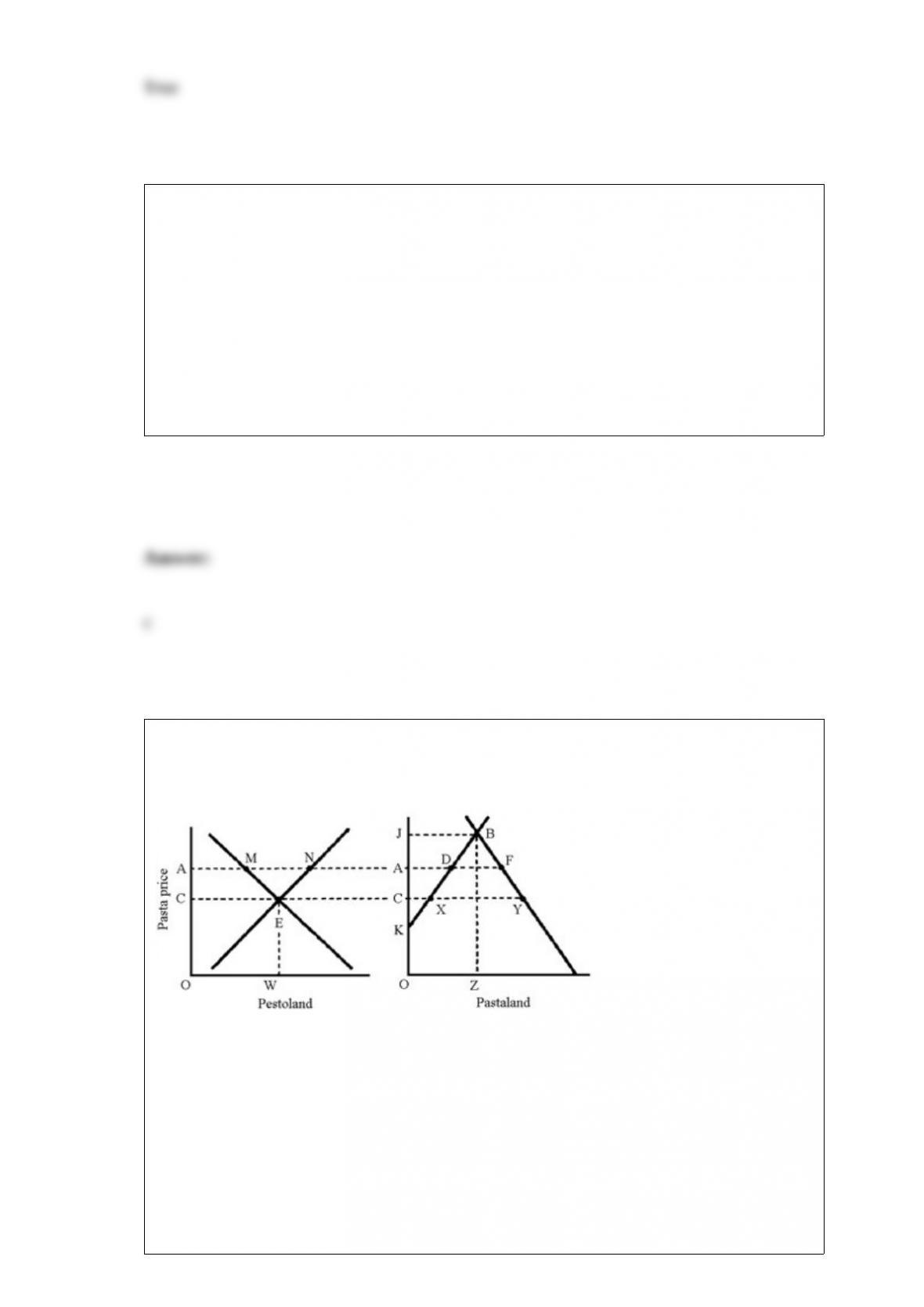
Figure 22-9
In Figure 22-9, Pestoland exports pasta to Pastaland. Equilibrium will occur when
a. points E and B are reached simultaneously.
b. either E or B is reached.
c. exports equal imports.
d. exports are maximized.

On necessities, more of the incidence of tax is
a. borne by the producer.
b. borne by the consumer.
c. shared equally between the producer and the consumer.
d. None of the above is correct.