
Table 7-1
In Table 7-1, the marginal physical product of labor after the addition of the fourth
worker is
a. 8.
b. 7.
c. 10.
d. 5.
A factor that would reduce the ability of the Social Security system to maintain current
benefit levels with constant tax rates is
a. rapid real wage growth.
b. reduced population growth.
c. adoption of a “pay as you go” system.
d. a slowdown in inflation.

All of the following observations concerning the elasticity formula are true except
a. the changes with which it deals is measured as a percentage change.
b. each of the percentage changes is calculated in terms of the average values.
c. the calculation considers both positive and negative signs.
d. each percentage change is taken as an “absolute value.”
Historically, the government has used fiscal policy to affect the economy through
a. central planning.
b. indicative planning.
c. aggregate demand.
d. aggregate supply.
A firm will shut down in the short run if

a. TR − TC > TFC.
b. TR + TC > TFC.
c. TC − TR > TFC.
d. TFC + TVC > TR.
The inflation rate in January of 2009 as measured by the CPI was zero. If inflation were
to remain at zero for a long period, what would be the effect on velocity?
a. It will decrease.
b. It will increase.
c. It will remain constant.
d. Velocity is unrelated to interest rates.
A theory can best be defined as
a. an untested assertion of untested fact.
b. a collection of assumptions that simplify the real world.
c. an opinion of a reliable person who studies a subject or discipline.

d. a deliberate simplification of factual relationships that attempts to explain how those
relationships work.
e. the body of knowledge that has been scientifically verified by the scientific
community.
A price level lower than equilibrium will cause quantity supplied to exceed quantity
demanded.
a. True
b. False
Are there impediments to international movement of labor and capital?
a. Yes, but they apply to labor only, capital mobility is almost completely free.
b. Yes, although these apply to capital, and not to labor.
c. Yes, there are significant (often prohibitive) restrictions on labor and capital mobility.
d. No, these have been removed with the passage of recent trade legislation.

A chart of the ratio of national debt to GDP from 1915 to 2014 would show
a. significant increases from 1945 to 1975.
b. significant increases during World Wars I and II.
c. a larger value in 1975 compared to 1945.
d. significant increases from 1995 to 2003.
The marginal productivity principle implies that
a. quantity demanded of an input normally declines as the input price falls.
b. at equilibrium, profit from the last unit of input will be zero.
c. for maximizing profit, marginal revenue product should be greater than price.
d. marginal productivity of inputs increase when price of inputs increase.

Direct cash grand programs are thought to be an example of an efficient redistribution
program.
a. True
b. False
Appreciation of the Japanese yen will lead to a significant balance of trade surplus.
a. True
b. False
The position of a demand curve is unaffected by changes in the price of the good.
a. True
b. False

The marginal productivity principle says that a profit-maximizing firm should
a. hire capital until its marginal product is zero.
b. hire labor until another worker costs more to hire than she can earn for the firm.
c. hire the quantities of capital and of labor at which their marginal products are equal.
d. hire capital until its marginal product is negative.
Economic fluctuations are defined as
a. alternating periods of significant GDP growth and decline.
b. events only encountered in developing countries.
c. periods of stable economic growth.
d. alternating periods of unemployment falling above and below zero.
In early 1996, Congress proposed an agriculture bill that would gradually reduce price
supports for many agricultural products. If the bill were to be approved, what would
most likely happen to the number of families employed in agriculture?
a. It would decrease, because agricultural prices would fall.

b. It would decrease, because agricultural prices would rise.
c. It would increase, because agricultural prices would fall.
d. It would increase, because agricultural prices would rise.
In 2008 and 2009, the budget deficit increased substantially because of
a. the weak economy.
b. extraordinary spending.
c. reduced tax receipts.
d. all of the above
If a country has a balance of payments deficit and wishes to maintain the fixed value of
its currency, it will generally
a. sell its own currency for foreign currencies.
b. buy its own currency with foreign reserves.
c. decrease taxes to increase domestic disposable income.
d. increase the money supply to keep interest rates down.

Most innovations come from just a few large industries.
a. True
b. False
“Plowback” is that portion of corporate profits used to
a. invest in future activities of the corporation.
b. advertise the company’s product.
c. buy back bonds (reduce debt).
d. pay owners for the use of their capital.

Taxes are the difference between
a. GDP and net exports.
b. GDP and consumer spending.
c. Consumer spending and saving.
d. GDP and disposable income.
Contractual provisions based on indexing are also called
a. withdrawal clauses.
b. swap clauses.
c. escalator clauses.
d. averaging clauses.
The ability of a government to fix its currency’s exchange rate is limited by the size of
its reserves.
a. True
b. False

Many economists believe that savings accounts should be added to M1 because they
a. are larger in size than conventional checking accounts.
b. pay larger interest than checking accounts.
c. can be transferred quickly into checkable accounts.
d. are also insured by the federal government.
A monopoly price reflects a good’s marginal utility.
a. True
b. False
For a given production possibilities frontier, which points are attainable?
a. points inside the frontier
b. points outside the frontier
c. points on or outside the frontier
d. points on the frontier only
e. points on or inside the frontier
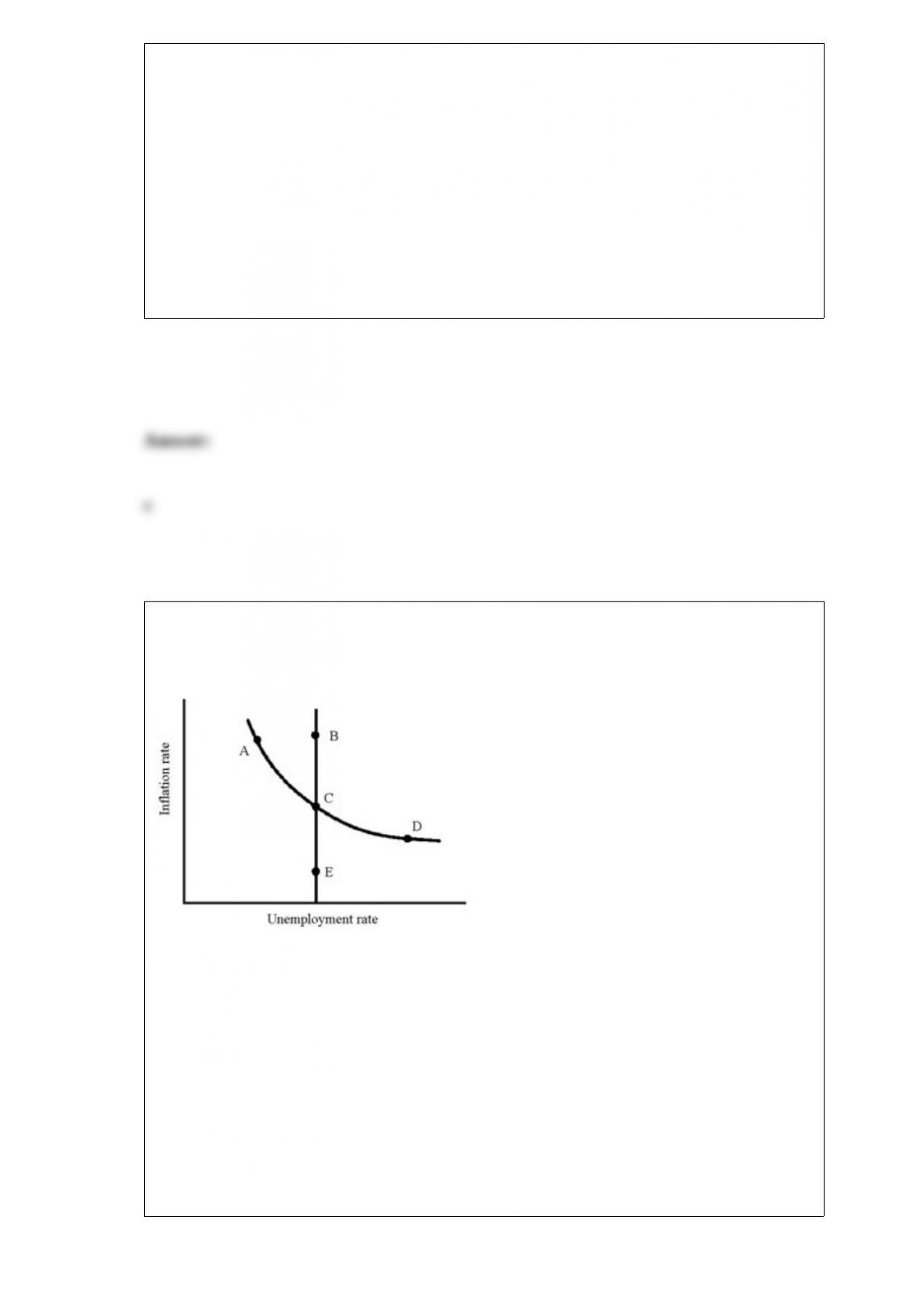
Figure 17-8
In Figure 17-8, which of the following movements illustrates the response of the
economy to a stimulation of aggregate demand when workers systematically
underpredict inflation?
a. C to A
b. C to B
c. C to D
d. C to E

Which of the following is not a factor that influences investment spending?
a. transfer payment policy
b. business confidence
c. business expectations
d. technical change
A person’s decision to supply a certain amount of labor in a week is simultaneously a
decision to consume a certain amount of leisure per week.
a. True
b. False