
Bankers’ business decisions effect the money supply because bankers
a. are respected men and women.
b. have the ability to create money.
c. use a special accounting system developed by the Federal Reserve Board.
d. All of the above are correct.
What would the Herfindahl-Hirschman Index equal for an industry consisting of 20
firms with each holding a 5% market share?
a. 20
b. 100
c. 500
d. 2,500
Which of the following is never true for a sales revenue maximizer with an
upward-sloping supply curve?
a. MR = 0
b. MR = MC

c. Economic profits are positive.
d. P = MC
In 1998, Japan decided to make the Bank of Japan, its central bank,
a. more independent.
b. more concerned with fighting inflation.
c. subject to direct control by the Japanese prime minister.
d. subject to direct control by the Diet, the Japanese parliament.
Which of the following can serve as an entry barrier?
a. legal restrictions
b. patents
c. control of scarce resources or inputs
d. All of the above are correct.

International trade usually benefits one trading partner while making the other trading
partner worse off.
a. True
b. False
America’s antitrust laws are used to protect competition against possible encroachment
by monopoly. This is an example of government as
a. regulator of businesses.
b. buyer of goods and services.
c. tax collector.
d. redistributor.

Death taxes, both state and federal, account for about _____ percent of total tax
revenue.
a. 1%
b. 2%
c. 3%
d. 10%
One nation can gain from an exchange only at the expense of another.
a. True
b. False
Part of the tremendous growth in China can be attributed to
a. loans received from the international financial bodies like World Bank, ADB.
b. FDI inflows and its ability to save and invest nearly half of its GDP.
c. financial aid received from foreign governments.
d. development assistance inflows from developed countries.
A tax reduction shifts the consumption schedule downward.
a. True
b. False
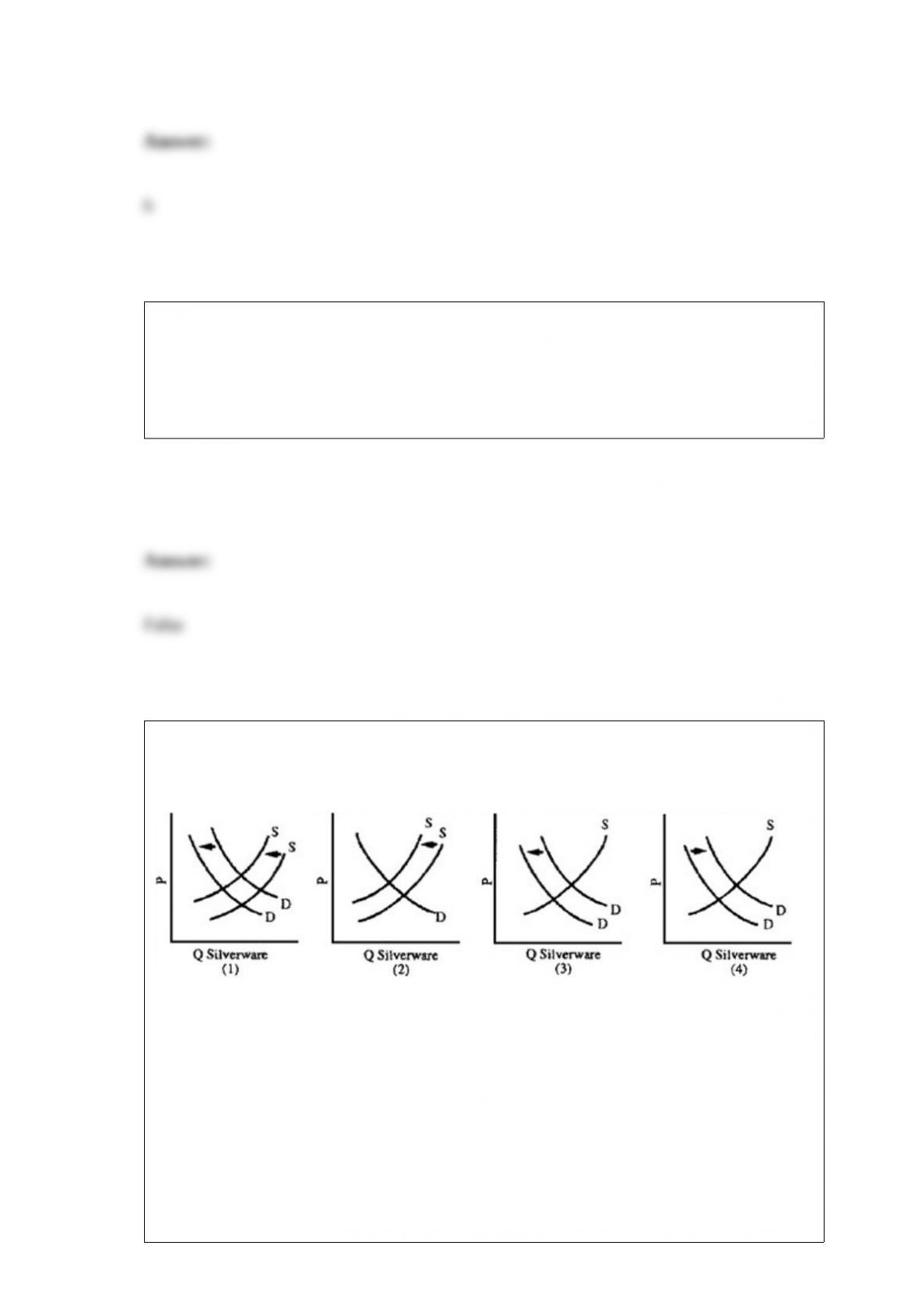
Figure 4-12
The silverware industry has been in serious decline since the 1980s. Family dining
habits are less formal so people purchase less silverware. Also, in 2006-2008, the price
of silver increased from $5 to $20 per ounce. Which graph in Figure 4-12 best
illustrates these developments?
a. 1
b. 2
c. 3

d. 4
The host at a party offers Justin a sixth beer. Justin says, “No thanks, man. The marginal
utility of that fifth beer was, like, 20 cents, but the marginal utility of the sixth would be
minus 10 cents.” If Justin consumes the sixth beer, his total utility will
a. rise by 10 cents.
b. reach a plateau and remain constant.
c. fall by 10 cents.
d. fall below his marginal utility.
The concept of opportunity cost is more applicable to society as a whole than it is for an
individual household.
a. True
b. False

Two of the three pillars of labor productivity growth responsible for the changes in the
United States after 1995 are technological change and
a. labor force improvement.
b. labor force growth.
c. capital formation.
d. consumption growth.
Does GDP for a particular year include items produced in a previous year?
a. Nominal GDP will not and real GDP will
b. Real GDP will and nominal GDP will not
c. Yes for both nominal and real GDP
d. No for both nominal and real GDP

Even though international trade is more complicated, supply and demand are still at the
center of the price determination mechanism.
a. True
b. False
Abstraction ignores many details in order to focus on the most important elements of a
problem.
a. True
b. False
Price increases always reduce economic efficiency.
a. True
b. False

A firm producing a smoke externality is producing
a. more than the socially optimal quantity of output.
b. less than the socially optimal quantity of output.
c. exactly the socially optimal quantity of output.
d. There is insufficient information to answer.
Is faster economic growth unambiguously better?
a. No, because growth has an opportunity cost.
b. No, because growth serves no useful purpose.
c. Yes, because more goods and services are always better.
d. Yes, because it expands the production possibilities of an economy.
e. Uncertain-economic growth has no answer to this question.
One disadvantage of the gold standard was that no nation had control of its domestic
monetary policies.
a. True
b. False
The government budget deficit must be equal to the surplus
a. of saving over investment.
b. in the current account in international trade.
c. of saving over consumption.
d. of saving over investment plus the trade deficit.
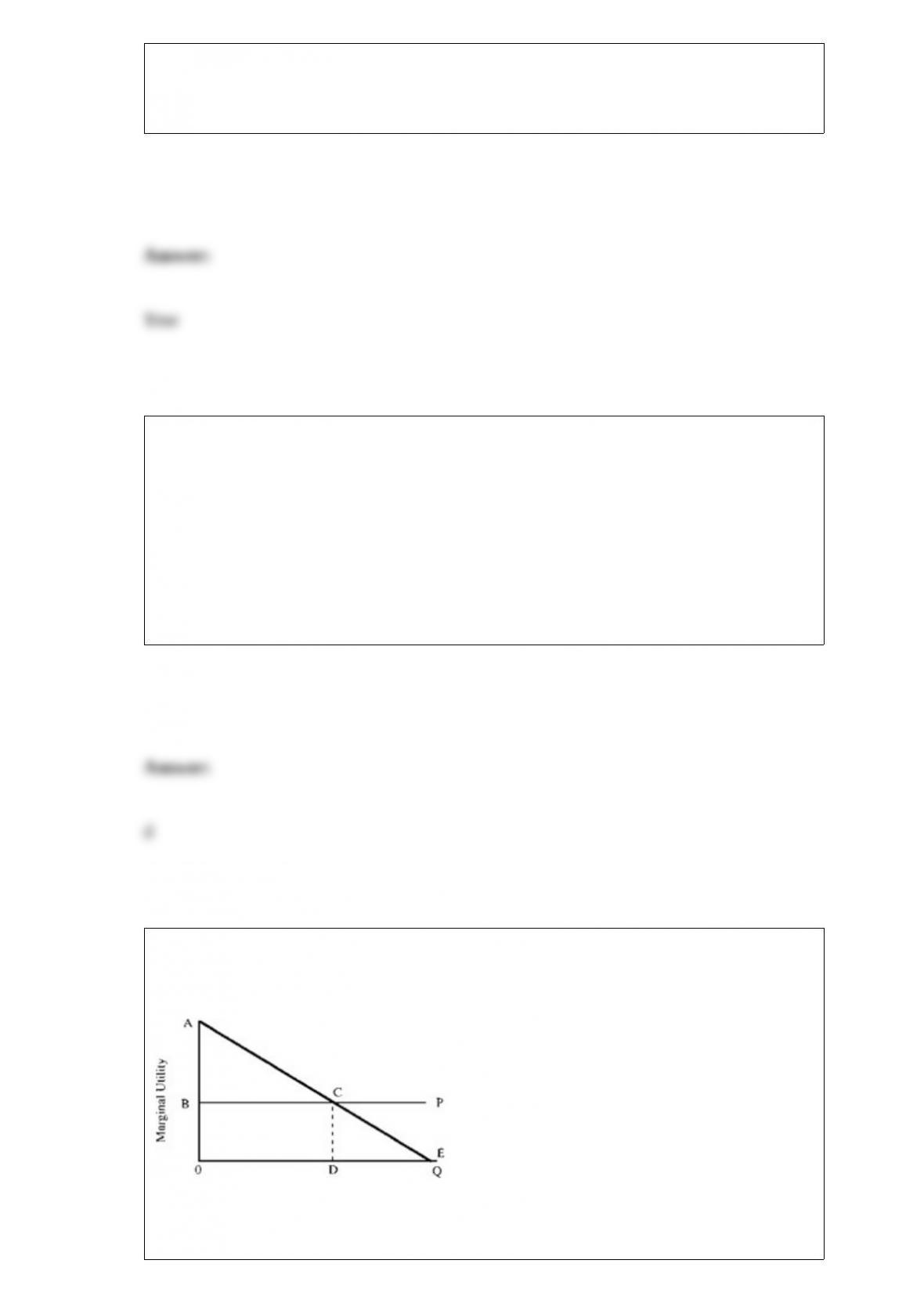
Figure 5-2
In Figure 5-2, consumer surplus is measured by the area

a. ABC.
b. OBCD.
c. OACD.
d. DCE.
In long-run equilibrium under perfect competition,
a. the firm and the industry will have the same cost curves.
b. only a very few firms will be earning economic profits.
c. the demand curves facing individual firms will fall to the level of minimum AC.
d. individual firms will tend to increase their outputs.
When will the difference between the actual deficit and the structural deficit be the
largest?
a. in an inflationary gap
b. at full employment
c. at potential real GDP

d. in a recession
Assume the demand schedule for cookies is downward sloping. If the price of cookies
falls from $1.50 to $1.25 per dozen,
a. the demand for cookies will fall.
b. the demand for cookies will rise.
c. a larger quantity of cookies will be demanded.
d. a smaller quantity of cookies will be demanded.
GDP consistently measures the output of goods and services in all countries.
a. True
b. False

The expected effect of the Bush tax cuts would be a(n)
a. lower real interest rate.
b. exchange rate depreciation.
c. increased current account deficit.
d. All of the above are correct.
Motorcycle helmet laws have been controversial in some states. Riders prefer the feel
of the wind on their faces. Others, however, point out that riders without helmets are
more likely to suffer severe injury and run up hospital bills at public expense. Which of
the following would most likely reduce the incidence of high bills for helmetless riders?
a. raise insurance rates for helmetless riders
b. lower insurance rates for helmetless riders
c. publish information on injury rates for helmetless riders
d. subsidize hospitals
Because of the owner’s prejudice, a firm chooses to discriminate against hiring Oriental
workers. Compared to an otherwise identical nondiscriminating firm hiring in the same

competitive market, the discriminating firm will have
a. higher costs.
b. lower profits.
c. a lower quantity of labor supplied at every wage.
d. All of the above are correct.
Marginal utility is measured by the maximum amount of money a consumer is willing
to pay for one more unit of a commodity.
a. True
b. False
How sensitive is the structural deficit to the state of the economy?
a. It is insensitive to the state of the economy.
b. The structural deficit changes cyclically with the economy.
c. Changes in the structural deficit trigger opposite swings in the economy.
d. The structural deficit changes countercyclically with the economy.

The threat of confiscated private property diminishes the incentive to invest.
a. True
b. False
In 2009, the Social Security System ran a surplus of approximately $137 billion.
a. True
b. False