
Reductions in the personal income tax, often advocated by supply-siders to increase
labor supply and effort, can be expected to also
a. decrease consumption spending.
b. increase consumption spending.
c. decrease investment spending.
d. increase export sales.
If the fluctuations in the economy’s real growth rate from year to year are caused
primarily by variations in the rate at which aggregate demand increases, then data
would show the
a. worst recession occurs when output expands most rapidly.
b. slowest inflation occurs when output expands most rapidly.
c. slowest economic growth occurs when output grows most rapidly.
d. most rapid inflation occurs when output expands most rapidly.
In the negative income tax plan, a guarantee of $5,000 and a tax rate of 50 percent
imply a break-even income of which of the following figures?
a. $1,000

b. $2,500
c. $10,000
d. $12,500
The government should not attempt to balance the budget if
a. the economy is in a recessionary gap.
b. actual GDP is below full-employment GDP.
c. unemployment is rising.
d. All of the above are correct.
Workforce explanations of the productivity changes in the 1973-1995 period include
a. rising SAT scores.
b. declining SAT scores.
c. rising educational attainment.
d. falling levels of average educational attainment.

If the price of garbage removal rises, people will
a. demand a lesser quantity of garbage removal.
b. take more waste to recycling centers.
c. repair broken items rather than throwing them out.
d. All of the above are correct.
Total revenue is equal to quantity multiplied by average revenue.
a. True
b. False

Normally an increase in the supply of a good will cause
a. a shift of consumer preferences in favor of that good.
b. consumers to use more of that good and less of others.
c. a shift of consumer preferences away from that good.
d. consumers to use less of that good and more of others.
If Japanese tourists visit Yellowstone Park, what is the effect in the foreign exchange
market?
a. It will increase demand for U.S. dollars.
b. It will decrease demand for U.S. dollars.
c. It will increase supply of U.S. dollars.
d. It will decrease supply of U.S. dollars.
In terms of the competing claims of equality and efficiency, in the United States we
have
a. chosen greater wage inequality for lower unemployment.
b. chosen higher unemployment for less wage inequality.

c. both greater wage inequality and higher unemployment.
d. not faced a trade-off between wage inequality and unemployment.
e. been able to choose both less wage inequality and lower unemployment.
Economists and psychologists are often on opposite sides of the economic growth
debate. The nature of the debate is such that
a. economists emphasize the benefits of growth to finance valuable programs, and
psychologists question whether more goods make people happier.
b. economists emphasize that more money means more income for the government, and
psychologists believe poorer people are happier.
c. economists believe that economic growth imposes no serious costs on the economy,
and psychologists question the statistical reliability of GDP numbers.
d. economists stress the importance of money relative to leisure, and psychologists
stress the importance of an unstructured life.
The recessionary gap is the
a. amount of unemployment compensation required during a recession.
b. budget deficit encountered during a recession.
c. amount of government spending needed to end a recession.
d. distance between the equilibrium level of output and the full employment level of
output.
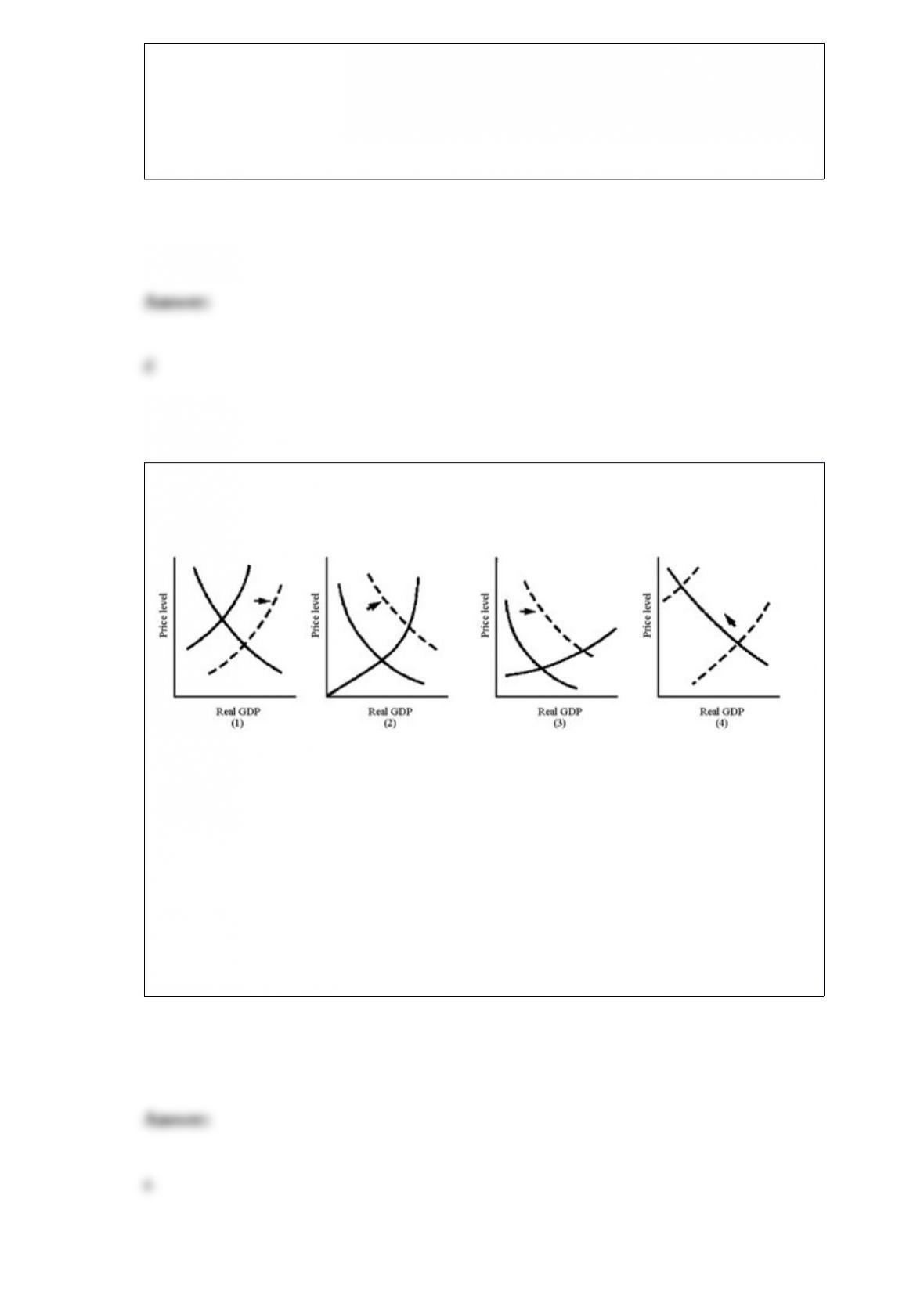
Figure 10-5
In Figure 10-5, which graph best illustrates the situation of an economy reacting to a
recessionary gap by reducing resource cost levels?
a. (1)
b. (2)
c. (3)
d. (4)

In the early 1990s, economists became alarmed over the national debt because it
a. was larger than three months’ GDP.
b. was growing faster than GDP.
c. had reached twice the size of GDP.
d. was growing faster than private debt.
Attempts by the government to reduce the rate of inflation often result in higher
unemployment in the short run.
a. True
b. False
The basic reason for the multiplier effect is that, when you spend money,
a. another person receives income.
b. another person must pay for it.
c. your money balances are reduced.
d. your net worth decreases.
Annual incomes of James, Jack, and Stanley are $30,000, $50,000, and $80,000 and
their tax rates are 10%, 20%, and 30% respectively. Which tax structure is this an
example of?
a. Proportional tax
b. Progressive tax
c. Regressive tax
d. Digressive tax
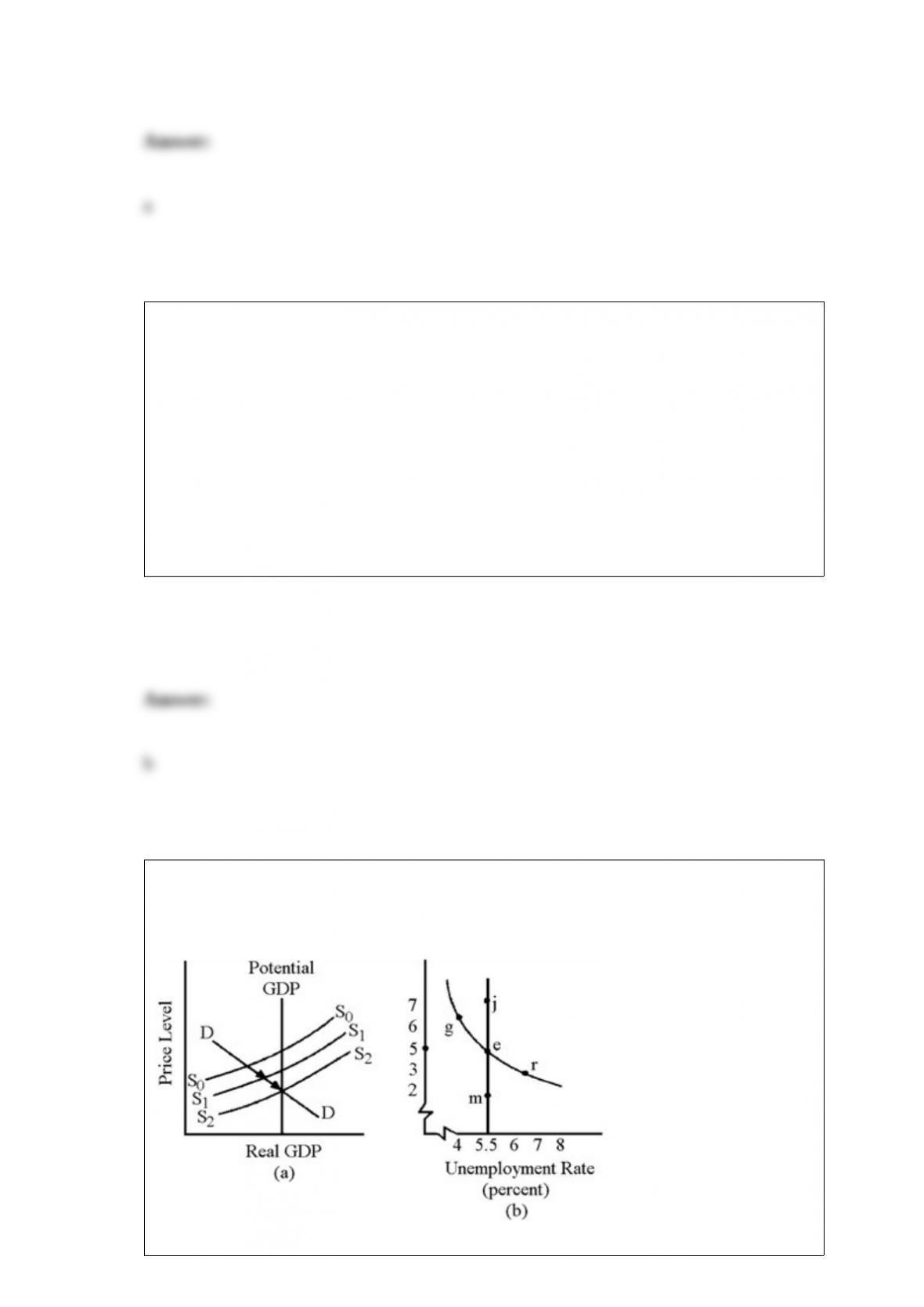
Figure 17-6

The short-run Phillips curve in Figure 17-6 would include which of the following
points?
a. g, e, m
b. g, e, r
c. j, e, r
d. j, e, m
If two families are identical with respect to size, income, general expenses, etc., and are
taxed equally, we say that there is
a. horizontal equity.
b. vertical equity.
c. observance of the ability-to-pay principle.
d. intergenerational equity.
Which of the following conditions distinguishes the monopolistic competitor from the
monopolist?
a. profit-maximizing rule

b. downward slope of demand curve
c. entry of rivals
d. short-run economic profits
Pure monopoly markets are very common in the real world.
a. True
b. False
Speculators play an important role in a system of floating exchange rates because
a. to make a profit, they must buy a currency when its value is low and sell it when its
value is high.
b. their purchases and sales lead to wild gyrations in exchange rates and thus increase
instability.
c. they place additional risks on businesses that need to purchase and sell foreign
currency.
d. All of the above are correct.
Money is scarce, but resources are not.
a. True
b. False
An economic boom in one country usually causes a recession in other countries.
a. True
b. False
Figure 10-3
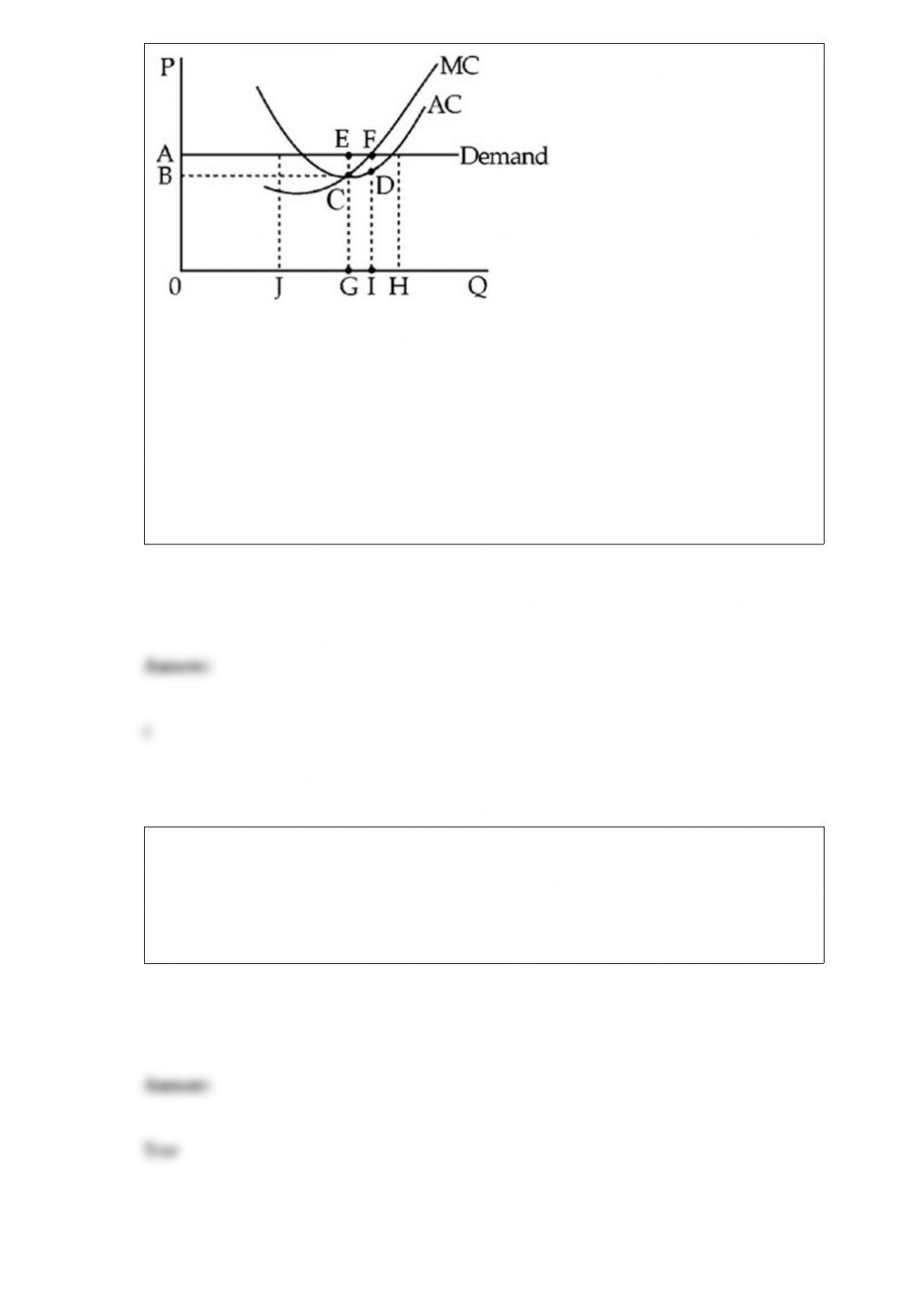
In Figure 10-3, the profit maximizing firm will operate at a level of
a. OJ.
b. OG.
c. OI.
d. OH.
The principle of comparative advantage helps explain trade between nations.
a. True
b. False
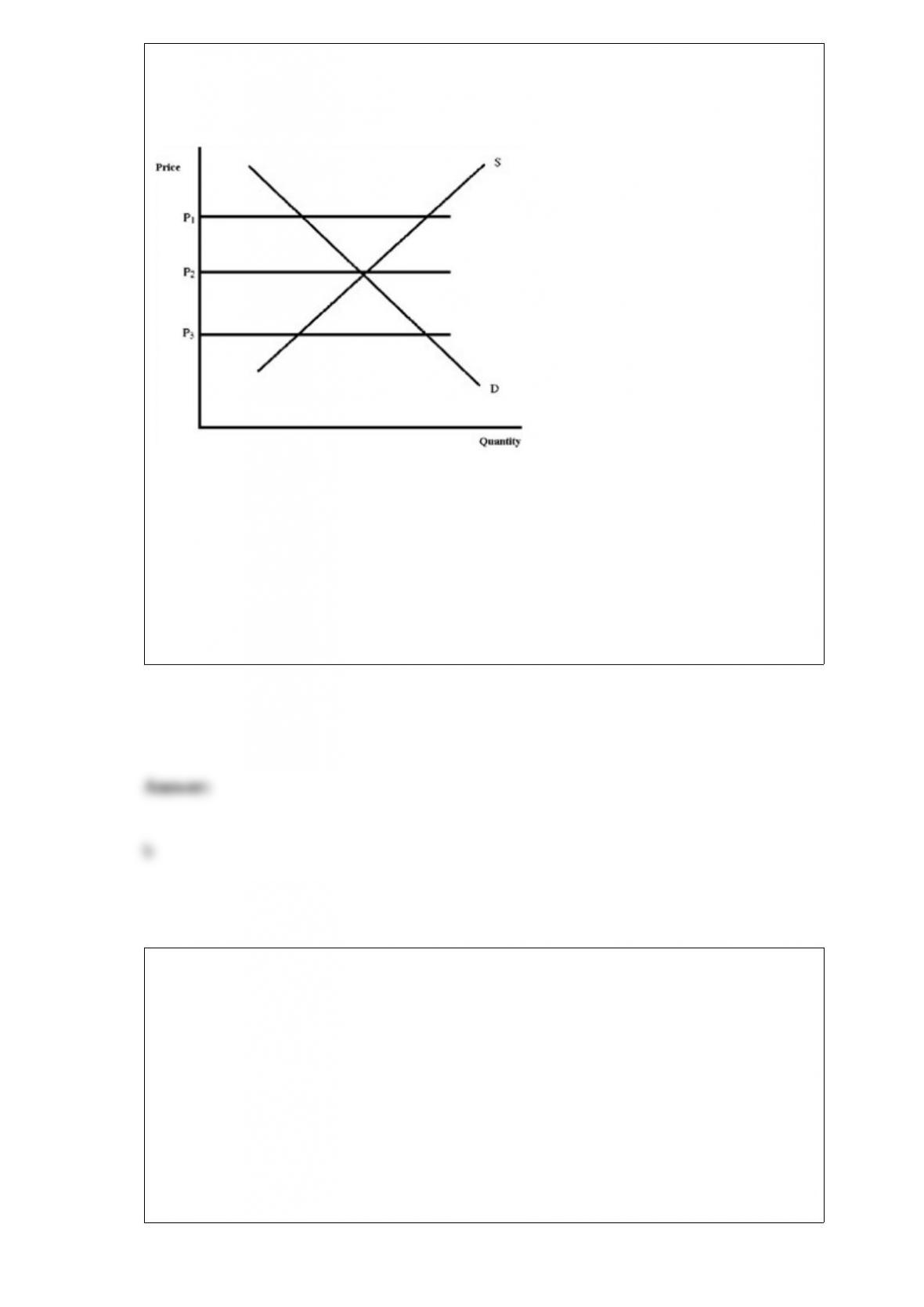
Figure 4-21
Which price in Figure 4-21 is equilibrium?
a. P1
b. P2
c. P3
The Bretton Woods agreements
a. established a system of fixed exchange rates based on the free convertibility of the
U.S. dollar into gold.
b. established a system of fixed exchange rates based on the gold standard.
c. permitted countries with a balance of payments deficit to make regular devaluations
of their currencies.
d. established GATT to police and manage exchange rates.
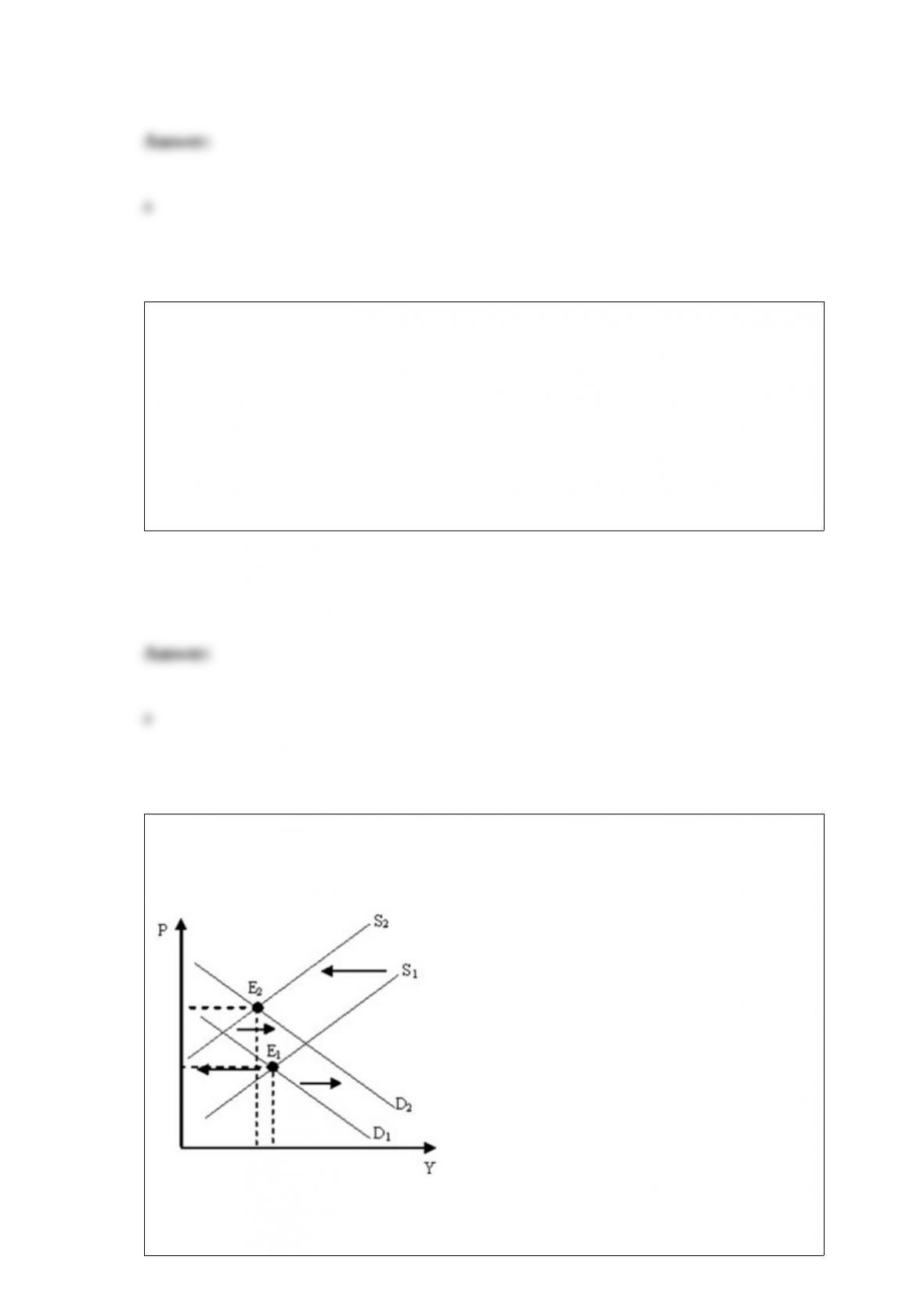
If the price level decreases, what will happen to the level of real GDP supplied?
a. It will usually decrease.
b. It will usually increase.
c. Nothing.
d. It will decrease at first and then increase.
Figure 10-8
Figure 10-8 illustrates a period of

a. low unemployment and high inflation.
b. low unemployment and low inflation.
c. high unemployment and high inflation.
d. high unemployment and low inflation.
Since a union represents individuals rather than firms, it cannot be considered a
monopoly.
a. True
b. False
Technically, the Federal Reserve district banks are corporations whose stockholders are
the
a. state governments in each district.
b. citizens of the United States.
c. Departments of Treasury and Commerce.
d. member banks.

The current role of the International Monetary Fund is one of
a. supervising a system of fixed exchange rates.
b. providing assistance to countries with currency or debt problems.
c. setting exchange rates based on a gold exchange standard.
d. acting as a lender of last resort to central banks.
Demand is said to be elastic when percentage changes in quantity demanded are
a. less than the percentage changes in price.
b. higher than the percentage changes in price.
c. equal to the percentage changes in price.
d. zero when price changes.

If aggregate demand shifts outward, the result will be inflation.
a. True
b. False