
If workers expect inflation, and negotiate wage increases that exactly match price
increases, the result is a
a. horizontal aggregate supply curve at the level of potential GDP.
b. vertical aggregate supply curve at the level of potential GDP.
c. horizontal aggregate demand curve at the level of potential GDP.
d. vertical aggregate demand curve at the level of potential GDP.
There is now general agreement among economists regarding the sources of the U.S.
productivity slowdown that occurred between 1973 and 1995.
a. True
b. False
The Fed and the government are working against each other if, as the government cuts
taxes to promote economic growth, the Fed
a. sells government securities.
b. buys government securities.
c. lowers the discount rate.

d. lowers the prime rate.
The narrowest definition of the money supply, including cash and checking deposits, is
known as
a. M0.
b. M1.
c. M payments.
d. currency.
e. real-value money.
Trish grows oregano in her backyard to use in her homemade pesto sauce. How is this
gardening included in GDP?
a. It is included in real GDP.
b. It is included in nominal GDP.
c. It is not included in GDP.
d. It is included as an intermediate good.

A “near money” is an asset that can be
a. indistinguishable from commodity money.
b. spent easily.
c. a close substitute for money.
d. only issued by a bank.
During the financial crisis of 2007-2009, the U.S. government determined that
a. AIG was too big to fail but Lehman Brothers was not.
b. Lehman Brothers was too big to fail but AIG was not.
c. both Lehman Brothers and AIG were too big to fail.
d. neither Lehman Brothers nor AIG were too big to fail.

Poverty and inequality in the U.S. are well below the OECD average.
a. True
b. False
The second largest source of income for the federal budget is:
a. personal income taxes.
b. corporate income taxes.
c. payroll taxes.
d. inheritance taxes.
When banking first began, it could be said that paper money was in reality
a. worthless.
b. receipts.
c. government money.
d. fiat money.

If all large firms in the economy were broken into smaller firms, the result might be
a. decreased manufacturing efficiency in some industries.
b. increased prices for some manufactured goods.
c. decreased investment in research and development in some industries.
d. All of the above are correct.
If businesses spend an additional $150 billion for investment projects in 2010, what will
be the impact on national income (Y) if the multiplier is 2?
a. Y will increase by $50 billion.
b. Y will increase by $150 billion.
c. Y will increase by $300 billion.
d. Y will increase by $450 billion.

In order to maintain a balanced budget, Congress has decided to cut taxes and
government spending both by $25 billion. What will happen to GDP?
a. It will increase.
b. It will remain the same.
c. It will decrease.
d. It’s impossible to know without the multiplier.
The initial stage of the procedure in which a union and an employer negotiate over a
contract is known as
a. featherbedding.
b. collective bargaining.
c. mediation.
d. arbitration.
In a market economy, the decisions about what to produce and how much of each good
or service to produce are made by
a. government officials.
b. economic planners.
c. central bankers.
d. consumers and producers.
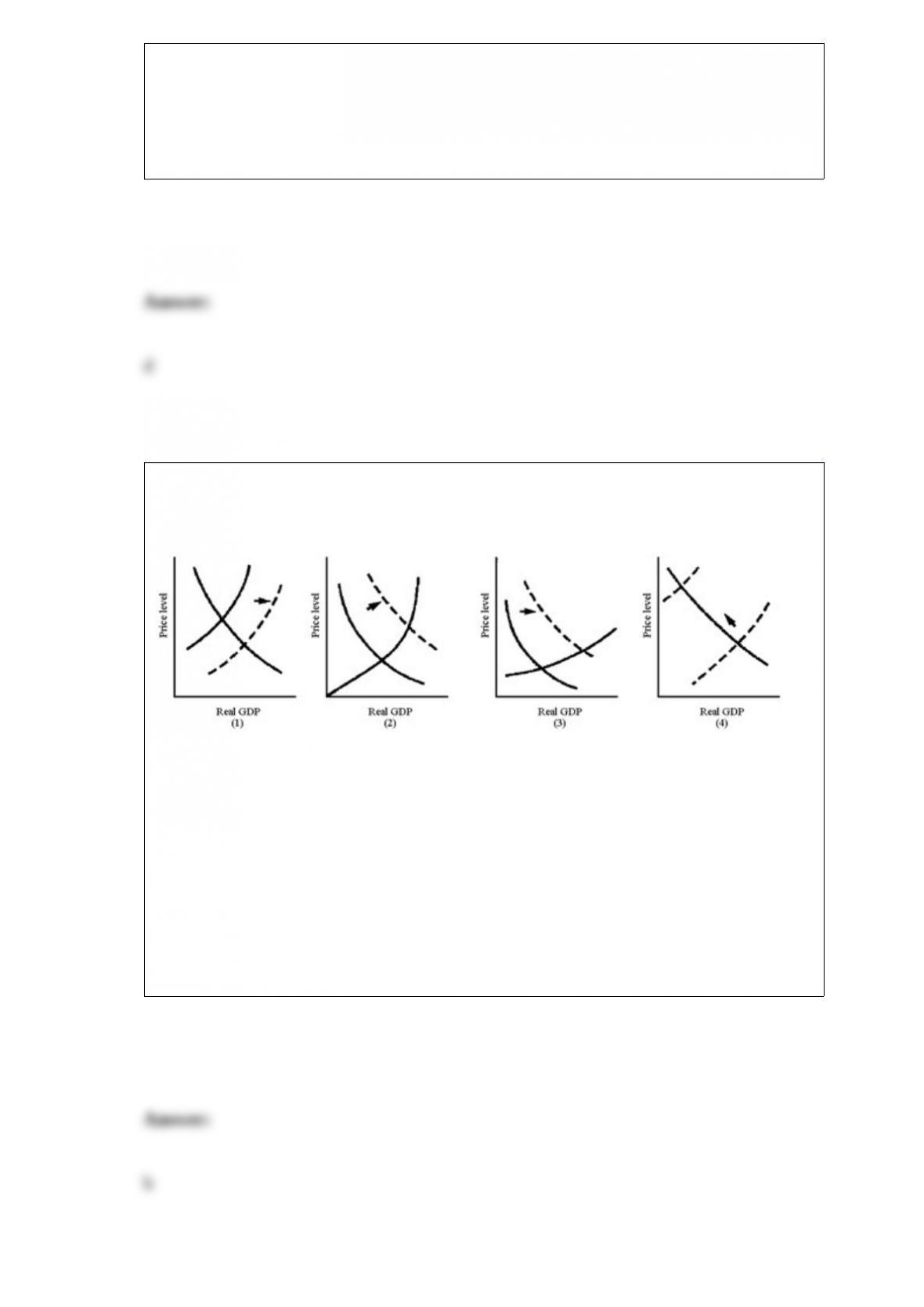
Figure 10-5
In Figure 10-5, which graph best illustrates the situation of an economy near full
employment that experiences an increase in autonomous consumer spending?
a. (1)
b. (2)
c. (3)
d. (4)

Anything that influences a good’s price or the marginal physical product of labor will
influence wages.
a. True
b. False
The share of the net national debt owned by foreign individuals, businesses, and
governments has steadily risen to 80%.
a. True
b. False
Something other than exploiting cheap foreign labor must be driving international trade.
a. True
b. False

In the Santa Rita silver mines in Arizona in 1870, Mexican miners received about $12
per month while “American” miners received $70. Although the wages of both groups
tended to rise over time, the gap persisted until at least 1910. Mexican and American
miners did the same work and were equally productive. Economists call this pay
differential
a. prejudicial differentials.
b. compensating differentials.
c. economic discrimination.
d. Lorenz discrimination.
Suppose that the supply of insulin is perfectly elastic and the demand for insulin
perfectly inelastic. Then the result of an excise tax would be
a. a significant increase in government revenue and a significant decrease in the
quantity consumed.
b. a significant decrease in the quantity consumed with no change in government
revenue.
c. a significant increase in government revenue and no change in the quantity
consumed.
d. no increase in government revenue and no change in the quantity consumed.

The U.S. economy is unique for both its size and prosperity.
a. True
b. False
If the marginal profit from increasing output by one unit is negative, then to attain an
optimum the firm should
a. increase output until marginal profit equals zero.
b. reduce output until marginal profit equals zero.
c. increase output until marginal profit is maximized.
d. reduce output until marginal profit is maximized.
An increase in aggregate demand is most likely to cause an increase in the price level
when the economy is
a. operating near full employment.
b. on the horizontal part of the aggregate supply curve.
c. operating with high unemployment.

d. operating with substantial excess capacity.
When an economist says a change in the market for land causes a farmer to use his land
more intensively, he means that the farmer
a. produces more output than before, so the marginal product of his land falls.
b. produces less output than before, so the marginal product of his land rises.
c. uses greater amounts of nonland inputs than before, so the marginal revenue product
of his land rises.
d. uses smaller amounts of nonland inputs than before, so the marginal revenue product
of his land falls.
A pure monopoly is defined as having only one seller.
a. True
b. False

If a firm is a natural monopoly, society will benefit if it is broken into several small
companies.
a. True
b. False
A statement issued by the president’s economic advisors stating that growth can
continue without price increases indicates that they believe the relevant aggregate
supply curve is
a. vertical.
b. horizontal.
c. downward sloping.
d. upward sloping.
The slope of a consumer’s indifference curve between two commodities represents

a. her marginal rate of substitution between the commodities.
b. the relative prices of the goods.
c. her marginal revenue from selling the commodities.
d. her marginal revenue product from consuming the commodities.
If the dollar appreciates relative to other currencies, which of the following is true?
a. It takes more foreign currency to buy a dollar.
b. It takes more dollars to buy a foreign currency.
c. U.S. exports will increase.
d. Foreign purchases of U.S. goods will increase.
A perfectly contestable market is one in which there are excessive costs to entry and
exit.
a. True
b. False

Deregulation of the airline and trucking industry has (i) resulted in considerable entry of
new firms, and (ii) has forced unions in these industries to make large concessions on
wages and working conditions.
a. i and ii
b. i but not ii
c. ii but not i
d. neither i nor ii
According to the law of comparative advantage, a doctor who is also a talented auto
mechanic should
a. get a part-time job at a gas station.
b. do her own auto repairs and those of her neighbors.
c. hire a professional mechanic to repair her car.
d. only repair the cars of other doctors.
If price rises, what happens to demand for a product?
a. It increases.
b. It decreases.
c. It does not change.
d. Uncertain-economic theory has no answer to this question.
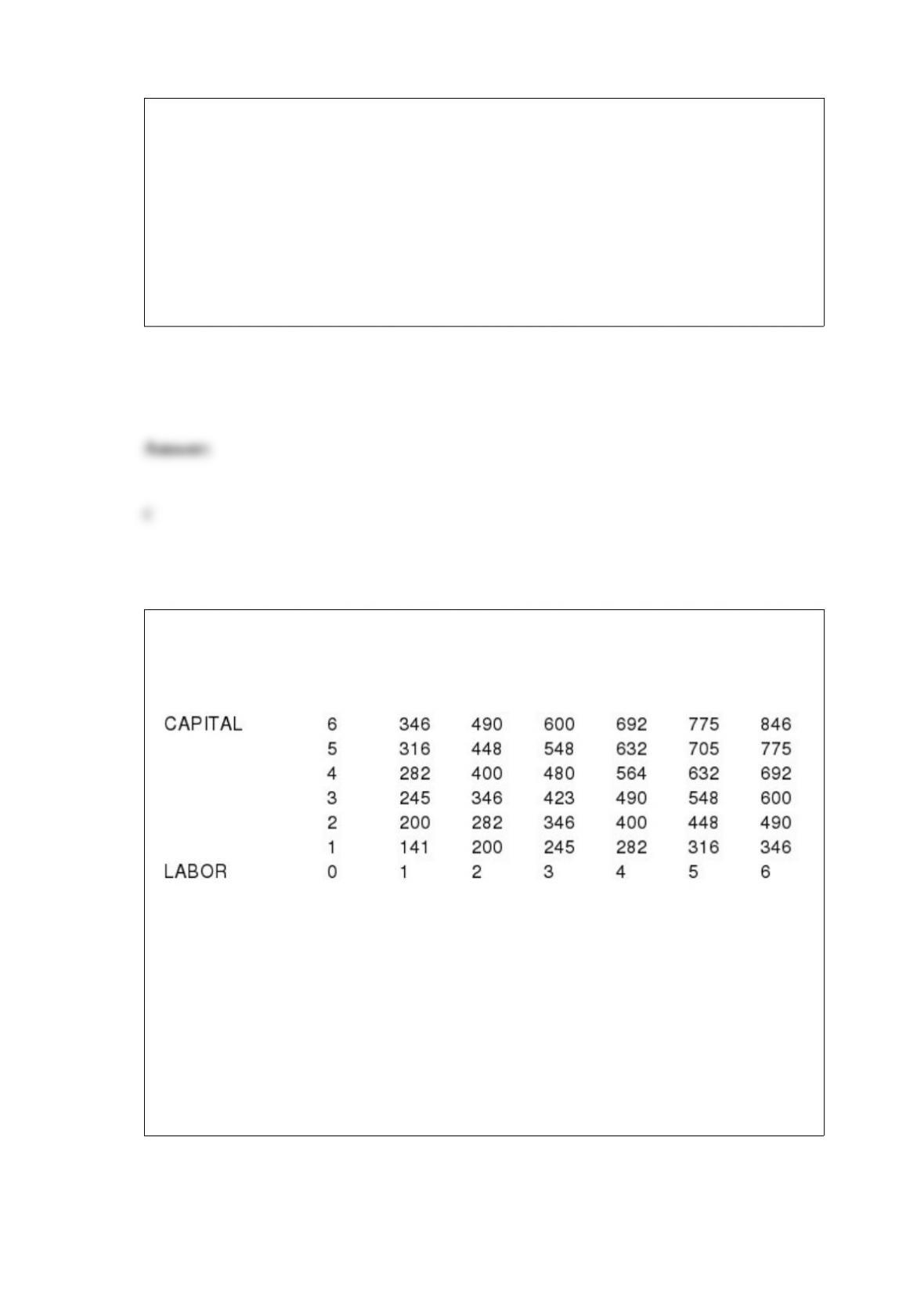
Table 7-4
The production relationship in Table 7-4 indicates a process characterized by
a. decreasing returns to scale.
b. constant returns to scale.
c. increasing returns to scale.
d. increasing then decreasing returns to scale.