
The net export component of aggregate demand is defined as U.S.
a. imports minus U.S. exports.
b. imports plus U.S. exports.
c. exports minus U.S. imports.
d. exports minus taxes and customs duties.
At higher interest rates, banks will want to hold more reserves.
a. True
b. False
Although a corporation that is owned by its member banks, the Federal Reserve System
a. reports directly to the president in an annual report.
b. is quite independent of them, and they receive almost none of the Fed’s profits.
c. is administered by Congress and all its profits are distributed to the member banks.
d. turns all its profits over to the state governments of each district bank.

If a firm increases inputs by 15 percent and output increases by 12.5 percent, the firm is
experiencing
a. increasing returns to scale.
b. decreasing returns to scale.
c. constant returns to scale.
d. increasing costs per unit of output.
Assume Joe invests a total of $10,000 in a company – $5,000 of which is his own
money and $5,000 which he borrowed at a 10% interest rate. If the company’s stock
value increases by 20% in one year at which time Joe sells his shares of the stock, what
is Joe’s rate of return on his investment?
a. 10%
b. 15%
c. 20%
d. 30%

The strength of the competition faced by a company can profoundly affect its
a. pricing.
b. output decisions.
c. input decisions.
d. All of the above are correct.
Average growth rates of per capita income were close to zero, on average, prior to the
Industrial Revolution.
a. True
b. False
Table 10-1
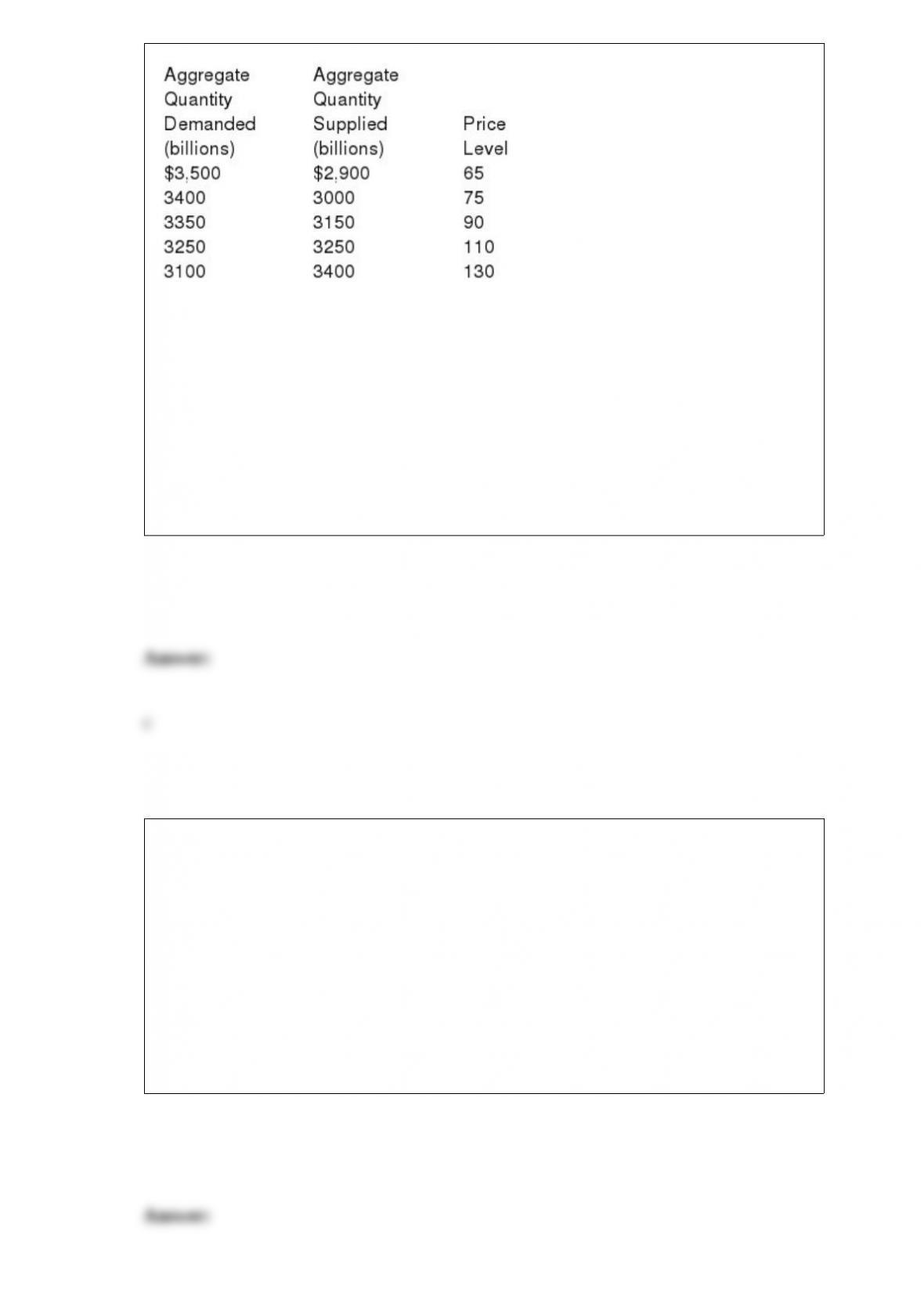
In Table 10-1, if full employment occurs at $3,100 billion, then
a. the economy experiences a recessionary gap of $150 billion.
b. the economy experiences a recessionary gap of $300 billion.
c. the economy experiences an inflationary gap of $150 billion.
d. the economy experiences an inflationary gap of $300 billion.
An externality is defined as
a. an opportunity cost that is not considered, which causes inefficiency.
b. a social cost that affects parties external to a transaction.
c. a transaction which imposes a loss on one of the parties involved.
d. a “cost of doing business” that cannot be allocated to any particular good.
e. the increase in cost associated with increased production.

Although specialization of labor increases efficiency of production, it can lead to
another major problem:
a. the need to exchange goods among producers.
b. the need to remain fully employed.
c. the depletion of natural resources.
d. assuring that exchange leads to mutual gains.
e. All of the above are correct.
For most welfare recipients, the negative income tax plan would increase incentives to
work.
a. True
b. False
The Herfindahl-Hirschman Index measures

a. concentration in the industry.
b. industrial average output.
c. economies of scale.
d. consumer confidence.
The kinked demand curve model explains pricing in monopoly markets.
a. True
b. False
By definition, a firm that practices satisficing
a. maximizes its sales, not its profits.
b. makes acceptable decisions, though not necessarily optimal ones.
c. satisfies government guidelines instead of consumer demands.
d. minimizes the cost of gathering enough information to make an optimal decision.

How does rent control tend to cause persistent imbalances in the market for housing?
a. Quantity demanded exceeds quantity supplied but price cannot rise to remove the
shortage.
b. Quantity demanded exceeds quantity supplied but price cannot fall to remove the
surplus.
c. Quantity supplied exceeds quantity demanded but price cannot rise to remove the
shortage.
d. Quantity supplied exceeds quantity demanded but price cannot fall to remove the
surplus.
Monetizing the deficit contributes to the inflationary pressures that are already present
in the economy.
a. True
b. False

If production involves decreasing opportunity cost, the production possibilities curve
a. is “bowed inward.”
b. is a straight line.
c. is “bowed outward.”
d. is a wavy line.
e. has an unpredictable shape.
Monetary policy is the system of actions taken by the Fed to influence the money
supply.
a. True
b. False
During inflationary periods
a. all prices rise at the rate of inflation.
b. real wages must necessarily decline.
c. some prices may fall.

d. relative prices do not change.
Which term refers to the share of an activity’s marginal cost that is paid for by the
persons who carry out the activity?
a. Beneficial cost
b. Incidental cost
c. Marginal private cost
d. Marginal social cost
Which retail operation would have the lowest costs per book sold?
a. a small independent bookstore
b. a large retail bookstore chain
c. an Internet seller of books
d. All would have the same costs.

Voluntarism includes methods for dealing with pollution that
a. carry no legal authority.
b. call the problems of pollution to the public’s attention.
c. involve trying to persuade polluters to reduce or eliminate pollution voluntarily.
d. include all of the above.
The key element in preserving a monopoly is
a. government subsidy of critical enterprises.
b. keeping potential rivals out of the market.
c. guaranteeing availability of substitute products.
d. increased advertising expenditure.
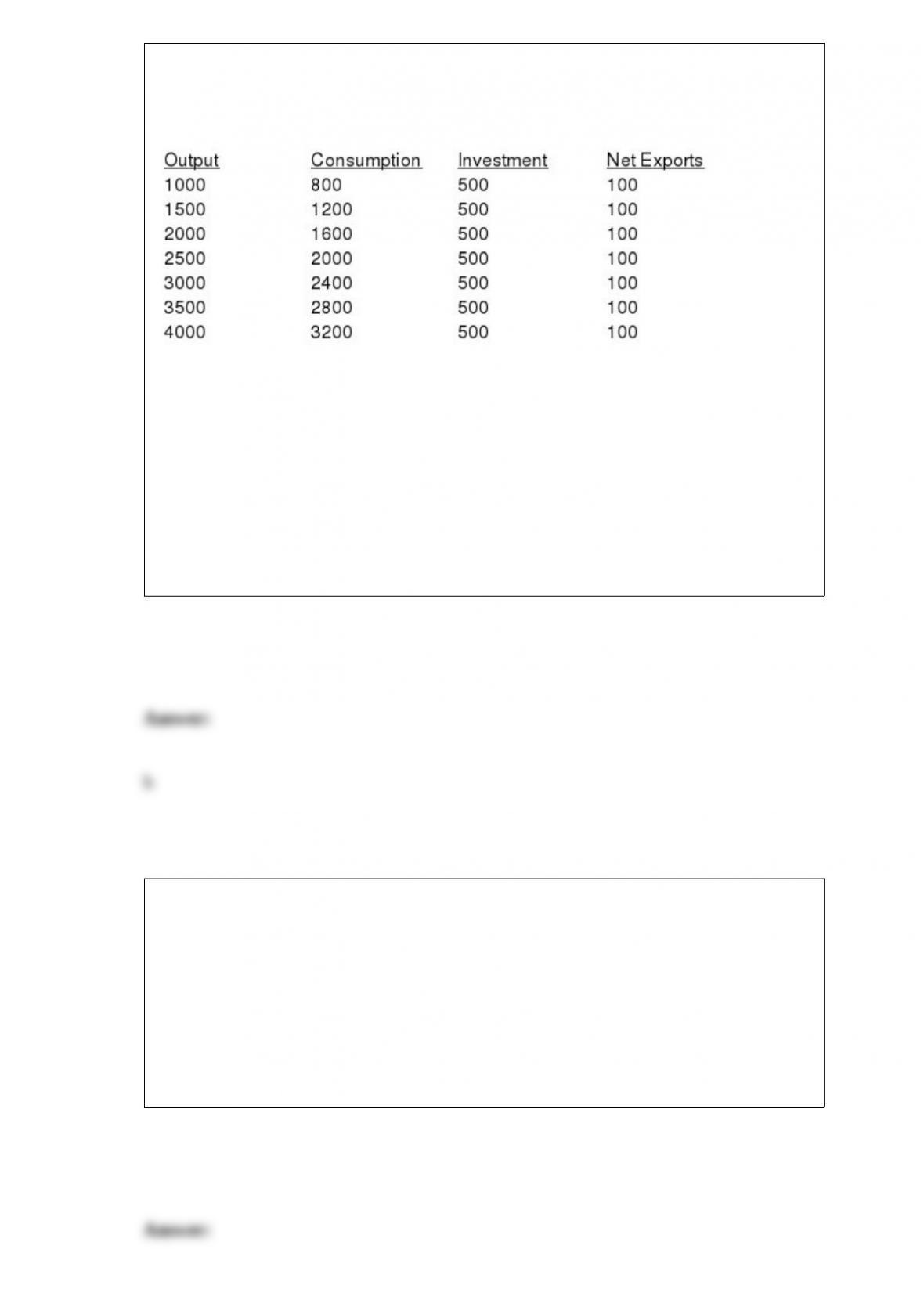
Table 9-1
In Table 9-1, at output of 4,000, inventories are
a. decreasing by 200.
b. increasing by 200.
c. increasing by 300.
d. decreasing by 300.
Which of the following would cause an increase in the demand for U.S. dollars?
a. an interest rate cut in the United States
b. an interest rate cut in Europe
c. an interest rate increase in Europe
d. a recession in Europe

According to Piketty, economic history is the story of a race between:
a. capital accumulation
b. population growth
c. technological progress
d. all of the above
e. a and c only
Define the following terms:
a. Human capital
b. Investment
c. Capital formation
d. Property rights
Since the 1970s, the velocity of money has
a. behaved in a predictable fashion.
b. behaved in an erratic fashion.
c. decreased in value.
d. increased in a stable and predictable fashion.
An economist would describe college fees as
a. an investment in human capital.
b. a transfer payment.
c. a waste of parents’ money.
d. an economic loss.

Recycling in the United States in recent years
a. has decreased in spite of increased rates for common recycling materials.
b. has remained unchanged, and increased raes for recycling may help.
c. has increased with increased rates for recycling mterials.
d. has increased with no help from increased fees for recycling materials.