
Bond prices and interest rates:
a. are interrelated
b. have no relationship to one another
c. rise or fall in tandem
d. none of these choices
The national debt is defined as the total
a. amount that U.S. citizens owe to foreigners.
b. value that U.S. citizens borrow from foreigners during any time period.
c. value of government’s indebtedness at any moment in time.
d. amount by which government’s expenditures exceed receipts during any time period.
Examples of public goods include national defense, police, and the U.S. Postal Service.
a. True
b. False

Which price would you expect to rise the most in a high-income growing economy?
a. semiconductors for personal computers
b. tickets to a ballet performance
c. passenger automobiles
d. Blu-ray players
In a market system, the primary instruments used to coordinate economic activity are
a. plans.
b. prices.
c. input-output analyses.
d. quantities.

Production indifference curves bow inward toward the graph’s origin because of
a. the law of diminishing returns to a single input.
b. the law of diminishing marginal returns to scale.
c. constant returns to scale.
d. minimizing costs in the short run.
A supply schedule can be plotted on a graph to yield a supply curve.
a. True
b. False
Pollution taxes are preferred to direct controls because they don’t require a way of
measuring pollutants produced.
a. True
b. False

When nominal interest rates are held below inflation rates, then households will have an
incentive to
a. consume.
b. save.
c. purchase financial assets.
d. postpone current consumption plans.
The federal budget deficit in 2009 was more than eight times larger than the deficit in
2007.
a. True
b. False
Tampering with the price mechanism

a. can be efficient for a while.
b. cannot be attempted in a market economy.
c. can enhance societal welfare if done properly.
d. often produces undesired side effects.
Consumer’s surplus can be written as
a. total expenditure − total utility.
b. total utility − total expenditure.
c. marginal utility − marginal expenditure.
d. marginal expenditure − marginal utility.
Most of the taxes collected by governments tend to
a. remain fixed.
b. move in the opposite direction from GDP.
c. be sales taxes.
d. rise and fall with the level of GDP.
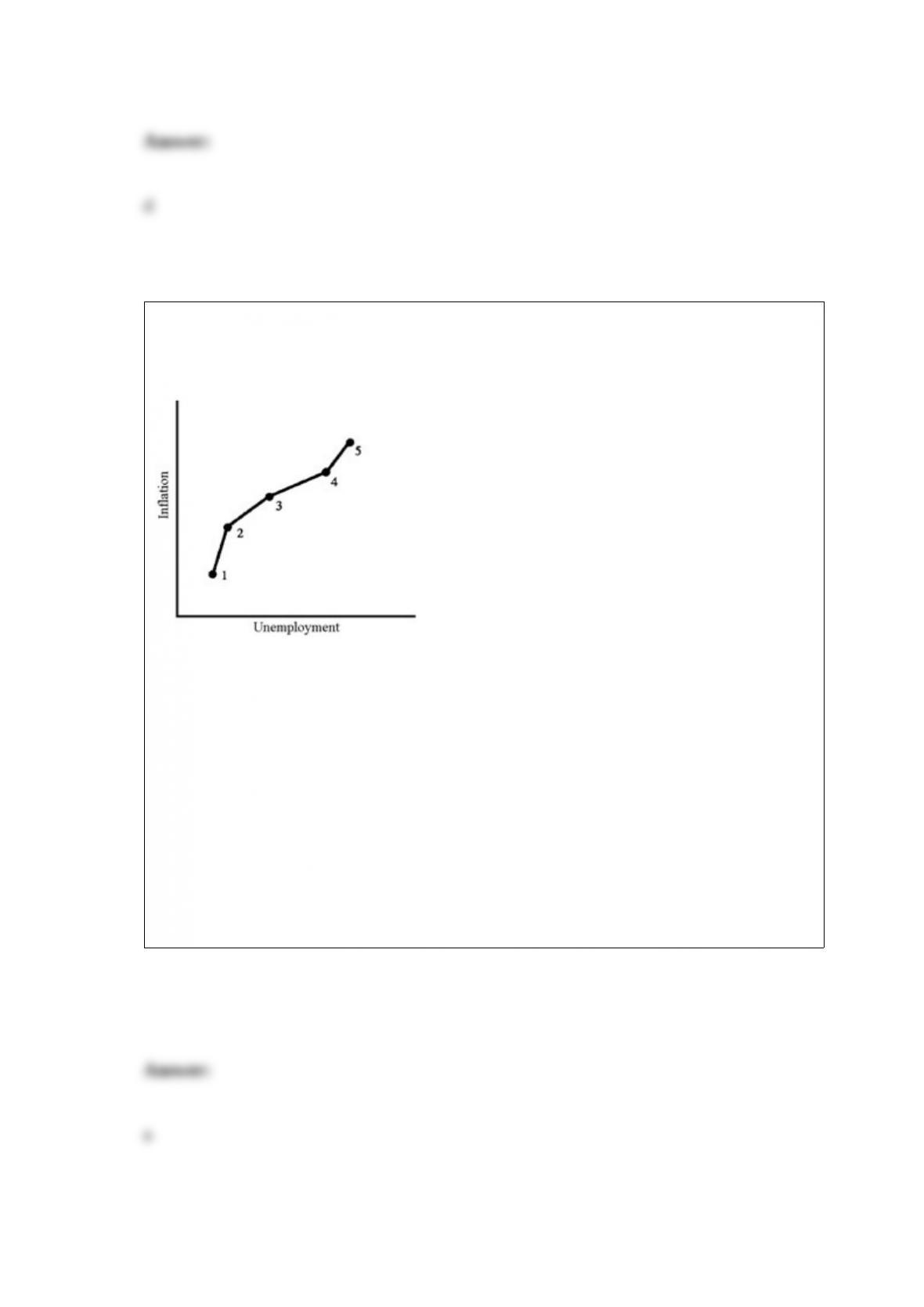
Figure 17-5
Over a five-year period, economists observed that the unemployment-inflation
relationship appeared as in Figure 17-5. Economic theory would conclude that the
period
a. was dominated by supply shocks such as increased energy and food costs.
b. was affected by both supply and demand shocks, with demand shocks dominating.
c. was dominated by demand-side changes.
d. cannot be explained because the relationship is the opposite of what the Phillips
curve would predict.
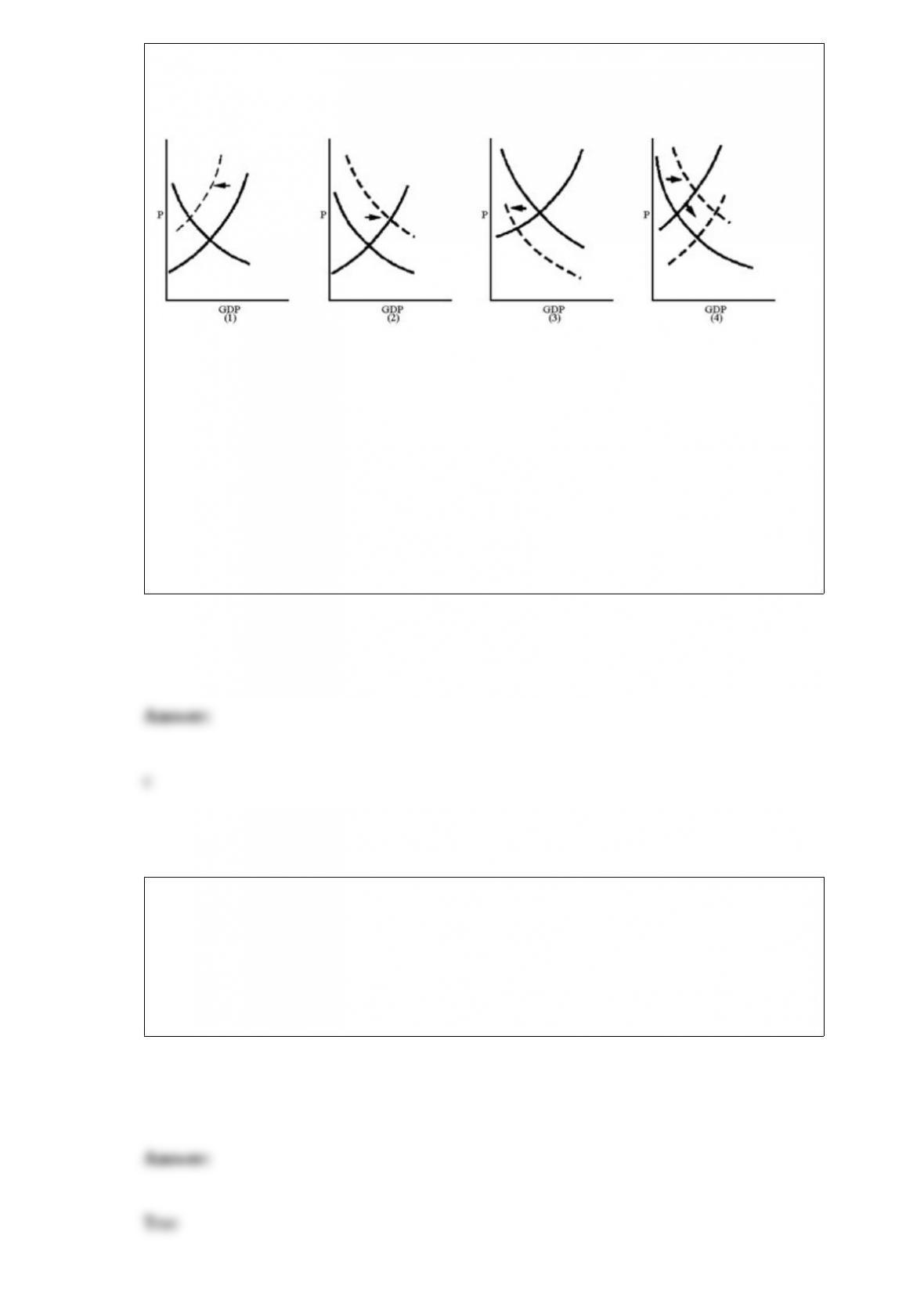
Figure 11-2
Which graph in Figure 11-2 best reflects a Keynesian’s view of the short-run impact of
an increase in the personal income tax rate?
a. 1
b. 2
c. 3
d. 4
A monopolist’s total profit is shown by the difference between price and average cost
per unit times the number of units sold.
a. True
b. False

The term “bilateral monopoly” refers to market situations in which
a. there are two participants on the selling side.
b. there are two participants on the buying side.
c. there is a monopoly on the selling side and a monopsony on the buying side.
d. a monopoly has evaded antitrust laws.
Suppose that a curve has a slope equal to zero at some point A. To the right of A, the
curve may
a. have a positive slope.
b. have a negative slope.
c. be a straight line.
d. All of the above are correct.
If Mexico experiences a period of stable prices while the United States experiences
rapid inflation, what will happen in the United States?
a. an increase in U.S. imports

b. an increase in U.S. exports
c. a decrease in U.S. imports
d. an increase in U.S. net exports
The 1994 book by Murray and Herrnstein, The Bell Curve, was about
a. government debt.
b. the intelligence factor.
c. capital growth.
d. military readiness.
A quota ordinarily specifies both minimum and maximum amounts of goods that can
come into a country.
a. True
b. False

How does an increase in taxes affect the expenditure schedule?
a. It causes movement to the left along the schedule.
b. It causes the schedule to shift upward.
c. It causes movement to the right along the schedule.
d. It causes the schedule to shift downward.
Capital, labor, and other factors of production move more freely from country to
country than they do within a country.
a. True
b. False
Expansionary fiscal policy in an open economy
a. leads to a balance of trade surplus.

b. decreases America’s capital account surplus and the current account deficit by the
same amount.
c. increases both America’s capital account surplus and current account deficit by equal
amounts.
d. increases America’s capital account surplus more than it increases the current account
deficit.
Assume that a country imposes a tariff in order to gain a price advantage on an item.
What is the typical response from the exporting country?
a. It accepts the situation, and does nothing about it.
b. It seeks greater efficiency in order to offset the tariff.
c. It refuses to sell to the country that imposes the tariff.
d. It retaliates by imposing tariffs or quotas on items from the other country.
A decrease in supply will have what effect on equilibrium price and quantity?
a. Price will increase; quantity will decrease.
b. Price will decrease; quantity will increase.

c. Both price and quantity will increase.
d. Both price and quantity will decrease.
The quantity theory of money assumes that
a. velocity varies inversely with interest rates.
b. if velocity equals six, the Fed can increase nominal GDP by 30 percent if it increases
the money supply by 5 percent.
c. changes in the money supply affect output but not prices.
d. changes in velocity are so small that velocity can be considered constant.
The counterpart to the unsold output of firms is the lack of jobs for workers willing to
work.
a. True
b. False

High unemployment and high rates of inflation are examples of coordination successes.
a. True
b. False
Attempts to keep the economy always within a hair’s breadth of full employment is
called
a. shock absorption.
b. lagging.
c. fine tuning.
d. crowding out.
When deciding on an appropriate course of action to counter a recessionary gap, which
of the following do policy makers consider?
a. the slope of the short-run Phillips curve

b. the costs of inflation and unemployment
c. the efficiency of the economy’s self-correcting mechanism
d. All of the above are correct.
High interest rates make a firm’s long-term investment in new capital
a. riskless.
b. less attractive.
c. more attractive.
d. no more attractive than short-term investment.