
Monetarists typically favor strong policy measures to fight recession.
a. True
b. False
The payoff matrix is a fundamental tool of
a. monopolistic competition.
b. game theory.
c. corporate finance theory.
d. regulatory oversight.
The efficiency of the payments’ mechanism affects
a. the speed with which money can be exchanged for other assets.
b. how quickly individual loan applications will be approved.
c. how slowly individuals deplete their cash balances.
d. the speed with which financial institutions can process checks and other funds.

The apparent stickiness of the price of goods sold by oligopolists can be explained by
the
a. contestable markets model.
b. sales maximization model.
c. kinked demand curve model.
d. entry deterrence model.
The Federal Reserve System is a(n)
a. corporation owned by its member banks.
b. independent branch of the U.S. government.
c. corporation owned by the government and member banks.
d. agency created by presidential executive order.
Ronald Reagan’s presidency could be characterized as a period of
a. passive monetary policy.
b. passive fiscal policy.
c. active fiscal policy.
d. active regulatory policy.
Members of the European Union (EU), rely heavily on this form of indirect taxes.
a. Value-added tax
b. Excise tax
c. Property tax
d. Sales tax
Which of the following is an example of the Fed’s use of unconventional monetary
policy?
a. buying assets other than Treasury bills
b. participating in rescue operations for troubled financial institutions
c. lending massive amounts to banks and other financial institutions
d. all of the above
Cheap labor is the source of comparative advantages.
a. True
b. False
Inflation can come from the demand side or from the supply side of the economy.
a. True
b. False

The Fed cannot predict the effects of open market operations with perfect accuracy
because of
a. changes in people’s desires for cash.
b. foreigners desire to hold U.S. dollars.
c. banks’ desires to hold excess reserves.
d. All of the above are correct.
The process of building up capital includes
a. acquiring funds from banks and other sources.
b. use of borrowed funds to hire inputs to build factories, warehouses, etc.
c. completion of the investment process by adding machinery and inventory.
d. All of the above are correct.
For conservatives, the United States needs
a. an expanded public sector to protect consumers.
b. a smaller public sector and less regulation.
c. a larger tax rate and more government spending.
d. more public goods and services, such as national health care.
Inflation tends to redistribute real income from lenders to borrowers.
a. True
b. False
The crowding-out effect is likely to be the strongest during periods of
a. recession.
b. large budget surpluses.
c. high employment.
d. expanding money supply.
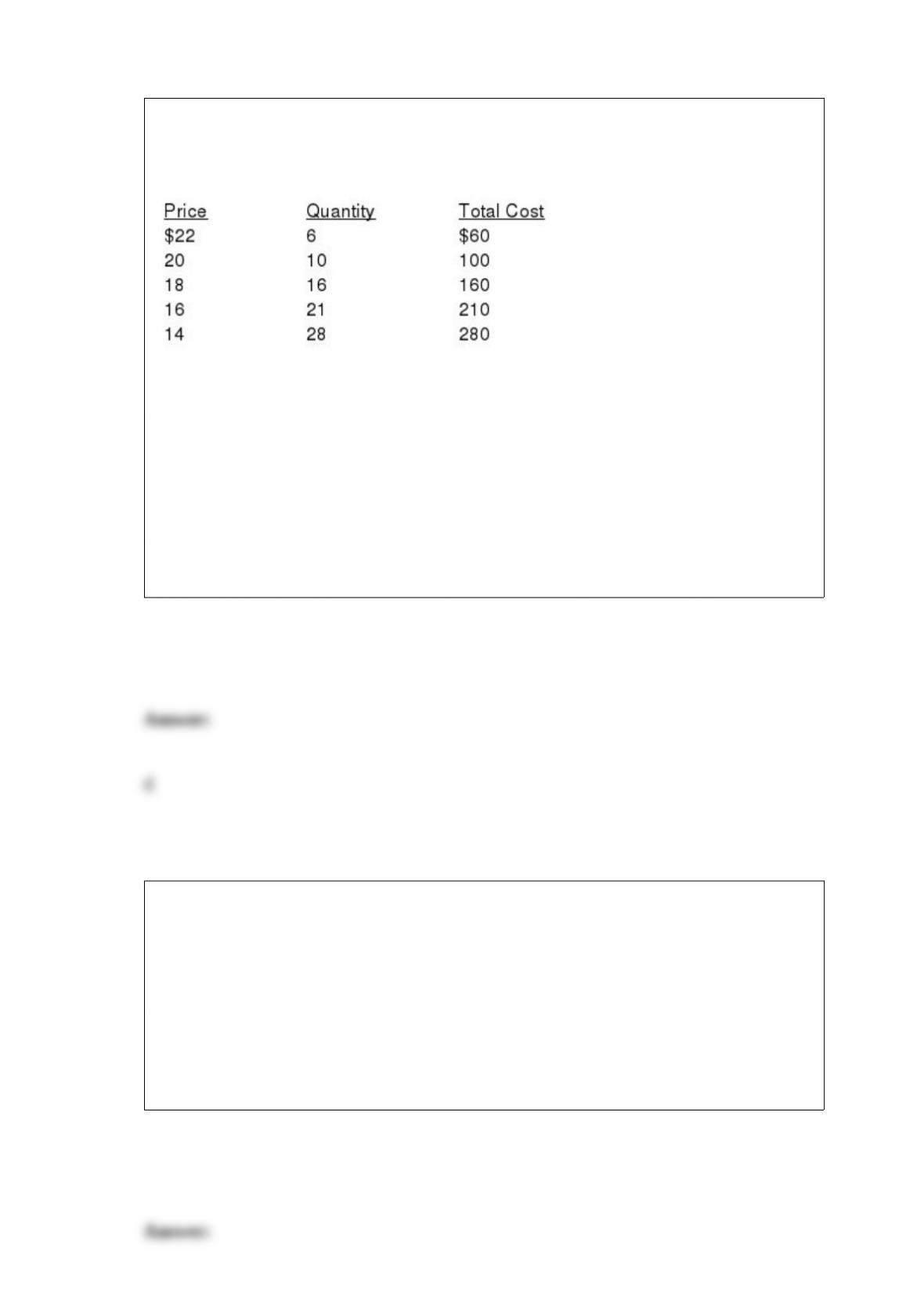
Table 8-2
In Table 8-2, the profit-maximizing level of output is
a. 6.
b. 10.
c. 16.
d. 21.
A recessionary gap exists when the equilibrium level of GDP
a. falls short of potential GDP.
b. equals potential GDP.
c. exceeds potential GDP.
d. causes inventory levels to fall.
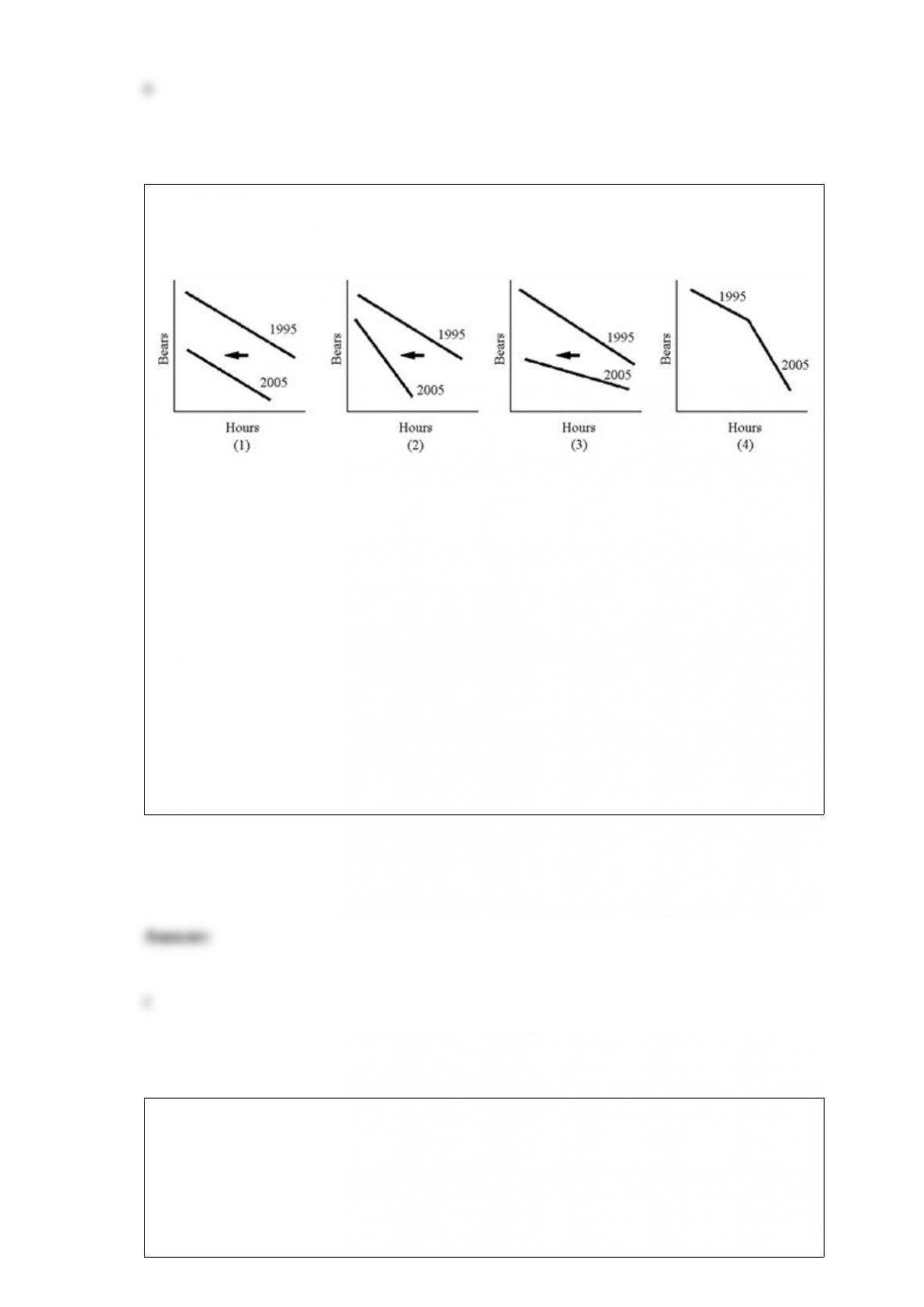
Figure 19-1
Mr. Paque is a bear hunter for timber companies that want to diminish damage to trees
done by bears in the spring. Due to a reduction in the bear population between 1995 and
2005, Mr. Paque finds fewer bears each year and additional hours spent hunting
produce fewer additional bears. With the information given and noting that the bounty
on bears has risen, one can conclude that (i) Mr. Paque’s income per hunting hours will
fall; (ii) the derived demand for Mr. Paque’s services will shift left.
a. i and ii
b. i not ii
c. ii not i
d. neither i nor ii
The trade deficit is the mirror image of the required capital inflows. So why worry
about these capital inflows?
a. Trade deficits automatically cause larger budget deficits.
b. Before long, the Germans, Japanese, and other foreigners will own the United States

and will be dictating policy to the U.S. government.
c. These capital inflows create debts on which interest and principal payments will have
to be made in the future.
d. During the period of trade deficits, personal consumption must be reduced to build
up wealth to repay the debt created.
The primary benefit of a monetary system of exchange compared to a barter system is
the increased
a. ability to record transactions.
b. time necessary to find trading partners.
c. time devoted to shopping.
d. efficiency in arranging transactions.
Externalities can create a threat to environmental quality.
a. True
b. False
A country with an overvalued currency
a. will have a balance of payments deficit.
b. will suffer losses of foreign reserves.
c. must intervene in the foreign exchange market to buy its own currency.
d. All of the above are correct.
Dumping is a trade practice in which countries sell goods in a foreign market at cheaper
prices than the goods can be produced domestically.
a. True
b. False
____ mean that the costs involved cannot be recouped for a considerable period of time.
a. Sunk costs
b. Opportunity costs
c. Overheads
d. Restructuring costs
An investment in yourself is an investment in what economists call human capital.
a. True
b. False
Which of the following exchanges handles numerous technology companies including
Intel and Microsoft?
a. NASDAQ
b. NYSE
c. AMEX
d. None of the above handle technology stocks.
Corporate taxes are a direct tax.
a. True
b. False
Government transfer payments
a. are subtracted from national income to obtain disposable income.
b. can be considered as negative taxes.
c. intervene between national product and disposable income in the same way as taxes.
d. are counted the same as taxes in computing national income.
The classic example of a detrimental externality is
a. education.
b. pollution.
c. discovery of an AIDS vaccine.
d. Mrs. Lewis’ prize-winning rose garden.
The Federal Open Market Committee meets
a. once a month.
b. eight times a year.
c. four times a year.
d. semi-annually.