
At equilibrium, the market will clear, with no surpluses or shortages occurring.
a. True
b. False
The supply curve of a depletable natural resource is usually
a. downward sloping because the resource runs out over time.
b. upward sloping because more of the resource can be profitably extracted at higher
prices.
c. upward sloping because the price of the resource rises over time.
d. vertical because the supply of the resource is fixed.
Budget deficits are inflationary when
a. the Federal Reserve contracts the money supply.
b. the economy has lots of slack and the aggregate supply curve is horizontal.
c. the economy is at full employment and the aggregate supply curve is vertical.
d. private citizens buy the bonds to finance the debt.

It is in society’s best interest that the MC of the last unit produced of a good is equal to
its MU.
a. True
b. False
For a rational consumer, the consumer’s surplus will never be a negative number.
a. True
b. False
Economic theory predicts that the price of a depletable resource will rise as it becomes
more scarce.

a. True
b. False
Disposable income can be defined as national product
a. minus federal and state taxes.
b. minus taxes plus transfers.
c. minus indirect taxes.
d. plus taxes plus transfers.
Demand-side inflation differs from supply-side inflation in the following way:
a. demand-side inflation has higher output; supply-side inflation has lower output.
b. demand-side inflation has lower output; supply-side inflation has higher output.
c. demand-side inflation is always followed by stagflation; supply-side inflation is
always followed by demand-side inflation.
d. demand-side inflation has a self-correcting mechanism; supply-side inflation does
not.

The main cost that low inflation imposes on an economy is that low inflation
a. inevitably leads to high inflation.
b. distorts some economic decisions.
c. reduces real wages.
d. benefits lenders at the expense of borrowers.
Oligopolistic firms never collude because they have almost no incentive to do so.
a. True
b. False
Absent regulation of the money supply, the money supply would likely reflect the
business cycle.
a. True
b. False
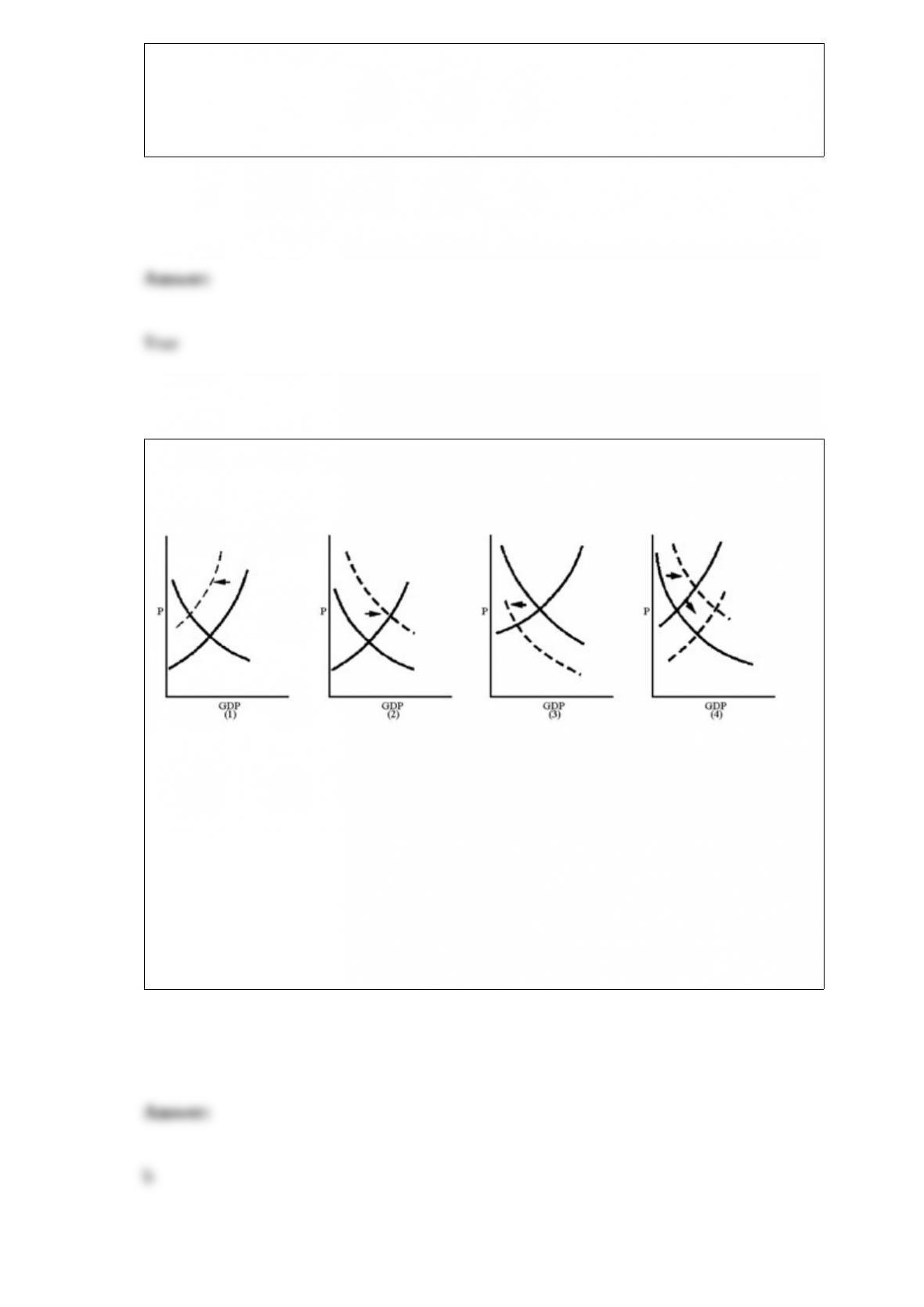
Figure 11-2
Which graph in Figure 11-2 best reflects a Keynesian view of the impact of a
$500-per-person tax cut?
a. 1
b. 2
c. 3
d. 4

During the period from 2001 to 2006, there were several major cuts in personal income
tax rates. What effect did these have on the value of the multiplier?
a. They decreased the value of the multiplier.
b. They had no effect on the multiplier.
c. They increased the value of the multiplier.
d. The effect was uncertain.
Which of the following led to the collapse of the Phillips Curve?
a. Rightward shift in the demand for labor curve
b. Leftward shift of the Phillips curve
c. Leftward shift of the aggregate supply curve
d. Rightward shift of the aggregate demand curve.
An inward shift of the demand curve for a product causes outward shifts in the demand
curves for all the factors used to produce the product.
a. True
b. False

What important lesson did American economists learn in the 1980s and again in
2001-2003?
a. Large tax cuts can lead to a balance of trade surplus.
b. Large government budget deficits can crowd out consumption.
c. Large government budget deficits can bankrupt the nation.
d. Large government budget deficits can crowd out net exports.
If interest rates in the United States are higher than interest rates in Europe, what is
most likely to happen?
a. Supply of dollars will increase, causing appreciation of the dollar.
b. Supply of euros will increase, causing appreciation of the euro.
c. Demand for dollars will increase causing appreciation of the dollar.
d. Demand for dollars will decrease, causing depreciation of the dollar.

Economics studies the logic of choices made from among available possibilities.
a. True
b. False
As the multiplier process works through time, the size of the multiplier effect becomes
a. larger.
b. smaller.
c. constant.
d. explosive.
At high levels of interest, borrowers will borrow ____ and suppliers will supply ____.
a. more; less
b. less; more

c. less; less
d. more; more
From 2007 to 2008, the Federal Reserve System reduced interest rates, the price which
borrowers pay. As a result, economists expected the quantity of money demanded to
a. increase.
b. decrease.
c. not change.
d. not change, although the demand schedule itself will shift outward.
Technological change was a major contributor to the productivity speed-up from
1995-2000.
a. True
b. False

Double taxation of corporate profits
a. imposes losses on investors’ incentives in corporate stock.
b. tends to keep corporations out of low-profit activities.
c. makes the allocation of resources more efficient.
d. makes issuing new stock prohibitively expensive.
The statement “saccharine causes cancer” is not a theory; it is a hypothesis.
a. True
b. False
Economists observed the following growth rates in the fourth quarter of 1995: real GDP
= 2.8 percent; M1 = 7.8 percent; GDP Deflator = 2.2 percent. Given this data, the
growth of nominal GDP was approximately
a. 12.8 percent.

b. 10.0 percent.
c. 5.6 percent.
d. 5.0 percent.
e. 0.6 percent.
If Brazil voluntarily ships coffee to the United States in return for airplanes,
a. Brazil will benefit, but the United States will lose.
b. one of the two nations will benefit and the other nation will lose since the trade does
not increase the physical quantities of coffee and airplanes available.
c. both Brazil and the United States will benefit since the trade allows each nation to
acquire items.
d. both Brazil and the United States will lose since there is no increase in the production
of coffee or airplanes and the trade will involve certain transaction costs.
The short-run equilibrium of the firm under monopolistic competition has excess
capacity.
a. True
b. False
If the price of gasoline rises by 20 percent and consumption of gasoline falls 5 percent,
a. demand is elastic.
b. demand is unit-elastic.
c. demand is inelastic.
d. elasticity of demand cannot be calculated.
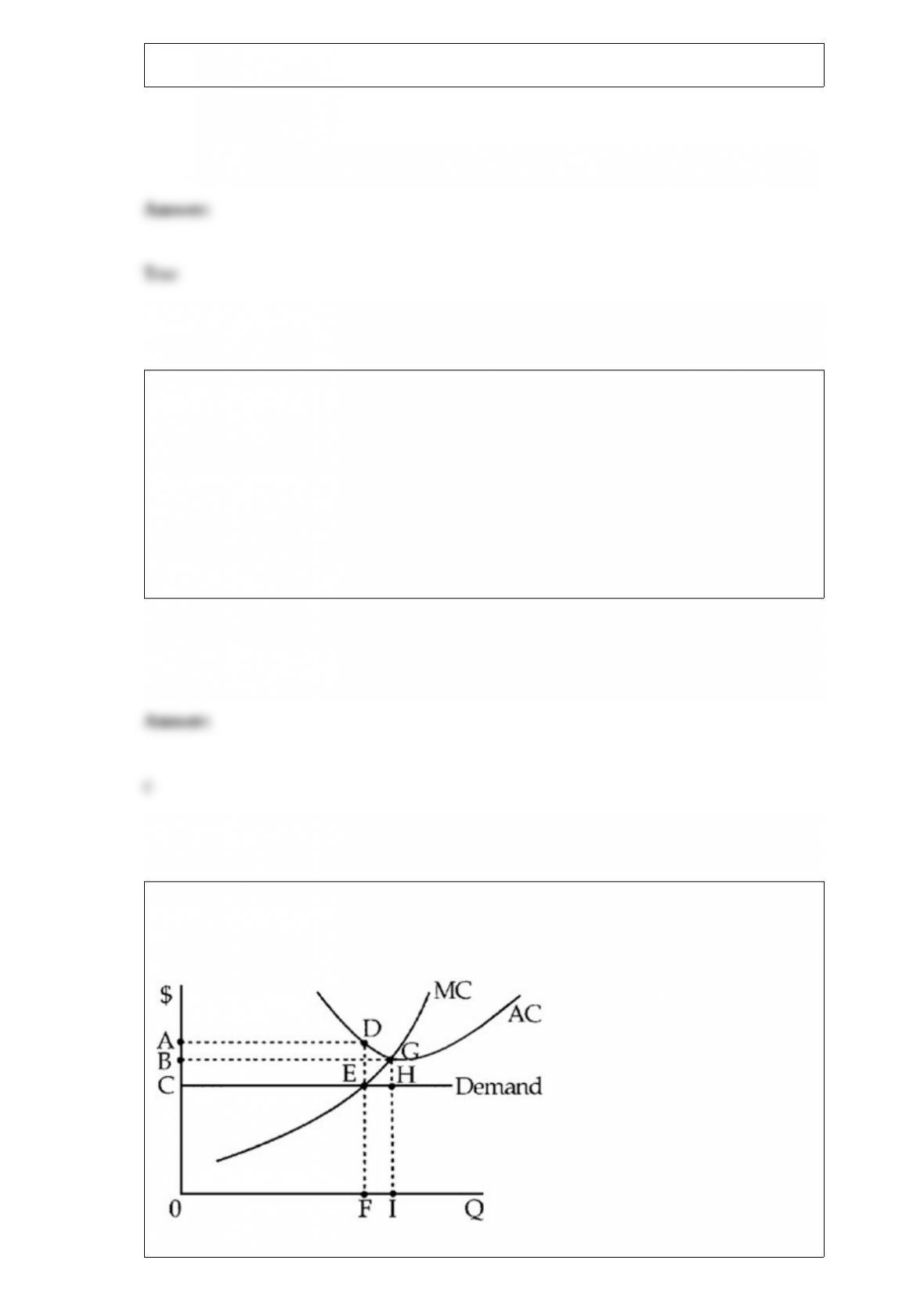
Figure 10-2

Figure 10-2 shows demand and short-run cost curves for a perfectly competitive firm.
At its profit-maximizing output, the firm’s total ____ is represented by area ____.
a. loss; GBHC
b. profit; ADGHC
c. loss; ADEC
d. profit; EGH
Consumer’s surplus
a. is the gap between total willingness to pay and the total market value of a good.
b. guarantees that the market value of a good in money is equal to the total economic
value of the good.
c. is always negative because of diminishing marginal utility.
d. is the total area under a consumer’s demand curve.
In the long run, a monopolistically competitive firm produces at minimum average cost.
a. True
b. False

In an open economy, the government deficit is 400 and investment exceeds saving by
300, so in equilibrium the trade deficit (IM − X) must be
a. 100.
b. 200.
c. 300.
d. 700.
From 1991 to 2007, the rate of inflation in the U.S. has been
a. zero.
b. between zero and 2.1%.
c. between 1.6% and 4.1%.
d. between 3.2% and 7.2%.