
The concept of “lender of last resort” is that when
a. lending decreases, the Fed will be the last to resort to higher interest rates.
b. borrowing increases, the Fed will be the last to increase lending.
c. commercial banks are hesitant to lend, the Fed will step in and increase reserves.
d. a borrower has tried everyone else, the Fed will lend directly to them.
Which of the following were invented centuries ago in China?
a. gunpowder
b. the wheelbarrow
c. printing with movable type
d. all of the above
The incidence of a payroll tax
a. depends upon whether it is levied on the employer or employee.
b. is the same whether it is levied on the employer or the employee.
c. is more heavily on the employee as demand for labor becomes more elastic.

d. is more heavily on the employer as demand for labor becomes less elastic.
If the national debt is owed entirely to U.S. citizens,
a. paying off the debt will necessarily stimulate growth.
b. future interest payments on the debt are not a burden to the nation as a whole.
c. future economic growth will necessarily be slowed.
d. the debt constitutes a burden to these citizens.
If the aggregate supply curve is steep,
a. increased aggregate demand will not lead to higher prices.
b. greater demand for labor will not cause significant wage increases.
c. business firms are probably producing near capacity.
d. All of the above are correct.

Inflation is a serious problem because inflation causes real wages to decline.
a. True
b. False
If the MRP of labor is below the wage rate, the firm should lay off workers.
a. True
b. False
Figure 9-4
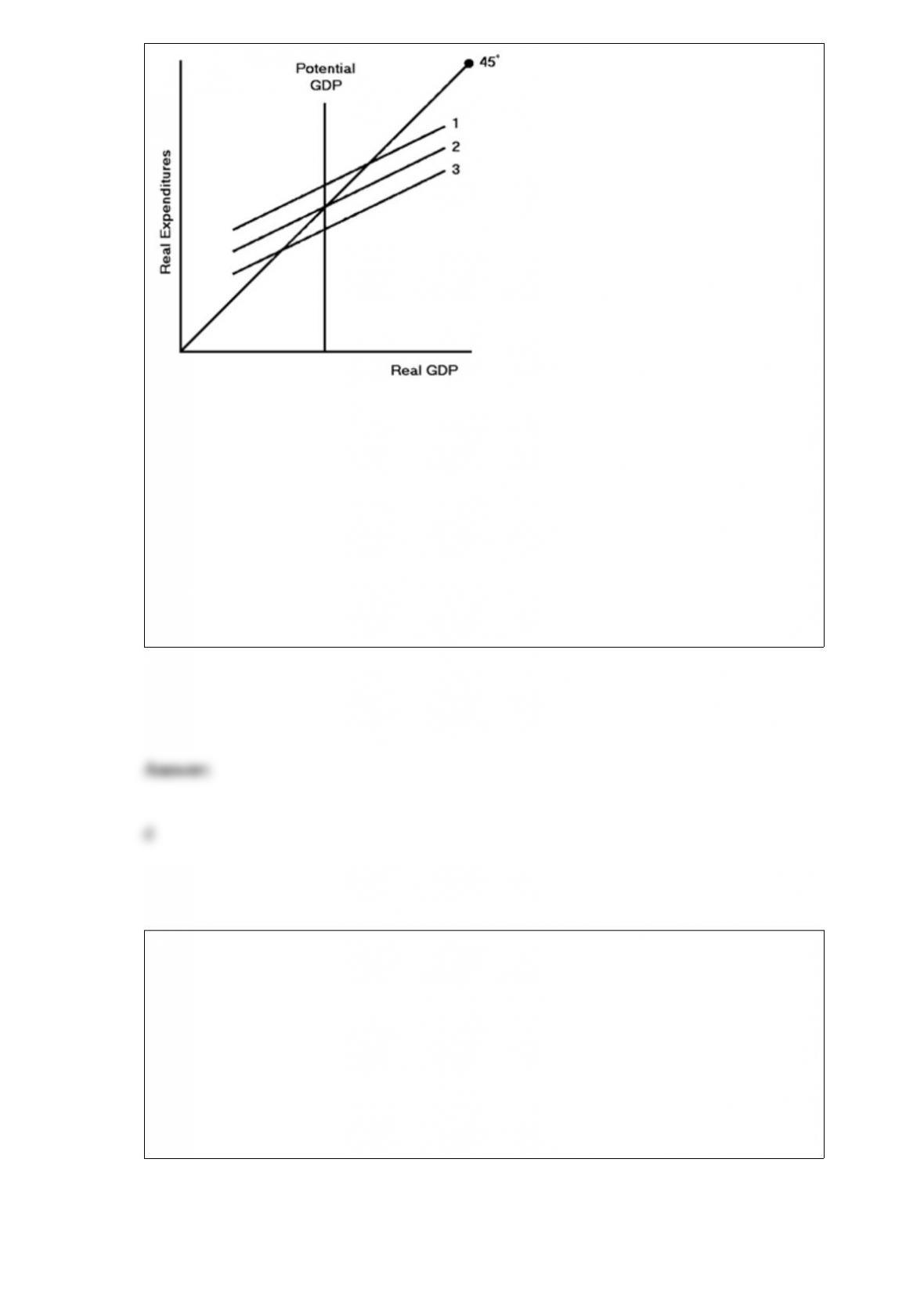
In Figure 9-4, if the economy faces an inflationary gap, what must happen to reach
potential GDP?
a. The expenditure level must rise and/or the price level must rise.
b. The expenditure level must rise and/or the price level must fall.
c. The expenditure level must fall and/or the price level must fall.
d. The expenditure level must fall and/or the price level must rise.
An increase in the number of hours worked would
a. shift the production function upward.
b. shift the production function downward.
c. shift the production function outward.
d. not shift the production function.

Economists believe it is feasible and desirable to reduce environmental damage to zero.
a. True
b. False
A balance of payments deficit is defined as the amount by which
a. a country’s exports exceed its imports.
b. a currency must appreciate in order to reach equilibrium.
c. quantity supplied of a country’s currency exceeds quantity demanded.
d. quantity demanded of a country’s currency exceeds quantity supplied.
“Peak pricing” involves setting lower prices at peak times so that people can afford a
good or service.
a. True

b. False
Which of the following transactions would be included in GDP for 2015?
a. On January 5, 2015, Chris Carter sold 100 shares of stock in IBM Corporation.
b. Bonita Delgado purchases a new 2015 Chevrolet on March 10, 2015.
c. Nadav Daniel buys a used desk from the “Struggling Students Used Furniture” store
on May 9, 2015.
d. Levi Lathan purchases a 75-year-old penthouse on Lake Shore Drive in Chicago,
Illinois, on June 23, 2015.
A decrease in demand will have what effect on equilibrium price and quantity?
a. Price will increase; quantity will decrease.
b. Price will decrease; quantity will increase.
c. Both price and quantity will increase.
d. Both price and quantity will decrease.

Which of the factors below contributed to the collapse of the Phillips curve in the
1970s?
a. Economic research proved there was no relationship between inflation and
unemployment rates.
b. The U.S. government was running triple-digit deficits in the 1970s, compounding the
normal shifts in aggregate demand.
c. The 1970s were full of adverse supply shocks such as the oil price increases of
1973-1974.
d. The aggregate demand curve shifted to the left at the end of the Vietnam War.
The nation listed below whose economy currently comes closest to a free market is
a. North Korea.
b. Germany.
c. People’s Republic of China.
d. Cuba.

Which of the following statements is not true in a perfectly competitive industry in
long-run equilibrium?
a. A profit-maximizing firm may produce any output level at which P < LRAC.
b. Every firm produces at an output level at which MC = LRAC.
c. There is no entry or exit from the industry.
d. No firm earns an economic profit.
Regarding new inventions, which of the following statements is not true?
a. a new invention typically has little competition
b. this effective monopoly on the market earns the inventor abundant profit
c. that profit gets the attention of other potential inventors, who create competing
products
d. reduced to zero economic profits, the inventor goes out of business

The opportunity cost to you of an action is
a. how much you must pay for the opportunity to take the action.
b. the value to you of the next best action you could have taken.
c. the cost to society of giving you the opportunity to take the action.
d. the dollar cost to you of the action.
Marginal cost is the
a. change in total cost resulting from the purchase of one more unit of the variable
input.
b. change in total cost resulting from the production of one more unit of output.
c. difference between total fixed cost and total variable cost.
d. difference between total cost and total expenditure.
Free market economies
a. often have dirty air and rivers.
b. acting on their own do not do enough to efficiently deal with externality problems.

c. while not protecting the environment automatically do offer a powerful tool that may
be used for that purpose.
d. All of the above are correct.
The four-firm concentration ratio for an industry is
a. the number of firms in the industry, divided by four.
b. the share of industry output sold by the four largest firms in the industry.
c. the percentage of total industry profits claimed by the four largest firms.
d. the share of industry output sold by the fourth largest firm in the industry.
Which of the following goods will have the most inelastic demand at any time?
a. jewelry
b. Big Macs
c. electricity
d. pork chops

If a currency appreciates, a country’s net exports
a. fall and AD increases.
b. rise and AD increases.
c. fall and AD decreases.
d. rise and AD decreases.
The existence of an inflationary gap or an recessionary gap depends on the
a. aggregate supply only.
b. expenditure schedule.
c. leakages schedule.
d. injections schedule.
e. aggregate demand and aggregate supply schedules.

Discrimination exists when a man and a woman with the same levels of education earn
different incomes.
a. True
b. False
If the dollar falls in value compared to other currencies, what will happen in the United
States?
a. a decrease in aggregate demand
b. an increase in aggregate supply
c. a decrease in aggregate supply
d. a decrease in the U.S. price level
The major coordination tasks can be summarized with the questions
a. who, what, when, where?
b. how, what, for whom?
c. how, what, why?

d. how, why, for whom?
e. who, how, what?
Product indifference curves bow inward toward the origin because of diminishing
returns to substitution of inputs.
a. True
b. False
A government policy that prevents the price of a good or service from falling below a
specified level is called a price floor and usually results in
a. a shortage.
b. a surplus.
c. a black market.
d. fewer producers of the good or service.
e. a decrease in demand.

Equilibrium price and quantity are determined by the intersection of the demand and
supply curves.
a. True
b. False
Taxes on polluting firms for pollution are intended to
a. raise enough revenue to cut the deficit in half.
b. encourage firms to reduce charges by polluting less.
c. be efficient, i.e., result in no excess burden.
d. raise revenue for general spending needs.