
The process of research and development
a. always leads to useful products.
b. almost never leads to useful products.
c. often involves a waste of resources.
d. is usually conducted in governmental laboratories.
The definition of efficiency implies that production is carried out on the production
possibilities frontier.
a. True
b. False
Appreciation is the term used to describe
a. the conversion of one currency into another currency in the free market
b. a reduction in the official value of a currency.
c. the upward movement of currencies in a free market.
d. an increase in the official value of a currency.

If the government uses stabilization policies to reduce inflation, the economy may have
to suffer
a. higher rates of real GDP growth.
b. higher rates of unemployment.
c. lower rates of unemployment.
d. higher rates of price level growth.
Dwindling resources encourage the development of substitute products.
a. True
b. False

The main reason that finished goods are scarce is that
a. raw material resources are scarce.
b. factories are not operated efficiently.
c. distribution systems are clogged.
d. taxes are destroying work incentives.
e. All of the above are correct.
In oligopoly, one expects
a. frequent introduction of new or redesigned products.
b. aggressive advertising campaigns.
c. intense marketing research into the impact of price changes.
d. All of the above are correct.
The central bank is said to monetize the deficit when it
a. prints Federal Reserve notes to satisfy the increased demand for money.
b. sells government bonds from its own portfolio of government securities.

c. requires member banks to buy the bonds to finance the deficit.
d. purchases the bonds that the government issues.
The demand curve for any input is the downward-sloping portion of its marginal
revenue product curve.
a. True
b. False
The invention of new mining methods will affect price through the supply side.
a. True
b. False

The beginning point of a graph (the 0,0 point) is known as
a. ground zero.
b. mother lode.
c. the origin.
d. square one.
e. the beginning.
One reason regulators push for higher prices in an industry is to
a. prevent excess profits in the industry.
b. protect the public from excessively low prices.
c. encourage usage of the good or service.
d. protect against the demise of existing firms.
Which of the following is most likely to reduce the consumption of an exhaustible
natural resource?

a. a decrease in monopoly control of the market for the resource
b. government tax policies that give tax breaks to entrepreneurs who search for new
reserves of the resource
c. implementation of a price ceiling for the resource below its equilibrium price
d. government macroeconomic policies that lower the interest rate on bonds
If a tax is regressive, the average tax rate
a. remains the same as income rises.
b. rises as income rises.
c. falls as income rises.
d. falls as income falls.
If real disposable income is $300 billion and real consumer expenditures are $250
billion, it can be assumed that
a. the government is spending the difference.
b. the difference is being invested.
c. households are saving the difference.
d. transfer payments make up the difference.
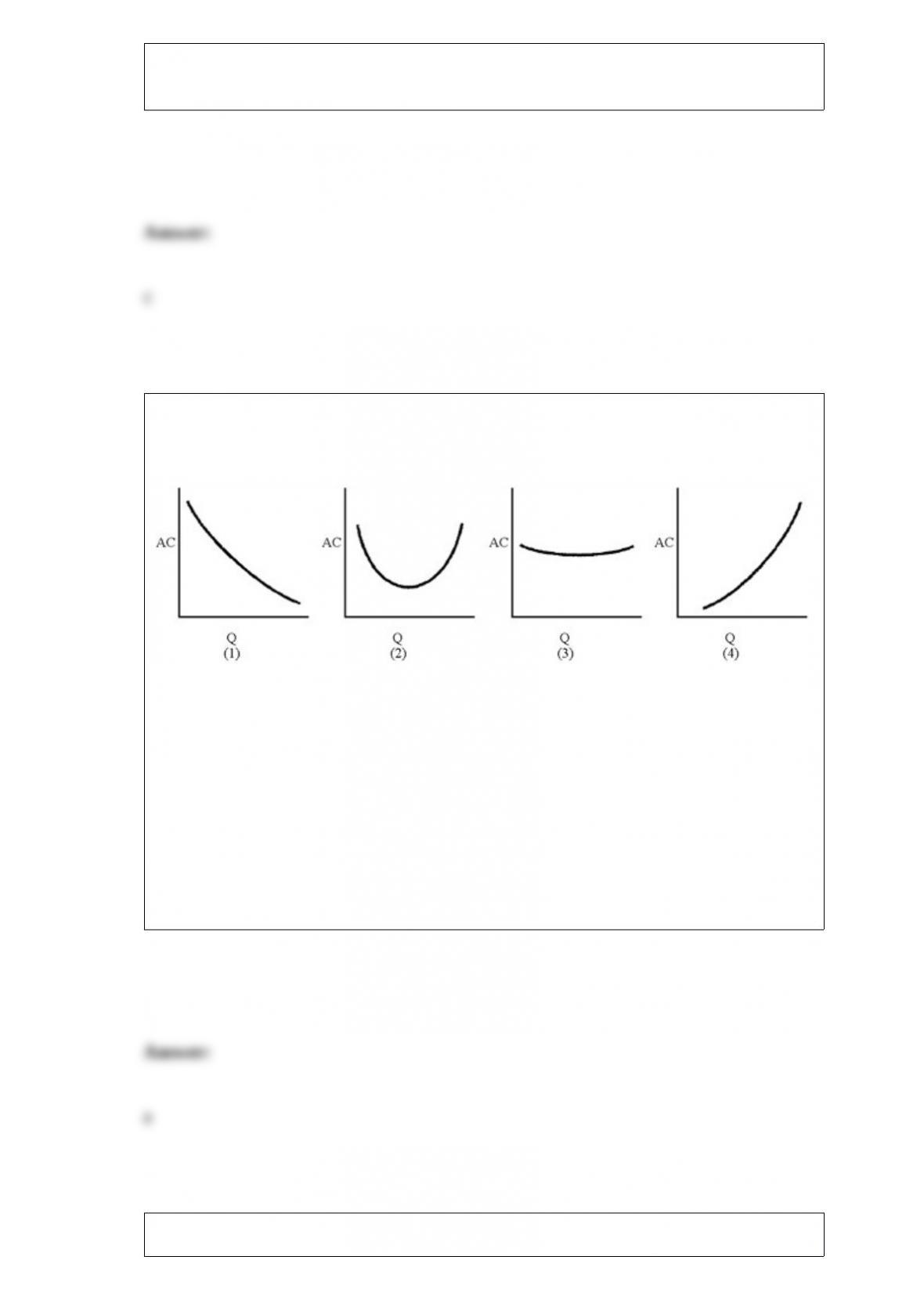
Figure 7-14
Of the long-run AC curves in Figure 7-14, which displays increasing returns to scale for
all levels of output?
a. 1
b. 2
c. 3
d. 4
For which of the following workers would the income effect be more likely to outweigh

the substitution effect of an increase in wage?
a. gardener
b. teacher
c. professional athlete
d. plumber
Suppose we observe an economy experience an economic expansion and high inflation.
This means the expansion is attributed to
a. growth in aggregate demand.
b. growth in aggregate supply.
c. a reduction in aggregate demand.
d. a reduction in aggregate supply.
In a long-run equilibrium in a perfectly competitive market, firms are selling at a price
equal to average cost.
a. True
b. False

Money and income are used interchangeably by noneconomists but mean different
things.
a. True
b. False
Labor markets are generally perfectly competitive markets.
a. True
b. False
Profit is the return to entrepreneurship.
a. True

b. False
Higher energy prices can be used to adequately explain the productivity slowdown in
a. the United States and the rest of the world.
b. the United States but not the rest of the world.
c. the rest of the world but not the United States.
d. neither the United States nor the rest of the world.
Supply-side inflation will increase the price level and reduce real GDP.
a. True
b. False

If the data show that periods of high economic growth rate accompanied by high
inflation rates, then changes in aggregate demand are the primary source of economic
fluctuations.
a. True
b. False
The main reason that President Clinton was forced to revise his campaign promise to
cut taxes was that, in 1993, he faced a large
a. balance of payments surplus.
b. balance of payments deficit.
c. federal budget deficit.
d. federal budget surplus.
A price above equilibrium always yields a surplus.
a. True
b. False

Government transfer payments are income earned by individuals who work for the
federal government.
a. True
b. False
An increase in the U.S. price level will increase U.S. net exports.
a. True
b. False
Money costs and opportunity costs are concepts that are
a. not related in any meaningful way.

b. used by tax accountants.
c. related through relative prices of goods and services.
d. used by economists to learn the most efficient level of output.
If gold and the dollar are substitutes, a cut in the Japanese discount rate can be expected
to
a. appreciate the dollar and decrease the price of gold.
b. depreciate the dollar and increase the price of gold.
c. depreciate the dollar and decrease the price of gold.
d. appreciate the dollar and increase the price of gold.
If aggregate quantity supplied exceeds aggregate quantity demanded, we can expect an
unplanned
a. depletion of inventories, causing firms to raise prices.
b. depletion of inventories, causing firms to lower prices.
c. accumulation of inventories, causing firms to raise prices.

d. accumulation of inventories, causing firms to lower prices.
If aggregate demand in the U.S. had grown more slowly than it actually did in 2010, the
a. unemployment rate would have been even lower.
b. inflation rate would have been even lower.
c. unemployment rate would have been the same.
d. economy would have grown faster.