
Serious environmental problems are
a. unique to industrial economies.
b. unique to Western economies.
c. unique to civilized economies (i.e., those in which people live mainly in cities).
d. None of the above is correct.
Points along a budget line represent the maximum combinations of two commodities
that a consumer can afford.
a. True
b. False
Microeconomics focuses on ____; macroeconomics concentrates on ____.
a. the basic tools of analysis; the use of abstractions and models
b. the economies of various countries; the decisions of individual companies
c. the decisions of individual units; the behavior of entire economies
d. the economic aggregates; the decisions of individual units

A profit-maximizing monopolist sets
a. her price where MC = MR.
b. her output where MC = MR.
c. Both a and b are correct.
d. Neither a nor b is correct.
The principal difference between conventional accounting and economic analysis of
inflation is that
a. accountants adjust nominal values for inflation.
b. accountants adjust real values for inflation.
c. economists adjust nominal values for inflation.
d. economists adjust real values for inflation.
If the expenditure schedule must be shifted upward to reach potential GDP, then the
economy is experiencing a(n)
a. inflationary gap.
b. precautionary gap.
c. recessionary gap.
d. expansionary gap.
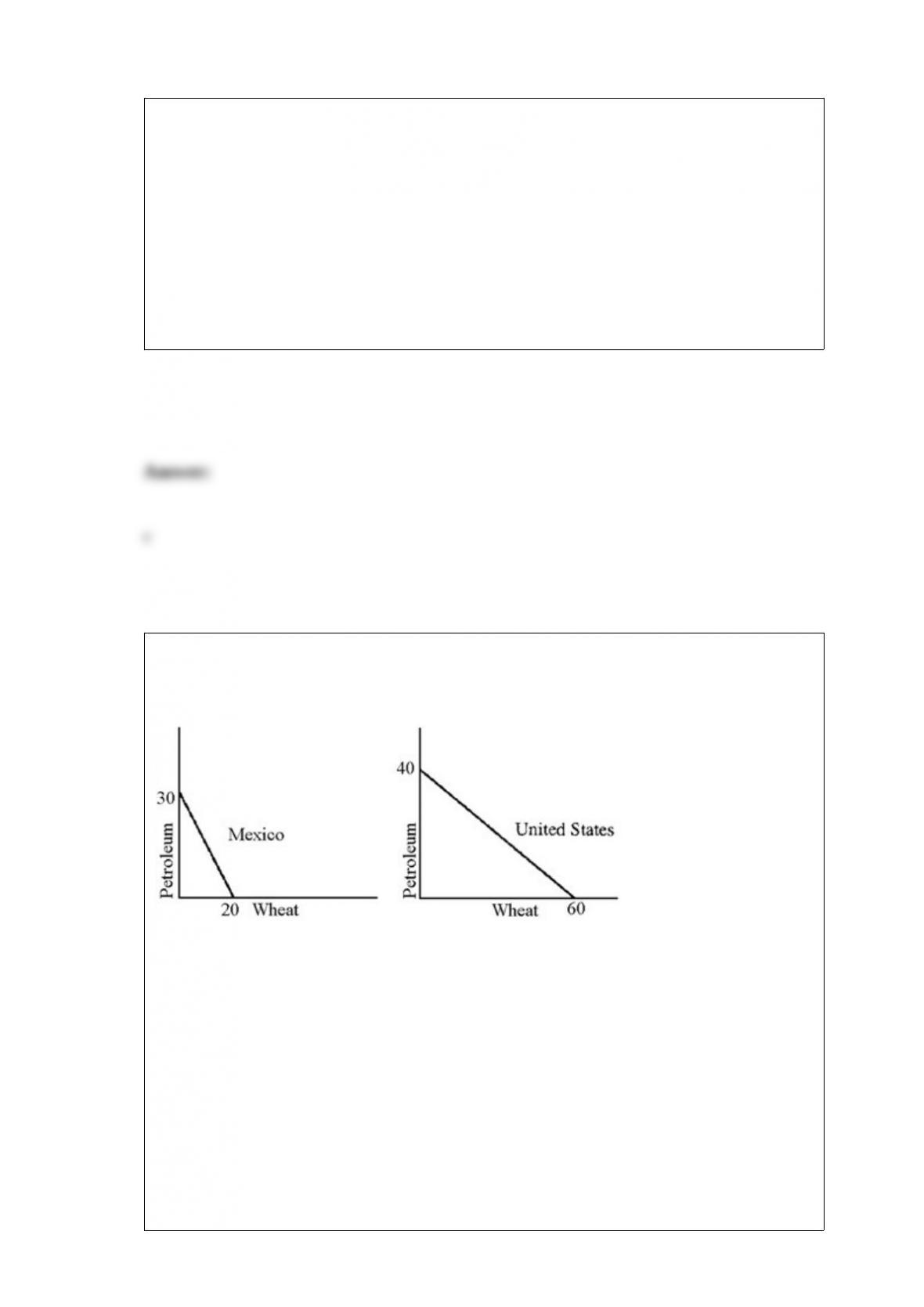
Figure 22-2
In Figure 22-2, if the United States and Mexico are negotiating to trade wheat for
petroleum,
a. the United States must receive more than 1 2/3 units of petroleum for a unit of wheat.
b. Mexico must receive more than 1 2/3 units of petroleum for a unit of wheat.
c. the limits of the agreement are between 1 unit of wheat for 2/3 unit of petroleum for
the United States and 1 unit of wheat for 1 1/2 units of petroleum for Mexico.
d. if the agreement is formalized at 1 unit of wheat for 1 unit of petroleum, then Mexico
will benefit from the trade but the United States will not.

Interest is the payment for the use of funds used to produce capital.
a. True
b. False
The scarcity of physical resources such as fuel means:
a. we should keep our homes cooler in the winter
b. we should keep our homes warmer in the summer
c. we should live close to our jobs to conserve fuel
d. all of these are true.

To the extent that high incomes can be attributed to very high demand for very scarce
abilities, the labor supply effects of a substantial increase in the tax rate
a. will be zero as long as the labor supply curve is vertical.
b. will be significant because the demand curve is fixed.
c. cannot be predicted because the substitution and income effects offset each other.
d. will be zero as long as there is no economic rent in the income.
If the equilibrium rate of interest would be 10 percent, but the usury law sets 8 percent,
a. the quantity of funds supplied would be greater than the quantity demanded.
b. economic efficiency would be promoted.
c. some applicants for loans would likely be turned down.
d. lenders would be able to fund fully all requests for loans.
Figure 19-4
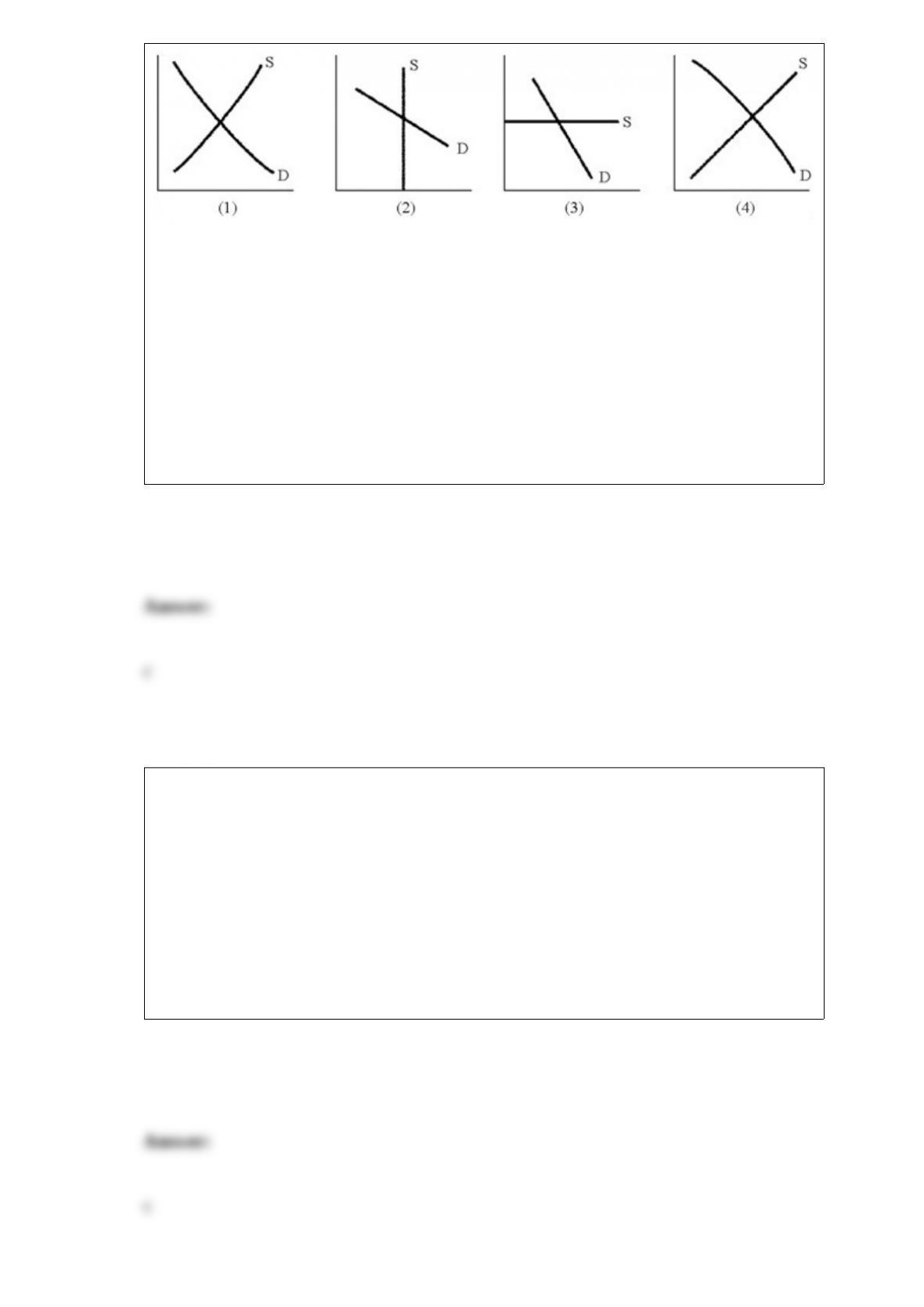
The panels in Figure 19-4 represent the supply and demand conditions for a factor of
production. In which case is the factor not earning any rent?
a. 1
b. 2
c. 3
d. 4
The vertical axis of the aggregate demand-aggregate supply model measures the
amount of
a. total employment.
b. total final output.
c. the price level.
d. net exports.

Economic models
a. are always based on realistic assumptions.
b. usually predict perfectly.
c. can never be tested with real world data.
d. are used to describe cause-and-effect relationships.
e. are too simple to be of much use.
Economists consider instances of increasing marginal utility to be
a. normal.
b. impossible.
c. unusual, as in the case of addictions.
d. irrational.
The profitability of an investment project will decrease if
a. tax rates decrease.

b. real interest rates increase.
c. real interest rates decrease.
d. business tax deductions increase.
Price levels rarely remain the same. This implies that
a. money is an excellent medium of exchange.
b. money is divisible.
c. money is a good medium for measuring value.
d. money is an imperfect medium for storing value.
The early goldsmiths issued money in the form of
a. coins made from gold in their safes.
b. receipts for the acceptance of gold deposits.
c. gold fragments left over from the production of jewelry.
d. fully backed gold certificates.

If a nation has “cheap labor,”
a. it can still benefit from trade.
b. other nations can still compete with it.
c. it cannot have a comparative advantage in everything.
d. All of the above are true.
The behavior of the perfectly competitive firm:
a. theoretically leads to an inefficient allocation of resources.
b. maximizes the benefits to consumers, given the resources available to the economy.
c. reduces output in order to raise prices in the short-term.
d. results in excess capacity and inefficiency.

The behavior of historical cost curves says nothing about the cost advantages or
disadvantages of a single large firm.
a. True
b. False
The goal of the business firm is maximization of ____, and the goal of the consumer is
maximization of ____.
a. total sales; income
b. total profit; utility
c. total output; utility
d. total sales; utility
In a free market the quantity demanded will not exceed the quantity supplied of a
resource, even if it is undergoing rapid depletion.
a. True
b. False

Phoebe and Rachel quit running in Central Park and join a health club to run on
treadmills. This decision
a. has no effect on GDP.
b. increases GDP.
c. decreases GDP.
d. increases nominal but not real GDP.
Scarcity raises both price and marginal utility but generally reduces total utility.
a. True
b. False

Forecasts of an inevitable exhaustion of essential natural resources are “simply beside
the point” because higher prices
a. reduce quantity demanded.
b. stimulate supply.
c. stimulate alternative technology.
d. All of the above are true.
The United States economy is
a. the third largest in the world.
b. larger than all other national economies combined.
c. second largest in the world, behind Japan.
d. largest in the world.
Last year your job at the university cafeteria paid you $9 an hour and the price of a
music download was $1.00. This year your cafeteria job pays $9.90 per hour and
download costs $1.10. You are clearly
a. worse off because of inflation.

b. worse off because the download is now relatively more expensive.
c. better off because your wage rate went up.
d. better off because the download now costs less work.
Discounting or computing present value is a way of comparing dollar values that will
appear at different points in time.
a. True
b. False
Investment increases by $200 million and the value of MPC is 0.75. What would be the
total increase in spending?
a. $200 million
b. $266 million
c. $750 million
d. $800 million

Which of the following is included in M1?
a. savings accounts
b. money market deposit accounts
c. money market mutual funds
d. certificates of deposit
e. None of the above are included.