
If workers and firms forecast inflation accurately,
a. the aggregate supply curve will be vertical.
b. the real wage will not decline as the price level rises.
c. workers will not lose from inflation, and firms will not gain.
d. All of the above are correct.
An increase in interest rates will generally lead to a(n) ____ in present investment and
a(n) ____ in future income and production.
a. decrease, decrease
b. decrease, increase
c. increase, decrease
d. increase, increase
Which of the following is a source of inequality in incomes?
a. luck
b. willingness to take risks

c. differences in investment in human capital
d. All of the above are correct.
A decrease in disposable income will
a. lead to an upward movement along the consumption function.
b. lead to a downward movement along the consumption function.
c. shift the consumption function upward.
d. shift the consumption function downward.
The total cost curve generally has
a. slope values which first decrease and then increase rapidly.
b. slope values which first increase rapidly and then decrease.
c. increasing slope values.
d. decreasing slope values.

Which of the following is not a principal means by which corporations obtain money
for investment?
a. selling stocks
b. selling bonds
c. retaining earnings
d. receiving dividends
In an open economy, aggregate supply consists of domestic production
a. plus imports.
b. plus exports.
c. minus imports.
d. minus exports.
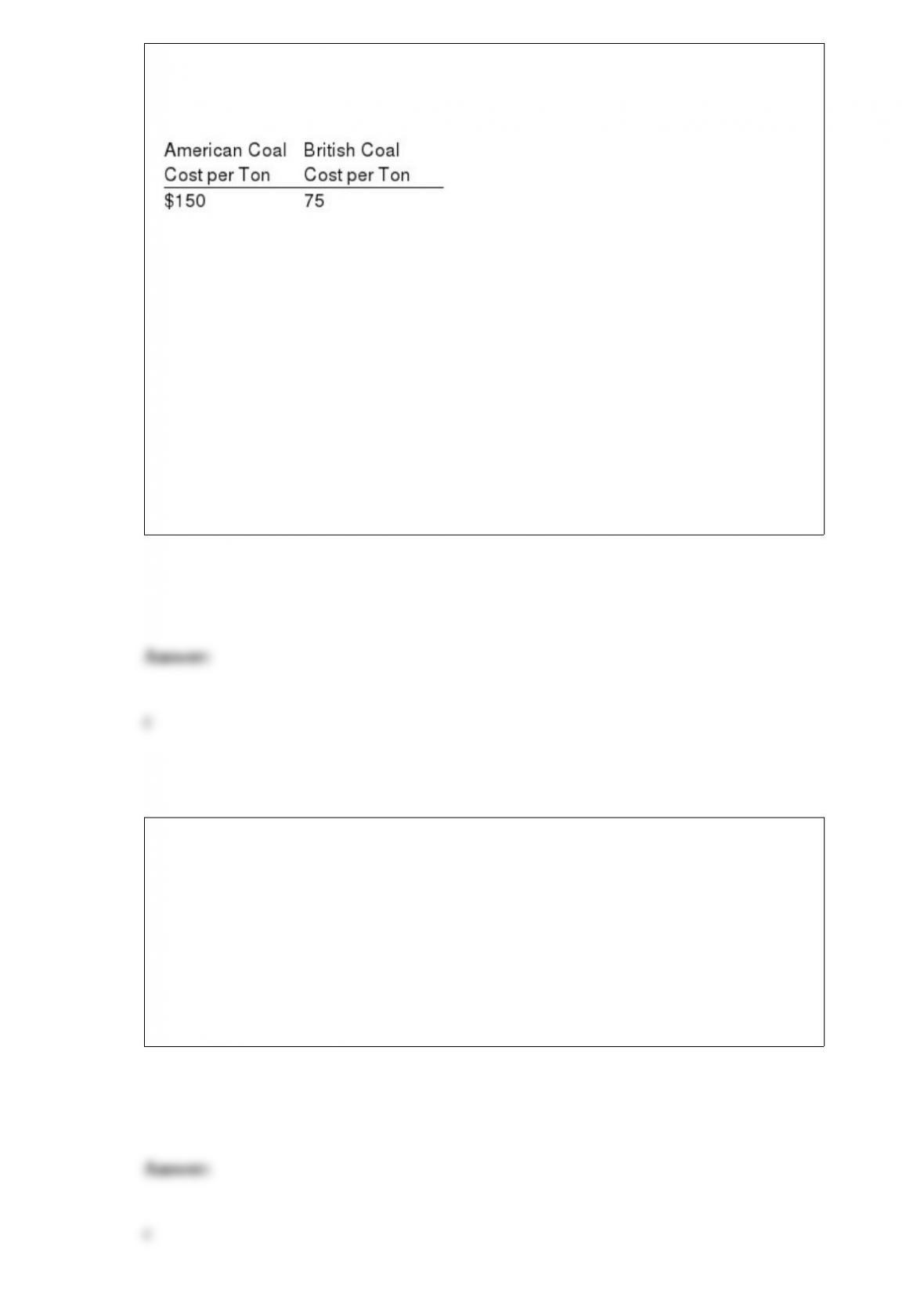
Table 19-1
Assume that the information in Table 19-1 applies to the cost per ton of coal in 1998.
Assume that also over a 10-year period prices rise 100 percent in Great Britain and 200
percent in the United States. According to the purchasing power parity theory, the
exchange rate between the dollar and the pound in the year 2008 will be
a. one dollar = two pounds.
b. one pound = two dollars.
c. one pound = three dollars.
d. one dollar = three pounds.
If the federal government has a deficit, and the current account is in balance, then
a. I = S.
b. I > S.
c. S > I.
d. S + I = 0.

At the end of 2014, the net national debt per person in the United States was
approximately
a. $14 trillion.
b. $142 billion.
c. $56,000.
d. $86,000.
A firm uses two inputs, A and B. At its optimal choice of input proportions,
a. MRP of A = MRP of B.
b. MRPA/PA = MRPB/PB.
c. MPP of A = MPP of B.
d. All of the above are correct.
When using the terms “total utility” or “marginal utility” we assume:
a. the consumer will exchange one commodity for another

b. the consumer will part with money for the commodity
c. the consumer has declined to purchase the commodity
d. a and b are correct
Which of the following functions is not performed by prices in a free market?
a. guiding the allocation of resources
b. conveying information about the marginal cost of production
c. making the distribution of income more equitable
d. replacing the need for governmental supervision of production
In periods of generally rising prices,
a. real GDP will grow faster than nominal GDP.
b. nominal GDP will grow slower than real GDP.
c. real GDP will grow slower than nominal GDP.
d. real GDP and nominal GDP will grow at the same rate.

A period of stagflation can be considered as part of the normal aftermath of a
a. decrease in aggregate demand.
b. period of high unemployment.
c. period of low unemployment.
d. period of inward shifting aggregate demand.
The marginal propensity to consume (MPC) is calculated by which formula?
a. MPC = change in DI divided by change in C
b. MPC = change in GDP divided by change in DI
c. MPC = change in C divided by change in DI
d. MPC = change in C divided by change in GDP

A student has a chance to see Katy Perry in concert. The student also has a major
economics exam in the morning. If the student goes to the concert,
a. she will get a lower grade on the economics exam.
b. the opportunity cost of the concert is time spent studying.
c. this decision implies a trade-off.
d. All of the above are correct.
In January, 2,500 quarts of ice cream are sold in Boston at $2 a quart. In February,
3,000 quarts are sold at $2.50 a quart. This change in quantity sold and price may have
been caused by
a. a reduction in wages in the Boston area.
b. the introduction of labor-saving automated ice cream-packing machinery.
c. the release of a medical study showing that ice cream consumption improves mental
health.
d. the decision by Boston ice cream sellers to eliminate discount coupons.
If good “A” is represented on the horizontal axis and good “B” on the vertical axis, then

the steeper the production possibilities frontier at a given level of production of good
“A,” the
a. larger the opportunity cost of producing an extra unit of good “A.”
b. larger the quantity of resources being devoted to the production of good “B.”
c. smaller the quantity of resources being devoted to the production of good “A.”
d. smaller the opportunity cost of producing an extra unit of good “A.”
e. greater the returns to scale in the production of good “A.”
A major problem with the negative income tax is that
a. low tax rates imply low break-even incomes.
b. low tax rates imply high break-even incomes.
c. high tax rates imply low minimums.
d. All of the above are correct.
Real wages more accurately reflect the payment to labor because they are adjusted for
the effects of inflation.
a. True
b. False
Carefully define the following terms and explain their importance.
a. variable
b. ray
c. slope
d. contour map

In the view of human capital theorists, educational institutions are factories that take
less productive workers as their raw materials and create more productive workers as
output.
a. True
b. False
The post-World War II record shows that recessionary gaps may be long-lasting because
____ tends not to occur.
a. deflation
b. reflation
c. stagflation
d. disinflation
When the Fed wants to expand the money supply through open market operation, it
a. sells government securities to the Treasury.
b. sells government securities to member banks.
c. buys government securities from member banks.

d. buys government securities from the Treasury.
Equilibrium is reached where there is no inherent force causing quantity supplied or
quantity demanded to change.
a. True
b. False
The money supply contracts when the Fed
a. replaces old worn-out notes and bills.
b. borrows from the Treasury.
c. sells government securities.
d. purchases stocks from corporate businesses.

The incidence of a tax explains what group pays the burden of a tax.
a. True
b. False
An accurate demand curve can be derived by examining the quantities of a good that
are sold over time as the price varies.
a. True
b. False
Monetizing the debt is a way of turning debt into money and reducing the burden of the
debt.
a. True
b. False

One principle that nearly all economists agree on when defining money is that it should
be
a. spendable.
b. liquid.
c. accepted as payment.
d. easily transferable.
e. All of the above are correct.
Why does equilibrium in the market for a traded good not occur where that country’s
quantity demanded equals quantity supplied?
a. Because equilibrium occurs where demand equals supply.
b. Because markets are never in equilibrium.
c. Because some of the good is imported or exported.
d. Because there are several demand curves, and the market can’t choose between them.
e. All of the above are correct.