
Among young Americans aged 19 to 25, _____% have no health insurance.
a. 11%
b. 17%
c. 22%
d. 26%
A ceiling on interest rates is likely to lead to
a. an increase in lending activity.
b. more rapid capital formation by business.
c. increases in hiring of labor.
d. a shortage of loanable funds.
Generally, the opportunity cost and the money cost of a good
a. are identical only if the good sells in a free market.
b. are different.
c. matter only to the purchaser of the good.

d. are not reflected in its price.
More education and training usually lead to higher levels of
a. productivity.
b. population.
c. pollution.
d. import protectionism.
The combination of high unemployment and high inflation is termed
a. reflation.
b. stagflation.
c. depression.
d. unflation.

When the U.S. dollar appreciates,
a. U.S. exports rise.
b. U.S. imports decline.
c. aggregate demand shifts inward.
d. aggregate demand shifts outward.
If the four-firm concentration ratio in an industry increases, the industry
a. must have become more competitive.
b. must have become a monopoly.
c. must have become less competitive, although not necessarily a monopoly.
d. may or may not have become less competitive.

An economist who studies the sales and profits of a large corporation would be
classified as a(n)
a. macroeconomist.
b. equity analyst.
c. stock broker.
d. microeconomist.
e. social economist.
Productivity increases are most likely to be achieved by
a. Tony Soprano’s psychiatrist.
b. major league baseball teams.
c. symphony orchestras.
d. personal computer manufacturers.
Unemployment in the United States varies considerably over time.
a. True

b. False
In response to the demands of environmentalists, large sections of timberlands are put
off limits to logging. What effect will this have on the aggregate supply curve?
a. Shift it outward.
b. Shift it inward.
c. Move the economy up along the curve.
d. Move the economy down along the curve.
Regarding economic models, which of the following statements is NOT true?
a. An economic model is a simplified representation of a theory or part of a theory
b. An economic model can provide answers for policy makers.
c. An economic model can illuminate an important economic problem
d. An economic model can depict 3-variable diagrams.
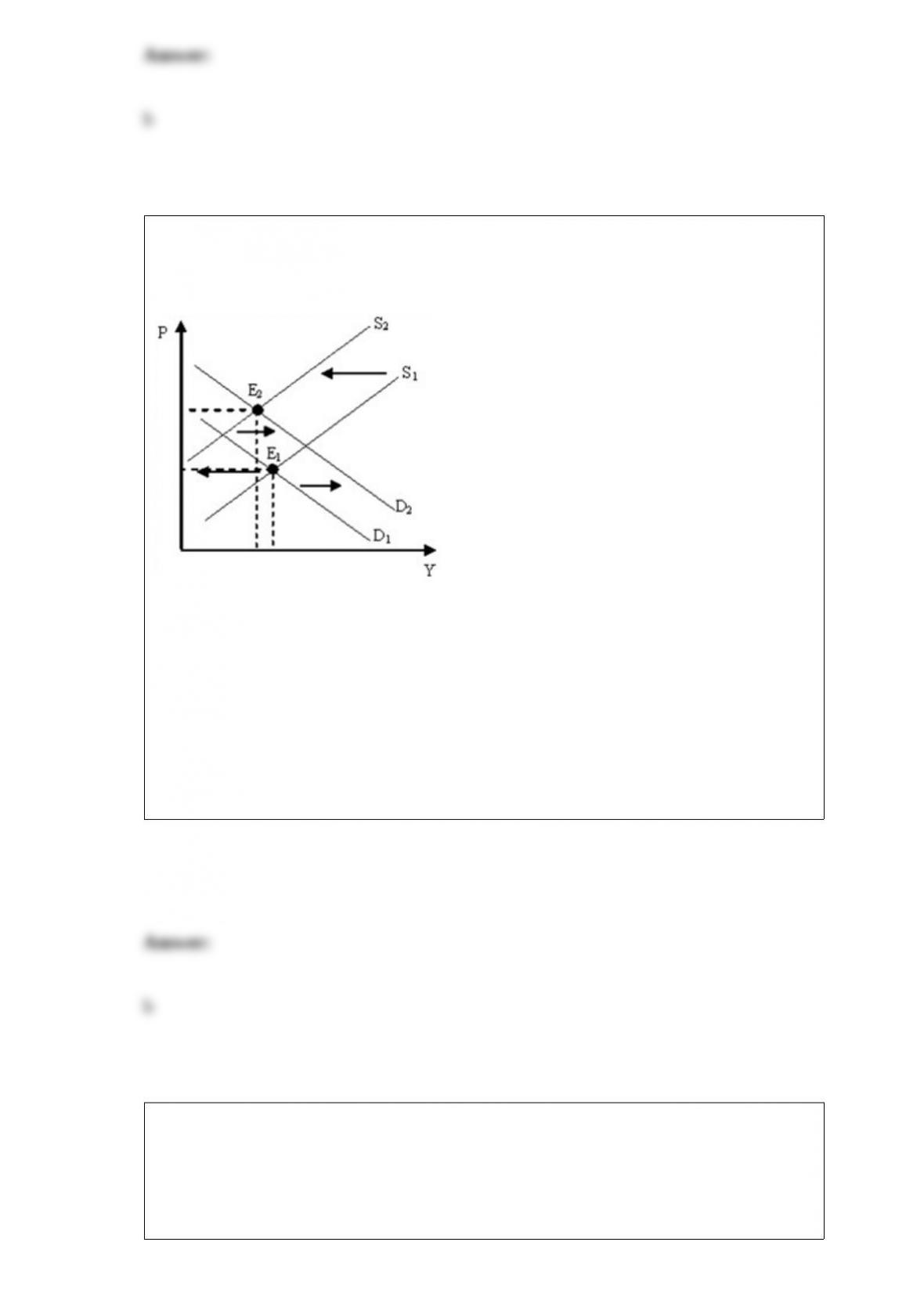
Figure 10-8
Figure 10-8 describes which of the following periods in the U.S.?
a. 1930s
b. 1973-1975
c. late 1990s
d. 2007-2009
The economy will reach equilibrium in a simple economy only if saving is
a. greater than investment.
b. less than investment.

c. equal to investment.
d. equal to disposable income.
To maximize sales revenue, an oligopolist will expand output until the elasticity of
demand becomes
a. negative.
b. zero.
c. one.
d. infinite.
Which of the following observations is not true?
a. Demand curve of the perfectly competitive firm is perfectly elastic.
b. There is only one price for a product in a perfectly competitive market.
c. A firm in a perfectly competitive market can sell as much as it wants at market price.
d. Demand curve of the perfectly competitive industry is perfectly elastic.
The federal government could stimulate investment spending by
a. phasing out the depreciation allowance on corporate income taxes.
b. enacting an investment tax credit.
c. reinstating the windfall profits tax.
d. reducing the tax rate on capital gains.
e. Both b and d are correct.
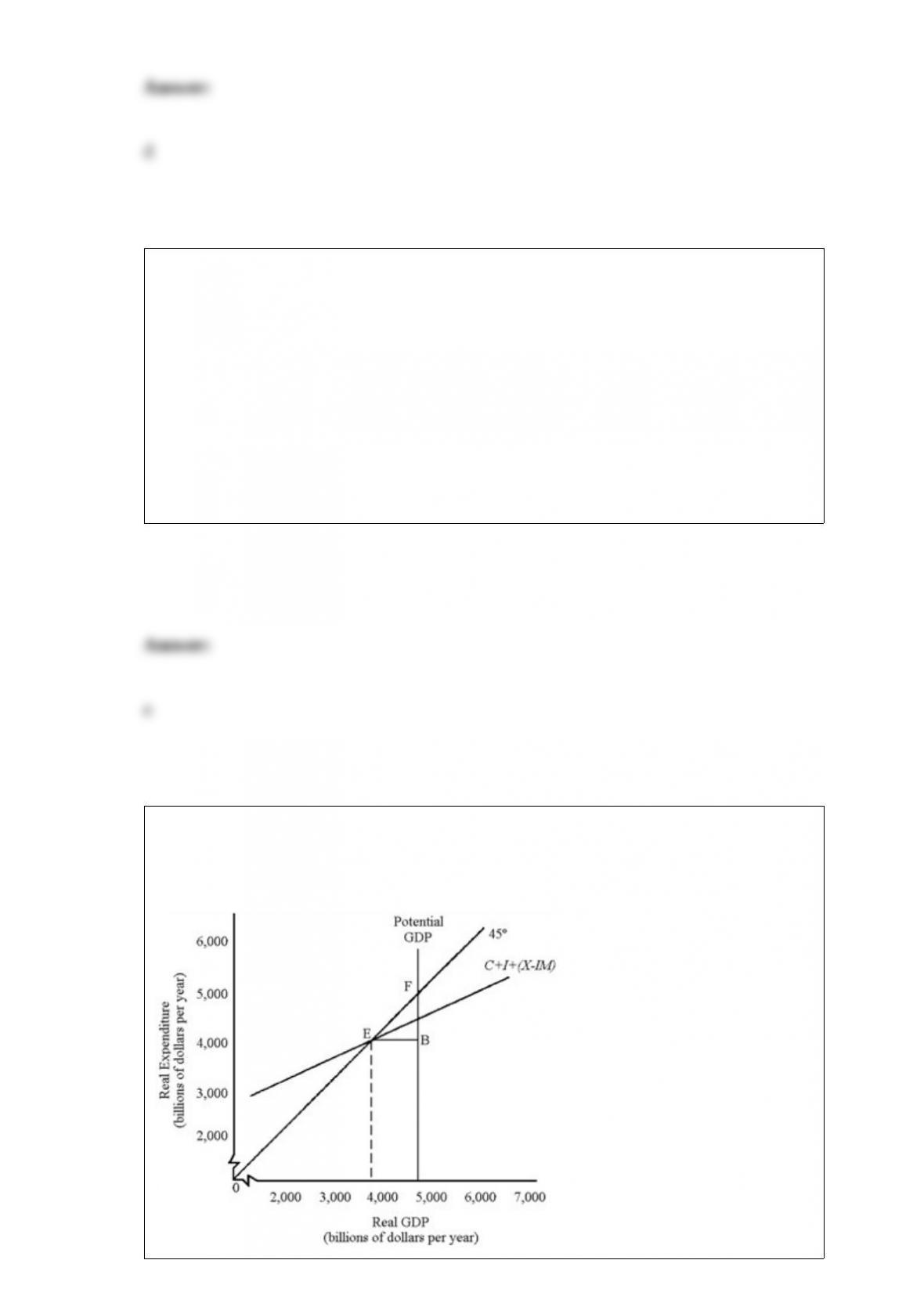
Figure 9-1

In Figure 9-1, the economy is
a. experiencing an inflationary gap, shown by the horizontal distance EB.
b. at full employment without inflation.
c. experiencing a recessionary gap, shown by the horizontal distance EB.
d. experiencing a recessionary gap, shown by the distance between EF.
The United States suffers more from strikes than Japan but fewer strikes than Canada.
a. True
b. False
As one moves down a straight-line demand curve, the elasticity increases.
a. True
b. False

It is most likely that the federal government will never actually pay off the national
debt.
a. True
b. False
Marginal productivity analysis shows that a drop in the price of the product will cause
input use to
a. increase.
b. decrease.
c. stay the same.
d. The information is insufficient to provide an answer.
Increased concern about environmental problems derive partly from

a. concerns about increasing economic output.
b. concerns about unemployment and inflation.
c. new awareness that the problems exist.
d. concerns about the quality of life.
Government stabilization policy
a. cannot influence investment spending.
b. can stimulate aggregate demand and thereby induce businesses to invest, but the
amount is not totally predictable.
c. can stimulate aggregate demand, but investment spending will not be affected.
d. can stimulate aggregate demand, but only in the long run.
Corporations account for a ____ proportion of U.S. firms and a ____ proportion of sales
by U.S. firms.
a. small; small
b. small; large
c. large; small

d. large; large
The way in which most persons pay their personal income tax is in the form of
a. quarterly payments throughout the year.
b. annual payment by April 15.
c. monthly payments as part of mortgage payments.
d. payroll withholding during the year.
Julie is in the 28 percent tax bracket. She earns an 8 percent rate of return after taxes on
a tax-free municipal bond. What will the after-tax rate of return be on a taxable bond
(with equal risk)?
a. 36 percent
b. 28 percent
c. 14 percent
d. 8 percent

The International Monetary Fund was established to manage the Bretton Woods
System.
a. True
b. False
On balance, markets do some things very well, and some things poorly.
a. True
b. False
Assume that Sharon purchases $5,000 worth of a stock. To do so she uses $1,000 of her
own money and borrows the remaining $4,000 at a 7.0% interest rate. If the stock’s
value decreases by 10% in one year and she has to sell the stock at that time, what is her
rate of return?

a. −10%
b. −50%
c. −78%
d. −156%
The most important advantages of bigness will be found in industries that show
increasing returns to scale.
a. True
b. False