
Efficiency in the choice of outputs requires that marginal cost be equal to marginal
revenue and nothing else.
a. True
b. False
In an ideal free unregulated market
a. supply curves reflect all negative externalities.
b. external benefits are abundant.
c. all individual and social needs are met by the market.
d. optimal quantities of all goods and services are produced.
Carefully define the following terms, and explain their importance in economics.
a. opportunity cost
b. abstraction
c. theory
d. model
e. marginal analysis
Aggregate demand grows because
a. patent laws protect and stimulate new inventions.
b. there is more machinery and technology improves.
c. the government increases its spending, a growing population increases consumer
spending, and the Fed increases the money supply.
d. All of the above are correct.

Changes in nominal GDP always reflect changes in real output.
a. True
b. False
The effectiveness of direct controls on pollution depends on: (i) the budgets and
enthusiasm of the regulatory bodies; (ii) sufficiently strong statutory penalties.
a. i and ii
b. i but not ii
c. ii but not i
d. neither i nor ii
Strategic trade policy relies on threats of protectionism to protect free trade.
a. True
b. False
In general, countries with lower rates of growth of labor productivity have
a. lower levels of productivity.
b. higher levels of productivity.
c. lower levels of educational attainment.
d. higher levels of natural resource endowments.
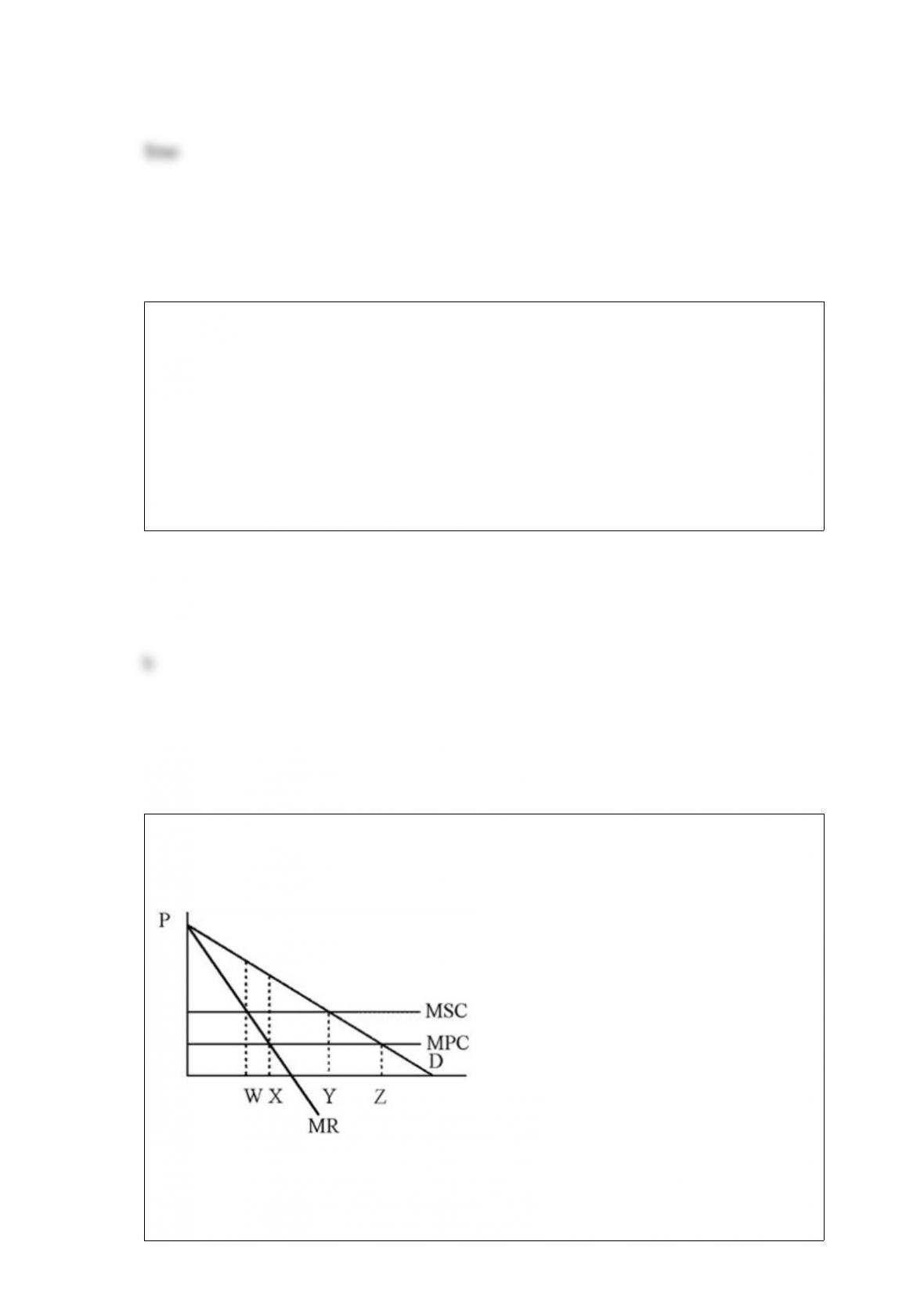
Figure 15-1
Figure 15-1 describes conditions in the monopolized weezil industry. If the government
replaces the monopolist with perfectly competitive firms and forces these firms to take
account of all the costs and benefits they impose on society, the industry will produce

an output equal to
a. W.
b. X.
c. Y.
d. Z.
When an economy is operating with maximum efficiency, the production of more of
commodity A will entail the production of less of commodity B because
a. resources are specialized and are not shiftable.
b. resources are limited.
c. the structure of demand is fixed at any point in time.
d. material wants are insatiable.
In the United States, all property is privately owned.
a. True
b. False
National income is
a. the sum of all wages and salaries, interest, rent, and profits in the economy.
b. equal to the money value of national output.
c. the before-tax income of all individuals in the economy.
d. All of the above are correct.
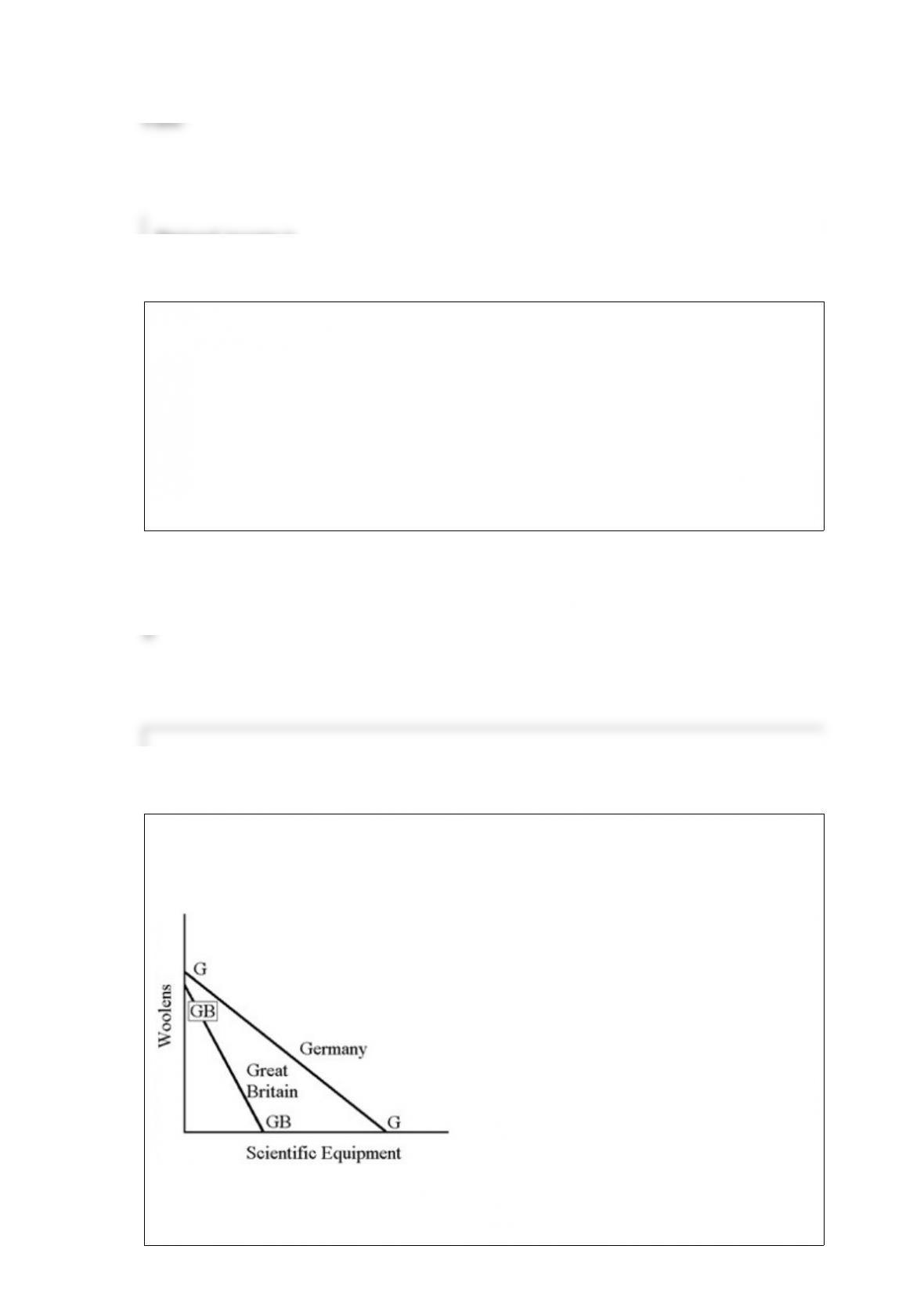
Figure 22-1
In Figure 22-1,

a. Great Britain has an absolute advantage over Germany in the production of both
scientific equipment and woolens.
b. Germany has a comparative advantage over Great Britain in the production of
woolens.
c. Great Britain has a comparative advantage in the production of woolens.
d. Great Britain should export scientific equipment to Germany, and Germany should
export woolens to Great Britain.
The issue of inequality has become prominent because of:
a. an increased sense of justice
b. a decrease in the strength of capitalism
c. the widening wage disparity
d. none of these
Private goods are not excludable.
a. True
b. False

Excess reserves are put to use by a bank when it
a. puts cash in the vault to back existing loans.
b. pays off the mortgage on its building.
c. sells government securities.
d. makes loans to its customers.
In the area of taxation, the trade-off between equity and efficiency
a. never occurs since efficient taxes are often the most progressive.
b. is relevant as efficient taxes are often regressive.
c. is irrelevant.
d. is relevant because efficient taxes are often progressive.

Goods that are actually produced by firms are not really limited in supply, because the
firms can always produce more of them.
a. True
b. False
An economic boom in the United States would cause the aggregate demand curve in
other countries to shift outward.
a. True
b. False
If Japan experiences a period of deflation and the United States does not, what will
happen in the United States?
a. an increase in aggregate supply
b. a decrease in aggregate supply
c. a decrease in aggregate demand
d. an increase in aggregate demand

Unlike a perfectly competitive firm, a monopolist
a. can choose how much output to produce.
b. cannot increase production without affecting the price she receives for her good.
c. usually sells in a market with a downward-sloping demand curve.
d. has an MR from increasing output by one unit equal to the price of his product.
Adam Smith believed that markets coordinated the self-interests of consumers.
a. True
b. False

One benefit of a negative income tax is that it would increase work incentives.
a. True
b. False
Economic theory
a. is a deliberate simplification of factual relationships.
b. seeks to disprove a hypothesis.
c. is based mainly on assumptions.
d. seeks to prove political ideals.
A labor union is an organization representing workers in negotiations with employers
over wages, benefits, and working conditions.
a. True
b. False

Pollution is a relatively new phenomenon.
a. True
b. False
A firm should make an investment only if
a. it is profitable in every year.
b. the present value of the profits exceeds the present value of the costs.
c. the present value of the revenues exceeds the present value of the costs.
d. there are no large losses in the early years.
Figure 11-2
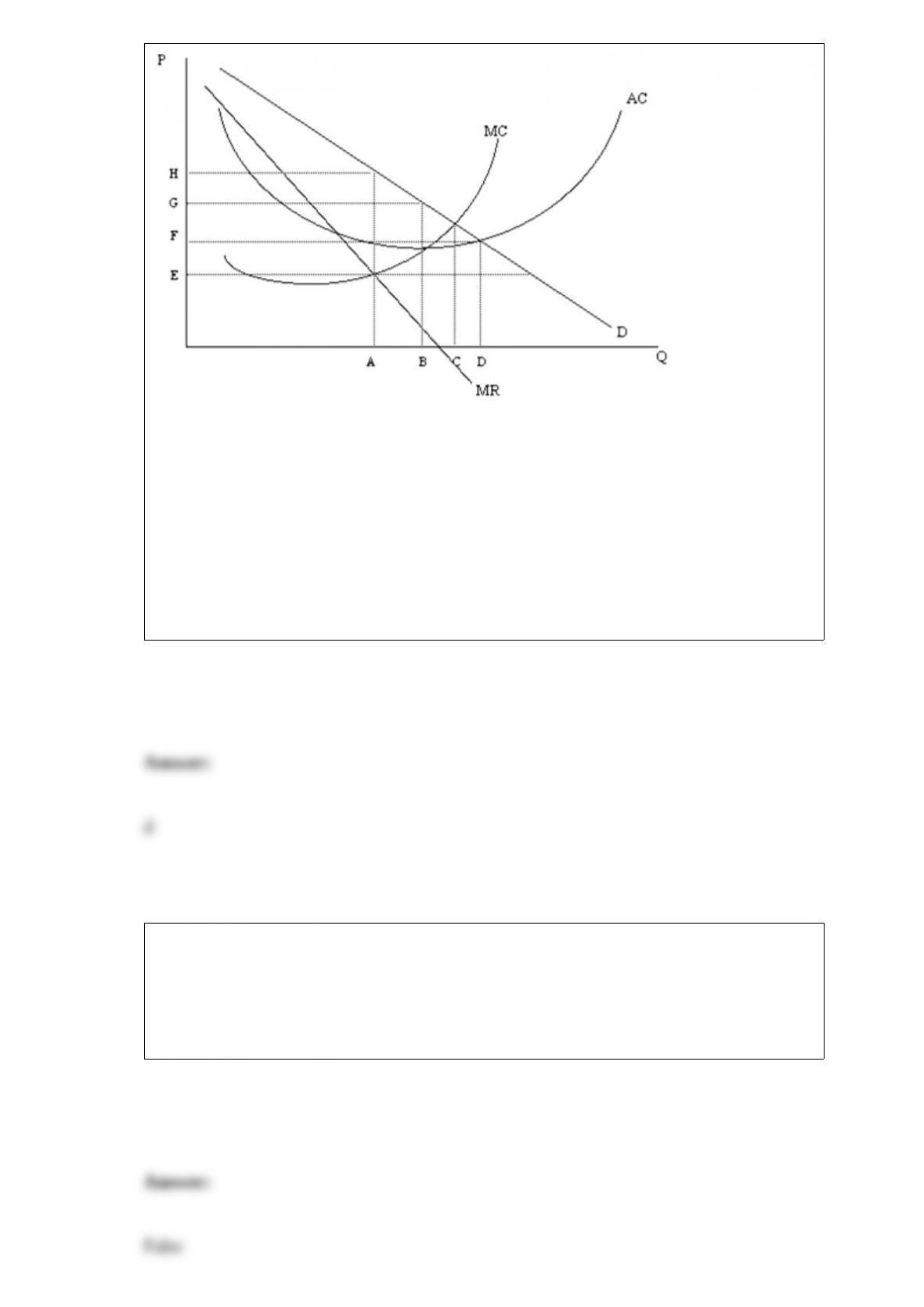
In Figure 11-2, at what quantity would the monopolist maximize profit?
a. E
b. F
c. G
d. H
In 2010, the debt-to-GDP ratio increased to roughly the same ratio as the 1990s.
a. True
b. False

Why would it be a mistake to treat opportunity costs and explicit monetary costs as
identical?
a. Because sometimes the market does not function well.
b. Because opportunity costs are different for different goods.
c. Because there are trade-offs involved in any decision.
d. Because of existence of efficient markets.
Unemployment insurance has an important macroeconomic effect because it
a. props up aggregate supply.
b. props up aggregate demand.
c. props up aggregate exports.
d. helps balance the federal budget.
A country like the U.S., which is operating at the technological frontier, can improve its
technology only by:
a. repurposing

b. redeveloping
c. innovating
d. purchasing
The least costly way to produce a given level of output is indicated by the point of
tangency between a budget line and the production indifference curve corresponding to
that level of output.
a. True
b. False
The marginal revenue curve for a monopolist is
a. always above the demand curve.
b. generally below the average cost curve.
c. always above the average revenue curve.
d. always below the demand curve.

To maximize sales revenue, an oligopolist will expand output until the marginal
revenue curve cuts the horizontal axis.
a. True
b. False