
Government-imposed limits on price movements are likely to
a. increase economic efficiency.
b. decrease economic efficiency.
c. leave economic efficiency unchanged.
d. promote economic growth in the economy.
An employer who refuses to hire women because of the chance they may quit for
childbearing purposes is engaging in statistical discrimination.
a. True
b. False
The personal income tax is the single largest source of revenue for the federal
government.
a. True
b. False

A perfectly competitive firm may, under some circumstances, be able to affect the
market price.
a. True
b. False
To try and stave off a devaluation of its fixed currency, Argentina was required to
a. lower interest rates.
b. reduce tax levels.
c. increase their money supplies.
d. increase interest rates.
Perfect competition is an ideal market structure.
a. True

b. False
Emissions permits might be called a “license to pollute.”
a. True
b. False
If a profit-maximizing firm’s fixed cost of producing widgets falls,
a. its total cost curve is unaffected.
b. its marginal cost curve shifts down.
c. the firm will produce more widgets.
d. the firm’s average profit per widget produced rises.
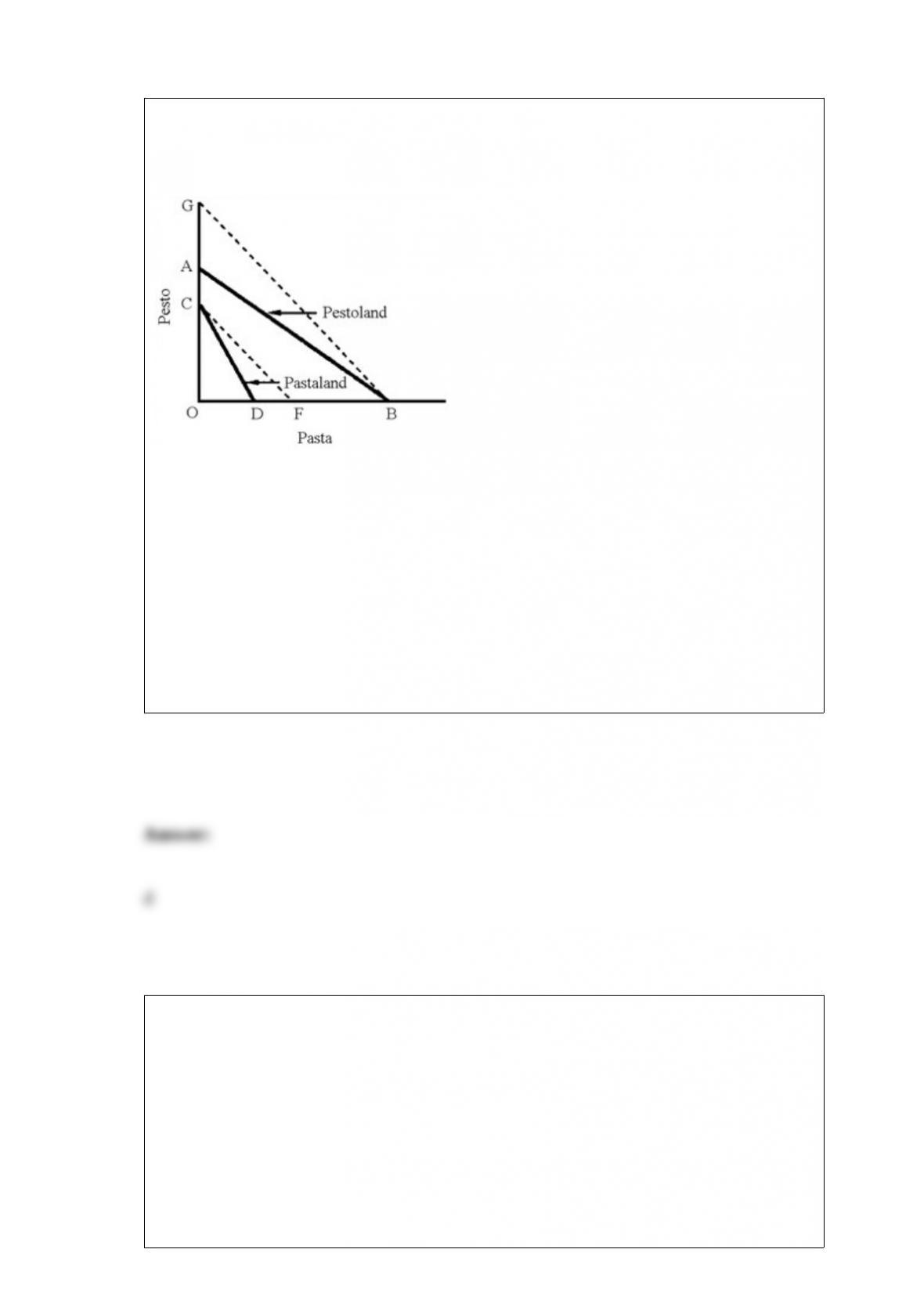
Figure 22-7
In Figure 22-7, where AB represents the production possibilities of Pestoland and CD
the production possibilities of Pastaland, Pastaland is
a. better at producing pasta and pesto than Pestoland.
b. better at producing pasta, but relatively inefficient in producing pesto.
c. relatively better at producing pasta than pesto.
d. relatively better at producing pesto than pasta.
The price for labor is the wage rate. What happens to the quantity of labor supplied if
wages increase?
a. It increases.
b. It decreases.
c. It does not change.
d. Uncertain-economic theory has no answer to this question.

The saying “the lower the price, the better” may not always be correct for an economy’s
public interest because
a. people should have to pay for what they want.
b. people will overuse something they perceive as being cheaper than the utility they
receive for it.
c. the government can no longer afford to provide all the goods and services it provides
because it is slowly going broke.
d. cheaper prices will make people buy less of other things.
Market economies are not constrained by scarcity; only planned economies have that
problem.
a. True
b. False

The quantity which a firm will supply in the short run
a. can be read from its average cost curve.
b. can be read from its average variable cost curve.
c. can be read from the firm’s marginal cost curve above average variable cost.
d. is always zero above minimum average variable cost.
The contemporary consensus with regard to stabilization policy is that
a. fiscal policy is, for now, the “only game in town.”
b. fiscal policy is more effective than monetary policy.
c. monetary policy is, for now, the “only game in town.”
d. monetary policy is slightly more effective than fiscal policy.
The oversimplified formula for the multiplier yields a number that is too large due to
the exclusion of
a. variable imports.

b. changes in the price-level.
c. income taxes.
d. All of the above.
Inflation increases the use of money as a store of value.
a. True
b. False
The equation of exchange is M Y = P V.
a. True
b. False

In the short run, fiscal and monetary policy cause unemployment and inflation to move
in opposite directions because
a. the Fed and Congress rarely agree on policy.
b. one controls aggregate demand, the other controls aggregate supply.
c. both policies control only aggregate supply.
d. both policies control only aggregate demand.
The ____ the demand curve for a good, the ____ the change in equilibrium quantity
after a shift of the supply curve.
a. flatter; greater
b. flatter; smaller
c. farther from the origin at every output level; greater
d. farther from the origin at every output level; smaller
Advertising has no effect on the demand schedule for a good.
a. True

b. False
In the short run, efforts to reduce the unemployment rate are likely to cause
a. a decrease in the inflation rate.
b. an increase in the inflation rate.
c. no change in the inflation rate.
d. Uncertain-economists have found no relationship between the two variables.
If a demand curve is unit elastic, then P times Q will remain constant when P changes.
a. True
b. False

To an economist, the cost of a college education
a. includes the income that the student could have earned during the time spent in
college.
b. can be measured solely by the dollar cost of tuition, books, and other fees.
c. includes only the cost of schooling, not the cost of housing and food.
d. excludes financial aid in computation of the cost of schooling.
e. All of the above are correct.
The law of diminishing marginal returns is the same as increasing returns to scale.
a. True
b. False
Average cost is higher with a monopolistically competitive firm than with a perfectly
competitive firm.
a. True
b. False

In the early 1980s, the economy experienced high unemployment with falling inflation.
a. True
b. False
For which of the following is there no such thing as a “price?”
a. labor
b. land
c. entrepreneurship
d. none of the above

Gross private domestic investment in the United States consists of three components:
a. stocks, bonds, and mutual funds.
b. automobiles, trucks, and houses.
c. plant, equipment, & software, houses, and inventories.
d. plant, equipment, & software, houses, and net exports.
Members of the Board of Governors of the Fed are
a. elected to two-year terms by the Electoral College.
b. appointed by the president for four-year terms and confirmed by the Congress.
c. appointed by the president for 14-year terms and confirmed by the Senate.
d. appointed by the president for 14-year terms and confirmed by the Supreme Court.
In Eastern Europe and the countries of the former Soviet Union,
a. grave environmental problems plague Eastern Europe.
b. the area suffers from widespread illness and countless premature deaths.
c. the Aral Sea, once the world’s fourth-largest inland sea, is now half its previous size.

d. All of the above are correct.
The marginal revenue product is the extra revenue the firm receives by selling one more
unit of output.
a. True
b. False
Figure 9-4
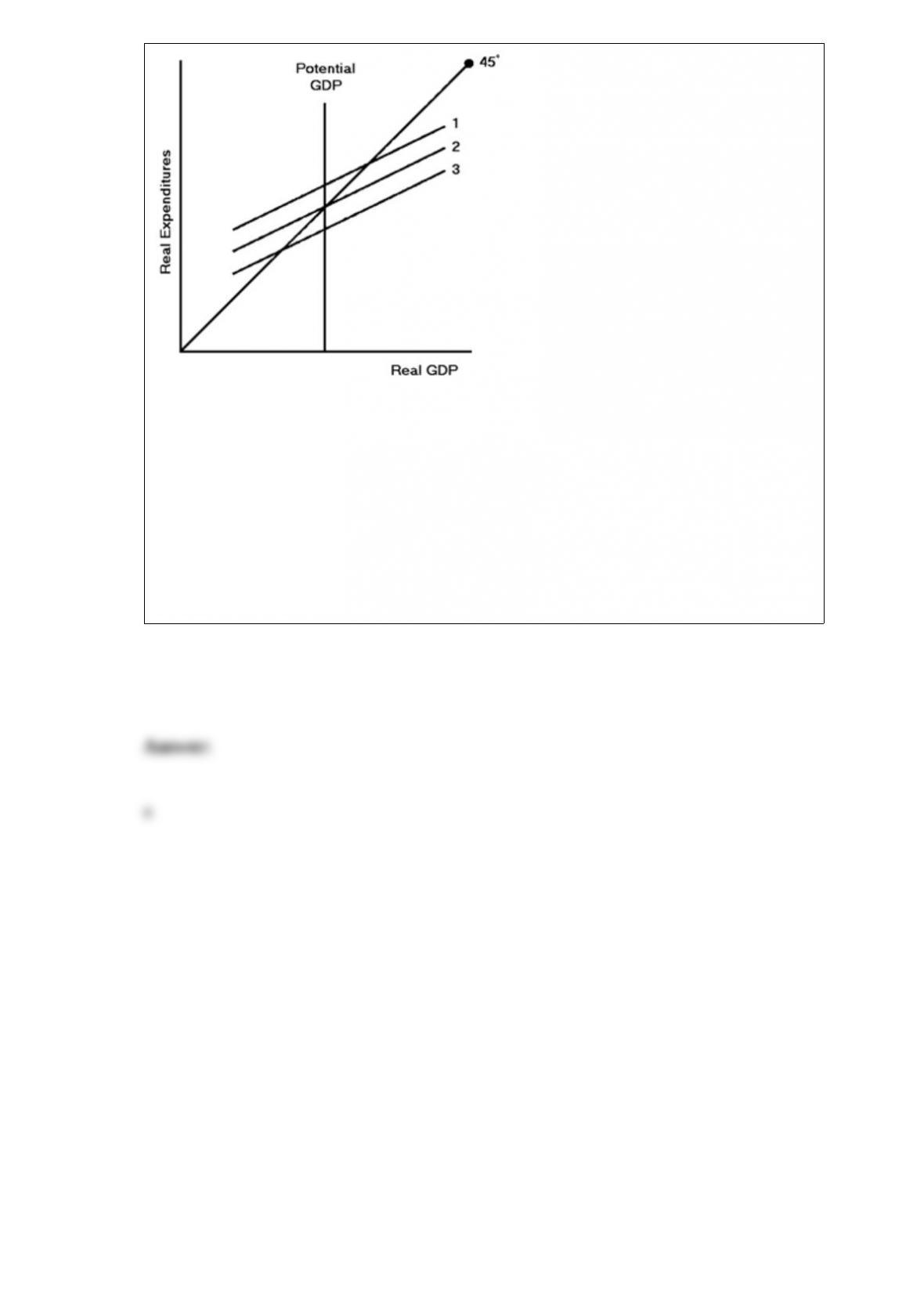
In Figure 9-4, which expenditure level will cause an inflationary gap?
a. 1
b. 2
c. 3
d. There will be no inflationary gap.