
During the 1960s and early 1970s, economists believed that the Phillips curve indicated
a. that higher inflation was the price for more unemployment.
b. that higher levels of employment could be achieved with lower inflation.
c. a menu of choices for policy makers.
d. All of the above are correct.
Regarding demand elasticity, which of the following statements is correct?
a. If demand for seller’s product is elastic, a price increase will decrease total revenue.
b. If demand for seller’s product is elastic, a price increase will increase total revenue.
c. If demand is exactly unit-elastic, an increase in price will raise total revenue.
d. If demand is exactly unit-elastic, an increase in price will raise total revenue.
Elasticity computations related to demand carry a minus sign to show that the demand
curve is negatively sloped.
a. True
b. False

Many economists believe that the difference between savings accounts and checking
accounts is disappearing.
a. True
b. False
If you have a checking account at Citibank, the account is a liability of the bank.
a. True
b. False
Figure 17-1
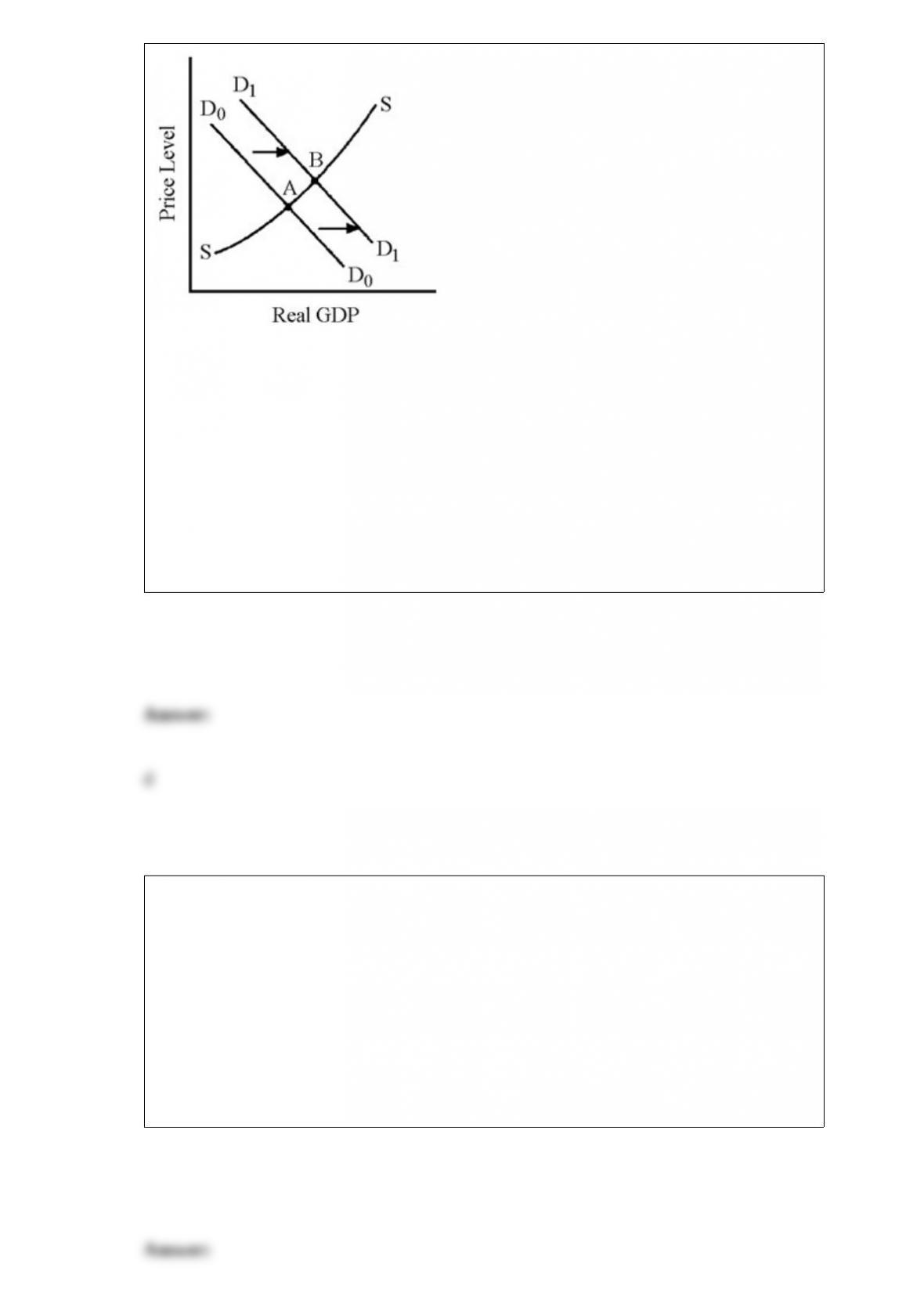
Which of the following is true about the economy depicted in Figure 17-1?
a. It is experiencing supply-side inflation.
b. Policy makers have chosen to fight inflation rather than unemployment.
c. The increase in aggregate demand has increased prices but not real GDP.
d. The slope of the aggregate supply curve embodies the trade-off between
unemployment and inflation.
As the demand for a product falls, it is not uncommon for the industry to become a
monopoly. This is most likely due to
a. an increase in the number of barriers.
b. legal restrictions being imposed.
c. the surviving firm operating on the declining part of its average cost curve.
d. patent protection causing high prices.

When other nations Orient “dump” products on the U.S. market, they
a. sell at prices that do not cover costs of production.
b. sell at prices lower than prices charged to their own domestic customers.
c. expect the United States to help pay any industrialists’ losses.
d. All of the above are true.
On May 12, 2011, the U.S. dollar was worth 0.61 British pounds. How many dollars did
it take to buy one British pound?
a. 1.19
b. 1.61
c. 1.64
d. 2.19

An oligopoly is a market dominated by a few sellers.
a. True
b. False
At his current level of output, a monopolist has an MR of $10, an MC of $6, and an
economic profit of zero. If the market demand curve is downward sloping and his
marginal cost curve upward sloping, the monopolist
a. is producing his profit-maximizing level of output.
b. could increase his profit by increasing his output.
c. could increase his profit by increasing his price.
d. should exit the market if he has positive fixed cost.
A firm can choose a quantity of output, and the price is then determined by
a. the government.
b. the supply schedule.
c. consumers’ demand.
d. the average cost.

Population density varies little between the fifty states.
a. True
b. False
What is the present value of an infinite stream of annual payments of $10,000 per year
if the first payment is received one year from today? Assume the interest rate is 10
percent.
a. $100,000
b. $1,000,000
c. $10,000,000
d. $1,000,000,000

In 2009 the average unemployment rate in U.S. averaged
a. 4.6 percent.
b. 5.4 percent.
c. 7.2 percent.
d. 9.3 percent.
A firm in a monopolistically competitive market makes no economic profit in the long
run because
a. long-run marginal cost will be too high to make any economic profit.
b. long-run price will be equal to long run marginal cost.
c. long-run marginal cost will be equal to long run marginal revenue.
d. long-run price will be equal to long run average cost.
Based on the relative size of factor payments, the most important resource in the U.S.
economy is
a. capital.
b. land.

c. labor.
d. natural resources.
List the three coordination decisions made by every economy.
a. Where? When? How?
b. How? What? To whom?
c. Why? Where? What?
d. When? To Whom? Where?
Monopolistic competition is characterized by
a. one firm selling several products.
b. many firms selling the same product.
c. many firms selling slightly different products.
d. one firm selling one product.

If you have a checking account at a local bank, your bank account there is a(n)
a. asset to the bank and an asset to you.
b. liability of the bank and a liability of yours.
c. liability of the bank and an asset to you.
d. asset to the bank and a liability of yours.
A consumer possesses five pounds of bananas and values their total utility at $2.14. If
one additional pound is acquired and marginal utility is 11 cents, total utility will
a. rise to $2.25.
b. fall to $2.03.
c. stay the same.
d. fall to $2.11.

Residential construction (new houses and apartments) are included in which component
of GDP?
a. government purchases
b. retail spending
c. investment spending
d. net exports
As long as TVC < TR, a firm will have a positive level of output in the short run.
a. True
b. False
Figure 5-17
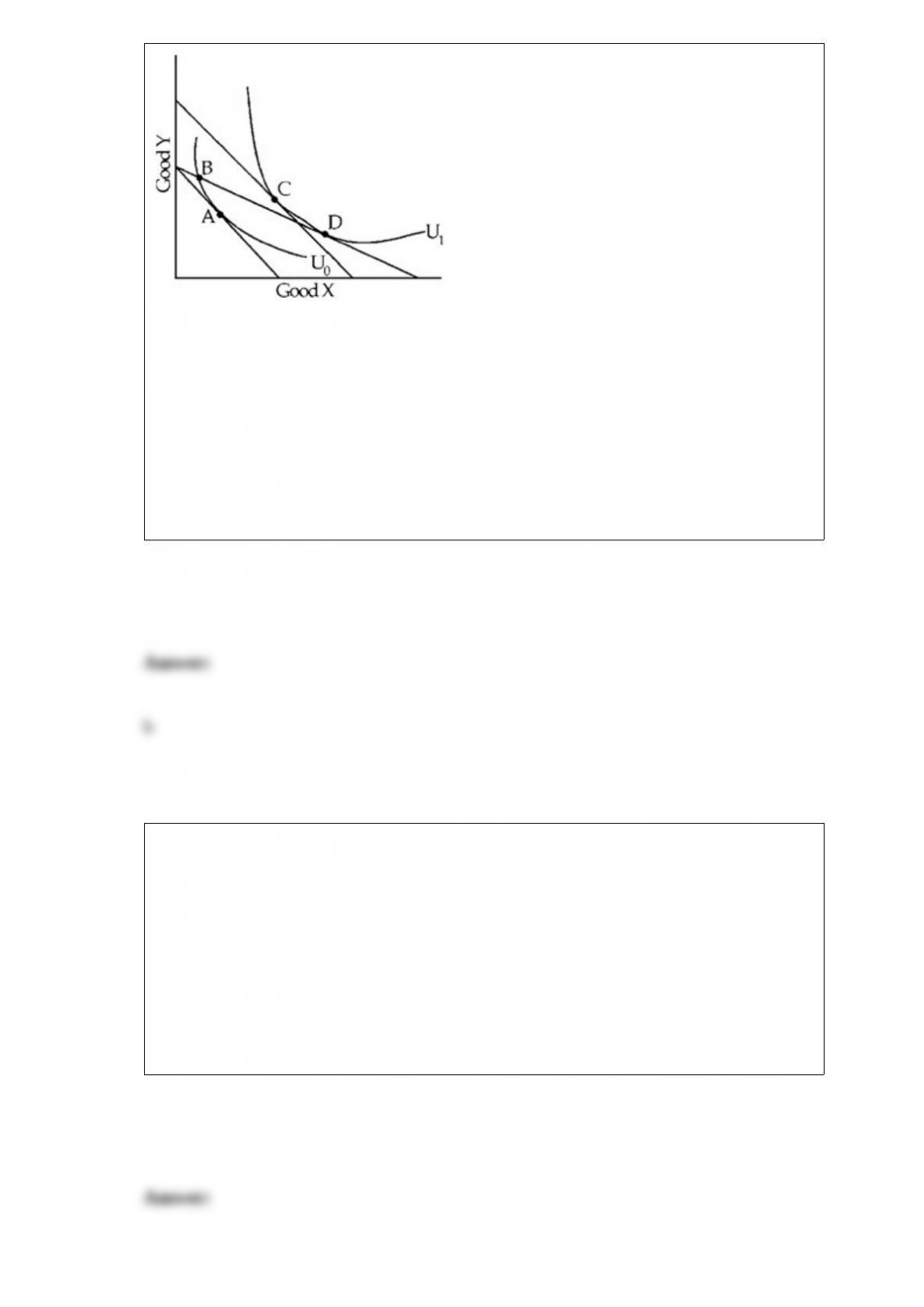
Which of the following statements about Figure 5-17 must be correct?
a. The consumer pays a higher dollar price per unit for good Y at A than at D.
b. The consumer pays the same dollar price per unit for good Y at A and at B.
c. The consumer pays a higher dollar price per unit for good X at D than at A.
d. The consumer pays a higher dollar price per unit for good X at A than at C.
Analysis indicates that the economy is in a recessionary gap. Which of the following is
the least appropriate policy mix in this situation?
a. a budget surplus and expansionary monetary policy
b. a budget deficit and expansionary monetary policy
c. a budget deficit and contractionary monetary policy
d. a budget surplus and contractionary monetary policy

Economic rents can lead to large wage differentials.
a. True
b. False
Can the U.S. dollar and the European euro both appreciate relative to each other?
a. Yes, both countries can gain in this manner.
b. Yes, provided the central banks permit it.
c. No, unless there is a system of fixed exchange rates.
d. No, if one currency appreciates, the other must depreciate.
During the financial crisis of 2007-2009, both fiscal and monetary policy turned more
expansionary.
a. True
b. False

The supply of euros would come from
a. American demand for European real estate.
b. European demand for U.S. government bonds.
c. Americans vacationing in Barcelona, Spain.
d. French supplies of wine to U.S. importers.
Which of the following is the best definition of openness?
a. The average of imports expressed as a share of GDP.
b. The average of goods traded in markets expressed as a share of GDP.
c. The average of imports and exports expressed as a share of GDP.
d. The average trade balance expressed as a share of GDP.
e. The average of exports expressed as a share of GDP.

On June 2, 2010, Dow Chemical’s 4.1 percent coupon bonds, with face values of $100,
sold for $95. This means that the yield on these bonds was
a. less than 4.1 percent.
b. equal to 4.1 percent.
c. equal to 95 percent of 4.1 percent.
d. greater than 4.1 percent.
If an oligopolist cuts the prices of its products,
a. customers will switch to a rival firm.
b. customers will remain unchanged in number.
c. customers will switch from rival firms to buy from them.
d. rival firms will not react.