
In the 2007-2009 period, the expenditure level in the United States intersected the
45-degree line below potential GDP, causing
a. hyperinflation.
b. a growing trade deficit.
c. a government budget surplus.
d. unemployment.
The United States has approximately
a. 80,000 businesses.
b. 5.1 million businesses.
c. 12.5 million businesses.
d. 28.million businesses.
In a free market for rental housing, the average rental rate
a. includes a large amount of economic rent.
b. includes zero economic rent.

c. is entirely economic rent, since rental housing is fixed in supply.
d. is about 10 percent economic rent.
The models of perfect competition and monopoly are the most realistic.
a. True
b. False
When the Fed purchases government securities from a commercial bank, the bank
a. loses its ability to make loans.
b. automatically becomes poorer.
c. loses equity in the Fed.
d. receives reserves that can be loaned out.

Increasing aggregate demand with fiscal policy may have undesirable inflationary
consequences.
a. True
b. False
If in fiscal year 2015, the federal government receives $2.2 trillion in revenues and
spends $3.5 trillion for goods and services, the national debt will
a. increase by $2.2 trillion.
b. increase by $1.3 trillion.
c. decrease by $1.3 trillion.
d. decrease by $2.2 trillion.
When the Phillips curve was first formulated (late 1960s), many economists thought
that it showed a
a. “menu” of budget deficits from different budget policies.
b. “menu” of possible choices available to policy makers.

c. guide to the appropriate mix of fiscal and monetary policy.
d. guide of political reactions to economic policy.
As interest rates rise, banks seek to decrease their loans and, thereby, shrink the money
supply.
a. True
b. False
The Trade Adjustment Assistance program is intended to help
a. businesses that seek to expand exports into protected foreign markets.
b. local governments that are harmed when businesses fail as imports increase.
c. protected industries obtain improved technology in order to increase productivity.
d. workers and businesses that lose markets because of increases in imports.

In contrast to the United States, the European Union has chosen
a. greater wage inequality for lower unemployment.
b. less wage inequality and lower unemployment.
c. greater wage inequality and higher unemployment.
d. similar wage inequality but more unemployment.
e. less wage inequality for higher unemployment.
IMF advice to countries such as Russia and Argentina that suffer from exchange rates
crises often requires these countries to adopt
a. fixed exchange rates.
b. expansionary monetary policies.
c. contractionary monetary policies.
d. state ownership of industry.

The danger of using the national defense argument to protect domestic industries
necessary to wage war is that
a. it has no validity on non-economic grounds.
b. it is unrelated to the United States’ ability to wage war.
c. other nations will retaliate with tariffs against U.S. producers of war material.
d. industries with only the most peripheral relationship to defense are likely to invoke
this argument on their behalf.
When determination of rent is left to the market,
a. that rent price is almost entirely determined by the supply side.
b. that price can settle at politically unpopular levels.
c. land is fairly distributed among the members of society.
d. the supply of land will be perfectly elastic.
In the current international monetary system, what is the role for gold?
a. The system is a gold-exchange standard, based on a fixed value for a key currency.
b. Gold backs each currency, and therefore, the system as a whole.

c. It serves as the principal reserve asset.
d. It has no role.
Because central banks intervene in currency markets, the term ____ has been used to
describe the system.
a. planned float
b. controlled float
c. flexible
d. dirty float
In the long run, a monopolistically competitive firm’s demand curve must be tangent to
its average cost curve.
a. True
b. False

The demand for U.S. dollars is derived from foreign demand for U.S. exports.
a. True
b. False
After a $5 million ad campaign, Coca-Cola measured its effectiveness by calculating
the cross elasticity of demand between Coke and Pepsi. A successful campaign would
be indicated if the cross elasticity went from
a. 0.9 to 0.5.
b. 0.9 to 1.5.
c. −0.5 to −0.2.
d. −0.9 to −1.5.
Producing more cabbage is efficient if

a. cabbage production can be increased without reducing production of other goods.
b. the opportunity cost of more cabbage is less than its marginal utility.
c. society values the additional cabbage more highly than the lettuce it must give up to
produce the extra cabbage.
d. All of the above are correct.
In what year did the technology stock bubble burst?
a. 2000
b. 2006
c. 2007
d. 2008
Exchange rates determined by the forces of demand and supply are called
a. fixed exchange rates.
b. floating exchange rates.
c. equilibrium exchange rates.
d. dirty exchange rates.
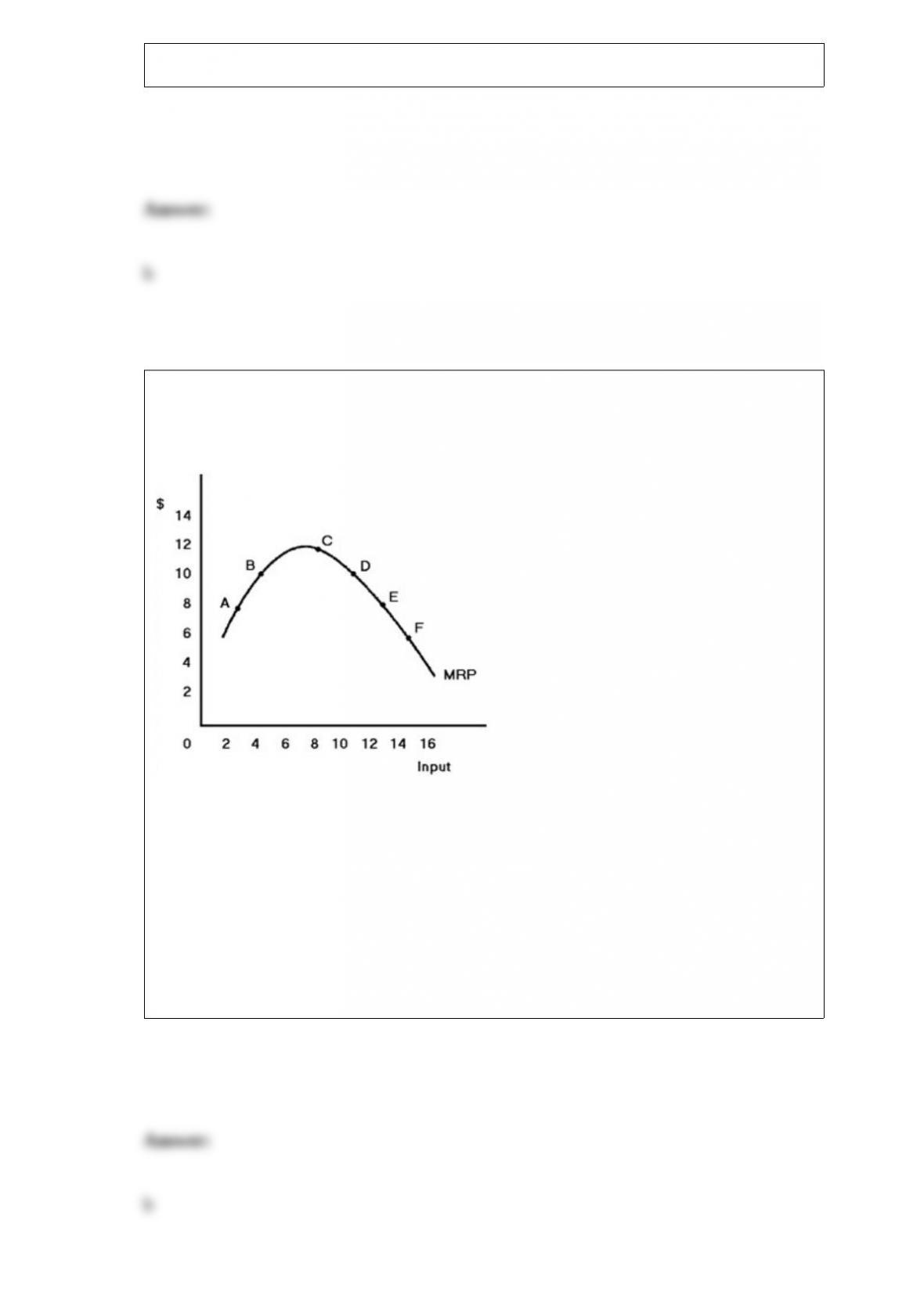
Figure 19-2
The demand curve for the input in Figure 19-2 is
a. ABCD.
b. CDEF.
c. BCDE.
d. EF.
What determines the position and shape of a society’s production possibilities frontier?
a. the physical resources of that society
b. the skills of the workforce
c. the level of technology of the society
d. the amount of factories in the society
e. All of the above are correct.
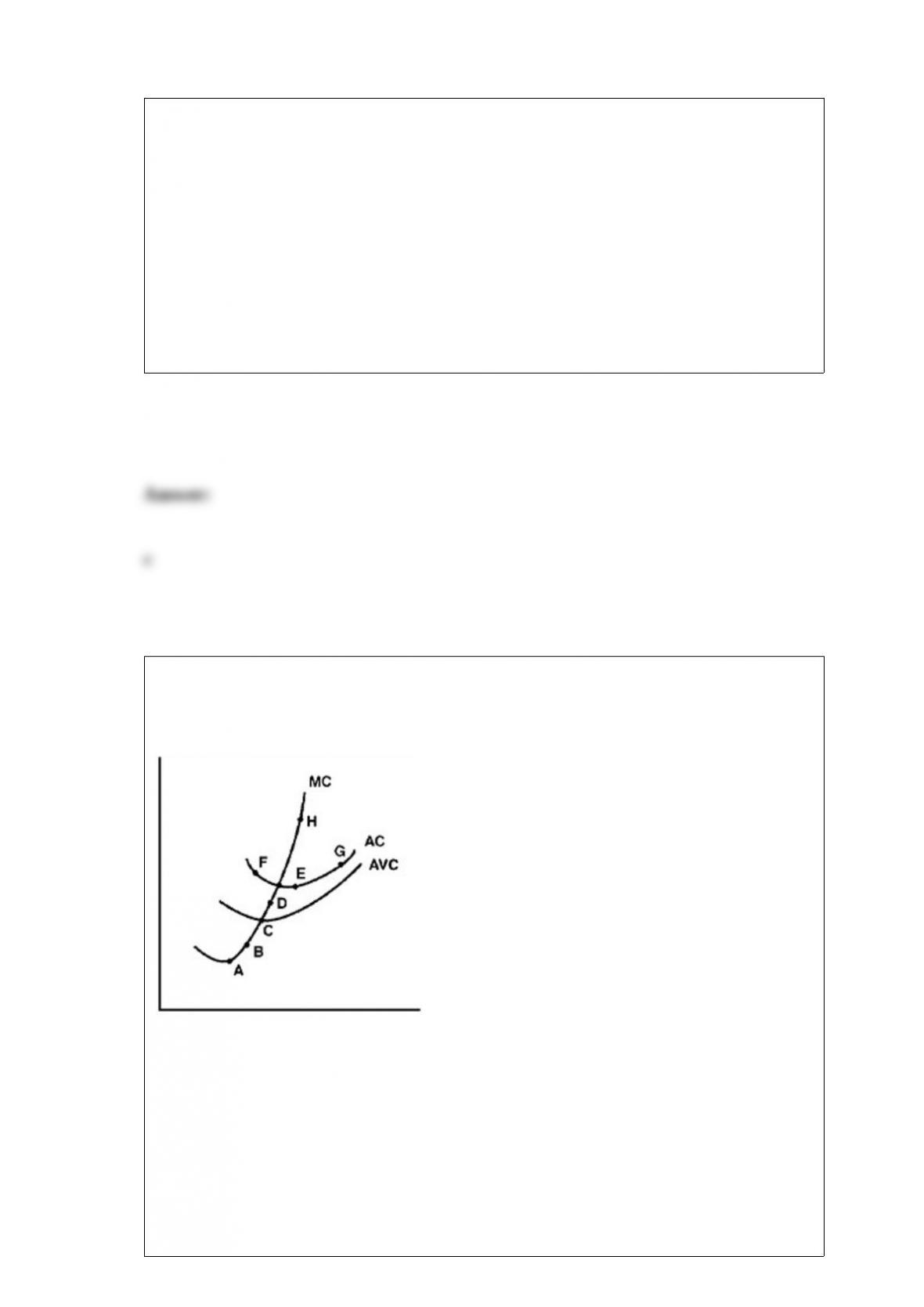
Figure 10-5
Figure 10-5 shows supply and demand conditions in a perfectly competitive industry
and for a firm in that industry. At point C, the firm would
a. earn zero economic profit.
b. earn negative economic profit.
c. have a zero opportunity cost of capital.

d. have a negative opportunity cost of capital.
As a resource becomes more scarce, we expect its price to
a. rise.
b. fall.
c. remain constant.
d. fluctuate wildly.
If the discouraged workers were included in the labor force,
a. the unemployment rate would fall.
b. the labor force would decrease.
c. the employment rate would rise.
d. the unemployment rate would rise.

If the aggregate supply curve is flat,
a. contractionary fiscal or monetary policy will reduce inflation with little effect on real
GDP.
b. contractionary fiscal or monetary policy will cause significantly less inflation.
c. expansionary fiscal or monetary policy will add significantly to real GDP will little
effect on inflation.
d. expansionary fiscal or monetary policy will add little to real GDP but will increase
inflation significantly.
When the marginal revenue product of an input is less than its price, the
a. producer should expand the use of that input.
b. price of the input will automatically rise in a free market.
c. producer should reduce the use of that input.
d. marginal physical product of that input must be below its average physical product.

In response to the Great Recession of 2007-2009, when did the Federal Reserve first cut
the federal funds rate to zero?
a. December 2007
b. June 2008
c. December 2008
d. January 2010