According to the quantity theory of money, a decision on the part of all business firms
currently paying employees on a monthly basis to begin paying on a weekly basis
would be expected to
a. increase velocity and increase nominal GDP.
b. increase velocity and decrease nominal GDP.
c. decrease velocity and increase nominal GDP.
d. decrease velocity and decrease nominal GDP.
Teenage employment in the United States has risen in the last two decades.
a. True
b. False
When government increases a fixed tax, consumption schedule
a. shifts downward in a parallel manner.
b. shifts upward in a parallel manner.
c. becomes horizontal.
d. becomes vertical.

If a firm has increasing returns to scale at all levels of output, the
a. slope of its long-run total cost curve is always negative.
b. slopes of its short-run average cost curves are always negative.
c. slope of its long-run average cost curve is always negative.
d. slope of its production function is always negative.
Externalities are created when parties not involved in an economic transaction are
affected by it.
a. True
b. False

Recessionary gaps are most likely to be accompanied by
a. inflation.
b. inventory reductions.
c. unemployment.
d. expanding output.
A factory in a centrally planned economy produces 1,000 left shoes and no right shoes.
No corresponding factory produces only right shoes. This outcome is an example of
inefficiency in
a. output selection.
b. production planning.
c. product distribution.
d. market segmentation.
The proliferation of new products that we are used to today has been occurring since the
advent of the Industrial Revolution.
a. True
b. False
The issue of fairness versus efficiency arises
a. only in a command economy.
b. only in a market economy.
c. in neither a command nor a market economy.
d. in both a command and a market economy.
Figure 4-21
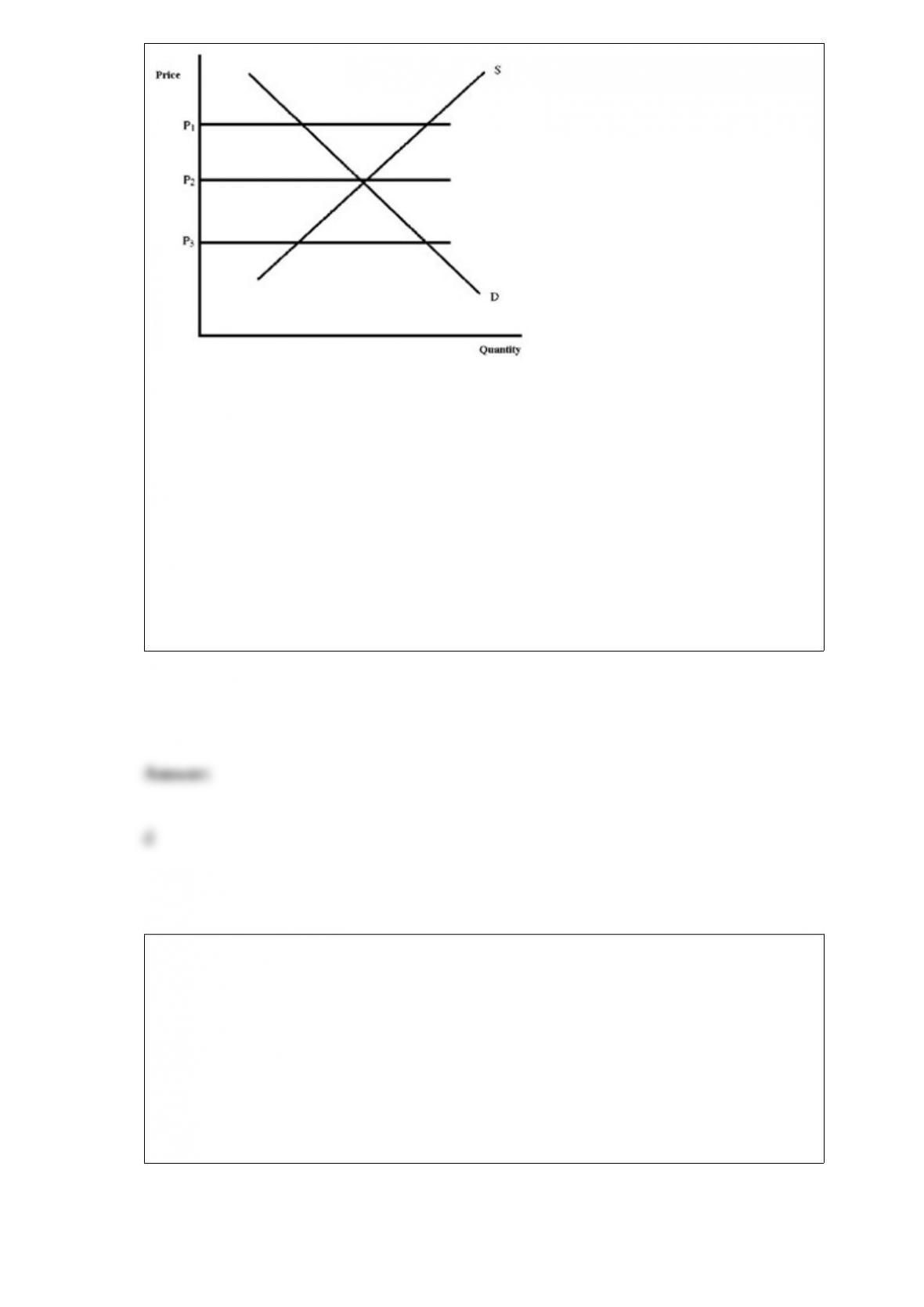
At price P1 in Figure 4-21, what will tend to happen?
a. There will be a shortage, and the price will fall.
b. There will be a shortage, and the price will rise.
c. There will be a surplus, and the price will rise.
d. There will be a surplus, and the price will fall.
e. Equilibrium will occur in the market.
Monopoly as a market structure leads to
a. prices equal to average cost.
b. quick response to economic change.
c. prices that equal minimum long-run average cost.
d. persistent economic profits.
If the economy is in equilibrium, it must be
a. on the 45 line.
b. on the 60 line.
c. below the 45 line.
d. below the 60 line.
Two policies to combat discrimination are affirmative action and right-to-work laws.
a. True
b. False
If the PPF for guns and butter is bowed outward from the origin, this indicates constant
opportunity cost between the two goods.

a. True
b. False
In a free market for depletable natural resources, any shortage where there is an excess
of quantity demanded over quantity supplied must be
a. expected as a matter of course.
b. due to a price floor.
c. the result of discovery of new deposits of the resources.
d. artificial.
Quotas and tariffs provide the same outcome: restriction of international trade and
higher prices for consumers.
a. True
b. False

An economic model can be defined as
a. a testable claim which can be evaluated with proper data.
b. a representation of a theory or a part of a theory.
c. another word for theory.
d. a method to distinguish correlation from causation.
e. All of the above are correct.
If the economy suffers a recession for reasons unrelated to fiscal policy, the deficit
should rise and
a. inflation should fall.
b. interest rates should fall.
c. real GDP should fall.
d. All of the above are correct.

In a perfectly competitive industry, influence over price is exerted by
a. individual sellers.
b. individual buyers.
c. the largest firms.
d. the forces of supply and demand.
Since 1948, the history of real wage rates generally shows that
a. prices and wages have risen at the same rate.
b. prices have risen at a slower rate than wages.
c. prices have risen faster than wages.
d. real wages have remained constant over the period.
Figure 7-6
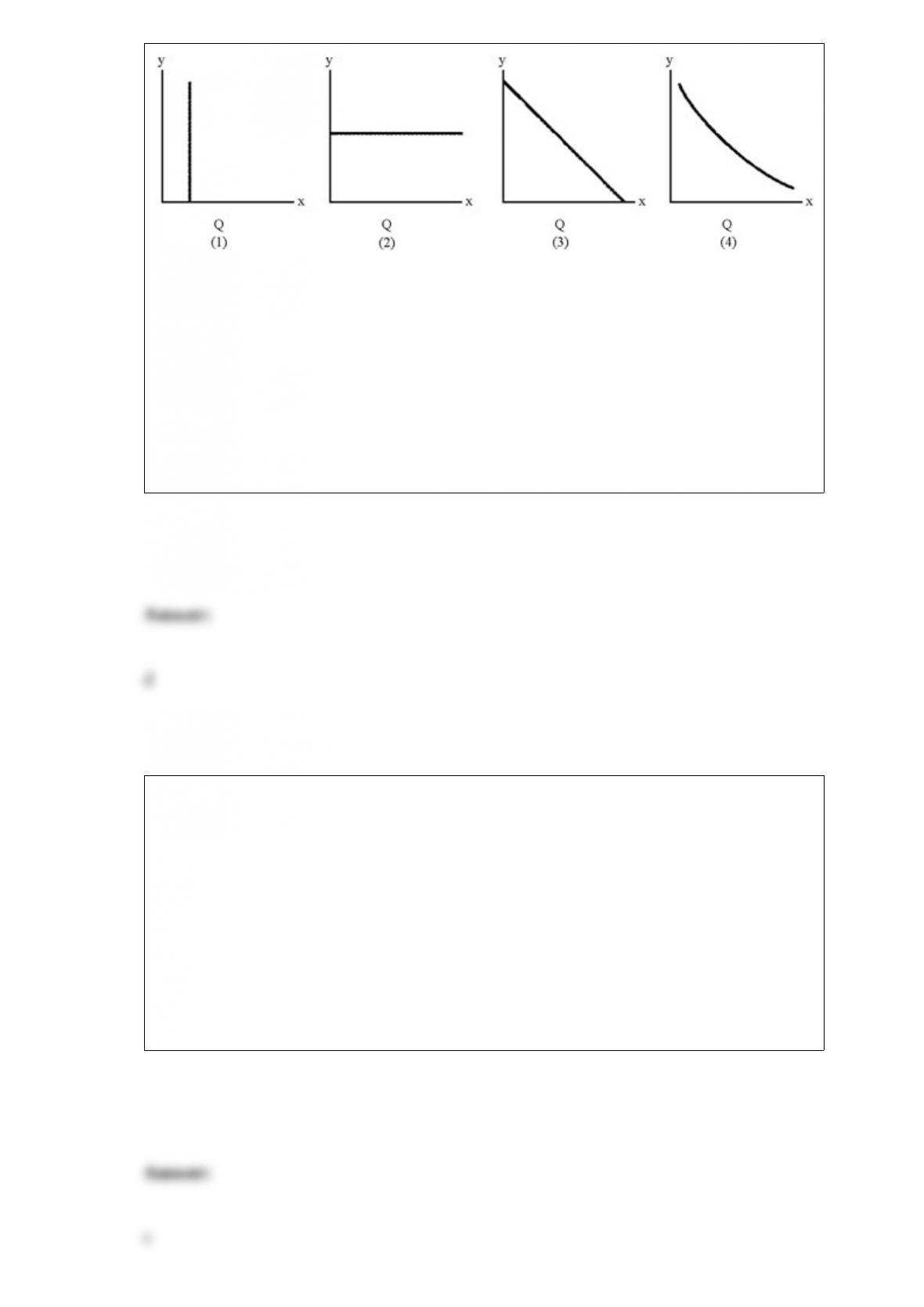
Which of the lines in Figure 7-6 represents a typical average fixed cost curve?
a. 1
b. 2
c. 3
d. 4
Economic theory predicted that the price of a depletable resource would rise by 10
percent. In reality, the price fell by 5 percent. Which of the following events could
explain this discrepancy?
a. Known reserves of the resource were depleted.
b. The interest rate rose by 15 percent.
c. Antitrust enforcement broke up a cartel among major suppliers of the resource.
d. The government imposed an effective price floor.

What is the order in which an economy tries to solve the issue of resource allocation?
a. Production planning, distribution, and output selection.
b. Output selection, production planning, and distribution.
c. Production planning, output selection, and distribution.
d. Distribution, production planning, and output selection.
Under what conditions will the inflationary impact of an expansionary monetary policy
be the largest?
a. When equilibrium real GDP is at potential real GDP.
b. When there is a recessionary gap.
c. When unemployment rates are high and there is substantial excess industrial capacity.
d. When real GDP is falling and the price level is decreasing.
Unrestrained monopolies are criticized because they restrict output and reduce
innovation.
a. True
b. False
Which of the following will shift the demand curve for milk?
a. change in the income of buyers of milk
b. change in the price of milk
c. change in input prices for milk
d. All of the above are correct.
If point A on an indifference curve lies higher (measured vertically) than point B on the
same curve, Point A automatically represents higher total utility than point B.
a. True
b. False

When the economy has an income tax that is variable, the multiplier is
a. unchanged.
b. larger.
c. smaller.
d. unpredictable.
A usury ceiling will be effective depending on
a. whether the usury rate is above 10 percent.
b. whether the usury rate is above 8 percent.
c. whether that rate is below what the equilibrium rate of interest would have been in a
free market.
d. how well organized the lending institutions are.
Elasticity of demand equals the ratio of the percentage change in quantity demanded to
the percentage change in the price of the good.
a. True
b. False
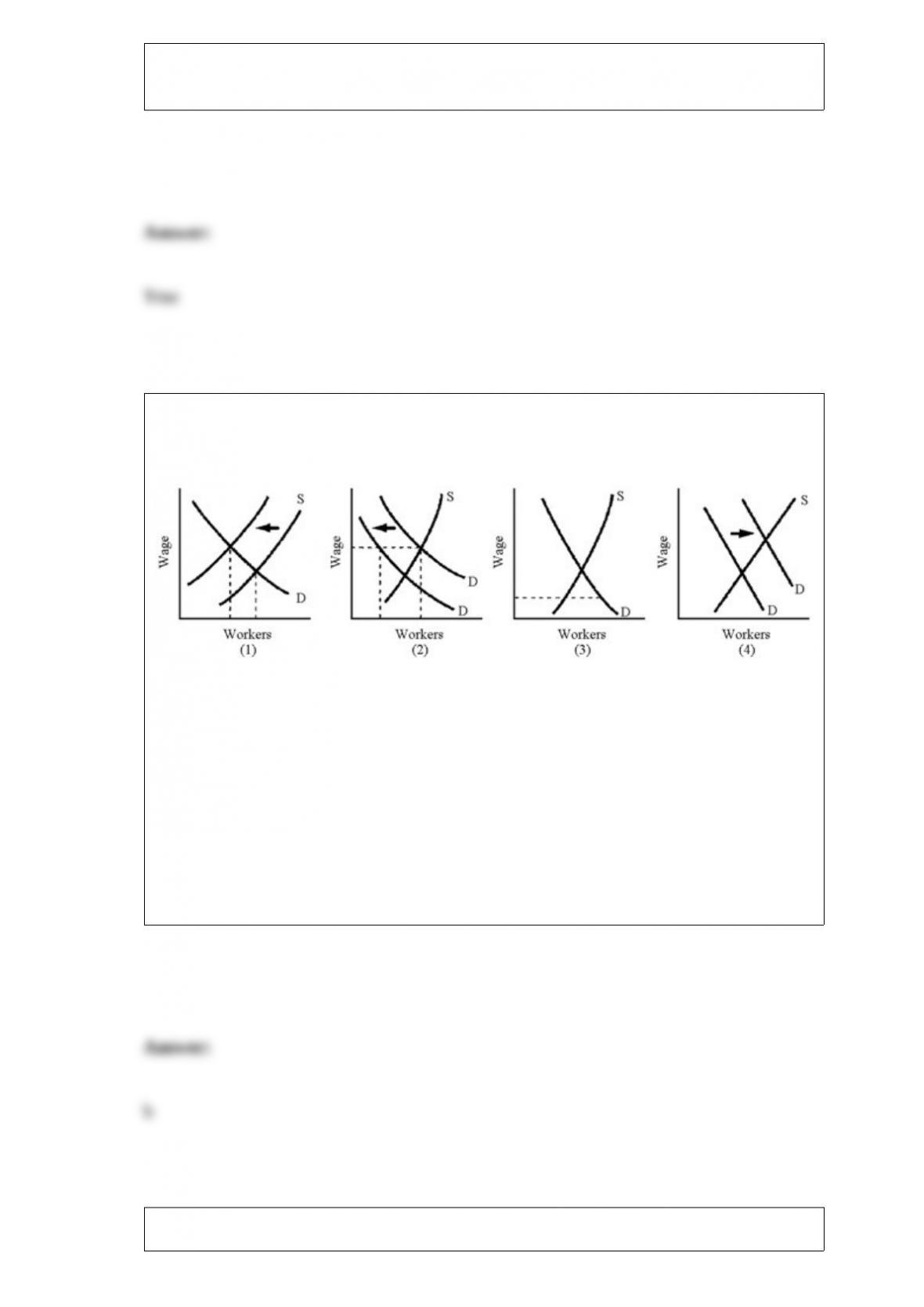
Figure 20-4
In Figure 20-4, which panel depicts a union suffering unemployment during a recession
rather than allowing the wage to fall?
a. 1
b. 2
c. 3
d. 4
Both M1 and M2 are monetary values much larger than nominal GDP.
a. True
b. False
Scarcity is illustrated graphically by a production possibilities frontier.
a. True
b. False
A theory is an explanation of the causal mechanism behind observed phenomena.
a. True
b. False
Explain how each of the following industries practices price discrimination:
a. movie theaters
b. airlines
c. auto dealers
d. U.S. Postal Service