
The central idea behind the Troubled Asset Relief Program was for the Treasury to sell
mortgage-backed securities to interested investors, wait for prices to increase, and then
buy these securities back for a profit.
a. True
b. False
If the demand-side effects of supply-side tax cuts are greater than the supply-side
effects, then we can expect the result to be a(n)
a. decrease in output and prices.
b. decrease in output and an increase in prices.
c. increase in output and prices.
d. increase in output and a decrease in prices.
The U.S. economy has grown steadily over the years.
a. True
b. False

Which of the following is an example of a fiscal policy initiative?
a. Lowering of interest rates.
b. Increase in reserve requirements.
c. Reduction in taxes.
d. Decrease in money supply.
The United States can reduce its trade deficit by limiting imports through tariffs.
a. True
b. False
Unemployment insurance benefits the macroeconomy by supporting purchasing power.

a. True
b. False
The nominal rate of interest is the difference between the real rate and the expected rate
of inflation.
a. True
b. False
A program of protection that results in preserving jobs in certain industries
a. raises average productivity in all sectors of the economy.
b. does so at very high cost to consumers of the products from those industries.
c. is an efficient way to preserve employment, and is cheaper than other forms of
maintaining full employment.
d. is an effective way of encouraging innovation and improvement in production.

The owner of a garage makes large contributions to a politician who is seeking the
office of state governor. If his candidate wins, he will get the contract, which now
resides with a competitor, to repair State Police vehicles. This is an example of
a. moral hazard.
b. externality.
c. rent seeking.
d. investment.
Which of the following transactions is included in GDP?
a. You buy a used car for $10,000.
b. An unemployed worker receives a check for $450 as unemployment benefits.
c. You buy a one-acre lot in Florida where you plan to build a beach house.
d. Toyota builds 1,000 Accords in Kentucky at a cost of $25,000 each but is unable to
sell them and, therefore, they are added to inventory.

As long as the aggregate supply curve is upward sloping, an increase in aggregate
demand will increase
a. real wealth.
b. price levels.
c. unemployment.
d. net exports.
When prices for goods and services are quoted in money terms, this is an example of
money being used as a store of value.
a. True
b. False
Bond prices in the marketplace will fall when
a. interest rates fall.
b. the company is losing money.
c. interest rates rise.
d. the company is making money.

The maximin criterion seeks to minimize the maximum payoffs in order to win.
a. True
b. False
Most economists reject the theory of rational expectations because
a. expectations adjust very quickly.
b. workers receive wage increases in advance of inflation.
c. the short-run aggregate supply curve is vertical.
d. labor contracts tend to embody past inflation rates.

Owning a patent can provide a firm with monopolistic power.
a. True
b. False
The average total cost curve of a natural monopoly is always
a. upward sloping.
b. horizontal.
c. downward sloping at all points.
d. downward sloping where it crosses the market demand curve for the good.
The “cost disease of personal services” phenomenon predicts that the price of tickets to
baseball games and cell phone rates will increase at approximately the same rate.
a. True
b. False

A minimum wage law might increase wages without reducing employment if the hiring
firm is
a. in perfect competition.
b. a monopolist.
c. a monopolistic competitor.
d. a monopsonist.
A sum of money to be received in the future is worth more than a sum of money today.
a. True
b. False
If the poor cannot afford proper medical treatment, an economist, for reasons of
efficiency, would favor

a. giving the poor added income to spend as they see fit.
b. paying doctors bonuses to treat the poor.
c. paying the medical bills of the poor.
d. giving the poor “medical stamps.”
By definition, total production must always equal total
a. sales.
b. demand.
c. purchases.
d. income.
John Amaker owns orange groves and hires pickers for a two-week period as shown in
Table 7-3.
Table 7-3
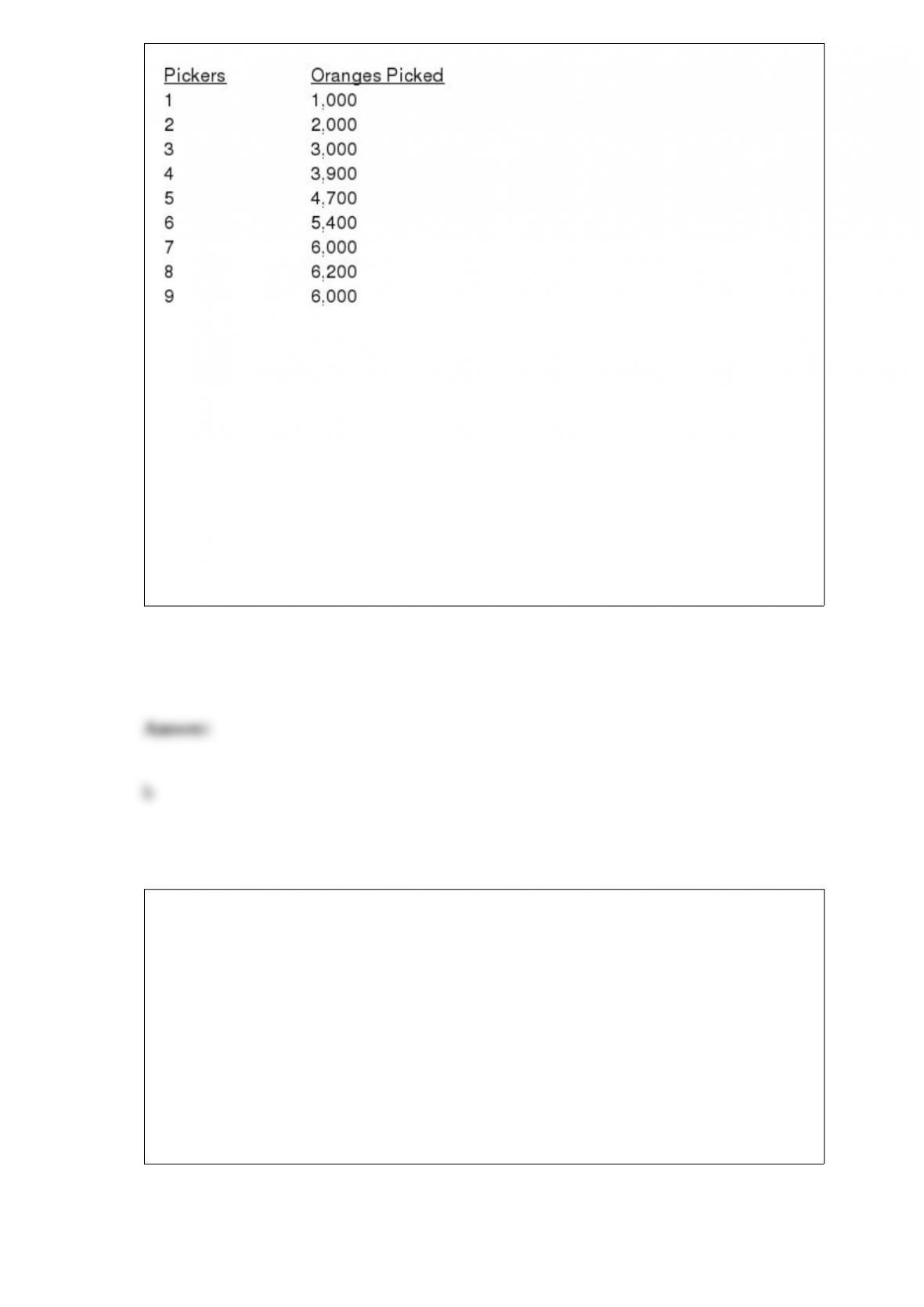
In Table 7-3, diminishing returns set in with picker
a. 3.
b. 4.
c. 5.
d. 6.
e. 9.
Most innovations in the economy come from
a. many different industries in a few countries.
b. a few industries in many different countries.
c. many different industries in many different countries.
d. a few industries in a few countries.
e. a few industries in the United States.

The argument that rising energy prices caused the decline in U.S. productivity in the
1970s is made less believable due to the
a. falling level of saving in the 1970s.
b. falling level of energy prices in the 1980s.
c. rising level of energy prices in the 1980s.
d. rising level of energy prices in the 1990s.
A major employer in a small town announces upcoming major layoffs of employees.
What should we expect to happen to the consumption functions of the affected
employees?
a. the consumption functions will shift upward.
b. most employees will move upward along their consumption functions
c. the consumption functions will shift downward
d. most employees will move downward along their consumption functions

An expansionary monetary policy is most likely to produce an inflationary effect with
little impact on output when the economy
a. is near full employment and the aggregate supply curve is horizontal.
b. is near full employment and the aggregate supply curve is vertical.
c. has substantial unemployment and the aggregate supply curve is vertical.
d. has substantial unemployment and the aggregate supply curve is horizontal.
Consumer surplus is the difference between the worth of a commodity to the consumer
and the price the consumer pays for the commodity.
a. True
b. False
Table 4-1
Use this table for the following questions.
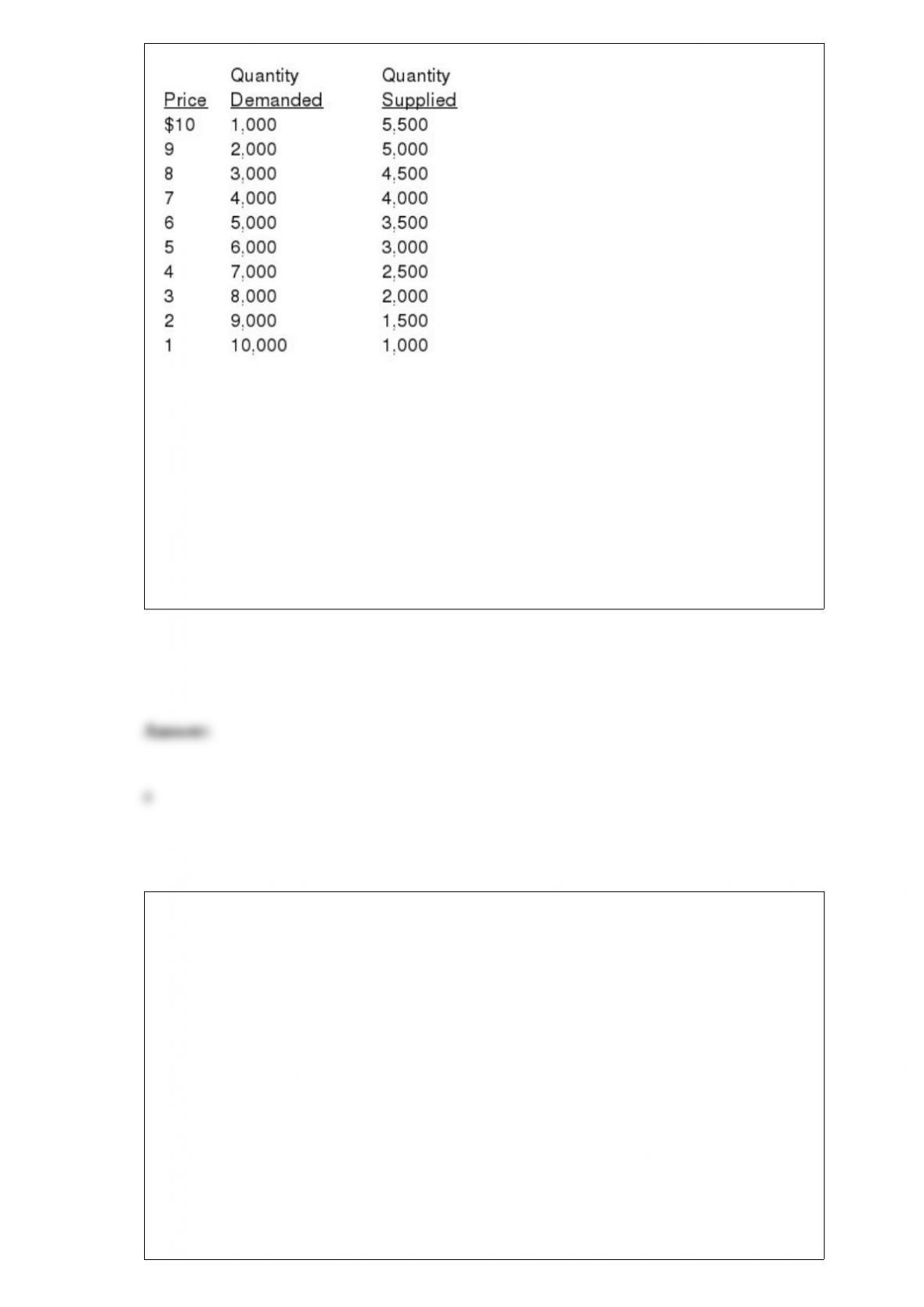
Refer to Table 4-1. At $10, what is the surplus?
a. 4,500
b. 3,000
c. 1,500
d. 0
Table 20-1
Suppose the economy of Macroland is described by the following:
C = 200 + .8DI (DI = disposable income)
I = 300 + .2Y − 50r (Y = GDP)
(r, the interest rate, is measured in percentage points. For example, a 9 percent interest
rate is r = 9).
For this economy, assume that the Federal Reserve uses its monetary policy to peg the
interest rate at

r = 5
G = 750
T = .25Y
X = 200
M = 150 + .2Y
Hint: DI = Y − T
From Table 20-1, compute equilibrium GDP for Macroland.
a. 3,000
b. 2,950
c. 2,625
d. 2,525