Profits will be maximized when the slope of the total revenue curve and the slope of the
total cost curve equal zero.
a. True
b. False
The marginal propensity to consume is calculated by dividing the change in consumer
spending by the change in disposable income.
a. True
b. False
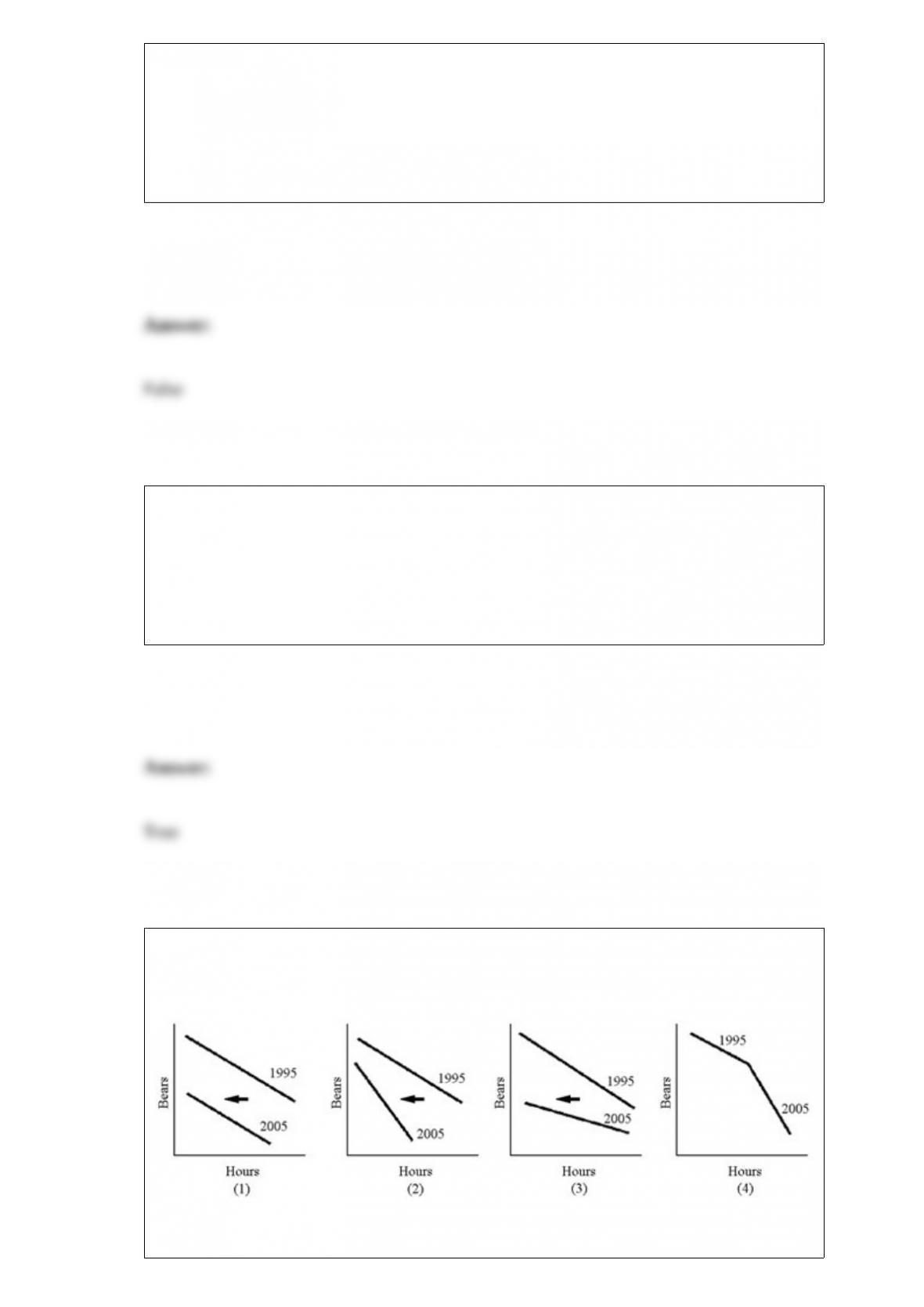
Figure 19-1
Mr. Paque is a bear hunter for timber companies that want to diminish damage to trees

done by bears in the spring. Due to a reduction in the bear population between 1995 and
2005, Mr. Paque finds fewer bears each year and additional hours spent hunting
produce fewer additional bears. This means that Mr. Paque’s (i) overall productivity has
fallen; (ii) marginal product has fallen.
a. i and ii
b. i not ii
c. ii not i
d. neither i nor ii
If MC > MR,
a. output should be reduced.
b. marginal profit is positive.
c. there are losses.
d. output should be increased.
An increase in wages in the public sector is caused solely by increased labor
productivity in that sector.
a. True

b. False
The U.S. government spent over $3.6 trillion in budget year 2010.
a. True
b. False
In arriving at the quantity of output and price of its product, a company
a. chooses either output or price, and consumer demand determines the other.
b. has no control over either quantity or price.
c. makes two decisions by setting both optimal output and optimal price.
d. generally leaves both quantity and price decisions to consumers.

The basic problem with the government setting an absolute poverty line is that it is
a. completely objective.
b. somewhat arbitrary.
c. unconstitutional.
d. based on average income.
Wage decreases lead to a decrease in aggregate quantity supplied.
a. True
b. False
Americans would probably be supportive of
a. strict controls on hours of work.
b. limits on income potential.
c. mandatory work limits.
d. loose controls on economic activities.

Because the United States has had substantial deficits in goods and services, it has also
necessarily had surpluses in
a. the federal budget.
b. the sales of assets.
c. the sales of military goods.
d. its gold supplies.
Taxes, transfer payments, and government purchases are the components of automatic
stabilizers.
a. True
b. False

President George W. Bush’s tax cut in 2001 was a rare example of
a. timely monetary policy.
b. timely fiscal policy.
c. the slow response of policy to events.
d. the inability of Congress to react to policy needs.
Marginal land can be defined as land that earns neither profits nor losses.
a. True
b. False
The “law” of diminishing returns
a. is deduced from the basic biochemical relationship of agricultural theory.
b. was constructed as the basis of observation during experiments on the impact of
fertilizer on output in the 1930s.
c. is based on regular observations of input-output relationships over the last two
centuries.
d. is borrowed from physical laws related to conversion of matter and energy.

An increase in fixed cost will, in the long run, alter the industry output of
a. both a monopolist and a competitive industry.
b. only a monopolist.
c. only a competitive industry.
d. neither a monopolist nor a competitive industry.
The only circumstance under which a factor will earn no rent is when the factor’s supply
curve is
a. vertical.
b. upward sloping.
c. perfectly horizontal.
d. kinked.

The quantity supplied by domestic producers in an importing country must be less than
the quantity demanded by its population.
a. True
b. False
In international trade, one country’s gain is another country’s loss.
a. True
b. False
Employment discrimination is a source of
a. economic inefficiency.
b. increased economic growth.
c. innovation.
d. shifting production possibilities.
e. All of the above are correct.

Velocity can be computed with the formula
a. (Annual spending)/(Money supply).
b. (Annual income)/(Annual spending).
c. (Average income)/(Average spending).
d. (Money supply)/(Average income).
Firms should stop borrowing funds
a. as soon as the bank raises the interest rate.
b. when the MRP of borrowed funds is equal to the cost of borrowing.
c. whenever the future of the firm looks gloomy.
d. if their debts are more than 25 percent of the value of the firm.

Do policy makers know the level of unemployment that is associated with “full
employment”?
a. Yes, economists have the precise level of unemployment that is full employment.
b. Yes, although there is a small range of uncertainty in this measure.
c. No, economists have no idea what this level of unemployment is.
d. No, this number is not known with complete accuracy.
Suppose you purchase a $1,000 bond that bears an interest rate of 10 percent. What will
happen if the interest rate goes to 20 percent?
a. The market price of the bond will increase to $2000.
b. The market price of the bond will drop to $500.
c. The return on the bond will double.
d. The return on the bond will halve.
Figure 16-1
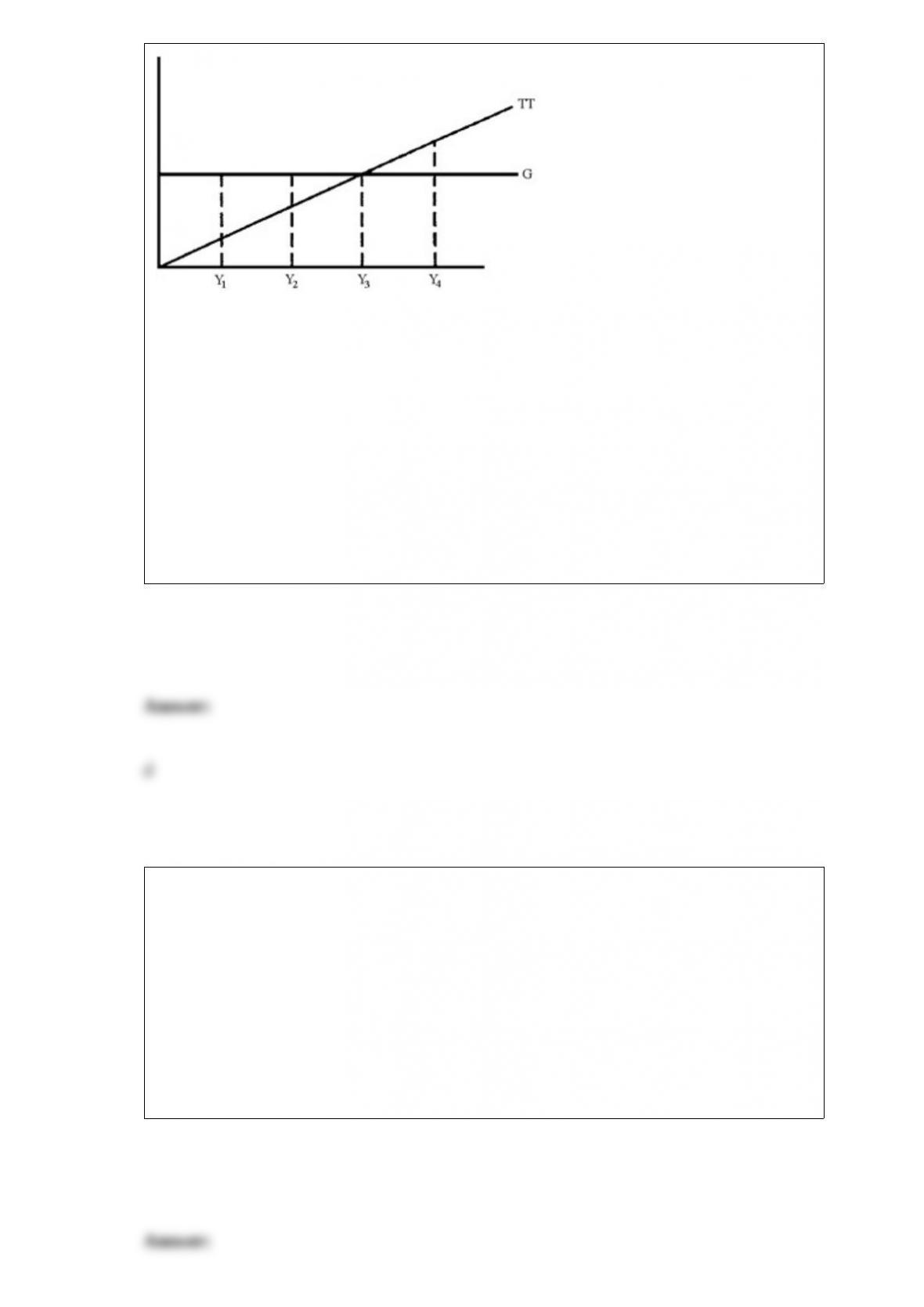
In Figure 16-1, there are four levels of income. G is government expenditures and TT is
taxes less transfers. At which level of income is the actual deficit the greatest?
a. Y4
b. Y3
c. Y2
d. Y1
If a market is contestable, then
a. long-run economic profits are minimal due to inefficiency.
b. long-run economic profits are zero.
c. short-run and long-run economic profits are zero.
d. positive economic profits are maximized due to the efficient production spurred by
the threat of entry.
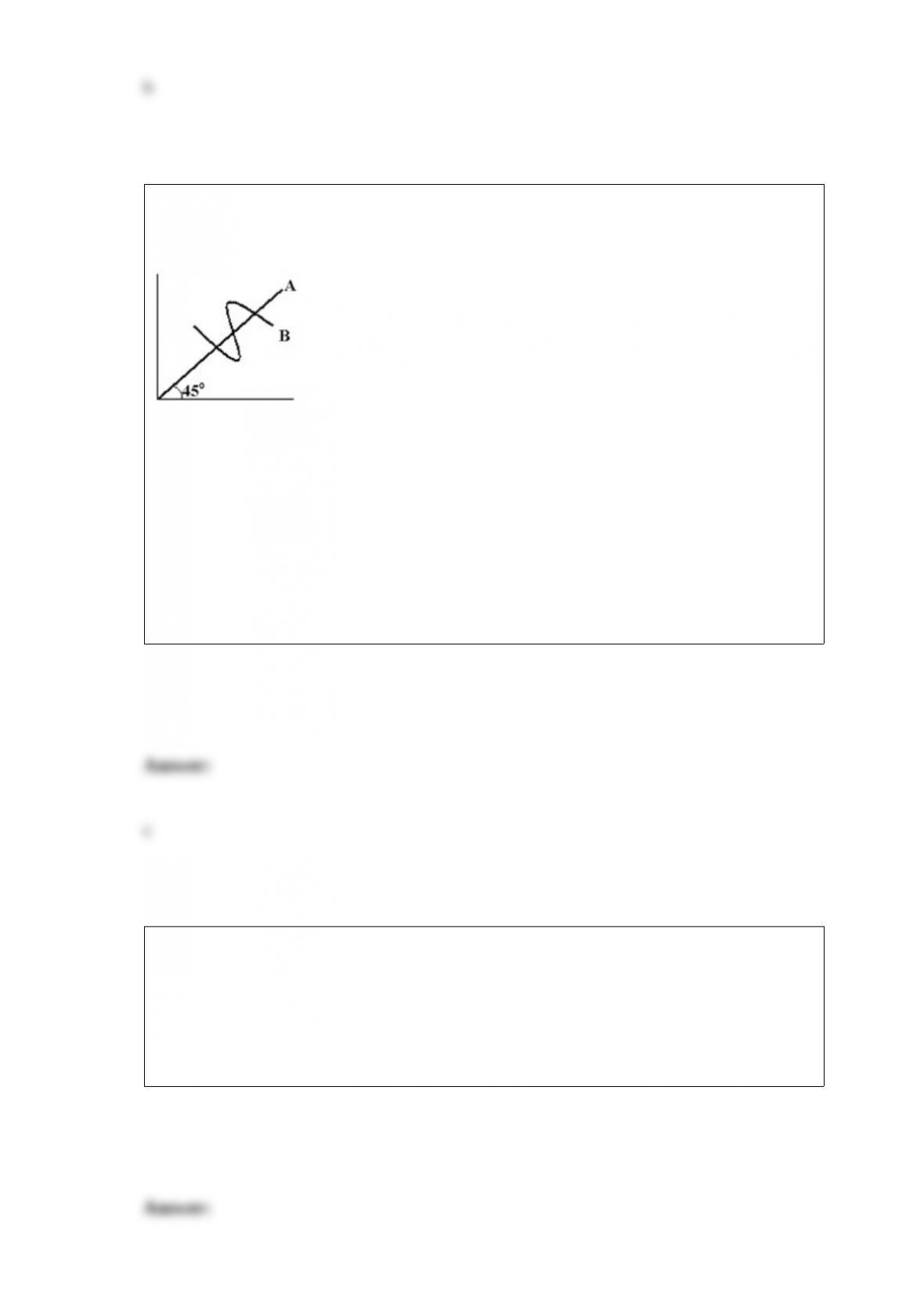
Figure 1-2
Identify the slope of the two curves A and B in Figure 1-2.
a. A – zero, B – one.
b. A – one, B – zero.
c. A – one, B – different at different points.
d. A – different at different points, B – zero.
In cases of natural monopoly, it is best to have only one firm producing all of the output
in a market.
a. True
b. False

When the Fed decreases the money supply, interest rates
a. rise, causing velocity to fall.
b. fall, causing velocity to fall.
c. rise, causing velocity to rise.
d. fall, causing velocity to rise.
International capital flows tend to strengthen the effects of interest rate changes on
aggregate demand.
a. True
b. False
The fundamental criticism from the efficiency perspective of AFDC and other
antipoverty programs is that
a. they do not help families with unemployed fathers.

b. the benefits are too low.
c. they offer disincentives to earning income.
d. the tax on this income is too low.
A level of GDP cannot be at equilibrium when aggregate demand exceeds output
because firms will notice that
a. inventory stocks are building up.
b. inventory stocks are being depleted.
c. their profits are negative.
d. many of their workers have little to do.
The number of firms in a perfectly competitive industry is not fixed in the long run.
a. True
b. False

Monopolistically competitive markets feature heterogeneous products.
a. True
b. False
Oligopolists almost always cooperate in making price and output decisions.
a. True
b. False