
Marginal revenue product is the
a. additional revenue from one additional dollar increase in price.
b. change in the revenue product resulting from one additional unit of input.
c. additional revenue from one additional unit of input.
d. change in revenue resulting in one additional dollar in price.
A monopolistic competitor faces a horizontal demand curve.
a. True
b. False
Economists generally recognize that rent controls cause shortages in housing, yet rent
controls tend to persist. Why does this occur?
a. Many people do not understand the effects that controls cause.
b. Property owners are politically unpopular.
c. Many persons tend to benefit from rent controls.
d. All of the above are correct.

A single bank is limited in its ability to create money because
a. loan recipients usually take the proceeds of the loan in cash.
b. the FDIC will not permit it to create money unless the loans are guaranteed by the
federal government.
c. the money loaned will probably be deposited in another bank.
d. federal legislation prohibits banks from creating money except to finance
international trade.
The combined incomes of Walmart, ExxonMobil and Chevron total more than the GDP
of:
a. Belgium
b. Denmark
c. Ireland
d. all of these

The primary benefit to the macroeconomy of increasing government spending is a(n)
a. decrease in the price level.
b. decrease in real GDP.
c. increase in the price level.
d. decrease in the unemployment rate.
Which furniture production process would have the highest wage rates?
a. furniture made by handsaw and hammer
b. furniture made with power equipment
c. furniture made by grade school-educated workers
d. furniture made in an automated furniture factory
Which of the following was not a typical characteristic of subprime mortgages?

a. low down payments
b. loans to borrowers with poor credit histories
c. limited incomes with which to make loan payments
d. fixed interest rates
In the case of Intimate Bookshop v. Barnes & Noble, Intimate alleged that Barnes &
Noble
a. was bundling products in order to reduce competition.
b. used technological advances to sell at lower prices.
c. was buying books at discriminatory prices.
d. had merged with other competitors in an effort to gain monopoly power.
Discount rate policy is most often
a. lowered when market rates rise.
b. used to actively control the money supply.
c. the Fed’s primary tool of monetary control.
d. passively changed by the Fed to follow market rates.
Currently, the United States imports more than it exports.
a. True
b. False
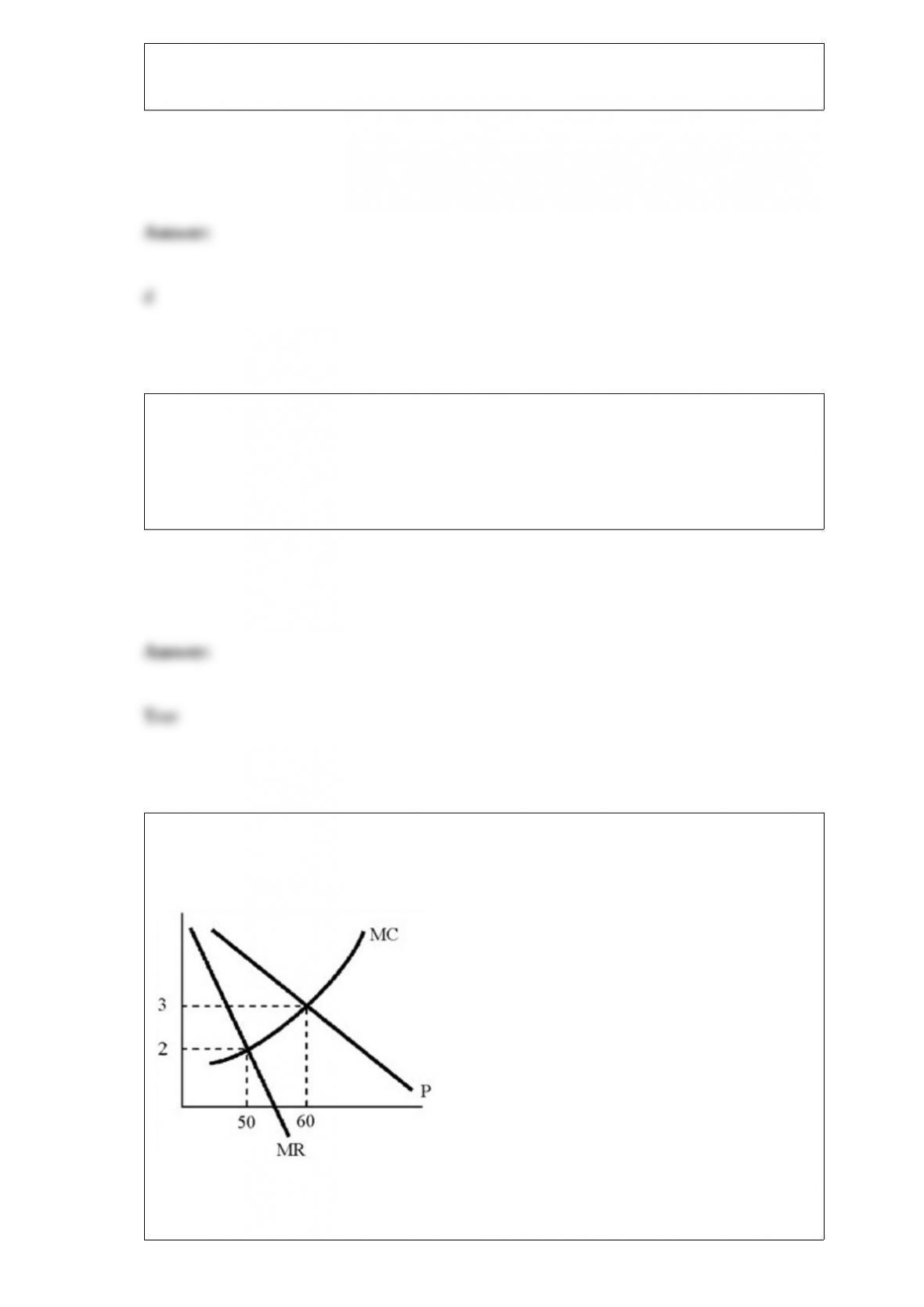
Figure 11-3
In Figure 11-3, one can tell from the graph that the monopolist will earn a positive
profit only if

a. the price exceeds $3.
b. the price exceeds $2.
c. output is less than 60 units.
d. One cannot tell from the information given.
What is inflation targeting?
a. Making sure inflation is reduced to zero.
b. Increasing the required reserve ratio when there is inflation.
c. Increasing the supply of money in the economy.
d. Aiming for a particular inflation level.
How does the U.S. economy rank in size?
a. first in economic output
b. second in economic output
c. third in economic output

d. fourth in economic output
e. fifth in economic output
At a perfectly competitive firm’s short-run equilibrium level of output,
a. P = MR = MC.
b. P = MR, but MR does not equal MC.
c. P = MC, but MR does not equal MC.
d. MR = MC and P < MR.
The opportunity cost of any decision is the forgone value of the next best alternative
that is not chosen.
a. True
b. False

The distribution process performed by the price system is not as efficient as the
distribution process of central planners.
a. True
b. False
The currency of the European Union, the euro, was established as part of the Bretton
Woods agreements.
a. True
b. False
If an economy at the equilibrium level of GDP experiences an increase in the amount of
investment spending, then inventories will be
a. depleted, causing firms to cut production.
b. accumulated, causing firms to cut production.
c. depleted, causing firms to increase production.

d. accumulated, causing firms to expand production.
Markets will always create more efficient outcomes without government intervention.
a. True
b. False
Input-output analysis is commonly used in production decisions.
a. True
b. False

The demand for potatoes at current prices is likely to be
a. elastic.
b. inelastic.
c. unit elastic.
d. perfectly elastic.
The use of automated teller machines (ATMs) has caused some bank tellers to lose their
jobs. This is an example of
a. cyclical unemployment.
b. seasonal unemployment.
c. frictional unemployment.
d. structural unemployment.
One advantage of a money system compared to a barter system is that
a. barter never works.
b. money creates the need for banks.

c. money is more efficient.
d. everyone has money.
The typical average cost curve
a. continually declines as output increases.
b. is horizontal.
c. continually increases as output increases.
d. first declines to a minimum and then increases as output increases.
A mixed economy blends private and public elements.
a. True
b. False

Keeping landing fees low at airports during the “peak” hours
a. perpetuates congestion during those hours.
b. is politically unpopular.
c. contributes to efficient allocation of airport facilities.
d. would lessen the problem of delayed flight landings.
Increasing opportunity cost tends to occur if
a. management is disorganized.
b. markets do not equate money and opportunity cost.
c. production is inefficient.
d. resources are scarce.
e. resources are specialized.
Unconventional monetary policies include massive lending to banks and open-market
purchases of assets other than Treasury bills.

a. True
b. False
Some critics of antitrust are worried that some firms
a. will seek to increase competition to a dangerous level.
b. will collude in order to avoid the laws.
c. may use antitrust to prevent competition.
d. may go out of business from large damage awards.
During the American Revolution, the Pennsylvania legislature enacted price controls on
essential commodities. The result of this legislation was
a. a large increase in the availability of those items, ending shortages.
b. a severe shortage of those essential commodities.
c. an increase in the price of those items, thus alleviating shortages.
d. new efforts to increase production of those commodities.
e. a minor inconvenience as persons adjusted to the new law.

Consider the following information regarding a person’s decision to go to college:
college tuition is $20,000 per year, room and board is $10,000 per year, and books and
materials are $2,000 per year. Suppose that instead of going to college this person could
have earned $18,000 working in a store. An economist would calculate the cost of
going to college as
a. $20,000.
b. $30,000.
c. $32,000.
d. $50,000.
e. $18,000.
Aid to families with dependent children was
a. a close-to-perfect welfare or public assistance program.
b. criticized because it provided little incentive for recipients to get jobs.
c. contributing to efficient production of goods.
d. superior to a negative income tax for work incentives.
Consumers should purchase a good up to the point where MU = P.
a. True
b. False
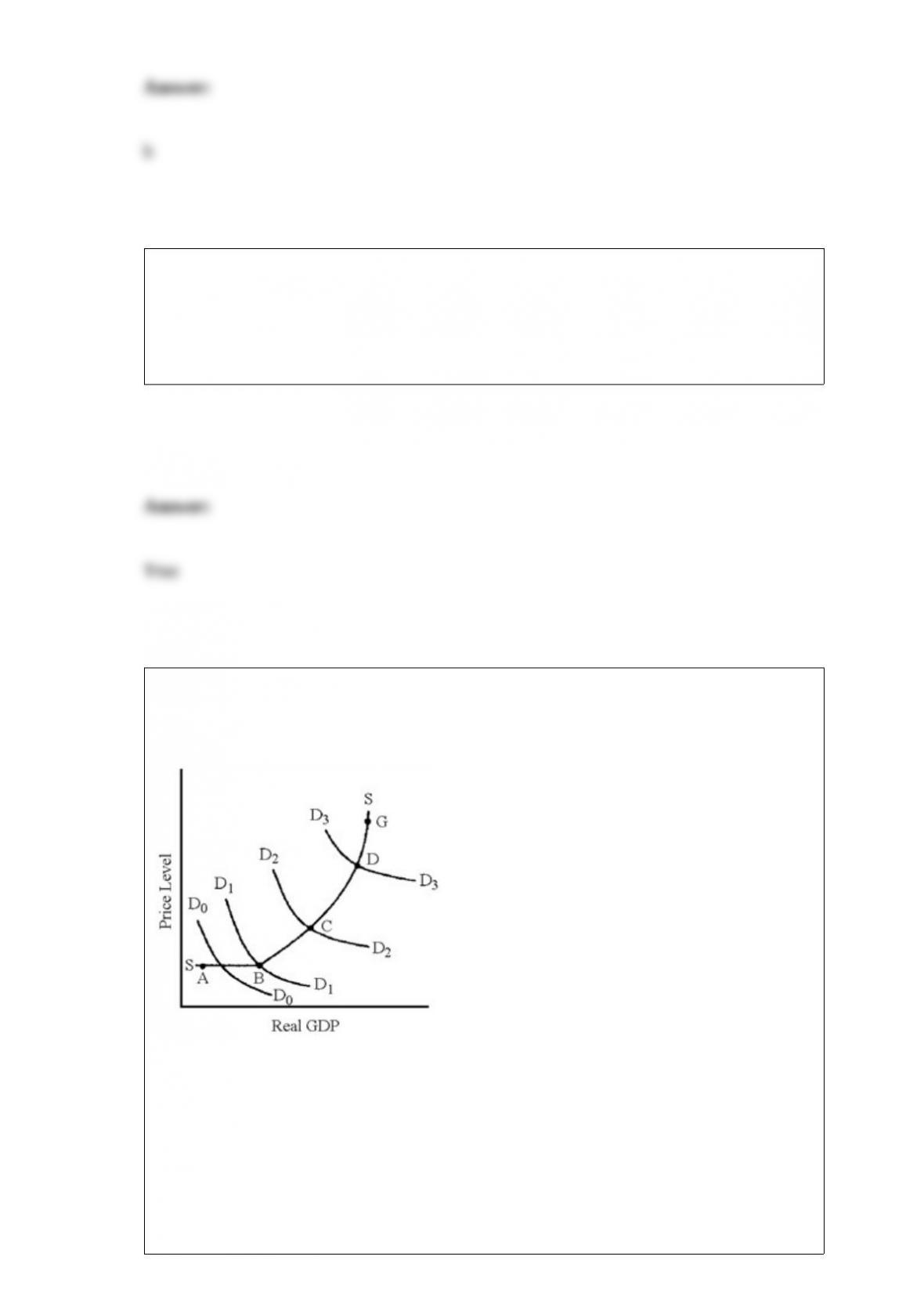
Figure 10-2
In Figure 10-2, which segment of the aggregate supply curve has the largest multiplier
effect?
a. AB
b. BC
c. CD

d. DG