
In the short run, a perfectly competitive firm can make a profit, a loss, or shut down.
a. True
b. False
In an ideal competitive market economy
a. resources are allocated according to a person’s needs.
b. resources are allocated according to ability to pay.
c. social and individual needs are met by the market.
d. All of the above are true.
Low levels of sales that cause low levels of investment spending is an example of a
a. vicious circle.
b. virtuous circle.
c. convergence circle.
d. divergence circle.

If one tracks the prices of critical metals, one sees that
a. they have risen more slowly than the general rate of inflation.
b. they have risen about as rapidly as the general rate of inflation.
c. the prices indicate increasing scarcity of the metals.
d. the prices have fluctuated too wildly to conclude anything.
How does the imposition of a tariff reduce the price of imports?
a. At the lower quantity supplied, the price to the importer is lower than if there were
free trade.
b. At the lower quantity demanded, the price to the importer is lower than if there were
free trade.
c. Supply of the product is increased from domestic production, reducing the price of
the imports.
d. Demand for the product is decreased, so that price must fall.

The expansion of information technology and the increasing complexity of the
economy should make the wage premium
a. continue rising.
b. continue falling.
c. rise.
d. fall.
Nominal GDP is
a. also called real GDP.
b. a more accurate measure than real GDP.
c. real GDP adjusted for changes in the price level.
d. GDP measured in current prices.
Spending on R&D among a group of firms is equally likely to increase or to decrease.
a. True

b. False
In the determination of disposable income, transfer payments are treated as if they
a. are the same as taxes.
b. did not exist.
c. are the opposite of taxes.
d. were a constant amount.
Consumer spending represents about what fraction of total spending in the economy?
a. one-fifth
b. two-thirds
c. one-third
d. two-fifths
e. three-fourths

The tax treatment of corporate profit means that corporations
a. cannot profitably issue common stock.
b. choose investment opportunities more efficiently than do other types of firms.
c. limits the things in which corporations can invest.
d. can generally avoid paying federal taxes but not state taxes.
In a market system, prices are used to coordinate economic activity.
a. True
b. False
Which of the following are problems that may limit economic growth in developing
countries?
a. geography

b. health
c. governance
d. all of the above.
____ is the income actually available to the consumers that determines aggregate
demand.
a. Nominal income
b. Net domestic product
c. Income corrected for depreciation
d. Disposable income
The average fixed cost curve increases as output increases.
a. True
b. False

High-wage workers are
a. more likely than low-wage workers to supply more labor when the wage rate rises.
b. about as likely as low-wage workers to supply more labor when the wage rate rises.
c. less likely than low-wage workers to supply more labor when the wage rate rises.
d. The available evidence does not indicate how high-wage workers and low-wage
workers differ in responding to changes in the wage rate.
MC and MU are set equal to one another in a market economy because
a. producers and consumers are free to communicate with one another.
b. producers and consumers both respond to the same price.
c. consumers must accept the prices set by producers.
d. producers must accept the price set by consumers.

As the term “opportunity cost” is defined in the text, the opportunity cost of going to
college includes
a. both tuition and the value of the student’s time.
b. tuition but not the value of the student’s time, which is a cash cost.
c. the value of the student’s time but not tuition, which is a monetary cost.
d. neither tuition nor the value of the student’s time, since obtaining a college degree
makes one’s income higher in the future.
e. neither tuition nor the value of the student’s time, at least at subsidized state
universities.
Most tax payments increase as GDP increases.
a. True
b. False
The new $20 bills were designed with features to make counterfeiting more difficult.
a. True
b. False
Opportunity cost is best defined as the value of
a. all of the other possible options that the decision maker could have chosen.
b. the alternative which the decision maker would choose if more resources were
available.
c. what is gained from the alternative which is chosen.
d. resources that are given up to obtain the alternative that is chosen.
e. the next best alternative that the decision forces one to give up.
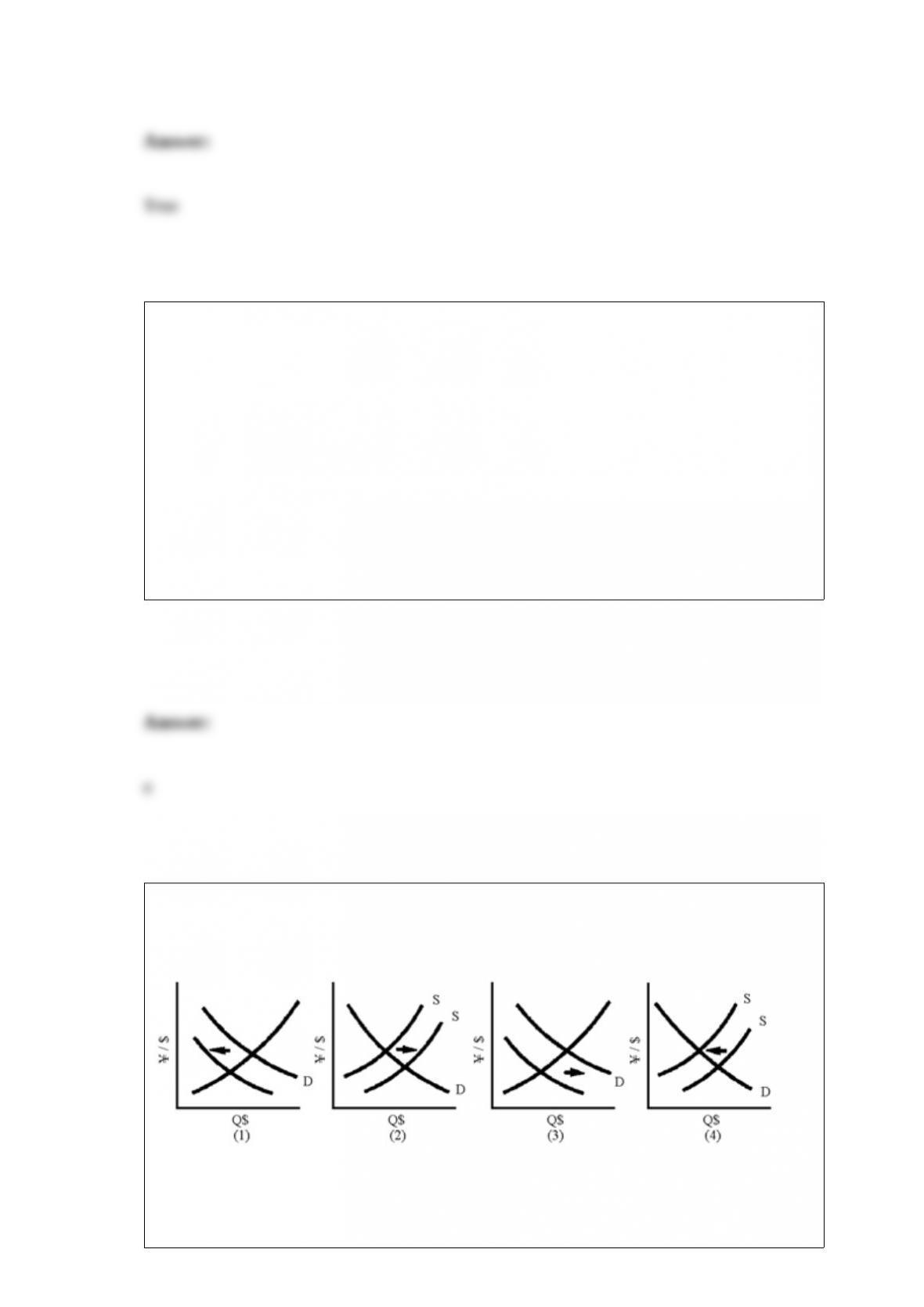
Figure 19-1
Of the graphs in Figure 19-1, which one shows that an expansion of the Japanese
economy leads to a depreciation of the yen?

a. 1
b. 2
c. 3
d. 4
An oligopoly is a market structure in which a few large firms dominate the sale of a
single product.
a. True
b. False
One of the great strengths of the market system is the way it acts as an engine of
economic growth and innovation.
a. True
b. False

An “opportunity cost” may be described as:
a. the value of what must be gtiven up
b. the opporrtunity foregone
c. the value of the next best alternative
d. the correct measure of cost
e. all of these are correct
Compared to college tuition, the prices of automobiles in the United States have
a. fallen.
b. risen.
c. stayed the same.
d. risen at the same rate as the CPI.
Carefully define the following terms and explain their importance in the study of
macroeconomics:
a. expenditure schedule
b. saving schedule
c. equilibrium GDP
d. leakages schedule
e. injections schedule

One of the reasons for the growth performance of free market economies is firms’ use of
innovation to compete with one another.
a. True
b. False
A firm can stay in business while taking a loss in the short run as long as it covers its
a. fixed costs.
b. variable costs.
c. fixed and variable costs.
d. A firm can never stay in business when it experiences losses.
Marginal physical product is
a. the increase in input usage resulting from an increase in revenue.
b. the same as marginal revenue product.
c. equal to average physical product when a monopoly firm is in equilibrium.
d. the increase in output stemming from a one-unit increase in input.
Efficient production can be carried out anywhere on or below the production
possibilities frontier.
a. True
b. False
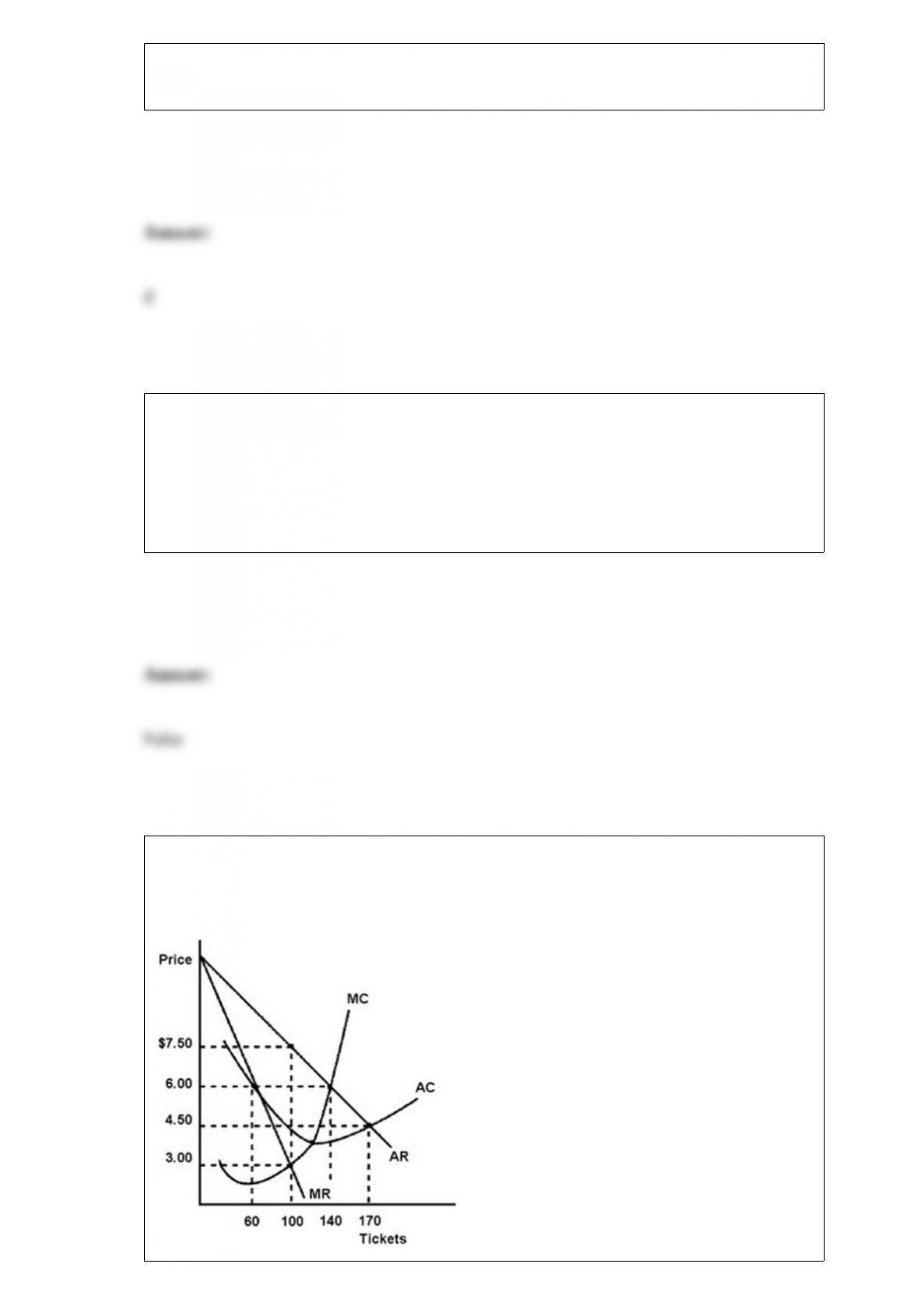
Figure 11-5
In Figure 11-5 are the cost and revenue curves of a monopolist in the theater market,
Crown Theater, which is the only movie theater in the city. At its profit-maximizing
quantity of tickets sold, movie goers will buy ____ tickets.
a. 60
b. 100
c. 120
d. 140
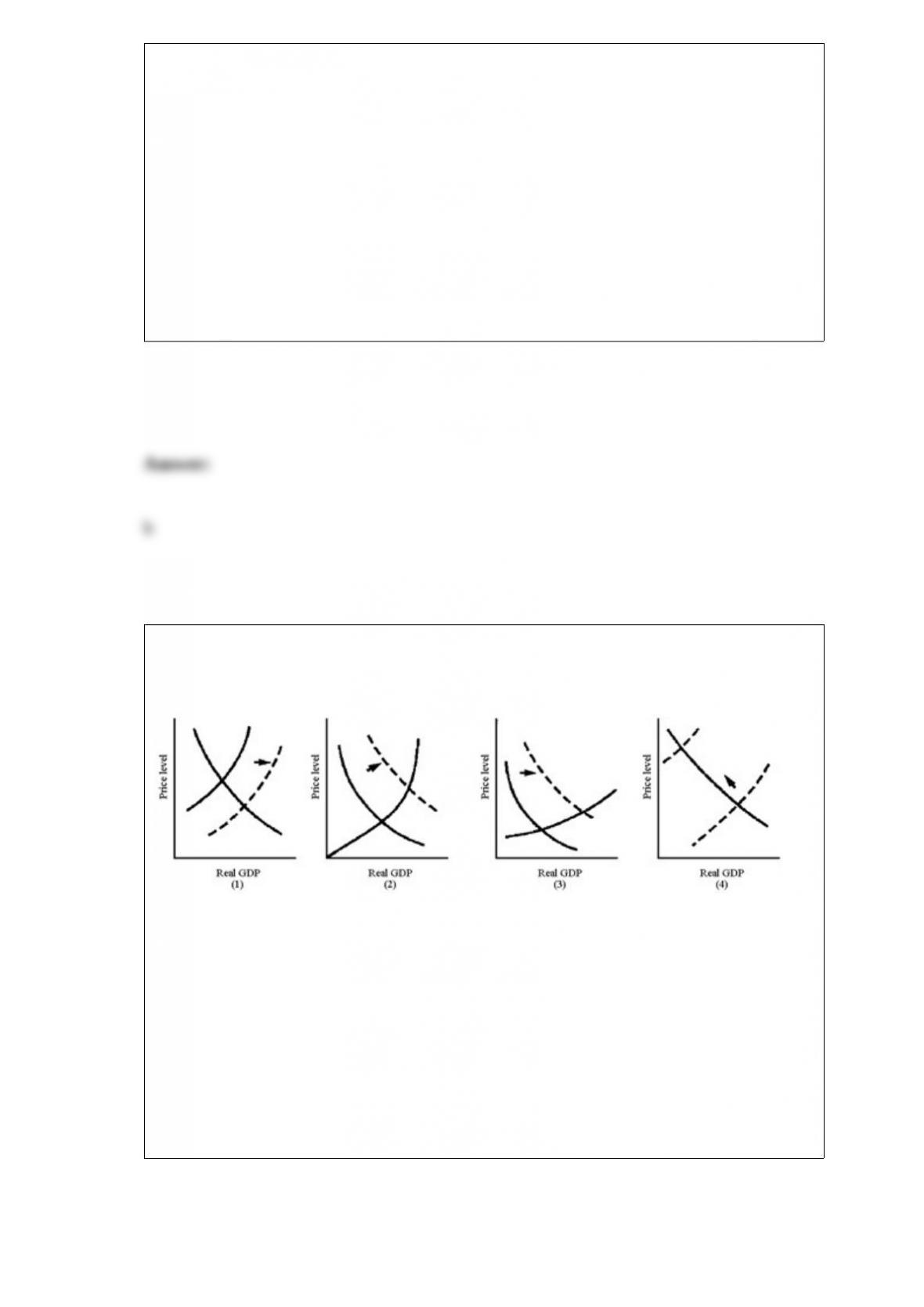
Figure 10-5
In Figure 10-5, which graph best illustrates the situation of an economy with high
unemployment that experiences an increase in investment spending?
a. (1)
b. (2)
c. (3)
d. (4)

For each $1 of a tax cut, economists expect consumption to
a. decrease by $1.
b. decrease by less than $1.
c. increase by less than $1.
d. increase by $1.