
Usury laws typically regulate
a. interest rates paid on savings.
b. interest rates charged on loans.
c. rents charged on land.
d. economic rent earned in all factor markets.
Government policy to reduce unemployment and increase national output can be
illustrated by an
a. outward shift of the aggregate demand curve caused by an increase in government
spending.
b. outward shift of the aggregate supply curve caused by a reduction in government
spending.
c. inward shift of the aggregate demand curve caused by an increase in government
spending.
d. inward shift of the aggregate supply curve caused by a reduction in government
spending.
Which of the following is the correct way to describe equilibrium in a market?
a. At equilibrium, demand equals supply.
b. At equilibrium, quantity demanded equals quantity supplied.
c. At equilibrium, market forces are no longer at work.
d. Equilibrium is a tendency, a state of perpetual motion.
e. Equilibrium is the best combination of price and quantity.
A good’s marginal social cost is defined as its
a. marginal private cost minus the value of any detrimental externality.
b. incidental cost.
c. marginal private cost plus the value of any taxes paid on its production.
d. marginal private cost plus its incidental cost.
A minimum wage law may cause unemployment among low-skill workers.
a. True
b. False
If the inflation rate falls, what will happen to the budget deficit?
a. It will rise, because government spending will rise.
b. It will rise, because interest payments will rise.
c. It will fall, because tax receipts will increase.
d. It will fall, because interest payments will fall.
In the last three decades, air quality in American cities has improved.
a. True
b. False
One of the more powerful forces leading to an end in economic discrimination is
a. pure competition.
b. pure monopoly.
c. government regulation.
d. oligopolistic rivalry.
Table 7-5
Table 7-5 shows short-run total cost figures for a stereo manufacturer. The
manufacturer’s short-run fixed cost is
a. 0.
b. $75.
c. $200.
d. $400.
The dramatic rise in the dollar between 1981 and 1986 was the result of a(n)

a. a tight monetary and a tight fiscal policy.
b. an expansive monetary and an expansive fiscal policy.
c. an expansive monetary and a tight fiscal policy.
d. a tight monetary and an expansive fiscal policy.
Sally leaves her $24,000 secretarial position with a company and invests her savings of
$15,000 (on which she was earning 6 percent interest) in her own Ready Sec agency.
After expenses, her net income was $28,900. Her economic profit was
a. $4,900.
b. $4,000.
c. $28,900.
d. −$10,100.
One of the practical issues in the choice of government spending or taxes to change
aggregate demand is how large a
a. change in demand we want.
b. trade deficit we want.

c. budget deficit we want.
d. government sector we want.
Despite the monies spent by the federal and state governments, many observers believe
which of the following?
a. public infrastructure such as bridges and roads is only adequate
b. our educational system is lacking
c. not enough monies are spent on homeland defense
d. all of these are correct
It is urgent that the U.S. improve in certain economic arenas.
a. True
b. False

Universal service means that one company provides service to all consumers,
everywhere.
a. True
b. False
If a market system is functioning well, we can conclude that goods with
a. high opportunity costs tend to have high money costs.
b. low opportunity costs tend to have high money costs.
c. high opportunity costs tend to have low money costs.
d. low opportunity costs tend to have zero money costs.
e. high opportunity costs tend to have zero money costs.
In economics the true cost of making a choice is the value of what must be given up.

a. True
b. False
The demand curve for a good connects points describing how much consumers
a. actually bought at different prices during a particular period.
b. actually bought at different prices in different periods.
c. would have been willing and able to buy at different prices during a particular period.
d. would have been willing and able to buy at different prices in different periods.
Technological advances that allow a good to be produced at a lower cost will shift the
demand curve rightward.
a. True
b. False
Which economist created the theory of creative destruction?
a. William Nordhaus
b. Joseph Schumpeter
c. Adam Smith
d. Milton Friedman
As a price change persists over a long period of time, we should expect the demand
elasticity to fall.
a. True
b. False
An asset of a bank is
a. the value of money that is on deposit.

b. the amount a depositor may legally borrow.
c. something of value that the bank owes to a depositor.
d. something of value that a bank owns.
Leakages are offset by investment and government spending in the circular flow model.
a. True
b. False
Intermediate goods, like milk sold by a farmer to a supermarket, are
a. included in GDP.
b. included in GDP at market value.
c. included if it is imported.
d. are not included in GDP.
Price competition among firms has proved to be more important than the introduction
of new products.
a. True
b. False
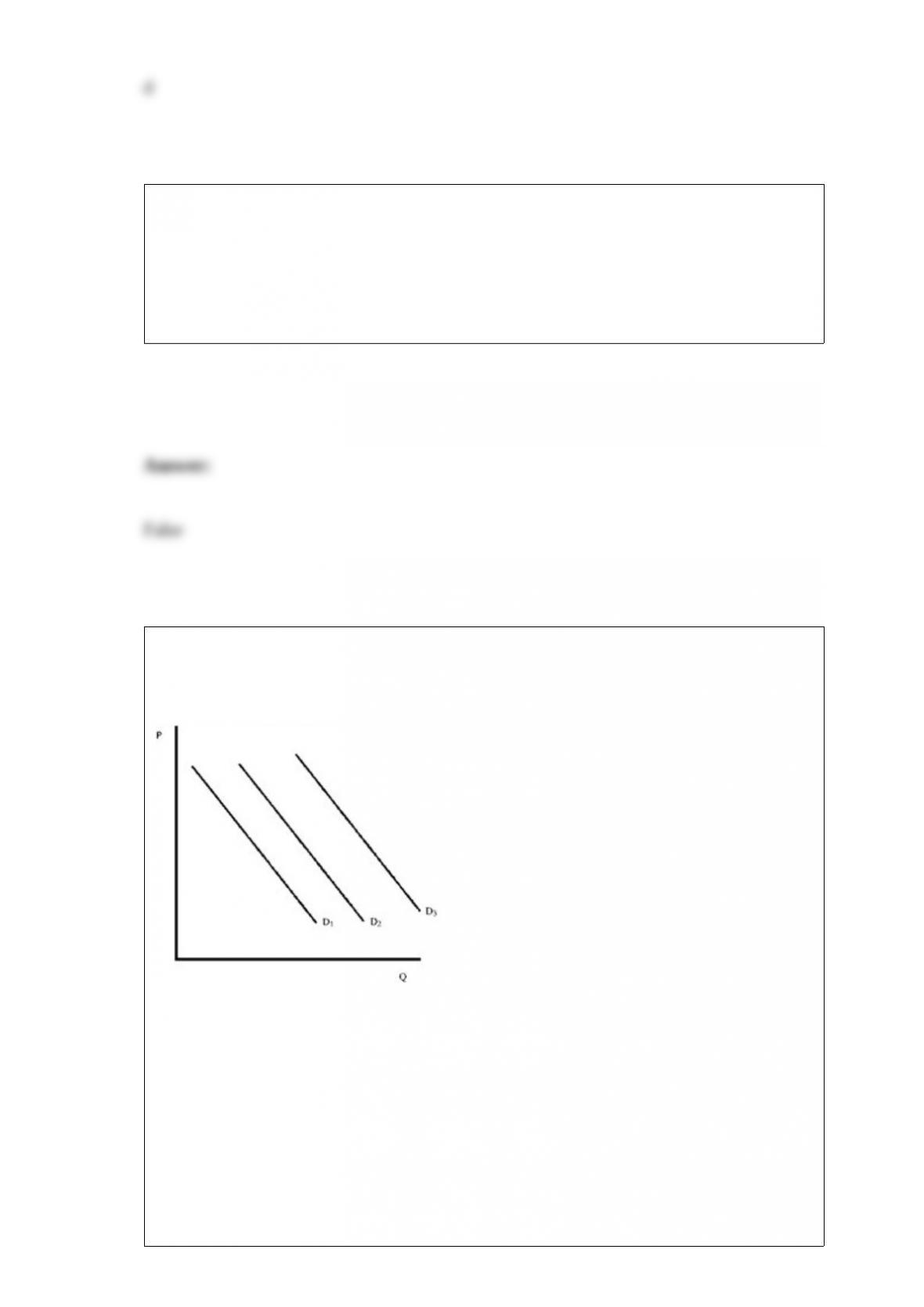
Figure 4-4
Assume that Figure 4-4 shows demand for soda. A decrease in the price of apple juice
will change demand from
a. D1 to D2.
b. D2 to D1.
c. D2 to D3.

d. D1 to D3.
Higher interest rates and, therefore, a decrease in investment spending is most likely to
be caused by which policy mix?
a. deficit reduction and expansionary monetary policy
b. larger deficits and contractionary monetary policy
c. larger deficits and expansionary monetary policy
d. deficit reduction and contractionary monetary policy
The “efficiency of the payments mechanism” refers to
a. the ease and speed of exchanging money for goods and services.
b. how fast member banks replenish required reserves.
c. how fast banks pay interest on deposit accounts.
d. how fast countries pay off foreign debts.

The initial development of paper money began when people used ____ as payment for
goods and services.
a. credit cards
b. commodity money
c. goldsmith receipts
d. gold bullion
e. gold coins
If the opportunity cost of capital is below the rate of return to capital in the perfectly
competitive beauty salon industry,
a. resources will flow into the industry.
b. beauty salon owners must be earning negative economic profit.
c. the beauty salon industry cannot be in long-run equilibrium.
d. beauty salon owners must be earning negative marginal revenue at their current
levels of output.

The objective of bank management is to
a. maximize stockholders’ profits by making risky investments and giving loans to
borrowers who will pay the highest interest rates.
b. refuse to make risky loans and make loans only to the safest borrowers.
c. invest in U.S. government securities and make loans only to established businesses.
d. strike the appropriate balance between the attraction of bank profits and the need for
bank safety.