Archives
Economics Chapter 1 1 In their study of the effect of legalized abortion on crime rates, Steven Levitt and John Donohue applied In conducting positive economic analysis, economists apply
Multiple Choice Questions 1. Which of the following topics is related to microeconomics? A. Explanations of why recessions occur. B. Determining how much output a firm should produce. C. The rate of unemployment. D. The rate of economic growth. AACSB: […]
Economics Chapter 1 2 In order to explain how societies deal with the problem of scarcity, economists apply simplified representations known as
AACSB: Reflective Thinking Blooms: Remember Difficulty: 1 Easy Topic: Tools of Microeconomics 34. A useful theory must A. apply to every conceivable situation. B. be broadly applicable. C. be agreed upon by all economists. D. not be able to be […]
Economics Chapter 10 1 People can earn in both the first and second stages of their life. People also prefer stability in their consumption patterns
1. The amount of money borrowed in a transaction is called: A. interest. B. principal. C. internal rate of return. D. present discounted value. AACSB: Reflective Thinking Blooms: Remember Difficulty: 1 Easy Topic: Transactions Involving Time 2. The amount of […]
Economics Chapter 10 2 Which of the following is NOT a reason why an increase in the interest rate usually makes investment projects less attractive
38. The difference between revenue and cost during a single year of a project’s life is called the: A. interest rate. B. net present value. C. net cash flow. D. profit. AACSB: Reflective Thinking Blooms: Remember Difficulty: 1 Easy Topic: […]
Economics Chapter 11 1 Suppose Alice is deciding whether or not to go to a New York Giants game. Alice’s enjoyment and thus decision, depends upon two uncertain events that are out of her control
1. Risk: A. is inherent in every action or decision. B. exists whenever the consequences of a decision are uncertain. C. exists when outcomes are certain. D. is a good that can be purchased. AACSB: Reflective Thinking Blooms: Remember Difficulty: […]
Economics Chapter 11 2 Explain why a risk averse individual will purchase full insure if a policy is actuarially fair, but only partially insure or not insure at all, if it is not. Use graphs to support your answer
30. Assume Brandon’s benefit function for water is S ( W ) = √ W and he consumes water both in droughts, WD, or in the rainy season, WR . Assume his current consumption bundle is WD = 36 and […]
Economics Chapter 12 1 Refer to Figure a. Charlie and Joe both want to ride shotgun with their mother, so they play a game of rock-paper-scissors to determine who gets to sit in the front seat
1. A game is: A. a situation in which each member of a group makes at least one decision and cares both about his own choice and about others’ choices. B. describes a situation in which strategy plays a role. […]
Economics Chapter 12 2 Refer to Figure a. Charlie and Joe both want to ride shotgun with their mother, so they play a game of rock-paper-scissors to determine who gets to sit in the front seat
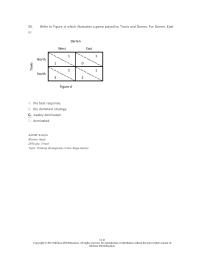
26. Refer to Figure d , which illustrates a game played by Travis and Darren. For Darren, East is: A. the best response. B. the dominant strategy. C. weakly dominated. D. dominated. AACSB: Analytic Blooms: Apply Difficulty: 3 Hard Topic: […]
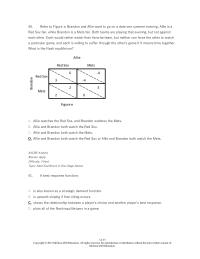
Economics Chapter 12 3 Refer to Figure e. Brandon and Allie want to go on a date one summer evening. Allie is a Red Sox fan, while Brandon is a Mets fan. Both teams are playing that evening
40. Refer to Figure e . Brandon and Allie want to go on a date one summer evening. Allie is a Red Sox fan, while Brandon is a Mets fan. Both teams are playing that evening, but not against each […]
Economics Chapter 13 1 decisions made in the laboratory replicate those made in the real world and the number of subjects is typically so large, that it is difficult to apply the results to economic behavior in the population
1. Motivations for behavioral economics include: A. people sometimes make choices that are inconsistent with standard economic theory. B. all choices made by individuals are consistent with standard economic theory. C. standard economic theory can lead to unreasonable conclusions about […]
Economics Chapter 13 2 Gabby flips a fair coin and it shows heads. When trying to guess what the coin will show on the next flip, Gabby guesses heads because she thinks it is more likely
32. Projection bias: A. is the tendency to evaluate future consequences based on tastes and needs at the moment of the decision making. B. is the tendency to project future states of mind into the present. C. can lead people […]
Economics Chapter 14 1 Each of the following is implied if we say that transactions costs are absent EXCEPT sellers can easily communicate their prices.
1. Each of the following is implied if we say that transactions costs are absent EXCEPT: A. sellers can easily communicate their prices. B. buyers can easily locate suppliers and learn their prices. C. buyers and sellers can arrange transactions […]
Economics Chapter 14 2 In a perfectly competitive market, an increase in demand will lead to a long-run increase in the product’s price if and only if the increase in demand is temporary
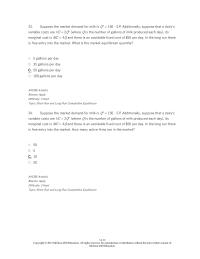
33. Suppose the market demand for milk is Q d = 150 – 5 P . Additionally, suppose that a dairy’s variable costs are VC = 2 Q 2 (where Q is the number of gallons of milk produced each […]
Economics Chapter 15 1 When the government implements a price support program it may end up buying a lot of the good, for which it has little or no use
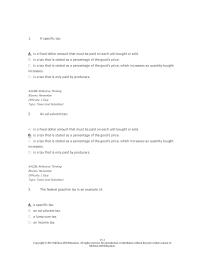
1. A specific tax: A. is a fixed dollar amount that must be paid on each unit bought or sold. B. is a tax that is stated as a percentage of the good’s price. C. is a tax that is […]
Economics Chapter 15 2 Suppose the government wants to increase the price of a specific agricultural product. Discuss the welfare effects of four possible policies: price floor, price support, production quota
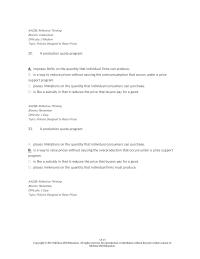
AACSB: Reflective Thinking Blooms: Understand Difficulty: 2 Medium Topic: Policies Designed to Raise Prices 32. A production quota program: A. imposes limits on the quantity that individual firms can produce. B. is a way to reduce prices without causing the […]
Economics Chapter 16 1 Outcome-oriented notions of equity focus on what people could choose rather than what they actually choose. The principle of equal opportunity is an example of
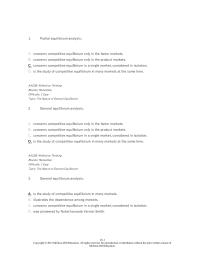
1. Partial equilibrium analysis: A. concerns competitive equilibrium only in the factor markets. B. concerns competitive equilibrium only in the product markets. C. concerns competitive equilibrium in a single market, considered in isolation. D. is the study of competitive equilibrium […]
Economics Chapter 16 2 The idea that every Pareto efficient allocation is the competitive equilibrium for some initial allocation of resources is known as
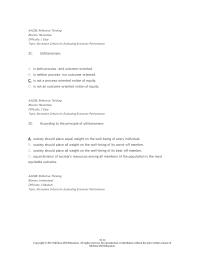
AACSB: Reflective Thinking Blooms: Remember Difficulty: 1 Easy Topic: Normative Criteria for Evaluating Economic Performance 31. Utilitarianism: A. is both process- and outcome-oriented. B. is neither process- nor outcome-oriented. C. is not a process-oriented notion of equity. D. is not […]
Economics Chapter 17 1 there can never be a difference between the marginal cost of higher product quality and the marginal value to consumers of higher product quality
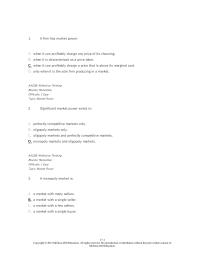
1. A firm has market power: A. when it can profitably charge any price of its choosing. B. when it is characterized as a price taker. C. when it can profitably charge a price that is above its marginal cost. […]
Economics Chapter 17 2 Discuss the difference between first-best and second-best price regulation. In your answer, you should address why governments regulate markets and the difficulties faced when doing so
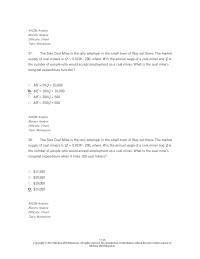
AACSB: Analytic Blooms: Analyze Difficulty: 3 Hard Topic: Monopsony 37. The Solo Coal Mine is the only employer in the small town of Way out there. The market supply of coal miners is Q s = 0.02 W – 200, […]
Economics Chapter 18 1 If a monopoly is price discriminating between two groups, A and B, based on observable customer characteristics, there is a difference in the marginal cost of selling to the two groups
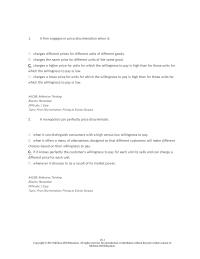
1. A firm engages in price discrimination when it: A. charges different prices for different units of different goods. B. charges the same price for different units of the same good. C. charges a higher price for units for which […]
Economics Chapter 18 2 Discuss the differences between perfect and imperfect price discrimination and the benefits of each to a monopolist Bundling always increases a multi-product monopolist’s profit
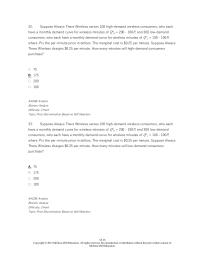
32. Suppose Always There Wireless serves 100 high-demand wireless consumers, who each have a monthly demand curve for wireless minutes of Q dH = 200 – 100 P , and 300 low-demand consumers, who each have a monthly demand curve […]
Economics Chapter 19 1 All else equal, in which oligopolistic market below would one expect the markup to be the smallest An oligopolistic market with inelastic demand and a very few firms
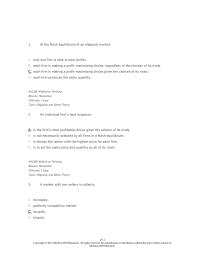
1. At the Nash equilibrium of an oligopoly market: A. only one firm is able to earn profits. B. each firm is making a profit-maximizing choice, regardless of the choices of its rivals. C. each firm is making a profit-maximizing […]
Economics Chapter 19 2 when there are only a few firms, each producing a unique product, prices above marginal cost and earns zero profit net of fixed costs.
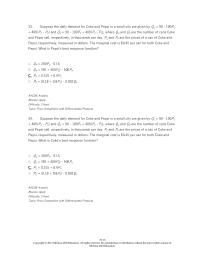
33. Suppose the daily demand for Coke and Pepsi in a small city are given by QC = 90 – 100 PC + 400( PP – PC ) and QP = 90 – 100 PP + 400( PC – PP […]
Economics Chapter 2 1 The relationship that shows how much buyers of a product want to buy at each possible price, holding fixed all other factors is called
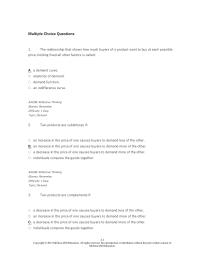
Multiple Choice Questions 1. The relationship that shows how much buyers of a product want to buy at each possible price, holding fixed all other factors is called: A. a demand curve. B. elasticity of demand. C. demand function. D. […]
Economics Chapter 2 2 Suppose there is a decrease in both the demand for and supply of a good. What happens to equilibrium price and quantity
AACSB: Reflective Thinking Blooms: Remember Difficulty: 1 Easy Topic: Market Equilibrium 39. Which of the following would result from an increase in the demand for a good? A. Both equilibrium price and quantity would rise. B. Both equilibrium price and […]
Economics Chapter 20 1 affects someone with whom the decision-maker has not engaged in a related market transaction and affects only those individuals engaged in the market transaction
1. An action creates an externality if it: A. does not affect someone with whom the decision-maker has not engaged in a related market transaction. B. affects someone with whom the decision-maker has not engaged in a related market transaction. […]
Economics Chapter 20 2 A public recreation area that has become unpleasantly crowded is exhibiting a negative externality that is frequently associated with
33. Your neighbor likes to blast 1970’s rock music and the louder the better. The loud music imposes a cost on you because it disrupts your study of economics. Let D stand for the volume of his music in decibels, […]
Economics Chapter 21 1 When one party to a transaction has more information about the characteristics of the good or service to be trade than does the other party, economists say that information is
1. When one party to a transaction has more information about the characteristics of the good or service to be trade than does the other party, economists say that information is: A. uneven. B. asymmetric. C. imperfect. D. disequilibriated. AACSB: […]
Economics Chapter 21 2 If homes owned by real estate agents stay on the market longer and sell for higher prices than homes owned by people who hire real estate agents, this may be evidence of
39. When employers use screening to distinguish high-ability workers from sufficiently numerous low-ability workers, the burden of asymmetric information falls on _________ because they ________ than when employers are well-informed. A. low-ability workers; perform more tasks B. low-ability workers; are […]
Economics Chapter 3 1 The cost associated with foregoing the opportunity to employ a resource in its best alternative use is called Total benefits minus total cost equals
1. The cost associated with foregoing the opportunity to employ a resource in its best alternative use is called: A. a sunk cost. B. an opportunity cost. C. a fixed cost. D. total cost. AACSB: Reflective Thinking Blooms: Remember Difficulty: […]
Economics Chapter 3 3 Use cost benefit analysis to explain the decision whether or not to attend college. Why do some people choose not to attend college
54. Consider a consumer choosing between spending her money on food, F, or clothing, C. Assume that a unit of food and a unit of clothing have the same price, and that the consumer can afford a total of 20 […]
Economics Chapter 3 Suppose that the slope of a line tangent to the total cost curve at point X is steeper than the slope of a line tangent to the total benefit curve at point X, then
AACSB: Reflective Thinking Blooms: Remember Difficulty: 1 Easy Topic: Thinking on the Margin 26. The marginal units of action choice X: A. are the last ∆X units and tend to generate the greatest amount of marginal benefits. B. are the […]
Economics Chapter 4 1 Netflix.com asks its customers to rate the videos they have watched. This information is then used to rank videos for other Netflix.com subscribers
Multiple Choice Questions 1. Which of the following is NOT a reason why economists are interested in understanding consumer behavior? A. Economists are often called upon to evaluate public policies that impact the well-being of consumers. B. It is important […]
Economics Chapter 4 2 Suppose Frank is completely indifferent between drinking Coke and drinking Pepsi. Then Frank’s indifference curves for Coke and Pepsi would be
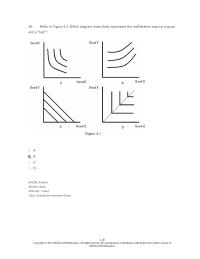
39. Refer to Figure 4.3. Which diagram most likely represents the indifference map for a good and a “bad”? A. A B. B C. C D. D AACSB: Analytic Blooms: Apply Difficulty: 3 Hard Topic: Substitution between Goods 4-20 Copyright […]
Economics Chapter 5 1 Suppose a consumer purchases pizza and soft drinks. If pizza is measured on the vertical axis and soft drinks are measured on the horizontal axis
Multiple Choice Questions 1. A consumer’s budget constraint is determined by: A. a consumer’s income. B. a consumer’s income and preferences. C. a consumer’s income and the prices of the goods she buys. D. a consumer’s preferences and the prices […]
Economics Chapter 5 2 As long as the law of demand holds for books, than an increase in the price of books will generate a price-consumption curve that traces a path
39. When the price elasticity of demand is large in magnitude, a _____ increase in the price leads to a _____ reduction in the amount purchased and the demand curve is relatively ____. A. slight; substantial; steep B. slight; slight; […]
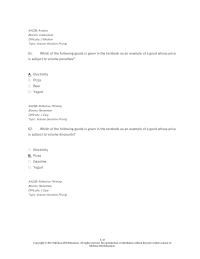
Economics Chapter 5 3 If electricity is measured on the horizontal axis, and the price of electricity becomes more expensive beyond 500 kilowatts, we draw
AACSB: Analytic Blooms: Understand Difficulty: 2 Medium Topic: Volume-Sensitive Pricing 61. Which of the following goods is given in the textbook as an example of a good whose price is subject to volume penalties? A. Electricity B. Pizza C. Beer […]
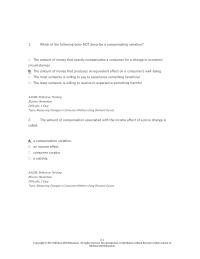
Economics Chapter 6 1 A change in price that is accompanied by a change in income sufficient to leave a consumer’s well-being unchanged is called
1. Which of the following does NOT describe a compensating variation? A. The amount of money that exactly compensates a consumer for a change in economic circumstances B. The amount of money that produces an equivalent effect on a consumer’s […]
Economics Chapter 6 2 If leisure is drawn on the horizontal axis and labor is drawn on the vertical axis, then a person who attaches more importance to leisure than to labor will have indifference curves that
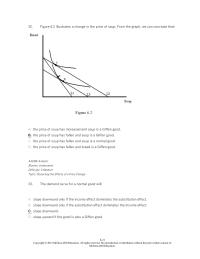
32. Figure 6.2 illustrates a change in the price of soup. From the graph, we can conclude that: A. the price of soup has increased and soup is a Giffen good. B. the price of soup has fallen and soup […]
Economics Chapter 6 3 Define consumer surplus. Using a graph, explain the change in consumer surplus that would result from a decrease in the price of a gasoline
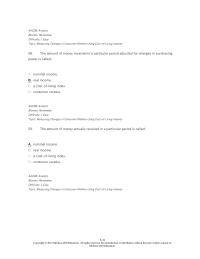
AACSB: Analytic Blooms: Remember Difficulty: 1 Easy Topic: Measuring Changes in Consumer Welfare Using Cost-of-Living Indexes 58. The amount of money received in a particular period adjusted for changes in purchasing power is called: A. nominal income. B. real income. […]
Economics Chapter 7 1 According to the Law of Diminishing Marginal Returns, as additional units of one input are employed as all other inputs are held constant, total output will eventually
1. A firm’s _______ summarizes all of its possible methods of producing its output. A. production technology B. efficient production frontier C. production function D. production possibilities curve AACSB: Reflective Thinking Blooms: Remember Difficulty: 1 Easy Topic: Production Technologies 2. […]
Economics Chapter 7 2 Suppose a firm uses only capital and labor to produce output. When the firm doubles the amount of both inputs, output increases by less than double
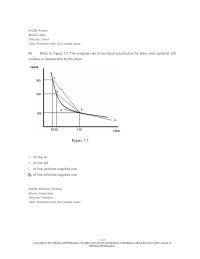
AACSB: Analytic Blooms: Apply Difficulty: 3 Hard Topic: Production with Two Variable Inputs 40. Refer to Figure 7.3. The marginal rate of technical substitution for labor with capital at 120 workers is represented by the slope: A. of line ac […]
Economics Chapter 7 3 Define decreasing returns to scale, illustrating your definition with isoquants. What are some reasons why firms might experience decreasing returns to scale
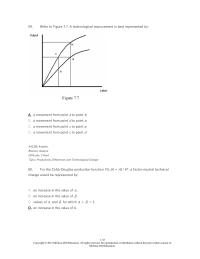
59. Refer to Figure 7.7. A technological improvement is best represented by: A. a movement from point a to point b . B. a movement from point d to point a . C. a movement from point c to point […]
Economics Chapter 8 1 Suppose the marginal rate of technical substitution for labor with capital is 5, the marginal product of labor is 8, and the marginal product of capital is 4
Multiple Choice Questions 1. ______ is the cost of inputs whose use does not vary as the firm’s output changes. A. Sunk cost B. Fixed cost C. Total cost D. Explicit cost AACSB: Reflective Thinking Blooms: Remember Difficulty: 1 Easy […]
Economics Chapter 8 2 If labor is measured along the horizontal axis and capital is measured along the vertical axis, an increase in the wage rate will cause the isocost line to
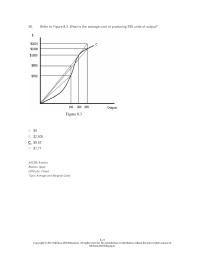
38. Refer to Figure 8.3. What is the average cost of producing 290 units of output? A. $9 B. $2,500 C. $8.62 D. $7.77 AACSB: Analytic Blooms: Apply Difficulty: 3 Hard Topic: Average and Marginal Costs 8-21 Copyright © 2014 […]
Economics Chapter 8 3 If a firm doubles the amount of labor it uses and triples the amount of capital it uses but its level of output less-than-triples as a result, what can be said about the firm’s returns to scale
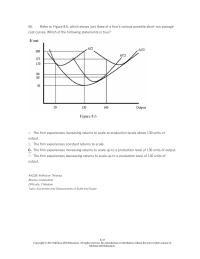
56. Refer to Figure 8.6, which shows just three of a firm’s various possible short-run average cost curves. Which of the following statements is true? A. The firm experiences increasing returns to scale at production levels above 130 units of […]
Economics Chapter 9 1 Checking to see whether the most profitable positive sales quantity results in a greater profit than not producing at all is the basis of what rule
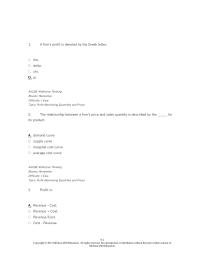
1. A firm’s profit is denoted by the Greek letter: A. rho. B. delta. C. chi. D. pi. AACSB: Reflective Thinking Blooms: Remember Difficulty: 1 Easy Topic: Profit-Maximizing Quantities and Prices 2. The relationship between a firm’s price and sales […]
Economics Chapter 9 2 A firm’s marginal and average costs may differ in the long and short run because How would a $10 increase in an avoidable per-unit fixed cost effect a price-taking firm’s supply curve
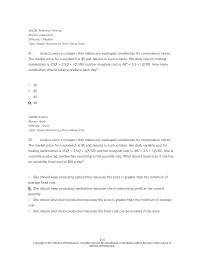
AACSB: Reflective Thinking Blooms: Understand Difficulty: 2 Medium Topic: Supply Decisions by Price-Taking Firms 41. Jessica owns a company that makes pre-packaged sandwiches for convenience stores. The market price for a sandwich is $5 and Jessica is a price-taker. Her […]
Economics Chapter 9 3 Define producer surplus. Using a graph, illustrate producer surplus for a firm with an avoidable fixed cost. Why is it convenient to focus on producer surplus when analyzing policy changes
AACSB: Reflective Thinking Blooms: Remember Difficulty: 1 Easy Topic: Supply by Multiproduct Price-Taking Firms 60. Dan is the owner of a price-taking company that manufactures sporting goods. One particular facility Dan owns produces baseball bats and baseball gloves. His cost […]