30. Assume Brandon’s benefit function for water is
S
(
W
) = √
W
and he consumes water both
in droughts,
WD,
or in the rainy season,
WR
. Assume his current consumption bundle is
WD
= 36
and
WR
= 25 and the probability of drought is 0.75. What is Brandon’s expected utility?
D. 30.5
31. Assume Brandon’s benefit function for water is
S
(
W
) = √
W
and he consumes water both
in droughts,
WD,
or in the rainy season,
WR
. Assume his current consumption bundle is
WD
= 36
and
WR
= 25 and the probability of drought is 0.75. Brandon’s certainty equivalent is:
D. 61 units of water.
32. Assume Brandon’s benefit function for water is
S
(
W
) = √
W
and he consumes water both
in droughts,
WD,
or in the rainy season,
WR
. Assume his current consumption bundle is
WD
= 36
and
WR
= 25 and the probability of drought is 0.75. Brandon‘s risk premium is:
D. 3.20 units of water.
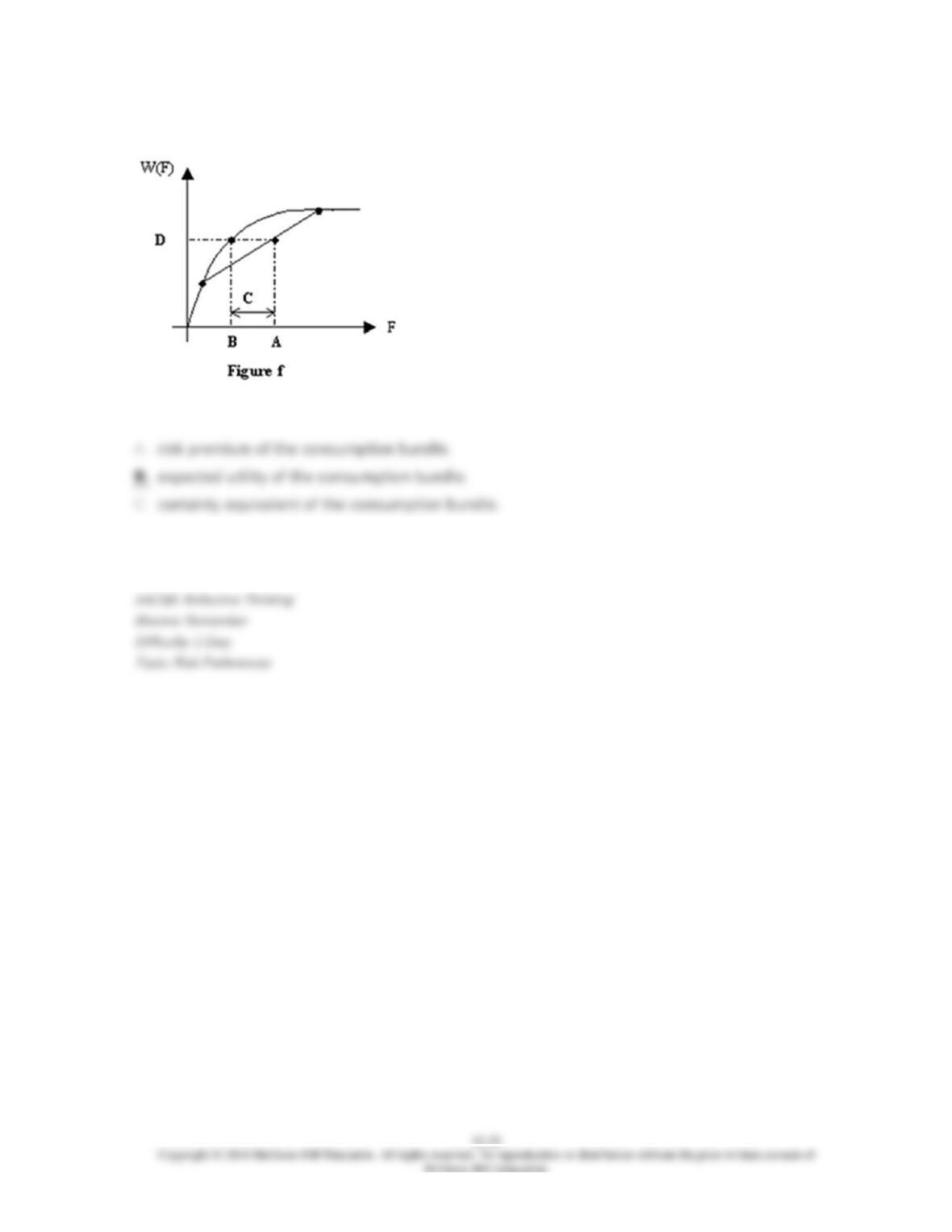
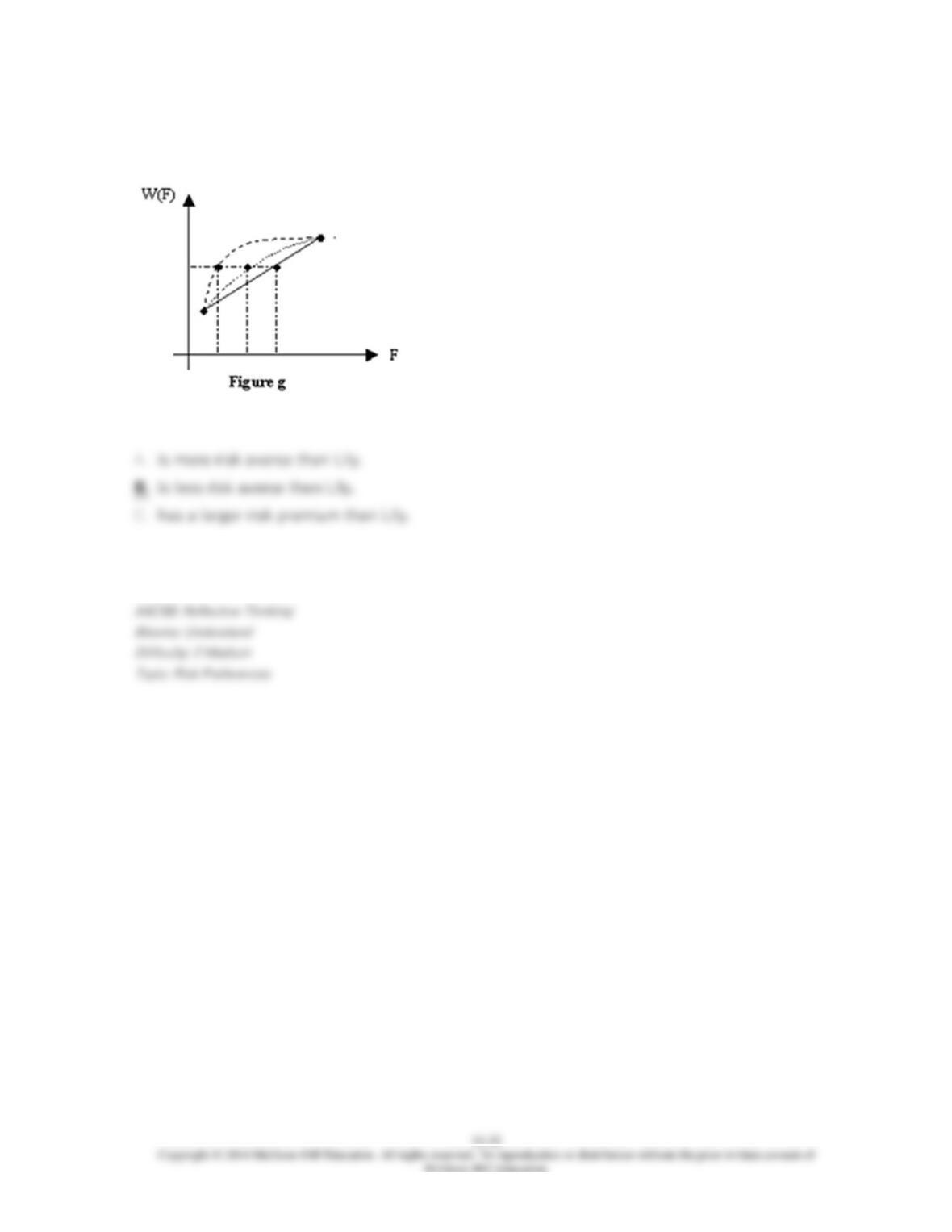
33. Refer to Figure f. A benefit function,
W
(
F
), is plotted in Figure f. The letter A represents:
A. the risk premium of the consumption bundle.
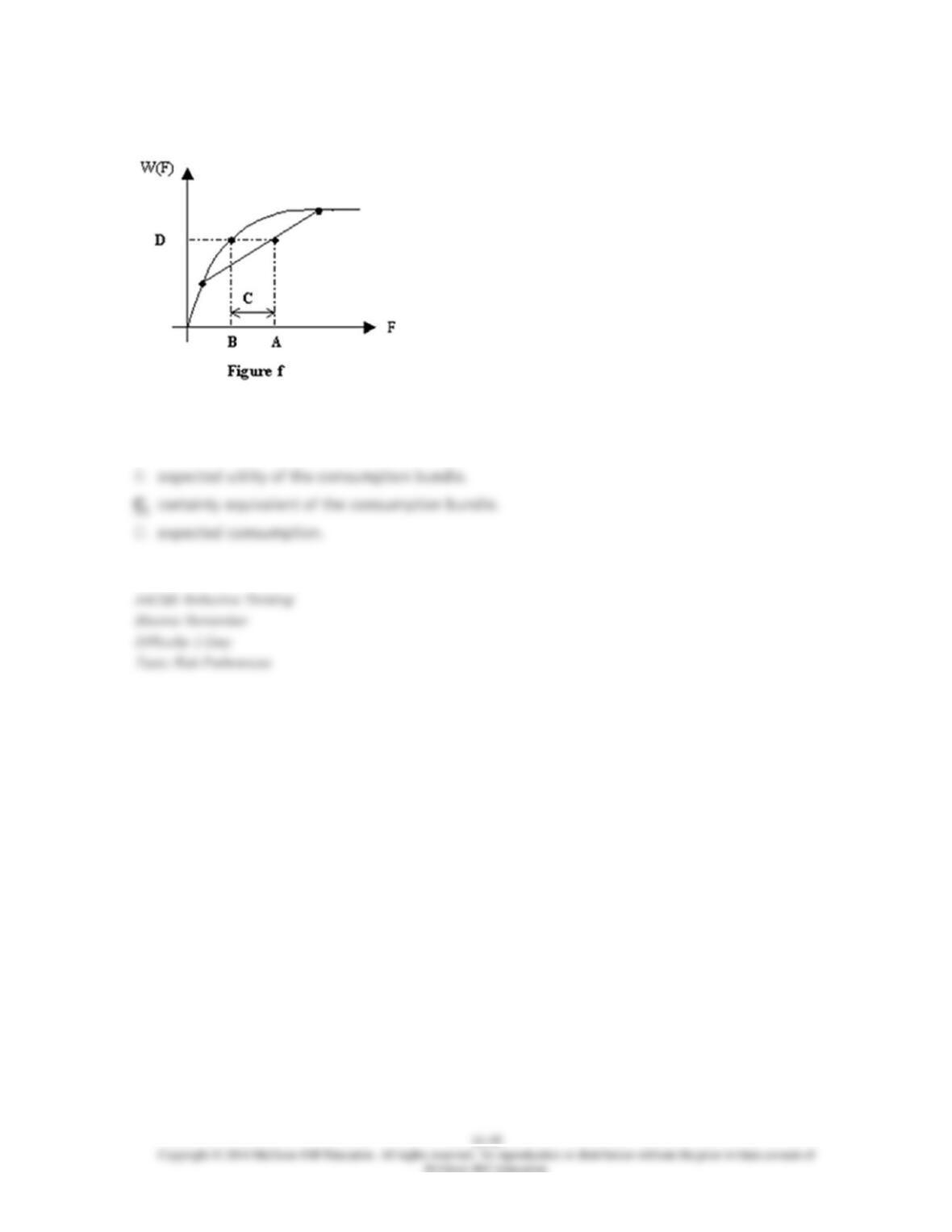
34. Refer to Figure f. A benefit function is plotted in Figure f. The letter B represents the:
A. risk premium of the consumption bundle.
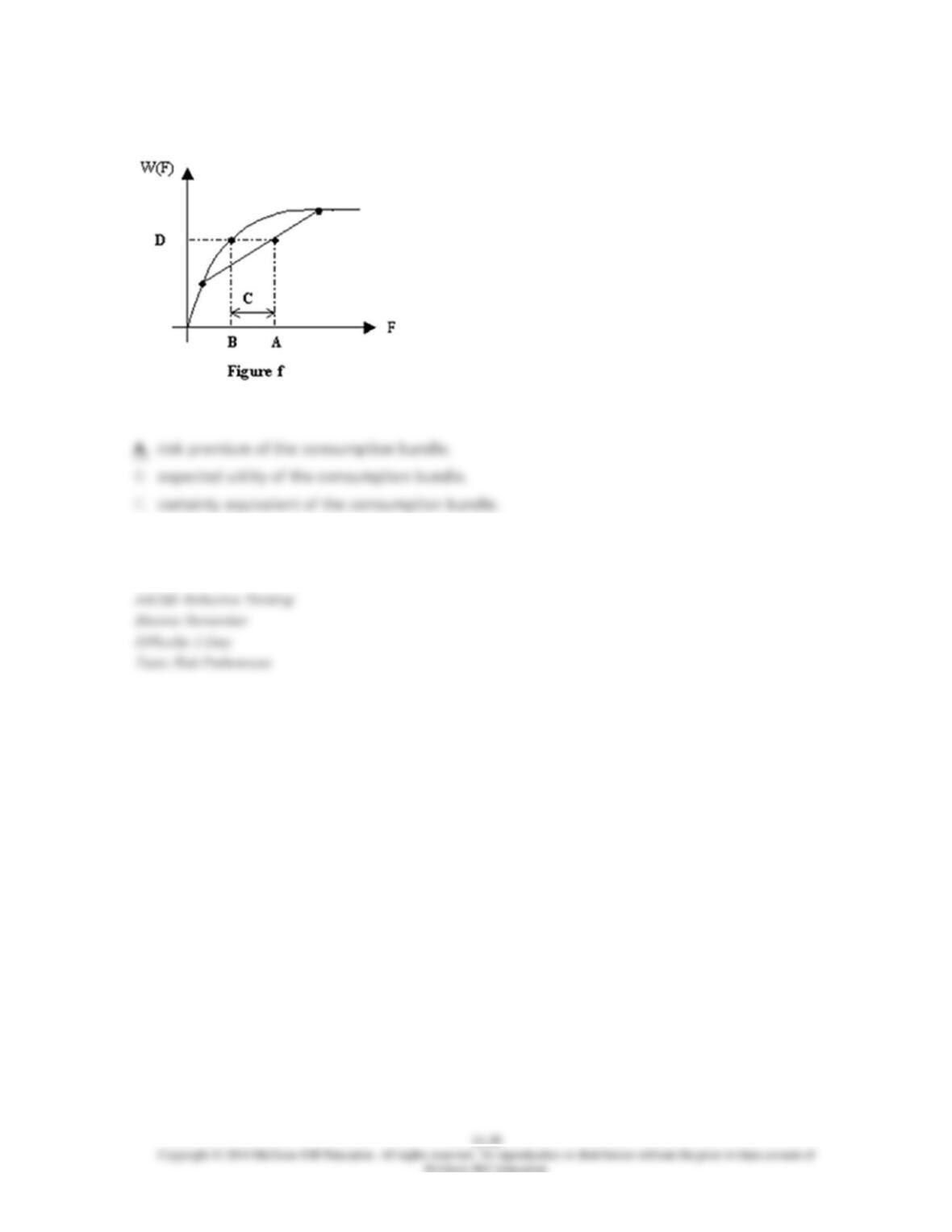
35. Refer to Figure f. A benefit function is plotted in Figure f. The distance C represents the:
D. expected consumption.
36. Refer to Figure f. A benefit function is plotted in Figure f. The letter D represents the:
D. expected consumption.
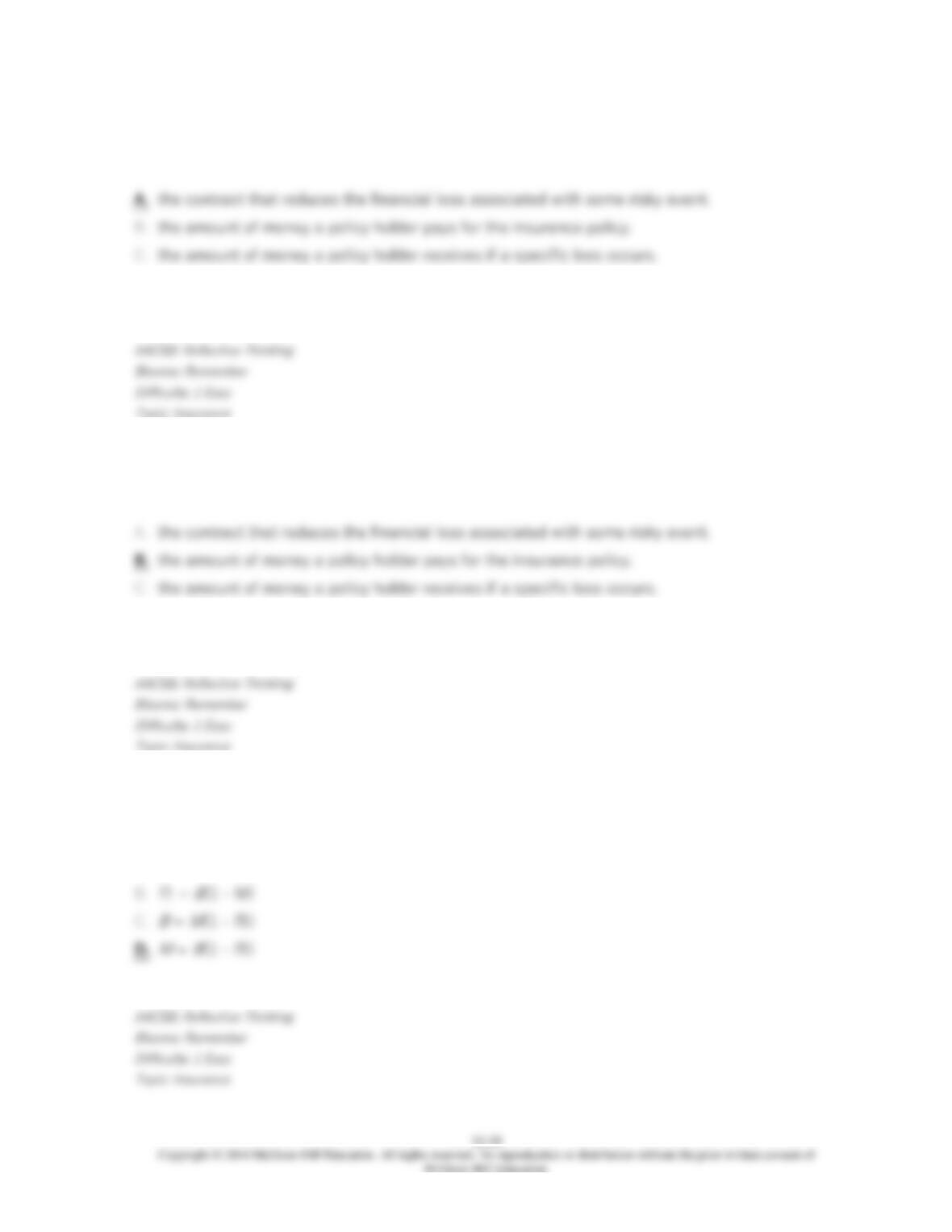
37. Refer to Figure g. Lily’s benefit function (dashed) is more concave than Millie’s (dotted) in
Figure g. Millie:
D. has a lower certainty equivalent than Lily.
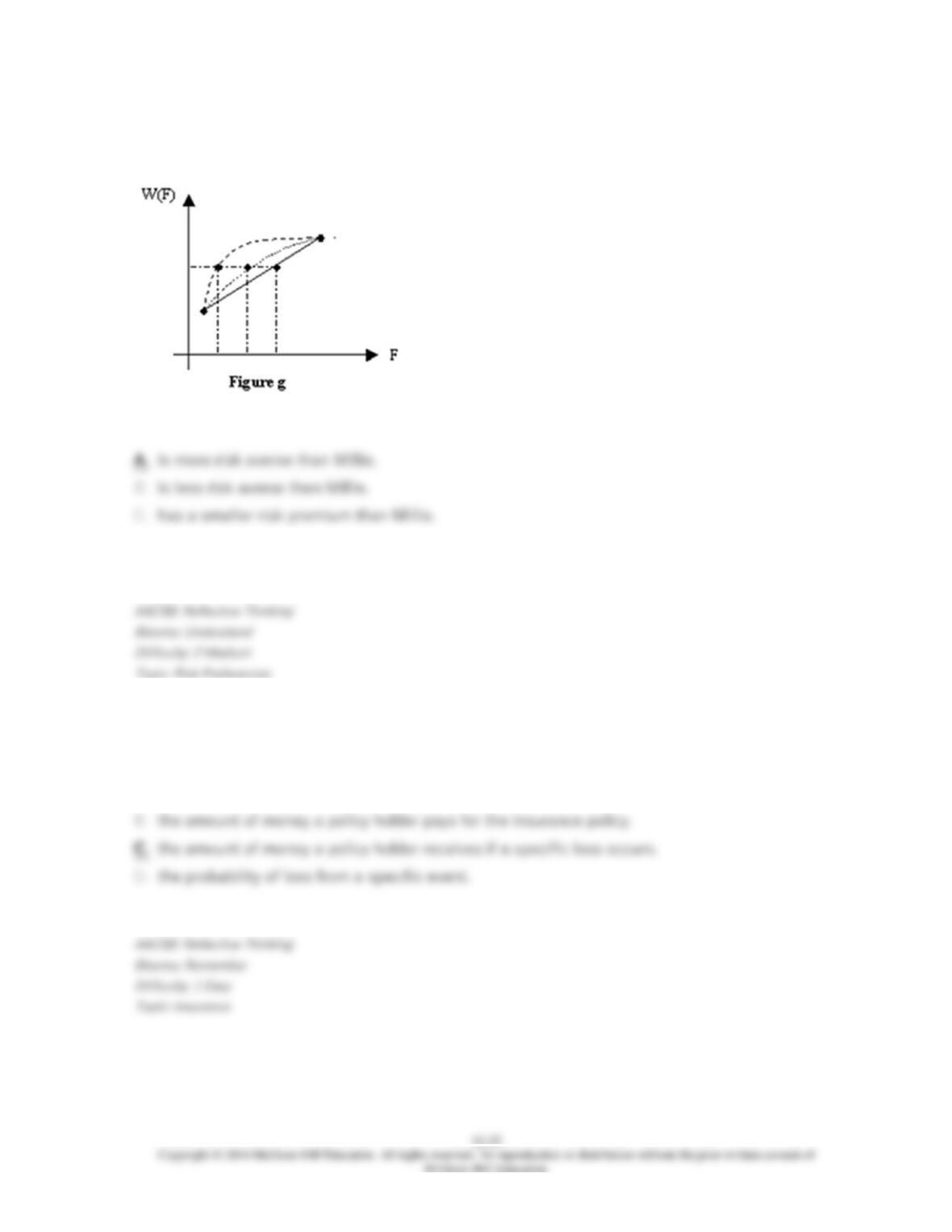
38. Refer to Figure g. Lily’s benefit function (dashed) is more concave than Millie’s benefit
function (dotted). Lily:
D. has a larger certainty equivalent than Millie.
39. An insurance benefit is:
A. the contract that reduces the financial loss associated with some risky event.
40. An insurance policy is:
D. the probability of loss from a specific event.
41. An insurance premium is:
D. the probability of loss from a specific event.
42. If an insurance policy is actuarially fair, then:
A.
M
= Π(1 – B)
43. What would be the actuarially fair premium for an insurance policy that pays $1,000 in the
event of a loss that has a 25% chance of occurring?
D. $500
44. Suppose a consumer’s expected utility function given two possible states of nature A and
B can be expressed in terms of consumption of food,
F
, in both states as
U
(
FA
,
FB
) = [0.6 ×
ln(
FA
)] + [0.4 × ln(
FB
)]. For this utility function,
MUA
is (0.6/
FA
) and
MUB
is (0.4/
FB
). Without
insurance, the consumer can consume 200 in state A but only 50 in state B. The consumer can
purchase insurance at a premium of 50 cents per dollar of benefit. Which of the following gives
her budget line?
D.
FB
= 50 –
FA
45. Suppose a consumer’s expected utility function given two possible states of nature A and
B can be expressed in terms of dollars worth of food consumption,
F
, in both states as
U
(
FA
,
FB
) =
[0.6 × ln(
FA
)] + [0.4 × ln(
FB
)]. For this utility function,
MUA
is (0.6/
FA
) and
MUB
is (0.4/
FB
).
Without insurance, the consumer can consume 200 in state A but only 50 in state B. The
consumer can purchase insurance at a premium of 50 cents per dollar of benefit. How much
insurance will she purchase?
D. $416.67
46. Suppose a consumer’s expected utility function given two possible states of nature A and
B can be expressed in terms of consumption of food,
F
, in both states as
U
(
FA
,
FB
) = [0.6 ×
ln(
FA
)] + [0.4 × ln(
FB
)]. For this utility function,
MUA
is (0.6/
FA
) and
MUB
is (0.4/
FB
). Without
insurance, the consumer can consume 200 in state A but only 50 in state B. The consumer can
purchase insurance at a premium of 50 cents per dollar of benefit. What is the value of the
insurance she purchases?
D. $114.87
47. Two variables are uncorrelated if:
A. they move in the same direction.
48. Two variables are negatively correlated if:
A. they move in the same direction.
49. Two variables are positively correlated if:
D. one is simply a multiple of the other.
50. If two investments are uncorrelated:
D. diversification reduces both risk and the expected payoff.
51. If two investments are perfectly positively correlated:
D. diversification reduces both risk and the expected payoff.
52. If two investments are perfectly negatively correlated:
D. diversification reduces both risk and the expected payoff.
53. Suppose Dean has $500 and there are two companies he could invest
X
dollars in: Dog
Gone Salon, which has a payoff of 2
X
with 50% probability and $0 with 50% probability and Pretty
Kitty Grooming, which has a payoff of 4
X
with 25% probability and $0 with 75% probability. Dean’s
expected payoff from investing in Dog Gone Salon only is:
D. $1,500.
54. Suppose Dean has $500 and there are two companies he could invest
X
dollars in: Dog
Gone Salon, which has a payoff of 2
X
with 50% probability and $0 with 50% probability and Pretty
Kitty Grooming, which has a payoff of 4
X
with 25% probability and $0 with 75% probability. Dean’s
expected payoff from investing in Pretty Kitty Grooming only is:
D. $1,500.
55. $500 and there are two companies he could invest
X
dollars in: Dog Gone Salon, which
has a payoff of 2
X
with 50% probability and $0 with 50% probability and Pretty Kitty Grooming,
which has a payoff of 4
X
with 25% probability and $0 with 75% probability. Dean’s expected payoff
from investing $250 in both Dog Gone Salon and Pretty Kitty Grooming is:
D. $250.
56. Suppose Dean has $500 and there are two companies he could invest
X
dollars in: Dog
Gone Salon, which has a payoff of 2
X
with 50% probability and $0 with 50% probability and Pretty
Kitty Grooming, which has a payoff of 4
X
with 25% probability and $0 with 75% probability. Which
of the following is true?
D. Investing in Pretty Kitty Grooming offers a higher expected payoff.
Essay Questions
57. Explain why a risk averse individual will purchase full insure if a policy is actuarially fair,
but only partially insure or not insure at all, if it is not. Use graphs to support your answer.
58. Explain the relationship between the correlation of payoffs and the risk reducing effects of
diversification and hedging.