1. A firm’s profit is denoted by the Greek letter:
A. rho.
2. The relationship between a firm’s price and sales quantity is described by the ______ for
its product.
D. average cost curve
3. Profit is:
D. Cost – Revenue.
4. In which situation might a company NOT want to maximize profit?
D. A corporation that has performed poorly in the last two quarters and is looking for new upper–
management
5. Given a demand function of
Q
d
=
D
(
P
) = 500 – 10
P
, what is the inverse demand function?
A.
D
(
P
) = 50 –
P
6. Given the inverse demand function
P
(
Q
) = 250 –
Q
, what is the demand function?
D.
Q
d
=
D
(
P
) = 250 +
P
7. How much a firm must charge to sell any given quantity of their product is described by
a(n):
A. demand curve.
8. Suppose you own a store that sells computers. You have determined that the demand
function for your computers is
Q
d
=
D
(
P
) = 900 – 3
P
. At what price would you sell the computers if
you wanted to sell 60 of them?
A. $250
9. Suppose you own a store that sells top-of–the-line MP3 players. You have determined that
the demand function for your MP3 players is
Q
d
=
D
(
P
) = 1200 – 4
P
. At what price would you sell
the MP3 players if you wanted to sell 100 of them?
D. $300
10. Which of the following is NOT a way to express the formula for profit?
A. Profit = Revenue – Cost
11. To earn the greatest possible profit, a firm must:
D. maximize price at any quantity.
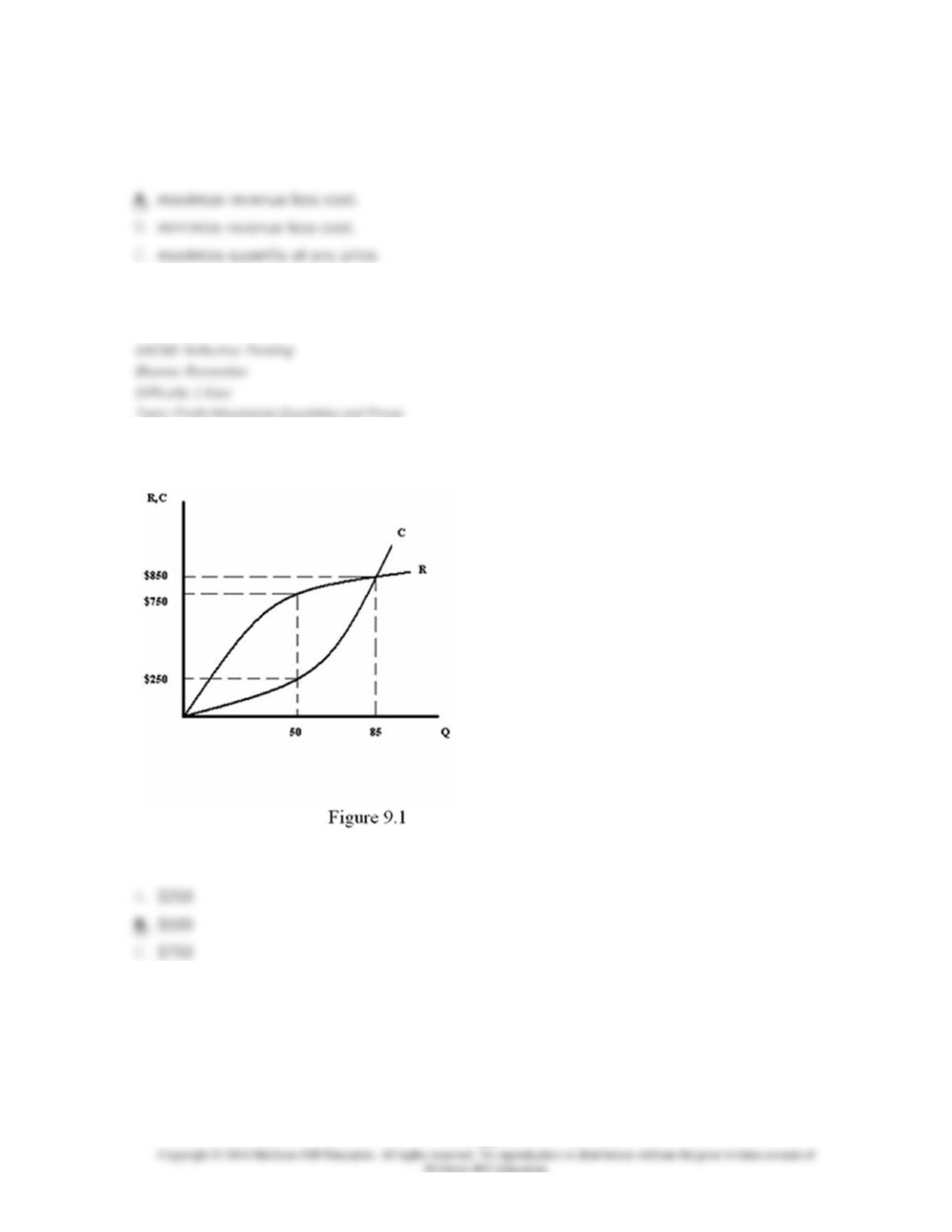
12. Refer to Figure 9.1. What is the maximum profit that can be achieved?
D. $850
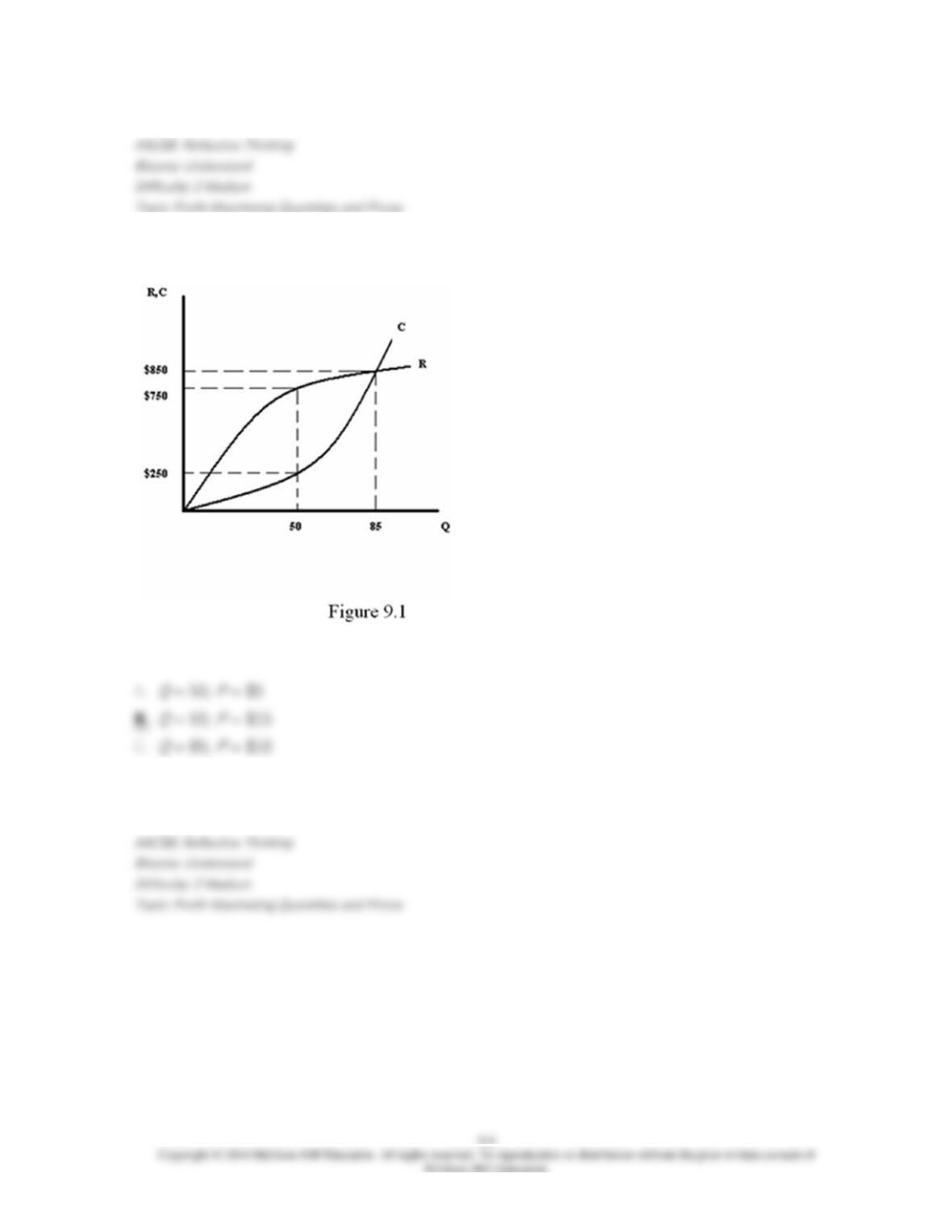
13. Refer to Figure 9.1. At what price and quantity combination is profit maximized?
D.
Q
= 85;
P
= $15
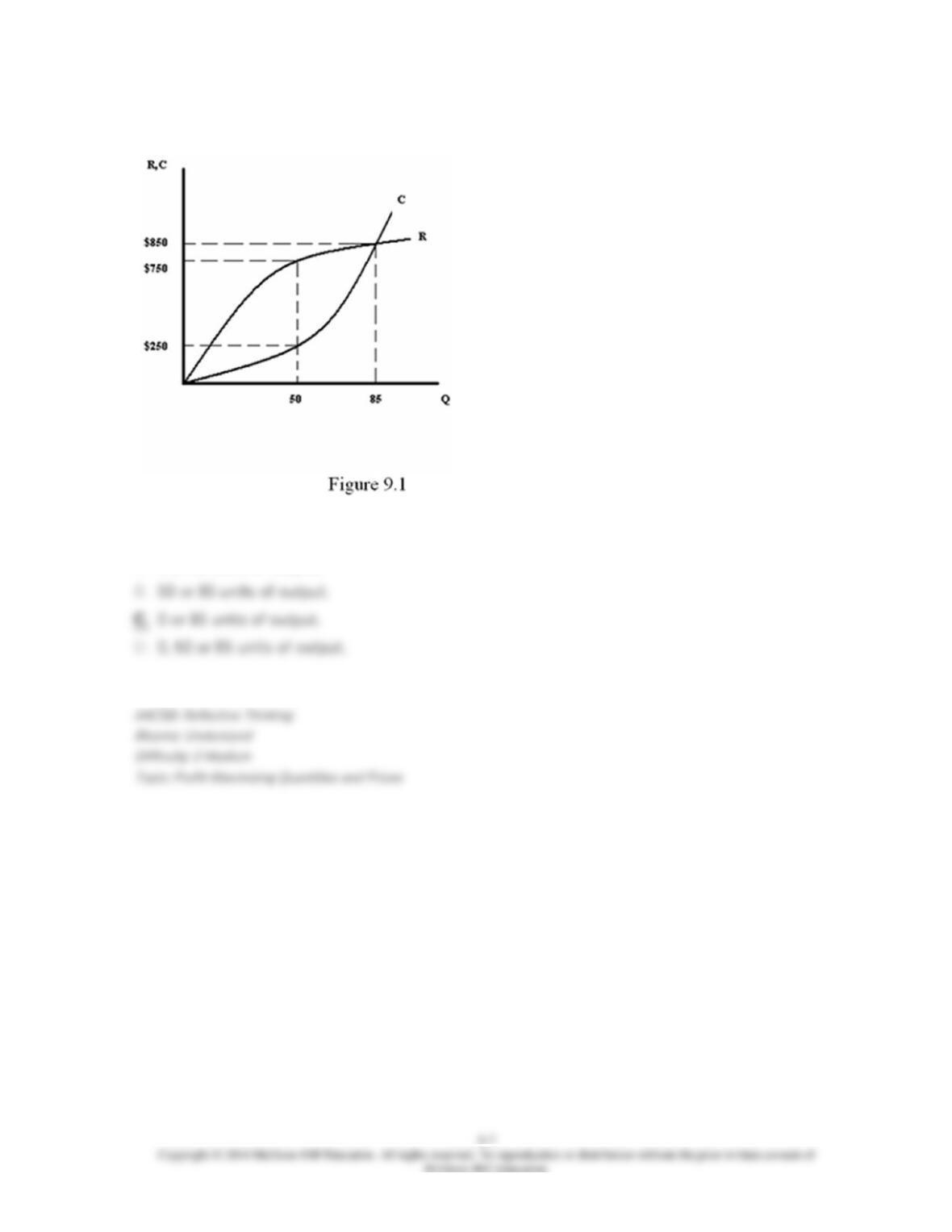
14. Refer to Figure 9.1. The firm’s profit stays the same whether it produces:
A. 0 or 50 units of output.
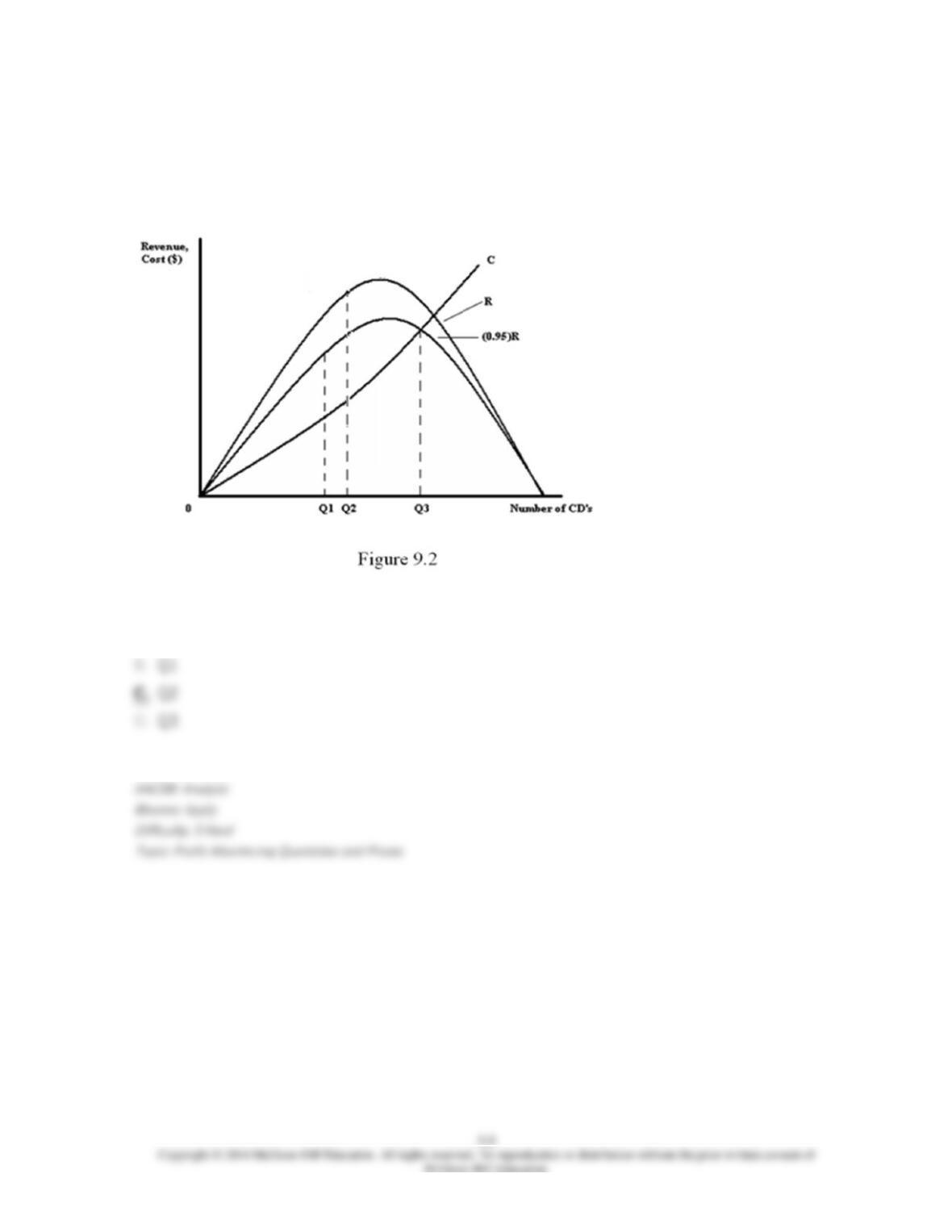
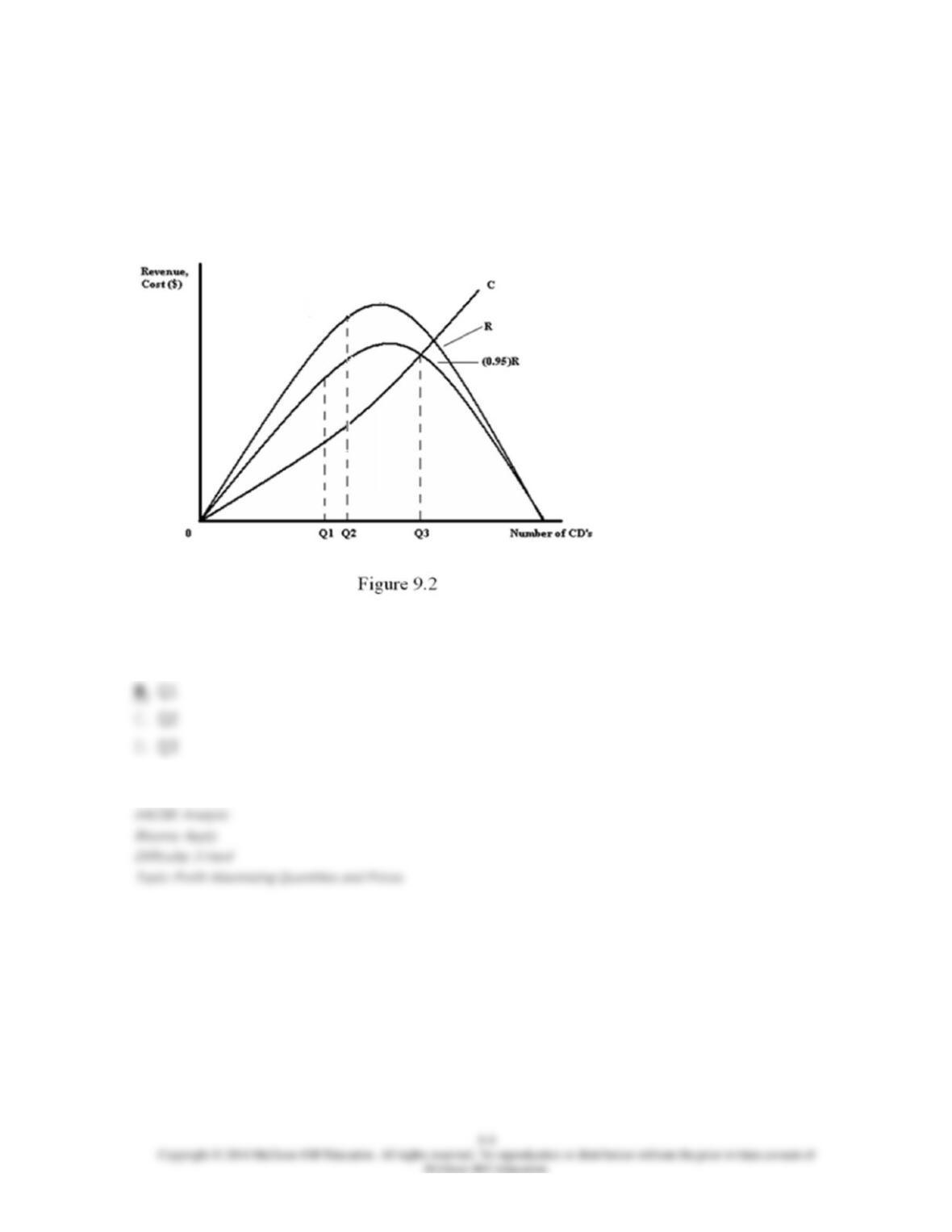
15. Refer to Figure 9.2. Whenever a CD is sold, 5% of the revenue goes to the artist and the
remainder of the revenue goes to the record company. The graph above depicts
R
, the total
revenue from sales; (0.95)
R
, the record company’s share; and
C
, the cost of producing the CD
(which the record companies bears). At what quantity would the artist prefer to produce the CD?
A. 0
16. Refer to Figure 9.2. Whenever a CD is sold, 5% of the revenue goes to the artist and the
remainder of the revenue goes to the record company. The graph above depicts
R
, the total
revenue from sales; (0.95)
R
, the record company’s share; and
C
, the cost of producing the CD
(which the record companies bears). At what quantity would the record company like to produce
the CD?
A. 0
17. A price-taking firm’s variable cost function is
C
=
Q
3, where
Q
is the output per week. It
has a sunk fixed cost of $2,000 per week. Its marginal cost is
MC
= 3
Q
2. What is the profit-
maximizing output if the price is
P
= $192?
A. 0
18. A price-taking firm’s variable cost function is C =
Q
3, where
Q
is the output per week. It
has an avoidable fixed cost of $2,000 per week. Its marginal cost is
MC
= 3
Q
2. What is the profit
maximizing output if the price is
P
= $192?
D. 10
19. A price-taking firm’s variable cost function is C =
Q
3, where
Q
is the output per week. It
has an avoidable fixed cost of $1,024 per week. Its marginal cost is
MC
= 3
Q
2. What is the profit
maximizing output if the price is
P
= $192?
A. 0 or 5.33 or 8
20. The extra revenue produced by the change in quantity, on a per–unit basis, is called:
A. marginal benefit.
21. When a firm’s demand curve is downward-sloping, its marginal revenue at any positive
sales quantity is ______ its price.
D. less than or equal to
22. When a firm’s profit maximizing sales level is positive, its marginal revenue is ______ its
marginal cost at that quantity.
A. greater than
23. Which of the following is NOT true about marginal revenue?
A. It is a firm’s marginal benefit.
24. Suppose a firm lowers its price in order to increase sales. The lower price will reduce the
revenue the firm earns on the:
D. incremental units.
25. A firm is a ______ when it can sell as much as it wants at some given price
P
, but nothing
at any higher price.
A. monopoly
26. The
output
expansion
effect
of the sale of a firm’s last Δ
Q
units of output is:
D. the reduced revenue from selling (
Q
– Δ
Q
) units at a lower price of
P
(
Q
– Δ
Q
).
27. The
price
reduction
effect
of the sale of a firm’s last Δ
Q
units of output is:
D. the reduced revenue from selling (
Q
– Δ
Q
) units at a lower price of
P
(
Q
– Δ
Q
).
28. When actions are finely divisible marginal benefit is ______ marginal cost at an interior
best choice.
A. greater than
29. A firm that is a price taker faces a perfectly ______ demand curve.
D. convex
30. Firms in perfectly competitive markets take the ______ as given when deciding how much
to sell.
A. market quantity
31. Identifying any positive sales quantities at which
MR
=
MC
(and determining which
positive sales quantity is best if there is more than one) is the description of what rule?
D. Profit-maximizing Rule
32. Checking to see whether the most profitable positive sales quantity results in a greater
profit than not producing at all is the basis of what rule?
A. Interior Action Rule
33. When a firm is a price taker, changes in its sales quantity have ______ effect on the price it
can charge.
A. a positive
34. A price-taking firm’s marginal revenue is ______ the price of its output.
D. less than or equal to
35. If a firm has no ______ costs, then the profit from shutting down is zero.
A. fixed
36. What type of cost has NO impact on determining the profit-maximizing sales quantity?
D. Average variable costs
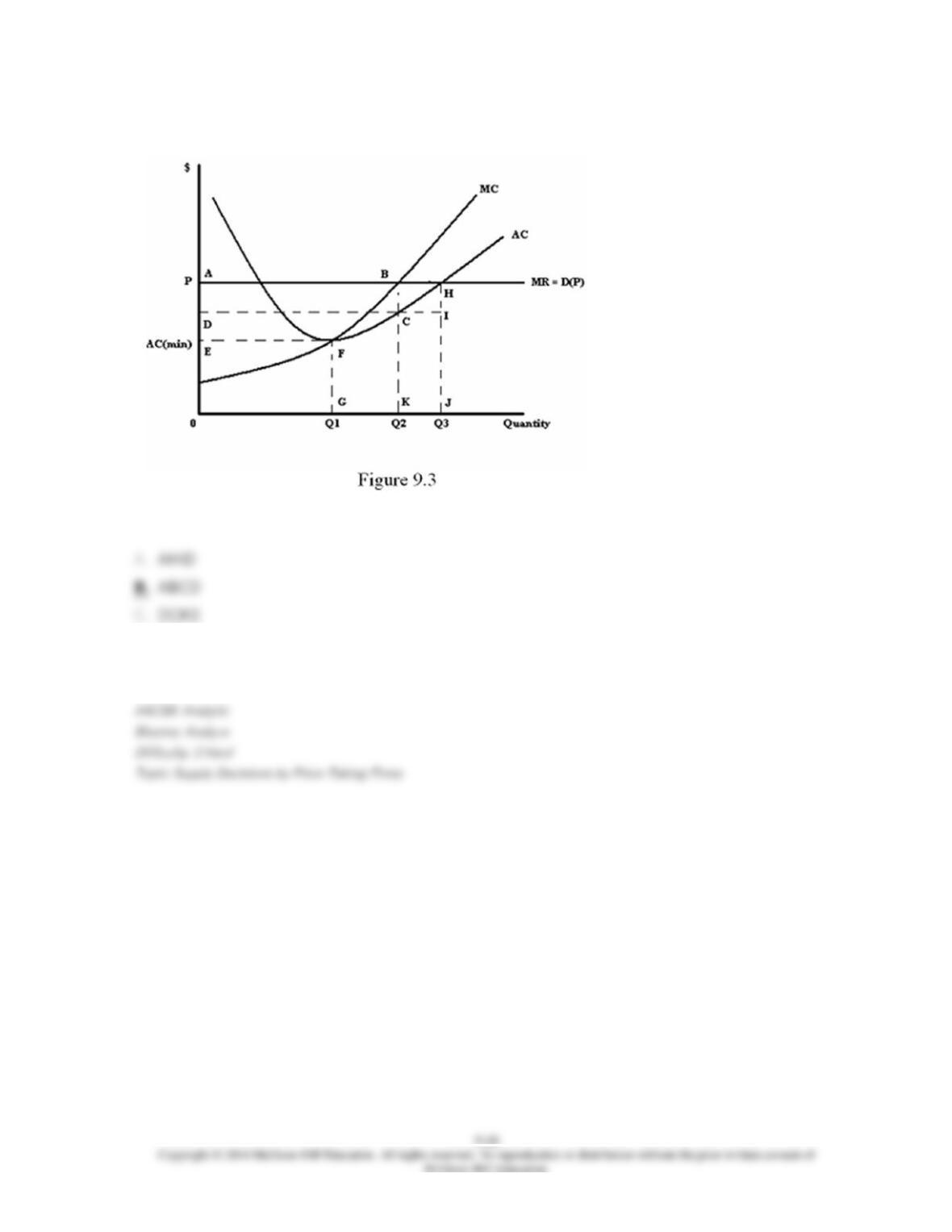
37. Refer to Figure 9.3. The firm’s profit it represented by what area?
D. EFG0
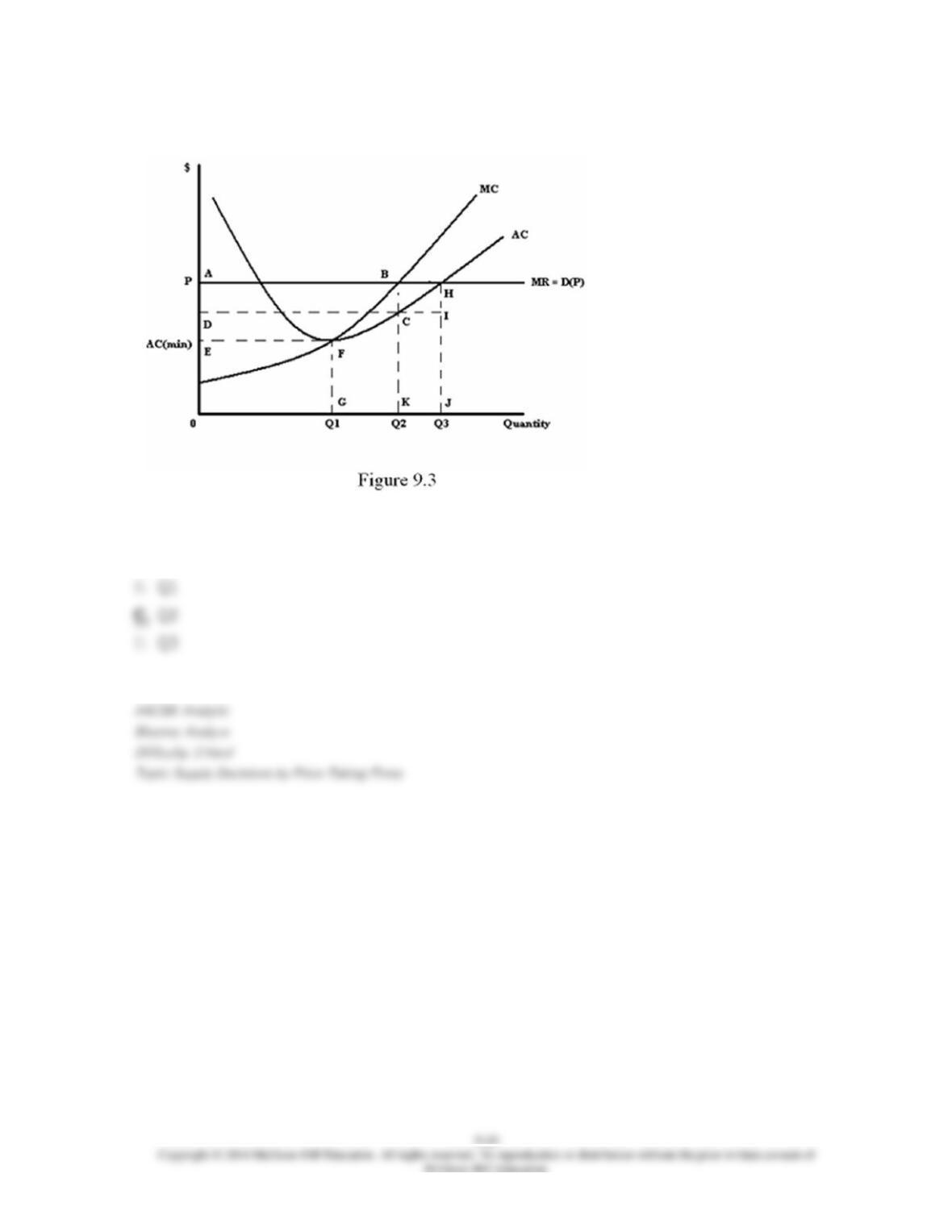
38. Refer to Figure 9.3. At what quantity is the firm maximizing profit?
A. 0
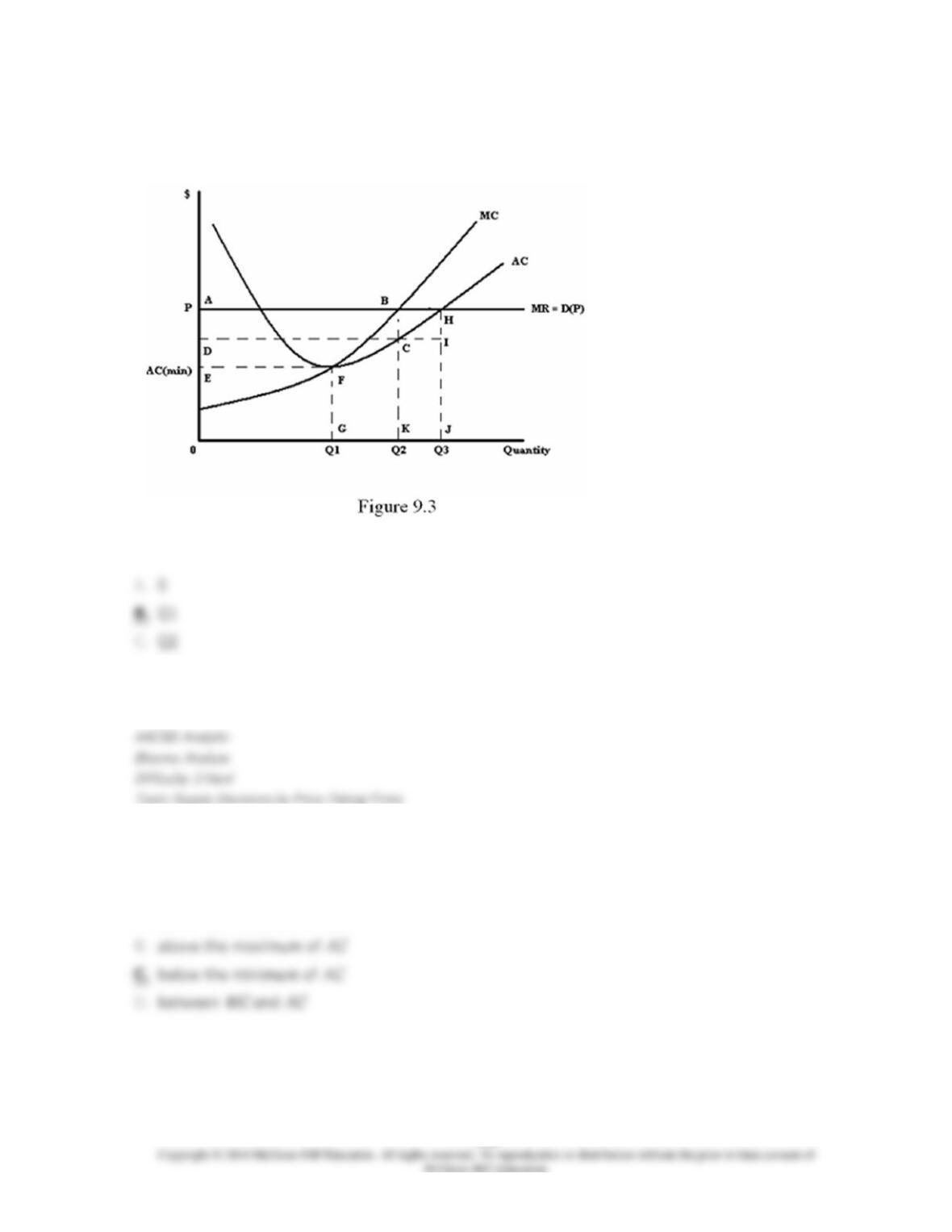
39. Refer to Figure 9.3. What is the smallest sales quantity that this firm will produce at any
price?
D. Q3
40. Any price ______ will cause the firm to shut down production.
A. below the minimum of
MC