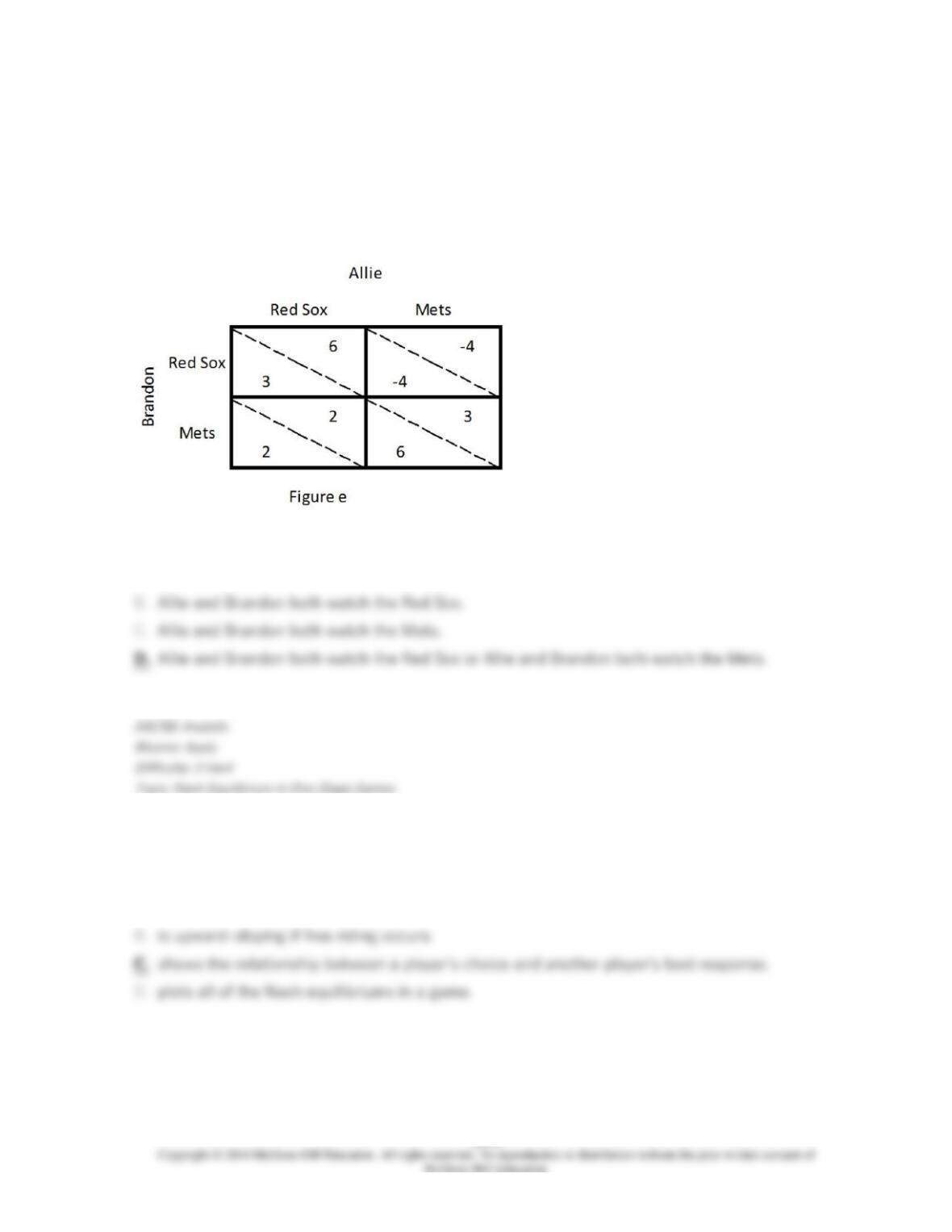
40. Refer to Figure
e
. Brandon and Allie want to go on a date one summer evening. Allie is a
Red Sox fan, while Brandon is a Mets fan. Both teams are playing that evening, but not against
each other. Each would rather watch their favorite team, but neither can force the other to watch
a particular game, and each is willing to suffer through the other’s game if it means time together.
What is the Nash equilibrium?
A. Allie watches the Red Sox, and Brandon watches the Mets.
41. A best response function:
A. is also known as a strategic demand function.
42. Free riding:
D. is no player’s best response.
43. A player is playing a pure strategy when:
D. it is not perfectly predictable.
44. A player is playing a mixed strategy when:
D. it is perfectly predictable.
45. In a mixed strategy equilibrium:
A. a player is indifferent between playing a dominated strategy and playing a non-dominated one.
46. Which of the following is a game of perfect information?
D. Both chess and poker are games of perfect information.
47. A repeated game:
A. can be finite or infinite.
48. John Nash shared the Nobel Prize in Economics with:
D. Milton Friedman.
49. Cooperation:
A. is sustained by the threat of punishment for bad behavior.
50. Cooperation:
D. All of these are true about cooperation.
51. Playing the equilibrium of a one-stage game over and over again when the one-stage
game is repeated is:
D. a mixed-strategy equilibrium.
52. Equilibrium in a repeated one-stage game:
D. can only be found if the game is infinite.
53. Playing the equilibrium of a one-stage game over and over again when the one-stage
game is repeated is:
D. dominated in some cases.
54. Cooperation in an infinite game
D. is possible if no one cares about the future.
55. Cooperation:
D. is always a Nash equilibrium.
56. The winner’s curse is the tendency in certain types of auctions for:
D. the owner of the item up for auction to unfairly drive up auction prices.
57. A second-price auction:
A. has two Nash equilibriums.
58. Reputations:
D. always lead to Nash disequilibriums.
59. Which of the following is true about games in which people have different information?
D. These games always have a Nash equilibrium.
60. Which of the following is true about games in which people have different information?
D. These games never have a Nash equilibrium.

Essay Questions
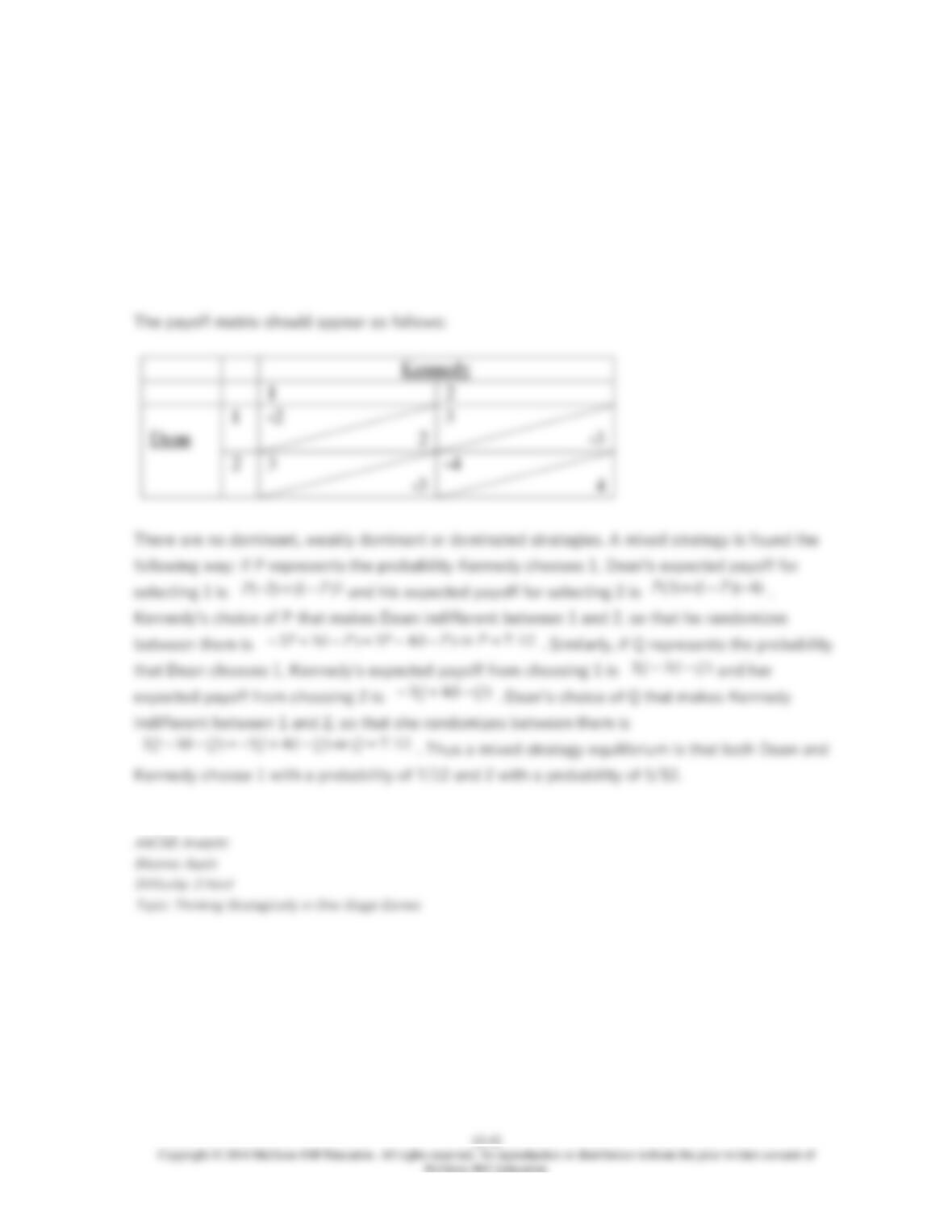
61. Suppose Dean and Kennedy are playing a single stage game. Each simultaneously
chooses either 1 or 2. If they both select 1, Dean pays Kennedy $2. If they both pick 2, Dean pays
Kennedy $4. If they select different numbers, Kennedy pays Dean $3. Draw a table showing the
two players’ strategies and payoffs. Are any strategies dominant? Weakly dominant? Dominated?
Solve for a mixed strategy equilibrium.
62. Use the concepts of reputation and asymmetric information to explain why some faculty
members become less productive after gaining tenure.