1. A firm’s _______ summarizes all of its possible methods of producing its output.
D. production possibilities curve
2. A firm’s _______ contains all combinations of inputs and outputs that are possible given
the firms’ technology.
D. production possibilities curve
3. A firm’s _______ contains all combinations of inputs and outputs that the firm can achieve
using efficient production methods.
D. production possibilities curve
4. A firm’s _______ shows the amount of output a firm can produce from given amounts of
inputs using efficient production methods.
A. production possibilities set
5. As long as a firm can freely dispose of any extra inputs it may have:
A. its production function must slope downward.
6. In the short run:
A. the firm is free to change the amount of capital it uses.
7. The long run refers to a period of time over which:
A. the firm can change its level of output.
8. Which of the following is a short-run decision?
D. The economics department buys new computers for the professors.
9. Suppose that a firm uses both labor (
L
) and capital (
K
) as inputs. The firm’s long–run
production function is
Q
=
F
(
L
,
K
) = 5√
L
√
K
. If the firm has 100 units of capital, what is its short–
run production function?
A.
Q
=
F
(K) = 50√
K
10. Suppose that a firm uses both labor (
L
) and capital (K) as inputs. The firm’s long–run
production function is
Q
=
F
(
L,K
) = 5√
L
√
K
. The firm has 100 units of capital. If the firm uses an
efficient production method, how much output does it produce in the short run if it hires 25
workers?
D. 50 units
11. Suppose that a firm uses both labor (
L
) and capital (K) as inputs. The firm’s long–run
production function is
Q
=
F
(
L,K
) = 8√
L
√
K
. The firm has _____ units of capital. If the firm uses
an efficient production method and hires _____ workers, it can produce _____ units of output.
A. 100; 100; 1,200
12. Suppose that a firm uses both labor (
L
) and capital (K) as inputs. The firm’s long–run
production function is
Q
=
F
(
L,K
) = 4√
L
√
K
. The firm has _____ units of capital. If the firm uses
an efficient production method and hires _____ workers, it can produce _____ units of output.
A. 100; 100; 40,000
13. The average product of labor is defined as:
A. the additional output produced by the last ∆
L
units of labor hired.
14. The marginal product of labor is defined as:
D. the amount of output divided by the number of workers employed.
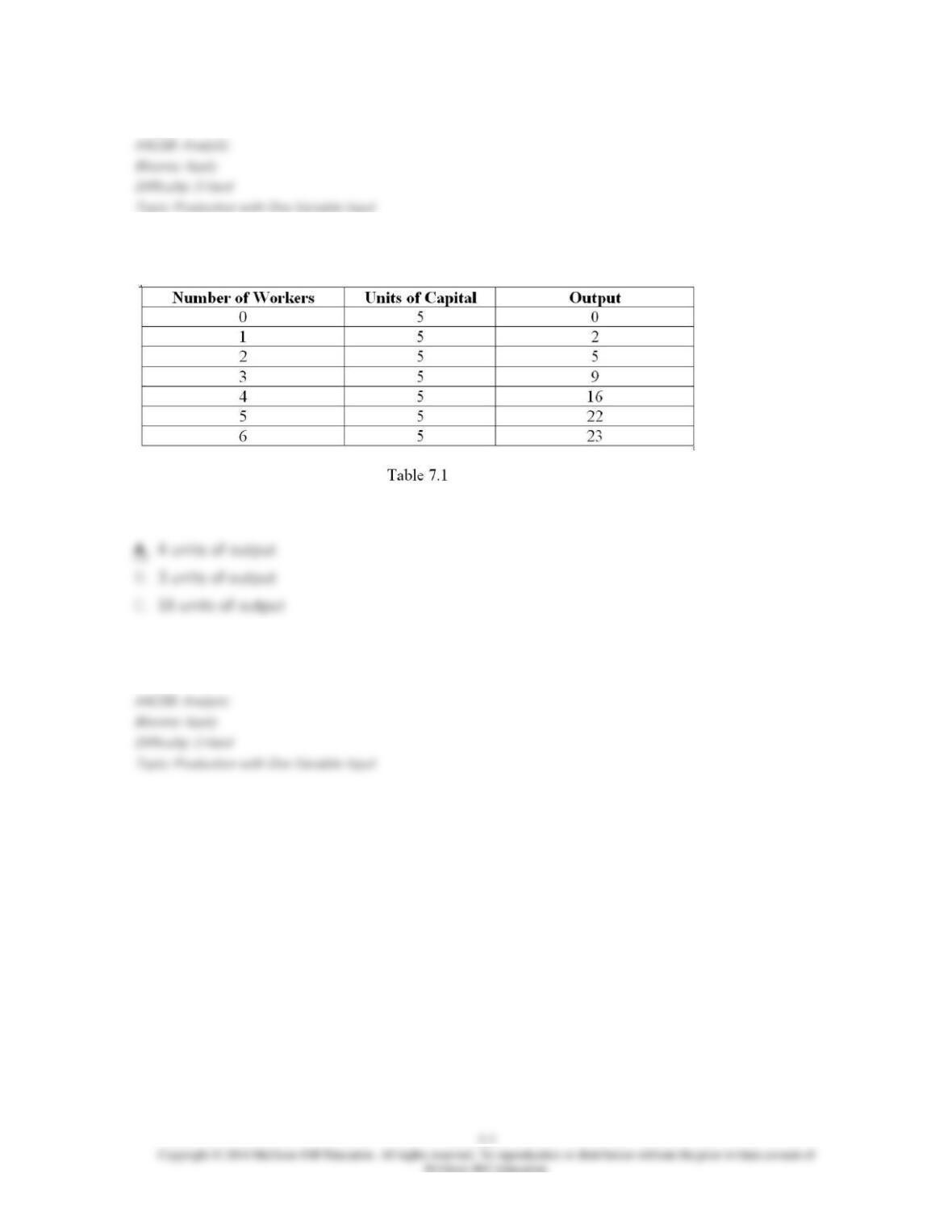
15. Refer to Table 7.1. What is the marginal product of the 3rd worker?
D. 5 units of output
16. Refer to Table 7.1. What is the average product of the 4th worker?
D. 6 units of output
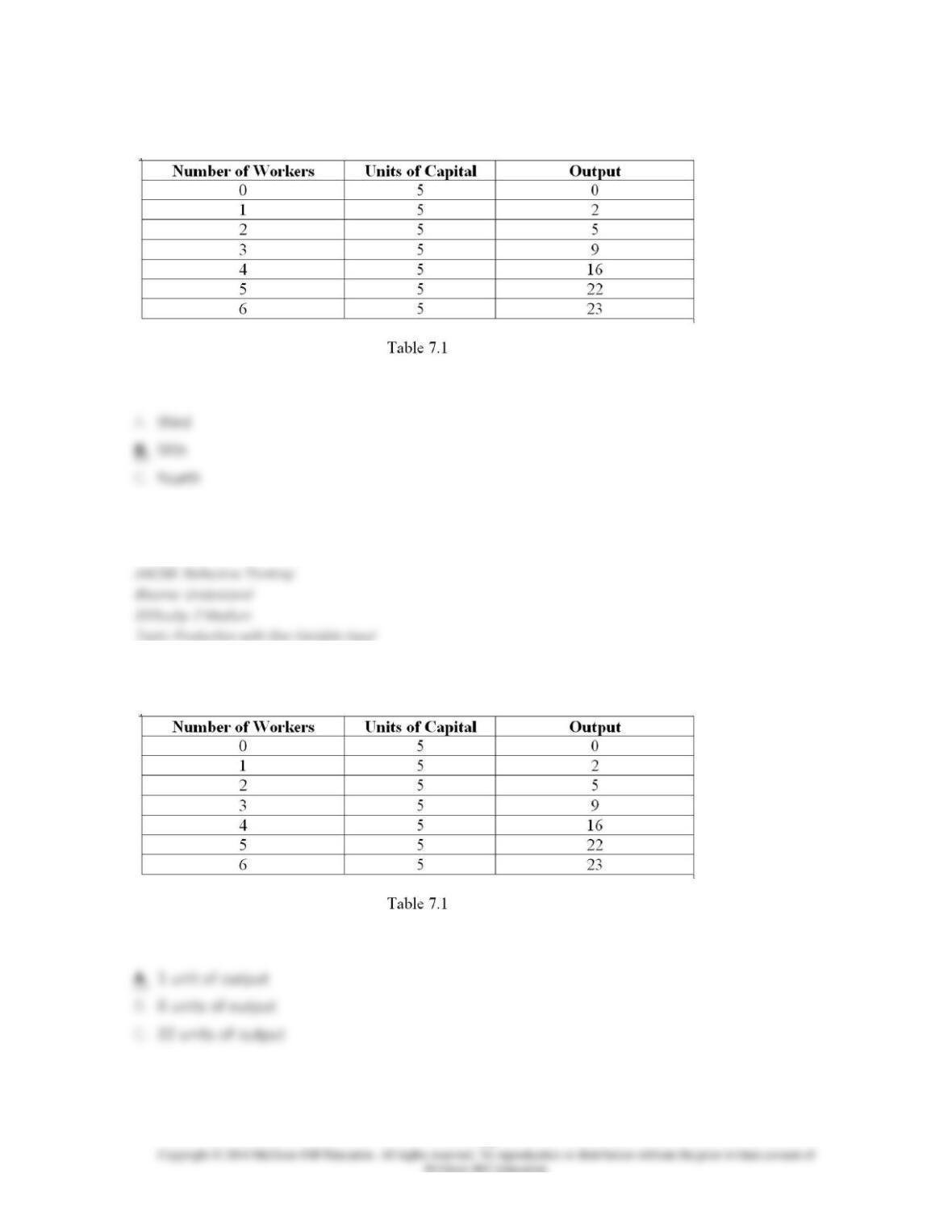
17. Refer to Table 7.1. Diminishing returns set in with the ______ worker.
D. sixth
18. Refer to Table 7.1. What is the marginal product of the 6th worker?
D. 23 units of output
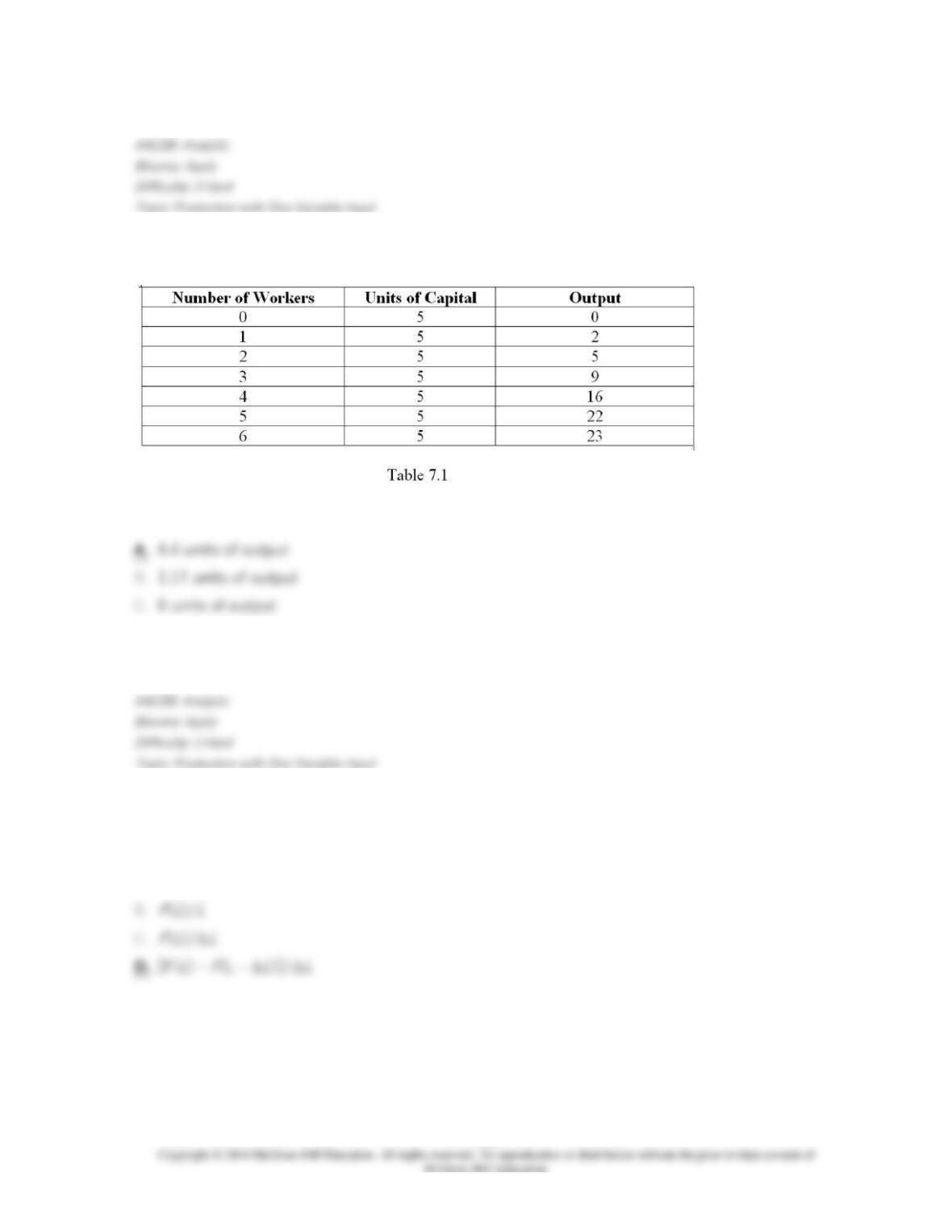
19. Refer to Table 7.1. What is the average product of the 5th worker?
D. 17 units of output
20. Which of the following is the formula for the marginal product of labor?
A.
F
(
L
) –
F
(
L
– ∆
L
)
21. Which of the following is the formula for the average product of labor?
D. [F(
L
) –
F
(L – ∆
L
)]/∆
L
22. According to the Law of Diminishing Marginal Returns, as additional units of one input are
employed as all other inputs are held constant, total output will eventually ______.
A. decrease
23. When the marginal product of an input is ______ than the average product, the marginal
units of the input _____ the average product.
A. larger; lower
24. If hiring one more worker causes the average product of labor to fall, then:
D. the marginal product of labor is negative.
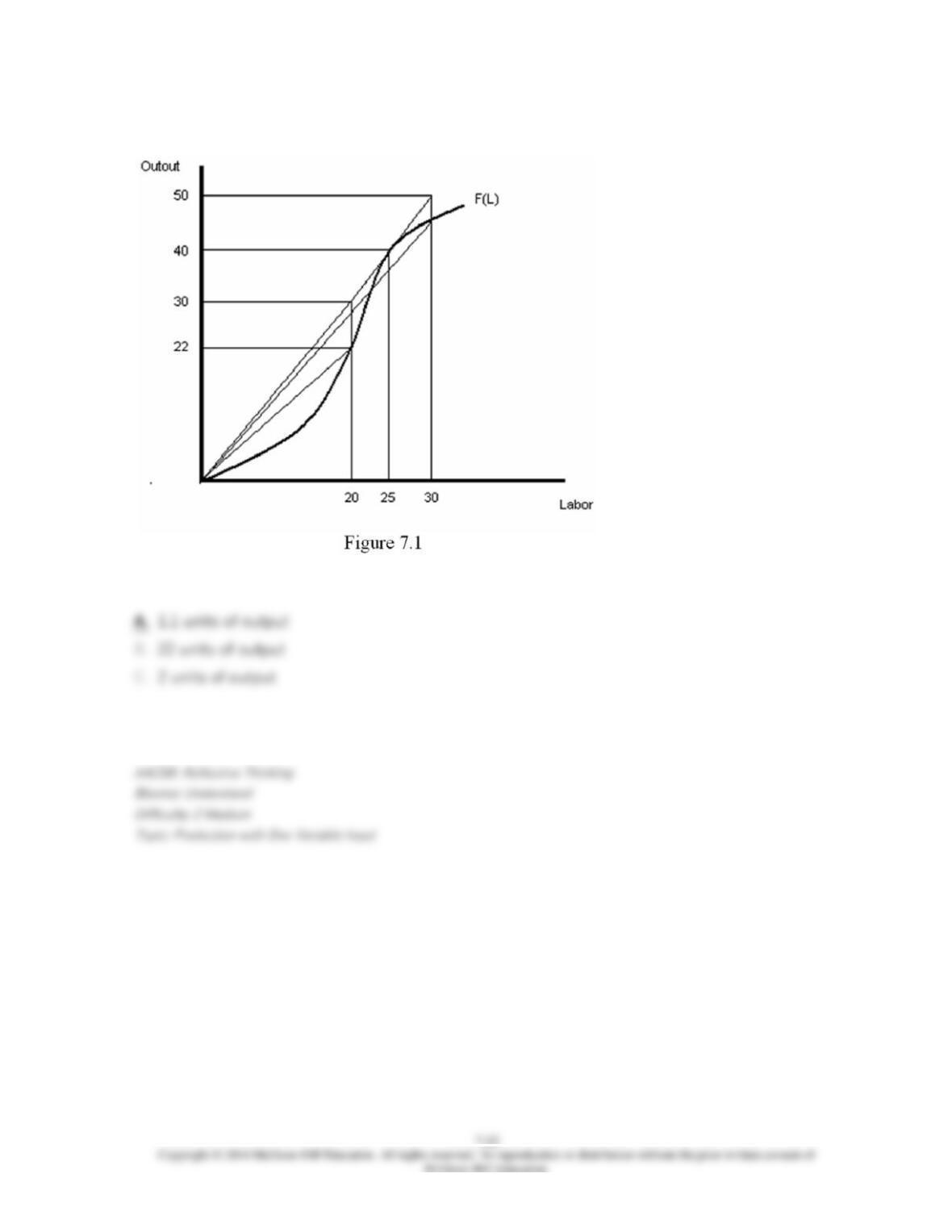
25. Refer to Figure 7.1. What is the average product of 20 workers?
D. 8 units of output
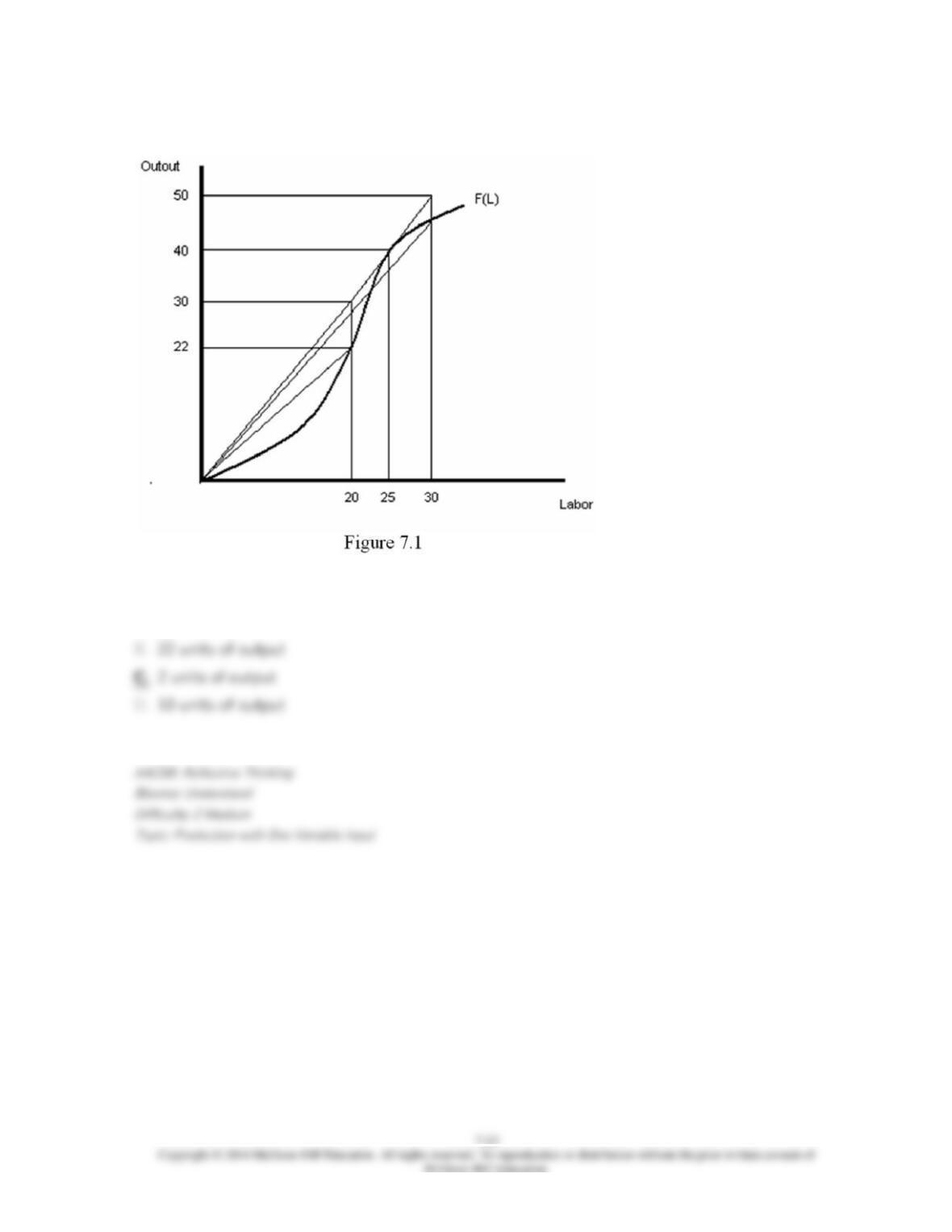
26. Refer to Figure 7.1. What is the marginal product of the 25th worker?
A. 1.1 units of output
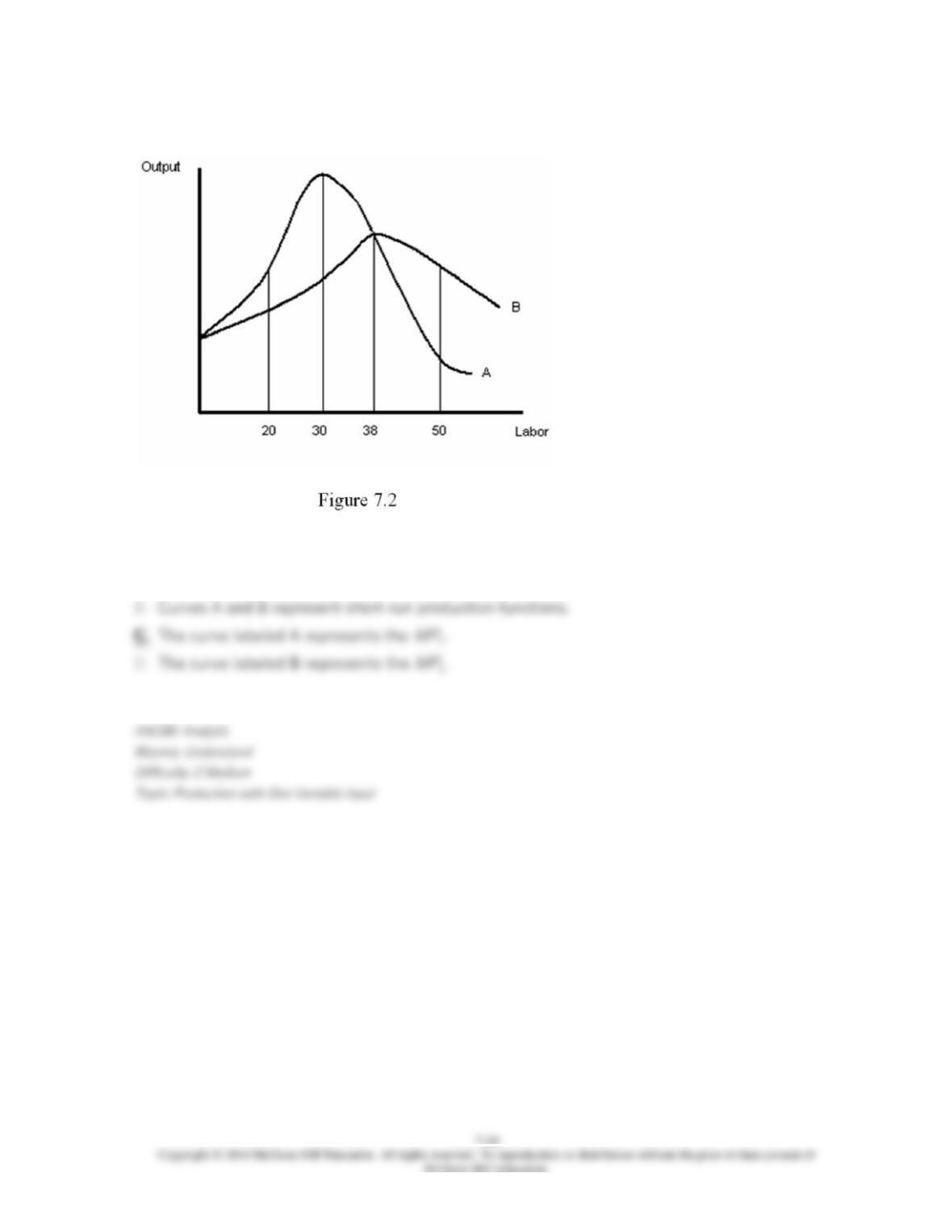
27. Refer to Figure 7.2. Which of the following statements is true?
A. The curve labeled A represents the
APL
.
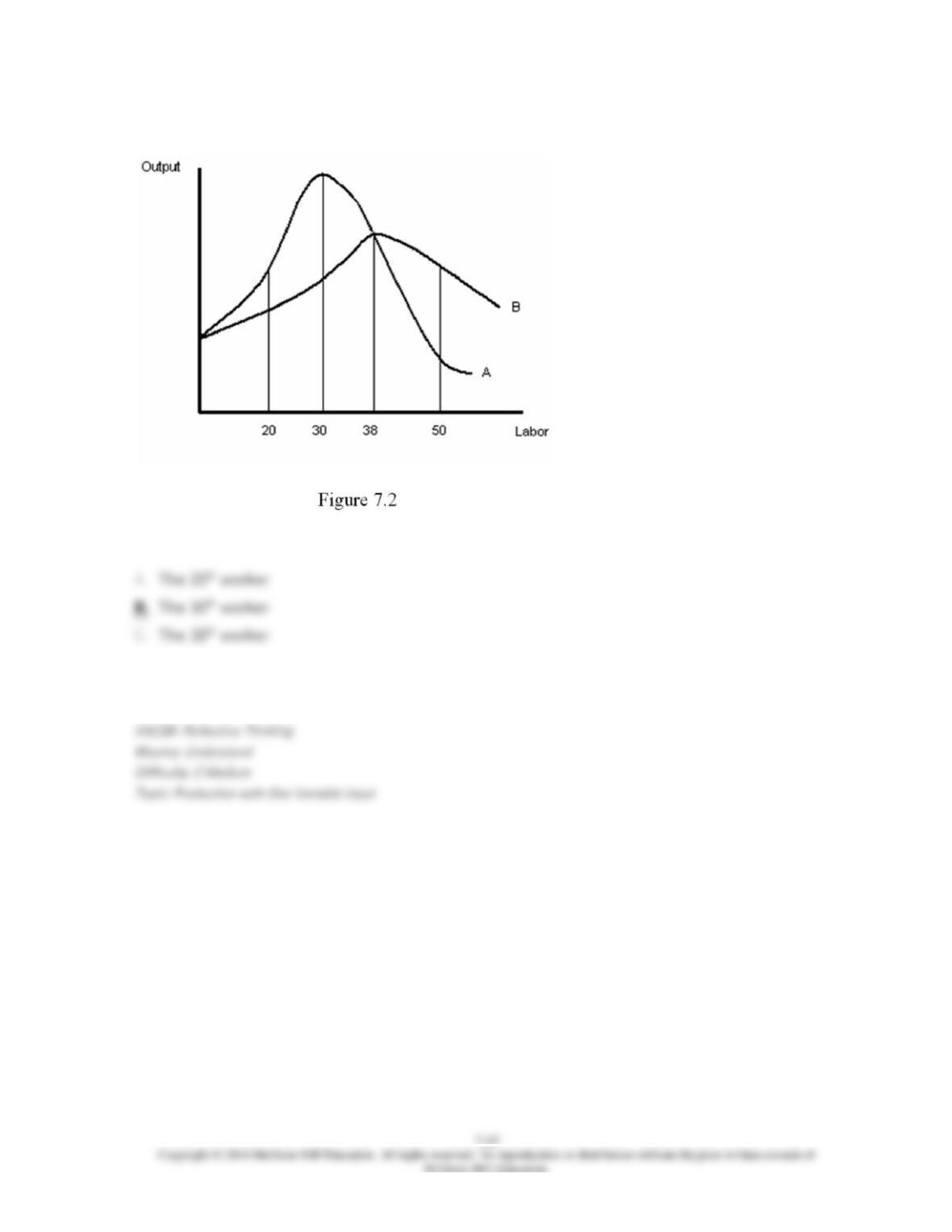
28. Refer to Figure 7.2. With which worker does diminishing marginal returns set in?
D. The 50th worker
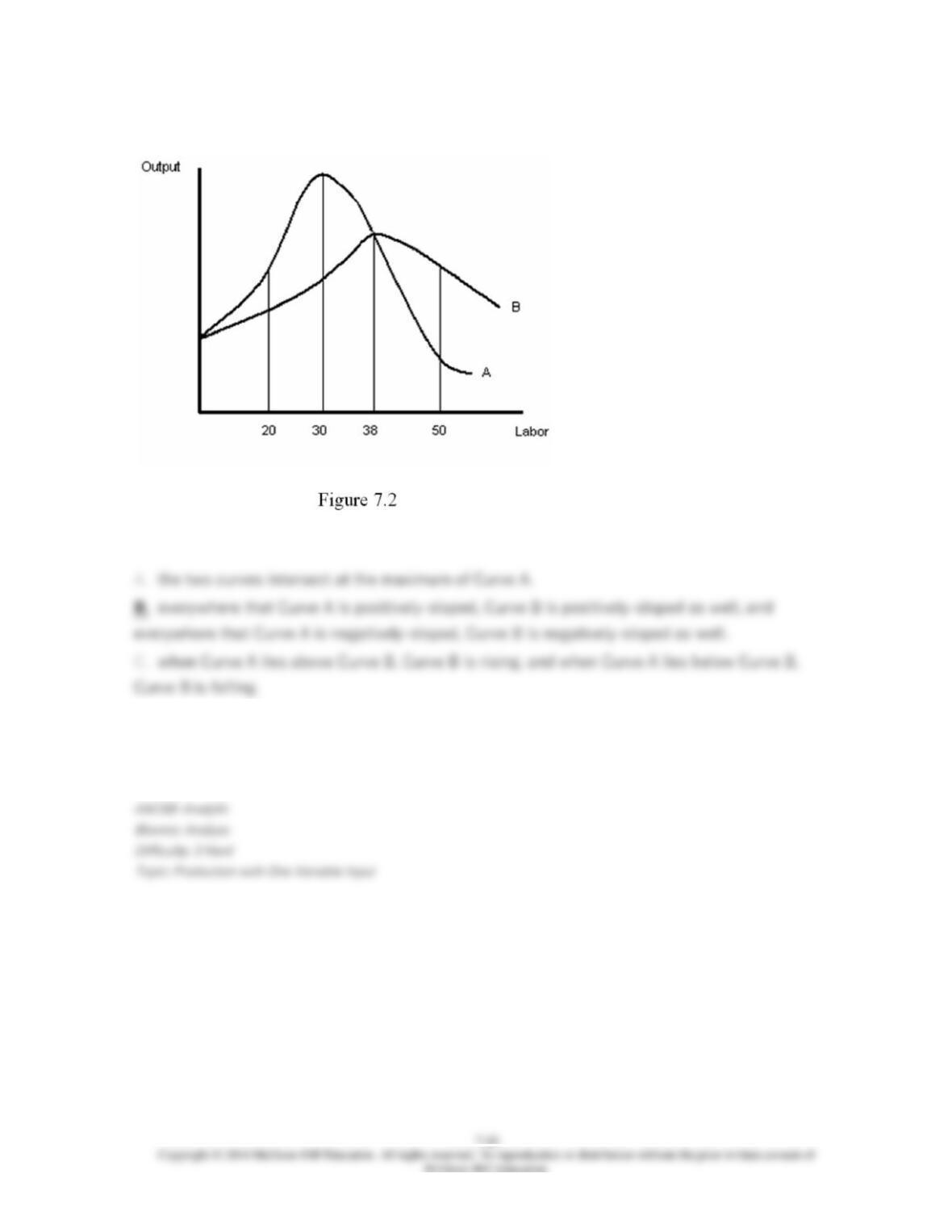
29. Refer to Figure 7.2. Curve A must be
MPL
and Curve B must be
APL
because:
D. when Curve B lies above Curve A, Curve A is rising, and when Curve B lies below Curve A,
Curve A is falling.
30. When labor inputs are finely divisible, the average product of labor curve is ______ sloping
at L if the marginal product is ______ the average product.
A. downward; above
31. Suppose a manager is deciding how to allocate workers between two plants. The marginal
product of labor in plant 1 is 10 units of output. The marginal product of labor in plant 2 is 14 units
of labor. What should the manager do?
D. Reallocate workers from plant 2 to plant 1, because
MPL
is greater in plant 1 than in plant 1.
32. ______ are resources that are fully used up in the production process.
D. Fixed inputs
33. ______ identifies all of the input combinations that efficiently produce a given amount of
output.
A. A production function
34. Isoquants are the ______ created by the ______.
D. tangent lines; production possibilities curve
35. Which of the following is NOT a property of isoquants?
D. Higher-level isoquants lie farther from the origin.
36. The rate at which one input can be substituted for another is shown by:
A. the slope of a firm’s production function.
37. Which of the following formulas measures the rate of substitution for labor with capital?
D. ∆
L
/∆
K
38. Which of the following formulas represents the marginal rate of technical substitution of
labor for capital?
A.
MPK
/
MPL
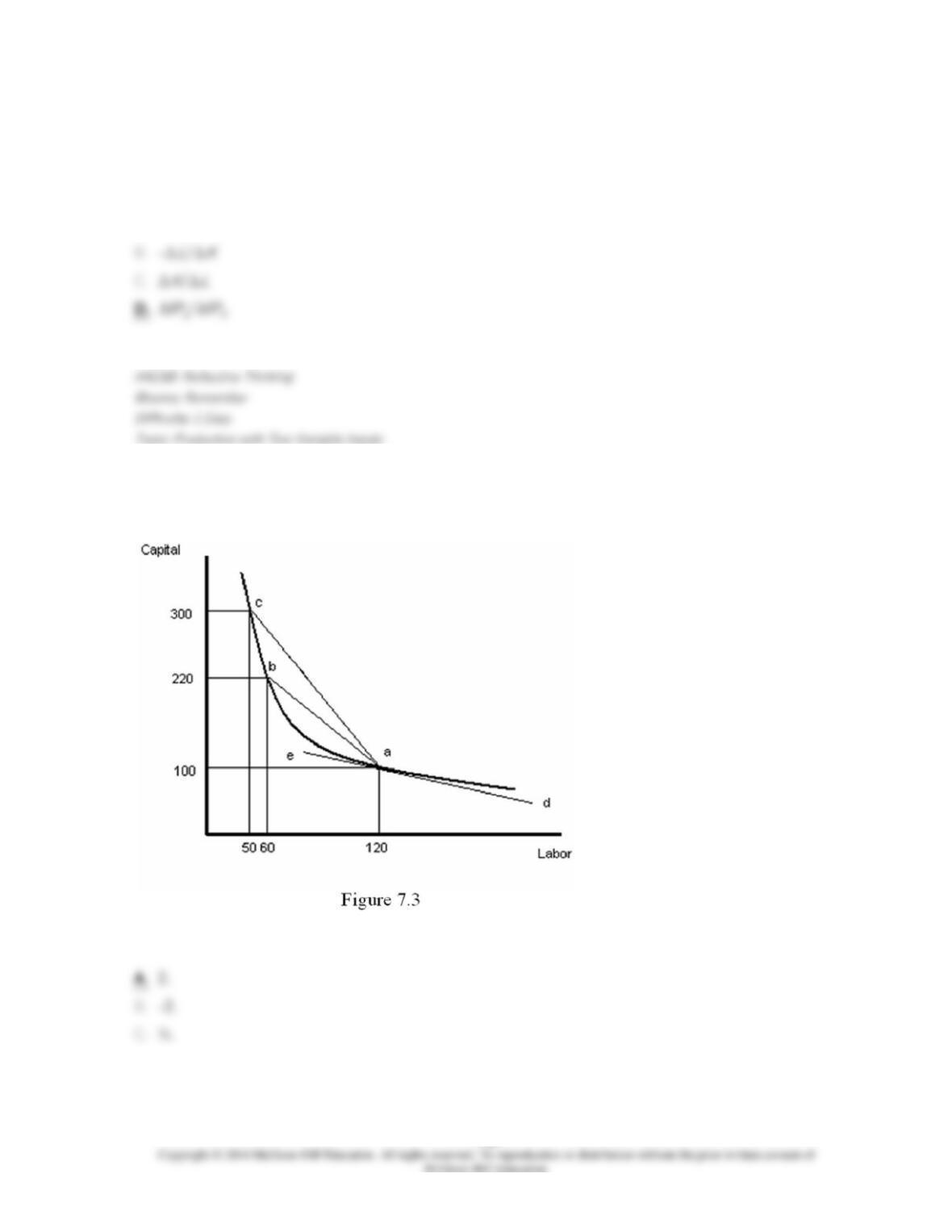
39. Refer to Figure 7.3. Suppose a firm moves along the isoquant from point a to point b. The
rate of substitution for labor with capital is:
D. –½.