Multiple Choice Questions
1. A consumer’s budget constraint is determined by:
A. a consumer’s income.
2. A consumer’s budget constraint is:
D. a vertical line at the level of the consumer’s income.
3. Suppose a consumer purchases pizza and soft drinks. If pizza is measured on the vertical
axis and soft drinks are measured on the horizontal axis, then the slope of the budget line is equal
to:
A. the price of pizza divided by the price of soft drinks.
4. Consumption bundles that lie above the boundary established by the budget line:
D. do not exhaust the consumer’s income.
5. Terry buys 10 pounds of cheese and 12 boxes of crackers each month. A pound of cheese
costs $5 and a box of crackers costs $3. If she is maximizing her utility, what is her monthly
income?
D. There is not enough information to determine her monthly income.
6. The price of bread is $1.50 per pound and the price of butter is $3 per pound. Steve has
an income of $30, with which he buys 4 pounds of bread. How many pounds of butter does he
buy, assuming he buys nothing else and he maximizes his utility?
D. There is not enough information to answer the question.
7. Suppose a consumer buys pizza (P) and soft drinks (S). The price of pizza is $10, the price
of soft drinks is $2 and the consumer’s income is $100. If pizza is measured on the vertical axis
and soft drinks are measured on the horizontal axis, then the consumer’s budget constraint is
given by:
D. P = 10 – 5S
8. Suppose a consumer buy books and DVDs. The price of a book is $10, the price of a DVD
is $20 and the consumer’s income is $400. If books are measured on the vertical axis and DVDs
are measured on the horizontal axis, then the budget line intersects the vertical axis at:
D. 400.
9. Suppose a consumer buy books and DVDs. The price of a book is $10, the price of a DVD
is $20 and the consumer’s income is $400. If books are measured on the vertical axis and DVDs
are measured on the horizontal axis, then the slope of the budget line is:
D. -1/2.
10. An increase in a consumer’s income will cause the budget line to:
D. become flatter.
11. An increase in the price of the good measured along the vertical axis will cause the budget
line to
A. shift outward.
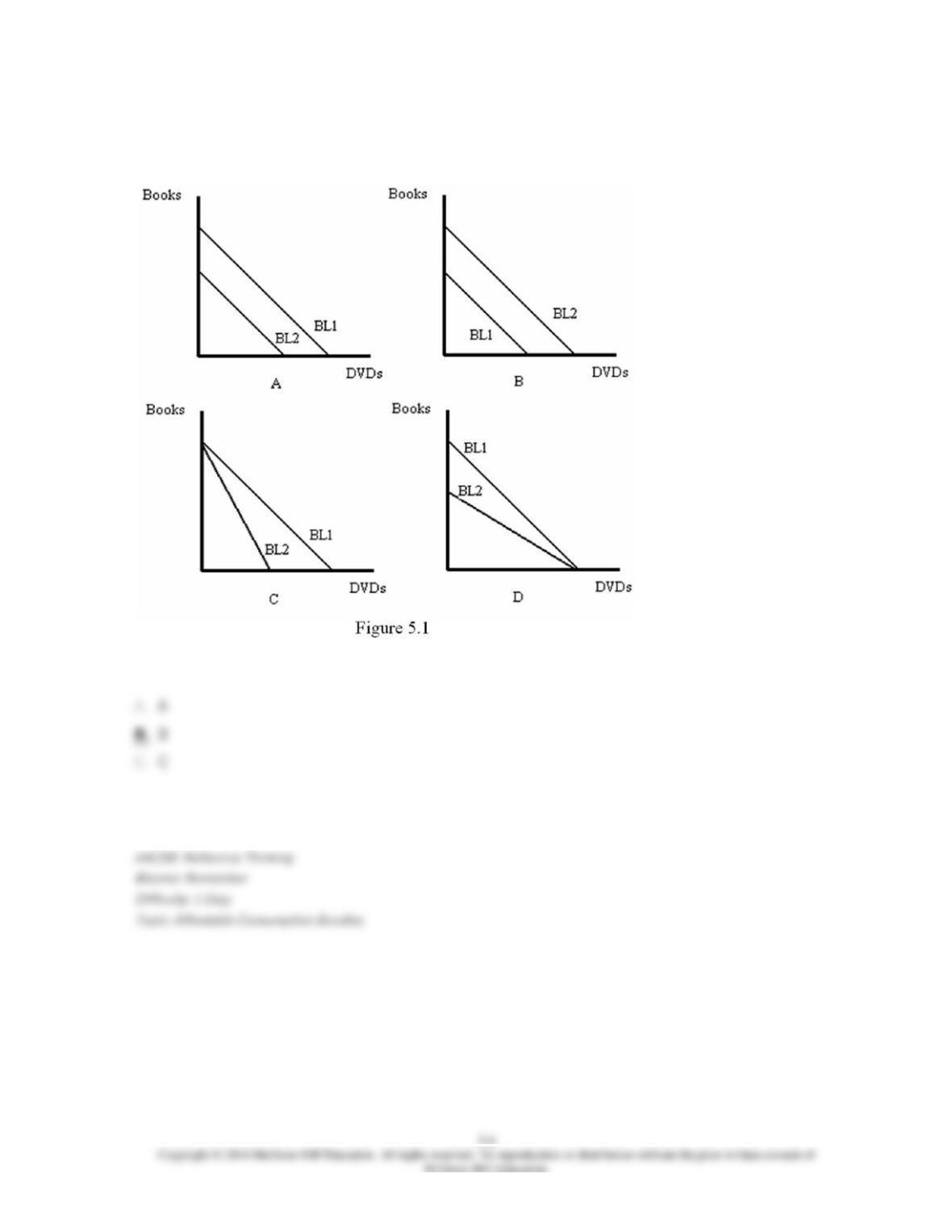
12. Refer to Figure 5.1. In which graph does a shift from BL1 to BL2 represent an increase in
the consumer’s income?
D. D
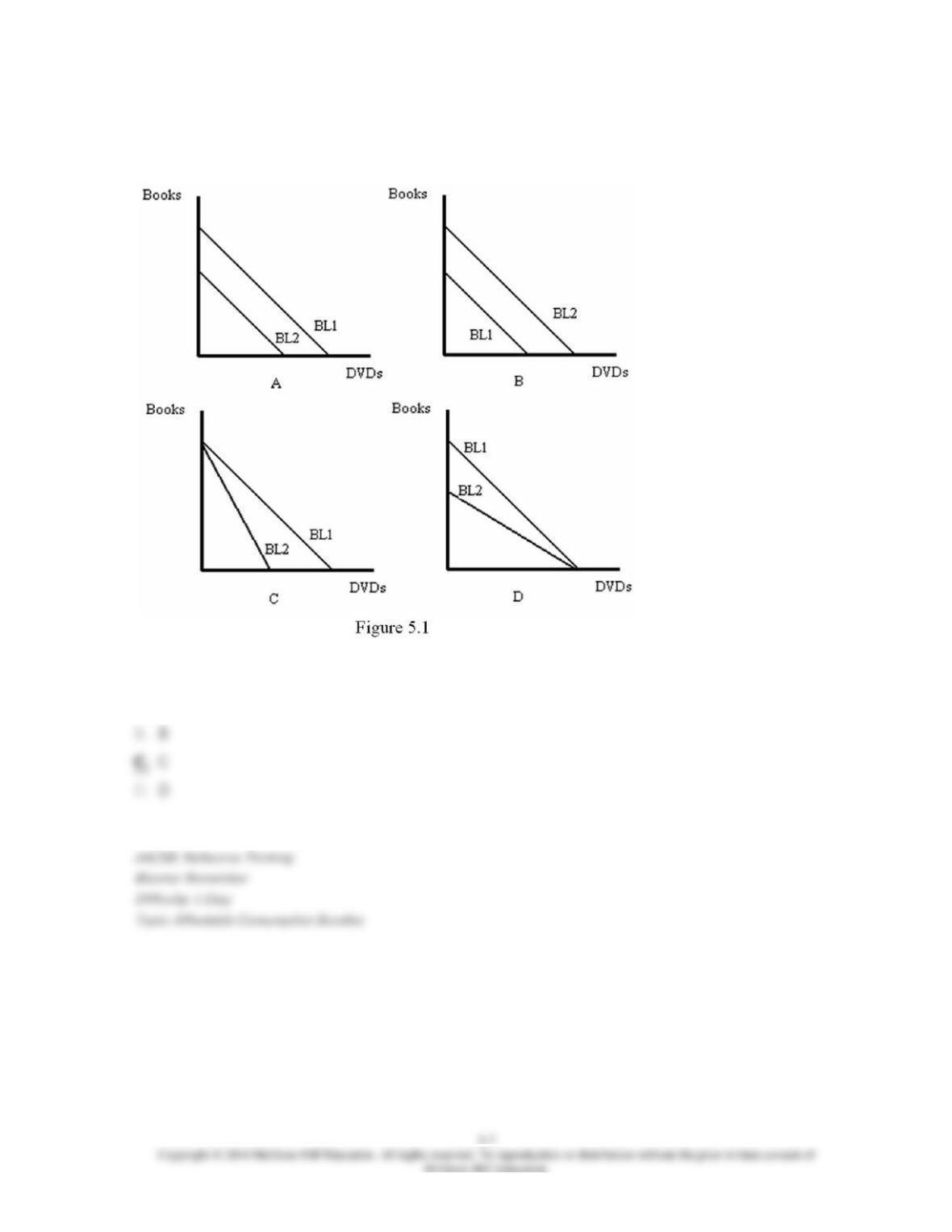
13. Refer to Figure 5.1. In which graph does a shift from BL1 to BL2 represent an increase in
the price of DVDs?
A. A
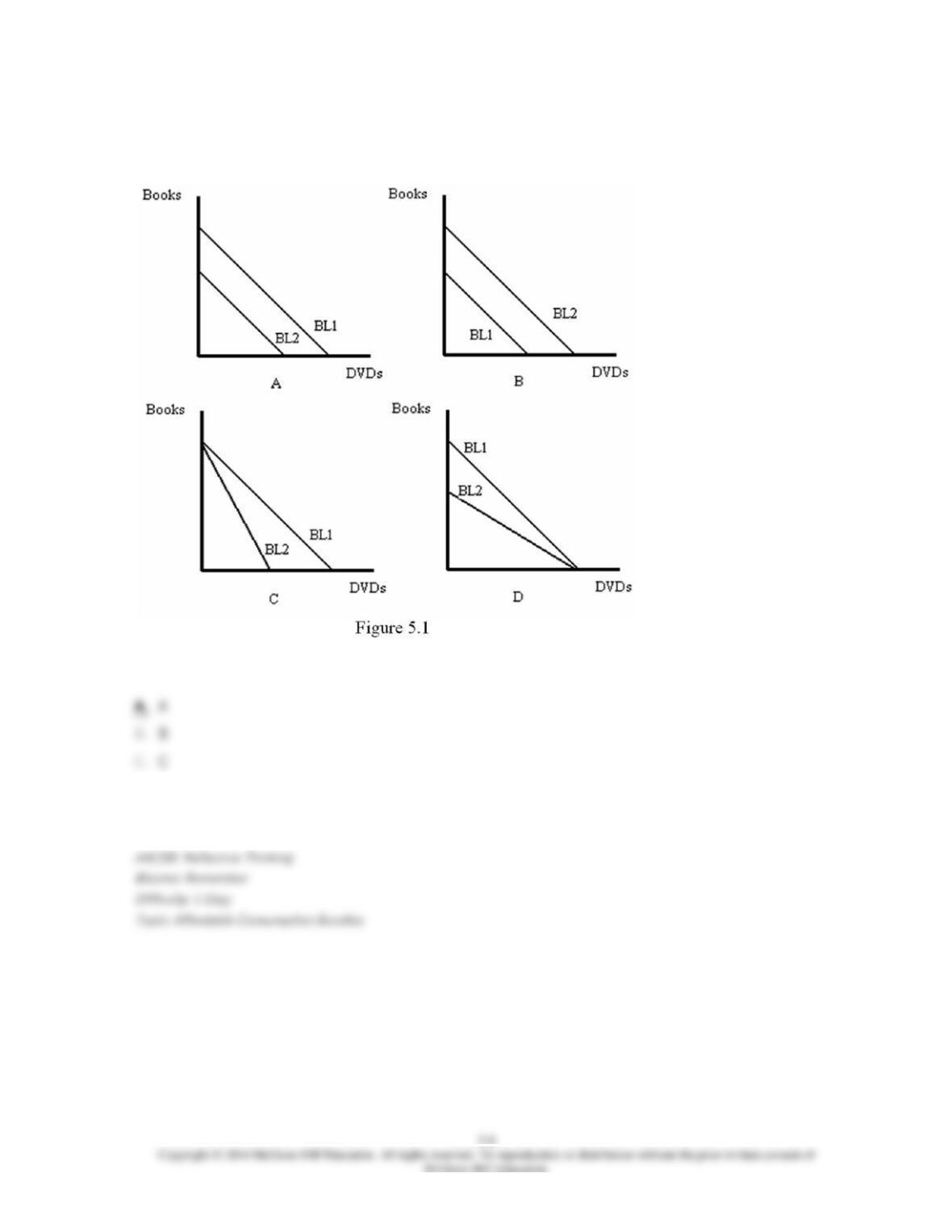
14. Refer to Figure 5.1. In which graph could a shift from BL1 to BL2 represent a doubling of
the prices of both Books and DVDs?
D. D
15. If all prices and income change by the same proportion:
A. the budget line shifts out.
16. Choices that do not exhaust the consumer’s budget lie to the ______ of the budget line.
D. southeast
17. An increase in the price of the good measured on the horizontal axis will cause the budget
line to:
D. shift inward.
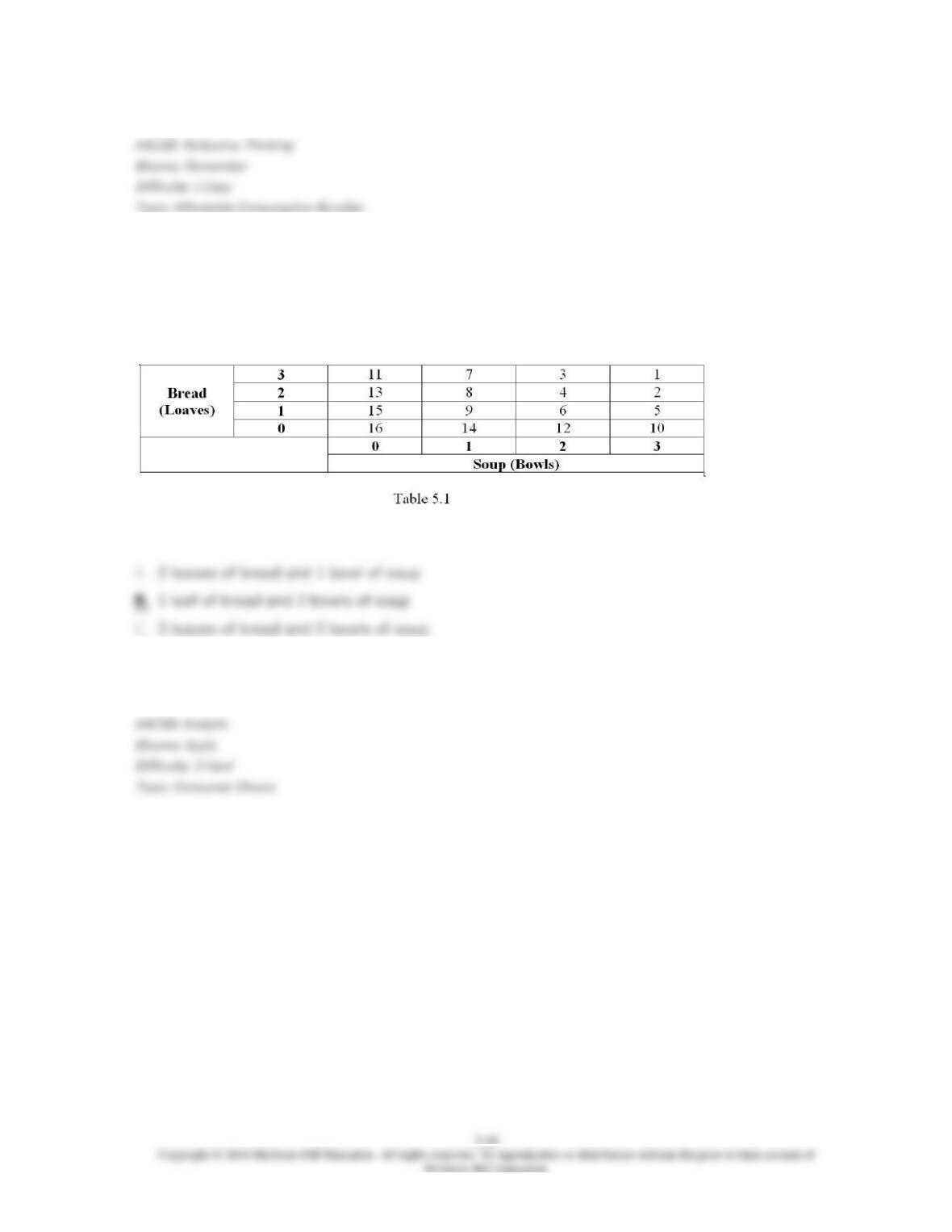
18. Refer to Table 5.1, which shows Madeline’s preference ranking for various consumption
bundles of bread and soup, where 1 represents her first choice, 2 her second, and so on. If the
price of soup is $3 per bowl, the price of bread is $3 per loaf and Madeline’s income is $9 per day,
which combination of bread and soup will she choose?
D. 0 loaves of bread and 3 bowls of soup
19. When the consumer has found the best affordable bundle of goods:
D. the area above the indifference curve that runs through any bundle other than the consumer’s
best bundle does not overlap with the area below the budget line.
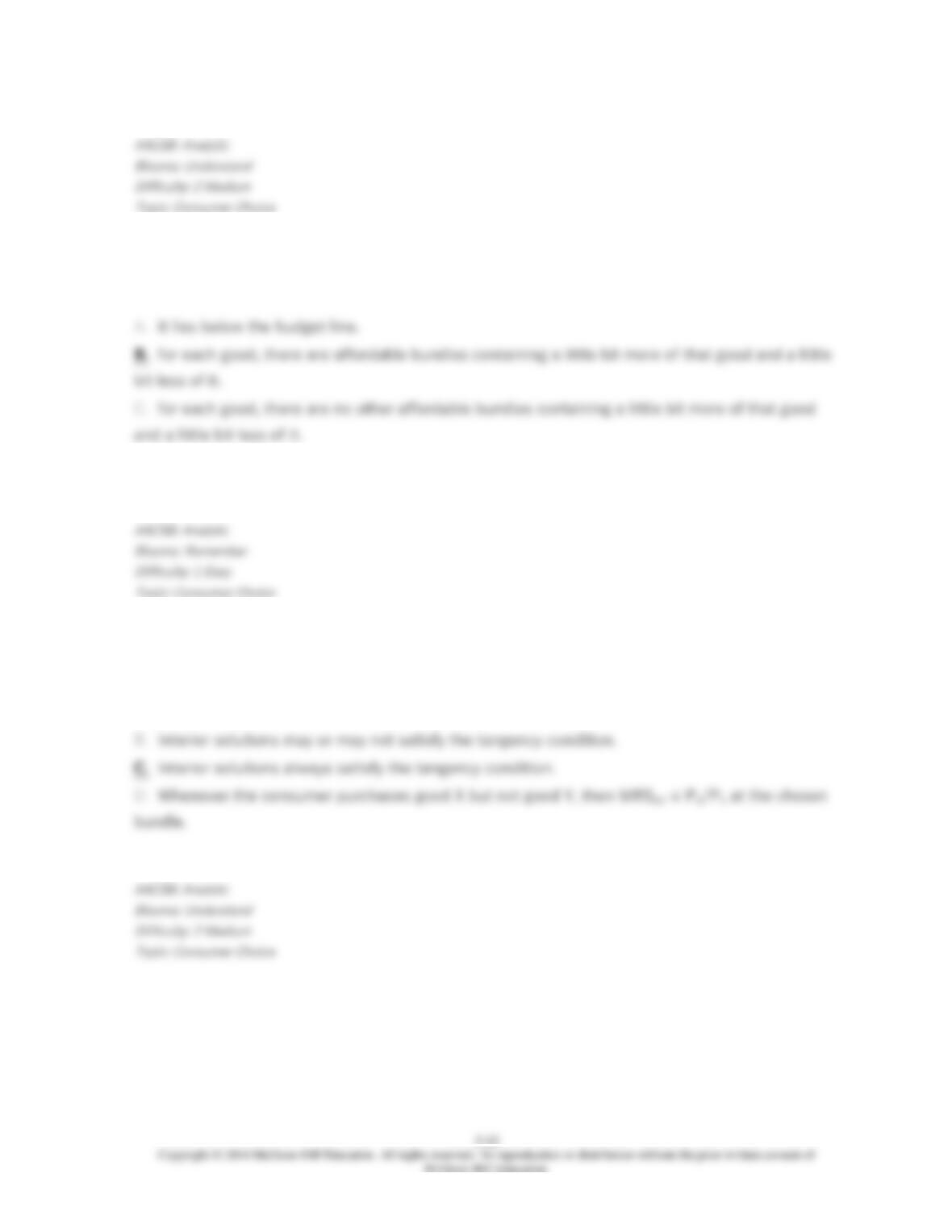
20. Refer to Figure 5.3. Which of the following statements is false?
D. It is possible for the consumer to afford better bundles than c.
21. An affordable consumption bundle is an interior choice if:
D. it exhausts the consumer’s income.
22. Which of the following statements is true?
A. Corner solutions always satisfy the tangency condition.
23. If everyone in an economy buys and sells goods at market-wide prices:
D. people will pay different prices and therefore will have different marginal rates of substitution.
24. Suppose that soup is measured on the horizontal axis and bread is measured on the
vertical axis. At an interior solution:
D. MRSSB = – PB/PS.
25. Hailey’s income is $40 per week. She spends all of it on coffee (C) and doughnuts (D).
Coffee costs $2 per cup and doughnuts cost $1 each. Her marginal rate of substitution for coffee
with doughnuts is D/C. How many cups of coffee and how many doughnuts will she purchase
each week?
D. 5 cups of coffee and 30 doughnuts
26. At a boundary choice:
A. the consumer purchases at least some of every good.
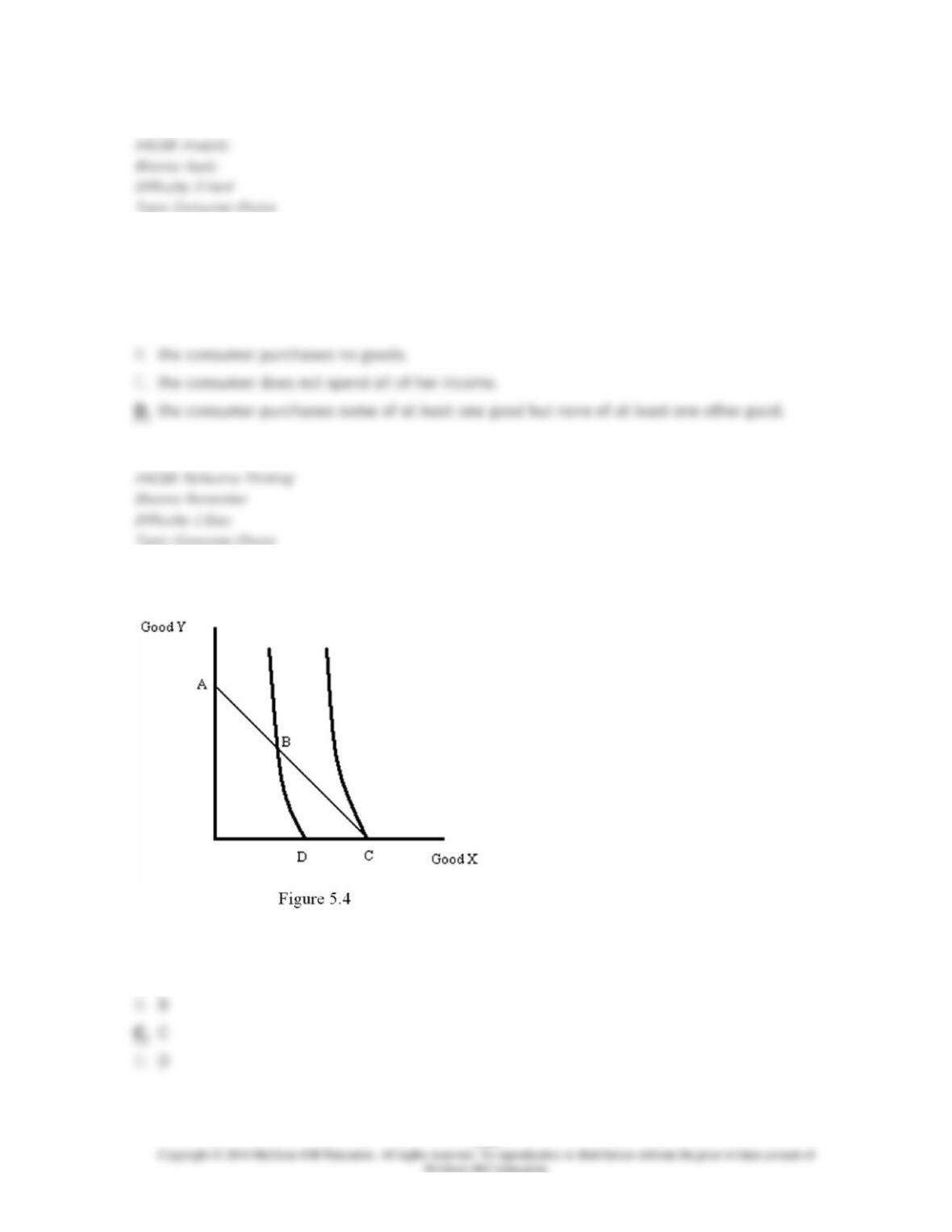
27. Refer to Figure 5.4. Which consumption bundle would maximize the consumer’s utility?
A. A
28. Boundary solutions arise when:
D. indifference curves exhibit increasing MRS.
29. Whenever a consumer purchases good X but not good Y, then:
D. MRSXY = – PX/PY at the chosen bundle.
30. When indifference curves have ________ marginal rates of substitution, any interior choice
that satisfies the tangency condition is the best affordable choice.
A. constant
31. When the government provides food stamps to low-income households:
A. the household definitely purchases more food.
32. A utility function is a mathematical function that assigns values to consumption bundles
to represent the:
D. prices of the goods in the consumption bundle.
33. Which of the following conditions must hold if a consumer is maximizing her utility?
A. MUX × PX = MUY × PY
34. Mike’s income is $600 per month. He spends all of it on books (B) and CDs (C). Books
cost $10 and CDs cost $15. His preferences correspond to the utility function U(B,C) = B × C. For
that utility function, the marginal benefit of books is C and the marginal benefit of CDs is B. How
many books and how many CDs will he purchase in a month?
D. 30 CDs and 15 Books
35. The curve that shows how the best affordable consumption bundle changes as the price
of a good changes (holding the consumer’s income, preferences and all other prices fixed) is
called:
D. a budget line.
36. A curve that describes the relationship between the price of a good and the amount a
particular consumer purchases (holding the consumer’s income, preferences and all other prices
fixed) is called:
D. a budget line.
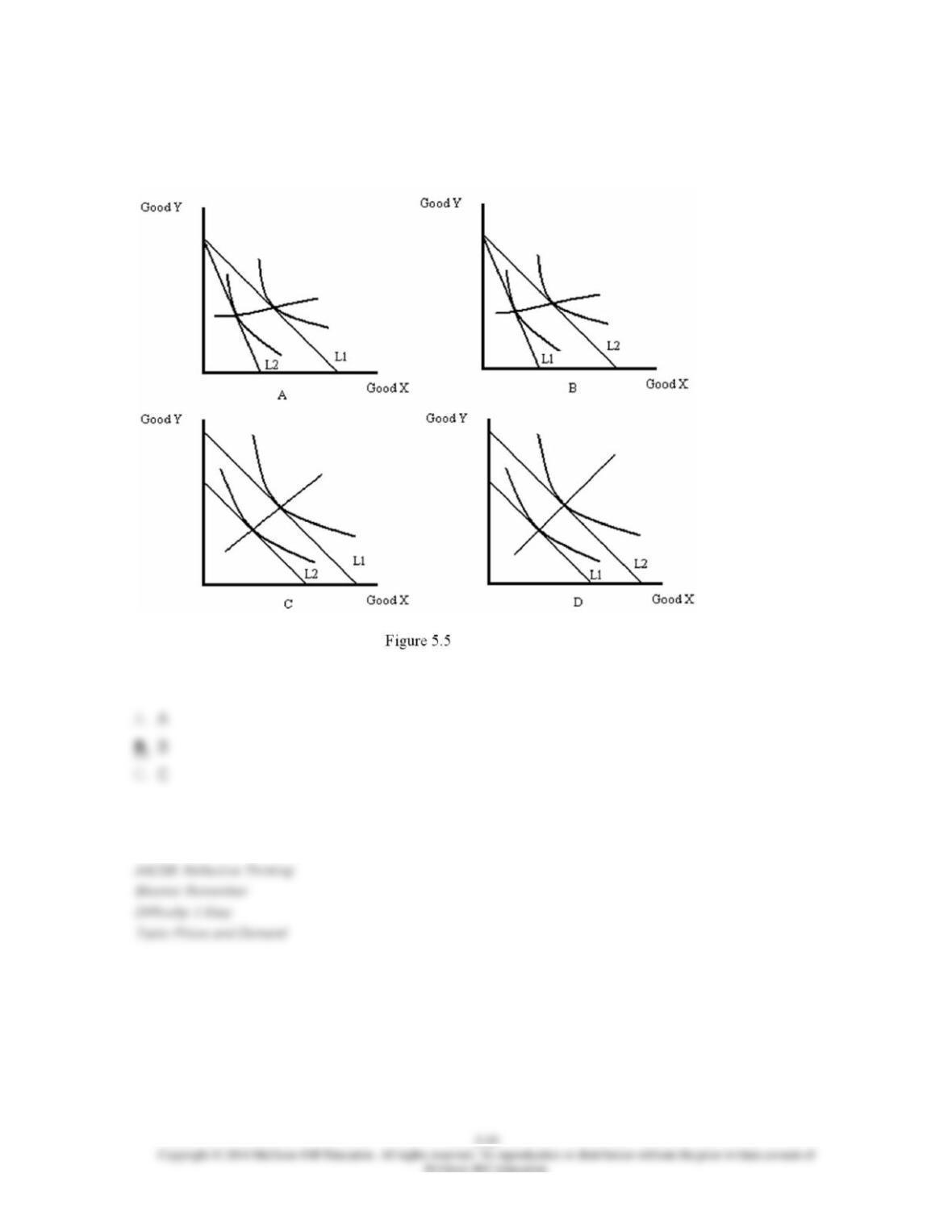
37. Refer to Figure 5.5. Which diagram shows the price-consumption curve resulting from a
decrease in the price of good X?
D. D
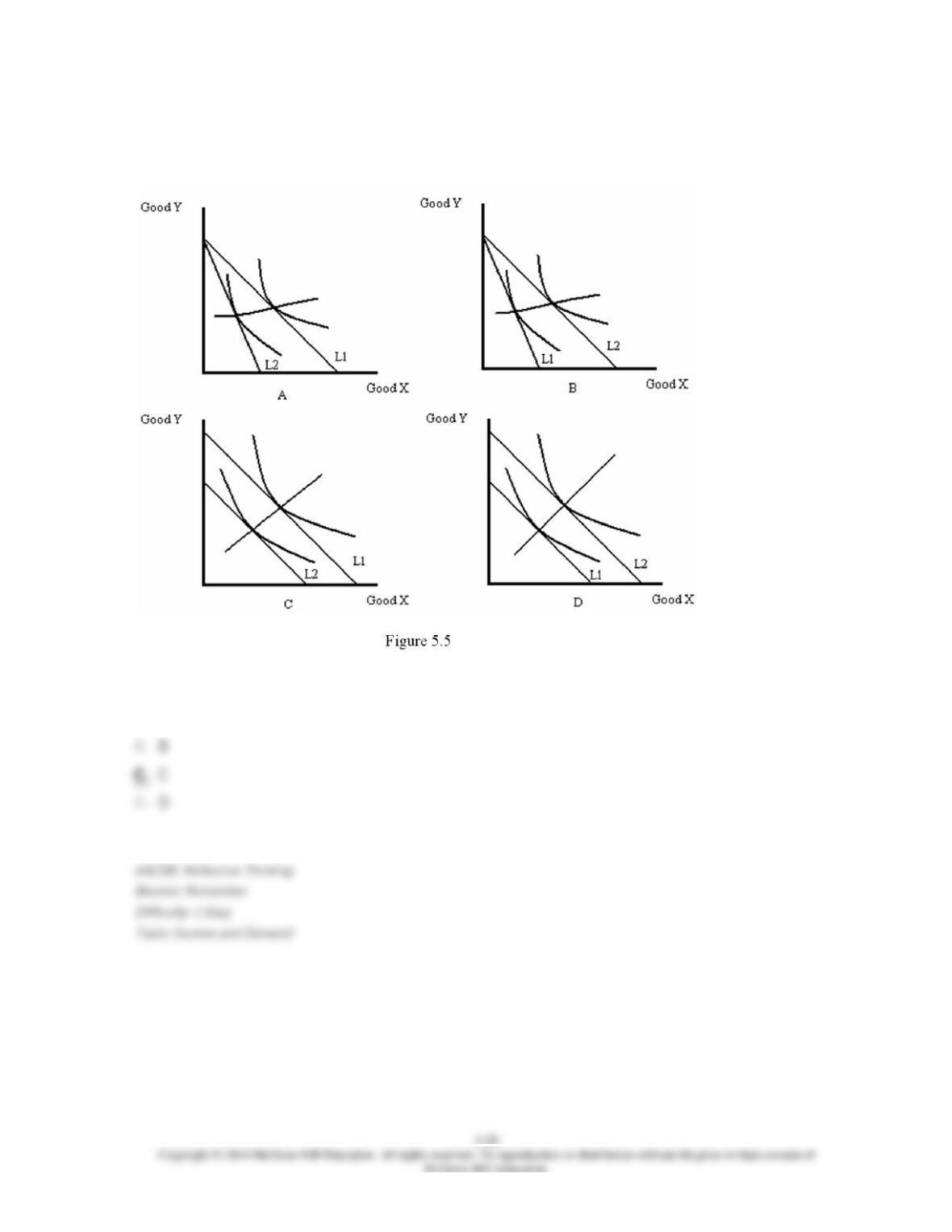
38. Refer to Figure 5.5. Which diagram shows the income-consumption curve resulting from a
decrease in income?
A. A