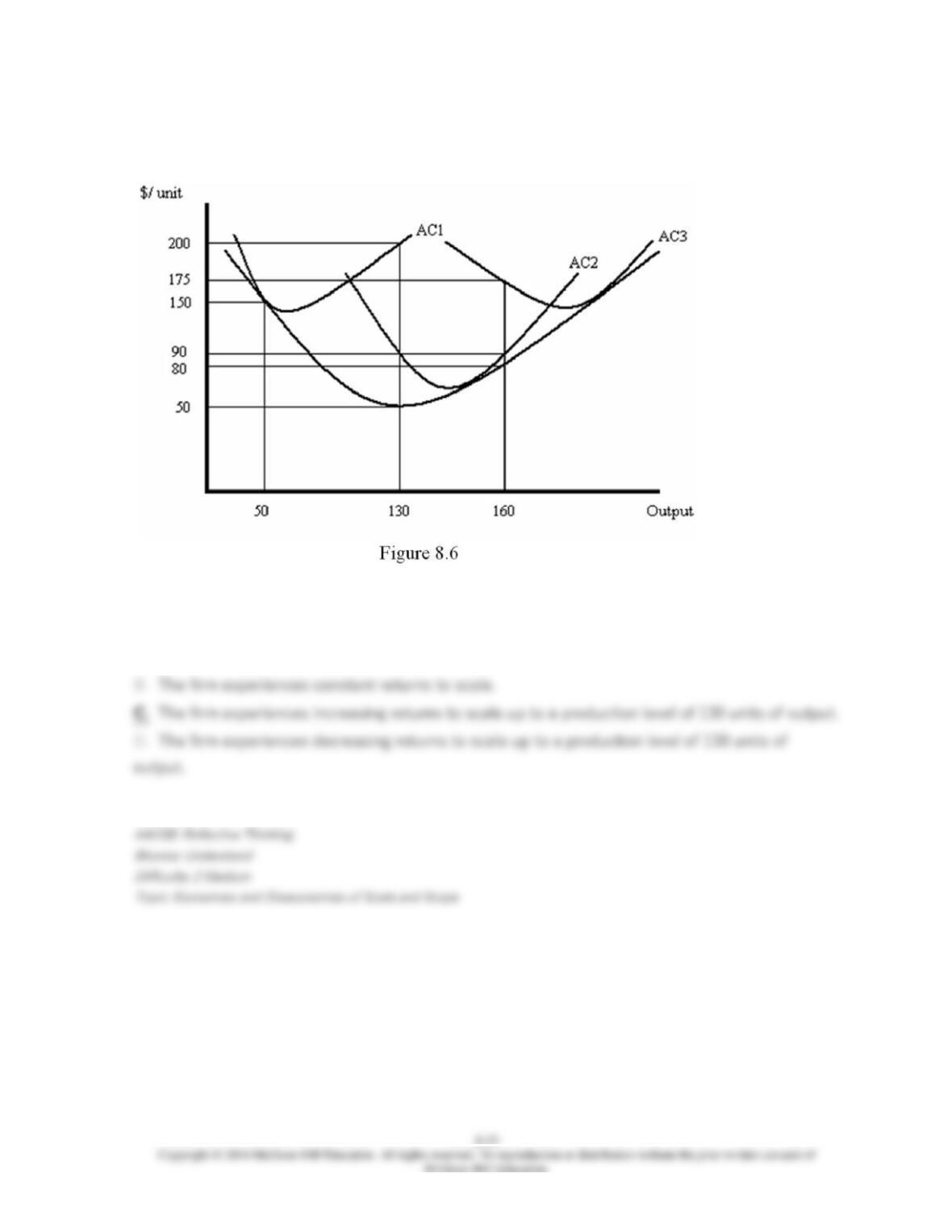
56. Refer to Figure 8.6, which shows just three of a firm’s various possible short-run average
cost curves. Which of the following statements is true?
A. The firm experiences increasing returns to scale at production levels above 130 units of
output.
57. A firm that experiences economies of scale has a ______ average cost curve.
D. flat
58. If a firm doubles the amount of labor it uses and triples the amount of capital it uses but
its level of output less-than-triples as a result, what can be said about the firm’s returns to scale?
A. This firm has increasing returns to scale.
59. As any firm with decreasing returns to scale increases its output:
D. its marginal cost of production must rise.
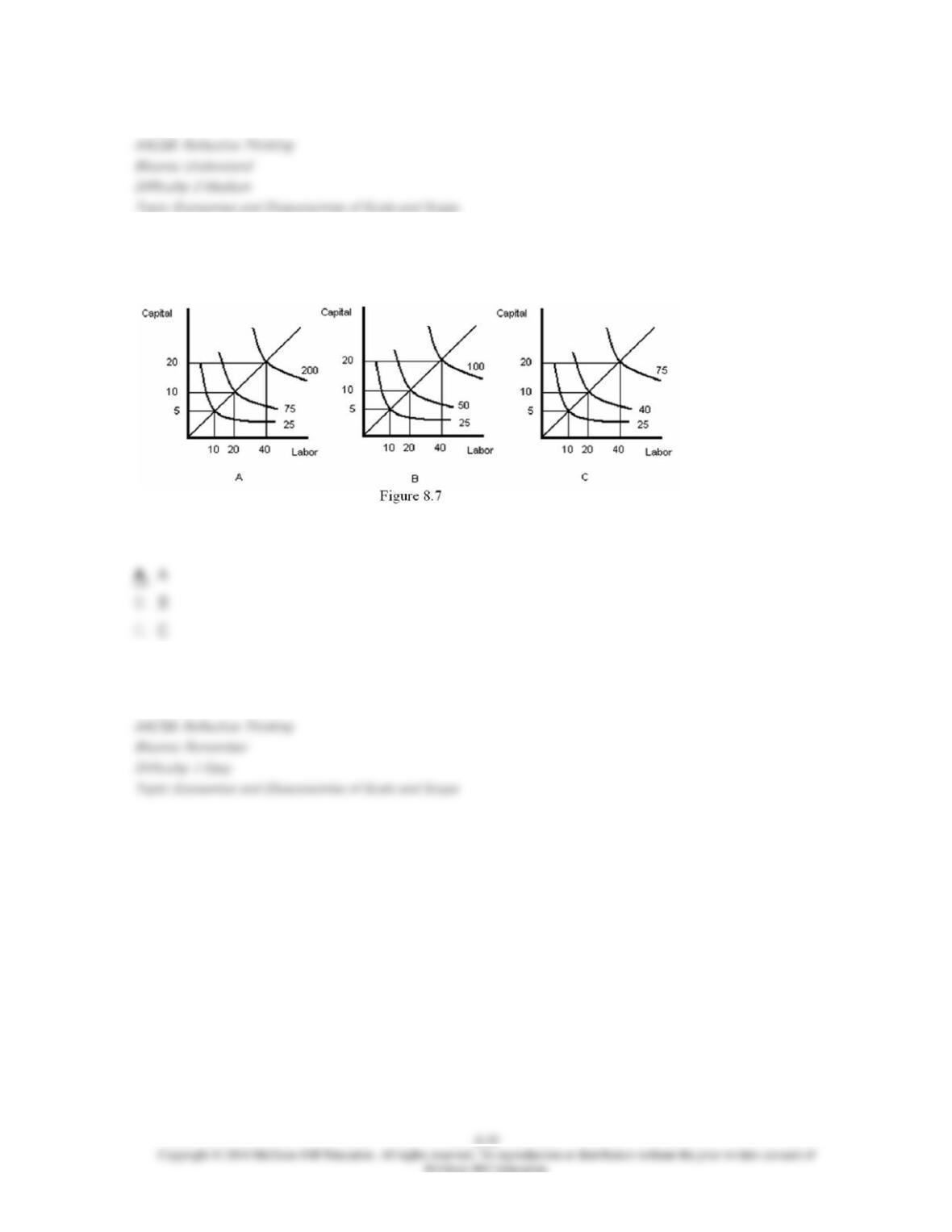
60. Refer to Figure 8.7. Which graph illustrates a firm that experiences economies of scale?
D. Both graphs A and C
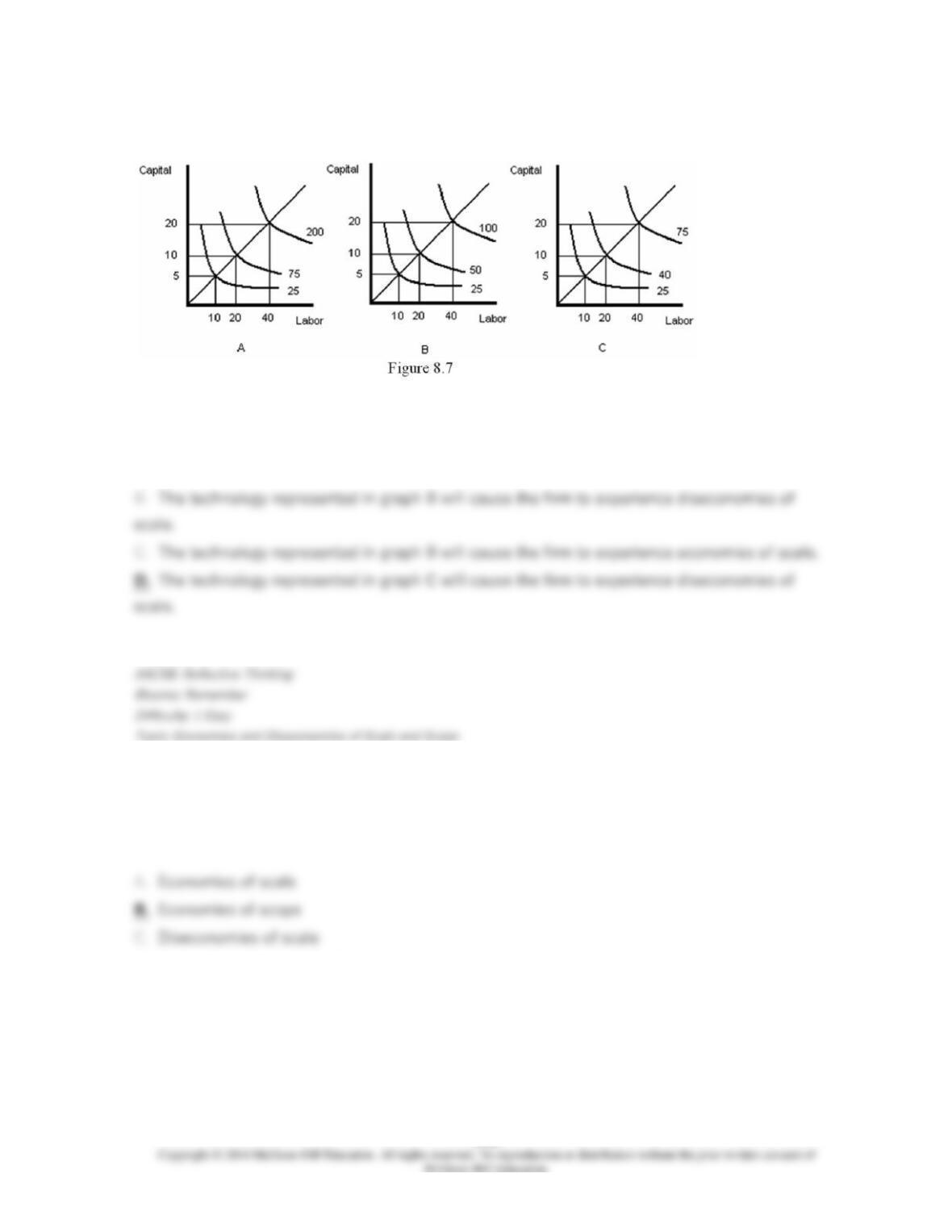
61. Refer to Figure 8.7. Which of the following statements is true?
A. The technology represented in graph A will cause the firm to experience diseconomies of
scale.
62. ______ occur when a single firm can produce two or more products more cheaply than can
two separate firms.
D. Increasing returns to scale
63. Diseconomies of scope occur when:
A. a firm’s input prices rise as it increases output.
64. Suppose that a firm produces both bottled water and carbonated soft drinks. It is cheaper
for this firm to produce both goods than it would be if they were produced by two separate firms.
Further, as this firm increases its production levels, the average costs of producing both bottled
water and carbonated soft drinks fall. This firm experiences:
D. diseconomies of scope and economies of scale.
65. Suppose that a firm produces both steel and electricity. It is cheaper for this firm to
produce both goods than it would be if they were produced by two separate firms. Further, as this
firm increases its production levels of both products, the average cost of producing steel rises,
while the average cost of producing electricity remains constant. This firm experiences:
D. diseconomies of scope, diseconomies of scale in the production of steel and increasing returns
to scale in the production of electricity.
Essay Questions
66. Suppose a firm’s short-run production function is given by
Q
= 3√L, where
L
represents
the number of hours of labor employed. The firm has a sunk cost of $500 and the wage rate is $18
per hour. What is the firm’s short-run cost function?
67. Suppose a firm’s technology is represented by the Cobb-Douglas production function
F
(
L,
K
) = 5
LK
. The wage rate is $50 and the rental rate of capital is $10. What is the least-cost
combination to produce 100 units of output?
68. Suppose a firm produces its output in two different plants. Production costs at plant 1 are
given by
C
1 = 4(
Q
1)2, where
Q
1 is the amount of production at plant 1. The production costs at
plant 2 are given by
C
2 = 2(
Q
2)2, where
Q
2 is the amount of production at plant 2. The
corresponding marginal costs at each plant are
MC
1 = 8
Q
1 and
MC
2 = 4
Q
2. If the firm produces a
total of 24 units of output, how much output should it produce at each plant?
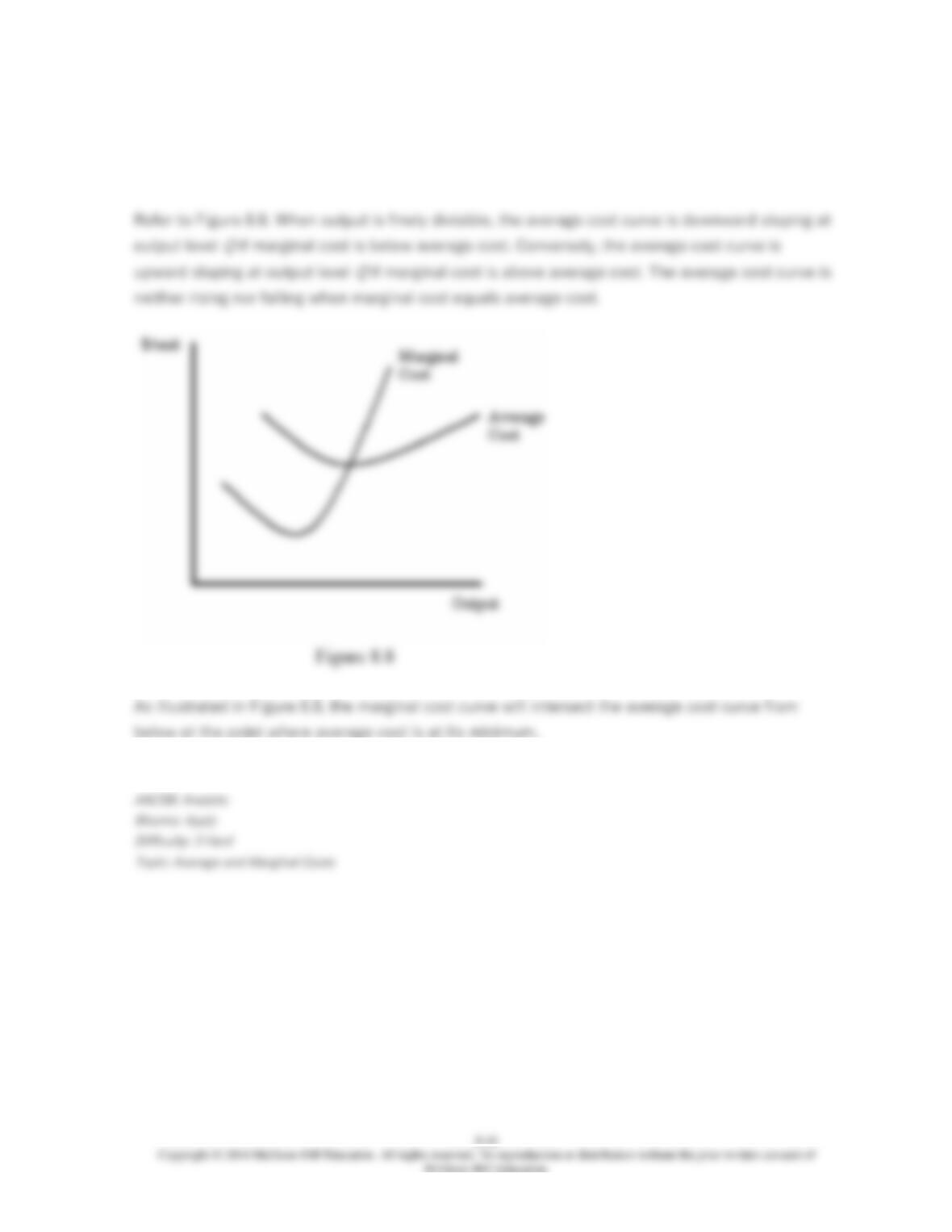
69. Using a graph, explain the relationship between average cost and marginal cost.
70. Suppose a firm’s technology is represented by the function
Q
=
F
(
L,
K
) = 5
L
0.25
K
0.75. Does
this firm experience economies of scale, diseconomies of scale or neither?
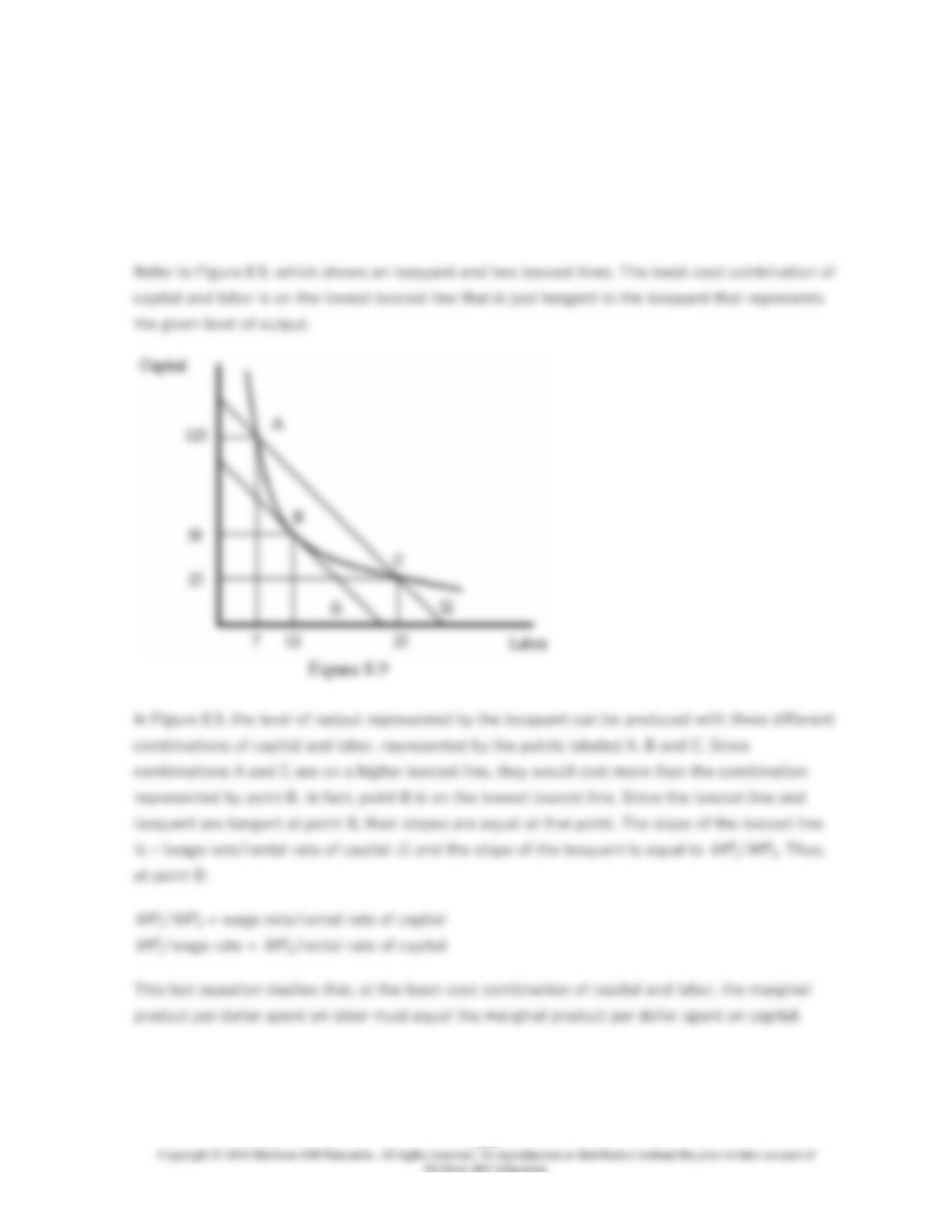
71. Use an isocost-isoquant diagram to explain how a firm determines the least cost
combination of labor and capital to produce a given level of output. What is true of the marginal
product per dollar at the least cost combination of capital and labor? Why?
72. Suppose a firm’s production function is given by
Q
=
F
(
L,
K
) = 5
LK
, where
L
is the amount
of labor and
K
is the amount of capital. The wage rate is $100 per unit of labor and the rental rate
of capital is $50 per unit of capital.
a. What is the least-cost combination of capital and labor if the firm produces 1000 units of
output?
b. What is the firm’s long run cost function?
c. If the firm currently uses 10 units of capital, what is its short-run cost function?