26. The marginal units of action choice X:
A. are the last ∆X units and tend to generate the greatest amount of marginal benefits.
27. The marginal cost of action choice X:
D. is minimized at the best level of activity X.
28. If C(X) represents the total cost of activity X, then which of the following expressions best
represents the marginal cost of activity X?
D. C(X – ∆X))/∆X
29. The marginal benefit of an action:
D. equals the additional benefit produced by extra units of X and tends to increase as X
increases.
30. If B(X) represents the total benefit of activity X, then which of the following expressions
best represents the marginal benefit of activity X?
D. B(X – ∆X))/∆X
31. Suppose that you can hire a worker in one-hour increments. For hours of work up to 4, the
total benefit of the worker (in dollars) is B(0) = 0, B(1) = 25, B(2) = 45, B(3) = 60, and B(4) = 70.
What is the marginal benefit of the second hour of the worker’s time?
D. There is not enough information to answer the question.
32. Suppose that the marginal benefit of an activity is less than the marginal cost, then:
D. there can be no marginal improvement by changing the amount of the activity.
33. The No Marginal Improvement Principle tells us that, at the best choice:
D. small changes in the level of an activity will always increase net benefit.
34. According to the No Marginal Improvement Principle, if X* is the best choice, then:
D. MB must be greater than or equal to MC at X*.
35. According to the No Marginal Improvement Principle, if X* is the best choice, then:
D. the difference between MB and MC must be as great as possible.
36. When actions are finely divisible, the marginal benefit of action X is equal to:
D. the inverse of the slope of the total benefit curve at point X.
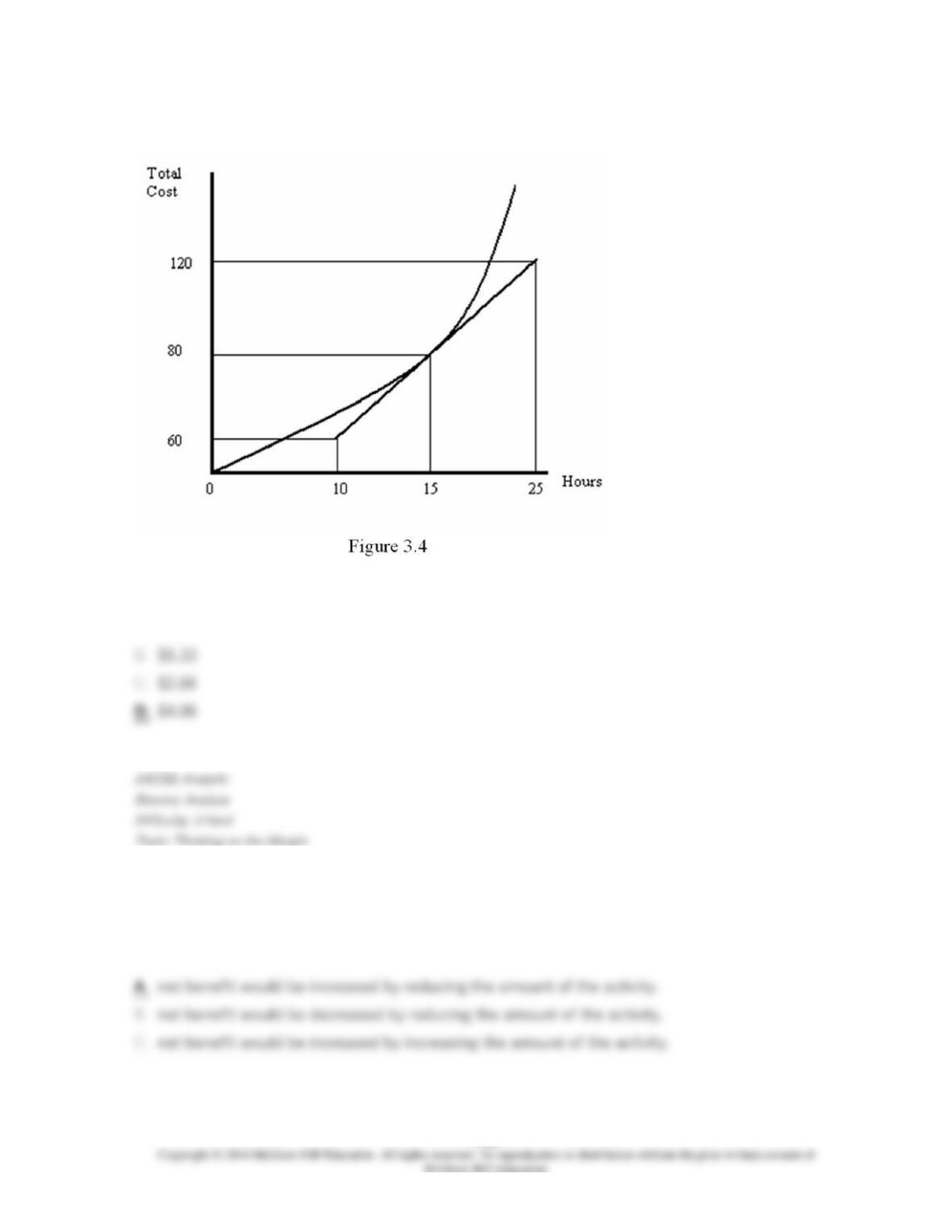
37. Refer to Figure 3.4. What is the marginal cost of the 15th hour spent on this activity?
A. $80
38. Suppose that the slope of a line tangent to the total cost curve at point X is steeper than
the slope of a line tangent to the total benefit curve at point X, then:
D. net benefit is maximized.
39. Suppose that the slope of a line tangent to the total cost curve at point X is equal to the
slope of a line tangent to the total benefit curve at point X, then:
A. net benefit would be increased by reducing the amount of the activity.
40. If H represents the number of hours spent on an activity, then which of the following could
represent a total benefit function?
D. -400H + 30H2
41. If H represents the number of hours spent on an activity, then which of the following could
represent a marginal cost function?
D. -100H + 20H2
42. According to the No Marginal Improvement Principle, if X* is the best choice then at X* it
must always be true that:
D. MB = MC.
43. Suppose that you can hire your mechanic for up to six hours. The total benefit and total
cost functions are B(H) = 300H – 20H2 and C(H) = 55H + 60H2. The corresponding formulas for
marginal benefit and marginal cost are MB(H) = 300 – 40H and MC(H) = 55 + 120H. For how
many hours should you hire your mechanic?
D. 0 hours
44. Suppose that you can schedule a worker for up to 4 hours per day. The total benefit and
total cost functions are B(H) = 300H – 20H2 and C(H) = 500H + 60H2. The corresponding formulas
for marginal benefit and marginal cost are MB(H) = 300 – 40H and MC(H) = 500 + 120H. For how
many hours should you schedule the worker?
A. 1.25 hours
45. Suppose that you can schedule a worker for up to 4 hours per day. The total benefit and
total cost functions are B(H) = 1,300H – 20H2 and C(H) = 500H + 60H2. The corresponding
formulas for marginal benefit and marginal cost are MB(H) = 1,300 – 40H and MC(H) = 500 +
120H. For how many hours should you schedule the worker?
A. 11.25 hours
46. Suppose that you can schedule a worker for up to 10 hours per day. The total benefit and
total cost functions are B(H) = 1200 × √H and C(H) = 200H. The corresponding formulas for
marginal benefit and marginal cost are MB(H) = 600/√H and MC(H) = 200. How many hours
should you schedule the worker?
D. 0 hours
47. A cost that is unavoidable regardless of the actions of a decision maker is called:
D. an incremental cost.
48. Suppose that you join a gym that charges a $250 membership fee. You also have to pay an
additional $5 each time you go the gym. In this case, your sunk cost is:
D. $250 plus $5 times every visit you make to the gym.
49. A sunk cost:
A. causes a decision maker to choose to pursue less of an activity.
50. Sunk costs:
D. can be ignored because they don’t have to be paid by the decision maker.
51. Which of the following statements is true?
A. Neither sunk costs nor the sinking of a cost will affect a decision maker’s best choice.
52. A decision maker can always make the best choice by:
A. including sunk costs as part of marginal costs.
53. Consider a consumer choosing between spending her money on food, F, or clothing, C.
Assume that a unit of food and a unit of clothing have the same price, and that the consumer can
afford a total of 20 units of either food or clothing. This is an example of:
D. the No Marginal Improvement Principle.